1862: Mary Timney, the last woman publicly hanged in Scotland

On this date in 1862, Mary Timney was hanged at Buccleuch Street in Dumfries, Scotland.

The penniless 27-year-old occupied the stone cottage adjacent to her victim’s way out in the countryside at Carsphad — near the fringe of present-day Galloway Forest Park. Timney was Ann Hannah’s tenant, but the two were known to have a fractious relationship and often cross words. Timney had borrowed so often that Hannah grew deaf to her importunities; Hannah suspected Timney of stealing firewood, and Timney suspected Hannah of stealing her husband’s caresses.

On January 13, 1862, Hannah was discovered breathing her last on that cottage floor in a puddle of her own blood, splatters of which also decorated the little home like a slasher movie. The obvious suspect had some incriminating bloodstains on her person. Timney claimed that Hannah started the fight by kicking the younger woman, and in the ensuing fracas Timney grabbed the weapons ready to hand (a knife, a poker, and a wooden mallet: seems like more than you’d need) and mauled her neighbor to death.

“Oh, my Lord, dinna do that,” Timney cried out in court when the judge donned the black cap to impose her death sentence. “Give me anything but that, let the Lord send for me!”

Mary Timney was initially regarded by her former neighbors in Carsphad as a monster. But as her execution approached, sentiment underwent a surprising reversal. The pathos of leaving the young woman’s four children motherless, or else the simple discomfiture of publicly swinging a woman from the gallows-tree,* soon led to a strong local push for mercy. “The great majority of the public of Dumfries were horrified and indignant that this butchery should be permitted in their streets,” one paper reported.

The Crown saw no grounds to extend it, and swore in an extra 200 constables to manage the crowd.

In a stateof near collapse, Mary Timney went to the gallows this date before 3,000 solemn spectators. She was still pleading. “Oh no, no, no! My four weans, my four weans.” (See this book)

The scene appalled everyone so entirely that it was never repeated: Mary Timney was the last woman publicly executed in Scottish history.

Coincidentally, Dumfries would also have the distinction — on May 12, 1868 — of hosting the last legal public hanging of a male offender, shortly before Parliament moved all UK executions behind prison walls.

There’s a recent book about Mary Timney’s case which appears easier to find stocked in Britain than stateside.

* Scottish streets at this moment had not witnessed any woman’s hanging for nearly a decade.

On this day..

1683: Yaoya Oshichi, fire horse

On this date in 1683,* Yaoya Oshichi gave her life for her red-hot love … and the want of a little white lie.

The greengrocer’s daughter Oshichi (English Wikipedia page | Japanese) legendarily fell in love with a priest of the nearby temple while taking refuge there during one of Edo’s many fires (Japanese link), and in a truly adolescent outburst proceeded to start another fire in the hopes of meeting him again. (Alternate version: it was Oshichi’s gesture that actually started the linked conflagration.)

As a 16-year-old, Oshichi was just barely eligible to suffer the full weight of the law for a capital crime.

In an age of scanty documentation, however, the pitying magistrate (Japanese link) hearing her case is supposed to have asked her in a hinting sort of way, “you’re 15, right?”

Either not catching his drift or else honest to a fault, Oshichi replied that, no, she was 16, thank you very much, and reiterated the point when it was followed-up … thus dooming herself to the stake.


Yaoya Oshichi’s execution.

A few years after this outstandingly tragic demise, poet Ihara Saikaku popularized the tale in his Five Women Who Loved. She’s been waxing immortal ever since in every manner of artistic interpretation, and remains a popular figure for joruri and bunraku and kabuki.

(When next in Tokyo, pay your own respects at her tomb.)

Meanwhile, Yaoya Oshichi’s apparent birth in the zodiacal “fire horse” year of 1666 — fire horses are supposed to be an especially passionate, impulsive bunch — followed by her unfortunate fiery end helps make such cycles superstitiously inauspicious for prospective parents, especially prospective parents of girls.

The year of a fire horse only rolls around once every six decades; in the last one, in 1966, Japanese “fertility dropped by over 25%;” even “the fertility rate of Japanese Americans in California and Hawaii also dropped by 3.3% and 1.8%, respectively, in the same year.”** The abortion rate in Japan for that one year spiked nearly 50% above expected without any other apparent cause.† It’s something to watch for when the next batch of little fire horses are due, in 2026.

* “The 29th day of the 3rd month” is widely cited as “March 29”, but it actually appears to refer to the 29th day of the 3rd month of the third year of the “Heaven’s Blessing” era. That third month spanned the Gregorian dates of March 28 through April 26, 1683.

** Jungmin Lee and Myungho Paik, “Sex Preferences and Fertility in South Korea during the Year of the Horse,” Demography, Vol. 43, No. 2 (May, 2006).

† Kanae Kaku, “Increased induced abortion rate in 1966, an aspect of Japanese folk superstition,” Annals of Human Biology, Vol. 2, No. 2 (1975).

On this day..

1791: Emanuel the runaway slave

A Negro man named Emanuel, who has been for some time past, advertised runaway from Samuel Kemp, was taken up at sea near Hyburn Key, in a failing boat, belonging to the brig Eliza, Stuart, in the beginning of last week, and brought to town. He has since been tried for stealing the boat, condemned, and sentenced to be hanged on Tuesday next.

-Bahama Gazette, April 12-15, 1791


A negro man found guilty of murder, was executed last Tuesday. He and the negro who was executed on Tuesday last week, are hung in chains on Hog Island, at the entrance of the harbour.

-Bahama Gazette, April 26-29, 1791

According to William Lofquist’s “Identifying the condemned: Reconstructing and analyzing the history of executions in The Bahamas,” The International Journal of Bahamian Studies, these appear to be the first documented judicial executions on the Bahamas since Great Britain re-established control of the archipelago in 1784. (The Bahamas were part of the territory contested in that war: Nassau was briefly occupied by American troops, and was in the hands of Spain when the fighting stopped. Spain transferred the island back to Britain in the postwar settling-up.)

On this day..

1860s: Sokichi, crucified servant

The trailblazing Italian-British photographer Felice (Felix) Beato was one of the first people to shoot in east Asia.

In 1858, he captured the aftermath of the 1857 “Sepoy Rebellion” in India (with possibly the first photography of corpses on a battlefield); in 1860, Beato documented in images military campaigns of the Second Opium War.

[Upon entering the conquered Taku Forts] a distressing scene of carnage disclosed itself; frightful mutilations and groups of dead and dying meeting the eye in every direction.

I walked round the ramparts on the west side. They were thickly strewed with dead — in the north-west angle thirteen were lying in one group round a gun. Signor Beato was here in great excitement, characterising the group as “beautiful,” and begging that it might not be interfered with until perpetuated by his photographic apparatus, which was done a few minutes afterwards. –David Field Rennie

In 1863, Beato moved to Yokohama, Japan and spent the next several years capturing historically invaluable images of Japan at the close of the Edo period.

In this capacity, Beato captured the execution of a young servant by the eye-catching means of Japan’s distinctive spread-eagled crucifixion. The caption on the image reads, the servant Sokichi, crucified at the age of 25* for killing Nikisasuro, son of his master Nuiske in the village of Kiso. Exact year unknown.


Original versions of this image here and here.

To my knowledge, there is no further documentation available about this execution that would, er, affix it to a specific date or even a specific year. But we don’t exactly have a multitude of photographed executions by crucifixion, so we’re not going to be picky about it.

While we’re on the subject, we also have from Beato on the same trip an image called “the executioner” — topical for this blog even though it looks completely staged. This photograph makes use of hand-coloring, for which Beato often engaged Japan’s artisan illustrators. (The crucifixion image is reproduced in monochrome, but it, too, was artificially colored.)

Some Felice Beato photography books

* Various ages of 22 to 25 are given in various locations for the executed servant.

On this day..

1793: Philibert Francois Rouxel de Blanchelande, governor of Saint-Domingue

On this date in 1793, Philibert Francois Rouxel de Blanchelande was guillotined in Paris — victim of two revolutions an ocean apart.

Blanchelande (English Wikipedia entry | French) was a comfortable henchmen of the ancien regime, descended of a marshal.

At the outbreak of the French Revolution, Blanchelande was the governor of the Caribbean sugar colony of Saint-Domingue.

Like other New World colonies, Saint-Domingue’s brutal slave plantations generated vast wealth for the grand blancs, a tiny white oligopoly which was massively outnumbered by its black servile chattel. The demographics made for a perpetual source of conflict and danger — but that was the price of doing business for Europe’s sweet tooth.

The promised liberte, egalite, fraternite of 1789 fell into this tinderbox like a torch.

By 1791, slaves were in full rebellion. Mirabeau had once said that Saint-Domingue’s masters “slept at the foot of Vesuvius”; when it exploded, Blanchelande fell into the caldera with the grand blancs. The slave rebellion quickly overran the western third of Saint-Domingue — the germ of the imminent Republic of Haiti. But the situation on the ground in the early 1790s was extremely fluid, and perilous from the French perspective: Great Britain lurked at nearby Jamaica, scheming to swipe the lucrative island away from its rival amid the chaos. So here Britain accepted Saint-Domingue’s white refugees, and there she treated with black rebels to grant their emancipation in exchange for their allegiance.

The old royal hand Blanchelande was impotent to control the cataclysm with only a handful of troops, and he must have looked increasingly antiquated by the rapid progress of the Revolution too. A 1792 relief force of 6,000 soldiers arrived bearing word of the National Assembly’s too-little-too-late grant of political rights to free blacks, and bearing also Blanchelande’s replacement: a Girondin envoy named Leger-Felicite Sonthonax.

Both these steps were also swiftly overrun by the eruption. Blanchelande returned to Paris and was forgettably guillotined as a counterrevolutionary on April 15, 1793, not long after France and Britain officially went to war. “For losing Saint-Domingo,” Carlyle says a bit dismissively, and maybe that’s even right. But if so the loss reounded to the glory of the Jacobins. The Revolution’s ideals would soon come to mesh with the pragmatics of maintaining the allegiance of Saint-Domingue.

On February 4, 1794 — 16 Pluviose Year II, if you like the revolutionary calendar — the National Convention thrilled to “launch liberty into the colonies” (Danton) with a momentous proclamation abolishing slavery throughout the empire.

Slavery of the blacks is abolished in all the colonies … all men living in the colonies, without distinction of color, are French citizens and enjoy all the rights guaranteed by the constitution.


“Les Mortels sont égaux, ce n’est pas la naissance c’est la seule vertu qui fait la différence…” (Via).

On this day..

1776: James Langar, Smuggerlius?

On this date in 1776, footpad James Langar was hanged at Tyburn for robbing a Hyde Park gentleman of his watch and coat.

Actually, and despite a reputation for honesty attested by his fellow militiamen, Langar was implicated in several highway robberies on shaky witness testimony, prompting him to remark in disgust, “I see they are determined to swear my life away, I leave myself to the mercy of the Court.”

He didn’t get it.

A vanishing obscurity even in his own time, Langar has been making 21st century headlines based on a pair of researchers’ identifying him with a ghoulish ecorche sculpture known as “Smugglerius”.

That astonishing object, and its controversial identification with James Langar, are discussed in this previous Executed Today post.

On this day..

1812: Jose Antonio Aponte, Cuban revolutionary

On this date in 1812, the great Cuban revolutionary leader “Black” Jose Aponte was executed with eight comrades.

Like South Carolina’s Denmark Vesey, Aponte led a slave revolt but was not actually a slave himself. Instead, he was a free black woodworker, and a respected captain in Cuba’s black militia.

Aponte led a bold island-wide conspiracy of slaves and free blacks who aimed at liberating themselves by revolution.

A few hours’ sail off Cuba’s eastern coast lay Haiti, whose slaves had done just that only a few years before to the greater hope or terror — depending on which end of the lash one had — of slave societies all around the region.*

So it was with Aponte.

There is some debate over the degree to which Aponte personally can be said to have led or coordinated the various planned (and in some cases, actual) rebellions around Cuba. He was certainly a leader of such a plot in the capital city and viewed by Spanish authorities as a figure of significance across the island, and so the whole movement has become known as the Aponte Conspiracy or Aponte Rebellions.

By any name they were an impressive undertaking, and the widespread collaboration of free black militiamen must have chilled the blood of plantation owners who banked on these forces to maintain order in Cuba. Five of those hanged with Aponte were, like him, freemen.

Sadly lost to history is a book of of Aponte’s drawings which are known only by the descriptions of interrogators who were alarmed by its depictions of, among other things, black armies defeating white ones** … and maps of the military fortifications around Havana.

This book and the movement it supported were betrayed to the Spanish with the familiar consequences. Aponte and his comrades hanged outside Havana’s Catillo San Salvador de la Punta on the morning of April 9, 1812. Then their heads were posthumously hewed off for public display around the city.

* Hilario Herrera, a principal organizer of the conspiracy in Oriente, was himself a veteran of the revolution on Saint-Domingue.

** Some of the subversive drawings depicted Aponte’s grandfather, Captain Joaquin Aponte, fighting the 1762 English invasion of Havana.

On this day..

1642: George Spencer, pork loin

On this date in 1642, George Spencer paid the penalty at the New Haven (Connecticut) colony for a pig-fucking that he probably never perpetrated.

Seven and a half weeks previous, a farmer named John Wakeman had reported to magistrates that his pregnant sow had delivered a litter of healthy piglets … plus one abomination from the nightmares of H.P. Lovecraft and Ron Jeremy.

Itt had no haire on the whole body, the skin was very tender, and of a reddish white collour like a childs; the head most straing, itt had butt one eye in the midle of the face, and thatt large and open, like some blemished eye of a man; over the eye, in the bottome of the foreheade which was like a childes, a thing of flesh grew forth and hung downe, itt was hollow, and like the mans instrument of generation.

Genetics is a funny thing. Once in a while the little variations in a new generation will produce an adaptive advantage that takes the species another step down its evolutionary path.

And then other times what you get is dickface swineclops.

As so often with a proper monster story, it was the frightened townsfolk who produced the real horror.

The resemblance of this poor (and mercifully stillborn) pig to a man — “nose, mouth and chinne deformed, butt nott much unlike a childs, the neck and eares had allso such resemblance” — looked like palpable divine anger to New Haven worthies, and inspired a suitably inquisitorial response.

Its target was localized to George Spencer, a former servant to the pig’s former owner. Spencer had a bum eye himself plus a reputation as a “prophane, lying, scoffing and lewd speritt.” With a model of heredity we might strain to credit as primitive, it emerged as widespread suspicion that soon manifested into fact that Spencer had fathered the penis-headed chimera.

Maybe George Spencer really did go hog wild. Who really knows? But the account of the “investigation” — in which the only actual evidence was Spencer’s own confession plus his mutant “progeny” — has every hallmark of the false confessions whose prevalence is only lately becoming well-understood. European and American “witches” were also telling their persecutors just what they wanted to hear in the mid-17th century.

Spencer denied the charges at first. The magistrate Stephen Goodyear(e)* interrogated him: did Spencer not “take notice of something in [the monster pig] like him”? Goodyear implied that they already knew Spencer was guilty.

During a nervous pause, which Goodyear took to be Spencer preparing his soul to unburden itself but a less hostile viewer might have taken to be the frightened farmhand fretting about how he was going to escape with his neck, Goodyear hit him with Proverbs 28:13. It’s a nice dual-purpose verse to stamp the divine imprimatur on the good cop-bad cop approach: “He that covereth his sins shall not prosper: but whoso confesseth and forsaketh them shall have mercy.”

Spencer wasn’t getting anywhere denying everything. He decided to try confessing and getting in on that mercy.

(Even at this, he told someone else that he had only confessed “for favor”. Upon hearing this, Goodyear stalked back to Spencer’s cell and made him commit to the confession.)

The next day, a team of town grandees showed up to get the details. Again, Spencer denied it, but now his previous day’s remarks hemmed him in. His story was shifty; he changed the location of the sin from the sty to the stable, varied between a half-hour and two hours engaged in his sin.

By the time of the trial that commenced on March 2, Spencer — perhaps now realizing that the proverb he ought to have heeded was “don’t talk to police” — was back to full denial. This time he stuck to it all the way through the proceedings, and little good it did him as witness after witness who had heard various iterations of his confession reported the admission. The judges had to decide how to adjudicate this kind of case at all, and they decided to go straight to the Pentateuch.

according to the fundamentall agreement, made and published by full and generall consent, when the plantation began and government was settled, that the judiciall law of God given by Moses and expounded in other parts of scripture, so far as itt is a hedg and a fence to the morrall law, and neither ceremoniall nor tipicall, nor had any referrence to Canaan, hath an everlasting equity in itt, and should be the rule of their proceedings. They judged the crime cappitall, and thatt the prisoner and the sow, according to Levit. 20 and 15, should be put to death.

By hanging-day on April 8, Spencer was still refusing to admit the charges, and he even continued his obstinacy to the gallows — giving only the sort of standard-issue hanging-day exhortation to straighten those laces and not skip church that everyone always gave. To this he still “joyned a denyall of his fact.”

Only at the very last, with the noose about his neck, “and being tolde it was an ill time now to provoke God when he was falling into his hands, as a righteous and seveere judge who had vengeanc at hand for all his other sins, so for his impudency and atheisme, he justified the sentence as righteous, and fully confessed the bestiality in all the scircumstances,” meanwhile blaming for the probable damnation of his soul a sawyer in the audience named Will Harding who tried to keep the flesh alive by counseling Spencer to just keep his damned mouth shut and not confess anything in the first place. This death’s-edge admission would have satisfied onlookers, but ought not satisfy us; the complex psychology of false confessions with their underlying fear of punishment and need to please a captor are potentially even sharper at the communal performance of a public execution — the offender’s last opportunity to spiritually rejoin his own community. Spencer knew he was doomed; he knew everyone thought he was lying; he would presumably have genuinely feared hell and deeply desired to give his own certain death meaning. Somewhere in this id soup is surely reason enough to say the thing his friends and neighbors all but willed him to say.

Thing said, the poor sow was butchered under Spencer’s eyes first (as Leviticus demands). Then Spencer was strangled on hemp, “God opening his mouth before his death, to give him the glory of his rightousnes, to the full satisfaction of all then present.”

* Goodyear(e)‘s daughter Hannah would eventually marry the son of John Wakeman, whose sow it was that gave birth to the pig that started all the ruckus. In the early 1650s, Stephen Goodyear would favor colonial authorities with suspicions of a witch in his very own household, but that poor servant managed to avoid execution.

On this day..

1571: James Hamilton, Archbishop of St. Andrews and uncle of a crack shot

On this date in 1571, the Archbishop of St. Andrews hanged in his clerical vestments at the Mercat Cross in Stirling.

John Hamilton‘s fate was tied up in that of his Romish church during the strife-wearied years of Queen Mary. There was a sure reckoning for the Church due in those years, but whose?

After the transition in England from the Catholic Queen Mary to the Protestant Queen Elizabeth, an alliance of Protestant Scottish nobles moved to overthrow the authority Mary of Guise, the French Catholic who ruled Scotland as regent for her expatriate daughter Mary, Queen of Scots.

As she was pushed back, Mary of Guise called in French reinforcements, and the Protestant lords English reinforcements. But Mary of Guise dropped dead of dropsy in 1560 and put the Protestants in the driver’s seat, shattering Scotland’s centuries-long Auld Alliance with France.

Political maneuvering in Scotland over the next decade makes for a tangled skein with many unexpected accommodations and alliances. But the religious direction of the realm would be the knottiest thread of them all.

James Stuart, Earl of Moray, one of the most prominent Protestant lords, was the illegitimate half-brother of Mary, Queen of Scots — Mary of Guise’s very Catholic daughter, who soon returned to rule a native land she had not laid eyes upon since the age of five.* The practical Moray became at first the real power behind the throne of the teenage queen, but the two also increasingly maneuvered against one another for, among other things, the future of Scottish Christianity.

The prelate Hamilton naturally held for out to keep reforms within the pale of orthodoxy. He had printed a noteworthy “Hamilton’s catechism” of Catholic doctrine in the 1550s, in the vernacular for popular consumption.**

So as the Moray-Mary relationship went pear-shaped in the late 1560s and the country fell into civil war, Hamilton of course gravitated to the side of the Catholic queen. Mary by this time had been forced to abdicate the throne in favor of her son, James VI (eventually also James I of England). Moray was now “Regent Moray” and exercised power in the infant king’s name. He also drove Mary to England, and her eventual execution.

He certainly had no shortage of mortal enemies.

On January 23, 1570, from the window of a house Archbishop Hamilton owned with his brother in Linlithgow, their kinsman James Hamilton shot Regent Moray dead as he passed in a procession en route to a diplomatic rendezvous in Edinburgh.†


James Hamilton prepares to win your barstool bet by becoming the first firearm assassin in history on January 23, 1570. (via)

This appears to be the first assassination with firearm on record (beating William the Silent‘s murder by a good 14 years), and it would set an encouraging precedent for Team Assassin: the gunman sprang onto a ready-saddled horse and successfully escaped his pursuers by desperately daggering his own mount in the hindquarters to spur it to leap over a creek. James Hamilton took refuge with others of the Hamilton clan in the town of that name.

As his subsequent course suggests, James Hamilton was not a lone gunman: a number of family members knew of and aided his plot. (He had actually been stalking Moray over several cities on his travels, looking for the right opportunity.)

Through them, the killer escaped to France. His uncle the archbishop was not so fortunate.

John Hamilton fled to the refuge of Dumbarton Castle following the assassination, but this citadel loyal to Mary was taken by surprise at the start of April 1571 by a daring nighttime escalade. John Hamilton was captured there and hailed to Stirling, where he was put to immediate death without benefit of trial.

* It was a bit of a step down from the French court for Mary, who had briefly been Queen consort of France when her frail husband unexpectedly succeeded the throne following the death of Henri II in a joust.

** Also in the 1550s, Bishop Hamilton granted the townspeople of St Andrew perpetual access to its Old Course, the legendary birthplace of golf.

† Two other short-lived regents succeeded Regent Moray until in 1572 the post fell to the hands of James Douglas, Earl of Morton.

On this day..

2013: A day in the death penalty around the Persian Gulf

A year ago today, three Persian Gulf states made the news for their April 1 executions.

Iraq

Iraq four people on April 1, 2013 for terrorism-related offenses, including Munaf Abdul Rahim al-Rawi.

This onetime al-Qaeda figure once styled the “governor” of Baghdad was arrested in 2010 and actually cooperated with his captors, enabling U.S. and Iraqi officials to assassinate two other al-Qaeda leadersAbu Abdullah al-Rashid al-Baghdadi and the long-hunted Abu Ayyub al-Masri.


Munaf Abdul Rahim al-Rawi, in a 2010 interrogation

Such cooperation didn’t come with any assurance for safety of his own. After the operations his intelligence made possible, al-Rawi went on trial for his life. “One of the investigators said a death sentence is waiting for me,” he told a reporter nonchalantly. “I told him, ‘It is normal.'”

The hangings were Iraq’s 19th, 20th, 21st, and 22nd of the year.

Saudi Arabia

On April 1, 2013, Saudi Arabia beheaded Abdul Rahman Al Qah’tani in Riyadh. He “shot dead Saleh Moutared following a dispute.”

His was the 29th execution of the year.

Kuwait

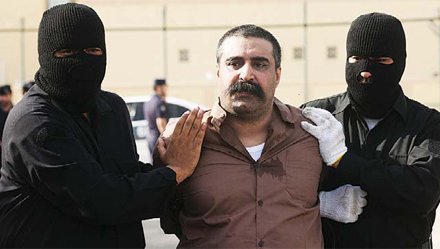
Three men were hanged at the central jail in Sulaibiya, Kuwait, on April 1, 2013, the first executions in the gulf monarchy since May 2007.

  • Pakistani Parvez Ghulam, convicted of strangling a Kuwaiti couple in 2006.
  • Saudi Faisal Dhawi Al-Otaibi, who stabbed a friend to death.
  • A stateless Arab Bedouin, Dhaher (or Thaher) al-Oteibi, who killed his wife and children and claimed to be the long-awaited twelfth imam. One imagines there was conceivably some mental instability there.

Kuwait employed the gallows with some regularity, with 72 hangings from the death penalty’s introduction in 1964 up until 2007. At that point, it ceased carrying out executions without any public explanation, though it has never ceased handing down death sentences.

This date’s resumption of hangings did not play at subtlety: media invitations resulted in a harvest of gallows photography. (See below.)

“We have begun executing death sentences as criminality and brutality have increased in our community, and the court issues sentences for serious crimes on a daily basis,” Kuwaiti prosecutor Mohammad Al-Duaij said in announcing the hangings. “These executions should eliminate the increasing number of crimes and be a deterrent.”

He added, ominously, that the other 48 people then on Kuwaiti death row had had their cases submitted to the emir for approval.

On this day..