602: Emperor Maurice and all his heirs

On this date in 602 (although some sources prefer November 23, but that’s close enough for ancient history) the 20-year reign of Byzantine Emperor Maurice came to a most unpleasant conclusion.

No gangster of love, Maurice made his bones (and other bones) as a military commander in a running war with the Sassanids unproductively engaged by the forgettable successors of Justinian.

So successful was the progress of his arms that Emperor Tiberius II Constantine married his daughter to Maurice and set him up as the official heir, a sage expedient considering that Roman commanders had once been known to take the succession into their own hands.

In fact, that’s exactly what happened to Maurice.

As a reward for his many victories in the field, Maurice got to take charge of a badly stumbling state: war both east and west (Maurice made peace with the Persians and brought the Slavs and Avars to heel in the Balkans), the intractable intra-Christian Monophysite controversy (Maurice extended a politic religious toleration), the bankruptcy of his state (Maurice cleaned up the reckless prodigality of his predecessors). For twenty years Maurice managed as well as anyone a very messy situation that in clumsier hands might easily have consumed the state entirely.

In the end this might be his legacy, for good and ill: a manager, not a visionary. Byzantium maybe doesn’t even survive without Maurice, but he was not fated to be familiar to posterity’s every schoolchild like Octavian Augustus — merely to lose his job to office politics.

Maurice, says Charles William Previte-Orton, “was a better judge of policy than of men.” And while the emperor “saw the dire need of economy,” he “forgot that the army did not” and so fatally disregarded “the ferment among the overtried soldiery.”

Maurice had already irritated his Dacian legions by refusing to pay an Avar ransom for their captured brethren — that fiscal rectitude thing, always a dangerous virtue to exercise in proximity to armed men. Now, he provocatively dialed back their pay and then tried to keep them beyond the frontier in Avar territory rather than retiring to home winter quarters.

The legions mutinied, thrusting a mere centurion named Phocas (or Phokas) to their fore. As Maurice commanded neither love nor fear in his home precincts, Constantinople itself yielded readily to the rebels while the enervated erstwhile emperor crossed the Bosphorus and there resigned to his fate not only himself but the several sons he had been designating to succeed him on thrones East and West. Gibbon:

Phocas made his public entry in a chariot drawn by four white horses: the revolt of the troops was rewarded by a lavish donative; and the new sovereign, after visiting the palace, beheld from his throne the games of the hippodrome. … The ministers of death were despatched to Chalcedon: they dragged the emperor from his sanctuary; and the five sons of Maurice were successively murdered before the eyes of their agonizing parent. At each stroke, which he felt in his heart, he found strength to rehearse a pious ejaculation: “Thou art just, O Lord! and thy judgments are righteous.” And such, in the last moments, was his rigid attachment to truth and justice, that he revealed to the soldiers the pious falsehood of a nurse who presented her own child in the place of a royal infant. The tragic scene was finally closed by the execution of the emperor himself, in the twentieth year of his reign, and the sixty-third of his age. The bodies of the father and his five sons were cast into the sea; their heads were exposed at Constantinople to the insults or pity of the multitude; and it was not till some signs of putrefaction had appeared, that Phocas connived at the private burial of these venerable remains. In that grave, the faults and errors of Maurice were kindly interred. His fate alone was remembered; and at the end of twenty years, in the recital of the history of Theophylact, the mournful tale was interrupted by the tears of the audience.

Maurice’s widow Constantina and his daughters were suffered to live, but only for a few years more: they too were eventually put to death for plotting. It was the perfect way to kick off a calamitous century for the Byzantines.

Phocas wore the purple from 602 to 610. Just guess how his term in office ended.

The History of Byzantium podcast covers Maurice’s rough go at the top in episode 34, 35, and 36.

On this day..

1933: Thomas Thurmond and John Holmes lynched in St. James Park


This still-notorious lynching — America’s seminal lynching for the broadcast media era — has been portrayed several times on the silver screen.

On this day..

1881: Four Black Friday hangings

November 25, 1881, was the day after Thanksgiving. And that date was a true “Black Friday” on the American gallows: four distinct murderers, all African-American men, were hanged in four different cities on this date in 1881.

We’re cadging entirely from the New York Herald of Nov. 26, and all quotes (as well as the pictured headline) source to that journal.

Richard James (South Carolina)

Richard James hanged in Marion, South Carolina for the previous year’s murder of a local shopkeep, David M. Harrell.

James insisted on his innocence, and even “turned upon the preacher with indignation” at in his cell on his last day when importuned to unburden himself of his sin. He “swore by all that was holy that he knew nothing of the crime, and was ready to face his Maker with this oath on his lips.”

James, “a light colored negro about thirty two years old” who “looked capable of committing any crime” and had a bad reputation in town, had been tried with his two brothers, Benjamin and Lewis for having waylaid the Harrell on his way home from closing the store.

A mixed-race jury (nine whites, three blacks) convicted the first two but acquitted Lewis. Benjamin had already been executed some weeks previously.

Henry Johnson (South Carolina)

Shortly afternoon that same day, Henry Johnson hanged in the jail in Sumter while “the housetops and fences near the jailyard were crowded with negroes, who heightened the scene by melancholy exclamations.”

Johnson, who converted to Catholicism the week before his death, occupied his last morning writing to a sweetheart in Port Royal, S.C. (He sent her some wooden buttons to remember him by, and demanded that she never marry.)

While he went mildly, his crime was “one of the most cold-blooded and unparalleled murders ever known in South Carolina.” (Of course, newspapers say this about every crime.)

John Davis, a good and hard working colored man was going through Hope Swamp on his way to the forest, where he was employed to cut cross ties for the railroad [but] he was followed by one Henry Johnson, also colored, who shrouded himself from view by the thick undergrowth. Thus, Indian like, he thirsted for his victim’s blood, and followed David step for step with the greed of a hungry panther until they arrived at a point where the depth and loneliness of the swamp was best suited for the tragedy that was enacted. The desired spot having been reached, Johnson, without uttering a word, raised his gun and fired, shooting John Davis in the middle of the back. Davis dropped dead in his tracks instantly. Johnson then caught him by his heels and dragged him to a hollow log, in which he placed Davis and then covered the log all over with … straw and leaves.

And then Johnson went to Davis’s house, where he knew he would get a good reception since Davis’s wife fancied him.

Explaining that Davis had had to go into town on business and would not be back for a day or three, Johnson made himself “not only lord of Davis’ house, but his much beloved wife.” He tried to lay the blame on a local fellow named Orange Isaacs whom Johnson by all appearances sincerely believed to be a sorcerer.

Joseph Harris (Tennesee)

In Rogersville, Tenn., Joseph Harris hanged for slaying two men in November 1880 in a crime that aroused so much local hatred that he was stashed away in Nashville until two days prior to the execution to prevent the appearance of lynch law.

Unlike the South Carolina condemned, Harris’s hanging was fully public, and a fair concourse of onlookers braved freezing temperatures to satisfy themselves with the course of justice.

Harris had targeted the outgoing proprietor of a country farm called Marble Hall. John Brown, having sold the estate, had sent his family on to their next lodgings in Bristol while he remained at Marble Hall with a 17-year-old stable hand named Heck to sell off the remaining livestock and close up affairs.

Those affairs were closed for good on November 23, when the room that Brown and Heck occupied was discovered on fire, its inhabitants having had their brains bashed in. $500 Brown had recently pocketed from the sale of his hogs was missing.

Sang Armor (Georgia)

Sang Armor not only had the most unusual name of November 25’s grim harvest, but was distinguished as the first-ever public execution (or execution of any kind) in Taliaferro county, Georgia. Taliaferro is currently (circa 2010 census) the least populous county east of the Mississippi with a population of just 1,717.

Armor was egged on by the crowd at his gallows to give up the names of accomplices whom he had previously implied had aided him in the murder of an elderly white man, but he remained “sullenly silent on the subject and talked only on religious matters.” The scaffold was erected in Ellington meadow, on the land of his victim, Amos Ellington.

“The feeling against Armor was very strong,” concludes the report, “especially among the colored men, several of whom he tried to implicate in the crime.”

Not Squire Clark (South Carolina)

It wasn’t all doom and gloom. Squire Clark, who was supposed to hang in Lexington, S.C., was respited until December 23.

Clark, sentenced to be die in a strange case where a body was found on a railroad tracks, mutilated by passing trains, had been convicted circumstantially for having killed the fellow before dumping his remains on the tracks. Convicted, overturned on appeal, convicted again, and ultimately commuted to a penal sentence, Clark never made it into the executioners annals.

The estate of his victim later sued the railroad for negligence in having run over the remains of W.S. Hook no fewer than three times.

On this day..

1793: Jean-Jacques Ampère, father of a savant, for Joseph Chalier

(Thanks to Amelia Fedo, a graduate student in French literature, for the guest post.)

He didn’t know it yet, but on this date in 1793, a brilliant adolescent named André-Marie Ampère lost his father to the guillotine. If the name sounds familiar, it’s because it would eventually become the SI unit of electrical current.

Andre-Marie Ampere, one of the founding pioneers of electromagnetism (Ampere called the new field “electrodynamics”) lost his father to the French Revolution’s guillotines.

The father in question was Jean-Jacques Ampère, an intelligent and levelheaded man whose sense of duty outweighed his instincts of self-preservation.

He was determined to do every job he had to the best of his ability — whether the task was educating a son or discharging the office of justice of the peace — and this diligence cost him his life.

A bourgeois silk merchant (a quintessentially Lyonnais occupation), he lived with his wife and son in a tiny village outside of Lyon called Poleymieux-au-Mont-d’Or. It was there that he and his wife, who were one of only five bourgeois families in a primarily peasant population, raised the boy who would grow up to be the father of electrodynamics.

In 1782, he retired and devoted himself full-time to his children’s upbringing — particularly that of his son, whom he soon realized was not an ordinary child. Born partly of necessity (Poleymieux lacked a school) and partly of choice (Jean-Jacques had, after all, opted to move to Poleymieux, and some speculate that he wished to give his son an upbringing like the one advocated by Rousseau in Émile), André-Marie’s unorthodox education resembled what today’s DIY pedagogues might call “unschooling”: he was encouraged to take charge of his own learning, given access to his father’s library, and taught a variety of eclectic subjects according to what most held his interest at the moment.

For most children, this technique is questionable; but when your kid happens to be a genius and a polymath, it works just fine. André-Marie was an audodidact and proactive in his learning, which would be a force for good in his life: as we’ll see, it was what pulled him out of his depression after his father’s death.

When the Bastille fell in 1789, not much changed at first. Jean-Jacques embraced the ideals of the Revolution and even wrote a play called Artaxerxe ou le Roi constitutionnel [Artaxerxe or the constitutional king], which James Hofmann, author of André-Marie Ampère: Enlightenment and Electrodynamics, sees as a parable containing Revolutionary themes.

A month after the fall of the Bastille, he lost his job as local aristocrat Guillin Dumontet’s procureur fiscal (a “judicial and administrative position,” according to Hofmann). Then, in the fall of 1791, he took another bureaucratic job: justice of the peace and “presiding legal functionary for the police tribunal” in Lyon. He may have done it voluntarily, out of sincere political fervor; but he may also have done it to protect his family, since his former boss, Guillin Dumontet, had been beheaded and partially cannibalized by his peasants a few months prior. If he had indeed taken this post for the good of his family, his plan backfired horribly…

As has been detailed in the post on Joseph Chalier, 1793 was not a good year for the Lyonnais.

The Revolution ran counter to the grain of Lyonnais culture for a number of historical reasons (the strong Catholic tradition and the silk trade being two of them). More immediately, famine and taxes had not disposed the people of Lyon towards the local Revolutionary government — particularly the far-left Jacobin faction, which continuously struggled for control of the city.

When the Jacobins seized power in March 1793, they provoked opposition from Girondins and royalists alike, and on May 29 important members of the Jacobin leadership were arrested. Among those apprehended was Joseph Chalier, head of a major Jacobin club known as the “Central Club.” Someone had to open the case against Chalier, and that someone was Jean-Jacques Ampère.

In spite of the Convention’s attempts at negotiation (which quickly turned to threats), Chalier was sentenced to death on July 16 and guillotined the next day. It was not Jean-Jacques who condemned Chalier to death — that does not appear to have been part of his job — but it was he who sent out the warrant for his arrest, and this was more than enough to get him sentenced to death when the political tides turned. (If the judges who actually sentenced Chalier to death — Cozon, Pourret, Régnier, and Maret — were ever punished, I haven’t found any evidence for it.)

Paris responded by placing Lyon under siege on August 9, and two months later, the city surrendered to the Convention. Rather than flee, Jean-Jacques remained in the city, resolved to see his duty through to the bitter end. Throughout the siege, he instructed his wife not to tell their children of the danger he was in. When Lyon was taken, he was immediately arrested, and in the six weeks he spent in prison, he had little doubt about his fate.

Trial and execution

Much of his trial is preserved in court documents. They refer to Lyon as “Ville-Affranchie” — “Liberated City,” the name Bertrand Barère gave to the town before declaring, “Lyon has made war against liberty; Lyon is no more” — so you know they mean business.

During his interrogation, Ampère père was accused not only of having issued the warrant for Chalier’s arrest, but also of having sentenced male and female Jacobin club members to public humiliation and having their eyebrows shaved off, respectively — as well as just generally having been a jerk to Jacobin detainees during interrogations.

The responses he gives show a man resolved to keep both his pride and his honor in the face of certain death, a functionary convinced that he had committed no wrong. Ampère admits to having had Chalier arrested but vehemently denies the other charges. He was also asked if he had left his post and/or sent a revocation to Paris, and responded that he had kept his post and had “no revocation to make.” This probably sealed his fate.

Here’s the full text of his interrogation, from Histoire des tribunaux révolutionnaires de Lyon (take my translations of legalese with a grain of salt; I don’t speak it in any language):

Frimaire 2, Year 2 (November 22)

Interrogation of Jean-Jacques Ampère, 61 years of age, justice of the peace of the canton of Halle-aux-Blés, residing in Lyon, Quai Saint-Antoine, Number 44. — Responses he gave.

I was in Lyon during the siege.

I never had any correspondence with the so-called constituent authorities in Lyon.

Question: You are accused of having filed the whole procedure against the patriots, of having been president of the correctional police during the whole time of the counter-Revolution, and of having judged those who had committed no crime other than belonging to the [Jacobin] club, sentencing the men to be tied to the post [this refers to a punishment formally known as “exhibition,” which was sort of like the pillory] and the women to having their eyebrows cut off; of having condemned, among others, Cadet Rufard, member of the [Jacobin] club, to six months of imprisonment for having sought bread for his brother, put in chains on May 29. You are reproached with having said to all of those whom you interrogated, “You are scoundrels, you people with your clubs; you had agents all the way out in the country, and your plot was the destruction of honest people.” In a word, you are accused of the assassination of the virtuous Chalier, since it was you who filed the first procedure, and it’s thanks to your arrest warrant that he mounted the scaffold.

Response: I never had any part in the judgments against patriots, men or women, which pronounced the sentence of pillory against the men and shaved eyebrows against the women; I admit to having filed the procedure against Citizen Chalier, on the declaration that had been made to me on May 27 by the public prosecutor who had the right to provoke my ministry; I also made several investigations against certain municipal officers after May 29, and in ruling on these procedures, I followed the law in sending back the accused in the presence of the director of the jury, the indictment alone regulating the jurisdiction. I conformed to the investigation of the functions of police officers who are uniformly employed to gather the vestiges of crimes and send the judgment back to the courts who should be informed of them. The circumstances were such that prudence joined with my sense of duty in making me carry out the measure indicated by the law. Before ruling on the procedure against the municipal officers, I had also ruled on the fate of a municipal named Sautemouche. I let him out under an oath to return, and soon after his release, the unfortunate Sautemouche succumbed to the blows of malicious persons. He was murdered, and most of the sections shouted for my arrest, because I had obeyed my conscience and my opinion by delivering an innocent man.

Question: Did you leave Lyon and did you send your revocation to the Committee of Public Safety, according to the law?

Response: I have no revocation to make.

Question: Did you continue your functions during the siege in a city in revolt?

Response: Yes, from May 27 until the beginning of August.

Question: Did you issue the warrant for Chalier’s arrest?

Response: Yes, on June 7.

On November 22, the same day as his trial (other sources give the date as November 23, 24 or 25, but I’m going by the date of execution given in legal documents), he was guillotined in Place Bellecour along with three men who appear not to have been involved in the affair: Étienne Chazottier, a lawyer and the president and secretary of the “permanent section” (a local political office), for “offenses against patriots”; Pierre-Elisabeth Chaponnay, an aristocrat, for “giving considerable sums to, and favoring the plans of, counterrevolutionaries”; and Jean Freidière, a geometer and secretary of the “surveillance committee” — no crime given. Ampère was 61 years old.

Shortly before his execution, he was allowed to write a final letter to his wife. Here’s the most complete version I can find, taken from Portraits Littéraires by Charles-Augustin Sainte-Beuve:

My dear angel, I have received your comforting letter; it was a life-giving balm to the emotional wounds that had been inflicted on my soul by my regret at being misunderstood by my fellow-citizens, who have denied me, through the most cruel separation, a homeland that I have cherished so much and whose prosperity is so close to my heart. I wish for my death to be the seal of a general reconciliation between our fellow-men. I pardon those who rejoice in it, those who caused it, and those who ordered it. I have reason to believe that the national vengeance, of which I am one of the most innocent victims, will not extend to the few possessions that have been sustaining us, thanks to your wise money-saving and our frugality, which was your favorite virtue … After my trust in the Eternal, to whose breast I hope will be taken that which remains of me, my sweetest consolation is that you will cherish my memory as much as I cherished you. That much is owed me. If from my home in Eternity, where our dear daughter has preceded me, I am able to attend to things on earth, you and my dear children will be the object of my care and concern. May they enjoy a better fate than their father and always have before their eyes the fear of God, that salutary fear that makes innocence and justice act on our hearts in spite of the fragility of our nature! … Do not speak to Josephine [André-Marie’s younger sister, then about eight years old] of her father’s misfortune — make sure she does not know about it; as for my son, there is nothing I do not expect of him. As long as you have them, and they have you, embrace each other in my memory: I leave you all my heart.

The author then explains that “There follow a few pieces of advice concerning the household economy, notes about paying off debts, and meticulous scruples regarding antique probity, signed with these words: J.-J. Ampère, husband, father, friend, and forever-faithful citizen.”

He continues with a sentiment shared by most nineteenth-century commentators on this affair: “Thus died, with resignation, with grandeur, and expressing himself almost as Jean-Jacques [Rousseau] would have been able to, this simple man, this reclusive merchant, this justice of the peace from Lyon. He died like so many members of the National Assembly, like so many Girondins, sons of [the spirit of] ’89 and ’91, children of the Revolution, devoured by it, but pious to the end, and not cursing it!”

We are also treated to some of Ampère’s actual notes (it would have been nice if Sainte-Beuve had just reprinted them in their entirety instead of only snatches): “It is impossible, my dear friend, for me to leave you rich, or even moderately comfortable; you cannot attribute this to my bad conduct nor to any spendthrift behavior. My greatest expense was the purchase of books and geometrical instruments which our son could not do without; but that expense was itself a bargain, because he never had any tutor except for himself.”

The Jacobins greatly spun the proceedings against Ampère; in a November 25 letter to the Convention, Collot d’Herbois and Fouché claimed that: “It was liberty that they wanted to assassinate in killing Chalier; his executioners have confessed it; before coming under the blade of justice, they were heard to say that they were dying for the king, that they had wanted to give him a successor.” It goes without saying that there is no reason to believe that Ampère said any such thing on the scaffold—he lived and died a Republican.

Aftermath

To say the execution was a shock to the eighteen-year-old André-Marie would be an understatement.

He never truly recovered from the death of his father, which was neither the first nor the last personal tragedy that would befall him; his older sister Antoinette had died a year earlier, and he would also lose his first wife after only four years of marriage. James Hofmann points out in Enlightenment and Electrodynamics that Jean-Jacques was André-Marie’s only link to the world outside Poleymieux, where he was socially isolated in addition to being intellectually stimulated (his undersocialization did indeed have a permanent effect; he was extremely awkward all his life).

Although André-Marie made a “return to normalcy” through study, he was scarred for life; Hofmann asserts that the event “contributed to the permanently melancholy cast of his adult temperament.”

After hearing the news, André-Marie became catatonic for a year; according to his friend and fellow-scientist François Arago, “The blow was too hard; it was beyond the strength of a young man of eighteen: Ampère was shattered. His intellectual faculties, so active, so intense, so developed, suddenly gave way to a veritable idiocy. He spent his days mechanically contemplating the earth and sky, or making little heaps of sand.”

Yikes. Arago claims that André-Marie was able to snap out of it with the help of Rousseau’s writings on, of all things, botany: “This lethargy of all moral and intellectual feeling had lasted for more than a year, when the letters of J.-J. Rousseau, on botany, came into Ampère’s hands. The limpid and harmonious language of this work entered the soul of the sick young man and partially gave him his nerves back, as the rays of the rising sun pierce the thick fogs of morning and bring life to the heart of plants stiff from the night’s chill.” With that, Ampère’s intellectual life reawakened; he began to study, and eventually became more or less functional — although, according to Hofmann, direct discussion of the event remained a taboo subject.

Indirect references are another matter; he named his son Jean-Jacques, in memory of his father and also, some speculate, as an homage to Jean-Jacques Rousseau.

On this day..

1797: Figaro the Elder and Jean Louis, Charleston slaves of Dominguan exiles

On this date in 1797, two French slaves were hanged in Charleston for plotting rebellion.

This plot was the product of the liberation-minded aftermath of the Haitian Revolution … although whether the product was in the minds of the slaves, or those of the paranoid slaveowners, is still up for debate.

As the great slave revolution unfolded, many of Saint Domingue’s white planters had fled abroad. Charleston, South Carolina was a major destination, one of several Atlantic cities in the U.S. that received these refugees in quantity* — lugging along as many slaves as they could. “My Fellow-Citizens know your goodness,” said one of their number in an address to the South Carolina legislature, “and anticipate the Share you are about to take in their Calamities.” The state government accordingly granted relief money to these put-upon immigrants; the British themselves are thought to have been kicking into the relief kitties in Charleston as part of 18th century covert ops to check the spread of Jacobinism.

With the Haitian Revolution and its beneficiaries aligned (for the moment) with the French Revolution,** these French exiles fit right in with pro-British federalists to a continental reactionary backlash.

Revolutionary France’s consul in Charleston (he was U.S. ambassador by the time of the events in this post) maneuvered against that city’s planter exiles (“colonial aristocrats,” as he called them†) and eyed hemispheric emancipation, according to this book.

Yet the very flight of Saint Domingue planters also brought like a contagion the idea and experience of successful revolt in the breast of those refugees’ own chattel slaves … and in the midnight terrors of those slaves’ owners. As early as August 1793, rumor gripped Charleston that a slave revolt was in the offing. Jittery Southern states began passing laws to restrict slave imports from the West Indies who might be carriers of the virulent dream of liberty.

It was in this context that Charleston authorities discovered in 1797 “a conspiracy of several French Negroes to fire the City and to act here as they formerly done at St. Domingo.”

These several Negroes denied the plot, for a while.

Eventually, and surely encouraged by what me might today dignify “enhanced” interrogation, one of them turned state’s evidence. This “Figaro the Younger” — there were two named Figaro arrested for this same plot‡ — was the property of one Jacques Delaire, one of the Dominguan community’s more belligerent aristocratic grandees. Figaro the Younger’s evidence, though only a “partial confession” was enough to doom two of his fellows.

After the condemnation of Jean Louis, he turned to the two Figaros and said, “I do not blame the whites, though I suffer, they have done right, but it is you who have brought me to this trouble.”

(A French freedman named Mercredi hanged for the same affair a week later.)

For testifying against his mates, Figaro the Younger saved his own life and was sentenced to be transported to Suriname. En route, the pressure of his leg irons caused “a swelling about the ankles which turn’d into a sore & … a mortification of the flesh ensuing his toes rotted & one of his feet drop’d of[f] entirely.”

The southern anti-slavery cause was soon crippled, too.

Especially after the 1800 Gabriel Prosser revolt, any dalliance with emancipation, republicanism, revolution, became practically unutterable, as if to speak the words would conjure up the flames of Cap-Francais. “Beyond a reasoned fear of domestic insurrection seems to have lain a desire to banish the reality of St. Domingo,” as Winthrop Jordan put it.

But the threat and the example of Haiti long stalked the imagination of those caught in the toils of the South’s peculiar institution. And more literally than that, as Robert J. Alderson notes,

Captain Joseph Vesey … was [one] of the dispensers of [refugee relief] aid, [and] many Domingan refugees made calls on him. When the Domingan planters visited, their slaves had a chance to speak with one of Captain Vesey’s slaves, Denmark Vesey.

* For example, see Gary Nash, “Reverberations of Haiti in the American North: Black Saint Dominguans in Philadelphia” in Pennsylvania History, Vol. 65 (1998). Philadelphia was at the time still the U.S. capital.

** Said alignment between revolutionary Haiti and the mother country was, of course, tenuous and not permanent.

There’s a report in the Paris archives from this period of the French consulate’s low opinion of Charleston’s Dominguans: “tricky people, at the end of their resources that vengeance towards their country and despair may lead to anything. Among the French whom we have here, there are some very good patriots who know what the hospitality of the country demands of their gratitude, but the number is small.”

‡ The Figaro plays and some of their operatic adaptations were culturally current in the 1780s and 1790s. That includes Mozart’s Marriage of Figaro but not yet Rossini’s Barber of Seville with its definitive Figaro aria … although such would be very poor excuse not to post the latter.

On this day..

1720: Edward Hunt, the first counterfeiter executed in colonial Pennsylvania

On November 19, 1720, Edward Hunt was hanged in Philadelphia. He was the only Pennsylvanian executed for treason prior to the American Revolution — that treason being not the betrayal of the state (in the sense we might think of it today), but counterfeiting.

In the bitterness of his scaffold speech, which disdains the customary acknowledge-my-guilt, pray-for-my-soul form of the genre to complain about his case, Hunt made plain that he was not reconciled to the justice men had rendered him.

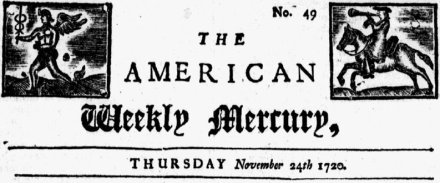
The American Weekly Mercury of Thursday, November 24 published “this extraordinary Piece” only with a preface complaining that “it is evident, that the following Speech was intended to misrepresent the Administration and Justice of this Government, as well as to infuse both ill Principles and Practices into the Minds of the People.”

The Dying Speech of Edward Hunt, formerly taken in Rebellion at Preston, and transported a bound Servant to the Island of Antigua, before his Execution upon the 19th Instant, at Philadelphia, where he had been legally convicted of High Treason, and most justly condemn’d for his Counterfeiting Spanish Silver Coin, made current* by Act of Parliament within all his Majesties Colonies in America.

It may be expected, that I should say some thing now concerning my Life and Conversation, which i must with Sorrow own to God and the Word has not been according to the Precepts and Principles of the Church, in which I was bred and educated: But with a sincere repentance and hearty Sorrow I do lament all the Errors of my past Life, firmly believing in my Saviour Jesus Christ, in whose Merits and ever flowing Mercy I do only trust for Salvation and Pardon, who has promised Eternal Life on no other Terms to the most Righteous upon Earth.

As to the Crime that now I suffer for in particular, I must own it is an Offence against the Laws, which I hope God will pardon me since he knows that I did not do it with any Design to cheat or defraud any one, or to make a Practice of Coining; but being ignorant of the Breach of any Laws of God or Man, I thought I might cut those Impressions as innocently as any other, or the Stamps that the Gentlemen of this place imploy’d me about, to make Farthings.** I am an English Subject, and desired to have the Privilege of the Laws of England, but it was not granted in any Point, except in Condemning me.

I am the first unhappy Instance of this kind that ever suffered in the King’s Dominions, pray God it may be a Warning to all, not to offend wilfully in the same that I did through Ignorance: For if I had known it, I would not have taken all the World to have done it. God give me a patient Resignation to submit to his blessed Will, in whatsoever he please.

I do heartily ask Forgiveness of all that I have offended in any manner of way, and do sincerely forgive all that have injured or offended me; particularly Mr. John Moore and Morris Birchfield, and the Evidence that swore against me in that Tryal. I do solemnly declare, That I know not any thing, or have been guilty of any one thing laid to my Charge in that Matter, or any of the other things laid to my Charge, by John Butler, either in England or Ireland.

I did petition the Honourable Governor for a Reprieve, until the King’s Pleasure was known concerning me, being I could not be tried by the Laws of England in all Points, as a Church of England Man ought to be: But it was a Privilege too great for me to obtain. Pray God to forgive them all, and every one that has a hand in taking away my Life any manner of way, and that my Blood be not required at their Hands, for they know not what they do. I am on Earth judged and condemned to die for the Breach of a Law of Man that was not duly published, which for that Reason I transgress’d it ignorantly, though the first that suffers for the Transgression of unknown Laws, or that was sentenced according to the Laws of England, without the Privilege of a Subject, which I desired of the Judge, which I know was not qualified by the same Laws to try me.

I do not know what Advantage there can be to any in my Death, and that I could not appeal to my King, neither before nor after my Tryal. I do not speak this because I am not in Charity with all the World, I do, from the Bottom of my Heart, forgive all in Obedience to my Saviour’s Command and Example, who suffered more for me, being innocent, and had not only done no Harm, but Good, and pray’d even for is cruel Persecutors and Murderers, and promised, That those that follow his Examples in this World by patiently enduring the Cross, shall reign with him to all Eternity: To Him therefore I commit all, an my poor Wife, beseeching him to help her, and be her Support and Comfort, and preserve her poor Soul free from the Polutions [sic] of the World, that through his precious Merits we may meet where we shall be both happy to all Eternity, in the merciful Arms of our dear Lord and Saviour Jesus, who I do beseech to receive my poor Soul.

According to Kenneth Scott’s Counterfeiting in Colonial America, Edward Hunt’s wife, Martha, got a £500 fine and a lifetime prison sentence for misprision of treason. (If that book is up your alley, Scott has an even more specific Counterfeiting in Colonial Pennsylvania.)

* Early colonial American commerce was severely hampered by a shortage of English/British currency. As a result, coins minted in Spain’s lucrative southern territories served as the colonies’ primary currency in the 17th and 18th centuries, particularly the iconic eight-real silver “pieces of eight”.

This is the reason why the currency of the present-day U.S. isn’t an “American pound sterling” but the almighty dollar: Dutch colonists had brought a coin called the leeuwendaalder to their former New Amsterdam (New York) province, the name deriving from the German thaler. As the pieces of eight corresponded to the thaler/daalder, it inherited the same name. Indeed, the “Spanish Dollar” remained legal tender in the post-colonial United States until 1857.

This is also the reason for reckoning of the eight constituent bits that comprised the dollar, and hence of the American colloquialism “two bits” to denote $0.25 … and, later, the adjective “two-bit” to man something cheap, mean, or small-time.

** They may have been Spain’s coins, but it’s wildly implausible that any Englishman could think he could counterfeit “innocently.”

On this day..

1427: Johann Bantzkow, Mayor of Wismar

On this date in 1427, the merchant-mayor of Wismar was beheaded — the incidental casualty of a Baltic trade war.

The Hanseatic League, that vast trading cartel stretching from Europe’s Low Countries in the west to Novgorod in the east, was in its glory at the start of the 15th century. The Hanse dominated Baltic trade.

Its major rival was Denmark, which had brought most of Scandinavia together in the Kalmar Union.


Map of the Hanseatic League at its apex, circa 1400. (Via Wikipedia)

Come the 1420s, the Danish monarch was Eric of Pomerania, a handsome and headstrong king. He would come to blows with Hanse cities over the Duchy of Schleswig.

Schleswig is the “neck” of Denmark’s Jutland peninsula. In the present day, the German-Danish border splits Schleswig horizontally: north Schleswig is Danish soil; south Schleswig, German.

To summarize a complicated history, the historical Duchy of Schleswig was long a bone of contention between the pre-modern precursors of those current states. Since Germany was very far from a unitary entity where we lay our scene in the 15th century, Denmark’s immediate rival for Schleswig was that territory’s southern neighbor, Holstein. Eric had fought intermittently in the 1410s and 1420s against the counts of Holstein over who controlled what and upon what terms in south Jutland.

After securing a legal ruling favorable to his claims from the Holy Roman Emperor, Eric in 1426 began enforcing his rights by force.

Holstein in turn sought aid from Hanseatic towns many of whom — wary of Denmark as a rival to its Baltic trading stranglehold — did indeed enter the fray on the side of Holstein. Hanseatic ships began raiding southern Denmark in the spring of 1427.

Wismar, a Hanse wool-trading port just a few kilometers outside of Holstein, was one of these cities. Johann Bantzkow (German link), its merchant ruler, supplied some 200 sail for the Hanseatic flotilla.

Unfortunately for the Hanse, and for Bantzkow, the Danes proved to have naval superiority and dealt a crushing defeat to the Hanseatic fleet on July 11, 1427 — then once again on July 25. A number of Wismar ships were captured in the process.

Public anger in Wismar was intense. That city had seen its own social conflicts in the generations preceding between the town’s patricians and its guilds; now popular anger over the souls lost at sea caused Bantzkow’s fellow-mayor Hinrik van Haren to be slain by the mob. Bantzkow himself was condemned judicially, and his influential family could not manage any better succor than a death by the sword instead of the horrible prospect of the breaking-wheel. Claus Jesup (German link), a leader of guilds, made himself mayor of a rearranged political order.

The prospective realignment was itself reversed in 1430, and the re-established magnates put up a Bantzkowsche Sühnekapelle (German again), or Bantzkow Penance Chapel, to atone for the unjust beheading. Regrettably, the chapel was demolished in the 19th century.

Given setbacks at sea, Holstein and its remaining Hanseatic allies focused on actual conquest in Schleswig, and with much better success. Eric was eventually forced after great expense to sue for a costly stalemate,* an affair which helped to undermine Eric’s own hold on power until he was finally deposed in 1440.

However, Eric’s success on the seas — and his urgent need for funds — led to his establishing Denmark’s Sound Dues on 1429, collecting lucrative tolls from all foreign ships sailing between the Baltic Sea and the Kattegat.** This tax would remain a pillar of the Danish state well into the 19th century, at times providing up to two-thirds of the government’s operating income.

A new Hanse was re-founded in 1980 as a cultural exchange network among the historic cities of the federation.

* Control of Schleswig-Holstein never was definitively resolved, and it re-emerged as a famously devilish diplomatic problem in the 19th century — prompting Lord Palmerston to remark that “only three people … have ever really understood the Schleswig-Holstein business — the Prince Consort, who is dead — a German professor, who has gone mad — and I, who have forgotten all about it.”

** It’s thanks to Sound Dues that Elsinore, the main tolling point, got big and rich enough for Shakespeare to set Hamlet there.

On this day..

1806: Fra Diavolo, royalist guerrilla

On this date in 1806, the Neapolitan partisan Michele Pezza was hanged as a bandit.

Better known by his infernal nickname “Fra Diavolo” — “Brother Devil” — Pezza (English Wikipedia entry | Italian) was forced into the army of the Kingdom of Naples as punishment for manslaughter in 1797, just in time to experience its thrashing at the hands of the French Republicans rolling down the peninsula.

By 1799, Naples was no longer a kingdom at all, but a French-modeled and -backed republic, one of several in Italy.

Populist, Catholic resistance to these impositions commenced almost immediately. Fra Diavolo was destined to become the enduring legend of this sanfedismo movement.

Pezza’s band, which eventually numbered as much as 4,000, stalked the roads around Rome and Naples, terrorizing French soldiers and Republicans. They had a reputation for cruelty.

Francis Maceroni, a writer and an aide (and eventual biographer) for Napoleonic marshal Murat, charges that Fra Diavolo was merely “a well known assassin and highwayman [who] could not but be infamous, in any service. Brief, he was put upon his trial, — found guilty of as many horrid felonies as would fill a dozen volumes like that of ‘Rookwood,’ and hanged upon a gibbet of extraordinary height, at the Ponte della Maddalena at Naples.” The author is disgusted that the name Fra Diavolo “has not only been immortalized by his atrocious crimes, but by the appliances of fine music and operatic representation” for the outlaw “was a most unmitigated mass of evil, without one redeeming point.”

Actually, his effectiveness with irregulars was a very significant redeeming point in a dirty-war environment.

After Naples’ Parthenopean Republic was deposed by France’s foes, Pezza was retired with an aristocratic title, a substantial pension, and a trophy bride: just the Bourbons’ way to say thanks.

But he was recalled to the field when the French re-invaded Naples in 1806, briefly installing Napoleon’s brother Joseph Bonaparte as the new Neapolitan king, and again set to raiding with a mass of guerrillas. This time the French hunted him to ground, defeating his irregulars in an October 1806 engagement and capturing Fra Diavolo himself days later.

Pezza hanged as a brigand in Naples, but the city’s exiled royalty funded a funeral mass for their lost commander in the cathedral of Palermo.

Maceroni wasn’t kidding about the “fine music and operative representation,” by the way. Daniel Auber composed a hit 1830 debut, Fra Diavolo.

On this day..

1571: Anneken Hendriks, cursed Mennonist

On this date in 1571, Anneken Hendriks was martyred in Amsterdam as an Anabaptist.

She was about 53 years old and illiterate, and had come to Amsterdam from Frisia. Considering her outlaw faith could have done better than to move in next to the underbailiff. He soon apprehended his neighbor for “having forsaken the mother, the holy church, now about six years ago and having adopted the cursed doctrine of the Mennonists, by whom she had been baptized on her faith.”

That’s per the Martyrs’ Mirror catalog of Protestant martyrdoms. For the 1685 edition of this volume, Dutch illustrator Jan Luyken favored poor Anneken Hendriks with one of his grisly illustrations.

Anabaptists — practitioners of adult baptism — were heavily persecuted in the Low Countries and throughout Europe, particularly after right-thinking folk were shocked by the short-lived Anabaptist commune at Muenster. Anneken Hendriks, sure enough, had by the words of the sentence against her “not been for six or seven years at confession, or at the holy, reverend sacrament, but went to the meetings of the cursed sect of Mennonists or anabaptists, so that they have even held secret meetings or assemblies at her house.” She also threatened traditional marriage by “marrying” her husband “by night, at a country seat, after the manner of the Mennonists.”

Our source here notes that Anneken Hendriks was tortured by rack and strappado for the names of other Anabaptists. She refused to divulge any, but she was chatty enough on the way to her burning — warning her former neighbor that God would punish him if he kept up the Judas act, and spurning her Catholic would-be confessors — until they stuffed her mouth with gunpowder to still her heretical tongue.

On this day..

1752: James of the Glen

On this date in 1752, the Scotsman Seamus a’ Ghlinne mounted a gallows above the narrows at Ballaculish with the reproach of Psalm 35 for his persecutors:

False witnesses rose; to my charge things I not knew they laid.
They, to the spoiling of my soul, me ill for good repaid.

Seamus a’Ghlinne — James of the Glen, or just James Stewart — had come there that day to die for the ambush murder of Colin Roy Campbell.

The victim was stock of Clan Campbell, one of the largest Highland clans and one whose loyalties to England’s Hanoverian kings were being richly rewarded.

The Stewarts, who had backed the recent ill-fated Jacobite rebellion in favor of the exiled pretender Bonnie Prince Charlie, were in the opposite predicament.

Colin Campbell was said on that fatal May 14 to be en route to expel the Stewarts from the village of Duror so that Campbells could move in. But even Campbell’s everyday job of extracting resentful rents from estates repossessed from Jacobite sympathizers would have turned many a murderous eye his way.

Someone that day shot Colin Campbell in the back from wooded cover, then vanished, murderous eye and trigger finger and all, never to be never apprehended. So they got James Stewart to answer for it instead.

This wasn’t a tragic case of well-intentioned police developing tunnel vision on the wrong suspect so much as repaying tit for tat in a family feud. The trial was held at the Campbells’ Inverary Castle. Its presiding judge was the Campbell alpha male, the Duke of Argyll. Eleven more Campbells sat on Stewart’s jury. But then, from the Campbells’ side, or London’s for that matter, what was to say that this one murder might not be the germ of a new rebellion if not ruthlessly answered?

Still, there was “not a shred of evidence,” says present-day Glasgow barrister John Macauley, who is pushing for an official reversal of the verdict. “The whole thing from start to finish was a farce.” (Judge for yourself here.)

James Stewart was, however, the foster father of a man who actually was suspected of firing the shot, Allan Breck Stewart, a former Jacobite fighter who had returned from exile in France to collect rents for the Stewarts. Known to have threatened the Campbells previously, Allan was also tried and condemned to death — but only in absentia, since he suspiciously fled to France immediately after the so-called Appin Murder.

Many years later, Robert Louis Stevenson would use this dramatic crime, and Al(l)an Breck’s flight to safety, in Kidnapped. “I swear upon the Holy Iron I had neither art nor part, act nor thought in it,” Stevenson’s Alan says to the fictional protagonist in the novel, just after both have witnessed the murder.

And in reality, Alan too is thought by those who know the case to be clear of guilt in the matter. The Stewart family reputedly knew all along which of their number was Campbell’s real killer, but refused to give him up and kept the family secret for generations. It’s even said that that man had to be forcibly held down on execution day to prevent him giving himself up.

To judge by the most recent research, that man was likely Donald Stewart, the son of Stewart of Ballachulish and the best shot among a group of several young hotheads who resolved together to slay the Campbells’ hated Factor. The conspiracy also goes as the reason — or at least excuse — for keeping Donald silent, since in giving himself up he might see all four of them to the gallows. The late Lee Holcombe makes a comprehensive case for Donald Stewart as the gunman in the 2004 book Ancient Animosity: The Appin Murder and the End of Scottish Rebellion; Donald Stewart was also fingered publicly in 2001 by a matriarch of the Stewarts of Appin, though others of her family have not publicly confirmed that that’s the secret name.

James Stewart’s decaying corpse remained gibbeted on the spot of his execution for 18 months after, a rotting warning to the Stewarts or any late Jacobites. In 1754, a local halfwit called “Daft Macphee” finally tore down the gallows and threw it into Loch Linnhe … but its former position overlooking the modern Ballachulish Bridge is still marked by a mossy stone monument to James of the Glen, “executed on this spot Nov. 8th 1752 for a crime of which he was not guilty.”

A Few Books About the Appin Murder

On this day..