1430: Seven Parisian conspirators, during the Hundred Years War

In the early 15th century, France had stacked upon the woes of the Hundred Years War those of a civil war — between Armagnacs and Burgundians.

Burgundy, doughty duchy of Nibelungenlied renown, stretched to the Low Countries and was a gestating wealthy merchant state that perhaps had more in common with the English than with feudal, agrarian France. What Burgundy and England demonstrably had in common from 1419 was an alliance. Together, they bossed the northern half of what is now France during the endless Hundred Years War.

Thanks to this timely arrangement, the English came to occupy Paris — in Burgundian possession since 1418, when said party had bloodily ejected the French royalist Armagnacs.

Into this very low ebb of Valois fortunes entered Joan of Arc.

It is true that the king has made a truce with the duke of Burgundy for fifteen days and that the duke is to turn over the city of Paris at the end of fifteen days. Yet you should not marvel if I do not enter that city so quickly. I am not content with these truces and do not know if I will keep them.

-Joan of Arc, in a letter to Reims

Late in the 1420s, the illiterate farm girl somehow reversed the failing fortunes of the southerly French court. Joan, of course, will die at an English stake … but it is the Burgundians who will capture her.

At any rate, in 1429, Joan showed up and the French suddenly began going from victory to victory, knocking English and Burgundian heads in north-central France and culminating with having Charles VII crowned at Reims … which is actually north (well, northeast) of Paris.

Although Joan’s attack on Paris failed, advancing French arms put the fear of Holy Maid in the city and also cut off quite a lot of its rural food supply. “The capital itself was in a frightful state. As a result of interrupted communication and exposed supply routes, together with harassment by brigands and peasants, many Parisians were starving.”

Good times.

This naturally led some of the Armagnac-inclined citizens of Paris to think about ways to give the city back up to the French. We take up the narration of Anatole France, on a plot revolving around the “Seigneur de l’Ours,” or Jaquet Guillaume. (From here (HTML), or here (PDF).)

He was not of gentle birth and his arms were the sign of his hostelry. It was the custom in those days to give the title of Seigneur to the masters of the great Paris inns. Thus Colin, who kept the inn at the Temple Gate, was known as Seigneur du Boisseau. The hôtel de l’Ours stood in the Rue Saint-Antoine, near the Gate properly called La Porte Baudoyer, but commonly known as Porte Baudet, Baudet possessing the double advantage over Baudoyer of being shorter and more comprehensible. It was an ancient and famous inn, equal in renown to the most famous, to the inn of L’Arbre Sec, in the street of that name, to the Fleur de Lis near the Pont Neuf, to the Epée in the Rue Saint-Denis, and to the Chapeau Fétu of the Rue Croix-du-Tirouer. As early as King Charles V’s reign the inn was much frequented. Before huge fires the spits were turning all day long, and there were hot bread, fresh herrings, and wine of Auxerre in plenty. But since then the plunderings of men-at-arms had laid waste the countryside, and travellers no longer ventured forth for fear of being robbed and slain. Knights and pilgrims had ceased coming into the town. Only wolves came by night and devoured little children in the streets. There were no fagots in the grate, no dough in the kneading-trough. Armagnacs and Burgundians had drunk all the wine, laid waste all the vineyards, and nought was left in the cellar save a poor piquette of apples and of plums.

The Seigneur de l’Ours … was the proprietor of the house with the sign of the Bear (l’Ours). He held it by right of his wife Jeannette, and had come into possession of it in the following manner.

Fourteen years before, when King Henry with his knighthood had not yet landed in France, the host of the Bear Inn had been the King’s sergeant-at-arms, one Jean Roche, a man of wealth and fair fame. He was a devoted follower of the Duke of Burgundy, and that was what ruined him. Paris was then occupied by the Armagnacs. In the year 1416, in order to turn them out of the city, Jean Roche concerted with divers burgesses. The plot was to be carried out on Easter Day, which that year fell on the 29th of April. But the Armagnacs discovered it. They threw the conspirators into prison and brought them to trial. On the first Saturday in May the Seigneur de l’Ours was carried to the market place in a tumbrel with Durand de Brie, a dyer, master of the sixty cross-bowmen of Paris, and Jean Perquin, pin-maker and brasier. All three were beheaded, and the body of the Seigneur de l’Ours was hanged at Montfaucon where it remained until the entrance of the Burgundians. Six weeks after their coming, in July, 1418, his body was taken down from gibbet and buried in consecrated ground.

Now the widow of Jean Roche had a daughter by a first marriage. Her name was Jeannette; she took for her first husband a certain Bernard le Breton; for her second, Jaquet Guillaume, who was not rich. He owed money to Maître Jean Fleury, a clerk at law and the King’s secretary. His wife’s affairs were not more prosperous; her father’s goods had been confiscated and she had been obliged to redeem a part of her maternal inheritance. In 1424, the couple were short of money, and they sold a house, concealing the fact that it was mortgaged. Being charged by the purchaser, they were thrown into prison, where they aggravated their offence by suborning two witnesses, one a priest, the other a chambermaid. Fortunately for them, they procured a pardon.

The Jaquet Guillaume couple, therefore, were in a sorry plight. There remained to them, however, the inheritance of Jean Roche, the inn near the Place Baudet, at the sign of the Bear, the title of which Jaquet Guillaume bore. This second Seigneur de l’Ours was to be as strongly Armagnac as the other had been Burgundian, and was to pay the same price for his opinions.

Six years had passed since his release from prison, when, in the March of 1430, there was plotted by the Carmelites of Melun and certain burgesses of Paris that conspiracy which we mentioned on the occasion of Jeanne’s departure for l’Île de France. It was not the first plot into which the Carmelites had entered; they had plotted that rising which had been on the point of breaking out on the Day of the Nativity, when the Maid was leading the attack near La Porte Saint-Honoré; but never before had so many burgesses and so many notables entered into a conspiracy. A clerk of the Treasury, Maître Jean de la Chapelle, two magistrates of the Châtelet, Maître Renaud Savin and Maître Pierre Morant, a very wealthy man, named Jean de Calais, burgesses, merchants, artisans, more than one hundred and fifty persons, held the threads of this vast web, and among them, Jaquet Guillaume, Seigneur de l’Ours.

The Carmelites of Melun directed the whole. Clad as artisans, they went from King to burgesses, from burgesses to King; they kept up the communications between those within and those without, and regulated all the details of the enterprise. One of them asked the conspirators for a written undertaking to bring the King’s men into the city. Such a demand looks as if the majority of the conspirators were in the pay of the Royal Council.

In exchange for this undertaking these monks brought acts of oblivion signed by the King. For the people of Paris to be induced to receive the Prince, whom they still called Dauphin, they must needs be assured of a full and complete amnesty. For more than ten years, while the English and Burgundians had been holding the town, no one had felt altogether free from the reproach of their lawful sovereign and the men of his party. And all the more desirous were they for Charles of Valois to forget the past when they recalled the cruel vengeance taken by the Armagnacs after the suppression of the Butchers.

One of the conspirators, Jaquet Perdriel, advocated the sounding of a trumpet and the reading of the acts of oblivion on Sunday at the Porte Baudet.

“I have no doubt,” he said, “but that we shall be joined by the craftsmen, who, in great numbers will flock to hear the reading.”

He intended leading them to the Saint Antoine Gate and opening it to the King’s men who were lying in ambush close by.

Some eighty or a hundred Scotchmen, dressed as Englishmen, wearing the Saint Andrew’s cross, were then to enter the town, bringing in fish and cattle.

“They will enter boldly by the Saint-Denys Gate,” said Perdriel, “and take possession of it. Whereupon the King’s men will enter in force by the Porte Saint Antoine.”

The plan was deemed good, except that it was considered better for the King’s men to come in by the Saint-Denys Gate.

On Sunday, the 12th of March, the second Sunday in Lent, Maître Jean de la Chapelle invited the magistrate Renaud Savin to come to the tavern of La Pomme de Pin and meet divers other conspirators in order to arrive at an understanding touching what was best to be done. They decided that on a certain day, under pretext of going to see his vines at Chapelle-Saint-Denys, Jean de Calais should join the King’s men outside the walls, make himself known to them by unfurling a white standard and bring them into the town. It was further determined that Maître Morant and a goodly company of citizens with him, should hold themselves in readiness in the taverns of the Rue Saint-Denys to support the French when they came in. In one of the taverns of this street must have been the Seigneur de l’Ours, who, dwelling near by, had undertaken to bring together divers folk of the neighbourhood.

The conspirators were acting in perfect agreement. All they now awaited was to be informed of the day chosen by the Royal Council; and they believed the attempt was to be made on the following Sunday. But on the 21st of March Brother Pierre d’Allée, Prior of the Carmelites of Melun, was taken by the English. Put to the torture, he confessed the plot and named his accomplices. On the information he gave, more than one hundred and fifty persons were arrested and tried. On the 8th of April, the Eve of Palm Sunday, seven of the most important were taken to the market-place on a tumbrel. They were: Jean de la Chapelle, clerk of the Treasury; Renaud Savin and Pierre Morant, magistrates at the Châtelet; Guillaume Perdriau; Jean le François, called Baudrin; Jean le Rigueur, baker, and Jaquet Guillaume, Seigneur de l’Ours. All seven were beheaded by the executioner, who afterwards quartered the bodies of Jean de la Chapelle and of Baudrin.

Jaquet Perdriel was merely deprived of his possessions. Jean de Calais soon procured a pardon. Jeannette, the wife of Jaquet Guillaume, was banished from the kingdom and her goods confiscated.

Joan, for her part, had taken a noble prisoner named Franquet d’Arras. Anatole France says that after the plot was discovered, she attempted to exchange that hostage for Jaquet Guillaume. Having no affirmative reply, Joan proceeded to execute Arras shortly before her capture in May 1430 — a fact that was used against her at her trial.

Burgundy lost her political independence a few decades later.

On this day..

1752: Mary Blandy, “forgiveness powder”

(Thanks to Meaghan Good of the Charley Project for the guest post. -ed.)

On this date in 1752, 32-year-old Mary Blandy was hanged for the murder of her father, Francis. He had died in agony on August 14 the previous year, having been sick for months.

That Mary had poisoned her father with arsenic was not in dispute; the evidence proved it and she admitted it herself, even before he died.

The question was as to her motive, and her intentions. Mary conceded she had caused Francis’s death, but denied having ever meant to harm him.

The events that lead to Francis Blandy’s demise at the age of 61 began in 1746. Mary was Francis’s beloved only child and an old maid by the standards of day. They lived in Henley-Upon-Thames, Oxfordshire, UK.

Although scarred from a bout with smallpox, she was well-educated, witty and intelligent, and advertised a dowry of £10,000. But she had never been able to find a suitor her father approved of, until Captain William Henry Cranstoun came along.

Cranstoun was several years older than Mary, short, ugly, a compulsive gambler and not terribly bright, but he was a member of the Scottish aristocracy, the younger son of an earl. When he proposed in 1747, both father and daughter happily said yes.

Unfortunately for the two lovers, Francis Blandy soon learned that Cranstoun was already encumbered with a wife and child back in Scotland. Cranstoun swore (falsely) that he was not legally married to the woman and she’d only ever been his mistress; smitten Mary believed him, but Francis didn’t take kindly to the deception and he showed his would-be son-in-law the door.

Cranstoun, however, was not going to let a £10,000 dowry slip through his fingers so easily.

While he tried (unsuccessfully) to annul his existing marriage, he remained in touch with Mary for years and told her about a special powder made by wise women in Scotland, which caused those who took it to forgive their enemies.

Mary was skeptical, but Cranstoun swore it really worked and said he’d taken it once himself and felt its effects. He obtained some of the powder and convinced Mary to start slipping it into her father’s food and tea, so his heart would soften and he would allow his daughter to marry the man she loved.

Such was Mary’s story, at any rate, and she stuck with it until her dying day.

She swore she did not realize the magic powder was toxic. Sure, Francis rapidly became sick with heartburn and stomach pains, but he had suffered these symptoms before. Then his condition worsened. He vomited constantly and all of his teeth fell out. Mary finally summoned a doctor.

By then it was too late, for both father and daughter. The family servants became suspicious after several of them got violently sick when they drank tea intended for Francis.

One of them noticed a white grainy substance in the bottom of a bowl of gruel Mary had fed her ailing father. The servants took the substance to Francis’s doctor, who determined it was arsenic. Around the same time, another servant saw Mary throw a bundle of Cranstoun’s letters into the fire. She also tried to burn a packet which the servant rescued from the flames; it contained white powder identical to the arsenic that was rapidly burning through the old man’s entrails from the inside out.

When he was informed his daughter had poisoned him and guessed why, Francis refused to be angry with her, saying, “Poor love-sick girl! What will a woman not do for the man she loves?”

As he lay in extremis, Mary rushed to his bedside and begged her father to forgive her. An indulgent parent to the very end (or perhaps the “forgiveness powder” really had worked), he blessed his wayward child and told her he would “pray to God to bless thee, and to amend thy life.” He blamed Cranstoun for everything.

A few days later he was dead.

Mary ran from the house after his death, pursued by an angry mob, and took refuge in the Little Angel Pub. Eventually she was persuaded to surrender herself to the authorities. On August 17, she was arrested.

When Francis’s estate was settled, its worth was determined to be only about £4,000. Cranstoun would have never gotten that £10,000 dowry: it didn’t exist.

James C. Whorton discusses her trial in his book The Arsenic Century: How Victorian Britain was Poisoned at Home, Work and Play:

‘A vast concourse of people’ gathered for the trial, including many students from the university (whom one prosecutor could not resist lecturing ‘See here the dreadful consequences of disobedience to a parent’). The proceedings lasted but a single day, albeit a long one, running from eight in the morning till nine at night. Conducting herself ‘with more than masculine firmness’, Mary continued to insist that she was the victim of a cruel deception (‘What women can withstand the arguments and persuasions men will make of us?’), but the jury would have none of it. Devoting only five minutes to deliberation, not even retiring from the courtroom, they pronounced the defendant guilty.

Just before her execution, Mary wrote out her side of the story, which can be read in full online. Whorton records her death:

The prisoner was hanged five weeks later, on 6 April 1752, still avowing her innocence: ‘May I not meet with eternal salvation,’ she declared from the scaffold, ‘nor be acquitted by the almighty God, in whose awful presence I am instantly to appear,’ if guilty. Then, ‘without shedding one tear,’ Mary Blandy pulled her handkerchief over her face and dropped into eternity.

Her last words were, “For the sake of decency, gentlemen, don’t hang me high.”

There was a lot of public sympathy for Mary, particularly after her execution, but none for Captain Cranstoun.

The Newgate Calendar called him a “profligate wretch” and “a disgrace to the noble blood from which he derived existence.” He escaped the grip of British justice by the skin of his teeth, going into hiding in the Continent when he found out about his fiancee’s arrest.

In the end, however, he got what was coming to him: nine months after Mary’s death, in Belgium, he was stricken by an unspecified intestinal ailment and met much the same end as Francis Blandy.

There was plenty of news coverage about Mary’s case, which had all the hallmarks of a morality play, and which was, in fact, made into one titled The Fair Parricide: A Tragedy in Three Acts. On top of this was the controversy over Mary’s intentions: was she was a conniving and ruthless little minx, a lovesick and pathetically naive girl, or something in between? The Newgate Calendar summed it up thusly:

With regard to Miss Blandy, the public have ever been divided in opinion on her case. Those who have presumed on her innocence have tacitly acknowledged that she was very weak, which contradicts the accounts we have of her genius and mental acquirements. On the contrary, those who have insisted on her guilt, have made no allowances for the weakness of the female mind; nor considered the influence of an artful man over the heart of a girl in love.

Her solemn declaration of her innocence would almost tempt one to think that she was innocent; for it is next to impossible to suppose that a woman of her sense and education would depart this life with a wilful lie in her mouth.

Be all this as it may, an obvious lesson is to be learnt from her fate. — Young ladies should be cautious of listening to the insidious address of artful love as they know not how soon, and how unsuspectedly, their hearts may be engaged to their own destruction, founded on the violation of all their nobler duties.

Mary Blandy was buried between her parents in the Henley Parish Church. There is no trace of her grave today, but her ghost is said to haunt the Little Angel Pub and also the site of her execution, which is the present-day Westford shopping center.

She would be remembered for hundreds of years after her death. Scottish lawyer and true crime writer William Roughead published an examination of her case, The Trial of Mary Blandy, in 1914; it is available free online here. Roughead concluded Mary had deliberately murdered her father. The case was made into a BBC miniseries, and in 1950, Joan Morgan published a novel based on the story, called The Hanging Wood, later retitled simply Mary Blandy.

Update: Because you can find anything on the Internet: the story of Mary Blandy in shadow puppetry.

On this day..

1811: Adam Lyal, highwayman

On this date in 1811, Adam Lyal was hanged as a highwayman in Edinburgh.

Adam Lyal went on trial with his brother John on January 3.

John’s counsel went with the insanity defense — you know, the classic; he’d been raving incoherently in prison and seemed not in his right mind. A doctor ruled that John “laboured under a state of idiotism … incapable of knowing the right hand from the left.”

So, despite the jailer’s suspicion that Lyal was simulating (he testified that John Lyal knew a hawk from a handsaw when he was first captured and didn’t start with the crazy talk for a few days), John Lyal was ruled unfit for trial.

That left Adam alone to answer for both. Maybe he should have requested a psychological evaluation too, because he was crazy to go on trial.

In that proceeding, he faced the detailed testimony of Matthew Boyd that on Oct. 25 previous, he was returning from the fair when the pair approached him.

On coming up, one of them laid his arm over the bridle, and having both pistols in their hands, they presented them, and desired him to deliver up his pocketbook, or they would blow his brains out.

Boyd boldly tried to bluff his way out of this at the risk of his life, but the robbers thrashed him until he coughed up a parcel of small notes … and then, most begrudgingly, another £100 of large notes he had stashed in his vest.

He’d relinquished his cash, for now, but this Matthew Boyd was an intrepid soul.

As he had been robbed in broad daylight, Boyd had plenty of time to get to Stirling, procure a warrant, and track Boyd’s assailants all the way to Edinburgh where the next day he finally found them in the streets and personally collared them.

Conclusion: do not rob Matthew Boyd.

Adam Lyal’s defense, considerably less effective than that of his brother, was to argue that the indictment charged a robbery in the shire of Perth, but it was actually done in the county of Stirling.

That … did not help.

Adam Lyal’s unfortunate fate has not precluded his latter-day career as an Edinburgh tour guide with an active Twitter account.

On this day..

1907: Emile Dubois, Valparaiso popular saint

On this date in 1907, Emile Dubois was shot in Valparaiso, Chile for murder.

The French-descended Dubois (English Wikipedia link | Spanish) was credited with a string of homicides in Valparaiso spanning 1905-1906. (Although the first murder attributed to him, and the only one he was formally convicted of, was that of an accountant in Santiago.)

The official version of our man’s career is roughly this: in September 1905, he killed a merchant named Reinaldo Tillmanns; in October, he killed another one named Gustavo Titius — robbing both.

The following April, he stabbed the French trader Isodoro Challe, although he did not rob him. In June, he attacked an American dentist in his office, although the dentist fought him off and the assailant fled.

All this was rolled up into the indictment when “Emile Dubois” was finally captured that summer. This was the name he gave, but his Colombian documents were sketchy; his real name might have been Luis Amadeo Brihier Lacroix, or heaven knows what else.

The crime spree alone would be interesting enough for this site, but it’s really the least interesting thing about this unusual man.

Dubois exerted a curious magnetism. He was handsome, certainly, but more than that: he was gracious, impossibly serene in the face of the dangerous charges against him, and his adherence to his innocence was calm and unshakable. Dubois’s intelligence was impossible to miss; he spoke ironically with inspectors, like their fellow-man instead of their prey. “He had ideas above those of a common criminal,” wrote one biographer. (Spanish link)

His long time loose on his crime spree — if indeed the attributed crimes were really all his — had served to direct popular scorn at the police who were unable to locate the criminal. At the same time, the victims in these cases were wealthy foreign “usurers” with limited purchase on public sympathy. (Especially as Valparaiso endured a natural disaster.) Meanwhile, in the courtroom itself, Judge Santa Cruz was so convinced of Dubois’s guilt that he cut a vindictive Javert-like figure hounding the accused to his death.*

Guilty or innocent, the wry and gentlemanly Dubois compared very favorably to the other characters in his drama.

Dubois played the part unerringly to the last, when he declined a blindfold and unpertubedly puffed a cigar as he faced his four-man firing detail with open eyes and the command “¡Ejecutad!”

Dubois’s last statement reasserted his innocence without vitriol or bitterness. “It was necessary that someone be held responsible for these crimes, and that someone was me,” he said. (More Spanish)

Then he died.

And after that Christ-like exit, he lived.

Dubois, who was obviously an utter obscurity prior to his arrest, went on to a surprising posthumous life as a popular folk saint. His brightly-painted grave in Valparaiso is a pilgrimage shrine forever crowded with votive offerings from followers convinced of Dubois’s powers of divine intercession (and, accordingly, his innocence).

* Dubois to the priest sent to confess him before execution: “You should be taking the judge’s confession, not mine. The judge who ordered my murder. Go inspire his repentance.” (Source)

On this day..

1881: George Parrott, future footwear

(Thanks to Meaghan Good of the Charley Project for the guest post. -ed.)

On this date in 1881, George Parrott, a cattle rustler popularly known as Big Nose George, was lynched in Rawlins, Wyoming.

His story doesn’t end with his death, however: as his Wikipedia entry notes, Parrott was notable for “Banditry, Murder, being made into a pair of shoes.” Oh, and being pickled.

The series of events that lead to Parrott’s death began on August 19, 1878, when he and his gang tried to wreck a train near Medicine Bow, Wyoming so they could rob it. They loosened a rail and waited patiently, but an alert section foreman spotted the loose rail and notified railroad authorities, who came and fixed it before the train arrived.
Realizing the law would be after them, Parrott’s gang fled toward Elk Mountain and hid in Rattlesnake Canyon, waiting to ambush the posse they knew would be coming.

As soon as the lawmen were within their rifle sights, the bandits opened fire. Parrott killed Tip Vincent, a Union Pacific Railroad agent; one of the other fugitives, “Dutch” Charley Bates, killed Deputy Sheriff Robert Widdowfield. The gang then fled and hid out in Montana for a span, eventually reaching Canada — and all the while continuing their criminal ways.

Parrott couldn’t keep his mouth shut about his outlaw exploits and bragged everywhere he went. Inevitably, someone who’d heard one of his stories went to Rawlins and happened to mention the hook-nosed man who’d tried to derail a train, then killed two people when their plan failed.

“Dutch” Charley Bates was arrested in Green River, Wyoming in December 1878 and put on a train bound for Rawlins to face trial. Ironically, it was the same train he’d tried to derail earlier that year.

But Bates never made it to Rawlins: when the train made a stop at Carbon City, a group of masked vigilantes overpowered Bates’s guards, hauled him off the train, forced him to confess to his crimes and then hoisted him up on a rope to slowly strangle to death.

Parrott remained at large and the reward for his capture grew to $2,000 before his big mouth got him into trouble again. He and his gang had held up several stagecoaches and pulled off a particularly lucrative job in July 1880. He bragged about it to a lady friend, who told other people, and eventually word reached the ears of the Rawlins sheriff. Within hours he was under arrest.

In a repeat of the Bates lynching, a posse forced Parrott from his Rawlins-bound train in Carbon City. R. Michael Wilson, in his book Frontier Justice in the Wild West, writes what happened next:

They escorted him onto the station platform, put a noose around his neck, yanked him up, then lowered him and asked for a full confession. When he hesitated the men pulled him up several times and then promised that if he confessed, he would be given a fair trial — but if he did not confess, he would be hung. Parrott talked, and once he began, he gave every detail of his various criminal ventures, some of which were quite a surprise to the vigilantes. The mob, true to their word, then returned the prisoner to the custody of Sheriff Rankin.

That’s touching behavior for a vigilante mob, but it sure feels like Carbon City could stand to tighten up its railroad security.

At any rate, Parrott was tried for Tip Vincent’s murder in the fall of 1880, convicted, and sentenced to death.

However, on March 20, 1881, thirteen days before he was scheduled to hang, he made a desperate escape attempt. Though Parrott managed to knock Sheriff Rankin unconscious, Mrs. Rankin foiled the breakout by locking up the cells before Parrott could get out. Extra guards were assigned to watch him after that.

As Wilson records,

Sheriff Rankin asked the townsmen to wait the short time remaining before the prisoner was to be legally hanged, but the general opinion was that the sheriff had taken enough abuse from the prisoner and that Parrott might yet escape if left to await his fate on April 2. On March 22 at 10:55 p.m., a party of thirty masked men went to the jail and removed Parrott. They marched him to the telegraph pole … A rope was placed over the crossbeam of a telegraph pole, the noose was secured around the prisoner’s neck, and Parrott was forced to stand upon a barrel. Parrott begged piteously to be shot and cried out that it was cruel to hang him, but his pleas were ignored.

They kicked the barrel out from under him, but it was too short: the rope and Parrott’s neck stretched enough so that his toes touched the ground.

The mob cut him down and went and got a ladder. Parrott climbed it and said he would jump off and break his neck, but as far as the vigilantes were concerned, that was too good for him: they pulled the ladder away instead, and he slowly strangled to death, tearing off one of his ears in the process.

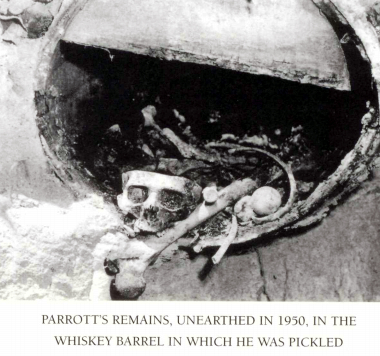
Drs. Thomas Maghee and John Eugene Osborne conducted the autopsy, examined Parrott’s brain, and could find no apparent abnormalities. Osborne then removed a large piece of skin from the dead man’s chest, kept the skullcap, and put the rest of the body in a whiskey barrel full of saline solution, effectively pickling it. The barrel was buried without ceremony, and Dr. Osborne had the skin tanned. He sent the leather to a shoemaker, who made him a pair of shoes with it.

Dr. Osborne was disappointed that Parrott’s nipples weren’t on the tips of the toes like he’d requested (!!!), but you can’t have everything you want in life.

He wore the human leather shoes on special occasions, including at his inaugural ball when he was elected governor of Wyoming in 1890. The skullcap he gave to his fifteen-year-old female assistant, Lillian Heath, who used it variously as a doorstop and an ashtray. (She would grow up to become the first female doctor in Wyoming.)

Parrott’s pickled remains were dug up at a construction site in 1950, and identified after some confusion. His skull, as well as the shoes, are now on display at the Carbon County Museum.

On this day..

1857: Gaspard Matraccia, parrot-lover

From the London Times, March 26, 1857.

AN EXECUTION AT MARSEILLES. — Matraccia, the Italian who, as reported in the Messenger, was some short time back condemned to death by the Court of Assizes of Aix for a series of extraordinary murders at Marseilles, was executed in the latter city on Saturday morning.

At 4 o’clock he was awakened by the chaplain and director of the prison, and told that the petition for a commutation of punishment which he had sent to the Emperor was rejected, and that he was about to be executed. He received the announcement with the greatest calmness, and getting up, seated himself on the side of the bed, and took some coffee and smoked several cigars.

At 6 o’clock he attended mass, and during the service he appeared very devout. The mass was followed by a sermon, which seemed to make a great impression on him. The service was attended by all the prisoners.

When it was concluded, Matraccia was taken back to his cell, and supplied with breakfast. Shortly before 7 o’clock the clerk of the Court of Assizes read to him the text of his condemnation, the chaplain translating it into Italian. He listened to the reading and translation with great resignation, and when they were concluded embraced the clerk and all the persons present, most of whom were so affected that they shed tears.

Shortly after the executioners of Aix and Nismes, accompanied by an assistant, arrived, and proceeded to pinion the condemned. He was then freed from the irons on his legs and he asked if he could not be allowed to walk to the scaffold, but was told that he must be conveyed in a cellular van.

He then begged, as a special favour, that he might be accompanied by one of his friends, a countryman, who had been with him all the morning, and that his parrot, which was in a cage in his cell, might be taken with him to the scaffold. Both these requests were granted, and he was placed in a van, the chaplain being in attendance on him.

Arrived at the scaffold, which was erected in the Place St. Michel, and which was surrounded by an immense crowd, consisting of at least 30,000 persons, the vehicle stopped, and the cage containing the parrot was, to the surprise of the spectators, first placed on the scaffold; the criminal, his friend, and the chaplain then alighted from the van, Matraccia cast a glance at the guillotine, and embraced several persons who were present.

Then, supported by his friend and the chaplain, he ascended the steps of the scaffold, and in doing so it was observed that he slightly trembled.

When he reached the platform he kissed with great fervour the crucifix which the chaplain presented; then he embraced the chaplain and his friend, and then, turning to the parrot, he said in Italian, “Your master is about to die, and he embraces you for the last time.”

Afterwards he advanced towards the front of the scaffold, and cried to the people, “I demand pardon of the inhabitants of Marseilles for the scandal I have occasioned. Pray for me, for in a few minutes I shall pray for you.”

He was then seized by the executioners, and in a few seconds all was over.

On this day..

1825: Peggy Facto, Plattsburgh infanticide

On this date in 1825, a woman named Peggy Facto was hung on Plattsburgh, N.Y.‘s Broad Street Arsenal Lot.

Facto — or “Facteau,” which variant recalls the French influence here on the shores of Lake Champlain — started her way to the gallows the previous autumn when some neighborhood dogs unearthed the remains of a human infant. It had been partially burned in a fireplace, and when found it still had fast about its throat the cord used to choke it to death. (Plus, of course, the dogs had done their own damage.)

This hideous discovery led back to our day’s principal character, the local mother of two [living] children whose husband had abandoned her due to her affair with a guy named Francis LaBare. Both Peggy and Francis were indicted for “being moved and seduced by the instigation of the devil” to murder their inconvenient bastard immediately after birth.

They faced separate trials for the crime, just hours apart on January 19, 1825, on very similar evidence. Witnesses established the discovery of the body, and an acquaintance named Mary Chandreau testified that she had seen Peggy Facto in an obvious late stage of pregnancy that August. This woman also visited Peggy Facto in jail before trial, and testified that Peggy admitted to having taken a string from one of her gowns to furnish the strangulation-cord.

While this evidence was sufficient to condemn Peggy Facto upon mere minutes of juror deliberation, the same case against Francis LaBare resulted in an acquittal. The mother, who did not testify at her own trial, did take the stand at LaBare’s trial, claiming (according to the notes of the judge), that immediately after she delivered the child, Facto

asked [LaBare] to go find her mother & he refused. She then asked him to go find Mrs. Chandreau & he refused, and next asked him if he meant to let her die there & he said the damned old bitch, I can do better than she can. She then requested him to help her & he did & then the child was born & he took it out and went off & was gone an hour, and when he returned … he came towards her with a knife & threatened her life if she said anything about it.

This quote, and much of what is known about Peggy Facto generally, comes via the research of Plattsburgh judge Penelope Clute. See here and here for HTML versions of the article, or here for a pdf.

It’s difficult to account, on the face of it, for the wildly differential outcomes of these trials; the all-male juries might have something to do with it.

At any rate, while LaBare walked, judge Reuben Walworth* pronounced Facto’s fate with enough fury for two … and a distinct disbelief in Facto’s attempt to blame LaBare:

there are very strong reasons for the belief that your own wicked hands have perpetrated the horrid deed. And if there was any other guilty participator in the murder, that your own wickedness and depravity instigated and persuaded him to participate in your crime. To the crime of murder, you have added the crime of perjury, and that in the face of Heaven, and even on the very threshhold of eternity. I am also constrained to say, it is much to be feared, that you will meet more than one murdered child, as an accusing spirit at the bar of Heaven.

Wretched and deluded woman! In vain was the foul and unnatural murder committed under the protecting shade of night, in your lone and sequestered dwelling, where no human eye was near to witness your guilt.

Facto’s only “appeal” after her half-day trial was the clemency consideration of Gov. DeWitt Clinton, a petition that ended up garnering a great deal of popular support, on three stated grounds:

  1. doubts with many as to the guilt of the convict
  2. as to this being a case that requires a public example
  3. As to the policy of executing any person for the crime of murder when the public opinion is much divided on this subject

Even Judge Walworth ultimately supported this appeal, despite his confidence “that the woman was perfectly abandoned and depraved and that she had destroyed this child and probably the one the year previous, not for the purpose of hiding her shame which was open and apparent to everybody that saw her but for the purpose of ridding herself of the trouble of taking care of them and providing for their support.”

The governor disagreed, arguing that the sort of enlightened people who signed on to death penalty appeals were out of touch with the rank terror necessary to keep the criminal orders cowed.**

So on March 18, 1825, an enormous crowd (fretfully many of them women) summoned from all the nearby towns slogged through spring-muddied roads to be duly cowed by the execution of the infanticide. The condemned, visibly terrified, barely made it through her death-ritual without fainting away, but she managed to re-assert her innocence from the gallows. (Some of the firsthand newspapering is here.)

After execution, Peggy Facto’s remains were turned over to the Medical Society for dissection. “A great many went to see her body, although it had been agreed that it should not be seen,” one woman later recollected in her memoirs. “Many young men went. So much talk was made of this that they said that no other body should ever be given to the doctors.”

* Walworth was a man of illustrious descent; one ancestor, William Walworth, was the Lord Mayor of London who killed Wat Tyler.

Judge Walworth would later become, for two decades, New York’s highest-ranking judicial officer; Walworth, N.Y. and Walworth County, Wisc. are named for him. But the American Walworths were bound for a tragic end … including a scandalous murder.

** “Their excellent character elevates them above those feelings which govern the conduct of the depraved … if terror loses its influence with them then indeed the life of no man will be secure.” For more on the evolution of the idea of “exemplary deterrence” as the death penalty’s raison d’etre, see Paul Friedland.

On this day..

1662: Rose Cullender and Amy Denny, Bury St. Edmunds witches

On this date in 1662, two elderly women were hung at Bury St. Edmunds for bewitching various neighborhood children.

This trial, the second notable witch trial at Bury St. Edmunds in the mid-17th century, got going when a well-off merchant, Samuel Pacy repeatedly declined to buy herring from Amy Denny (also spelled Deny or Duny in various accounts). Denny was heard muttering something indistinct as she left the house, and soon Pacy’s daughter Deborah was seized by the “most violent fits, feeling most extream pain in her Stomach, like the pricking of Pins, and Shreeking out in a most dreadful manner like unto a Whelp, and not like unto a sensible Creature.”

Actually, Deborah had already been hit with “”was suddenly taken with a Lameness in her Leggs, so that she could not stand” even before Amy Denny’s visit. Nonetheless, she apparently called out Amy Denny’s name during her throes of this most recent affliction. When an area doctor couldn’t diagnose the situation, Pacy finally filed a witchcraft complaint.

That was Oct. 28, 1661, when Amy Denny was clapped in irons. Two days later, the heretofore unperturbed eldest daughter (age: 11) came down with the same stuff. Anyone with a bit of experience in multiple-child is probably conjuring up an alternative hypothesis right this moment.

Both girls now commenced a litany of woes, coughing up pins, and reporting visions of evil little witches’ familiars like mice and flies, and having dreams “that Amy Duny and Rose Cullender would appear before them holding their Fists at them, threatning, That if they related either what they saw or heard, that they would Torment them Ten times more than eve they did before.”

Rose Cullender was another local widow of advanced age. Like Denny, Cullender had a pre-existing reputation as a witch.

By the time these two crones went on trial on March 10 — a week before their hangings — three other teenage girls were rocking the same symptoms. They even showed up to court, where they “fell into strange and violent fits, screeking out in a most sad manner, so that they could not in any wise give any Instructions in the Court who were the Cause of their Distemper.” Yet another woman deposed that Amy Denny had, several years before, bewitched both of her children, killing one of them: she said she caught a toad lurking around her ailing child, threw it in the fire, and the next day Denny was covered with burns. She didn’t say why she hadn’t mentioned any of this before.

The scientist Thomas Browne turned up to provide expert testimony that witchcraft did exist and that “the Devil” could exacerbate otherwise natural illnesses arising from an imbalance of the four humours.

stir up and excite such humors, super-abounding in [human] Bodies to a great excess, whereby he did in an extraordinary manner afflict them with such distempers as their bodies were most subject to, as particularly appeared in these children; for he conceived, that these swooning fits were natural, and nothing else but that they call the Mother, but only heightened to a great excess by the subtlety of the devil, cooperating with the malice of these which we term witches, at whose instance he doth these villanies.

Despite the court’s confidence as to the existence of witchcraft (The judge — more on him in a bit — instructed the jury that there could be no question on this point, only as to whether the children at hand were indeed bewitched at the defendants’ hands), it did its best impression of skepticism, trying to verify the sorcery by means of whatever tests it could. Unfortunately, the era’s forensics left something to be desired.

Samuel Pacy’s daughters’ reactions to Amy Denny were tested in a few different ways. For instance, as they sat near-comatose with fists clenched, nobody in the court could pry open their stubborn hands … but they popped right open when Amy Denny touched them. Elizabeth once broke out of her torpor to scratch and claw wildly at Amy Denny.

This little girl failed a more plausible test, however. When she was blindfolded and touched by two different women, she had the same reaction to both Amy Denny and the control contact. This embarrassing result was waved off by the widespread conviction in the courtroom that nobody “should counterfeit such Distempers, being accompanied with such various Circumstances, much less Children; and for so long time.” By the time of the trial, it was fully five months since Amy Denny had tried to get the Pacys to buy her darn herring.

In the end, none of the six still-living children supposedly affected by the witches testified directly. Their creepy presence in court did the talking for them. Within the hour after jurors handed down convictions for both women, all the children were freed of their symptoms. Both women, however, refused the many imprecations to confess and set their souls right before execution on March 17.

Noted jurist Matthew Hale heard the case (he was fresh off an assignment trying Charles I‘s regicides). Hale later became Chief Justice of the King’s Bench.

And his authority in this case survived his death in 1676. In the 1680s there was a (slightly misdated) pamphlet published, “A Tryal of Witches at the Assizes Held at Bury St. Edmonds for the County of Suffolk; on the Tenth day of March, 1664”.

Hale’s reputation gave the weight of juridical precedent to his witchcraft superstition.

Across the pond in New England, the Salem witch trials judges would refer to this very case when determining to admit so-called “spectral evidence” from the shitty little fabulistspossessed children who accused various townsfolk of enspelling them.

Witch trials apologist Cotton Mather dedicated a whole chapter (under the title “A Modern Instance of Witches, Discovered and Condemned in a Tryal, before that Celebrated Judg, Sir Matthew Hale”) to the authority established by the Cullender-Denny trial.

It may cast some Light upon the Dark things now in America, if we just give a glance upon the like things lately happening in Europe. We may see the Witchcrafts here most exactly resemble the Witchcrafts there; and we may learn what sort of Devils do trouble the World.

The Venerable Baxter very truly says, [“]Judge Hale was a Person, than whom no man was more Backward to condemn a Witch, without full Evidence.[“]

Now, one of his latest Printed Accounts about a Tryal of Witches, is of what was before him … it was a Tryal, much considered by the Judges of New-England.

… [Mather spends several pages outlining the investigation and trial] …

The next Morning, the Children with their Parents, came to the Lodgings of the Lord Chief Justice [i.e., Hale, although he was not Chief Justice in 1662], and were in as good health as ever in their Lives; being restored within half an Hour after the Witches were Convicted.

The Witches were Executed, and Confessed nothing; which indeed will not be wondered by them, who Consider and Entertain the Judgment of a Judicious Writer, That the Unpardonable Sin, is most usually Committed by Professors of the Christian Religion, falling into Witchcraft.

We will now proceed unto several of the like Trials among our selves.

On this day..

1726: William “Vulcan” Gates, Black Act casualty

March 14, 1726, was the hanging date of five men* at the gallows of Tyburn.

We’ll come to the other four of them presently, but our featured case among the group is one Bill Gates — not the Microsoft billionaire, obviously; this fellow was, rather, a victim of the plutocracy.

William Gates was a blacksmith by trade, presumably the source of his outstanding nickname or alias “Vulcan”.

But he also liked to hunt, and that’s how he ended up having his neck pinched.

It was only logical in the early 18th century for hunters like Vulcan to take quarry from the common lands. But these longtime traditional rights were under long-term attack; just a few years before, the “Black Act” dramatically escalated penalties and enforcement mechanisms for “poaching”.

Among other things, the Black Act permitted a suspect to be accused by reading out charges “on two Market Days, and in two Market Towns in the County, where the Offence is committed.” If the named party failed to turn himself in within 40 days, he stood convicted — no trial necessary.

This was Vulcan’s situation exactly. He’d been accused of “being one of the Men that entered Enfield Chace, killed two Deer,” and took some potshots at the gamekeepers. Having not given himself up, the entirety of the short proceeding once Gates was taken was to establish his identity. (A potentially tricky affair in those days, but not in this instance.)

Frequent death-blog litterateur Charles Dickens glossed this story for the literary magazine he founded, All the Year Round, quoting in Vol. 18 the account of the Ordinary of Newgate when Gates and the four who were doomed to die with him “took it into their foolish heads that they would not be hanged.” (I’ve added line breaks to the Dickensian version, for readability.)

The day on which they were executed, when I [the Ordinary] came to Newgate to give them their last exhortations and prayers, they would not allow any person to come near them, having got an iron crow into the prison, with which they had forced out stones of a prodigious bigness, and had made the breach two feet deep in the wall.

They had built up the stones at the back of the door of the condemned hold, so that nobody could get at them. The keepers spoke to them through the door, but they were inflexible, and would by no entreaties yield. I spoke to them also, representing to them how that such foolish and impracticable projects interrupted their repentance, and the special care they should have taken in improving those few moments to the best advantage; but they seemed inexorable.

I said that I hoped they had no quarrel with me. They answered, ‘No, sir, God bless you; for you have been very careful of us.’ Bailey said, that they would not surrender till they either killed or were killed.

It was twelve at night before they began this enterprise; and, to conceal their purpose from the keepers, while part of them were working, the rest sung psalms, that the noise might not be heard.

Sir Jeremiah Morden, one of the present sheriffs of London and Middlesex, came with proper attendance, and, desiring them to open the door, they refused it; upon which they [not the prisoners, but the sheriff and his men] were obliged to go up to the room over the hold, where there is a little place that opens, which is made in case of such disturbances.

This shutter they opened, but the prisoners continuing obstinate, they [the sheriff’s assistants] fired fifteen pistols with small shot among them, not to kill, but to wound and disable them. They retired to the remotest part of the room where the shot could not reach them, yet Barton and Gates, the deer-stealer, were slightly wounded in the arm.

At last Sir Jeremiah Morden spoke seriously to them through the little hole above, desiring them to surrender. Barton asked, ‘Who are you?’ Sir Jeremiah answered, ‘I am one of the principal sheriffs.’

‘Show me your chain,’ says Barton. Sir Jeremiah was so good as to show him his gold chain through the little hole, upon which they consulted, and agreed to surrender.

After this they removed the stones for the back [of the] door, and, the keepers entering, Barton snapped a steel tobacco–box in the face of one of them, which made a little noise like the snapping of a pocket-pistol, and then gave him the box” [saying ‘D-me, you was afraid.’ -Dickens omits this taunting clincher (ed.)]

After this the unctuous Ordinary tried to dog the intended escapees out of any parting sacrament on the grounds that their souls were not adequately prepared, to which the mutineers justly replied that they “been busied otherwise; they said it was only out of a desire of self Preservation … upon which account they desired to be excused.”

The Ordinary is vague on whether he excused them so far as to grant a last absolution. They were never to be excused from the rope.

While we’ve mentioned the singular case of Vulcan Gates, the other four were a more prosaic bunch of convicted burglars. Three of the four denied their guilt to the last. And while it’s nigh-impossible to judge credibility from the few second-hand words of an interlocutor religiously convinced of their culpability, it’s quite an affecting testimony to the scant circumstances needed to doom a fellow under the Bloody Code.

More than likely we’re a little skeptical of Benjamin Jones, who said that he chanced to stumble upon some silver plate in the darkness when stumbling out drunk from his tavern to pick up a whore. Was it just a bit of mutual aid among thieves that Jones accused a different prisoner, one Frazier, who was sick on his deathbed? The Ordinary said that he “ask’d Frazier, if this account was true? who said that it was, and that he had written the full Narrative thereof to Persons of the highest Quality.”

Hmm.

Francis Baily was doomed by the detailed testimony of a fellow-inmate in his same boarding house. He did admit to being a professional robber whose real crimes were quite enough to stretch his neck, but that his particular condemnation was thanks to the perjury of “one of the most infamous, wicked Women in the World who had sworn away his life, as she had the Life of some others, besides several there whom she had got transported and whipp’d &c. Baily pointed the finger at the absconded landlord of the house, the aptly named Matthew Wildman, who was his frequent burglarious partner.

Maybe.

The saddest of the self-proclaimed innocents was William Swift. He was accused along with another man, Lawrence Simpson, of having been part of a gang of highway robbers who committed a couple of muggings one evening. Although it was dark, one woman claimed to have been able to recognize Swift’s face by the light of “a Lamp about 6 Yards off,” and this was enough to seal his fate. Simpson hadn’t been glimpsed so clearly, so he was acquitted.

As for the last fellow at Tyburn that March 14, John Barton didn’t claim any species of innocence at all. Instead, he announced at the scaffold, “I am the Man, who in Company with two or three others, whom he named, particularly one Capel [Bob Cable], who committed the Robbery for which Swift dies.” (Barton had been set to testify at the Swift-Simpson trial, but was disallowed on account of his own pending burglary charges.)

* Seven were originally condemned to die this date; two petty thieves received the crown’s mercy.

On this day..

1421: The last Viennese Jews

On this date in 1421, a months-long campaign to purge Vienna of her Jews culminated with over 200 burned — and the rest of the once-thriving community either driven into exile or forced to convert.

Vienna had had a Jewish presence for centuries, centered on the Judenplatz.

The religious wars unleashed between Catholics and followers of the Czech reformer Jan Hus complicated the Jewish position. While not an unblemished relationship, Hussites were generally seen to be more sympathetic to Jews, and vice versa. Fellow-victims of Catholic persecution, Hussites recast the Biblical Antichrist with Papist rather than Jewish associations. Hussites openly looked to the Torah and Jewish divines like Rabbi Avigdor Kara for inspiration.*

That’s all well and good, but Vienna was emerging as one of the principal cities of the very Catholic Habsburg empire. (It was not yet the official seat: that would come later in the 15th century.)

To the perceived Hussite-Jewish alliance one must add consideration of Duke Albert V — later the Holy Roman Emperor Albert II — and his considerable debts, no small part of them held by Vienna’s Jewish moneylenders.

On Easter 1420, Albert pumped up a rumor that Jews had desecrated the Eucharist and ordered mass-arrests and -expulsions of Jews, complete with handy asset forfeiture. This was the onset of the Wiener Gesera, the Viennese persecution — as it was remembered later by remnants of the shattered Jewish community scattered abroad.

Pogroms attacking the Jews in Vienna (and elsewhere in Austria) ensued, culminating with the dramatic three-day siege of Vienna’s Or-Saura synagogue. That ended Masada-style when 300 trapped denizens committed suicide to escape forced baptism, and the last living among them torched the building from the inside. Its blasted remains were razed to the ground by the besiegers.**

Albert at that point finished off Vienna’s Jews by sending its final hardy (or foolhardy) members — 120 men and 92 women, it says here; different figures in the same neighborhood can be had elsewhere — to the stake.

“As the waters of the River Jordan cleansed the souls of the baptized, so did the flames which rose up in the year 1421 rid the city of all injustice,” read a Latin plaque erected on the site.

Jews were not permitted to return to Austria for centuries.

* “The Hussites pioneered a uniquely Czech form of philo-Semitism … the fascination, among a persecuted, dissident group, with the Jewish people and religion,” writes Eli Valley. “The Hussites were perhaps the first religious group in Christian European history to argue against the ban on Jews in craftsmaking and farming” and “unlike Martin Luther’s similar program in the sixteenth century, the Hussite movement did not predicate its kindness to Jews on the condition that they would be baptized.”

** The synagogue’s foundations have been only recently rediscovered, as part of the excavation for a Museum Judenplatz at the site. That museum has not necessarily been welcomed by the Viennese Jewish community it’s supposed to represent.

On this day..