1862: 38 Sioux

On this date in 1862, 38 rebellious Sioux were hanged in Mankato, Minnesota, in the largest mass execution in U.S. history.

Fully 303 had been condemned to die in drumhead trials after the five-week Dakota War, one of the numerous native conflicts sparked by the march of European settlers across North America.

Abraham Lincoln — in a political risk — commuted all but 39 sentences* adjudged “to have participated in massacres, as distinguished from participation in battles,” essentially defining a special category for what today might be considered “war crimes.”

Lincoln had more pressing business on his hands, to be sure, but seems to have been affected by the plight of the natives that drove them to wage hopeless war on encroaching settlers:

“[Bishop Henry Whipple] came here the other day and talked with me about the rascality of this Indian business until I felt it down to my boots. If we get through this war, and I live, this Indian system shall be reformed!”

Fateful “if” — but politicians say many things, after all, and it was long before Lincoln went to Ford’s Theater that the tribes had been forced out of Minnesota, scattered to wasteland reservations and subsequent clashes with the American army.

On this day, all that doleful future was prefigured in the 38 who hanged together in what is now Mankato’s Reconciliation Park, an event that after a century’s time has become a moment for commemoration.

Two academics’ pages on the Dakota War and its aftermath are here and here.

*One of those was subsequently spared over uncertainty of the evidence against him.

Part of the Themed Set: The Spectacle of Public Hanging in America.

On this day..

1948: Amir Sjarifuddin

On this date in 1948, leftist former Indonesian Prime Minister Amir Sjarifuddin was summarily executed by forces of the infant Indonesian Republic for his participation in an attempted coup d’etat three months before.

A Dutch-educated Communist politician who had adhered to an anti-fascist “common front” position, Sjarifuddin was a vigorous activist against the Japanese occupation during World War II — and lucky to avoid execution for it.

Indonesia’s declaration of independence following the war sparked the National Revolution, during which Sjarifuddin emerged a leading player of the left as rival factions maneuvered against each other within Indonesia under pressure from the Dutch colonial power looking to reassemble its old dominions.

Sjarifuddin briefly served as the fledgling state’s second prime minister, but resigned in January 1948 after an unpopular diplomatic foray to calm tensions with the Dutch. His support for a botched and premature revolt by Communist officers in September sealed his end as a political factor and eviscerated left influence in the revolution, confining the latter’s character to an essentially nationalist one.

The rising’s suggestion of internal division may also have encouraged the Dutch incursion into Java on this date. There was a touch of poetic justice if that was the case: Republican troops, melting away from superior firepower for an insurgency campaign, opted to execute Sjarifuddin and about 50 other captured leftists before retreating rather than free them.

According to George Kahin, Sjarifuddin rendered with his death one last service to his nationalist — if not his Communist — ambitions:

[O]nce the [Indonesian] government … had put down the [September] rebellion and shot its leaders, it was no longer possible for the Dutch to make American officials and the US Congress believe — as previously many of them had — that most leaders of the Republic were under strong Communist influence and that their government was providing a bridge to an ultimately Communist Indonesia.

Its Marshall Plan aid threatened, the Netherlands recognized Indonesian independence in 1949.

On this day..

401 B.C.E.: Clearchus of Sparta

Around this time in the late autumn or early winter some weeks following the Battle of Cunaxa, the general of a Greek mercenary army — along with most of its other commanders — was treacherously seized by a Persian satrap and summarily beheaded.

In the train of the Peloponnesian War‘s devastation, sturdy Greek hoplites with bills to pay found a lucrative gig backing a Persian prince‘s bid to seize the throne.

The prince marched the Hellenes deep into Persia before falling in battle at Cunaxa in Mesopotamia, a discomfiting scenario alike for the stranded but still-potent invading army and the somewhat outclassed Persians.

The seizure around this day of the veteran soldier and former tyrant of Byzantium Clearchus — lured under color of friendship — aimed to crush the Greeks’ morale, but instead feathered the laurels of “the Ten Thousand”. This “marching Republic” hastily self-organized and proceeded upon an astonishing escape, intrepidly fighting its way north over the ensuing year to the Black Sea, and thence to hearth and home.

The Greeks’ perseverance offers one of classical antiquity’s stock testimonies to the resilient polis — and at this stage, practically the last breath of that dying spirit. More to the immediate point, it illustrated strikingly the Persian army’s vulnerability to the phalanx, exploited to decisive effect in the century to come by Alexander the Great.

One of the replacement generals, Xenophon, immortalized the Greeks’ march in the Anabasis.

After the generals had been seized, and the captains and soldiers who formed their escort had been killed, the Hellenes lay in deep perplexity — a prey to painful reflections. Here were they at the king’s gates, and on every side environing them were many hostile cities and tribes of men. Who was there now to furnish them with a market? Separated from Hellas by more than a thousand miles, they had not even a guide to point the way. Impassable rivers lay athwart their homeward route, and hemmed them in. Betrayed even by the Asiatics, at whose side they had marched with Cyrus to the attack, they were left in isolation. Without a single mounted trooper to aid them in pursuit: was it not perfectly plain that if they won a battle, their enemies would escape to a man, but if they were beaten themselves, not one soul of them would survive?

Haunted by such thoughts, and with hearts full of despair, but few of them tasted food that evening; but few of them kindled even a fire, and many never came into camp at all that night, but took their rest where each chanced to be. They could not close their eyes for very pain and yearning after their fatherlands or their parents, the wife or child whom they never expected to look upon again. Such was the plight in which each and all tried to seek repose.

The tale’s motif was borrowed for a 1965 novel of a New York gang struck leaderless making its way out of hostile territory, later adapted for a cult 1970’s film:

On this day..

1635: Ivan Sulyma

On this date in 1635, Cossack commander Ivan Sulyma was put to death in Warsaw for razing the Kodak Fortress on the Dnieper River.

Sulyma‘s death, a footnote historically, unfolded in the rising action of Zaporozhian Cossacks‘ conflict with the Polish-Lithuanian empire then at the peak of its power.

Those famed corsairs of the steppes made their way in the world by plunder. The European powers at play around the Black Sea domains of the Zaporozhian host — Poland, Russia and the Ottoman Empire — each struggled to exploit Cossack raiders for their own ends of statecraft.

The Zaporozhian Cossacks, as portrayed by Ilya Repin

It was perhaps the misfortune of Poland to claim suzerainty during this unruly horde’s upswinging arc. The Poles endeavored to gather the Cossacks into the formal apparatus of the state, “registering” an elite corps of Cossacks inducted into the armed forces while reducing the remainder to peasantry.

The registry’s size and privileges became a permanent bone of contention, driving a cycle of uprisings through the 1620’s and 30’s that sapped Cossacks’ loyalty to the Polish crown.

Sulyma was a partisan of the militant unregistered Cossacks, fresh from war against the Ottomans. He returned to find that Poland had thrown up a fortress controlling the Dnieper, with an eye both to checking Cossack provocations against the now-peacable Turks, and to controlling internal Cossack disturbances.

Sulyma sacked the fortress, slaughtering its 200 inhabitants, but the disturbance was quickly put down and loyal registered Cossacks handed over the rebel. By the late 1630’s, Poland had imposed a peace of arms on the region … but hardly a secure one. As historian Orest Subtelny notes:

[E]ach successive uprising reflected the growing strength and military sophistication of the rebels. Their numbers grew, their tactics improved, and Cossack identification with the plight of the peasantry and the defense of Orthodoxy deepened. The decade-long Golden Peace merely masked a problem that was waiting to explode again.

It exploded in 1648. Where Sulyma had failed, Bohdan Khmelnytsky would succeed — breaking the Cossack lands permanently free of Poland.

Remembered to the modern state of Ukraine as a father of the country, Khmelnytsky’s immediate achievement was to rearrange the balance of power in Eastern Europe. Poland, ravaged by invading Swedes just as the Cossacks slipped away, fell into permanent decline — leaving a vacuum filled by Russia, which soon pulled the Cossacks into its orbit.

On this day..

1941: Zoya Kosmodemyanskaya

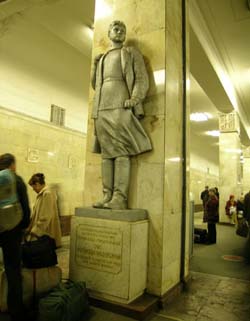
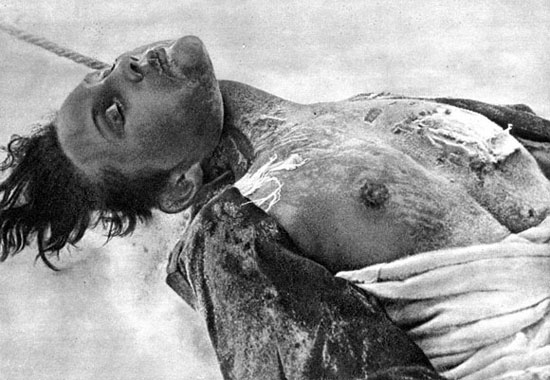
On this date in 1941, Soviet partisan Zoya Kosmodemyanskaya was hanged by the Wehrmacht for sabotaging buildings behind German lines near Moscow.

A statue of Zoya Kosmodemyanskaya stands vigil over Moscow’s World War II-era Partizanskaya metro station. Image used with permission.

One of the most famous Soviet war heroines and the first woman decorated as Hero of the Soviet Union during World War II, the 18-year-old had quit school to volunteer for a partisan unit only a few weeks before her hanging as Russia mobilized against Hitler’s race towards Moscow.

Known simply as “Tanya”, the nom de guerre which was the only information she volunteered during two days of torture, the power of the press offered her apotheosis into a propaganda coup for the Kremlin, and a symbol of courage that would long outlive Stalin. Before the public execution, the Nazis paused to photograph the scene; Kosmodemyanskaya availed the lull to harangue the Germans — “you can’t hang all 190 million of us!” — and call on the Russian villagers present to resist occupation.

Her bayoneted, mutilated body hung on the gibbet until the Red Army recaptured the village; witnesses related the tale of her dying heroism to a newsman.

It was only after the story of “Tanya” hit the press in January 1942 that her identity was established … and then promulgated widely. Anonymous and obscure in death, Zoya Kosmodemyanskaya would inspire millions and become the heroic emblem of other women partisans.


Soviet propaganda poster unabashedly modeled on the already-iconic image of Zoya Kosmodemyanskaya’s abused corpse.

Zoya, a 1944 Soviet film, was scored by Dmitri Shostakovich.

Part of the Themed Set: Women Against Fascism.

On this day..

1919: Felipe Angeles

On this date in 1919, Mexican hero General Felipe Angeles was shot at dawn in Chihuahua, hours after a military tribunal condemned him for rebellion.

Angeles, a humane and cosmopolitan socialist, had tacked a unique course through the dangerous Mexican Revolution. The career artillerist’s military counsel was a high card in the hands of the revolutionaries, and helped to make the coruscating career of Pancho Villa. Crucially, Angeles advised Villa to seize the mines of Zacatecas, dealing a mortal blow to the putschist Huerta government by throttling its currency at the source.

But that brilliant maneuver countermanded an order of the Revolution’s moderate political face, Venustiano Carranza, and both personality conflicts and support for more radically redistributionist measures soon sundered the Villa factions’ alliance with Carranza.

Angeles hitched his destiny to Pancho Villa and is historically recalled as the “angelic” opposite number to the famed guerrilla’s other top military henchman, the murderous Roberto Fierro. The three lend themselves almost implausibly to allegorical literature — “the decisive biographical proof of Villa’s duality … found in the two men closest to him, equidistant and extreme extensions of his nature.” (Enrique Krauze)

Angeles aimed, perhaps, at a statesmanship that might have remembered him the father of his country.

‘It was the recurrent dream of the impotent revolutionary intellectual: to play Plato to some powerful but pliant popular caudillo.’ This may well be an accurate analysis of Angeles, who probably had ambitions to be president of Mexico, with Villa as the power behind the throne but based in Chihuahua, allowing Angeles free rein to implement radical reforms in the capital

… Angeles probably saw Villa as a tabula rasa on which he could imprint his ideology. The problem was that Villa had no taste for abstract thought; as [John] Reed remarked ironically: ‘You had to be a philosopher to explain anything to Villa.’

To the grief of both, Villa neglected Angeles’ expertise when the Villists faced Carranzo at arms. Against advice, Villa abandoned Mexico City, failed to attack when the constitutionalists were tenuous, then spurned guerrilla operations for a frontal assault into the teeth of a foe with numerical superiority and lethal tactical advances culled from the slaughterhouse of World War I.

All was postscript after the Battle of Celaya — Villa maintaining for a few years as a bandit force and famously raiding New Mexico while his strategist drifted into exile in Texas before returning to Mexico on a quixotic peacemaking mission that led him instead to a show trial.

Angeles’ end came with the all the dignity of his romantic age. Before his judges — before all the world — he gave “full and clear expositions of his history and his ideas about everything from politics to ontology. It was clear that he knew this was his end, and he seems to have written a kind of intellectual memoir in the protracted answers … he was not defeated morally so much as physically.”

Angeles himself arranged particulars of his own execution with the Carranza men detailed to shoot him. He enjoys posthumous esteem commensurate with his qualities in life:

On this day..

1944: An unknown Allied airman

On this date in 1944, in the midst of a worldwide conflagration that would claim 70 million lives, one unknown crew member of an Allied bomber was shot by Nazi SS/SD troops in the woods around Enschede, Netherlands.

From late 1942, the Allies’ massive industrial capacity had sapped the vaunted Luftwaffe, bleeding down the German air force in desperate airborne combat in the Mediterranean and the Eastern front. Crippling losses in July and August 1943 lay Germany’s industrial heart open to devastating bombing and would within a year spell the end of the Luftwaffe as an effective fighting force.

The contest’s stakes were high. This hour-long compilation of contemporaneous U.S. propaganda footage celebrates the decisive effect of air supremacy in western Europe:

With hostile planes darkening Europe’s skies, the Germans called upon ruthlessness to stand in for materiel. Nazi SS chief Heinrich Himmler issued, according to Robin O’Neil, an August 1943 order to show no quarter to captured enemy pilots.

The young man shot this day suffered its effects:

The airman (estimated age 26 years), who was apparently unhurt, was taken by the SS to the cellar of the villa [serving as SS headquarters], where he was kept under guard while arrangements were made for his disposal. These arrangements consisted of the removal of his flying kit, and the substitution of a civilian light-coloured shirt, a pair of dark trousers, and a pair of socks.

In this dress he was put into a security vehicle, his hands handcuffed behind his back, and taken some distance in the grounds of the SS HQ to a spot within the compound where a grave had already been prepared. The airman was marched from the car by an escort of two SS men, one of whom dropped back and shot the airman in the back of the neck. He was buried and the grave was carefully camouflaged.

To this day, the airman’s identity has not been established. It was assumed that he was British or American, most probably American, as the trousers he was wearing were of a dark shade of khaki, and the fact that when he was informed in the car, in English, that he was to be executed, he made an indistinct reply in which the word “America” was uttered.

Countless such executions undoubtedly took place and were lost, forgotten or concealed in the charnel house of war. Thanks to the witness of Dutch prisoners who survived the war, this single act of routine brutality endured not only historically but juridically: little more than a year later, its author, Dr. Karl Eberhard Schongarth — an SS officer who participated in the Wannsee Conference and slaughtered thousands in occupied Poland and Holland — faced a war crimes prosecution for the execution of the anonymous airman.

His actions this date may have been small by the gauge of a bloodthirsty career, but since pre-war treaties explicitly regulated treatment of war prisoners, they also constituted a conveniently plain transgression of the far-from-bright line demarcating “war crimes.” For this one killing, Schongarth was himself hanged as a war criminal in Hamelin, Germany on May 16, 1946.

On this day..

1695: Zumbi dos Palmares

On this date in 1695, Zumbi dos Palmares, the last leader of Brazil’s most famous free colony of fugitive slaves, was captured by the Portuguese and summarily beheaded.

From the very beginning of European settlement in the New Wold, Maroon communities of escaped slaves, free-born blacks, Indians, poor whites, and mixed-race outcasts formed at the fringes of slave states.

Colonial power did not welcome their presence.

Consequently, the community of Palmares faced repeated harassment from the Portuguese and the Dutch West Indies Company from the time of its establishment around 1600 — even as it burgeoned into a kingdom of over 30,000 inhabitants.

Zumbi, a black free-born in Palmares, was kidnapped by such a sortie and raised with a missionary priest who taught him Portuguese and Latin. At 15, he escaped and returned to Palmares, quickly rising to prominence and in 1678 overthrowing his adoptive uncle King Ganga Zumba when the latter attempted to accept peace under Portuguese rule.

Zumbi’s skepticism was vindicated when the followers of Zumba who had defected to Portugal were re-enslaved, but free Palmares soon faced intensified Portuguese pressure. In 1694, artillery finally battered its largest settlement into submission — forcing its ruler into the bush, where he long eluded capture.

In Zumbi’s honor, November 20 is a Brazilian celebration of national pride and especially pride for those of African descent … while the king who would not be a slave has lent his name, somewhat paradoxically, to an international airport.

On this day..

1002: St. Brice’s Day Massacre

On this date over a millennium past, according to the chronicle of John of Wallingford, King Ethelred the Unready of England conducted a massacre of Danes living in the realm.

The character of this sanguinary event — named after a fourth-century French bishop whose feast day Nov. 13 happens to be — lies half-buried in history’s shifting sands. Surely the slaughter of every Dane in a Britain then very much in the Scandinavian orbit would have been not only morally reprehensible but logistically unimaginable.

The accepted, albeit sketchy, story has it that to consolidate his own authority — or to check an actual or suspected plot against him — Ethelred ordered the surprise apprehension and summary execution of some sizable number of Danish lords and mercenaries. British historian Thomas Hodgkin characterizes it as a sort of coup d’etat.

On this date, it was the Danes who were unready for Ethelred.

But whatever its true extent or immediate object, it occurred within the context of intensifying conflict between the English crown and Scandinavian aspirants. Ethelred was to spend the better part of his life struggling — both militarily and through the ruinous tribute of Danegeld — to hold back the incursions of the Viking king Sweyn I.

The St. Brice’s Day Massacre exacerbated those tensions. Sweyn’s sister was apparently among those massacred, and — whether driven by vengeance or simply availing a pretext — Sweyn resumed harrying the English kingdom in the following years.

By 1013, Sweyn had driven Ethelred to Normandy and ruled all of England, welding together a Norse empire fringing the whole north of Europe.

But the empire — and England’s place in it — proved an historical cul-de-sac. Authority in England would be contested for another half-century, gradually sapping the crown’s strength until the Norman Conquest in 1066 swept aside Viking power and set England on a course that would redefine its history.

Update: The story of Ethelred, Normandy, and the Vikings told in Episode 3 of Lars Brownworth’s Norman Centuries podcast:

[audio:http://c4.libsyn.com/editions/58550/17915/03-richard-the-good.mp3]

The British History Podcast covers the St. Brice’s Day Massacre in episode 328.

On this day..

1755: Rowley Hanson

On this date in 1755, a young soldier named Rowley Hanson was hanged at Tyburn.

Though the hanging, like many of its era, was for a trifling theft, the account of the Newgate ordinary (chaplain) did not dwell overmuch on the watch he stole from a London barrister.

What wrought his ruin was, the company he fell into, when a drummer [in the army]; and shocking delusion from the most abandoned, and unnatural crew of wretches, that ever the world knew, called Sodomites, first led him into that damnable violation of all laws, natural, civil, and religious.

…

all he had besides his pay arose from the advantages which he received from those worse than brutes, whom St. Paul has complimented with the name of men, who leaving the natural use of the woman, burned in their lust one towards another; men with men working that which is unseemly, and receiving in themselves that recompense of their error which was meet.

…

This unfortunate youth, who laid open the way to these short observations, declared himself much more affected with sorrow, for that he had been among so vile a set of wretches, than that he was to suffer death for the robbery … He thanked God, who had thus afflicted him, and given him time to repent; and generally when we conversed he wept very bitterly.

On this day..