Lithuanian anti-Soviet partisan Jonas Žemaitis was shot in Moscow’s Butyrka prison on this date in 1954. He’s one of the big names in the Forest Brothers movement that kept up a hopeless fight against Moscow from 1944 into the 1950s.
An artillerist of Polish ancestry who deserted the retreating Red Army and surrendered himself the Wehrmacht arriving in the summer 1941, Žemaitis is breezily credited in state histories (and as of this writing, both English and Lithuanian Wikipedia pages) of essentially taking the war years off because “he did not want to serve the Nazis.” That was sure considerate of the Nazis! Instead the fellow just mined peat since he preferred not to get involved.
One could turn here to Joseph Melamed, a survivor of the Kovno Ghetto who collected witness testimonies and published thousands of names of alleged Lithuanian “Jew-Shooters” (zydsaudys). Melamed has charged that Žemaitis put his Polish fluency to use facilitating genocide and “having proved his efficiency and diligence in murdering Jews, was rewarded by the SS and promoted to the rank of Colonel” in the Police Battalions, Lithuanian paramilitaries that worked hand in glove with Nazi executioners.*
Or alternatively, one could rely on the plain fact that Žemaitis was a trained, early-30s officer in a desperate war zone where everyone was being pressed into action, and that anti-Soviet fighters afterwards treated him as a General. That’s not the profile of a figure who simply kept his head down while the Great War raged past him.
The post-USSR independent state of Lithuania, which has not been shy about whitewashing Holocaust collaborators, absolutely rejects such inferences and has retroactively elevated Žemaitis to its officially recognized head of state during his postwar resistance; there’s a Vilnius military academy that’s named for him.
* Melamed is now deceased but during his latter years Vilnius accused him of slander. Modern Lithuania is ferociously determined about apotheosizing the Forest Brothers; officially, the Venn diagram between wartime genocidaires and the postwar anti-Soviet resistance consists of two different shapes on two different planets.
Spanish terrorist Santiago Salvador died to the garrot on this date in 1894.
A central-casting figure from the heyday of anarchist bomb attacks on bourgeois society, Salvador highlighted the November 7, 1893 premier of opera season at Barcelona’s Gran Teatre del Liceu by chucking a couple of Orsini bombs from the balcony during the second act of William Tell.*
“My wish was to destroy bourgeois society,” he would explain. “I did not set out to kill certain people. I was indifferent to killing one or the other. My desire was to sow terror.” A more specific provocation (cited by Salvador at his trial) was the execution one month before of another anarchist, Paulino Pallas.
Salvador successfully escaped the scene amid the confusion and the hunt for him licensed a year of martial law with a plethora of offices ransacked and subversives sweated.
The man died with the requisite cry of Viva la Anarchia! upon his lips; however, anarchist violence in his parts did greatly abate in the ensuing couple of years, with the main theater of the propaganda-of-the-deed tendency now shifting to France.
* France’s Le Petit Journal had an explosive illustration of the event on the cover of its 26 November issue.
On this date in 1716, a woman named Maria was burned for leading a slave rebellion on the West Indies island of Curacao.
Maria was a cook owned by the Dutch West India Company itself who apparently instigated the slaves on her plantation to rise up and slaughter the white staff in September of 1716.
Whether Maria herself was Curacao-born or a recently captured import is not known, but her plantation of St. Maria held many of the latter category; Curacao was a major shipping nexus for the Dutch slave trade. It’s possible that this meant Maria’s newly-arriving peers were more liable to harbor that cocktail of hope and desperation needed to wager their lives on rebellion.
Whatever the case, the rising was quickly put down. Another slave named Tromp, Maria’s lover, told his torturers that she had sought revenge on a white overseer named Muller for killing her husband.
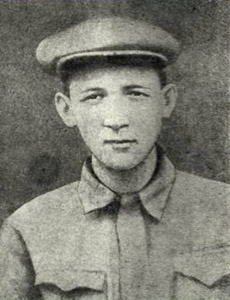
Sixteen-year-old partisan Alexander Chekalin earned his martyrs’ crown as a Hero of the Soviet Union when he was executed by the occupying Third Reich on this date in 1941.
The city of Tula, a transport hub 200 kilometers south of Moscow, was a key target for the German drive on the Soviet capital in those pivotal months; the Wehrmacht’s eventual inability to take it from determined defenders was crucial to thrwarting the attack on Moscow by protecting her from the southern tong of the intended pincer maneuver.*
Chekalin didn’t live long enough to see any of this come to fruition but in his moment he did what any one man could do: ambushes, mining, and other harassment of the occupation army in the Tula oblast (region) with his comrade irregulars. Our principal was found out by the Germans recuperating from illness in a town called Likhvin — see him defending his house of refuge against hopeless odds in the commemorative USSR stamp below — and then suffered the usual tortures and interrogations before he was publicly strung up on November 6. He hung there for 20 days before the Red Army took the town back and buried him with honors
In 1944, the tiny town of Likhvin was renamed in his honor: to this day, it’s still called Chekalin.
* Tula was recognized as a Hero City of the USSR for the importance of its defence.
Boyarina Feodosia Morozova starved to death in the early hours past midnight on the night of November 1-2, 1675.
This wealthy “Old Believer” noblewoman (English Wikipedia entry | Russian) is one of art history’s most famous religious dissidents thanks to Vasily Surikov‘s iconic painting of her being hauled away by the authorities, defiantly making the outlawed two-fingered sign of the cross.
But her writ of privilege had long since run out, for she had been arrested and tortured back in 1671 together with her sister Evdokia Urusova and a fellow-travelling friend, Boyarina Maria Danilova. (This is the event captured by Surikov’s painting.) Perhaps her position saved her from outright execution — which all-grown-up Tsar Alexei reportedly contemplated — but not from being done to death by the state.
After all three women were arrested and so dramatically dragged away, they were locked up in the cellars of a small-town monastery where their guards were eventually ordered to permit them to waste away by deprivation.
Her movement did not carry its contest for religious primacy and was violently persecuted for many years thereafter, but Old Believers still exist to this day — thought to number about one to two million worldwide. As of the 20th century, Old Believers are longer anathema to mainline Orthodoxy, and a fearless martyr such as Boyarina Morozova cannot but inspire respect no matter how many fingers you use to make the blessing. She’s still well-known in Russia and is the subject of a 2006 choral opera.
Dictator Muammar Gaddafi (several alternate transliterations are familiar, such as Qaddafi and Gadhafi) was killed by his captors during the Libyan civil war on this date in 2011 — an act very much on the extrajudicial and summary side of the foggy borderlands defining an “execution”.
Libya’s despot since ejecting the British-supported King Idris way back in 1969, the wily colonel steered his state for 40-odd years; his blend of pan-Arabism, Islamic socialism, pan-Africanism, and direct democracy is known as the Third International Theory and expounded in Gaddafi’s own manual of political theory, The Green Book — which became required reading for generations of his subjects.
Eventually a figure of western vilification and a fixture in the United States’s enemy-of-the-month rotation, Gaddafi’s anti-imperialist credentials earned him respectful eulogies from Palestinians, black South Africans, and Latin American revolutionaries, all of whom he had at times aided. Whatever measure of genuine popular support he earned by measures like land distribution, Gaddafi did not hesitate to buttress with brutality. Internal regime opponents and dissident exiles alike had cause to fear him, and it’s not as if innocent bystanders could sleep easily either: a London constable was shot from the Libyan embassy during demonstrations in 1984, and only worldwide outcry prevented the execution of six foreign doctors who were scapegoated for an HIV outbreak in the early 2000s. Gaddafi’s government in 2008 paid $1.5 billion in compensation to settle a bundle of international terrorism incidents, including the 1986 West Berlin discotheque bombing and the 1988 Pan Am Flight 103 bombing over Lockerbie, Scotland.
Fitting that his own savage end might enter periodization historiography as the fin de siècle américain.
The ham-fisted NATO intervention into Libya’s Arab Spring-era civil war that brought about Gaddafi’s death might be the last that Washington will have undertaken in its purported “hyperpower” era, accountable to none but its own intentions; certainly it was (in the words of James Mann) “the apotheosis of the Obamian approach to the world.”
The chief advocate of the intervention within the Obama administration, Samantha Power of Strangelovian nomen and Bosnian war dreams, recently published her memoir, The Education of an Idealist and issued the enraging auto-exoneration, “We could hardly expect to have a crystal ball when it came to accurately predicting outcomes in places where the culture was not our own.” Merely being alive for the aftermath of the Iraq omnishambles might have done her the job of scrying; Power’s boss, at least, learned the lesson well enough to shy from the reckless regime-change commitments demanded (including by Power herself) for the Syria conflict that might have brought not only similar catastrophe to its immediate “beneficiaries” but the prospect of nuclear confrontation with Russia. More warfare is surely on humanity’s horizon as the 2020s approach, but with great power competition rising alongside the seas, the prospect that it will be undertaken with such careless self-regard in such a large and consequential state seems remote.
Nor will future Libyas be so vulnerable as Libya, if they can help it. In the years prior, Gaddafi had ostentatiously surrendered his nuclear ambitions in exchange for aid and diplomatic normalization. Other observers like North Korea have justifiably concluded that states armed with nukes don’t get invaded while those armed with Foggy Bottom IOUs are just the next Melos in waiting. They’ll have the horrific viral videos of a bloodied and pleading Gaddafi being brutalized by his captors to remind them.
On 19 October 2011, Qadhafi’s son Mutassim decided they should leave Sirte because the thuwar had encircled and entered the city, trapping Muammar Qadhafi and his men in District 2. On the morning of 20 October they set off in a heavily armed convoy of approximately 50 vehicles. The convoy consisted of Muammar Qadhafi; his son Mutassim who was already wounded; Defence Minister Abubakr Younis … and approximately 200 armed men. There were also women and children in the convoy. Some of the armed men evacuated their wounded colleagues from the hospital and these unarmed men were placed in cars with their bandages still on; some still had tubes in their bodies.
The convoy headed east on the main road but ran into a rebel ambush. Numerous cars were badly damaged in the ambush and a number of people were injured. They circled to the sea road and headed west. The convoy split up. At this point a Toyota Corolla in front of Muammar Qadhafi’s green Landcruiser was hit by a NATO airstrike, probably by a Predator drone, and exploded. The explosion set off the airbags in Qadhafi’s car. Muammar Qadhafi and switched cars. The front of the convoy started taking fire from thuwar positions near the power plant and so Muammar Qadhafi, and others took refuge in a house as some of their bodyguards engaged in a fire fight with the rebel positions.
Moments after Muammar Qadhafi entered the house, an airstrike hit the vehicles, setting off secondary explosions. The strike and subsequent explosions left many wounded lying on the ground. At this point the thuwar began shelling the house where Muammar Qadhafi was hiding. Mutassim Qadhafi took approximately 20 fighters and left to look for vehicles. Muammar Qadhafi reportedly wanted to stay and fight but was persuaded to escape. The group belly-crawled to a sand berm. On the way an electrical transformer was struck and electrical wires fell on Qadhafi, striking his head, but he was saved by his blue flak jacket and a Kevlar helmet which was knocked off. The group reached the berm and ran behind it to the road where there were two drainage pipes. The group crawled through the pipes and took up a defensive position on the west side of the road where the pipes terminated.
Muammar Qadhafi crouched outside and between the two pipes. Abubakr Younis was in the right pipe and two fighters took up a position by a berm facing south and the other fighters faced north. The group was sheltered from the road and was unseen by the rebels … [until it] decided the group would make a stand and opened fire on a passing rebel vehicle. There was a fire fight. One of the guards threw a grenade. The grenade hit the top of the cement wall above the pipes and fell in front of Muammar Qadhafi. The guard tried to pick up the grenade but it exploded, killing him … Qadhafi was wounded in the blast by grenade shrapnel that hit and shredded his flak jacket. He sat on the floor dazed and in shock, bleeding from a wound in the left temple.
At that point, one of the party fashioned a white flag from his turban and waved in surrender to the thuwar from the 501st Brigade. The thuwar laid the men on their faces and bound their wrists. Muammar Qadhafi was immediately surrounded by thuwar and beaten. Muammar Qadhafi was heard to ask, “What is going on?” The survivors were placed into vehicles and taken away. [Mutassim Gaddafi and Abu-Bakr Yunis were also killed that same day by their captors. -ed.]
This is where the eyewitness evidence received by the Commission ends. Videos of the scene show Muammar Qadhafi being roughly handled by the thuwar, many screaming “We are Misrata” to identify where they are from. He is apparently stabbed with a bayonet in the buttocks. He is placed on the hood of a vehicle, bloody but alive, before being placed in an ambulance. He clearly has one head wound from the grenade shrapnel, but is otherwise not wounded. This is the last time Muammar Qadhafi is seen alive.
A televised interview of one of those who accompanied Muammar Qadhafi in the ambulance gave an account of what happened next. The young man, who states he is from Benghazi but was travelling with men from the Misrata thuwar when the Qadhafi convoy was attacked, claims he was the one that found Muammar Qadhafi and got into the back of the ambulance with him and two men from the Misrata thuwar. The ambulance started to drive to Misrata. The young man claims there was an argument between himself and the men from Misrata on what to do with Muammar Qadhafi, with him wanting to bring Qadhafi back to Bengazi. He claims he shot Qadhafi in the head and abdomen.
The Commission is unable to verify his claims. Video shows he was in the ambulance when Muammar Qadhafi was placed in it. What is clear is that Qadhafi was alive when he was taken into custody and placed in an ambulance in Sirte by members of the Misrata thuwar and was seemingly dead when the ambulance arrived in Misrata …
According to news reports, the official autopsy states Qadhafi was killed by a gunshot to the head. The Commission was not provided access to the autopsy report despite numerous requests to the NTC. Photos of Muammar Qadhafi’s body were provided to the Commission by members of the medical committee of Misrata who participated in the external examination of Qadhafi’s body … Analysis of the photos of the abdominal wounds by the Commission’s forensic pathologist determined they were penetrating wounds in the epigastric area, the nature of which was difficult to determine from photographs. Interviews with journalists who saw the body indicate Qadhafi was shot once in the head and twice in the abdomen.
* Just months ago as of this writing, the German sea captain Carola Rackete was arrested for breaking an Italian blockade to dock in Sicily with some 40 migrants: they’d been rescued off the coast of Libya.
Russian writer Vladimir Varankin was executed on this date in 1938, during Stalin’s purges.
Varankin got interested in the international Esperanto language movement as a secondary school student in Nizhny Novgorod during the ecstatic months following the Bolshevik Revolution, and he founded an Esperantist club there that soon reached throughout the province.* This was the high-water moment for the Esperanto movement, now 30 years mature since its founding: World War I had shattered the international system and spawned small states and revolutionary governments shaping a new world on the fly. Esperanto would have been adopted by the League of Nations for official use but for the furious resistance of jealous France.
For the same reason that it interested visionaries and radicals, the language attracted the suspicion of authoritarians; in Mein Kampf Hitler denounced Esperanto as an insidious Semitic project.
the language spoken at the time by the Jew … is never a means of expressing his thoughts, but for hiding them. When he speaks French, he thinks Jewish, and when he turns out German poetry, he only gives an outlet to the nature of his people.
As long as the Jew has not become the master of the other peoples, he must, whether he likes it or not, speak their languages, and only if they would be his slaves then they might all speak a universal language so that their domination will be made easier (Esperanto!).
Esperantists became targets for political persecution in the Third Reich as a result.
In Soviet Russia, the utopian 1920s offered a far more congenial scene. These were the years Varankin came into himself and as he advanced in life, so did his enthusiasm for the artificial tongue. The late 1920s find him living in Moscow, teaching at the pedagogical institute and churning out a corpus of Esperanto books (Theory of Esperanto, the ideologically calibrated Esperanto for Workers) as well as study curricula. His magnum opus, the 1933 novel Metropoliteno, was also composed in Esperanto.
But Stalin’s purge years soon cast a pall over Esperanto and much else besides — even though Stalin actually studied a little Esperanto himself in his youth, according to Trotsky. (Pray, good reader, for Koba’s Esperanto instructors.) In about 1937 he abruptly reversed the Soviet Union’s formerly benign view of Esperanto; now, the movement’s internationalism would be held to affiliate it with the purported foreign cabals whose subversions furnished the pretext for demolishing so many lives. In Varankin’s case, and facilitated by an unauthorized visit he had made to an Esperanto conference in Germany many years before, the charge — unanswerable in those terrible days — was that his Esperantist circles comprised a network of fascist spies and saboteurs overseen by enemies abroad.
The verdict against him was posthumously reversed in 1957.
* The regional environs of present-day Nizhny Novgorod Oblast, of which the city Nizhny Novgorod is the capital; in Varankin’s youth, this was a gubernia, a regional unit held over from the deposed imperial administration. Russia’s “states” were greatly redrawn and redefined during the first decade of the Soviet experiment, and gubernias were abolished in 1929.
Through “the professional zeal and personal militancy of its director” (quoth historian David Ruiz) this paper emerged as an essential organ of the rising Asturian working class in the fraught years running up to the Spanish Civil War. Repeated bannings (of the newspaper) and imprisonments (of Bueno) only enhanced his stature; “you attract the pyrotechnic rays of our enemies,” Indalecio Prieto wrote him admiringly.
The revolutionaries freed him in 1936, two years deep in a life sentence, and Bueno went back to agitation in the pages of Avance before taking to the front lines himself. Franco’s victory in 1939 found him in Madrid, working at another radical paper, Claridad. Bueno faced a snap military tribunal with no more than a pro forma pretense of defense.
Horman was interrogated at the military school and then transferred to the national stadium for further questioning. He was ordered shot and killed the evening of September 19. According to [redacted] the authorities at the stadium did not know that Horman was an American … the body was taken from the stadium and left at a location to create the idea that he had been killed in a firefight with the military. However, in the confused days following the coup, and after it was known that he was an American, the military sought to hide the fact that he was dead.
On this date in 1973,* American journalist Charles Horman was extrajudicially executed by the Chilean coup junta of Augusto Pinochet.
Horman was a prizewinning U.S. journalist and filmmaker from the heyday of crusading, adversarial journalism: stateside, he’d made a documentary about napalm use in Vietnam and protested that war at the 1968 Democratic convention in Chicago.
With his wife Joyce, Horman had been living in the Chile of socialist president Salvador Allende since the spring of 1972, reporting freelance while working as a screenwriter. He was right there in the capital on September 11, 1973, to see Allende’s vision ground under tank treads when the Chilean military with U.S. support overthrew the elected civilian government and initiated a litany of horrors.
One of the most emblematic atrocities of Pinochet in his earliest hours was his regime’s commandeering the Santiago football stadium as a makeshift concentration camp for leftists whose blood would desecrate the facility’s recreational purpose.**
The putschists did not fear to extend their terror to subversive Yanks like Horman and (a few days after him) a fellow-journalist named Frank Teruggi — their murders secretlyokayed by Pinochet’s CIA comrades.†
* There are some citations out there for September 17 (the date of Horman’s arrest) or September 19, and a good many general punts to only “September 1973” for this extrajudicial execution/murder. We’re depending for our part on the firm published findings of Chilean judge Jorge Zepeda:
the following day, September 18, 1973 at around 1:35 p.m., military officials took the remains of an unidentified male to the Servicio Medico Legal [Medical Legal Department], and this individual was later fingerprinted and identified as Charles Edmund Horman Lazar, in accordance with Protocol No. 2663/73; the Medical Legal Department concluded that his death had occurred on September 18 at approximately 9:45 a.m. The corresponding death certificate was issued on October 4, 1973 by Doctor Ezequiel Jimenez Ferry of the aforementioned Department.
** In November 1973, the Soviet Union honorably refused to set boots on this boneyard to contest a World Cup playoff and was disqualified as a result — although not before the hosts were made to take the pitch unopposed in a sham “match”.
Thanks to Chile’s consequent advance to the 1974 tourney, a Chilean player holds the distinction of being the first footballer red-carded at the World Cup finals.
† Post-Pinochet Chile unsuccessfully sought the extradition of the former American military mission commander for permitting these murders, when he as the delegate of the coup’s sponsor-empire presumably would have had the juice to forbid them.

 An artillerist of Polish ancestry who deserted the retreating Red Army and surrendered himself the Wehrmacht arriving in the summer 1941, Žemaitis is breezily credited in state histories (and as of this writing, both English and Lithuanian Wikipedia pages) of essentially taking the war years off because “he did not want to serve the Nazis.” That was sure considerate of the Nazis! Instead the fellow just mined peat since he preferred not to get involved.
 “My wish was to destroy bourgeois society,” he would explain. “I did not set out to kill certain people. I was indifferent to killing one or the other. My desire was to sow terror.” A more specific provocation (cited by Salvador at his trial) was the execution one month before of another anarchist,
 “Shura” (


_-_Ant%C3%B3nio_de_Oliveira_(%3F),_Museu_de_Arte_Sacra_da_S%C3%A9_de_%C3%89vora.png)
 Libya’s despot since ejecting the British-supported
  Varankin got interested in the international
  Bueno (
