1776: Benjamin Harley and Thomas Henman, Smugglerius?

On this date in 1776, smugglers Benjamin Harley and Thomas Henman were hanged at Tyburn for murdering a customs-house officer who had intercepted them trafficking tea on the Deptford turnpike.

One of these two gentleman might well be the flesh-and-bones person behind the ghoulish ecorche sculpture known as “Smugglerius”.

This beautifully ghastly item was commissioned of sculptor Agostino Carlini by the anatomist William Hunter: it is the cast of a hanged man, meticulously flayed of his skin to reveal the musculature for the convenience of future students’ sketches. Those students gave their subject the jocular nickname, since in life it was thought to be a smuggler.

For good measure, Carlini posed the corpse in the manner of the Hellenistic marble Dying Gaul.


Dying Gaul (known in the 18th century as Dying Gladiator), one of the world’s best-known classical sculptures. (cc) image from Tom Magliery.

Of the “Dying Gladiator”, Byron wrote:

He recked not of the life he lost, nor prize,
But where his rude hut by the Danube lay,
There were his young barbarians all at play,
There was their Dacian mother, — he their sire,
Butchered to make a Roman holiday; —
All this rushed with his blood; — Shall he expire,
And unavenged? — Arise! ye Goths, and glut your ire!


A copy of Agostino Carlini‘s bronze cast of “Smugglerius”, displayed in Edinburgh. (cc) image from Chris Hill.

So that is Smugglerius, an astonishing artifact. For decades, it (actually a copy of Carlini’s original, which is long lost) has been parked at the Edinburgh College of Art, translating thence into countless students’ anatomical sketch pads.


William Linnell‘s 1840 drawing of Smugglerius.

To trace the ecorche‘s origin, we have, to start with, this letter from John Deare … not the tractor guy, but a noteworthy Liverpool sculptor. At time of writing in 1776, he was a 15-year-old matriculating art student:

One of the men bid me tell you, that Mr. Carter would give me half-a-guinea, at least, a week, for the first part of my time, and fifteen shillings for the latter part; but you will write to him, and ask him what he proposes: he is, just as they say, a blustering fellow, but a good man. I have seen two men hanged, and one with his breast cut open at Surgeons’ Hall. The other being a fine subject, they took him to the Royal Academy, and covered him with plaster of Paris, after they had put him in the position of the Dying Gladiator. In this Hall there are some casts from Nature that are cut from the middle of the forehead down to the lower part of the body, one part excoriated, and the other whole.

With the direct reference to the Dying Gladiator/Dying Gaul pose, we seem very clearly to have a bead on the creation of Smugglerius, and the letter suggests that it was one man taken from a pair of hanging subjects. Conveniently (or inconveniently) there were just two such pairs of executions at Tyburn in the spring of 1776: those of Benjamin Harley and Thomas Henman on May 27; and, those of Samuel Whitlow and James Langar on April 12.

Now, artist Joan Smith and anthropologist Jeanne Cannizzo have recently, and very publicly, argued that Smugglerius is not Harley or Henman, but James Langar — a man from the earlier hanging pair. This claim even teased an exhibition carrying the perhaps unfortunate title Smugglerius Unveiled.

The case for Langar basically has two components:

  1. Deare dated his letter about the “Dying Gladiator” on May 1, so the executions must precede that date — which means that it’s one of Langar or Whitlow.
  2. It’s more likely that Langar, a soldier, would have had the outstanding physique to attract Hunter’s interest. (Whitlow was a domestic servant who robbed his master in an unrelated crime.)

Headlines aside, this sleuthing obviously falls well shot of airtightness.

Historian Tim Hitchcock, incidentally a moving spirit behind the creation of the invaluable Old Bailey Online database, doesn’t find James Langar a persuasive candidate. In private communication with this site (4 April 2012), he remained “still very much of the opinion that [Smugglerius] is either Thomas Henman or Benjamin Harley … I am even more convinced now than before.” Here’s the case for one of the Harley/Henman pair:

  1. Harley and Henman were smugglers. You know … like Smugglerius?
  2. Trial records indicate death-sentenced prisoners also condemned to anatomization, and they do not say that about Whitlow and Langar, who were merely thieves
  3. Harley and Henman, by contrast, had killed; they were therefore subject to the Murder Act, and accordingly sentenced “to be afterwards dissected and anatomized; which sentence was executed upon them”*

All things equal outside of the date on Deare’s letter, Harley and Henman look much the likelier source of Smugglerius. (If so, we seem to lack any good reason to prefer Harley as the Smugglerius model as against Henman, or vice versa. Flip a coin.)

The historiography for Langar depends inordinately upon the present-day interlocutor’s confidence in the “1 May” date a Georgian-era teenager slapped onto a bit of personal correspondence with, one can be sure, nothing resembling academic gravity. May 1 could be mistaken outright (maybe it was June 1, and he wrote “May” out of the previous 31 days’ habit); or, it could be only a reference to when Deare began a letter that he might have composed over several weeks; or, it could be that the author had some trivial reason of personal expediency to backdate.

Maybe so, maybe not. But who would have thought anyone would be interested in Harley or Henman (or Langar) going on two and a half centuries after their deaths.

Executed Today had occasion to discuss this fascinating object d’art and its discomfiting origin with one of Hitchcock’s collaborators, IUPUI Professor of British History Jason M. Kelly.

ET: What’s the background? Why is Smugglerius being produced at all in 1770s Britain?

JK: Well, 1768 marked the establishment of the Royal Academy of Arts. It took over 20 years to create.

The idea was to give Britain a school of art — of painting, sculpture, and architecture — to rival its continental peers. The French had established art academies in the previous century; they were among the premier art schools in Europe, if not the premier schools.

The British didn’t have anything comparable. And, in an age of rivalries, both political and cultural, artists and patrons alike saw the Royal Academy as central to British national identity.

The Academy hired William Hunter to be the professor of anatomy. He was an anatomist — a doctor — by training, not an artist, so he was very interested in teaching things like musculature, skeletal structure, and the circulatory system.

Smugglerius was not William Hunter’s only ecorche. He had made at least one other as a teaching aid, and he was proud to associate himself with it. He even poses for a portrait with a miniature version of it.


Miniature portrait of William Hunter holding a miniature bronze from Michael Henry Spang‘s reduction of an earlier ecorched figure. (The full-sized figure can be seen in the background of this sketch.)

What actually goes into producing an ecorche?

They had to get the body from the gallows to the art academy. Then they flayed it. In this case, somebody decided to pose the corpse as the Dying Gladiator.

They had some time prior to rigor mortis to get everything situated. in this case, they flayed him, posed him, then let him dry out, possibly overnight, so that they could make a mold of his body.

Beyond its immediate use as a teaching device, it’s also an art object for appreciation in its own right. How do you read that phenomenon?

This is very much a representation of the power of the state, the unrestrained power.

The execution itself is a display of power, but the government went further when in 1752 it passed the Murder Act allowing the College of Surgeons to get six bodies a year to dissect.

Ordinary people had no desire to have their remains used in this way. In the example of Smugglerius, the criminal was executed. Then, the body was desecrated — transformed into an art object for elite connoisseurs.

The sculpture was meant to represent ideal beauty as well as the terrifying strength of the state. The very people who were meant to appreciate the model of the Dying Gaul were the same people holding the reigns of power. In a sense, this image reinforced the elites’ view of the world, both aesthetically and politically.

Why pose the figure in this way, as the Dying Gaul or Dying Gladiator?

There’s one reading of Smugglerius to the effect that it was very subversive because the Dying Gladiator was seen as emblematic of the decline of Rome: the sculpture represented Rome’s decadence and corruption.

an inveterate abuse, which degraded a civilised nation below the condition of savage cannibals. Several hundred, perhaps several thousand, victims were annually slaughtered in the great cities of the empire; and the month of December, more peculiarly devoted to the combats of gladiators, still [in the early 5th century] exhibited to the eyes of the Roman people a grateful spectacle of blood and cruelty … which had so long resisted the voice of humanity and religion.

-Edward Gibbon in The Decline and Fall of the Roman Empire

So, you could speculate that this pose slyly represented contemporary executions under the Bloody Code in the same critical way.

The Gladiator was also one of the best-known and -admired classical sculptures in all of Europe, along with the Laocoön.
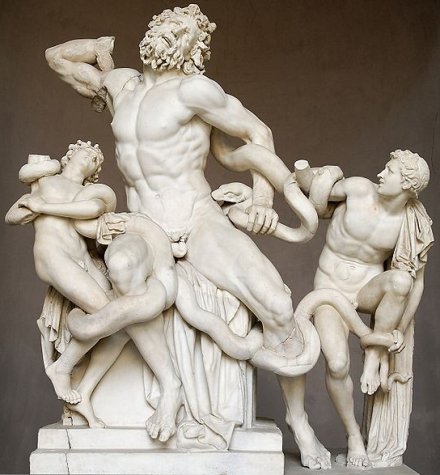
In the 18th century they were compared as two examples of dignified dying. Contemporaries saw a certain stoicism in the sculptures — even though Virgil wrote that Laocoön cried out.

Ultimately, Smugglerius reminds us what happens when power is unrestrained. In a world where most people don’t have a voice, the state can ignore the rights and dignity of individuals. The real story here is the story of arbitrary authority and the importance of an enfranchised citizenry with the ability to put limits on those wielding power.

* Hanged felons not sentenced to anatomization could still wind up being taken apart in an operating theater, either as a result of their striking a direct bargain with the surgeons, or involuntarily via London’s growing trade in illicit corpses.

On this day..

1917: Emil Rebreanu, Forest of the Hanged inspiration

On this date in 1917, Romanian Lieutenant Emil Rebreanu was hanged for attempted desertion by the Austro-Hungarian army.

Here’s Rebreanu’s entry at the Enciclopedia Romaniei, which says in brief that he was one of 14 (!) brothers born in the part of present-day Romania that was then attached to the Kingdom of Hungary.

Upon the outbreak of World War I, Rebreanu was drafted into the Austro-Hungarian forces and fought on several fronts. But his removal to the lines to fight against the independent Romanian state was a front too far: he attempted to cross the lines to the Romanians on the night of May 10-11, but was captured, court-martialed, and sentenced to hang.

However, tragedy for the sizable Rebreanu family was a boon to world literature.

One of Emil’s many brothers was author Liviu Rebreanu, one of the greats of Romanian letters.

The latter’s 1922 novel Forest of the Hanged clearly draws upon his brother’s fate: in Forest, a Romanian officer uneasily serving in the Habsburg army first condemns a Czech deserter to death as part of a tribunal, then attempts himself to desert to Romania.

For his trouble, the character suffers the exact same fate as Emil Rebreanu.

A 1965 Romanian film, also called Forest of the Hanged, adapts this novel for the silver screen.

On this day..

1388: Three evil counselors of Richard II

On this date in 1388, James Berners, John Beauchamp, and John Salisbury were convicted by the “Merciless Parliament” of treason, and put to immediate death.

You could say that relations between the branches of government were a bit on the frayed side, since crown and parliament had civil war for political primacy. Parliament won.

It just wasn’t quite one of those all-out, kill-you-when-we’re-done wars to depose the king outright. (That would come later.) “We do not rebel or arm ourselves against the King except in order to instruct him,” one of the rebelling Lord Appellant told His Majesty.

“Instructing” Richard II meant politically isolating him and then mercilessly — hence the resulting parliament’s name — attainting his aides and allies for treason.

So all that spring, young Richard II helplessly “presided” over a parliament where his supporters were condemned on trumped-up charges.

This date was the turn for Sir John Beauchamp of Holt and Sir James Berners (or Barnes), two guys noble enough to suffer “merely” beheading, plus Sir John Salisbury, who was far enough down England’s class hierarchy that he got to endure the full drawing and quartering treatment.


Berners may have been the father of a 15th century prioress and author, Juliana Berners.

This woman wasn’t the type to keep to her cloister and meditate: Berners wrote books on her vigorous pastimes of heraldry, hunting, and hawking. Her Treatise of Fishing with an Angle remains one of the seminal books for the sport of angling.

On this day..

1671: Zrinski and Frankopan, Croatian conspirators

He who dies honorably lives forever.

-Fran Frankopan

On this date in 1671, Croatian noble Fran Krsto Frankopan and his brother-in-law Petar Zrinski were beheaded by the Austrian empire at Wiener-Neustadt Prison.

The Zrinski-Frankopan Conspiracy — or Magnate Conspiracy — was the product of great powers chess in central Europe … and specifically, of the frustration of these lords in the frontier zone between the Austrian and the Ottoman Empires at being a sacrificial pawn.

Instead, they’d take control of their own destiny and be a self-sacrificial pawn.

Croatia and Hungary had been on the perimeter of Hapsburg authority for generations, and seen the rising Ottomans push well into Europe.

In the latest of innumerable wars, the Austrians had trounced the Ottomans, potentially (so the Croats and Hungarians thought) opening the door for reconquest of lost territory. Croatia in particular had been nibbled away by Ottoman incursions into a “remnant of a remnant.” Emperor Leopold I thought otherwise: he had Great Games to play in western Europe as well and didn’t find this an auspicious moment to go all in in the east.

Rather than following up his victory by trying to run the Turks out of their half of divided Hungary, or out of Transylvania, Leopold just cut an expedient peace on status quo ante terms quite a bit more favorable to Istanbul than the latter’s military position could demand.

The aggrieved nobles started looking around for foreign support to help Hungary break away.

This scheme never came to anything all that palpable, perhaps because the operation’s leading spirit Nikola Zrinski got himself killed by a wild boar on a hunt, and definitely because no other great powers wanted to get involved in the mess.

Zrinski (or Zrinyi) was also a noteworthy Croatian-Hungarian poet, as were the remaining conspirators.

The boar-slain’s younger brother Petar, his wife Katarina, and Katarina’s half-brother Fran Frankopan, also better litterateurs than conspirators, inherited the scheme’s leadership, and its penalty.


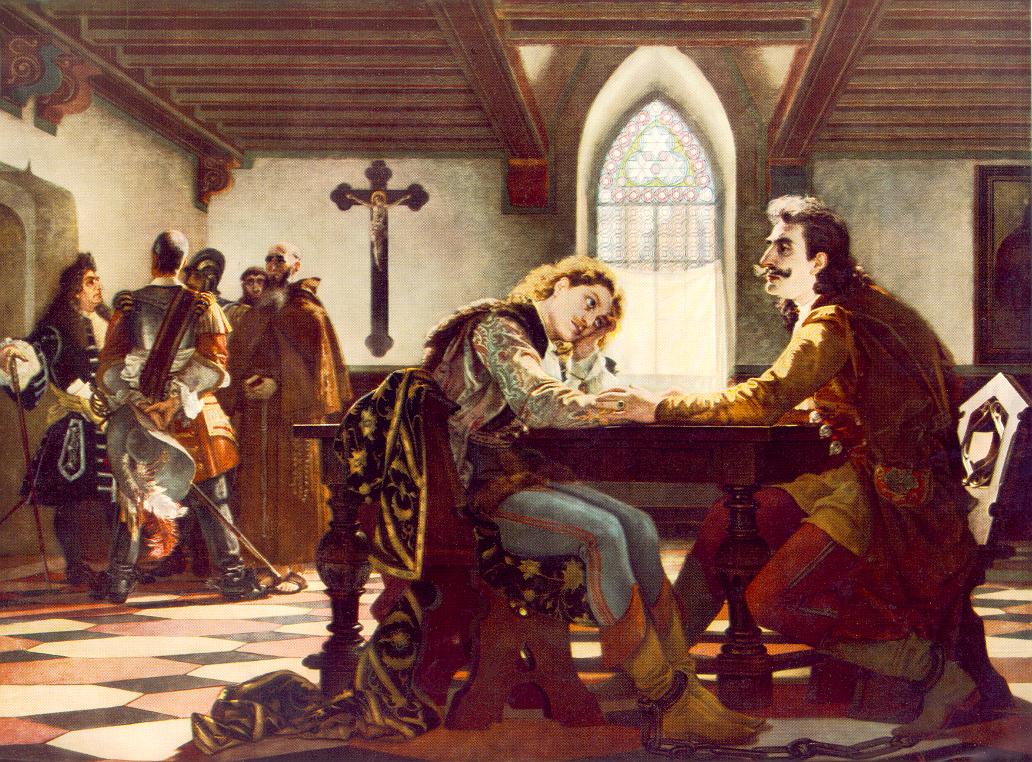
Zrinski and Frankopan in the Wiener-Neustadt Prison, by Viktor Madarasz (1864)

Royal vengeance against the plot shattered two mighty noble houses: the Zrinskis were all but destroyed by the seizure of their estates. The Frankopans — an ancient and far-flung family whose Italian Frangipani branch was even then about to yield a pope — were done as major players.

After these executions, anti-Hapsburg sentiment metastasized in Hungary into outright rebellion.

But in what was left of Croatia, the loss of the two largest landholders spelled the end of effective resistance until the era of 19th century romantic nationalism — when our day’s unfortunates were recovered as honored national heroes.

Zrinski and Frankopan are pictured on modern Croatia’s five-kuna bill, and were both reburied in Zagreb Cathedral after World War I finally claimed the Austrian Empire. (They also got memorial plaques in Wiener-Neustadt) Their mutual relation Katarina Zrinski, who avoided execution but was shut up in a convent, was a writer as well, and has ascended to the stars of founding patriotess, seemingly the go-to namesake for most any Croatian women’s civic organization. (Dudes honor the House of Zrinski by slapping the name onto sports clubs.)

On this day..

1905: Chief Zacharias Kukuri

On this date in 1905, in the midst of Germany’s genocidal destruction of the Herero people in its Southwest Africa colony (present-day Namibia), the Otjosazu chief Sacharias Kamaituara Kukuri was hanged in Windhoek.

More than half the Herero population perished following an abortive attempt to resist German colonization during this unfortunately little-remembered period, perhaps the very first of the 20th century’s ample store of genocides.

Our man’s execution occurred at the moment of a policy pivot: after the horrific extermination policy initially practiced by General Lothar von Trotha, Germany’s Herero policy was “moderating”. Von Trotha’s extermination order had been officially reversed by Berlin; by November of 1905, the murderous general would be recalled to Germany. Instead, they’d be collecting the Herero into concentration camps.

It was into the Windhoek camp that Kukuri arrived as the wounded prisoner of a German ambush.


The concentration camp under the walls of Windhoek’s Alte Feste (Old Fort). Today, the fort is a museum … and the camp, forgotten, is the grounds of a high school. (Source)

Of course, it goes without saying that, even if state policy no longer aimed officially at racial annihilation, the system of concentration camps continued the de facto genocide: the systematic destruction of Herero life in order to incorporate the population as a subject proletariat (enlightened self-interest — the colony’s “economic future would be completely destroyed by the extermination of the indispensable labor power” — is what finally trumped von Trotha). At the same time, camps structured a punitive neglect of Herero living conditions, a years-long “period of suffering” in which Herero died of overwork, malnutrition, disease and neglect as surety against any future resistance. Courts-martial of fighting-age men alleged to have had some hand in resisting by arms the German onslaught completed the salutary lesson.

Missionary sources provide us with eyewitness accounts of conditions in the camps. Missionaries stationed in the Herero Konzentrationslager reported to their superiors in Germany on the extensive and unchecked rape, beatings and execution of surrendered Herero by German soldiers. Missionary Kuhlmann spoke of the delight of settler women witnessing the drawn-out public hangings of captured Herero in Windhoek. At one such hanging, a drooling Herero fighting for his life was berated” ‘You swine, wipe your muzzle’. (pdf source)

Kukuri fell into this last category.

His fate is especially poignant for us (and, convenient to date) thanks to the memoirs of Friedrich Meier, one of the many German Christian missionaries who had poured into Namibia ever since it became a German colony. As Meier’s account of swapping Biblical allusions with Kukuri in the shadow of the latter’s gallows underscores, these missionaries had achieved some inroads.

I did not see the slightest trace of fear on him, instead it was as if he were going to a wedding. ‘Muhonge’, he said at one stage, ‘oami otja Elias mohamakuao na je otjinga me keende kejuru metemba,’ i.e. ‘Muhonge, like Elias, I too travel to heaven in a waggon.’

Having arrived at the execution site, I noticed how he kept looking at the gallows, at which preparations were still taking place. I feared for his tranquility and asked him to stop looking at it. ‘Muhonge,’ he said to me, ‘I hear everything, why should I not look at it? For is it not “my wood” [my cross]?’

When we finally stood underneath the gallows, we prayed together that beautiful song: ‘So then take my hand and lead me.’

German:

English:

Possibly he noticed that I was worried about him. Anyway when I was finished he said, ‘It would appear that you still fear that I am afraid, but have I not told you: “When a father calls his child, does that child then fear to go to him?” Give my wife, who is in Okahandja, my greetings and tell her that I have died in the faith of the lord Jesus, so too tell my children if you should ever see them.’ I asked him again to be infatuated with the lord Jesus. ‘Lord Jesus, you help me,’ with this, after he had given me his hand, he climbed up the ladder. Soon the noose was laid around his neck. And then — never will I forget that moment — the unheard-of happened, as he fell the noose slipped and the wretch fell to the ground. He lost consciousness for a moment, so too, the observers were dumbstruck. Today I still see how his eyes sought me out. Soon, however, two soldiers were there, they lifted him up, and then a little to the side, on orders of the major who led the proceedings, he was shot.

Kukuri’s grave can still be seen at the Gammans cemetery (German link) in Windhoek.

His memory as an emblem of Herero dignity under persecution also remains in present-day Namibia.

Anette Hoffmann (in “The Merits and Predicaments of Opacity: Poetic Strategies of Evasion and Resistance” for the fall 2007 Research in African Literatures) relates a later “praise poem” for 1959 Herero martyrs, whose allusion to the hanged chief (as “Hauzeo”) emphasizes his agency, rather than his victimhood.

For he as the son of the chief Kukuri and must die since Samuel Maherero had escaped to Botswana. They said that if they kill him, then that could serve as a symbol that they had exterminated the sovereignity of the Herero … he was taken to a tree near the White’s cemetery in Otjomuise, which is still here today. I can show you his grave. He is still there until now, near the railway line to Aris … when he was taken to the tree, the tree of Hauzeu, as you hear about it, it was said: now you will be hanged to die. Heavily wounded as he was, he had a rope around his neck and was hanged. However, his weight broke the rope. Then the Germans said he was innocent and had to be released. But he himself insisted to be hanged again … [he said] “I have come to see the children of Tjamuaha’s house, those left in the camps of enslavement: to see them with my own eyes … this is why I have come: take me up the tree.” They did and he died. He lies at Hauzeu’s tree. He had given himself to be hanged.

On this day..

1857: Francis Richeux, witnessed by Tolstoy

On this date in 1857, a robber-murderer named Francis Richeux was publicly guillotined in Paris before a crowd of 12,000 to 15,000 people.

One of those onlookers was a 28-year-old Russian noble, fresh from the Crimean War and abroad on his first European trip: Leo Tolstoy.*

Overcome with curiosity, Tolstoy (as he recorded in his diary; here it is in Russian)

rose at seven o’clock and drove to see an execution. A stout, white, healthy neck and breast: he kissed the Gospels, and then — Death. How senseless … I have not received this strong impression for naught. I am not a man of politics. Morals and art I know, love, and [understand]. The guillotine long prevented my sleeping and obliged me to reflect.

And he developed the impression into a full-on rant that same day, in his running correspondence with Russian litterateur Vasily Botkin. The following is as translated in Dialogues with Dostoyevsky: The Overwhelming Questions.

The spectacle made such an impression on me that it will be long before I get over it. I have seen many horrors in war and in the Caucasus, but if a man were torn to pieces in my presence it would not have been so repulsive as this ingenious and elegant machine by means of which they killed a strong, hale, healthy man in an instant. There [in war] it is not a question of the rational [will], but the human feeling of passion, while here it is a question of calm and convenient murder finely worked out, and there’s nothing grand about it. The insolent, arrogant desire to carry out justice, the law of God. Justice, which is determined by lawyers every one of whom, basing himself on honor, religion, and truth, contradicts each other. With these same formalities they have murdered both the king and Chenier, both republicans and aristocrats.† . . Then the repulsive crowd, the father explaining to his daughter what a convenient and ingenious mechanism it is, and so forth. The law of man — rubbish! The truth is that the state is a conspiracy not only for exploitation, but chiefly to corrupt its citizens. But all the same states exist, and moreover in this imperfect form. And they cannot pass from this system into socialism . . . For my part, I can only see in all this repulsive lie what is loathsome, evil, and I do not want to, and cannot, sort out where there is more and where there is less. I understand moral laws, the laws of morality and religion, binding on no one, that lead people forward and promise a harmonious future; I feel the laws of art which always bring happiness; but the laws of politics constitute for me such an awful lie that I cannot see in them a better or worse. All this is what I felt, understood, and recognized today. And this recognition at least to some extent relieves the burden of the impression for me . . . From this day forward I will not only never go to see such a thing again, but I will never serve any government anywhere.**

He wasn’t kidding about that long insomnia, either: the impression startled him, permanently. Recalling the effect years later in his Confessions, Tolstoy still attributed to it an important confirmation of his egalitarian philosophy.

When I saw the head separate from the body, and how they both thumped into the box at the same moment, I understood, not with my mind but with my whole being, that no theory of the reasonableness of our present progress can justify this deed; and that though everybody from the creation of the world, on whatever theory, had held it to be necessary, I know it to be unnecessary and bad; and therefore the arbiter of what is good and evil is not what people say and do, and is not progress, but is my heart and I.

Tolstoy developed the same theme further a few years later in What Is to Be Done? … the shade of the long-forgotten Francis Richeux still haunting the great man of letters.

Thirty years ago in Paris I once saw how, in the presence of thousands of spectators, they cut a man’s head off with a guillotine. I knew that the man was a dreadful criminal; I knew all the arguments that have been written in defence of that kind of action, and I knew it was done deliberately and intentionally, but at the moment the head and body separated and fell into the box I gasped, and realized not with my mind nor with my heart but with my whole being, that all the arguments in defence of capital punishment are wicked nonsense, and that however many people may combine to commit murder — the worst of all crimes — and whatever they may call themselves, murder remains murder, and that this crime had been committed before my eyes, and I by my presence and nonintervention had approved and shared in it. In the same way now, at the sight of the hunger, cold, and degradation of thousands of people, I understood not with my mind or my heart but with my whole being; that the existence of tens of thousands of such people in Moscow — while I and thousands of others over-eat ourselves with beef-steaks and sturgeon and cover our horses and floors with cloth or carpets — no matter what all the learned men in the world may say about its necessity — is a crime, not committed once but constantly; and that I with my luxury not merely tolerate it but share in it. (PDF source | Original Russian)

* Among Tolstoy’s other activities in Paris was hanging around Turgenev … but the two mostly irritated one another. Nevertheless, they shared a distaste for the guillotine, at least to judge by Turgenev’s repulsion at seeing it in action years later.

** Two days after the execution, Tolstoy left Paris for Geneva. Execution-disgust is a suggestive speculation, although Henri Troyat argues that it merely gave him a “dramatic excuse” to stop putting off travel plans he had already made.

On this day..

1098: Rainald Porchet, martyr Crusader

On this date in 1098, Antioch’s besieged Muslim defenders martyred a Crusader knight who refused to secure a ransom for himself.

The armies of the First Crusade had pressed their way through Anatolia and had laid to siege these past five months the ancient Syrian city of Antioch. (It’s in modern Turkey now, where it’s known as Antakya.)

On April 3, 1098, by the account of the priest Peter Tudebode, an eyewitness to the event,

the Turks led to the top of an Antiochian wall a noble knight, Rainald Porchet [alternatively, Rainaud or Reynaud Porquet], whom they had imprisoned in a foul dungeon. They then told him that he should inquire from the Christian pilgrims how much they would pay for his ransom before he lost his head.

According to Encounter Between Enemies: Captivity and Ransom in the Latin Kingdom of Jerusalem — a source which ought to know, if any would — marching a guy out to appeal to his comrades was little to the Antiochians but the time-honored practice of ransoming captured VIPs, “the usual diplomatic method of starting a peaceful encounter with the enemy, in the between-fighting interlude.” It’s not like this sort of hostage-hocking was unknown to Europeans; even hundreds of years later, France cratered its economy by ransoming its captured king from the English.

To the shock of the garrison, Porchet went all clash-of-civilizations on this routine diplomacy.

From the heights of the wall Rainald addressed the leaders: “My lords, it matters not if I die, and I pray you, my brothers, that you pay no ransom for me. But be certain in the faith of Christ and the Holy Sepulchre that God is with you and shall be forever. You have slain all the leaders and the bravest men of Antioch; namely, twelve emirs and fifteen thousand noblemen, and no one remains to give battle with you or to defend the city.”

The Turks asked what Rainald had said. The interpreter replied: “Nothing good concerning you was said.”

The emir, Yaghi Siyan, immediately ordered him to descend from the wall and spoke to him through an interpreter: “Rainald, do you wish to enjoy life honorably with us?”

Rainald replied: “How can I live honorably with you without sinning?”

The emir answered: “Deny your God, whom you worship and believe, and accept Mohammed and our other gods. If you do so we shall give to you all that you desire such as gold, horses, mules, and many other worldly goods which you wish, as well as wives and inheritances; and we shall enrich you with great lands.”

Yaghi Siyan was obliged to make this proposition of apostasy to his prisoner as a prelude to executing him.

Rainald replied to the emir: “Give me time for consideration;” and the emir gladly agreed. Rainald with clasped hands knelt in prayer to the east; humbly he asked God that He come to his aid and transport with dignity his soul to the bosom of Abraham.

When the emir saw Rainald in prayer, he called his interpreter and said to him: “What was Rainald’s answer?”

The interpreter then said: “He completely denies your god. He also refuses your worldly goods and your gods.”

After hearing this report, the emir was extremely irritated and ordered the immediate beheading of Rainald, and so the Turks with great pleasure chopped off his head: Swiftly the angels, joyfully singing the Psalms of David, bore his soul and lifted it before the sight of God for Whose love he had undergone martyrdom.

Rainald got himself a starring role in the Chanson d’Antioche, an epic poem celebrating the Crusade, for this pious self-sacrifice. We can only presume that his name- and numberless compatriots in the dungeons, who also paid the price for Rainald’s obstinacy, were satisfied with suffering the same fate but only getting a role in the chorus.

Then the emir, in a towering rage because he could not make Rainald turn apostate, at once ordered all the pilgrims in Antioch to be brought before him with their hands bound bend their backs. When they had come before him; he ordered them stripped stark naked, and as they stood in the nude he commanded that they be bound with ropes in a circle. He then had chaff, firewood, and hay piled around them, and finally as enemies of God he ordered them put to the torch.

The Christians, those knights of Christ, shrieked and screamed so that their voices resounded in heaven to God for whose love their flesh and bones were cremated; and so they all entered martyrdom on this day wearing in heaven their white stoles before the Lord, for Whom they had so loyally suffered in the reign of our Lord Jesus Christ, to Whom is the honor and glory now and throughout eternity. Amen.

In these heady early months of the Crusades, when the enterprise stumbled from near-disaster to miraculous success, the renown of Porchet et al was clinched by the siege’s success in early June — just days ahead of the arrival of a Turkish relief force which thereafter had to content itself with besieging the now-Crusader-held city.

When this second siege was repelled with the help of the Christians’ convenient — staged, one might think — “discovery” of the Holy Lance of Antioch, everyone had to know that the Big Guy was truly on their side.

On this day..

1815: Anthony Lingard, the last gibbeted in Derbyshire

On this date* in 1815, Anthony Lingard was hanged for murder and robbery at Derby.

Lingard strangled the widow who operated the Wardlow Miers tollbooth in order to rob her poor possessions and lavish those ill-gotten proceeds upon the girl he had impregnated — “with a view to induce her to father the child upon some other person.” That’s the world without contraception for you.

Lingard’s girl thought this bribe fishy and gave him back the widow’s incriminatingly distinctive shoes after hearing reports that footwear had been taken from the murder scene. Then, she testified against him at the Derby Assizes (Lingard had also confessed the crime). Tried on Saturday the 25th, convicted “after a few minutes,” and strung up in front of the county gaol at noontime Tuesday, Lingard “met his fate with a firmness which would deserve the praise of fortitude if it was not the result of insensibility. He appeared but little agitated or dejected by his dreadful situation.”

Rather than the increasingly standard post-execution coda of anatomization, Lingard’s body was given over to a use of more ancient vintage: gibbeting.

Hung up in chains on the aptly named Gibbot Field in Wardlow near the spot of the murder, Lingard’s bleaching bones provided a grisly object lesson to passersby of the consequences of crime. Or, maybe not: though the novelty at first made a crowd-pleasing spectacle, it soon faded into the scenery.

A few years later, a 16-year-old girl poisoned off a rival in the very shadow of the gibbet, winding up executed for her trouble. A younger fellow named William Lingard eventually drew a death sentence for highway robbery committed near his own older brother’s clanking remains — a sentence commuted to convict transportation.

If what was left of Anthony Lingard failed to overawe his criminal counterparts, it did at least leave an impression on poet William Newton, who penned this sad meditation on the local landmark, found in full here. (It must have helped his perspective that Newton was into his sixties when the young pup hanged.)

“The supposed Soliloquy of a Father, under the Gibbet of his Son; upon one of the Peak Mountains”
TIME — Midnight. SCENE — A Storm.

 Art thou, my Son, suspended here on high? —
Ah! what a sight to meet a Father’s eye!
To see what most I prized, what most I loved.
What most I cherish’d, — and once most approved,
Hung in mid air to feast the nauseous worm.
And waving horrid in the midnight storm!

 Let me be calm; — down, down, my swelling soul;
Ye winds, be still, — ye thunders, cease to roll!
No! ye fierce winds, in all your fury rage;
Ye thunders, roll; ye elements, engage;
O’er me be all your mutual terrors spread.
And tear the thin hairs from my frenzied head:
Bring all your wrathful stores from either pole.
And strike your arrows through my burning soul :
I feel not, — fear not, — care not, — shrink not, — when
I know, — believe, — and feel, — ye are not men!
Storms but fulfil the high decrees of God,
But man usurps his sceptre and his rod.
Tears from his hand the ensigns of his power.
To be the petty tyrant of an hour.

 My Son! My Son! how dreadful was thy crime!
Thy name stands branded to remotest time;
Gives all thy kindred to the eye of scorn,
Both those who are, and those that may be born;
Scatters through ages on thy hapless race
In every stage of life, and death, — disgrace:
In youth’s gay prime, in manhood’s perfect bloom.
Ah! more, — it ends not, dies not, on the tomb!
O woman! woman! choicest blessing given.
If pure; — the highest gift of highest heaven!
If lax, corrupt, deceitful, — worse than hell!
Worse than the worst of demons dare to tell!
It was thy lot, ill-fated Son! to find
Thy doom pour’d on thee by the faithless kind;
Fraudful, and false, their treacherous snares they spread.
And whelm’d destruction on thy thoughtless head.

 To die, to perish from the face of earth.
Oblivion closing on thy name and birth.
Hid under ground from each invidious eye,
From every curious, every rancorous spy,
Was what thy crime deserved: — not more;
The rest seems cruelty. — When heretofore
Our barbarous sires the aweful Gibbet rear’d.
The Gibbet only, not the laws were fear’d:
The untutored ruffian, of an untaught clime,
Fear’d more the punishment than dreaded crime.
We boast refinement, say our laws are mild.
Dealt equally to all, the man, the child: —
But ye, who, argue thus, come here and see,
Feel with a Father’s feelings; — feel with me!
See that poor shrivell’d form the tempest brave.
See the red lightning strike, the waters lave.
The thunders volleying on that fenceless breast! —
Who can see this, and wish him not at rest?

At rest, — vague word! — the immaterial mind
Perhaps even now is floating on the wind: —
Ah! no, — not mind, — not spirit, — but the shell;
The mind ere this has drank of Mercy’s well:
‘Tis not for that I feel, for that I sigh.
But sweltering, putrid, rank mortality.
O! blind to truth, to all experience blind.
Who think such spectacles improve mankind:
Bid untamed youth on such sights feast his eyes,
Harden you may, but never humanise.
Ye who have life, or death, at your command.
If crime demand it, let the offender die.
But let no more the Gibbet brave the sky:
No more let vengeance on the dead be hurl’d.
But hide the victim from a gazing world.

Anthony Lingard was the last person ever gibbeted in Derbyshire. England abolished gibbeting and hanging in chains full stop in the 1830s.

* The date March 8 is widely attributed on other sites, but the primary documentation for March 28 is unambiguous. I want to suspect a seminal typo somewhere that’s been copied a thousand other times over.

On this day..

1644: Mary Latham and James Britton, adulterous lovers

One James Britton, a man ill affected both to our church discipline and civil government, and one Mary Latham, a proper young woman about 18 years of age, whose father was a godly man and had brought her up well, were condemned to die for adultery, upon a law formerly made and published in print.

It was thus occasioned and discovered. This woman, being rejected by a young man whom she had an affection unto, vowed she would marry the next that came to her, and accordingly, against her friends’ minds, she matched with an ancient man who had neither honesty nor ability, and one whom she had no affection unto.

Whereupon, soon after she was married, divers young men solicited her chastity, and drawing her into bad company, and giving her wine and other gifts, easily prevailed with her, and among others this Britton. But God smiting him with a deadly palsy and fearful horror of conscience withal, he could not keep secret, but discovered this, and other the like with other women, and was forced to acknowledge the justice of God in that having often called others fools, etc., for confessing against themselves, he was now forced to do the like. The woman dwelt now in Plymouth patent, and one of the magistrates there, hearing she was detected, etc., sent her to us.

Upon her examination, she confessed he did attempt the fact but did not commit it, and witness was produced that testified (which they both confessed) that in the evening of a day of humiliation through the country for England, etc., a company met at Britton’s and there continued drinking sack, etc., till late in the night, and then Britton and the woman were seen upon the ground together, a little from the house. It was reported also that she did frequently abuse her husband, setting a knife to his breast and threatening to kill him, calling him old rogue and cuckold, and said she would make him wear horns as big as a bull. And yet some of the magistrates thought the evidence not sufficient against her, because there were not two direct witnesses; but the jury cast her, and then she confessed the fact, and accused twelve others, whereof two were married men. Five of these were apprehended and committed, (the rest were gone,) but denying it, and there being no other witness against them than the testimony of a condemned person, there could be no proceeding against them.

The woman proved very penitent, and had deep apprehension of the foulness of her sin, and at length attained to hope of pardon by the blood of Christ, and was willing to die in satisfaction to justice. The man also was very much cast down for his sins, but was loth to die, and petitioned the general court for his life, but they would not grant it, though some of the magistrates spake much for it; and questioned the letter whether adultery was death by God’s law now.* This Britton had been a professor in England, but coming hither he opposed our church government, etc., and grew dissolute, losing both power and profession of godliness.

March 21 [1643/44*]. They were both executed, they both died very penitently, especially the woman, who had some comfortable hope of pardon of her sin, and gave good exhortation to all young maids to be obedient to their parents, and to take heed of evil company, etc.

–John Winthrop‘s journals, specifically this volume

While Puritan courts were certainly known to execute for sexual transgressions, Mary and James appear to be the only documented case in the history of [what is now] the United States of an outright execution for adultery.**

The crime and the setting inevitably call to mind Nathaniel Hawthorne’s The Scarlet Letter, and indeed he would likely have known about this case from Winthrop’s journals.

There are, however, even more compelling parallel cases — which, if they do not end on the scaffold, are at least as dramatic from the standpoint of posterity.

The case of the woman branded for adultery first appeared in the records of York, in what is now Maine. Dated 15 October 1651, the entry reads:

“We do present George Rogers for, & Mary Batchellor the wife of Mr. Steven Batcheller minister for adultery. It is ordered by ye Court yt George Rogers for his adultery with mis Batcheller shall forthwith have fourty stripes save one upon the bare skine given him: It is ordered yt mis Batcheller for her adultery shall receive 40 stroakes save one at ye First Towne meeting held at Kittery, 6 weekes after her delivery & be branded with the letter A.”

Beside that entry, written in the same hand, is the notation, “Execution Done.” It appears that Charles Edward Banks, in his History of York, Maine (1935), recognized the connection between Hawthorne’s novel and this case, for he refers to Mary Batchellor’s branding in a section titled “The Scarlet Letter.”

… the similarities between Hester Prynne and Mary Batchellor are so outstanding that is is tempting to argue for a direct source. For example, Mary Batchellor’s adultery is the only known case involving a child that can be linked to Hester’s plight. By postponing execution of the sentence until six weeks after Mrs. Batchellor’s delivery, the officials of York obviously considered the health of the unborn child. Hawthorne suggests a similar delay in the novel, for when Hester and Pearl appear in the opening scaffold scene, Pearl is “some three months old”.

It’s rather interesting to notice that in Latham and Britton’s case, even the judges who ultimately sentenced the lovers to die were overtly reluctant about doing so: the subtext of Winthrop’s narrative suggests to this reader that, had the pair not confessed, everyone would have been more than happy to use the “two witnesses” loophole to avoid noosing a concupiscent teenager stuck in a barren marriage. Whatever our caricature of them, Puritan elites too had some sense of proportionality about these things.

Even in Hawthorne, where the protagonist is punished only with public shaming, one of the crowd complains,

“This woman has brought shame upon us all, and ought to die. Is there not law for it? Truly, there is, both in the Scripture and the statute-book. Then let the magistrates, who have made it of no effect, thank themselves if their won wives and daughters go astray.”

And they have, ever since.

Thanks to Laura James of the (alas) dormant true-crime blog CLEWS for bringing this case to our attention.

* 1643/44: England was observing the legal new year on March 25 at this point.

** See the Espy file.

On this day..

1995: Flor Contemplacion, OFW

On this date in 1995, Filipina maid Flor Contemplacion was hanged for murder in Singapore.

Contemplacion had, four years before, strangled a fellow-maid and drowned that maid’s four-year-old charge.

That’s what she confessed to, at least. Even though Contemplacion’s camp would eventually argue that the confession had been coerced, or that she’d been possessed by a strange epileptic, Contemplacion herself never really walked back that admission.

Still, Flor Contemplacion the cause celebre and Flor Contemplacion the cultural phenomenon was never only about the woman’s innocence, even if many do still believe she was framed.

By whatever happenstance of timing and circumstance, widespread publicity of her case in the Philippines during the months leading up to her hanging tapped a national discontent among her countrymen and -women about “OFWs” — overseas Filipino workers.

This economic sector — exported labor — had been intentionally nurtured (pdf) by Manila beginning with a 1974 labor code, and over the ensuing generation ballooned twentyfold into a positively enormous phenomenon.* By the time Flor Contemplacion hanged, everybody in the Philippines knew people who had worked overseas, and whose wage remittances were indispensable (pdf) for supporting their families in the Philippines. (And increasingly, the entire national economy.)


Boom of the overseas Filipino workers sector, 1975 – 2000 (1975 = 1). Source of figures; there are more official OFW stats here.

Ascendance of the OFW industry brought with it the discontents attendant with scattering wholesale quantities of the populace to unfamiliar corners of the globe, many of them to confront the timeless varieties of workplace abuse from positions of special vulnerability: “The dark reality,” one organization says this year, of “low wages, horrid working conditions, little protection for human rights, exploitation, harassment, threats, illegal arrests, imprisonment, criminalization, and deportation.”

To say nothing of the political discontents raised by such a discomfiting abdication of autarky, and the “domestic anxieties” (pdf) of developing “the embarrassing reputation that we are a country of DHs [domestic helpers], entertainers, and even prostitutes.” This is, truly, a rich and complex tapestry.

Flor Contemplacion is practically the patron saint of the indicted Filipino/a abroad, and her fruitless clemency appeal the political breakout of OFWs and their allies as a constituency to reckon with.

The effect was immediate. Contemplacion hadn’t had any great level of consular support early in her criminal process — the time when it might have made the most difference. (The Philippines embassy in Singapore later took considerable heat for this fact.)

But as the story made headlines and some sketchy witnesses accused the victim’s widower husband of being the real perpetrator, the case became a national sensation. Recently-elected president Fidel Ramos, who campaigned on restoring the previously-abolished death penalty in the Philippines, not only had to put on the full-court press for this condemned woman but incongruously declared her a “national hero”; his wife personally received Contemplacion’s remains at the airport. Leaders and ordinary people from Catholics to Communists rallied (sometimes rioted) in anger.

(Singapore was just at this time establishing its own reputation as the place that never gives diplomatically expedient clemencies. Never.)

Whatever the domestic controversies, the labor-export business has only continued to grow in the generation since Contemplacion’s hanging. To this day, the Filipino public has shown great sympathy with OFWs entangled in alien criminal justice systems, and demanded diplomatic support — regardless of particular individuals’ putative guilt.

Regrettably, it is often called to do so: from Saudi Arabia to China, the plight of Filipinos executed abroad remains a recurrent and emotionally charged theme in the country.

Flor Contemplacion’s name, well-known still anywhere in the archipelago, was back in the news last year … when her three sons all drew lifetime prison sentences for drug-smuggling.

On this day..