1973: Victor Jara, among thousands in Chile’s September 11

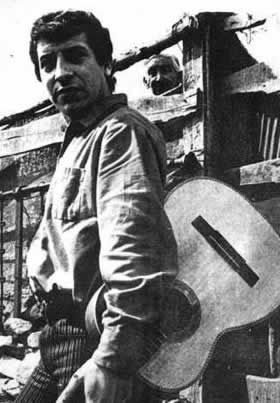
At an unknown time on this evening in 1973, or else the early hours of the following day, Chilean putschists ushering in the Pinochet dictatorship machine-gunned folk singer Victor Jara near the Santiago stadium that today bears his name.
“I don’t see why we need to stand idly by and let a country go communist due to the irresponsibility of its own people,” said Henry Kissinger of Allende’s election. Victor Jara had another idea.

Four days before, Chile’s September 11 had seen General Augusto Pinochet topple the elected leftist government of Salvador Allende, murdering the president in his palace. (Or, go some accounts, Allende committed suicide — “pausing only twice to reload.”)

A long pall of evil settled over the country, with all the accustomed chilling familiars: “disappeared” people, mirrored shades, Jeane Kirkpatrick.

The day after the CIA-backed coup, popular folk singer and activist Victor Jara, a pioneer of the Nueva Cancion (“New Song” movement) then teaching at Santiago’s Technical University, was among thousands of undesirables rounded up and packed off to a makeshift prison camp at the city’s Chile Stadium — a stadium Jara had performed at.*

Left there to the tender mercies of a thuggish Chilean officer, Jara was beaten and tortured over the intervening days — evocative but possibly undependable tradition holds that the guitarist’s hands were cut off, shattered or otherwise destroyed. According to the U.S.-based United States Institute of Peace,

[t]he the last day Víctor Jara was seen alive was September 15. During the afternoon he was taken out of a line of prisoners who were being transferred to the National Stadium. In the early morning of the next day, September 16, shantytown dwellers found his body, along with five others, including that of Littré Quiroga Carvajal, near the Metropolitan Cemetery. As the autopsy report states, Víctor Jara died as a result of multiple bullet wounds (44 entry wounds and 32 exit wounds).

The Commission came to the conviction that he was executed without due process of law by government agents, and hence in violation of his fundamental human rights.

To say the least.

And as the text implies, Jara was only the most recognizable name among unknown hundreds killed as the military cemented its control of the country.

Jara remains larger-than-life martyr figure in Latin America and liberation movements worldwide, but he’s almost unknown north of the Rio Grande. Pinochet was our bastard; in the weird way history writes its own geography, Jara became a political emblem behind the Iron Curtain for the perfidy of the capitalist powers: obscure in Peoria, but a household name in Potsdam, as the credit roll from this 1978 East German film suggests.**

That’s Jara himself on the soundtrack, of course. The pat conclusion for such a figure is that his art is his legacy, and that Jara’s body of work as against Pinochet’s will be a walkover in posterity. Is that enough? Pinochet died in his bed at age 91; earlier this year, the Jara case was closed in underwhelming fashion. Thirty-five years down the road, most authors of Pinochet’s human rights depredations are dead or lost or decrepit. Justice delayed is justice denied.

Victor’s widow, Joan Jara — today director of the Fundacion Victor Jara (it’s a Spanish-only site); you can hear her interviewed on Democracy Now! for the 25th anniversary of her husband’s death in 1998 — managed to leave the country with some of his works.

Her publication of a poem he wrote while imprisoned, an untitled, unfinished work generally known as “Estadio Chile,” made it a signature cry of hope amid desperation. Here it is in the Spanish rough-hewn under the shadow of death; there’s an English translation here.

Somos cinco mil
en esta pequena parte de la ciudad.
Somos cinco mil
¿Cuantos seremos en total
en las ciudades de todo el pais?
Solo aqui, diez mil manos que sembran
y hacen andar las fabricas.

¡Cuanta humanidad
con hambre, frio, panico, dolor
presion moral, terror y locura!

…¡Y Mexico, Cuba y el mundo?
¡Que gritan esta ignomonia!

Somos diez mil manos menos
que no producen.
¿Cuanto somos en toda la Patria?
La sangre del companero Presidente
golpea mas fuerte que bombas y metrallas.
Asi golpeara nuestro puno nuevamente.

¡Canto que mal me sales
cuando tengo que cantar espanto!
Espanto como el que vivo
como el que muero, espanto.

De verme entre tanto y tantos
momentos de infinito
en que el silencio y el grito
son las metas de este canto.
Lo que veo nunca vi,
lo que he sentido y lo que siento
hara brotar el momento…

Whether or not it’s enough, his work is his legacy after all.

* Some 7,000 people were held at Chile Stadium in the days after the coup, most later moved in with other detainees at the larger Estadio Nacional. The USIP excerpt alludes to Jara being pulled out for execution during such a move.

** In a similar vein, Stanford has a small online exhibit of Jara-themed East German propaganda art. Not to be outdone, there’s a Soviet rock opera about Jara, and an asteroid discovered by a Soviet astronomer was named in Jara’s honor within a week of his execution.

On this day..

1946: Amon Göth, Schindler’s List villain

On this date in 1946, Plaszow concentration camp commandante Amon Göth was hanged near the camp site by Poland’s postwar Communist government.

Göth is most widely recognizable as Ralph Fiennes’ fiendish character in Schindler’s List, one of the American Film Institute’s top movie villains of all time. (And, naturally, a first-class bastard in real life, too.)

A short-drop strangulation is not the way you’d want to go. It turns out, though, that Steven Spielberg (ever the sentimentalist) seriously tidied up the proceedings.

As you watch the video of the real Amon Goeth’s exit below — and it’s a snuff film, so proceed advisedly — consider the following:

  • Amon Goeth does bear a passing fair resemblance to Ralph Fiennes.

  • To judge by their getup — dig the masks! — the executioners might have been Batman and Robin.
  • To judge by the discharge of their duties, the executioners might have been Larry, Moe and Curly. Goeth survived two drops (notice the executioner on the right gesticulating in frustration as the second try fails) before they finally got it right:

On this day..

1599: Beatrice Cenci and her family, for parricide

On the morning this day in 1599, the Cenci family — mother Lucrezia, son Giacomo, and immortal tragic heartthrob Beatrice — were put to death at Sant’Angelo Bridge for murdering the clan’s tyrannous father.

Francesco Cenci, the victim, was more accustomed to making victims of his own: detested around the Eternal City, he indulged his violent temper and fleshy lusts with the impunity of a wealthy cardinal’s son. By all accounts, he enjoyed pushing around his family, too.

This much is stipulated. What lies beyond is legend.

But the legend is why we’re dallying with Beatrice today, so we might as well begin there: in fear that her father would rape her, it goes, Beatrice tried to turn to the authorities, who let mean old dad walk on account of his connections. Desperate to protect herself from incest, Beatrice and family arrange to batter his gulliver and toss him over a balcony to make it look like suicide.

Slight problem: it didn’t look very much like suicide.

So the family was hauled in and tortured, and eventually Lucrezia and Beatrice (both beheaded) and Giacomo (quartered after suffering the mazzolatura of an incapacitating hammer blow to the head followed by gory lethal knifework by the executioner) all paid the price while the youngest child watched, spared death but condemned to life in the galleys.

(The papacy gobbled up the patricides’ estate, which puts a fine point on the ironically-named Pope Clement VIII‘s law-and-order stance on the appeal for mercy, and his subsequent edicts to quash public comment on the affair.)

Then Beatrice’s body — the part below the neck — contrived to disrobe when fumbled by the brethren taking it away for burial.

You’ve got to admit it’s pretty romantic. Some versions even hold that the responsible executioners died violently themselves within a month, or that a ghostly Beatrice returns to the scene of her demise on this anniversary.

And not a word of Italian fluency will be necessary to catch the gist of this excerpt from this 1969 Lucio Fulci film:

It’s a little too Romantic, as in capital-R.

While the case was a true sensation Rome at the turn of the 17th century, the legend as we know it was heavily constructed in the 19th century … and specifically Percy Bysshe Shelley, who heard the story in Italy* where it had persevered as local folklore. A girl who killed her despot-father, executed by the despotic agents of the Divine Father? You don’t get into the canon without knowing what to do with that kind of material.

And he had this charming painting of her to boot:

Shelley amped up the menaced-virginal-purity theme, made the bloodshed a lot more demure, and turned it into a long poem, “The Cenci” (available on Google Books, and on Bartleby.com) which in Melville’s description proceeds from putting its protagonist between the “two most horrible crimes possible to civilized humanity — incest and parricide.”

This doesn’t all actually turn out to be well supported: at a minimum, Shelley inflated an incest allegation of doubtful lineage into accomplished fact. Beatrice’s camp did not raise this claim until just before her execution, when it needed a high card for clemency. The loutish victim eventually got his own biographer, who strongly disputed the incest charges. (Francesco also sports his own Italian Wikipedia page.)

From Shelley’s influential quill** into the DNA of western literature: Stendahl tapped the vein, as did Artaud, and risorgimento figure Francesco Domenico Guerrazzi; both Melville and Hawthorne used that painting so captivating to Shelley as plot devices (Dickens loved the painting, too). American sculptor Harriet Hosmer worked Cenci’s complex sensuality in marble.

Remarkable how the tradition in its modern incarnation proceeds root and branch from Shelley’s apprehension of a single painting, and how his reading stamped itself upon the canvas for later observers — like Hawthorne, writing in his journal:

It is the very saddest picture that ever was painted, or conceived; there is an unfathomable depth and sorrow in the eyes; the sense of it comes to you by a sort of intuition. … It is the most profoundly wrought picture in the world; no artist did it, or could do it again. Guido may have held the brush, but he painted better than he knew. I wish, however, it were possible for some spectator, of deep sensibility, to see the picture without knowing anything of the subject or history; for no doubt we bring all our knowledge of the Cenci tragedy to the interpretation of the picture.

He wrote better than he knew: the painting is no longer attributed to Guido Reni, and it’s doubtful whether it’s a portrait of Beatrice at all. One wonders if it would retain its place in Hawthorne’s estimation as a local washer-woman modeling for an allegory.

* Apparently you can still crash at the same place Shelley first got hep to Cenci.

** Kick back with some polysyllabic literary analysis of Shelley’s Cenci stuff.

On this day..

1642: Thomas Granger and the beasts he lay with

On this date in 1642, a teenager was hanged in the Plymouth colony for bestiality — in accordance with the law of the Pentateuch.

William Bradford — we just met him, trying to keep things cool with the Indians — relates the “very sadde accidente of the like foule nature in this govermente”:

Ther was a youth whose name was Thomas Granger; he was servant to an honest man of Duxbery, being aboute 16 or 17 years of age. (His father and mother lived at the same time at Sityate.) He was this year detected of buggery (and indicted for the same) with a mare, a cowe, tow goats, five sheep, 2 calves, and a turkey. Horrible it is to mention, but the truth of the historie requires it. He was first discovered by one that accidentally saw his lewd practise towards the mare. (I forbear perticulers.) Being upon it examined and committed, in the end he not only confest the fact with that beast at that time, but sundrie times before, and at severall times with all the rest of the forenamed in his indictmente; and this his free-confession was not only in private to the magistrates, (though at first he strived to deney it,) but to sundrie, both ministers and others, and afterwards, upon his indictemente, to the whole court and jury; and confirmed it at his execution. And whereas some of the sheep could not so well be knowne by his description of them, others with them were brought before him, and he declared which were they, and which were not. And accordingly he was cast by the jury, and condemned, and after executed about the 8 of Sept 1642. A very sade spectakle it was; for first the mare, and then the cowe, and the rest of the lesser catle, were kild before his face, according to the law, Levit: 20.15 and then he him selfe was executed.* The catle were all cast into a great and large pitte that was digged of purposs for them, and no use made of any part of them.

So, pilgrims: weird about sex, a bit rough with the punishment. No wonder they got a rep.

Granger is the first juvenile known to be executed in the territory of the modern United States — if you like, you could read it as the start of a pattern, even though almost a century would pass before the next such execution. “Juvenile” is a relative term, of course, since we see our day’s victim across a historical redefinition (arguably, outright creation) of “childhood” in the centuries to come: Granger left a wife and daughter.

“Sodomy, rapes, buggery,” were one of the five classes of crimes punishable by death according to the Plymouth Colony’s 1636 statutes. Still, Granger’s is the only one of ten recorded Plymouth Colony executions not imposed for murder (Source, via.) — not that other hot-blooded Puritans, including later zoophiles, didn’t get themselves into hot water.

American poet Charles Olson reimagined Thomas Granger in the 1940’s by remixing William Bradford’s narrative into a startlingly poignant piece, “There was a Youth whose Name was Thomas Granger”:

From the beginning, SIN
and the reason, note, known from the start

says Mr. Bradford: As it is with waters when
their streames are stopped or damed up, wickednes

(Morton, Morton, Morton)
here by strict laws as in no more,
or so much, that I have known or heard of,
and ye same nerly looked unto
(Tom Granger)
so, as it cannot rune in a comone road of liberty
as it would, and is inclined,

it searches every wher (everywhere)
and breaks out wher it getts vente, says he

Rest, Tom, in your pit where they put you
a great & large pitte digged of purposs for them
of Duxbery, servant, being aboute 16. or 17. years of age
his father & mother living at the time at Sityate

espetially drunkennes & unclainnes
incontinencie betweene persons unmaried
but some maried persons allso
And that which is worse
(things fearfull to name)

HAVE BROAK FORTH OFTENER THAN ONCE
IN THIS LAND

2
indicated for ye same) with
a mare, a cowe, tow goats, five sheep, 2. calves
and a turkey (Plymouth Plantation)

Now follows ye ministers answers

3
Mr Charles Channcys a reverend, godly, very larned man
who shortly thereafter, due to a difference aboute baptising
he holding it ought only to be by diping
that sprinkling was unlawful, removed him selfe
to the same Sityate, a minister to ye church ther

in this case proved, by reference to ye judicials of Moyses
& see: Luther, Calvin, Hen: Bulin:. Theo: Beza. Zanch:
what greevous sin in ye sight of God,
by ye instigation of burning lusts, set on fire of hell,

to procede to contactum & fricationem ad emissionem seminis,
&c.,
& yt contra naturam, or to attempt ye grosse acts of

4

Mr Bradford: I forbear perticulers.
And accordingly he was cast by ye jury,
and condemned.

It being demanded of him
the youth confessed he had it of another
who had long used it in old England,
and they kept cattle together.

And after executed about ye 8. Of Septr, 1642.
A very sade spectakle it was; for first the mare,
and then ye cowe, and ye rest of ye lesser catle,

were kild before his face, according to ye law
Levit: 20.15.

and then he him selfe

and no use made of any part of them

* The hangman, John Holmes — no, not that one — claimed a fee “for x weeks dyett for Granger £1., and for executing Granger and viij beasts, £2.10.0.” His count of executed beasts falls short of the total (12) enumerated by Bradford, presumably accounted by the difficulty in identifying the sheep.

On this day..

1930: Carl Panzram, rage personified

On this date in 1930, one of the most nihilistic criminals in American history was hanged for murder at Leavenworth Federal Penitentiary — in character to his last breath, a sneer at the hangman about to put him to death:

“Hurry it up, you Hoosier bastard! I could hang 10 men while you’re fooling around!”

Panzram — according, at least, to an autobiography which is largely unverifiable — had the chops to back up his taunt.

A Minnesota-born son of German immigrants, Panzram was into the juvenile detention system by adolescence, and at 14 hopped a freight train bound for a life of vagrancy. In Panzram’s recounting, his boyhood was a hellscape — even knowing what he became, it’s possible to feel compassion for the the killer’s remembrance, “Everybody thought it was all right to deceive me, lie to me and kick me around whenever they felt like it, and they felt like it pretty regular.”

Worse was to come for Carl — sexual molestation, a gang-rape by fellow hobos — and much worse by Carl.

The rape may have shattered the restraints on his conscience … or maybe they was already gone by then. “Might makes right” became his credo; to alcoholic and thief he added a portfolio of rape and enthusiastic homicide, crisscrossing the country (with a side trip to Africa), escaping or wheedling out of jails when he was picked up for something, and finding it amazingly easy to slay his fellow men.

A full narrative of Panzram’s grisly career is available at trutv.com. Much of this is, again, sourced only to Panzram himself, so the possibility of bloodthirsty braggadocio cannot be dismissed; even at a fraction of its alleged scope and brutality, his career was a triumph in horror.

While I was sitting there, a little kid about eleven or twelve years old came bumming around. He was looking for something. He found it, too. I took him out to a gravel pit about one-quarter mile away. I left him there, but first I committed sodomy on him and then killed him. His brains were coming out of his ears when I left him, and he will never be any deader.

It was the murder of a fellow inmate at the federal prison in Leavenworth, Ks., that sealed his fate. Panzram was in his late 30’s by this time, facing a long prison sentence. Something between the fury that fueled him and the desperate reality of not seeing the outside again until he was an old man may have impelled him to check out intentionally: he had warned that he would murder an inmate, and he responded to anti-death penalty campaigners’ attempts to save him by threatening to kill them, too.

In my lifetime I have murdered 21 human beings, I have committed thousands of burglaries, robberies, larcenies, arsons and last but not least I have committed sodomy on more than 1,000 male human beings. For all these things I am not in the least bit sorry.

It seems the fate of common criminals, even those as prolific and infernal as Panzram, to shuffle into obscurity in fairly short order. Among devotees of the dark underbelly, Panzram may be well-known; to the larger public, he’s long forgotten.

Panzram’s memoirs, released as Killer: A Journal of Murder, were turned into a 1996 James Woods vehicle of the same title:

Interestingly, Panzram is also name-checked in another more famous literary artifact: In the Belly of the Beast, the tour de force of Norman Mailer protege Jack Abbott, who had conned the litterateur into backing his bid for parole, was rather boldly dedicated to Carl Panzram.* It will not surprise the reader to learn that Abbott, upon his release, killed again.

But a new generation is waiting to rediscover its butchers … and a new documentary, Panzram, is in production to bring the story back to silver screens and Netflix queues of the 21st century.

* Abbott was writing to Mailer while the latter was banging out his book about notable executee Gary Gilmore.

On this day..

1724: Half-Hangit Maggie Dickson

Allegedly on this date in 1724, a young woman was hanged at Edinburgh’s Grassmarket for concealing her pregnancy.

Any number of details in this horrible/wonderful story are shaky, including the date: some sources make it 1728, a few say 1723, and only a handful attest a specific calendar date. Nobody seems to doubt the tale in the main, however — and it’s certainly excellent enough lore to deserve even a heavily asterisked entry.

Deserted by her husband, young Maggie Dickson took lodgings at an inn in exchange for work, and became pregnant by either the innkeeper or his son. (Again — details in the various sources available read like a game of telephone.) Since single* pregnant working-class women had about as many employment options as birth control options, Maggie kept quiet about her condition in the interest of keeping her job.

And since male parliamentarians figured their job was to keep young lasses of loose character and modest means on the straight and narrow by criminalizing their options, Maggie’s sleight-of-womb put her in violation of a law against concealing a pregnancy. (The same situation was playing out elsewhere in the British sphere at this time.)

When the resulting infant turned up dead, the trail led straight to Dickson … but the concealment of the pregnancy and birth were capital crimes on their own, making it immaterial whether it had been a miscarried pregnancy, an act of infanticide, or simply one of the many early 18th century babies to die in the cradle. The law was an indiscriminate instrument to prevent women terminating their pregnancies.

Nothing noteworthy about the hanging itself is recorded; it seems to have been one of the routine public stranglings of the age, and even the scuffle over the body between family and medical students hunting dissection-ready cadavers was a normal occurrence.

The family won. And en route to Musselburgh for burial, Maggie started banging on the inside of the coffin, and was forthwith revived. Officials decided the sentence of hanging had already been carried out … and her awestruck neighbors suddenly started seeing Maggie sympathetically

And they all lived happily ever after. This day’s principal, at any rate, gained a foothold in adequate prosperity, bore more children, and answered to the nickname “Half-Hangit Maggie Dickson” all the many more years of her life.

The story passed into legend; the dates, as we’ve alluded, fuzzed. One entrepreneurial English broadside publisher of the 19th century even transported the affair to February 1, 1813 — four years after a Concealment of Pregnancy Act reduced the penalty for Maggie Dickson’s “crime” to penal servitude. And near the site of the not-quite-Passion, should you call sometime in Edinburgh, you can raise Half-Hangit Maggie a pint at Maggie Dickson’s Pub.

I’le crye as fu’ o’ tears an egg,
‘Death, I’ve ae favour for to begg,
That ye wad only ge a flegg,
And spare my life,
As I did to ill hanged Megg,
That graceless wife

-Broadside, ‘The last speech and dying words of John Dalgleish, Hangman of Edinburgh’

* Technically, she was still married but separated.

Part of the Themed Set: Judging Abortion.

On this day..

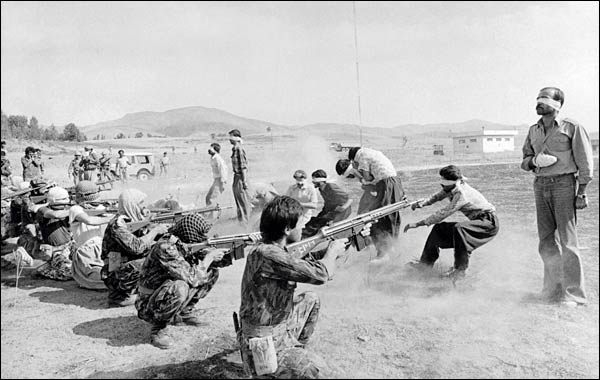
1979: Eleven by a Firing Squad in Iran

On this date in 1979, the only anonymous photograph to win a Pulitzer Prize captured nine Kurdish rebels and two of the Shah’s policemen executed by firing squad in revolutionary Iran.

This shot, one of a series taken of the event with the permission of the judge who condemned the men to immediate death in a half-hour trial at the Sanandaj airfield, ran the next day in the Iranian paper Ettela’at, whose editor prudently kept the photographer’s identity secret. Within two days, the stunning photo had rocketed around the world.

It won the Pulitzer Prize for Spot News Photography the following spring, still credited anonymously.

Two years ago, the Wall Street Journal revealed — with the photographer’s permission — the identity of the man who shot this indelible image: Jahangir Razmi, who had gone on to a career as one of Iran’s top photographic journalists. He came to New York to collect the prize 27 years late.

The article breaking the story is still available on the Journal‘s website, and on the personal site of reporter Joshua Prager. An NPR story discussing the search for Razmi’s identity is here.

On this day..

1305: William Wallace, Braveheart

On this date in 1305, Scottish knight Mel Gibson — er, William Wallace — was hanged, drawn and quartered at Smithfield for treason to a British crown he refused to recognize.

Just like so:

Well, close enough. Some wags have alleged one or two historical liberties in Braveheart.

Among the lesser (but more pertinent here): that they weren’t — you knew this already — offering the former Guardian of Scotland the opportunity to reduce his suffering with a public submission, or use the stage for theatrical defiance. Hanging, drawing and quartering was a brand new execution Edward I was experimenting with for emasculating, disemboweling, and (so the idea went) utterly cowing the rebellious hinterlands of the British Isles. Wallace may have been just the second person to suffer it.

But only a pointy-headed blogger could possibly care when the main point is that back before Christendom succumbed to nancy decadences like Vatican II, men wore woad, defenestrated queers, and tapped top-shelf babes.


Among the few things known for certain about William Wallace is that he did not score with Isabella of France. Or with Sophie Marceau.

Facts? This is show business!

Mel’s bloodbath only riffs the already-fantastic 15th century epic of “the Wallace” by Scottish minstrel Blind Harry, which in turn got a lyrical call-out in Robert Burns’ 18th century Scottish patriotic tune Scots Wha Hae.

National martyrs — and, sure, it helps to die at the right time, as Wallace did just before Robert the Bruce secured Scottish independence — feed a train of hungry authors and ready audiences in every time, place and medium.

However genuinely flesh-and-blood the limbs that wrought his feats and were torn apart on this day, Wallace returns to his generations of interlocutors half-shrouded in mythology. Seven centuries on, his contested (and sometimes absurd) use as precedent or metaphor stakes a claim to his Truth at least as compelling as battlefield tactics at Stirling Bridge. What does he “really” have to tell us? No matter how grisly his end, William Wallace doesn’t get to decide: it’s between you, me, Mel, and a few billion other folks.

Only a character really worth remembering is worth that kind of fictionalizing.

On this day..

1848: Camila O’Gorman and Father Ladislao Gutierrez, for traditional family values

On this date in 1848, a pregnant 20-year-old socialite and her forbidden lover were shot at the order of an Argentine dictator.

Virtually a lens for the contradictory currents of gender, class and power in her time, Camila O’Gorman was the daughter of an elite family of (as her name suggests) Irish extraction, and a bosom friend of the daughter of her future executioner, dictator Juan Manuel de Rosas.

She fell into a torrid affair with Gutierrez, the family priest, and in 1847 eloped with him, a grand gesture of romanticism that brought a government warrant for their capture to “satisfy religion and the law and to prevent further cases of immorality and disorder.”

A scandal, as one might suppose — there was much chatter over who seduced whom, and whether it was a kidnapping — but a manhunt (and womanhunt)? Rosas appears psychotically enraged by two young people crazy in love, and still more so for summarily decreeing their death when he had them in his clutches. Another priest, it turned out, handed them over — more in sadness than in anger, in the manner of such folk, but understanding deep down that the arbitrary law is the law and immorality and disorder don’t go about preventing themselves.

O’Gorman was the first woman executed in independent Argentina, and she was eight months pregnant: the better to “satisfy religion” (though not the law, which forbade the execution of a pregnant woman), O’Gorman’s unborn child was baptized … by making her mother drink holy water.

The lovers were then shot together at the town of General San Martín, then known as Santos Lugares de Rosas.

The pregnant O’Gorman, borne to her firing squad. The image comes from this Argentinian page (in Spanish) about the heroine.

According to this effusively pro-elopers essay,

Camila and Uladislao’s brave sense of freedom upset the structured norms of a society used to obeying through fear. Their only way of facing the tyrannical power was escaping from a society which would never understand. They did not give up on their love to please the Restorer [Rosas], as was expected in those days. They never showed signs of repentment, [sic] on the contrary their peaceful minds reflected their clean consciences.

…

And among the many questions this tragic true story might raise, there’s one that particularly appals [sic] us: why did Rosas shoot Camila knowing the law stated a pregnant woman could not be murdered? Was that baby guilty of his parents’ “crime”?

He evidently was, since by being born he would symbolise the testimony not only of the criminal act, but also the evidence of “disobedience” of a moral code imposed by a fearful dictator.

Such Shakespearean drama ripped from recent history has not failed to inspire literary treatment — such as Enrique Molina’s Una Sombra Donde Suena Camila O’Gorman, (“A Shadow Where Camila O’Gorman Dreams”) and this 19th century Spanish text.

On the screen, O’Gorman and Gutierrez’s doomed love was the topic of one of the first Argentine feature films (a century-old silent film now thought lost), and an Academy Award-nominated 1984 film with plenty of talking:

On this day..

1571: Marco Antonio Bragadin, flayed Venetian

On this date in 1571, the commander of a Venetian garrison was flayed by the Turks.

Marco Antonio Bragadin (English Wikipedia entry | Italian) — or Marcantonio Bragadin — was the captain of Famagusta as an Ottoman Empire near the peak of its power began to wrest Cyprus from eight decades of Venetian control.

The Turks sacked the wealthy Cypriot capital Nicosia in September 1570, slaughtering or enslaving the inhabitants. Bragadin thereupon received an inducement from the invaders to surrender the last Venetian outpost still remaining in Cyprus: the severed head of Nicosia’s general.

Bragadin was having none of it.

Milord pasha of Carmania,

I have seen your letter. I have also received the head of the lord lieutenant of Nicosia, and I tell you herewith that even if you have so easily taken the city of Nicosia, with your own blood you will have to purchase this city, which with God’s help will give you so much to do that you will always regret having encamped here.

The Famagustans didn’t get quite that much help from God, but they forced a dear purchase in blood. For nearly a year, they repelled the siege; starving and exhausted, they at last accepted a merciful surrender only to have the entire garrison slain (the link is in Italian) at the beginning of this month.

The entire garrison, save Bragadin.

Special torments were reserved for the general who had given them such trouble. Executed Today friend Melisende’s Historic Biography post on Bragadin recounts the nauseating Calvary of the Venetian: mutilated, dragged around his fallen fortress, then exposed on the docks for flaying alive. The skin was stuffed with straw and sailed back to Istanbul as a war trophy for the Sultan Selim II.

One can see here, of course, the narrative of East vs. West in a war for civilization itself, although one should observe that the overthrow of Catholic hegemony on Cyprus restored the privileges of the Orthodox church. But the fall of Cyprus was itself the backstory for one of the pivotal naval battles of the age two months later, the Battle of Lepanto, at which a league of Mediterranean powers including Venice decisively checked Ottoman influence at sea, pre-empting a likely invasion of Italy.

Bragadin, for his part, became a potent symbol blending civic and religious martyrdom in what turns out to be (post-Lepanto) a victorious cause. One might say that he fulfilled a need.

Cultures which have drawn nourishment from their legendary martyrs feel a need to prolong the spectacle of their suffering. They hark back to the desire to keep the dying man with them; and the memory of this desire strengthens their tales of holy victimhood, dramatizes them, keeps them alive. Bragadin’s torture was long-drawn-out, and it must be constantly remembered as such.

… Christians’ preoccupation with relics has been complex, enduring and, at times, feverishly obsessive. It has reached high points in moments when Catholic doctrines and practices have felt most dramatically threatened. During Marcantonio Bragadin’s lifetime, and during the period immediately following, Christendom trembled before the encroaching Muslims. In this context, the story of Bragadin’s martyrdom acquired particular potency: not because the Church proclaimed him a saint, but because by analogy, he seemed to bring the ancient Christian matrydoms up to the present. He seemed to make those sufferings real and explicit, lifting them out of their legendary fogginess. Step-by-step, piece-by-piece, he “demonstrates” the martyr’s ordeal, almost as in a manual of suffering.

Nor was the fulfillment merely conceptual. According to this page on Rome tourist destinations, the painting of St. Bartholomew‘s flaying executed for the ancient basilica of Santi Nereo e Achilleo in the 1600 Jubilee alludes directly to the more contemporary event — notice the dark, turban-clad figure on the left.

In 1596, one of the few survivors of Cyprus nicked Bragadin’s hide from Istanbul and returned it to Venice, where it remains today entombed as a relic at the Basilica di San Zanipolo.

On this day..