1833: Captain Henry Nicholas Nicholls, sodomite

On this date in 1833, Captain Henry Nicholas Nicholls was hanged in London for sodomy.

Sodomy — “buggery,” in the more evocative British phrase, often bowdlerized in court records as b-gg–y or the like — was a capital offense in England until 1861, when the penalty was reduced to “merely” life imprisonment.

The London Courier reported the event:

Captain Henry Nicholas Nicholls, who was one of the unnatural gang to which the late Captain Beauclerk belonged, (and which latter gentleman put an end to his existence), was convicted on the clearest evidence at Croydon, on Saturday last, of the capital offence of Sodomy; the prisoner was perfectly calm and unmoved throughout the trial, and even when sentence of death was passed upon him. In performing the duty of passing sentence of death upon the prisoner, Mr. Justice Park told him that it would be inconsistent with that duty if he held out the slightest hope that the law would not be allowed to take its severest course. At 9 o’clock in the morning the sentence was carried into effect. The culprit, who was fifty years of age, was a fine looking man, and had served in the Peninsular war. He was connected with a highly respectable family; but, since his apprehension not a single member of it visited him.

The popular broadside on the case was scarcely more sympathetic. [Here’s another version of the gallow lit]

Even though once or twice a year someone would hang for it and the scandal would send family fleeing his name, Old Blighty still had a vigorous underground gay scene in the 19th century. While Lord Byron was enjoying the easier same-sex access of the Ottoman lands, a friend wrote to him, “that what you get for £5 we must risque our necks for; and are content to risque them.” (Cited here)

Quite accidentally, the senseless destruction this day of a respectable veteran helped set the put-upon gay underground upon its long march towards mainstream acceptance.

A first-person narrative written* in 1833 under the name of Lord Byron (who was in fact nine years dead, but whose queer identity clearly informs the work), Don Leon was a signal piece of literature: the first overt literary defense of homosexuality in English.**

It opens with a scene said to be inspired by Captain Nicholls:

Thou ermined judge, pull off that sable cap!
What! Cans’t thou lie, and take thy morning nap?
Peep thro’ the casement; see the gallows there:
Thy work hangs on it; could not mercy spare?
What had he done? Ask crippled Talleyrand,
Ask Beckford, Courtenay, all the motley band
Of priest and laymen, who have shared his guilt
(If guilt it be) then slumber if thou wilt;
What bonds had he of social safety broke?
Found’st thou the dagger hid beneath his cloak?
He stopped no lonely traveller on the road;
He burst no lock, he plundered no abode;
He never wrong’d the orphan of his own;
He stifled not the ravish’d maiden’s groan.
His secret haunts were hid from every soul,
Till thou did’st send thy myrmidons to prowl,
And watch the prickings of his morbid lust,
To wring his neck and call thy doings just.

The author — whose identity is still debated† — continues writing more or less autobiographically of Byron’s life, and using his illicit desires and lifestyle (with digressions into historical precedent) to defend homosexuality as ultimately natural and harmless.

The tree we plant will, when its boughs are grown,
Produce no other blossoms than its own;
And thus in man some inborn passions reign
Which, spite of careful pruning, sprout again.
Then, say, was I or nature in the wrong,
If, yet a boy, one inclination, strong
In wayward fancies, domineered my soul,
And bade complete defiance to control?

…

Though law cries “hold!” yet passion onward draws;
But nature gave us passions, man gave laws,
Whence spring these inclinations, rank and strong?
And harming no one, wherefore call them wrong?
What’s virtue’s touchstone? Unto others do,
As you would wish that others did to you.
Then tell me not of sex, if to one key
The chords, when struck, vibrate in harmony.
No virgin I deflower, nor, lurking, creep,
With steps adult’rous, on a husband’s sleep.
I plough no field in other men’s domain;
And where I delve no seed shall spring again.

…

Look, how infected with rank disease
Were those, who held St. Peter’s holy keys,
And pious men to whom the people bowed,
And kings, who churches to the saints endowed;
All these were Christians of the highest stamp-
How many scholars, wasting over their lamp,
How many jurists, versed in legal rules,
How many poets, honoured in the schools,
How many captains, famed for deeds of arms,
Have found their solace in a minion’s arms!
Nay, e’en our bard, Dame Nature’s darling child,
Felt the strange impulse, and his hours beguiled
In penning sonnets to a stripling’s praise,
Such as would damn a poet now-a-days.
To this conclusion we must come at last:
Wise men have lived in generations past,
Whose deeds and sayings history records,
To whom the palm of virtue she awards,
Who, tempted, ate of that forbidden tree,
Which prejudice denies to you and me.
Then be consistent; and, at once confess,
If man’s pursuit through life is happiness,
The great, the wise, the pious, and the good,
Have what they sought not rightly understood;
Or deem not else that aberration crime,
Which reigns in every caste and every clime.

…

To this conclusion we must come at last:
Wise men have lived in generations past,
Whose deeds and sayings history records,
To whom the palm of virtue she awards,
Who, tempted, ate of that forbidden tree,
Which prejudice denies to you and me.
Then be consistent, and, at once confess;
If man’s pursuit through life is happiness,
The great, the wise, the pious, and the good,
Have what they sought not rightly understood;
Or deem not else that aberration crime,
Which reigns in every caste and every clime.
…

Statesmen, in your exalted station know
Sins of omission for commission go;
Since ships as often founder on the main
From leaks unstopped as from the hurricane.
Shore up your house; it totters to the base;
A mouldering rot corrodes it; and the trace
Of every crime you punish I descry:
The least of all perhaps is sodomy.

…

I stand a monument, whereby to learn
That reason’s light can never strongly burn
Where blear-eyed prejudice erects her throne,
And has no scale for virtue but her own.

* Don Leon circulated initially in manuscript form, and was not published in England until years later — a known printing in 1866, and possibly another lost edition from before 1853.

** Here lagging well behind France, which had burned only a bare handful of homosexuals under monarchist anti-sodomy laws in the 18th century, and decriminalized homosexuality full stop in 1791. In Philosophy in the Boudoir the Marquis de Sade preened casually triumphant over the bad old days while Lord Byron was still a boy.

We wonder that savagery could ever reach the point where you condemn to death an unhappy person all of whose crime amounts to not sharing your tastes … Nature, who places such slight importance upon the essence that flows in our loins, can scarcely be vexed by our choice when we are pleased to vent it into this or that avenue.

† Candidates include parliamentarian William Bankes, who was arrested for sodomy in 1833 but acquitted later in the year; fellow MP John Cam Hobhouse; and playwright and Byron-idolizer George Coleman.

On this day..

1890: William Kemmler, only in America

On this date in 1890 the iconic symbol of the American death penalty made its grisly debut upon the person of William Kemmler at New York’s Auburn Prison.

The long New World tradition of hanging condemned prisoners came under fire as a barbarism in the late 19th century, leading reformers to look for killing procedures less likely to result in a horrendously protracted strangulation or a midair decapitation. As Empire State Governor David Hill put it,

The present mode of executing criminals by hanging has come down to us from the dark ages, and it may well be questioned whether the science of the present day cannot provide a means for taking the life of such as are condemned to die in a less barbarous manner.

On this stage, Executed Today presents a rogues’ gallery of homo Americanus, the salesmen and swindlers who would help the U.S.A. ride the lightning.

The Dentist

A true renaissance man, Buffalo dentist Dr. Alfred Southwick, applied his active mind to the need to better kill a fellow, and soon hit upon an inspiration — that is to say, a town drunk hit upon an electrical generator and died instantaneously, and the observant Southwick said “eureka!”

Without the subsequent industry of this neglected gentleman, who added to his repertoire scientifically-minded electrical butchery of animals alongside political gladhandings to bring a flutter to a busybody’s heart, the Chair’s entire oeuvre of machismo-sadism might have missed the country altogether. Just imagine living in a world where New York had pioneered its other leading reform alternative: lethal injection.

(This, incidentally, is why the chair is a chair, and not a bed or a stake or a St. Andrew’s Cross: because the guy who thought of it spent all day administering his own tender mercies to seated penitents.)

The Plutocrats

As Southwick nagged his senator and shocked stray cats into the great hereafter, the gears of commerce strove relentlessly ever-onward. The business of America was ever business, and never more so than the Gilded Age.

And the business of killing people was about to become the biggest business there was.

The age of electricity was buzzing into incandescence, and two rival standards were at currents amped over eventual dominance of this stupendous industry. Thomas Edison’s earlier Direct Current (DC) standard was being challenged by Nikolai Tesla’s Alternating Current (AC), backed by the financial muscle of George Westinghouse.

Cheaper and more efficient, AC tilted the playing field against Edison. Seeing his days numbered, the Wizard of Menlo Park fought back the way any dinosaur industry would: dirty.

AC, Edison said, was too dangerous for consumer use — a lurking killer. “Is this what your wife should be cooking with?” And he started taking up traveling road shows zapping large animals with AC to demonstrate the rival product’s deadliness. (This press coined the term “electrocution” from these spectacles.)

This clip of the electric demise of a circus elephant — don’t hit “play” if you’re not up for animal cruelty — is from some years later (Edison kept tilting at windmills and megafauna carcasses as his DC empire disappeared), but it’ll give a sense of the horrifying spectacle.

(Topsy, it should be noted, was being put down as a danger and not strictly for kicks.)

Elephants? Horses? Dogs?

How about a human?

With the New York legislature’s embrace of Southwick’s seated voltage people-eater, Edison turned his PR gears on the state, demanding they adopt his competitor’s “deadlier” current for the contraption. And they did, reflecting a widespread belief inculcated by Edison’s experiments — as this New York Times article on an Edison crony’s public livestock-killing show in the days leading up to the advent of the electrocution law indicates:

The experiments proved the alternating current to be the most deadly force known to science, and that less than half the pressure used in this city for electric lighting by this system is sufficient to cause instant death.

After Jan. 1 the alternating current will undoubtedly drive the hangmen out of business in this State.

Too bad for Edison that the business he was really trying to kill was made of sturdier stuff.

The Alcoholic Vegetable Merchant

As the 1880’s wane, we come at last to our subject — in several senses of the term — an illiterate nobody of German stock who chanced to kill his common-law wife with just the right timing to join in a new kind of experiment.

William Kemmler mounted a “cruel and unusual punishment” appeal against his sentence funded by Westinghouse himself: no dice. Perhaps appreciating the odd foothold on history he was about to attain, he showed little worry as he entered the execution room and sat himself — “undoubtedly the coolest man in the room,” a journalist present reported.

The End of the Beginning

That reporter’s description for the New York Herald graphically captures humanity’s first horrible encounter with this “humanitarian” machine, beginning with the prisoner’s parting remarks.*

Doubtless he knew that his words will go down in history and he had his lesson well learned. He addressed his audience [in] a commonplace way and without hesitation.

…

“Well, gentleman, I wish everyone good luck in this world, and I think I am going to a good place, and the papers have been sa[yi]ng a lot of stuff that isn’t so. That’s all I have to say.”

And so with a parting shot at what he was good enough to refer to not long ago as “those d—d reporters,” William Kemmler took his leave of earth. The quiet demeanor of the man as he entered had made a strong impression on those in the room. His self-possession after his oratorical effort simply amazed them. He got up out of his chair as though he were anxious to try the experiment, not as though he courted death, but as though he was thoroughly prepared for it. …

There was no delay. Kemmler constantly encouraged the workers at the straps with “Take your time; don’t be in a hurry; do it well; be sure everything is all right.” He did not speak with any nervous apprehension.

Warden Durston leaned over, drawing the buckle of the straps about the arm. “It won’t hurt you, Bill,” he said, “I’ll be with you all the time.”

A minute later Kemmler said, “There’s plenty of time.” He said it as calmly as the conductor of a streetcar might have encouraged a passenger not to hurry.

…

Kemmler was pinioned so close that he could hardly have moved a muscle except those of his mouth.

The Warden took a last look at the straps. “This is all right,” he said.

“All right,” said Dr. Spitzka, and then bent over and said, “God bless you, Kemmler.”

“Thank you,” said the little man, quietly.

“Ready?” Said the Warden.

“Ready,” answered the doctors.

“Goodbye,” said the Warden to Kemmler. There was no response.

GAVE THE SIGNAL.

The Warden stepped to the door leading into the next room. It was then forty-three and one-half minutes past six o’clock by the prison clock. “Everything is ready,” said the Warden to some one hidden from view in the next room.

The answer came like a flash in the sudden convulsion that went over the frame of the chair. If it seemed rigid before under the influence of the straps, [it] was doubly so now has it strained against them.

The seconds ticked off. Dr. McDonald, who was holding the stopwatch, said “Stop.”

Two voices near him echoed, “Stop.”

The Warden stepped to the door of the next room and repeated the word “Stop.”

As the syllable [passed] his lips the forehead of the man in the chair [grew] dark [in] color, while his nose, or so much of it as was exposed, appeared a dark red.

There was very little apparent relaxation of the body, however. [A] fly lighted on the nose and walked about unconcernedly. The witnesses drew nearer to the chair.

“He’s dead,” said Spitzka, authoritatively.

“Oh, yes, he’s dead,” said McDonald.

“You’ll notice,” said Spitzka, “the post-mortem appearance of the nose immediately. There is that remarkable change that cannot be mistaken for anything else, that remarkable appearance of the nose.”

The other doctors nodded [assent]. They looked at the body critically for a minute and then Spitzka said, [“]oh, undo that now. The body can be taken to the hospital.”

“Well, I can’t let you gentlemen out of here until I have your certificates,” said the Warden.

FOUND SIGNS OF LIFE.

It was while this businesslike conversation was going on that Dr. Balch made a discovery.

“McDonald,” he cried, “McDonald, look at that rupture,” he pointed at the abrasion of the skin on Kemmler’s right thumb. In the contraction of the muscles the figurehead[?] scraped against it and removed the skin, and from that little [wound] blood was flowing-[an] almost certain indication of life.

A low cry of horror went through the assemblage.

“[Turn] on the current,” excitedly cried Dr. Spitzka. “This man is not dead.”

The crowd fell back from the chair, as though they were in danger. The Warden sprang into the closed door and pounded on it with his hand.

“Start the current!” he cried. As he spoke of fluid began to drop from Kemmler’s mouth and to run down his beard; a groaning sound came from his lips, repeated and growing louder each time.

It seemed [an] age before the card was again turned on. In fact it was just seventy-three seconds from the end of the first contact when the first sound was heard to issue from Kemmler’s lips, and it was not more than a half [minute] before the card was again turned on.

RECOVERING CONSCIOUSNESS.

But every second to that time the horrible sound from those groaning lips was becoming more distinct, [a straining] of the chest against the leather harness stronger and more evident.

The man was coming to life. The spectators grew faint and sick. [Men] who had stood over dead and dying [men] and had cut [men] to pieces without an emotion [grew] pale and turned their heads away.

One witness was forced to lie down while one of the doctors fanned him.

But [the end] came at last. There was another convulsion of the body, and … it became rigid with the rigidity of iron.

“That man wasn’t dead,” cried Spitzka excitedly. As he spoke the body twitched again. The electrician had given the current gain new alternation and now 2,000 volts [were] playing in short, successive shocks down Kemmler spine. The sound ceased with the first convulsion, but the fluid continued to trip from the mouth and down the beard, making the body a sickening spectacle.

“Keep it on now until he’s killed,” said one of the doctors. …

“Keep it on! Keep it on!” Cried Warden Durston through the door.

Silence reigned for a moment. A bell without began to [toll] solemnly. …

BURNED BY THE CURRENT.

Then from the chair came a sizzling sound, as of [meat] cooking on hand. Following it immediately a billow of smoke came from the body and filled the air of the room with the odor of burning hair.

There was a cry from all the members of the little group, and Warden Durston cried through the door leading to the next room to [turn] the current off.

(Also of interest: the New York Times‘ (non-eyewitness) report on the affair.)

More shocking — so to speak — papers ran the next day’s headline “Kemmler Westinghoused,” the verb “to Westinghouse” being another shameless Edisonian bid to stamp his marketing project onto the Queen’s English. This fine, rounded, archaic neologism the right sports anchor could resuscitate as a fresh synonym for thrashing, horsewhipping, poleaxing, or else (in greater justice) for moderation and decency as the only principal in the sordid affair that rejected death-dealing by electricity.

(Officially, Edison also opposed the death penalty. Like Dr. Guillotin, he was doing his part for humanity in the meantime … just with a little skin in the game. Did we mention the business of America is business?)

Westinghouse, for his own part, thought the Kemmler debacle would nip the electric chair in the bud, and he was scarcely the only one.

Official reviews for the “art of killing by electricity” were, ahem, mixed.

“They could have done better with an axe.”**
-George Westinghouse

“Strong men fainted and fell like logs on the floor.”
-New York Herald

“Revolting … a disgrace to civilization.”
-New York Times

“We live in a higher civilization from this day on.”
-Alfred Southwick

Books (remarkably numerous!) about the creation of the electric chair

It should, in fairness, be noted that the U.S. was not the only country (pdf) to mull an electrocution chair in the 19th century … but it was (and for a long time remained) the only one to actually use one.

* The Herald excerpt, along with several other articles from the same paper about the Kemmler execution, is here, but the text has obviously been generated from a scan with uneven results. As I do not have access to the originals, [bracketed] remarks in the excerpt indicate this author’s own interpretations or interpolations of seemingly mistaken transcriptions.

** Some sources make it “would have done better with an axe.”

On this day..

1811: Miguel Hidalgo y Costilla, for Mexican independence

On this date in 1811, Mexican independence icon Miguel Hidalgo was shot for treason at the government palace in Chihuahua.

The subversive priest had set the spark to the Mexican War of Independence in the hours before sunrise of September 16, 1810. There, he rang the parish bell in the small town of Dolores and issued his “Grito de Dolores” — “Cry of Dolores” — summoning native Amerindians and mestizos to throw off the Spanish.

The movement got added juice from the fact that the Spanish jackboot was then being worn by Napoleon, who had installed his brother as king.*

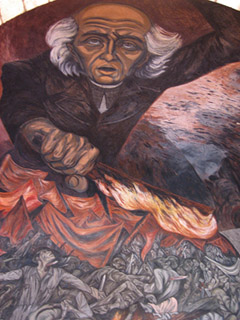
Hidalgo tributes are a mainstay of every Mexican town. This Orozco mural is in a government building in Guadalajara.

Hidalgo’s fired-up downtrodden mob slaughtered the local garrison and gathered numbers on a march towards Mexico City before the professional Spanish soldiery rallied to stop it. But the priest wouldn’t make his father-of-the-country credentials in generalship: he’d been relieved of command after repeated combat debacles by the time the insurrection’s leaders were betrayed in March.**

While his comrades Ignacio Allende, Jose Mariano Jimenez and Juan Aldama were shot on June 26, Hidalgo got an old-school detour through the ecclesiastical arm for defrocking (and a highly suspect alleged retraction).

When he was shot this day, he directed the firing squad to aim for the hand he placed over his heart.

Then, his head was cut off and stuck on a pike as a warning.

The struggle lived on, long past Hidalgo’s execution and Bonaparte’s fall, and finally resulted in Mexican independence in 1820. Today, the padre whose call to action not only started the revolt but made it a mass movement is the face on the 1,000-peso note, and his Grito de Dolores is repeated every Diez y Seis de Septiembre as an independence day tribute by Mexican authorities — as in this from 2006:

* Inspiring this blog’s banner in the process.

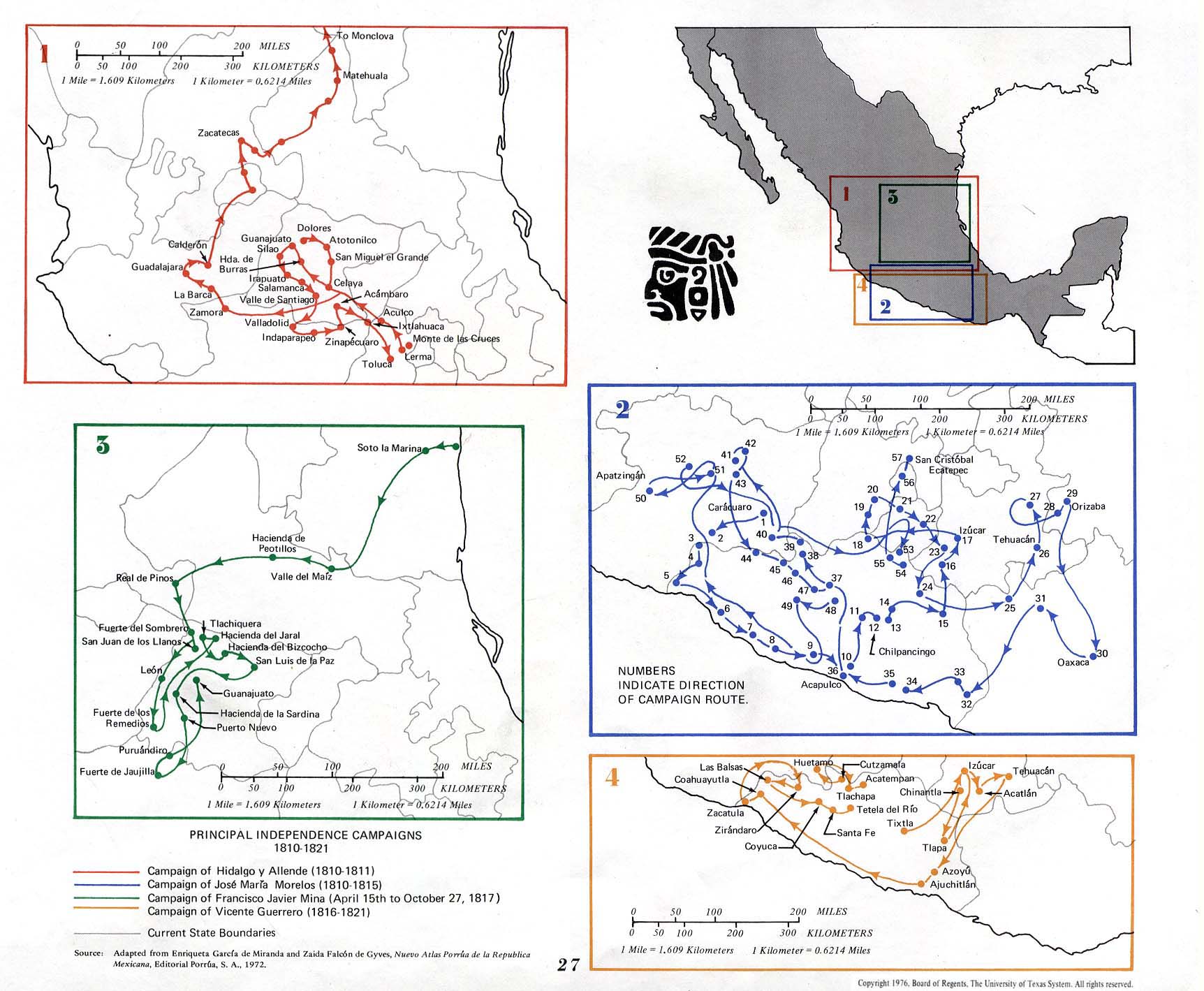
** There’s a map of Hidalgo and Allende’s army’s movements — and subsequent campaigns in the war — here.

On this day..

1794: Maximilien Robespierre, Saint-Just and the Jacobin leadership

On this date in 1794, the curtain — and the blade — fell on the Terror.

Maximilien Robespierre, who had breakfasted the previous day as master of France, was guillotined this evening with his chief lieutenants and partisans.

His fall came as sudden and inevitable as his rise had been unpredictable.

Five years before, Robespierre was an unprosperous Arras attorney of fashionably liberal philosophies, and you wouldn’t have given a sou for the prospects of his being remembered five minutes after he died. Yet it would come that his inseparable lieutenant Saint-Just would remark with understatement, “The words we have spoken will never be forgotten on earth.”

The historic convocation of the Estates-General thrust him onto the political stage where he would make the dread name that follows him, starting off in the Revolution’s inception as a far-left deputy. He took a notable early stand against the death penalty, with several arguments that are quite familiar by our day:

The first obligation of a legislator is to form and preserve public morals, the source of all freedom, source of all social happiness. When in running to a particular goal he turns away from this general and essential goal he commits the most vulgar and dire of errors. The king must thus present to the people the purest model of justice and reason. If in place of this powerful, calm and moderate severity that should characterize it they place anger and vengeance; if they spill human blood that they could spare and that they have no right to spread; if they spread out before the people cruel scenes and cadavers wounded by torture, it then alters in the hearts of citizens the ideas of the just and the unjust; they plant the seed in the midst of society of ferocious prejudices that will produce others in their turn. Man is no longer for man so sacred an object: we have a less grand idea of his dignity when public authority puts his life at risk. The idea of murder inspires less fear when the law itself gives the example and the spectacle. The horror of crime is diminished when it is punished by another crime. Do not confuse the effectiveness of a penalty with the excess of severity: the one is absolutely opposed to the other. Everything seconds moderate laws; everything conspires against cruel laws.

For Robespierre, it was an abomination for the nation to deal out death within its community, but his Rousseauan elevation of the collective and abstract People made extirpating existential threats to the community itself an altogether different matter.

The future tyrant’s anti-death penalty case for executing the deposed Louis XVI, flowing directly from those principles, makes interesting reading and is excerpted at length (all emphases added) here for its topicality:

When a nation has been forced to resort to the right of insurrection it returns to a state of nature as regards its tyrant. How can the latter invoke the social compact? He has annihilated it. The nation can preserve it still, if it thinks fit, in whatever concerns the interrelations of its citizens: but the effect of tyranny and insurrection is to break it entirely as regards the tyrant; it is to throw them into mutual war; the tribunals, the judiciary procedures, are made for the members of the city. … The right to punish the tyrant and that to dethrone him are the same thing. The one does not admit of different forms from the other. The tyrant’s trial is insurrection; his judgment is the fall of his power; his penalty, whatever the liberty of the people demands.

Peoples do not judge like judiciary courts. They pass no sentences; they hurl the thunderbolt. They do not condemn kings: they thrust them back into oblivion; and this justice is not inferior to that of courts. If they arm themselves against their oppressors for their own safety, why should they be bound to adopt a mode of punishing them which would be a new danger to themselves?

…

As for me, I abhor the penalty of death so lavish in your laws, and I have neither love nor hatred for Louis. Crimes only I hate. I have asked the Assembly, which you still call Constituent, for the abolition of the death penalty, and it is not my fault if the first principles of reason seem to it moral and political heresies. But if you never bethought yourselves to invoke them in favor of so many unfortunates whose offenses are less their own than those of the government, by what fatality do you remember them only to plead the cause of the greatest of all criminals? You ask an exception to the death penalty for him alone against whom it can be legitimate! Yes, the penalty of death generally is a crime, and for that reason alone, according to the indestructible principles of nature, it can be justified only in cases when it is necessary for the safety of individuals or the social body. Public safety never demands it against ordinary offenses, because society can always guard against them by other means and make the offender powerless to harm it. But a dethroned king in the bosom of a revolution which is anything but cemented by laws, a king whose name suffices to draw the scourge of war on the agitated nation, neither prison nor exile can render his existence immaterial to the public welfare: and this cruel exception to ordinary laws which justice approves can be imputed only to the nature of his crimes.

It is with regret that I utter this fatal truth. But Louis must die, because the country must live.

“Pity is treason.”

Months later, as head of the Committee of Public Safety — the Orwellian name harkens to the body’s power to judge who lay inside the community and who, lying outside, made war upon it — he would find an inexhaustible fifth column of kindred threats to the Revolution.

But Revolutionary France really was in a war for its survival, against external and internal foes alike. The monarchist for whom crime multiplied upon crime every day after the Tennis Court Oath has the easiest time of this period, for every step brings a new monstrosity. And it is well enough to call Robespierre illiberal, to shudder at his prim and icy persona.

But if the French Revolution’s liberte, egalite, fraternite is a legacy for celebration — as it is to much of the west, and much of the world — one must grapple with the place of this man and his methods.

Merely because they are the paths not taken, one hardly seems entitled to assume that at that tumultuous moment the rule of a constitutional monarchy heir to all the monstrosity of the ancien regime, the government of the Girondins who had launched the nearly fatal war against Austria, or that of Danton‘s haute bourgeoisie would necessarily have delivered France to a better place, or even a different one.

For a Dickens, Robespierre’s Terror is simply the appalling wrong turn of a high-minded movement. For Trotsky, “the Incorruptible”* is the admirable sword of France’s bourgeois revolution who effects the needful task of annihilating the feudal nobility, who presses fearlessly forward seeing that the only alternative is the slide into Bonaparte. Between the two lie many readings of the man.

Whether an aberration, a visionary, or a necessity, he waded a sea of blood for his frightening twins Virtue and Terror.

The fall of 9 Thermidor preceded Robespierre’s execution by a full — and very eventful — day. Arrested by the Convention, he was promptly liberated by his base in the Paris Commune which came within a whisker of overthrowing the Convention at that very moment. Instead, a frantic few hours of marshaling the armed power of the Revolution’s rival claimants to leadership ensued ending in a fray which saw the Robespierrists overpowered.

Robespierre was shot through the jaw in the process of signing an appeal to arms — some say a botched suicide, but a wound from the invading national guard is more generally believed; at any rate, the bloodied document with his signature begun “R-o-” is one of the age’s most arresting historical artifacts.

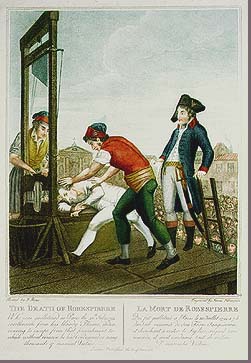
Horrifically injured, he lay most of the following day exposed for public derision before he was hauled with his party to the guillotine, re-erected in the Place de la Revolution for this most memorable execution. In Carlyle’s florid (and free) narration:

Robespierre lay in an anteroom of the Convention hall, while his Prison-escort was getting ready; the mangled jaw bound up rudely with bloody linen: a spectacle to men. He lies stretched on a table, a deal box his pillow; the sheath of the pistol is still clenched convulsively in his hand. Men bully him, insult him: his eyes still indicate intelligence; he speaks no word. … -O reader, can thy hard heart hold out against that? His trousers were nankeen; the stockings had fallen down over the ankles. He spake no more word in this world.

…

Fouquier had but to identify; his Prisoners being already Out of Law.** At four in the afternoon, never before were the streets of Paris seen so crowded. From the Palais de Justice to the Place de la Revolution … it is one dense stirring mass; all windows crammed; the very roofs and ridge-tiles budding forth human Curiosity, in strange gladness. … All eyes are on Robespierre’s Tumbril, where he, his jaw bound in dirty linen, with his half-dead Brother, and half-dead Henriot, lie shattered; their “seventeen hours” of agony about to end. The Gendarmes point their swords at him, to show the people which is he. A woman springs on the Tumbril; clutching the side of it with one hand; waving the other Sibyl-like; and exclaims: “The death of thee gladdens my very heart, m’enivre de joie;” Robespierre opened his eyes; “Scelerat, go down to Hell, with the curses of all wives and mothers!” — At the foot of the scaffold, they stretched him on the ground till his turn came. Lifted aloft, his eyes again opened; caught the bloody axe. Samson wrenched the coat off him; wrenched the dirty linen from his jaw: the jaw fell powerless, there burst from him a cry; — hideous to hear and see. Samson, thou canst not be too quick!

Samson’s work done, there bursts forth shout on shout of applause. Shout, which prolongs itself not only over Paris, but over France, but over Europe, and down to this generation. Deservedly, and also undeservedly. O unhappiest Advocate of Arras, wert thou worse than other Advocates? Stricter man, according to his Formula, to his Credo and his Cant, of probities, benevolences, pleasures-of-virtue, and such like, lived not in that age. A man fitted, in some luckier settled age, to have become one of those incorruptible barren Pattern-Figures, and have had marble-tablets and funeral-sermons. His poor landlord, the Cabinet-maker in the Rue Saint-Honore, loved him; his Brother died for him. May God be merciful to him, and to us!

Part of the Themed Set: Thermidor.

* Even his enemies agreed — sometimes adding it to the bill of particulars against him — that Robespierre lived a life of personal moderation; he lived as a boarder with a working-class family, and disdained to avail the politician’s typical harvest of political graft.

** The Convention had decreed Robespierre’s outlawry when he escaped custody; his immediate execution was, of course, akin to the logic he had once turned against the king.

On this day..

1794: The last cart of the Terror, not including the Marquis de Sade

July 27th, 1794 — the 9th of Thermidor, year II — is inscribed in history as the day Robespierre fell, when a parliamentary coup d’etat between the right and the remnants of the parties he had destroyed shouted him down as he readied the National Convention for his next purge.

This scene from the multinational bicentennial epic La Revolution Francaise conflates the events of 8 Thermidor — when Robespierre delivered a menacing two-hour address but provoked outcries by failing to name the deputies he implicated in “conspiracy” — and 9 Thermidor, when Robespierre’s lieutenant Saint-Just was shouted down from the podium and Robespierre ended up staggering through the benches appealing against the imprecations of his colleagues as his arrest is decreed.

Even as the month of Thermidor’s eponymous epochal event was unfolding, the daily gears of Revolutionary justice were turning: the usual haul of unfortunates condemned, including seven women from the previous day’s batch of Saint Lazare prison conspirators who had pled their bellies to buy a day.

That day was one day too little.

Stanley Loomis is overtly hostile to the Revolution, but his middlebrow sensibilities are well-tuned for the pathos of the scene:

Indifferent to the storms that were raging in the Convention, the Revolutionary Tribunal continued to go about its implacable business with cold efficiency. The arrest of its President [the Robespierrist Rene-Francois Dumas (the link is French), who was taken in the courtroom] startled no one. Since its inception that court had been witness to too many dramas to be astonished any further. Dumas quietly departed; the trials continued. Forty-two prisoners were sentenced to death. By four o’clock their hair had been cut and they were ready to be sent on their way. But Samson, aware of disturbances in the St. Antoine quarter of the city, suggested to [prosecutor] Fouquier[-Tinville] that the executions be deferred until the morrow.*

“Justice must take its course,” snapped the Public Prosecutor. “Do your work.”

And so the last “batch” lumbered off in the direction of the Faubourg St. Antoine and the Place de la Nation. With the exception of the Princesse de Monaco, they were nearly all obscure and humble members of the petite bourgeoisie. Hanriot, waving his sabre, conducted the procession to the place of execution. By seven o’clock that evening, as the minutes of the military escort poignantly show, the unfortunate victims, who had been so close to deliverance, had all been executed.

Henriot proceeded directly from his escort service to the Convention to liberate Robespierre for the night’s brief pitched battle against the Convention, and here we take our leave of them, for now. We shall meet both of them on the scaffold tomorrow.

Not on the wagon** with the Princess of Monaco was a man whom Loomis would have pitied rather less.

The bloated, penniless 54-year-old fruit of an ancient noble house, Donatien Alphonse François de Sade, Marquis de Sade had, in the most recent chapter of his astounding career, navigated the Revolution in the improbable guise of a proletarian section head and revolutionary tribunal judge, until his own arrest late the previous year.

This day, de Sade’s name was on a list of prisoners to be seized from Madelonnettes Prison — “Sade, former count, captain of Capet’s guards in 1792, has corresponded with enemies of the republic,” it said — which he had occupied until a recent transfer to Picpus, a monastery converted into a prison adjacent to the guillotine’s place at the Place de la Nation. Whether the result of another of the many bureaucratic snafus we’ve witnessed this week or a well-placed bribe from his friend and/or mistress Marie-Constance Quesnet, the guards were in the wrong place, didn’t find him, and didn’t care to dig any further.

Three months later, he was — for the last time in his life — a free man.

One could hardly say that the Revolution made the author of Justine the man he so (in)famously was — but having lived within sight of the blade that might any day be called upon to chop off his own head, and the entire tableau of the years preceding, left their impression. Hundreds of bodies from the Terror were stuffed in the unpropitious clay of the makeshift jail’s yards under de Sade’s cell. “Those few months in the shadow of the guillotine did me more harm than all the years of my incarceration under the King,” he wrote a friend.

According to Writing the Orgy: Power and Parody in Sade, Revolutionary France would inexorably influence his subsequent work,

strangely mixing real memories with very Sadean embellishments … Plots, betrayals, denunciations, beheadings: these fictional motifs and Sadean phantasies are linked with the reality and the imaginary of the Revolution.

Good for what ails you.

* Sanson’s diaries — a memoir of the family business constructed by the famous executioner’s grandson — leave off before the events of Thermidor and suggest that the hecatombs of the Terror were taking their toll on the aging headsman. Other accounts of this day have the tumbrils stopped in the streets by clemency-inclined onlookers, only to be forcibly extricated by Henriot.

** Also not (really) on the cart: the fictional occultist Zanoni, who is beheaded in this batch in the novel of the same title by legendary awful writer Edward George “it was a dark and stormy night” Bulwer-Lytton.

Part of the Themed Set: Thermidor.

On this day..

1794: Loizerolles and others for the Conspiracy of the Prisons

On this date in 1794, the Jacobin government struck what would prove to be its last blow against the “Conspiracy of the Prisons.”

The “conspiracy” was really a cover story for Robespierre‘s boys to wield their purifying torch against prisons and (of course) tighten the grip of authority by wild reference to treasonable plots abroad.

Supposedly, the prisons had birthed a scheme to effect a mass escape further to some sort of counterrevolutionary insurrection, or assassination of Robespierre. Marvelously, these conspiracies simultaneously spanned most all of Paris’ prisons, and their “authors” formed a dominant demographic among the Terror’s last tumbrils as the authorities purged each prison in turn.

While we have tarried to profile select victims individually this week, we have in fact repeatedly met so-called prison conspirators.

Luxembourg Prison — whose warders had concocted the earlier “conspiracy” involving Camille Desmoulins’ wife — had been purged repeatedly earlier in the month; its last spasm swept up the Noailles women.

An efficient detour to the Carmelite Monastery converted by revolutionary Paris into another gaol netted Alexandre de Beauharnais.

And the first batch of St. Lazare Prison felled Andre Chenier, where, as elsewhere, dozens were punished for some impressively villainous designs.

Being convicted of having declared themselves the enemies of the republic, by keeping up communications with the enemies of the state; by furnishing them with assistance; by participating in the plots, conspiracies, and assassinations of the tyrant and his wife, against the people; by conspiring in the maison d’arret (lock-up house), called Lazare, to escape, and to dissolve, by the assassination and murder of the representatives of the people, and more especially of the members of the committees of public safety and general security, the republican government, and to re-establish royality; — in fine, by wishing to destroy the unity and indivisibility of the republic.

(The march of the penal inquisitors through the plots is covered in a French Wikipedia page.)

Charles-Louis Muller’s 19th century painting of the Saint Lazare Prison “conspirators” being summoned to their doom. Seated in the center is Andre Chenier.

Each of these famous figures is a noticeable face among dozens of hapless wretches, largely drawn from the Third Estate and often laughably implausible escape artists and assassins — such as, among this day’s victims, an 80-year-old priest. The most poignant fate among the many forgotten threads threads of life clipped short is undoubtedly one Jean Simon Loizerolles, who was imprisoned with his son.

On the 7th Thermidor, about four o’clock, p.m., the bailiff of the tribunal presented himself at the prison with the mortuary list, or, in other words, the death-warrant.

Loizerolles was called for: it was Loizerolles, junior, whom death surrounded. Loizerolles, the father, did not hesitate to present himself; and, comparing his sixty-one years to the twenty-two years of his son, he determined to give him life a second time: the father went down, and was conducted to the Conciergerie.

He there received the bill of accusation, drawn up by order of the Committee of Public Safety, and headed Prison Conspiracy.

This bill bore the name of Loizerolles, junior.

The next day the father appeared for examination, with his twenty-five companions of misfortune.

The bill of accusation, which was joined to the depositions, stated that it was Francois Simon Loizerolles, junior, aged twenty-two.

The declaration of the sentence, prepared in anticipation upon the bill, bore the same designations. The recorder contented himself with effacing the name of Francois, and putting above it Jean.

Finally, the questions submitted, for the sake of form, to the jury, and drawn up in anticipation upon the same bill of accusation, contained the names and the designation mentioned in the accusation. But, at the time of the trial, when the charge was made to the jury, Coffinhal took care to efface the name of Francois, to substitute that of Jean, and to erase te word son, which was replaced by the word father. He rudely altered the two figures from twenty-two to sixty-one, and added the former profession of the father, which the accusation did not state.

And Jean Simon Loizerolles, against whom there was no accusation, was put to death on the 8th Thermidor.

Loizerolles is renowned for nothing in life save the touching valor of his death, but his name was a watchword for paternal devotion in France in the 19th century; Jadin wrote a short opera to his honor, and Victor Hugo references Loizerolles (bizarrely side by side with Robespierre’s younger brother) in Les Miserables as the sort of paragon of loyalty disdained by a gauche skeptic. But the gambit worked: Loizerolles junior survived the last days of the Terror, and was later pensioned by Charles X.

For every triumph, there were countless tragedies. The prisoners had wind of the enterprise to decimate their number days before; an anonymous account printed here (also the source of the Loizerolles story) describes a ramping-up of abuses great and petty in an effort to provoke a rising that would license a bloodbath, and the fear and desperation of the prisoners as death circled them.

Our melancholy and dejected hearts prepared themselves for death. The prison appeared surrounded by a funeral veil, and the death-like silence which pervaded it produced a dreadful feeling of misery in its inmates. Games and amusements were banished from the grounds, and our cadaverous countenances afforded an index of our afflicted souls; the refectory, which was wont to inspire a sentiment of cheerfulness, became a meeting of moving spectres, who quitted each other without exchanging a word.

…

The prisoners at St. Lazare could no longer indulge in illusions on the fate that awaited them … old age and infancy had ceased to be respected; all were alike condemned as guilty of the project of escape; and the man who was the most harmless and the most devoted to his country was no longer exempt from accusation.

But there was a small favor: a third repetition of the scene was postponed two days, which turned out to be all the difference between life and death.

[T]he Robespierrists, delighted in perpetuating our terrors, announced that the tragic scene would be renewed on the 10th.

The two days which we passed in anticipation of our destiny were two days of unmitigated agony: a general mourning reigned through our asylum; our eyes, in fancy, beheld on all sides the palpitating and struggling bodies of the victims of Robespierre, and of the villainy of his agents; tranquility quite abandoned us; death was hovering over our heads; and the prison appeared, to our diseased fancies, like a sea of blood, on which we had suffered shipwreck …

In this deplorable situation we saw no end to our sorrows but in death; and, however terrifying the grim visitant may naturally be, yet we deemed his arrival too long delayed, and invoked his coming, while we regretted that we had not been of the number of the first victims. When, about ten o’clock, p.m., of the 9th Thermidor, it was reported in the prison, that Robespierre was formally accused, the news, which had been brought by three new prisoners from without, inspired distrust, and savoured too much of the miraculous to be easily believed.

…

The following morning … the information was confirmed … in such a positive and circumstantial manner that we could no longer entertain a doubt of its truth.

It may easily be conceived how sudden was the change which was effected in the prison of St. Lazare: the prisoners began, for the irst time, since the 5th, to breathe more freely; their hearts, which had been so long cast down, received a fresh inspiration; their countenances cleared up; the full use of their suspended faculties was restored; and the images of death, which had affrighted them, were dissipated; and if they could have forgotten the assassination of their companions, they might have entirely lost the recollection of their misfortunes.

The death of Robespierre, and the close of his dark crimes, were the subject of an epigram, which an individual wrote upon the wall; it describes the monster too accurately, not to find a place here:

Il s’abreuva du sang d’un million de victimes, —
Il parla de vertus, et commit tous les crimes.

A thousand victims slaked his thirst for blood,–
He spoke of virtues while he swam in crimes.

Part of the Themed Set: Thermidor.

On this day..

1794: Andre Chenier, poet

On this date in 1794, proto-Romantic poet Andre Chenier went to the guillotine the unfortunate victim of his father’s love.

In the operatic version of this Istanbul-born poet‘s life story, Chenier is accused by a rival in love, convicted, and guillotined the next day together with his beloved Maddalena, who effects a Sydney Carton-like swap into the lot of the condemned in order to share his fate.

Chenier’s real end was both more mundane, and far more tragic.

A revolutionary of the constitutional monarchist variety and an open opponent of the Jacobins bold enough to compose an ode to Marat’s murderess, Chenier had spent a year staying out of sight when the police picked him up almost accidentally.

Prisoners suffocating in the Paris jails were suspended horribly between life and death, but the anonymity of this living tomb offered — as with Tom Paine — a measure of occasional safety.

When Chenier’s father blunderingly appealing to the authorities for his son, he accidentally stripped away that anonymity. Chenier had been under lock and key for three-plus months — writing, the whole time, in minuscule letters on scraps of paper he arranged to have smuggled out to his father — but once reminded of the writer’s existence, the authorities promptly had it snuffed out. (A friend and fellow poet, Jean-Antoine Roucher, shared his tumbril.)

Chenier’s prison verses are among the most affecting of his 32 years — like the acidic Iambes blistering his persecutors, and the heartbreaking “La Jeune Captive”, in which he gives voice to the young fellow-prisoner who has smitten him, excerpted here:

Mon beau voyage encore est si loin de sa fin!
Je pars, et des ormeaux qui bordent le chemin
J’ai passé les premiers à peine.
Au banquet de la vie à peine commencé,
Un instant seulement mes lèvres ont pressé
La coupe en mes mains encor pleine.

Je ne suis qu’au printemps, je veux voir la moisson;
Et comme le soleil, de saison en saison,
Je veux achever mon année.
Brillante sur ma tige et l’honneur du jardin,
Je n’ai vu luire encor que les feux du matin:
Je veux achever ma journée.

Chenier was not broadly published or extremely well-known in his own lifetime; many critics think he was pinched out while still maturing. The poet himself told a friend in parting, “I leave nothing for posterity; and yet, (touching his forehead) I had something there.” In the backstory to one of the tales in Balzac’s La Comedie Humaine, a grocer who annoys one of Robespierre‘s associates is also among this day’s batch and arouses more notice than the man of letters:

Though Descoings died, he had the honour, at any rate, of going to the scaffold with Andre de Chenier. There, no doubt, grocery and poetry embraced for the first time in the flesh; for they have always had, and will always have, their private relations. Descoings’ execution made a far greater sensation than Andre de Chenier’s. Thirty years elapsed before it was recognised that France had lost more by Chenier’s death than by that of Descoings.

Robespierre’s sentence had this good result — until 1830 grocers were still afraid of meddling in politics.

The salutary effect upon grocers has long faded, but Chenier’s reputation has steadily ripened like wine since his demise. And the title part of the late-19th century opera Andrea Chenier — however scant its resemblance to the man who inspired it — is one of the most gorgeous tenor roles in opera.

Part of the Themed Set: Thermidor.

On this day..

1944: Col. Claus Schenk Graf von Stauffenberg, for the plot to kill Hitler

Minutes after midnight this date in 1944, four senior Wehrmacht officers who had come within an ace of murdering Adolf Hitler less than 12 hours earlier were summarily shot in Berlin — the first of thousands executed for the most famous assassination attempt on the Fuhrer.

One of those rare moments where historical epochs (arguably) turn on the minutest exigencies of chance, the so-called July 20 plot had seen Col. Claus Schenk Graf von Stauffenberg insinuate a bomb into Hitler’s conference room in modern-day eastern Poland, then fly back to Berlin to mount a coup d’etat.

Blam

Stauffenberg had every reason as he left Wolfsschanze to believe the devastating blast at 12:42 p.m. must have killed the Nazi dictator. Little did he know that another officer at the table where the high command was plotting strategy for the eastern front had, in the name of legroom, shifted the deadly satchel to the other side of a heavy oak table support — shielding Hitler from the brunt of the explosion.

Four men died. Hitler had hearing loss, an injury to his right arm, and one hell of a grudge.

Stauffenberg weaseled out of the confused bunker and flew back to Berlin, expecting that his confederates were even then launching Operation Valkyrie — a contingency plan for martial law in the case of civic disturbance that the conspirators intended to use to mount a coup.

Failure to Communicate

Control and distribution of information was not the least of the many threads in the tapestry of July 20, 1944. Hitler had risen to power on his artful grasp of propaganda; today, his headquarters’ mastery of communications would overpower the putschists’ rank amateurism.

While en route, Stauffenberg had no ability to communicate to the wider world. Landing in Berlin three hours after the not-quite-deadly-enough blast at Wolfsschanze, he must have been stunned to find that Valkyrie had not been launched. Apparently, fragmentary reports from the east were unclear as to whether Hitler had survived; everyone was reluctant about committing himself.

Frantically, Stauffenberg — already deeply committed — rallied his comrades and set the treasonable gears into motion. But by this time, communications with Hitler’s headquarters had been re-established and contradictory reports of the assassination attempt’s success were flying in Berlin. Stauffenberg’s sincere but incorrect eyewitness testimony of Hitler’s death became increasingly untenable. Compounded by the sluggish and ill-coordinated action of the conspirators, officers of a more opportunist bent soon began lining up with the bad guys.

Joseph Goebbels, the senior Nazi in Berlin and Hitler’s wizard of public relations, was inexplicably left unmolested for hours — long enough to phone the radio station (also never seized) an announcement of Hitler’s survival. “To think that these revolutionaries weren’t even smart enough to cut the telephone wires! My little daughter would have thought of that.”

Conspirators’ orders to military units around Berlin went out late, piecemeal, and far too often fell on ears already deaf to the appeals. In some cases, the proclamations that should have been queued up for inundating the airwaves instantaneously were with some other officer not on the scene, and consequently were haphazardly redrafted on the fly — for telex operators who had caught the day’s drift themselves and intentionally delayed or ignored them.

From the perspective of a radio editor it was tragic. Tragic because the way in which details were handled made it obvious that this revolt had had very lithe chance of succeeding. (Source)

The coup fell apart almost as soon as it began.

Fromm Here to Eternity

Most decisively of all, timely information had prevented any participation by Gen. Friedrich Fromm, Stauffenberg’s commanding officer and the head of the Reserve Army — it was that position that allowed his aide access to Hitler’s person, and it was under his authority that the putschists were issuing their Valkyrie orders.

Fromm fell in the “opportunist” camp, and would have been ready to strike had the Fuhrer been demonstrably killed. But a telephone connection straight from the scene of the crime assured him that Hitler had survived … and that his adjutant was a wanted man.

Fromm the potential collaborator quickly turned the tables on Stauffenberg and company late on the night of the 20th.

The Schwein Abides

Before advancing to our heroes’ foreordained fate, take a moment to appreciate this newsreel rushed into production to assure the German public that everything was under control. It’s an impressive advance on statist slick-talking from Germany’s World War I clunkers (like this):

Notice Hitler greeting Mussolini — the two had been scheduled to meet that day; it would be their last encounter in this world. His maimed right arm hanging concealed beneath a greatcoat, Hitler shakes left-handed.

Shoot First, Ask Questions Later

Now that Fromm saw which way the wind was blowing, he acted with alacrity: many executions in the days to come were the product of Hitler’s vengeance, but this night, Claus von Stauffenberg, Albrecht Mertz von Quirnheim, Friedrich Olbricht, and Werner von Haeften were shot on Fromm’s orders for Fromm’s benefit. Here’s Shirer’s description of the fatal scene:

Fromm … had quickly made up his mind to eliminate these men and not only to cover up the traces — for though he had refused to engage actively in the plot, he had known of it for months, sheltering the assassins and not reporting their plans — but to curry favor with Hitler as the man who put down the revolt. In the world of the Nazi gangsters it was much too late for this, but Fromm did not realize it.

He … announce[d] that “in the name of the Fuehrer” he had called a session of a “court-martial” (there is no evidence that he had) and that it had pronounced death sentences on four officers: “Colonel of the Genera Staff Mertz, General Olbricht, this colonel whose name I no longer know [Stauffenberg, his aide], and this lieutenant [Haeften].”

…

In the courtyard below in the dim rays of the blackout-hooded headlights of an Army car the four officers were quickly dispatched by a firing squad. Eyewitnesses say there was much tumult and shouting, mostly by the guards, who were in a hurry because of the danger of a bombing attack — British planes had been over Berlin almost every night that summer. Stauffenberg died crying, “Long live our sacred Germany!”

The courtyard of the Bendlerblock on modern-day Stauffenbergstrasse in Berlin, where Col. Stauffenberg and three compatriots were shot. Photo by Daniel Ullrich, licensed by CC-by-sa.

Minutes after they died, the SS arrived on the scene and forbade any further executions of potential witnesses.

Fromm’s gambit didn’t work any better than Stauffenberg’s had: he was arrested right away, and was himself later shot.

What If?

While the afternoon’s theatrics may have been doomed from the moment Hitler arose unkilled from the bomb’s debris, his miraculous escape from death — “confirmation of the task imposed upon me by Providence,” he told the nation in a radio address an hour after Stauffenberg’s execution — is an inexhaustible mine for historical hypothesizing.

That the bomb could have, and would have with the least change in the principle variables, slain the dictator is widely accepted; a 2005 reconstruction of the blast scene by the Discovery Channel supports that belief in the context of the cable-documentary-friendly format* of Adolf Hitler plus slow-mo explosives. (Parts 1, 2 and 3 of this series set up the episodes excerpted here with the plot’s historical background and the crew’s investigation into the precise dimensions of the blast space — a combination of file footage, modern recreation shots, talking heads, and tromping about the forest in the modern remains of Wolfsschanze.)

But that’s the easy what-if.

More problematic — and well into the realm of bar-stool dickering — are the questions of what would have happened if the explosive had hit its target.

Stauffenberg enjoys latter-day popularity in Germany — the street where he was shot bears his name — in no small measure because of the confessedly quixotic nature of the attempted murder. Indeed, he probably died at the height of his potential popularity for history.

But it’s not for nothing that this attempt (though it did have many botched antecedents) took place in the weeks when Germany’s military position went from desperate to disastrous. Over the preceding two months, Soviet offenses had pushed the front back to the prewar Polish border, and the Normandy landing had opened a rapidly expanding western front. The assassination had a healthy dose of self-interest … and therefore was at least potentially antithetical to other interests at play in the great conflagration.

The motivation of sparing the Fatherland the ravages of war on its own soil is not ignoble of itself, of course. But given this opposition circle’s years-long failure to take effective action against Hitler while he went from successful crime to successful crime, one might ask a little more than a late-breaking suicidal gambit for unreserved historical vindication.

The German military’s deal with the devil had seen Europe’s greatest armed forces squandered by its dumbest commander. The end result would bleed the Nazi state white at unspeakable human cost … but also, arguably, towards one of the better postwar outcomes imaginable.

And would the coup even have achieved the goal of leaving Germany unoccupied? It seems impossible to think that any outcome would have been worse than Hitler, and the last year of the war was also its bloodiest … but among the spectrum of counterfactual alternatives, the appealing possibilities mostly seem to work out in spite of the plotters, rather than because of them.

1. Civil War?

Countercoups, or even outright civil war, might very likely have erupted between rivals for succession. This might have worked out as the best-case situation — fragmenting German resistance and hastening the inevitable — but it might also have given Germany a leaner, meaner fascism with a path to enduring long-term. Predicting any particular arrangement of players to emerge from this black box is a just-so story, and any of them probably leads to one of the other three alternatives; certainly the plotters weren’t banking on their own subsequent overthrow.

2. Status Quo Ante?

The coup might have utterly failed to obtain peace. German was close to defeat; the Allies were demanding unconditional surrender, and the entire point of the plot was to surrender on better terms than that. Had no quarter been offered, the putschist government might then have fought on (either by choice, or by the compulsion of internal politics) to much the same end, although quite plausibly with much less gratuitous bloodletting in the camps. Accidentally abating the Holocaust would be a very significant plus, of course, but probably not what posterity has in mind when it goes naming streets for the man.

3. World War Against Russia?

The new government might have successfully made peace with the western Allies, which was its fervent hope. Under the circumstances of the summer of 1944, that practically implied the continuation of the global war with the capitalist and fascist powers aligning against the USSR. The horrors of the eastern front up to the summer of 1944 then would likely pale in comparison to what followed. You could tell the story so that it all works out in the end, but replacing the long Cold War with an immediate hot war, especially with the United States less than a year away from its first successful A-bomb test, isn’t exactly a presumptive improvement.

4. 1918 Redux?

In the all but unimaginable case that the post-Hitler government successfully sued for peace on both its fronts (or accepted unconditional surrender), it would have had to give up to a Soviet buffer zone much of what the Soviets ultimately conquered. Millions who died fighting for it, and millions more who died in concentration camps while the fighting played out, and millions of women raped by the conquering Red Army, would have considered that arrangement an improvement; still, the peace itself could have ensconced a less crazy and therefore more durable military dictatorship in central Europe, which wouldn’t necessarily seem like an altogether positive outcome vis-a-vis the actual postwar history. More worryingly, this might have horribly recapitulated the post-World War I scenario in which the liberal politicians who accepted defeat, and not the crazed reactionaries who caused it, were blamed for the loss, fueling the subsequent rise of some unattractive revanchist successor state. Precisely because that example would have been uppermost in the officers’ own minds, it’s hard to believe this least-bloodthirsty path would have been the actual consequence of the coup.

And so on …

Second-order effects from any of these possibilities generate a novelist’s trove of alternative histories. What would the map of eastern Europe have looked like? Whither European Jewry … and therefore the postwar state of Israel … and therefore the political chessboard in the Middle East? What would an early resolution in Europe have meant for the Pacific theater, or for the Chinese revolution? How would decolonization movements have been affected had the war concluded earlier, or had it transformed into a worldwide anti-Communist war?

Postscript

Somewhere in those alternate realities, staff at the re-education camp are bantering over happy hour about what would have happened if Stauffenberg had failed.

Who knows if “internally peacable European social democracies” are a bullet point for the pie-eyed optimists, or the incorrigible pessimists?

A few of the books about Stauffenberg and Operation Valkyrie

Poor Col. Stauffenberg is due to be played by a smirking Tom Cruise in the biopic Valkyrie, a role that has drawn some slightly overheated controversy in Germany over Cruise’s adherence to Scientology.

* And, let’s face it, blog-friendly, too.

On this day..

1514: György Dózsa, Transylvanian Braveheart

On this date in 1514, the leader of a Hungarian peasant uprising that scared the ermine robes off the feudal nobles met a punishment from the unspeakable depths of their medieval imaginations.

While Marki Sandor’s 1913 biographical treatment of this character — also rendered Georghe Doja or Dosa, or as György Székely for his native soil — is available online, it seems to be available only in Hungarian.

Since readily-accessible non-Magyar sources such as Dozsa’s Wikipedia page all appear to spring root and branch from the public domain edition of the 1911 Encyclopedia Britannica … well, who is Executed Today to buck the trend? (Some paragraph breaks added for readability.)

GYORGY DOZSA (d. 1514), Hungarian revolutionist, was a Szekler squire and soldier of fortune, who won such a reputation for valour in the Turkish wars that the Hungarian chancellor, Tamas Bakocz, on his return from Rome in 1514 with a papal bull preaching a holy war in Hungary against the Moslems, appointed him to organize and direct the movement.

In a few weeks he collected thousands of so-called Kuruczok (a corruption of Cruciati), consisting for the most part of small yeomen, peasants, wandering students, friars and parish priests, the humblest and most oppressed portion of the community, to whom alone a crusade against the Turk could have the slightest attraction.

They assembled in their counties, and by the time Dozsa had drilled them into some sort of discipline and self-confidence, they began to air the grievances of their class. No measures had been taken to supply these voluntary crusaders with food or clothing; as harvest-time approached, the landlords commanded them to return to reap the fields, and on their refusing to do so, proceeded to maltreat their wives and families and set their armed retainers upon the half-starved multitudes. Instantly the movement was diverted from its original object, and the peasants and their leaders began a war of extermination against the landlords.

By this time Dozsa was losing control of the rabble, which had fallen under the influence of the socialist parson of Czegled, Lorincz Meszaros. The rebellion was the more dangerous as the town rabble was on the side of the peasants, and in Buda and other places the cavalry sent against the Kuruczok were unhorsed as they passed through the gates. The rebellion spread like lightning, principally in the central or purely Magyar provinces, where hundreds of manor-houses and castles were burnt and thousands of the gentry done to death by impalement, crucifixion and other unspeakable methods.

Dozsa’s camp at Czegled was the centre of the jacquerie, and from thence he sent out his bands in every direction, pillaging and burning. In vain the papal bull was revoked, in vain the king issued a proclamation commanding the peasantry to return to their homes under pain of death. By this time the rising had attained the dimensions of a revolution; all the feudal levies of the kingdom were called out against it; and mercenaries were hired in haste from Venice, Bohemia and the emperor.

Meanwhile Dozsa had captured the city and fortress of Csanad, and signalized his victory by impaling the bishop and the castellan. Subsequently, at Arad, the lord treasurer, Istvan Telegdy, was seized and tortured to death with satanic ingenuity. It should, however, in fairness be added that only notorious bloodsuckers, or obstinately resisting noblemen, were destroyed in this way. Those who freely submitted were always released on parole, and Dozsa not only never broke his given word, but frequently assisted the escape of fugitives. But he could not always control his followers when their blood was up, and infinite damage was done before he could stop it.

At first, too, it seemed as if the government were incapable of coping with him.

In the course of the summer he took the fortresses of Arad, Lippa and Vilagos; provided himself with guns and trained gunners; and one of his bands advanced to within five leagues of the capital. But his halfnaked, ill-armed ploughboys were at last overmatched by the mailclad chivalry of the nobles. Dozsa, too, had become demoralized by success. After Csánad, he issued proclamations which can only be described as nihilistic. His suppression had become a political necessity.

He was finally routed at Temesvar* by the combined forces of Janos Zapolya and Istvan Bathory.

The radicalism of this revolt is not to be downplayed; Friedrich Engels’ The Peasant War in Germany, reports that Dozsa declared a republic and abolished nobility.

As with his French predecessor Guillaume Cale, his punishment would demarcate the feudal order by horrifically mocking its victim’s pretension to political authority. This description of Dozsa’s unenviable end comes from The History of Hungary and the Magyars, a 19th century text available free at Google Books, beginning with :

[After hearing his sentence, Dozsa] exclaimed — addressing the crowd whom he saw shuddering at his approaching doom — “Come back tomorrow, you miserable slaves, and see if I shrink in the midst of my sufferings! If a single groan escapes my lips, may my name be covered with eternal infamy!”

On the following day, he was placed almost naked on a burning throne, and his head was encircled by a crown of red-hot iron. Fourteen of his followers had been kept without food for several days, and were then brought into his presence, and while he was yet living the flesh was torn from his bones and cast to them that they might satiate their hunger. “To it hounds!” was his bitter exclamation, “ye are of my own rearing!”

This insurrectionist’s confrontation with backward power structures would offer plentiful fodder for those lands’ now-fallen Communist regimes; his name adorns many streets and monuments in Hungary and Romania.

However, Dozsa was well on his way into the nationalist pantheon before Communist ascendancy. Nineteenth-century composer Ferenc Erkel, for instance,** wrote an opera about him, and poet/nationalist revolutionary Petofi Sandor saluted him in verse in 1847.

The latter text is available in Hungarian on Dozsa’s Hungarian Wikipedia page, which also attributes at least two plays about him to the Interwar period.

* aka Timisoara — in modern-day Romania, where the execution actually took place.

** Dozsa was actually captured in a fortress constructed by John Hunyadi, whose executed son is a fellow nationalist martyr (playing for the traditional-authority team), and the subject of one of Erkel’s more famous operas.


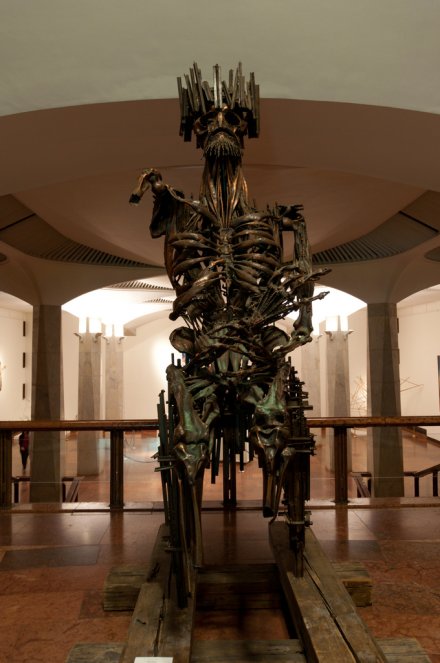
Sculpture of Gyorgy Dozsa burned on his throne, from Budapest’s Hungarian National Museum. (cc) image from redteam.

On this day..

1824: Alexander Pearce, cannibal convict

On this date in 1824, Irish convict Alexander Pearce received the Catholic last rites and was hanged in Australia’s Hobart town jail for murdering and cannibalizing a fellow con during an escape attempt.

When Pearce, a petty thief who had been sentenced in England to penal transportation, was caught at King River after fleeing a Tasmanian prison colony. He had human flesh in his pocket … pretty much as alleged in this court scene from the docudrama “Exile in Hell”:

… or, at least, there is no record of Pearce, who was defended by no lawyer, contesting the charges. He is said to have had other food available at this time; it seems he killed his young companion when he realized the boy would hold him up … then ate him, because he liked the taste.

You’re wondering how he knew he liked human flesh, right?

Incredibly, the crime for which he was hanged was not Pearce’s first incident of cannibalism — not even his first incident of confessed cannibalism.

During a previous escape attempt in 1822 with six other men, the party had plunged ill-equipped into forbidding terrain, and fallen to … well, you know. Here’s a newspaper account by the author of a book about Pearce:

As the journey continued, one by one, the weakest man was killed with an axe and butchered to provide food for the others. After five weeks of endless walking, only three men were left: [Robert] Greenhill, Pearce and [Matthew] Travers.

…

Driven by extreme hunger, Greenhill finally faced the prospect of having to kill his injured friend Travers, who had been bitten on the foot by a venomous tiger snake. With Travers’ foot now gangrenous, Greenhill and Pearce half-dragged and carried their injured companion for five days until Travers begged them to kill him. The only weapon left was the axe. They killed him in his sleep, and ate his flesh.

…

Pearce and Greenhill struggled on for eight days, playing cat and mouse with each other, desperate to stay awake, fearing that the other would attack him if he closed his eyes and nodded off. It was Pearce who kept awake long enough to grab the axe and kill the sleeping Greenhill with a blow to the head.

Months later, when the law finally caught up with Pearce, he admitted to killing and eating his companions. He wasn’t believed: authorities figured his collaborators were still on the run and Pearce was covering for them, so they sent him back to the prison colony.

Whoops.

This unpleasant story is the subject of a forthcoming film, The Last Confession of Alexander Pearce.

On this day..