1535: Thomas More, the king’s good servant but God’s first

On this date in 1535, Sir — later Saint — Thomas More kept his conscience at the expense of his head on Tower Hill.

For all More‘s greatness — as intellectual, polemicist, lawyer, statesman, father — none of his many gifts at the end could avail him beside his commitment to Catholicism at the dawn of the English Reformation.

Yet it is for those gifts that he cut such a commanding presence in his times, for those very reasons that his sovereign hounded his first citizen to assent to the divorce and remarriage he was fixed upon.

A devotee and friend of Erasmus from years before, More was in Henry’s more orthodox youth the king’s very scourge of Protestantism. His scatological invective against Martin Luther in Responsio ad Lutherum — much in the impolite tenor of Catholic-Protestant rhetoric continent-wide, it should be noted — is of the sort to crimson the cheeks of the milquetoast modern:

Since he has written that he already has a prior right to bespatter and besmirch the royal crown with shit, will we not have the posterior right to proclaim the beshitted tongue of this practitioner of posterioristics most fit to lick with his anterior the very posterior of a pissing she-mule until he shall have learned more correctly to infer posterior conclusions from prior premises?

Over that hairshirt, he wore the robes of state. But his engagement with the world had a selective bent that must have exasperated his colleague and predecessor as Lord Chancellor, Cardinal Wolsey. Orson Welles and Paul Scofield spar here in the definitive More hagiography A Man for All Seasons over the intellectual’s delicate refusal to dirty his gloves with the great matter of state before them — the annulment the king demanded of his marriage to the Queen (and More’s friend) Catherine of Aragon:

Peas in a pod, these two: Wolsey, the cleric grounded in realpolitik; More, the barrister who trusts to God. (More considered holy orders as a young man.)

Our man’s reputation for honesty in a den of hypocrites has certainly outrun Wolsey’s. Still, all More’s disdain for the deal-making that invests the sovereign majesty and all his foreboding for the relationship he had with his dangerous king were not quite enough to stop him accepting the Chancellorship and the opportunity to stamp out Lutheranism … knowing perfectly well the simultaneous thrust of Henry’s boudoir policy.

It all cuts quite a contrast to More’s (barely) pre-Reformation text, Utopia (available free from Project Gutenberg), which named a literary genre and described an imagined society of tolerant primitive communism that surely would have blanched at its inventor’s coming role in the state’s machinations:

I can have no other notion of all the other governments that I see or know, than that they are a conspiracy of the rich, who, on pretence of managing the public, only pursue their private ends, and devise all the ways and arts they can find out; first, that they may, without danger, preserve all that they have so ill-acquired, and then, that they may engage the poor to toil and labour for them at as low rates as possible, and oppress them as much as they please

…

[E]very man might be of what religion he pleased, and might endeavour to draw others to it by the force of argument and by amicable and modest ways, but without bitterness against those of other opinions; but that he ought to use no other force but that of persuasion, and was neither to mix with it reproaches nor violence* …

It’s not a given that More himself agrees with every (or even any) sentiment expressed in Utopia, but his most famous work’s criticism of the death penalty too liberally applied makes interesting reading.

[E]xtreme justice is an extreme injury: for we ought not to approve of those terrible laws that make the smallest offences capital … God has commanded us not to kill, and shall we kill so easily for a little money [i.e., execute petty thieves]? But if one shall say, that by that law we are only forbid to kill any except when the laws of the land allow of it, upon the same grounds, laws may be made, in some cases, to allow of adultery and perjury: for God having taken from us the right of disposing either of our own or of other people’s lives, if it is pretended that the mutual consent of men in making laws can authorise man-slaughter in cases in which God has given us no example, that it frees people from the obligation of the divine law, and so makes murder a lawful action, what is this, but to give a preference to human laws before the divine? and, if this is once admitted, by the same rule men may, in all other things, put what restrictions they please upon the laws of God.

This insistence on the supremacy of divine law over human institutions forms the basis of his objection to parliament’s overthrowing the papacy — which he expressed openly only after he was convicted by obviously perjured “jailhouse snitch” testimony

[Y]ou have no authority, without the common consent of all Christians, to make a law or Act of Parliament or Council against the union of Christendom.

Paul Scofield bears enjoying in the role in A Man for All Seasons:

More is sometimes suspected of desiring martyrdom since he marched so unerringly into it, but he also made every attempt to survive Henry’s demand the he affirm the royal remarriage and the king’s ecclesiastical supremacy by withdrawing silently from the public sphere rather than openly opposing it. More had by every account an enviable, downright happy life at his own hearth, and a tender and intellectual relationship with his favorite daughter Meg. (Meg corresponded with her father in prison, collected his works, and retrieved his head from London Bridge.)

But by his way of thinking — Meg tried to talk him out of it — he couldn’t swear to the Act of Succession acknowledging the king’s right to divorce Queen Catherine and disinherit her daughter Mary if Henry decided to force the choice. And in the king’s eyes, there was no middle ground for someone of the ex-Chancellor’s stature.

Henry could see to it, though, to cut his old friend a break and commute the sentence from drawing and quartering to “mere” beheading, here depicted in the past season of the Showtime series The Tudors.

More’s last moments as rendered here — the ironic remark at the foot of the scaffold, “See me safe up: for my coming down, I can shift for myself”;** his generous answer to the headsman’s plea for forgiveness — are well-documented. Undoubtedly, his sturdy martyr’s bearing, the extension of a life of joyful piety, helped cement for posterity the fame he held in life.

And that dying address — “I die the King’s good servant, but God’s first” — gathers in one sentiment free of bombast or self-pity the irreconcilable demands of conscience that would lead many thousands besides More to Henry VIII’s scaffolds, and rings equally true to less lethal challenges to the conscience in every land and time since.

Anne Boleyn, who caused More’s fate, shared it less than a year afterwards.

Thomas More was canonized by the Catholic Church in 1935 — the patron saint of politicians. Rather bizarrely, July 6 is also his feast day on the Anglican calendar, a tribute to the nearly universal regard his memory enjoys.
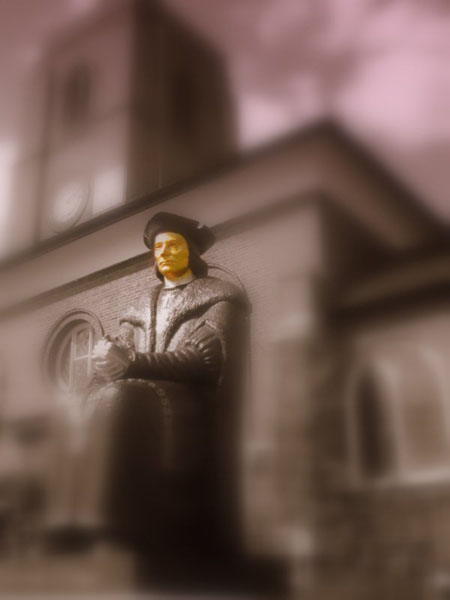
Thomas More's statue at the Chelsea Old Church

Chelsea resident Thomas More’s statue at the (Anglican) Chelsea Old Church.

* Despite its religious tolerance, More’s Utopia — anticipating Dostoyevsky — maintains:

a solemn and severe law against such as should so far degenerate from the dignity of human nature, as to think that our souls died with our bodies, or that the world was governed by chance, without a wise overruling Providence … since a man of such principles must needs, as oft as he dares do it, despise all their laws and customs: for there is no doubt to be made, that a man who is afraid of nothing but the law, and apprehends nothing after death, will not scruple to break through all the laws of his country, either by fraud or force, when by this means he may satisfy his appetites.

** According to the biography published by More’s son-in-law — who married More’s favorite, Margaret — the jest was occasioned by the rickety look of the scaffold. The Mirrour of Vertue in Worldly Greatness; Or, The Life of Sir Thomas More is available free on Google Books.

On this day..

1947: Ding Mocun, not as hot a lay in real life

On this date in 1947, Ding Mocun was shot for “conspiring with a foreign government to overthrow China” in Shanghai by the Kuomintang.

This former Communist turned right-wing radical may be most readily recognizable outside China as the real-life inspiration behind Ang Lee’s steamy 2007 art-house menace to undergarments Lust, Caution.

Based on a story by Eileen Chang (or Zhang Ailing), Lust, Caution fictionalizes Mocun’s real-life escape from an attempted assassination in 1939.

That incident was authored by Ding’s young plaything, who turned out to have a very serious side indeed. (Ding had her shot.)

While the attempt on the turncoat spy’s life really happened, there’s some dispute over whether Chang really had this particular woman strongly in mind over the twenty-plus years she composed her story. There’s more about the evolution of the fictional story here, but you’ll need Chinese skills to follow the links to Chang’s evolving text.

At any rate, Ding’s actual death would come by order of a more august character: Chiang Kai-shek.

Why so many people out to get him?

Despite his nationalist credentials, when Ding lost a party struggle in 1938, he found a gig with the collaborationist government of Japanese-occupied China running a nasty intelligence unit that made nationalists and Communists disappear. That’s the sort of resume anyone would be touching up come the mid-1940’s, and Ding went with a revision (not widely credited, though it has its advocates) that he was secretly passing information to the nationalist resistance all along. And as the nationalists and Communists turned on one another in the postwar power vacuum, it looked like his usefulness to the Kuomintang might get him off the hook after all.

It worked for a while, but Chiang — or so goes the story — caught a tabloid expose about Ding catching R&R at a lake when he’d used a medical pass to get out of prison, and impulsively ordered him shot.

Perhaps Ding’s status as official evildoer vis-a-vis a China whose messy birth many are old enough to remember helps account for the resonance of literary works that engage him as a human being. In a nonfiction vein, Konrad Lawson’s layered critique of the pro-Ding apologia linked above thoughtfully evokes the complexity of Ding’s era and the challenges it poses for historiography.

On this day..

1959: Charles Starkweather, Nebraska spree killer

Just past midnight this date in 1959, Charles Starkweather was electrocuted in Lincoln, Nebraska, for a mass-murdering road trip with his jailbait date that claimed ten lives.*

A loner and loser, Starkweather’s spree in January 1958 caught the national imagination and has never quite let it go since — the prototypical despair of miscarried white masculinity, a primal scream from the underbelly of the American dream.

Bowlegged, myopic, slightly speech-impaired, Starkweather was an outcast at school and fought back with his fists, then dropped out entirely and into a yawning dead-end economic life collecting garbage from the wealthier quarters of Lincoln. “The more I looked at people the more I hated them because I knowed they wasn’t any place for me with the kind of people I knowed,” he said in his confession. Starkweather palliated his isolation by aping James Dean, dreaming of a big robbery score, and losing his heart to 14-year-old Caril Ann Fugate, in whose adolescent eyes the beaten boy felt his stature grow.

He — or maybe they together — killed her parents when they tried to interfere in the relationship, and then eight days of murderous desperation ensued that riveted Lincoln and the nation: they lived a few days with the corpses, shooing neighbors away with a story about the flu, then fled like animals, killing ruthlessly for a couple of cars and a place to spend the night and heading for Wyoming — all to no end that would make a lick of sense, not even the cockeyed hope that there was somewhere to go to outrun the gore. Killing and running had just become what they did to keep from having to stop.

I had hated and been hated. I had my little world to keep alive as long as possible and my gun. That was my answer. (Source)

Four months after he murdered the Fugate family and not yet 20 years of age, Charles heard his own death sentence from jurors in the city he’d briefly but unforgettably terrorized. (There’s a pdf timeline of the case from the Lincoln Evening Journal here.)

He lived cruelly, and it went cruelly with him to the last; offered a chance to donate his eyes, Starkweather retorted that “nobody ever did anything for me when I was alive. Why should I help anybody when I’m dead?” According to the Los Angeles Times, the doctor who was supposed to pronounce the prisoner dead himself suffered a fatal heart attack minutes before the electrocution.

Fugate’s tender age and sex spared her a death sentence, even though Starkweather said that she ought to be “sitting in my lap” when he went to the chair. She was paroled in 1976 and has mostly stayed out of view since. Laura James at CLEWS recently posted an update on her whereabouts.

More detailed annotations of this notorious duo’s life and times can be found here and here; the Lincoln Journal Star recently published an online 50-year retrospective on the case with high production values.

But if Starkweather’s James Dean fixation denoted the pull of celebrity glamor culture, his death left an enduring legacy for a world that had nothing for him in life, a haunting name recognition few school shooters or bell tower snipers have been able to hold since. He captivated the boyhood Steven King:

I do think that the very first time I saw a picture of [Starkweather], I knew I was looking at the future. His eyes were a double zero. There was just nothing there. He was like an outrider of what America might become.

The title track of Bruce Springsteen’s 1982 album Nebraska is written as a first-person narrative by Starkweather, to the tune of a desolate acoustic accompaniment that imbues the killer’s brutality with an aching loneliness.

They wanted to know why I did what I did
Well sir I guess there’s just a meanness in this world

Martin Sheen wonderfully rendered a (heavily fictionalized) Starkweather character opposite Sissy Spacek on the silver screen in Badlands (1973):

Rather less artistically consequential, the 1963 low-budget film The Sadist, also based on the Starkweather case, is in the public domain and available free on Google video:* Starkweather killed a gas station attendant in a separate incident weeks before, so his body count is 11, with ten of them on his infamous spree.

On this day..

Unspecified Year: Justine Moritz, Frankenstein family servant

Around this date in the unspecified 18th-century year of Mary Shelley’s Frankenstein, the titular family’s servant is put to death for the murder of their youngest child, William.

In the novel, smarty-pants university student Victor Frankenstein has created (and immediately rejected) his famous monster. Not long after, he receives a letter (dated May 12, “17–“) from his father informing him of the murder of his youngest brother.

About five in the morning I discovered my lovely boy, whom the night before I had seen blooming and active in health, stretched on the grass livid and motionless; the print of the murder’s finger was on his neck.

Covering the 600-plus kilometers home to Geneva, Victor becomes convinced that his creation is the culprit.* But upon reaching his destination, he finds that circumstantial evidence has accused the family’s blameless (and ironically named) servant, Justine.

He’s back just in time to watch, in horror, as she’s convicted — impotent (or at least that’s what he tells himself) to help her with his fantastical truth, and despairingly watching her friends abandon her to her fate.

Justine has grown up with Victor and the others, so the entire Frankenstein family remains convinced of the servant’s innocence, though they’re practically alone in Geneva in that belief.

A woodcut illustration of Justine in prison, by Lynd Ward — as seen here.

Shelley includes an interesting passage in which Justine (having already been convicted) is battered by her priest into falsely confessing to the crime. Though clearly anti-clerical in intent, it’s also a moment with remarkable current resonance given the prevalence of false confessions in modern wrongful conviction scenarios:

“I did confess, but I confessed a lie. I confessed, that I might obtain absolution; but now that falsehood lies heavier at my heart than all my other sins. The God of heaven forgive me! Ever since I was condemned, my confessor has besieged me; he threatened and menaced, until I almost began to think that I was the monster that he said I was. He threatened excommunication and hell fire in my last moments if I continued obdurate. Dear lady, I had none to support me; all looked on me as a wretch doomed to ignominy and perdition. What could I do? In an evil hour I subscribed to a lie; and now only am I truly miserable.”

The poor woman’s fate is sealed either way — and in her parting conversation with Victor and his future wife Elizabeth, we find Justine more at peace than the monster’s creator:

“I do not fear to die,” [Justine] said; “that pang is past. God raises my weakness and gives me courage to endure the worst. I leave a sad and bitter world; and if you remember me and think of me as of one unjustly condemned, I am resigned to the fate awaiting me. Learn from me, dear lady, to submit in patience to the will of heaven!”

During this conversation I [Victor] had retired to a corner of the prison room, where I could conceal the horrid anguish that possessed me. Despair! Who dared talk of that? The poor victim, who on the morrow was to pass the awful boundary between life and death, felt not, as I did, such deep and bitter agony.

…

“In these last moments I feel the sincerest gratitude towards those who think of me with kindness. How sweet is the affection of others to such a wretch as I am! It removes more than half my misfortune, and I feel as if I could die in peace now that my innocence is acknowledged by you, dear lady, and your cousin.”

Thus the poor sufferer tried to comfort others and herself. She indeed gained the resignation she desired. But I, the true murderer, felt the never-dying worm alive in my bosom, which allowed of no hope or consolation. Elizabeth also wept and was unhappy, but hers also was the misery of innocence, which, like a cloud that passes over the fair moon, for a while hides but cannot tarnish its brightness. Anguish and despair had penetrated into the core of my heart; I bore a hell within me which nothing could extinguish. We stayed several hours with Justine, and it was with great difficulty that Elizabeth could tear herself away. “I wish,” cried she, “that I were to die with you; I cannot live in this world of misery.”

Justine assumed an air of cheerfulness, while she with difficulty repressed her bitter tears. She embraced Elizabeth and said in a voice of half-suppressed emotion, “Farewell, sweet lady, dearest Elizabeth, my beloved and only friend; may heaven, in its bounty, bless and preserve you; may this be the last misfortune that you will ever suffer! Live, and be happy, and make others so.”

And on the morrow** Justine died. Elizabeth’s heart-rending eloquence failed to move the judges from their settled conviction in the criminality of the saintly sufferer. My passionate and indignant appeals were lost upon them. And when I received their cold answers and heard the harsh, unfeeling reasoning of these men, my purposed avowal died away on my lips. Thus I might proclaim myself a madman, but not revoke the sentence passed upon my wretched victim. She perished on the scaffold as a murderess!

Shelley gives us quite the gentle picture of the Frankenstein family, in which Victor is practically the only exponent of vengeance after the dreadful crime. Even the father’s initial letter home, written in the immediate shock after discovering the boy’s body, summons his son to come

not brooding thoughts of vengeance against the assassin, but with feelings of peace and gentleness, that will heal, instead of festering, the wounds of our minds.

After the hanging, dad again endeavors to keep Victor from wasting himself on rage … which it seems that Victor would have readily assented to had he not carried his secret burden of guilt:

“Do you think, Victor,” said he, “that I do not suffer also? No one could love a child more than I loved your brother” — tears came into his eyes as he spoke — “but is it not a duty to the survivors that we should refrain from augmenting their unhappiness by an appearance of immoderate grief? It is also a duty owed to yourself, for excessive sorrow prevents improvement or enjoyment, or even the discharge of daily usefulness, without which no man is fit for society.”

This advice, although good, was totally inapplicable to my case; I should have been the first to hide my grief and console my friends if remorse had not mingled its bitterness, and terror its alarm, with my other sensations.

Frankenstein is available free at Project Gutenberg. Of course, it has been adapted many times into other cultural artifacts; these are somewhat famous for their infidelity to the original work, and Justine tends to get short shrift in most (although she’s hanged in quite an over-the-top spectacle in the 1994 Kenneth Branagh vehicle Mary Shelley’s Frankenstein (review here)).

If Justine is usually pulled from the story, Hollywood has found a role for the scaffold elsewhere. Where Shelley has Victor haunting “charnel houses” and the like, the seminal and oft-imitated 1931 Boris Karloff film makes a point to include a hanged criminal for some of the creature’s parts — although “the brain is useless”:

But a criminal brain finds its way into the monster just the same, an explanation of its behavior completely antithetical to Mary Shelley’s:

* He’s right, of course — the creature later admits it — but you could certainly quibble with Victor’s methodology:

Nothing in human shape could have destroyed the fair child. HE was the murderer! I could not doubt it. The mere presence of the idea was an irresistible proof of the fact.

** The precise date is never disclosed, but the events are roughly dated by Victor’s subsequent narration, “it was about the middle of the month of August, nearly two months after the death of Justine, that miserable epoch from which I dated all my woe.”

On this day..

1953: Julius and Ethel Rosenberg, “the first victims of American fascism”

On this date in 1953, Julius and Ethel Rosenberg were put to death in Sing Sing’s electric chair as Soviet spies.

Divisive since it was handed down — or more precisely, since a famous article in London’s Guardian challenged the verdict and helped elevate it into a latter-day Dreyfus case — the Rosenbergs‘ sentence has inspired so much acrimony over several generations that merely to observe the date is to invite a debate capable of eminently more heat than light.

Where to begin with a case so towering in the recent cultural milieu?

A textbook might say that Julius and Ethel were convicted of passing atomic secrets to the Russians, that they maintained their innocence and their defenders carried that flame years after their deaths, and that intelligence files opened after the Cold War — notably the Venona project — apparently confirmed that Julius was a spy after all, though Ethel seems to have been little more than an approving bystander and Julius, come to think of it, never had anything so worthwhile as atomic secrets to share with Moscow. This information (which does have its own skeptics, albeit a small minority) undermines the maximal “absolute innocence” position that this day’s victims always asserted, but it’s a curious leap to take it as vindicating the legal outcome.

“My husband and I must be vindicated by history; we are the first victims of American fascism.”

Half a century on, juridical guilt or innocence seems distinctly secondary in the lasting importance of the Rosenberg trial, the two-year battle to save them, and their potent symbolic afterlives.

The Rosenbergs are the only stateside judicial executions for espionage since the Civil War.* That is a remarkable distinction, after all; so, how comes it that it is held by — to state the case against them in its strongest imaginable terms — two enthusiastic but bush-league players, and not by the likes of Aldrich Ames? How was it that a judge with a largely center-liberal career on the bench would read them a sentence of death hysterically accusing these Lower East Siders of causing the Korean War?

[Y]our conduct in putting into the hands of the Russians the A-bomb years before our best scientists predicted Russia would perfect the bomb has already caused, in my opinion, the Communist aggression in Korea, with the resultant casualties exceeding 50,000 and who knows but that millions more of innocent people may pay the price of your treason.

…

I feel that I must pass such sentence upon the principals in this diabolical conspiracy to destroy a God-fearing nation, which will demonstrate with finality that this nation’s security must remain inviolate; that traffic in military secrets, whether promoted by slavish devotion to a foreign ideology or by a desire for monetary gains must cease.

It is here in the age of McCarthyism, in the shadow of the USSR’s balance-altering A-bomb test in 1949, that the Rosenbergs stand in sharpest relief — not because of “guilt” or “innocence”, but as the ne plus ultra of that era’s range of social discipline.

A few years before, the United States and the Soviet Union had made common cause against Hitler in World War II, the United States pumping war materiel to Russians bearing the brunt of the fighting.

No longer operative.

The Communist Party USA enjoyed membership rolls pushing six figures; other socialist parties and movements had found niches in American life in the interwar years.

As the Great War gave way to the Cold War, the great powers remained nominal allies (that’s the reason the Rosenbergs weren’t tried for treason), but shifted rapidly into conflict. The American polity organized to expel the red menace by rendering it foreign and criminal — ideological rigging for the forty years’ imperial contest ahead. Loyalty oaths, blacklists, the House Un-American Activities Committee … in the whole of the self-conscious construction of communism as “contagion”, the power and willingness of the state to kill Julius and Ethel Rosenberg formed the tip of the spear, and an ugly contrast to that same state’s solicitous handling of Nazi scientists then developing the vehicles to deliver atomic technology to Moscow in mushroom cloud form.

Though different in many particulars, the thrust will be familiar to any sentient denizen of post-9/11 America: the extreme penalty enforces a wall between the suspect and abject (but tolerated) loyal liberal and the enemy left. Depend upon Ann Coulter for the most brutal articulation:

We need to execute people like John Walker [the American-born soldier captured fighting for the Taliban in 2001] in order to physically intimidate liberals, by making them realize that they can be killed, too. Otherwise, they will turn out to be outright traitors.

Like most symbols, the Rosenbergs came by their exaltation by accident; at the strictly personal level, their deaths are nearly operatic performances of human stubbornness and bureaucratic inertia. Investigators rolling up a spy ring** were looking for confessions and names to keep the indictments coming.

Julius refused to provide either, so his wife was arrested for leverage against him on the reasoning that he would confess to protect her. The gambit failed: both prisoner and hostage remained obstinate. The government’s bluff had been called, and it ruthlessly executed its threat.

Had the two really been responsible for starting a war, execution would hardly begin to cover the bill — yet to the very foot of the chair, the condemned, and Julius especially for the sake of his wife, were pressed with offers of mercy for confessing and “naming names”.

Abjure or expire: show trial logic.

[audio:Julius_and_Ethel_Rosenberg.mp3]

An Execution in the Family

Given names to name, the personal mystery of their silence — the ultimate heroism or folly or tragedy or transcendence — only deepens the resonance of their fate both for contemporaries and posterity, the poignance of their orphaned children’s subsequent path, the contrast with Ethel’s brother David Greenglass who has since admitted to perjuring testimony against Ethel in order to shield his own wife. (Greenglass says the Rosenbergs died from the “stupidity” of not copping a deal of their own.)

Even before Julius and Ethel went to the chair this date,† they had become the emblem of a paranoid age. In the days following, Sartre savaged the United States for trying “to stop scientific progress by a human sacrifice”:

Your country is sick with fear. You’re afraid of everything: the Russians, the Chinese, the Europeans. You’re afraid of each other. You’re afraid of the shadow of your own bomb.

Decades later, the shadows haven’t faded altogether. In playwright Tony Kushner’s imagination, the spirit of Ethel stalks her real-life prosecutor, closeted McCarthy henchman Roy Cohn, as he succumbs to AIDS in the 1980’s.‡

Rosenberg resources — and vitriol — are in plentiful supply online and off. A good starting point on the case is this page at the University of Missouri – Kansas City. Be sure to check the tale of a last-ditch legal maneuver that almost succeeded.

* There is one partial exception in the unusual case of six German saboteurs electrocuted in Washington, D.C., during World War II on a charge sheet that included espionage. The hearing was held by a military commission and only one of the six was an American citizen, so it was far from the regular judicial process — if one can call it that — the Rosenbergs faced.

** Originating in the investigation of Klaus Fuchs, the man who actually did what Julius and Ethel Rosenberg were accused of doing — passing atomic secrets to Moscow — although with debatable ultimate effect for the Soviets’ research. Fuchs served nine-plus years in a British prison and was released to East Germany; more than a few were galled at the difference between his sentence and the Rosenbergs’.

Stateside, George Koval was another spy far more valuable to Moscow in the nuclear race than were the Rosenbergs. Koval got away clean and died in Moscow in 2006.

† Julius first, then Ethel. Her execution was botched; repeated shocks were required to kill her.

‡ Cohn’s posthumous autobiography did acknowledge illegally rigging the Rosenberg trial, as his Kushner character does.

On this day..

1594: Rodrigo Lopez, Shylock inspiration?

On this date in 1594, a 70-year-old Portuguese physician was torn apart at Tyburn before a jeering London mob for attempting to poison Queen Elizabeth I.

Born around 1525 to a family of conversos — Jewish converts forcibly converted to Christianity — Rodrigo Lopez (alternatively, Lopes) went abroad because the Spanish Inquisition menacingly suspected him of secretly maintaining the faith of Abraham.*

For us, the man’s true doctrines might be a matter for his god. In the 16th century, Lopez never could outrun his Jewishness.

Establishing himself in London in 1559, nearly the precise midpoint of his life, Lopez built a thriving medical practice, eventually rising in 1586 to the attendance of Her Majesty herself. England in those days was scrapping with the mighty Spanish empire, one front of which was endlessly byzantine diplomatic intrigue. It happened that Elizabeth gave harbor to a Portuguese pretender (Lopez had attended him, too), whose circles the Spanish were naturally endeavoring to infiltrate.

Some nefarious machinations in this ambit that came to light in 1593 opened an investigation characteristically heavy on the torture, and Lopez’s name came up. Allegedly, the doctor was negotiating to take Spanish gold for slipping the Queen a mickey.

Lopez doesn’t seem to be any less capable of greed or intrigue than anyone else at court, but poison? It was doubted at the time, the prosecution itself a product of the courtly rivalry between Essex and Cecil.** Despite a confession (extracted by torture, like the accusations), even Elizabeth never seems to have really bought the charge: she held Lopez more than three months after his sentence before finally permitting the punishment to go forward, and pensioned his family when the treason conviction entitled her to confiscate their property.

The London mob entertained no such nuance. When Lopez was hauled to the scaffold this day for his public butchery — still protesting that he “loved the Queen as he loved Jesus Christ,” derisively taken as a backhanded confession by spectators who didn’t doubt the practicing Protestant was really a Jew — it elevated popular anti-Semitism to fever pitch.

Hath not a Jew eyes?

Lopez, or at least the popular mood of Jew-baiting current after his trial, is thought to have helped inspire William Shakespeare’s use of the Shylock character in The Merchant of Venice — one of the most controversial and captivating of all the Bard’s creations, a villain far more compelling (and sympathetic) than the play’s lightweight good guys and one whose place in the Shakespeare canon and the fabric of Elizabethan England is still vigorously debated.

Is Shylock a vicious caricature? A sublimely three-dimensional human? Both? Wherever the “real” William Shakespeare stood on the matter of religious equality, he put one of literature’s great apologias for it in Shylock’s mouth:

* Insincerely converted Muslims and Jews were a choice target of the Inquisition in the 16th century; many thousands were driven to emigrate. For the fate of some other crypto-Jews who fled to Spain’s possessions in the New World, see here.

** Lopez’s Javert, the Earl of Essex, lost the power struggle a few years later … and with it, his own head.

On this day..

1568: The Counts of Egmont and Hoorn, insufficiently Inquisitorial

On this date in 1568, two Flemish nobles were beheaded at Brussels’ Grand Place for treason to the Spanish crown that then ruled the Low Countries.

Lamoral, Count of Egmont and Philip de Montmorency, Count of Hoorn had a beef with the introduction of the Inquisition into the Netherlands by Egmont’s cousin, King Philip II, and got to hanging around with dubious characters like William of Orange.

Unluckily for this day’s duo, William didn’t teach them to read the writing on the wall.

After the Counts went easy on an outbreak of Protestant Iconoclasm, the Catholic king sent the hammer in the person of the Duke of Alba (or Alva).

Let this long-expired generation counsel posterity to find itself elsewhere when one’s door is darkened by a man known as “the Iron Duke”. William had the wit to get out of town. Egmont and Hoorn hung around, depending on their (professedly) clean consciences.

Oops.

Count Egmont Before His Death, by Louis Gallait

The beheadings were widely protested both locally and abroad, and festered as a grievance against the empire — a grievance that, as the nascent conflict evolved into a revolution that would detach the Netherlands from Spain, elevated these distinctly non-revolutionary wealthy nobles into freethinking martyrs of independence.

Two centuries later, Goethe put the story on the stage with his play Egmont (original German | English translation), a production for which Beethoven subsequently composed gorgeous orchestral companion pieces.

Here’s the lovely, lovely Ludwig Van’s beloved (including by Goethe himself) Overture to Egmont, Op. 84:

On this day..

1913: Antonio Echazarreta, defending Matamoros

On this date in 1913, constitutionalist troops in the Mexican Revolution consolidating control over the border town of Matamoros shot a 23-year-old colonel who helped lead the city’s volunteer resistance.

Garrisoned by fewer than 50 regular soldiers, Matamoros put up only brief resistance to Gen. Lucio Blanco‘s June 3-4 attack, many of its government officials and wealthy denizens bolting over the Rio Grande to adjacent Brownsville, Texas.*

But some of the young guns in town had an overdeveloped sense of heroic machismo and sold their lives dearly to postpone the inevitable.

Groups of young Matamoros men, some of them fourteen and fifteen years old, volunteered for service under irregular huertista officers. They fought stubbornly until early in the morning of June 4. A number of them were captured and executed by Blanco’s men. (Source.)

Echazarreta’s leadership of these ill-fated guerrillas saw him up against the wall this day, but also saw him into the revolution folk song about the city’s conquest, “Corrido de la toma de Matamoros”. Nor was the revolution yet finished with Matamoros, or its martial prowess.

In 1915, as the rival revolutionary factions openly broke with one another, carrancistas loyal to President (and Villa rival) Venustiano Carranza inflicted a signal defeat on Villa at Matamoros that began Villa’s march into political and literal wilderness. It’s commemorated in yet another revolutionary corrido, here sung by Jose Suarez (via the U.S. Library of Congress):

[audio:Corrido_villesta_de_la_toma_de_Matamoros.mp3]

* An interesting photo album covering this battle is available here.

On this day..

1962: Adolf Eichmann

On this date in 1962, the architect of the Final Solution received such justice as could be meted to him on earth at Israel’s Ramla Prison.

Adolf Eichmann, the vacuum cleaner salesman turned SS Obersturnbannfuhrer, remains the only person judicially executed in the history of modern Israel, whose intelligence services kidnapped him from Argentina where he had settled after the war.

Other Nazis had used the “only following orders” defense with little success in the Nuremberg Trials shortly after World War II. On trial years later (and at the hands a Jewish state) Eichmann — a bookish, unmenacing man who invoked Kant — posed the questions of individual responsibility and human psychology in starker terms.

To be sure, he was no anonymous functionary. Neither, however, had he dirtied his nails at the stomach-churning business end of the Holocaust: rather, he had engineered the stupendous logistical project of deporting Eastern Europe’s Jews for extermination, an (impressive) accomplishment worth exponentially more lives than any Einsatzgruppe could ever account for, yet simultaneously abstract from the upshot.

Eichmann said he did it without ill-will towards its subjects — simply to obey and to achieve.

The Banality of Evil

[I]f it was of small legal relevance, it was of great political interest to know how long it takes for an average person to overcome his innate repugnance of crime, and what exactly happens to him once he has reached that point. To this question, the case of Adolf Eichmann supplied an answer that could not have been clearer or more precise.
-Hannah Arendt

Hannah Arendt took him at his word* and saw in Eichmann the abyss gazing back into us, into his judges — not a monster but a man unsettling in his normalcy, whose job was not TPS reports or quarterly sales results but turning humans into ash.

The company man. The career man. Every man, standing in for countless thousands more who pushed the papers that drove the trains to Auschwitz.

What for Eichmann was a job, with its daily routine, its ups and downs, was for the Jews quite literally the end of the world.

Not everyone accepts her conclusions, but Arendt’s characterization of “the banality of evil” has become the man’s epigraph. And Eichmann disturbs us precisely because we seem to be able to meet him on his terms, even sympathize with him when the horror of his crimes begs for a monster like Streicher or Goebbels we could safely consign to the Other.

Arendt’s turn of phrase has a certain breezy (hackneyed, even) life in the public discourse, but her analysis of Eichmann’s careerism remains a challenging and deeply relevant one for we heirs of the world that hanged him.

The complete transcript of Eichmann’s trial is available online here. Video of his trial has been posted online here (in English) and here (original languages).

* Albeit with some reservations; others have argued that Eichmann was considerably more personally invested in his mass-murder project than his demeanor at trial admitted. Certainly he had an interest in showing the mellower Eichmann when he was on trial for his life.

On this day..

1431: Joan of Arc

On this date in 1431, Joan of Arc (also Jeanne d’Arc, even though d’Arc wasn’t really her name at all) was burned at the stake for heresy in the marketplace of Rouen, France.

A Joan of Arc statue in Philadelphia, Pennsylvania.

Very much has been written and said about this strange figure, the Maid of Orleans — not quite so much larger than life as she seems otherworldly to it: in her mystical exaltation, in her unthinkable elevation from the illiterate peasantry to military command (and bizarrely effective intervention in the intractable Hundred Years’ War).

Apotheosis to the ranks of France’s national heroes is the least of it; Joan’s iconography extends well outside her homelands and well beyond the project of feudal restoration that was her short life’s concern.

Her myth has had a robust afterlife, but her accomplishments in the flesh were quite real — staggering, even. At the nadir of France’s fortunes, she convinced the French dauphin Charles VII of her divine inspiration in April 1429 and, far more aggressive (and some would say lucky) than the army’s noble commanders, immediately relieved the English siege of Orleans. By July, she had captured Reims, where Charles was crowned king.

The next year, Joan was captured by the Burgundians, who sold her to the British, who in turn subjected her to an ecclesiastical inquiry — what became a remarkable, exhaustively documented three-week interrogation, in which she deftly matched wits with academic persecutors over the reality and nature of her divine visions.

She was immediately considered a martyr by her own side — and twenty years later, when the war had finally ended, another court reversed the verdict against her — but her universal appeal and cultural ubiquity remained a long time off.*

“Dark-minded man!”
The Maid of Orleans answered, “to act well
Brings with itself an ample recompense.
I have not reared the oriflamme of death —
Now God forbid! The banner of the Lord
Is this; and, come what will, me it behooves,
Mindful of Him whose minister I am,
To spare the fallen foe: that gracious God
Sends me a messenger of mercy forth,
Sends me to save this ravaged realm of France,
To England friendly as to all the world;
Only to those an enemy, whose lust
Of sway makes them the enemies of man.”

–Robert Southey

The romantic 19th century took up her standard when the trial records were uncovered — liberals cottoned to her lowly birth, conservatives to her monarchist project, all France to her proto-nationalism, all Catholics to her faith (she was elevated to sainthood in the early 20th century; May 30 is also her feast day). The Vichy government and the French Resistance both claimed her in World War II. Her gender and sexuality have invited modern attention, just as they did for her judges: she works (anachronistically, of course) as a girl-power pop feminism icon, and her masculine social role gives her queer cachet; she made a point of keeping her virginity, but may have been sexually assaulted in prison, an event that figures in Andrea Dworkin’s Intercourse.

Joan stands equal to such varied identities because the mysteriously personal qualities of her story invite the observer into it, and those qualities hold precisely because of her fiery end this day. What would Joan have been in five or ten years’ time, had she escaped capture or held to her temporary renunciation of wearing men’s clothes (the head-scratching but subtly profound charge that finally doomed her)? An aging commander with the gloss off her, a partisan of some faction of the abject French court, a hostage somewhere being ransomed for gold plate or quietly poisoned off?

Her myth and its antithesis work because she came in radiance from dust, and followed her conscience — her God, her will, her destiny, or what have you — back to dust.

Though adapted many times for the screen, the definitive Joan of Arc film remains the 1928 silent treament La Passion de Jeanne d’Arc, scripted largely from the original trial transcripts. The movie’s lead Maria Falconetti — and indeed the very silence of the medium — convey something of that mysterious, multifaceted meaning left to us tantalizingly suspended between the 19-year-old who stood at the stake this day and the legend that arose from her ashes.

Books about Joan of Arc

(The Mark Twain book is in the public domain and available free at Project Gutenberg in both text (part 1 | part 2) and audio (part 1 | part 2) forms.)

* Shakespeare, for instance, writing Henry VI Part I about Charles VII’s English opposite number, has Joan in a rather more negative light than a modern reader is used to seeing — as a witch and a whore. In her last battlefield appearance, she summons demons …

Enter Fiends
This speedy and quick appearance argues proof
Of your accustom’d diligence to me.
Now, ye familiar spirits, that are cull’d
Out of the powerful regions under earth,
Help me this once, that France may get the field.

… who fail to aid her although she offers them her body. Later, condemned to the stake, she cravenly tries to plead her belly by claiming that she slept with several other characters.

On this day..