Rome in the 5th Century was a difficult place for the general populace. The Roman Empire was at the front end of its long decline, and with its partitioning in 395 on the death of Theodosius I, a series of invasions was to follow that would shake confidence in the leadership of the Empire.
Much of the activity in Rome at the time was tied to the young Visigoth King Alaric. Alaric initially invaded the Eastern Roman Empire, but he was met with resistance in Greece. During negotiations, the de facto head of the Western Roman Empire,* Stilicho, who has been claimed by some sources to have been born a Visigoth, marched on the Goths and prepared to engage in what likely would have been Alaric’s downfall.
According to accounts, Stilicho was called out of the neighboring province of Illyricum, and Alaric, now unencumbered of the prospect of a Western reinforcement, marched through Greece.
But Stilicho would not sit still, and in 397, he brought his army against the Goths and forced them into a difficult spot in the mountains of Pholoe, in the southern prefecture of Illia. Alaric slipped away,** moving his forces north and setting his sights on the Western Roman Empire, starting in northeastern Italy, in 400 AD.
While Stilicho was engaged on this eastern front, the Ostrogoths, led by the commander Radagaisus, prepared for their own invasion. While history is uncertain as to how the series of events transpired, it is clear that Stilicho bested Alaric at Pollentia and Verona and, because of a budding camaraderie with the defeated commander, enjoyed a few years’ respite from the Gothic invaders. Which was useful, because the Roman army had shrunken to a point where even small defeats were extremely costly to the Empire.
So it was that, when Radagaisus invaded Italy in 405, Stilicho had nearly all his army in place. Radagaisus marched with 100,000 people (likely) to 400,000 people (highly unlikely), though a relatively small percentage of these were thought to be armed. His trail of terror displaced uncounted Romans as Radagaisus made his way through northern Italy.
Finally, at the start of the 406 campaign, Stilicho had mustered sufficient forces to assault the invaders. As Radagaisus blockaded Florence, Stilicho amassed his regulars and, fortified also with recalled frontier soldiers, massacred the opposition. The battle was decisive, with the Roman army starving out the invading hordes, and Radagasius apparently quickly losing control of his loose band of warriors.
Whether he was turned on by his own men, or whether the Romans simply overran their enemies after a period of famine, Radagasius eventually fled the battlefield and was captured at one of Stilicho’s outposts. On 23 August 406, the man who called himself King Radagasius was beheaded.† Many of his soldiers defected to the Roman army — joining a long line of conscripts from conquered people — and his supporting band was scattered or enslaved.
Like Alaric, Radagasius has sometimes been indicated as King of the Goths, but his history is a little more murky than that. Radagasius (or Rhodogast, or Radegast, depending on the source) issued from northern Germany before making his march. He had united several tribes under his banner, but he could hardly be said to rule any region. And because of the remoteness of Ostrogoth territories and the limited written history on the region, it’s difficult to assess his true nature.
* Stilicho was protector of the underage Honorius, who has been regarded as weak and incompetent. Honorius died in 423, long after Stilicho was murdered.
** Alaric and Stilicho may have been conspiring at this point: Stilicho again claimed to have been recalled from the battlefield, but, owing to their common heritage and their later connections in defense of the Empire, it’s thought that Stilicho was actively recruiting Alaric for military service in defense of Rome.
† “The death of the royal captive, who was ignominiously beheaded, disgraced the triumph of Rome and of Christianity,” sniffed Edward Gibbon.
A century ago today, the first Indian revolutionary martyr to be hanged in England was put to death at Pentonville Prison.
Madanlal Dhingra (or Madan Lal Dhingra) was a bright young scion of a loyalist Indian family that disowned him when he took to radical politics.
As an engineering student in London, Dhingra quaffed the martyr’s cup by assassinating Sir William Curzon Wyllie, a career imperial official spending his golden years keeping tabs on nationalist types among England’s Indian students. (Evidently, he could have been doing his job better.)
Dhingra rejected the legitimacy of the British court, disdained a defense, and was sentenced to death on the first day of trial. His martyrdom being the shared object of both the prosecutors and the offender, he was not long for the world — supposedly checking out with the well-turned last words,
My only prayer to God is that I may be re-born of the same mother and I may re-die in the same sacred cause till the cause is successful.
Dhingra is a noteworthymartyr to the cause of Indian independence now, but like anything else things weren’t so black and white at the time. Gandhi was not down with Dhingra — Gandhi’s own differences with Hindu extremists would eventually cost him his life — and plenty of Indian liberal types shared his abhorrence.
On the other hand, a subversive Brit like poet Wilfrid Scawen Blunt filled his blog-like diary with admiration for the assassin during the weeks of his celebrity — writing of this date, for instance:
They have done me the honour of choosing [my birthday] for Dingra’s execution, thus making of it an anniversary which will be regarded as one of martyrdom in India for generations.
And reflecting later, after the hanging:
People talk about political assassination as defeating its own end, but that is nonsense; it is just the shock needed to convince selfish rulers that selfishness has its limits of imprudence.
“I do not approve, but I must not pretend to misunderstand” – Eamon de Valera
The arrest of Reginald Dunne and “James Connolly” (Joseph O’Sullivan) in 1922
On December 1921 at 22 Hans Place in Knightsbridge, a treaty was signed between a provisional Irish Government and the British to create what was called the Irish Free State. However only six months later, a few hundred yards away in Eaton Place, an assassination occurred, the reverberations of which could be said to have helped start the Irish Civil War in 1922.
Sir Henry Hughes Wilson in 1918
Sir Henry Hughes Wilson in 1921
At around midday of 22 June 1922, Field-Marshall Sir Henry Wilson unveiled a war memorial at Liverpool Street Station. He made a speech, quoted some relevant Kipling poetry and soon after returned by taxi to his home at 15 Eaton Place in Knightsbridge. Two 24 year old men, Reginald Dunne and Joseph O’Sullivan, were surreptitiously waiting for his arrival. They watched while Wilson paid for his taxi before running up to him and killing him in cold blood on the footsteps leading up to his front door. In Dunne’s words:
I fired three shots rapidly, the last one from the hip, as I took a step forward. Wilson was now uttering short cries and in a doubled up position staggered towards the edge of the pavement. At this point Joe fired once again and the last I saw of him he (Wilson) had collapsed.
Joseph O’Sullivan
Reginald Dunne
The Field Marshall had half withdrawn his sword in a futile effort to protect himself but after being shot seven times he fell face first on to the pavement with blood running profusely from his body and mouth. Dunne and O’Sullivan started to run but O’Sullivan had been seriously wounded at Ypres during WW1 (both men had fought for the British) and his wooden leg severely hindered their escape. Dunne and O’Sullivan both attempted to shoot their way out of trouble and shot and injured two policemen and a civilian in the process but were soon surrounded by an angry and hostile crowd and the two men were quickly arrested. They actually had to be protected by the police from a mob who wanted instant revenge for Wilson’s death.
The steps of 36 Eaton Place where the Field Marshall fell fatally wounded.
The killing of Field-Marshall Wilson in Eaton Place turned out to be pivotal in an extraordinarily complex political period of Ireland’s history when a national liberation struggle turned into a civil war. However much of Britain was outraged with the murder and The Times wrote:
Field-Marshall Sir Henry Wilson, the famous and gallant soldier, was murdered yesterday upon the threshold of his London home. The murderers were Irishmen. Their deed must rank among the foulest in the foul category of Irish political crimes.
Six months earlier at 2.20 am 6th December 1921 the Anglo-Irish Treaty was signed between an Irish delegation, led by Michael Collins, and the British Government at 22 Hans Place. Incidentally, there is nothing on the outside of the building commemorating the historical event and today, in what is probably one of the most expensive property areas of London, seems to be unused and empty with security boards up in the windows.
22 Hans Place in Knightsbridge and where the Anglo-Irish Treaty was negotiated
Signing the Anglo-Irish treaty in 1922
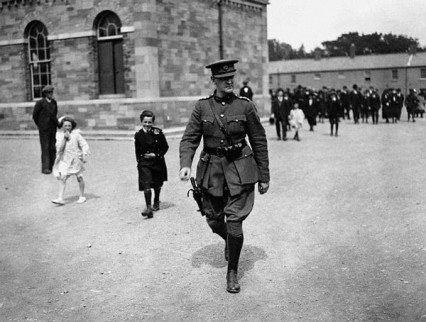
Michael Collins in London October 1921
11th October 1921
Collins outside Downing Street 1921
The treaty envisaged an independent Ireland that would be known as the Irish Free State but the agreement was hugely controversial, especially back in Ireland. For a start, de Valera, the President of the Irish Republic and who had a difficult relationship with Collins at the best of times, was angry that the treaty was signed without his authorisation (although it was at his insistence that Collins went, with de Valera considering it wrong to be involved in the negotiations if Britain’s King George V wasn’t either). Also controversial was both the British insistence that they continued to control a number of ports, known as the Treaty Ports, for the Royal Navy and that Northern Ireland (which had been created in the Government of Ireland Act 1920) was able to leave the Irish Free State within one month, which of course it duly did.
In April 1922 a group of 200 anti-treaty IRA men had occupied the Four Courts in Dublin in defiance of their Government. Collins, wanting to avoid Civil War at all costs, decided to leave them alone. However after the Field Marshall’s assassination and the subsequent Fleet Street outrage this all changed. It was assumed by the British that Dunne and O’Sullivan were anti-treaty IRA men and after the shock of the Field Marshall’s murder Winston Churchill wrote to Collins threatening that unless he moved against the Four Courts anti-treaty garrison he (Churchill) would use British troops to do so for him. After a final attempt to persuade the men to leave the Courts, Collins borrowed two 18 pounder Artillery guns from the British and bombarded the Four Courts until it’s garrison surrendered. A surrender which almost immediately led to the Irish Civil War with fighting breaking out over Dublin and subsequently the rest of the country.
The Four Courts siege, Dublin 1922
Sackville Street, Dublin 1922
Meanwhile back in London at the Old Bailey, and before Mr Justice Shearman, Dunne and O’Sullivan were both tried together for the murder of Sir Henry Wilson on 2 July 1922. Dunne stood with his arms folded while the charge was being read while O’Sullivan stood stiffly at attention. When Dunne was asked, “Are you guilty or not guilty?” he replied “I admit shooting Sir Henry Wilson.” “Are you guilty or not guilty of the murder?” the Clerk of Arraigns repeated. “That is the only statement I can make,” was the response. O’Sullivan made a similar reply and after some discussion the plea was treated as one of “Not guilty.”
Towards the end of the trial, which lasted just three hours, the defence Counsel handed the judge a double sheet of blue official paper given to him by Dunne. After perusing the contents Mr Justice Shearman said – “I cannot allow this to be read. It is not a defence to the jury at all. It is a political manifesto…I say clearly, openly, and manifestly it is a justification of the right to kill.”*
Dunne’s hand written statement
Dunne and O’Sullivan were sentenced to death by hanging and sent to Wandsworth gaol where they were both hanged together by the executioner John Ellis on the 10th August 1922.
Less than two weeks later Michael Collins was ambushed and shot dead in his home county of Cork by anti-treaty IRA members.
Commander in Chief Michael Collins in July 1922, two or three weeks before he was assassinated in Cork.
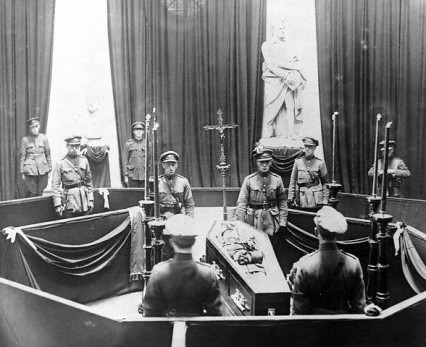
Michael Collins' funeral, O'Connell Street August 1922
The coffin bearing the body of Michael Collins lying in state in the City Hall, Dublin. September 2, 1922 Dublin, Ireland
Michael’s brother Sean Collins
It was never really established whether Dunne and O’Sullivan acted on their own (the assassination seemed pretty badly organised for an official assassination so this was likely) or with the approval and help of Michael Collins. Collins had been a friend of Dunne’s while Sir Henry Wilson was responsible for establishing the Cairo Gang (a group of experienced British Intelligence agents who met frequently at Dublin’s Cairo Cafe) twelve of whom were murdered by the IRA acting under Collins command in 1920. The Cairo Gang killings provoked the British Auxiliaries in Dublin to shoot trapped innocent civilians at Croke Park in not the bloodiest but perhaps the nastiest of the various historical Bloody Sundays.
The infamous Cairo gang
Perhaps the ironic aspect to the story of the murder of Sir Henry Hughes Wilson was that Reginald Dunne and Joseph O’Sullivan were both born and bred in London, whereas Field-Marshall Wilson was born smack bang in the middle of Ireland at Ballinalee in County Longford.
A letter sent to O'Sullivan while waiting for his execution
* The text of Dunne’s intended last statement, as transcribed from the images in this post.
Lord and Members of the Jury. My friend and I stand here before you today charged with the offense of murder; and I have no doubt that, from the evidence placed before you by the prosecution, you will find us both guilty. With respect to the charges of attempted murder, we merely tried, as everyone must know, to try and escape arrest.
The offence of murder is a very serious matter; so much so, that any act which results in loss of human life requires very grave and substantial reason. We have never until now been charged with any crime. As you have heard from the Police Officer, who gave evidence as to our character and our previous records, we have both been in the British Army. We both joined voluntarily, for the purpose of [making Europe safe?] in order that the principles for which this country stood, should be upheld and preserved. These principles, we were told, were Self-Determination and Freedom for Small Nations. We both, as I have said, fought for these principles, and were commended for doing so; and I imagine that several of you gentlemen of this jury did likewise. We came back from France to find that Self-Determination had been given to some Nations we had never heard of, but that it had been denied to Ireland, We found, on the contrary that our Country was being divided into two Countries; that a Government had been set up for the Belfast district, and that under that Government outrages were being perpetrated, that are a disgrace to civilization — many of the outrages being committed by men in uniform and in the pay of the Belfast Government. We took our part in supporting the aspiration of our fellow Countrymen, in the same way as we took part in supporting the nations of the world who fought for the right of small nationalities.
Who was Sir Henry Wilson? What was his policy? And what did he stand for? You have all read in the newspapers lately, and been told, that he was a great British Field Marshal; but his activities in other fields are unknown to the men of the British public. The nation to which we have the honour to belong, the Irish nation, knows him, not so much as the British Field Marshal, but as the man behind what is known in Ireland as the Orange Terror. He was at the time of his death the Military Advisor to what is colloquially called the Ulster Government, and as Military Advisor he raised and organized a body of men known as the Ulster Special Constabulary, who are the principle agents in his campaign of terrorism.
My Lord and Members of the Jury, I do not propose to go into details of the horrible outrages committed on men, women and children of my race in Belfast and other places under the jurisdiction of the Ulster Government. Among Irishment it is well known that about 500 men, women and children have been killed within the past few months, nearly two thousand wounded, and not one offender brought to justice. More than 9000 persons have been expelled from their employment; and 23,000 men, women, and children driven from their homes. All the big cities of this country and even those of Northern France are now receiving these refugees. Sir Henry Wilson was the representative figure and the organiser of the system that made these things possible.
At his suggestion and advice the Ulster Parliament passed an Act authorising the [purging?] of political opponents and this power is now exercised and enforced by the Courts in Ulster.
There is and can be no political liberty in a country where one political party outrages, oppresses, and intimidates not only its political opponents, but persons whose religious opinion differ from those of the party in power. The same principle for which we shed our blood on the Battle Field of Europe led us to commit the act we are charged with.
My Lord and Members of the Jury, you can condemn us to death today, but you cannot deprive us of the belief that what we have done was necessary to preserve the lives, the homes, and the happiness of our countrymen in Ireland. You may by your verdict find us guilty, but we will go [to] the scaffold justified by the verdict of our own Conscience.
Dunne truncated his statement to “cut out the patriotic adjectives I feel inclined to use under the present circumstances” (as well as his specific delineation of the atrocities of Henry Wilson and the Ulster government). -ed.
On this date in 1864, the leadership of Poland-Lithuania’s abortive January Uprising against the Russian tsar was hanged before 30,000 at Warsaw Citadel.
Romuald Traugutt depicted (somewhat ironically) on the 20-zloty note of Soviet bloc Poland.
Romuald Traugutt (English Wikipedia link | Polish) had been a decorated Lieutenant Colonel in the Tsarist army, and a heretofore apolitical man — but he resigned shortly after the outbreak of the doomed national uprising to take up sides against Russia.
This installment of the venerable Russians vs. Poles series was characteristically nasty.
In 1863 – Polonia by Jan Matejko, an allegory for the Polish nation is manacled by the Russians.
And it ended the way these affairs have ended these last 400 years or so: Russian victory.
In addition to this day’s batch — Traugutt along with (all Polish Wikipedia links) Rafal Krajewski, Jozef Toczyski, Roman Zulinski and Jan Jezioranski — a further 391 were put to death after the war; tens of thousands were deported to Siberia or otherwise scattered in the vast Romanov empire; a war indemnity tax was imposed; and over three thousand estates in Poland and Lithuania were confiscated.
Traugutt has gained some latter-day support in the Catholic Church for beatification.
“Who cannot be sorrowful and amazed that he should be a traitor against your majesty? He that was so advanced by your majesty, he whose surety was only by your majesty, he who loved your majesty, as I ever thought, no less than God; he who studied always to set forward whatsoever was your majesty’s will and pleasure; he that cared for no man’s displeasure to serve your majesty; he that was such a servant, in my judgment, in wisdom, diligence, faithfulness, and experience, as no prince in this realm ever had …
If he be a Traitor, I am sorry that ever I loved him, or trusted him, and I am very glad that his treason is discovered in time; but yet again I am very sorrowful; for who shall your grace trust hereafter, if you might not trust him? Alas!”
It was on this date in 1540 that the Machiavellian minister of Henry VIII fell by the instrument he had wielded so ably against so many others.
While Henry strove to get his end away, Thomas Cromwell made the Reformation, setting his energetic hand to the needfully violent reordering of England.
In almost a decade as the king’s chief minister, he had dissolved so many monasteries, annulled so many noble prerogatives, backstabbed so many courtiers, and sent so many of every class to the scaffold that most at court had some reason to hate him. (Cranmer was the only one to (cautiously) object to his old partner’s arrest.)
Hilary Mantel’s acclaimed Man-Booker Prize-winning 2009 novel Wolf Hall humanizes Cromwell’s side of his clash with Thomas More. (Review)
Though it may be, as Edward Hall recorded, that “many lamented but more rejoiced” at Cromwell’s fall from the very height of his power — “and specially such as either had been religious men, or favoured religious persons; for they banqueted and triumphed together that night [of his execution], many wishing that that day had been seven year before” — the reasons for it are murky enough to invite recourse to the royal person’s irrationality.
The bedroom politics get all the press: Cromwell’s bit of marital statecraft arranging Henry’s marriage to Anne of Cleves was a famous dud, but negotiations to end it were well on their way by the time of Cromwell’s arrest.
Why, too, should the minister have been ennobled Duke of Essex in April 1540, months after the disastrous union? That Cromwell, whose own security rested upon the stability of the realm, was a radical Protestant promulgating inflammatory religious ideas — and he was condemned for both treason and heresy, incidentally giving the king wide latitude for just how painfully to kill his former servant — seems to beggar belief.
Once fallen, Cromwell was kept alive long enough to add testimony to the Cleves divorce; that much is clear. But then why keep him alive still three weeks more?
In the end, maybe it was inevitable that one in his position, at his time and place, had to follow to the scaffold the many he had sent thither, just the Tudor version of that familiar “bad advisors” trope: it were not treason to murmur against the aide whose ill counsel did wrong by His Majesty, and so Cromwell stood to accumulate the share of hostility that properly belonged to his sovereign. As an expert practitioner of the game of power politics, Thomas Cromwell could hardly be in a position to complain.
Oh, and by the by: with the German princess on the outs, the king’s wandering eye had fallen upon a niece of Cromwell’s enemy. On the day that Cromwell lost his head, Henry married Catherine Howard. No matter your brilliance, in Henrican England you only had to lose at court politics once, even if the king would be lamenting this injudicious trade within months.
Henry gave his loyal servant the easiest death, beheading on Tower Hill (although it turned out to be a botched job) — alongside a distinctly undercard attraction, Walter Hungerford, the first person executed under the Buggery Act.
Hall records Cromwell playing ball with a fine entry in the scaffold-speech genre that kept his son in the peerage.
I am come hether to dye, and not to purge my self, as maie happen, some thynke that I will, for if I should do so, I wer a very wretche and miser: I am by the Lawe comdempned to die, and thanke my lorde God that hath appoynted me this deathe, for myne offence: For sithence the tyme that I have had yeres of discrecion, I have lived a synner, and offended my Lorde God, for the whiche I aske hym hartely forgevenes. And it is not unknowne to many of you, that I have been a great traveler in this worlde, and beyng but of a base degree, was called to high estate, and sithes the tyme I came thereunto, I have offended my prince, for the whiche I aske hym hartely forgevenes, and beseche you all to praie to God with me, that he will forgeve me. O father forgeve me. O sonne forgeve me, O holy Ghost forgeve me: O thre persons in one God forgeve me. And now I praie you that be here, to beare me record, I die in the Catholicke faithe, not doubtyng in any article of my faith, no nor doubtyng in any Sacrament of the Churche.* Many hath sclaundered me, and reported that I have been a bearer, of suche as hath mainteigned evill opinions, whiche is untrue, but I confesse that like as God by his holy spirite, doth instruct us in the truthe, so the devill is redy to seduce us, and I have been seduced: but beare me witnes that I dye in the Catholicke faithe of the holy Churche. And I hartely desire you to praie for the Kynges grace, that he maie long live with you, maie long reigne over you. And once again I desire you to pray for me, that so long as life remaigneth in this fleshe, I waver nothyng in my faithe.
And then made he his praier, whiche was long, but not so long, as bothe Godly and learned, and after committed his soule, into the handes of God, and so paciently suffered the stroke of the axe, by a ragged and Boocherly miser, whiche very ungoodly perfourmed the Office.
If Cromwell’s dying sentiment concealed any lasting bitterness for the crown, maybe his spirit would take some satisfaction a century later when another of his name and family rose high enough to behead a king.
* Cromwell’s bit about the “Catholic faith” in his dying confession is to be carefully handled; it’s sometimes rendered “the traditional faith,” and occasionally treated by later Protestant polemicists as a phony addition made by Roman apologists. It’s not, appearances aside, walking back the Reformation; according to Charles Carlton’s “Thomas Cromwell: A Study in Interrogation” (Albion: A Quarterly Journal Concerned with British Studies, Vol. 5, No. 2 (Summer, 1973)) our day’s victim “did not see himself as a Catholic separate from the Church, but as a Christian, who, with his King, had escaped the Pope’s usurped authority.” Cromwell is also explicit in this passage about rejecting sacramentarianism, which was part of the heresy accusation against him.
On this date in 1915, Haitian President Jean Vilbrun Guillaume Sam had his predecessor* Oreste Zamor, and 160 or so of his closest proximity, executed in Port-au-Prince.
Within hours, Sam himself was dead at the hands of an outraged mob — and Haiti on its way to 19 years of American military occupation.
Haiti in the 1910s was a dangerous place to aspire to political authority; Sam was the 7th different man to hold the presidency since 1911. Like many others, he gained it by force, and held it tenuously against rivals who planned to do likewise.
The hecatomb that did in Sam, who had been head of state for less than five months, was seemingly intended to shore himself up in the face of an advance upon Port-au-Prince by one Rosalvo Bobo — or else just done for the principle of the thing. Either way, it left a mess.
A few minutes after 4 a.m., Charles Oscar Etienne, the chief military officer of the Haitian government and a close friend of the President, hurried to the national prison, where ensued the bloody massacre of some 167 prisoners who were held only as political suspects without being even charged with any crime. Among the victims were members of the most prominent families of Haiti …
Stephen Alexis, one of the political prisoners who escaped death in the massacre, has testified before the claims commission that on the morning of the twenty-eighth [sic] of July he has awakened by the prisoner who shared his cell and told that there was firing in town. He heard shots being fired with increasing intensity, and at twenty minutes past four the sound of voices in the conciergerie and the order, “To arms, sound the bugle, prepare for action; fifteen men, forward march.” As the firing squad reached the first cell, Alexis heard Chocotte, the adjutant of the prison, say, “Fire close to the ground; a bullet in the head for each man,” and when the second cell was reached a loud voice cried, “Every one of the political prisoners must die. The arrondissement’s orders are that not one be left standing” …
Except for the very few who escaped by a miracle, the political prisoners were all slaughtered like cattle, their bodies slashed and horribly mutilated, limbs hacked off, the skulls of some of the corpses smashed in, and the bodies of others disembowelled …
The report of the claims commission says: “The barbarous act perpetrated in the prison in Port-au-Prince is all the more inexplicable in that it had no act of war for excuse. There had been no revolt in the interior of the prison. The prisoners were locked into their cells. The prison had not been attacked. The bureau of the arrondissement, which adjoined the prison, had not had to repulse any offensive on the part of the revolutionists. It was with appalling cold-bloodedness that Haitian officers, in whom military authority had been vested, to whom the care and security of the prisoners had been entrusted, perpetrated, with the assistance of their subordinates, the wholesale slaughter of July 27.”
An incensed mob invaded the French embassy (where Sam had taken refuge) and literally tore apart the president.
On July 28, marines from the American ship USS Washingtonlanded in Port-au-Prince to do the usual restore-peace-and-freedom thing. (Greeted as liberators? Surprisingly, “Haitians Dislike[d] Landing of Marines”.)
As a happy side effect, the American occupation froze out French and German commercial interests who had made Haitian inroads, secured debt repayment from the bankrupt country, and allowed Washington to reorder its neighbor to its liking.
From 1915 to 1929 U.S. military tribunals made rulings on political cases. A treaty that provided for American control of customs and construction of roads, as well as supervision of schools and the constabulary, was approved by the Haitian legislature under threat that American troops would remain in the country. American officials dissolved the Haitian legislature when it refused to approve a new American-sponsored constitution, which was then ratified by a referendum supervised by the U.S. military.**
* Zamor was not Sam’s immediate predecessor; rather, Sam had deposed the man who had deposed Zamor.
** Filed under “everything old is new again,” here‘s the American chattering class circa 1921 making a familiar-sounding case for giving the occupation a few more Friedman units on behalf of the Haitian
people, all of whom, less the native ruling class, a small group, recognize the benefits of the American occupation and are grateful for the peace and security they now enjoy … The United States, [Admiral Knapp] says, has only made a start for the good of Haiti, and five years of healing occupation would be lost if the Americans withdrew.
She is of stately Norman figure; in her twenty-fifth year; of beautiful still countenance: her name is Charlotte Corday, heretofore styled d’Armans, while Nobility still was … A completeness, a decision is in this fair female Figure: ‘by energy she means the spirit that will prompt one to sacrifice himself for his country.’ What if she, this fair young Charlotte, had emerged from her secluded stillness, suddenly like a Star; cruel-lovely, with half-angelic, half-demonic splendour; to gleam for a moment, and in a moment be extinguished: to be held in memory, so bright complete was she, through long centuries!–Quitting Cimmerian Coalitions without, and the dim-simmering Twenty-five millions within, History will look fixedly at this one fair Apparition of a Charlotte Corday; will note whither Charlotte moves, how the little Life burns forth so radiant, then vanishes swallowed of the Night.
Hapless beautiful Charlotte; hapless squalid Marat! From Caen in the utmost West, from Neuchatel in the utmost East, they two are drawing nigh each other; they two have, very strangely, business together.
Or was it strange at all?
Implacable in her purpose, utopian in her design, unafraid to plant a butcher’s knife into the chest of an enemy of France, Corday has a little something in common with her mortal foe.
These make casting too easy: Marat, bad because he was ugly and ugly because he was bad; Charlotte, therefore, just the reverse. (She was also a virgin; they made sure to check at the autopsy.) Our Norman assassin’s looks have inordinately exercised her interlocutors from the moment of her arrest; her prosecutors, too, understood them as essential.
“Not at all pretty,” a contemporaneous government article (cited in Crisis in Representation) put about. “She was a virago, brawny rather than fresh, without grace, untidy as are almost all female philosophers and eggheads … an old maid … with a masculinized bearing … [who] had thrown herself absolutely outside of her sex.”
And there it is. Charlotte Corday’s power to excite both rapture and repulsion is plainly rooted in the unexpected contradiction between her sex and her crime. If she is a resolute political assassin, surely she is not feminine … or is it the other way around?
Take Andre Chenier‘s engorged ode: “Fair, young, resplendent, led to the executioners, you seemed to be riding in your bridal car … You alone were a man and vindicated the human race. And we, vile eunuchs, a cowardly and soulless herd, we know how to repeat some womanly whimper, but the steel would weigh heavy in our feeble hands. … One scoundrel less crawls in this slime. Virtue applauds you. Hear the majestic sound of its virile praise, heroic maid.” This is “throwing herself outside of her sex” in the affirmative sense of uplifting herself beyond mere womanhood, a girl so heroic she might almost qualify as a dude.
Place it at the historical pivot into a modernity unready to reckon with the place of the woman, and confusion reigns.
“The spectacle of such wickedness, beauty, and talent united in the same person,” a newspaper recorded, “the contrast between the magnitude of her crime and the weakness of her sex, her appearance of actual gaiety, and her smile before the judges, who could not fail to condemn her, all combined to create an impression on the spectators that is difficult to portray.”*
Still, this judgment offers more insight than some latterly “tributes,” like this Anglo magazine piece 30 years later: “an ornament and an honour to the sex of woman … Woman is the child of feeling. From this source spring up all her good and bad qualities. It is seldom ambition or policy which leads her on to any enterprise: it is the passions. … it was under the influence of such feelings that Charlotte Corday performed that act, which virtuous and generous minds, so far from considering a crime, will look upon as one of the most heroic deeds of recorded history.”
Which is a fascinating form of sexism, since it was precisely Corday’s unearthly calm — masculine virtue! — that awed the Revolutionary Tribunal. But everything about Charlotte Corday is up for interpretive grabs; Nina Rattner Gelbart even argues, in “The Blonding of Charlotte Corday” (Eighteenth-Century Studies 38.1 (2004)) that though a real-life brunette, her depictions trend increasingly flaxen-haired.**
As for Charlotte Corday her work is accomplished; the recompense of it is near and sure. The chere amie, and neighbours of the house, flying at her, she ‘overturns some movables,’ entrenches herself till the gendarmes arrive; then quietly surrenders; goes quietly to the Abbaye Prison: she alone quiet, all Paris sounding in wonder, in rage or admiration, round her. …
On Wednesday morning, the thronged Palais de Justice and Revolutionary Tribunal can see her face; beautiful and calm: she dates it ‘fourth day of the Preparation of Peace.’ A strange murmur ran through the Hall, at sight of her; you could not say of what character. Tinville has his indictments and tape-papers the cutler of the Palais Royal will testify that he sold her the sheath-knife; “all these details are needless,” interrupted Charlotte; “it is I that killed Marat.” By whose instigation? — “By no one’s.” What tempted you, then? His crimes. “I killed one man,” added she, raising her voice extremely (extremement), as they went on with their questions, “I killed one man to save a hundred thousand; a villain to save innocents; a savage wild-beast to give repose to my country. I was a Republican before the Revolution; I never wanted energy.” There is therefore nothing to be said. The public gazes astonished: the hasty limners sketch her features, Charlotte not disapproving; the men of law proceed with their formalities. The doom is Death as a murderess. To her Advocate she gives thanks; in gentle phrase, in high-flown classical spirit. To the Priest they send her she gives thanks; but needs not any shriving, or ghostly or other aid from him.
On this same evening, therefore, about half-past seven o’clock, from the gate of the Conciergerie, to a City all on tiptoe, the fatal Cart issues: seated on it a fair young creature, sheeted in red smock of Murderess; so beautiful, serene, so full of life; journeying towards death,–alone amid the world. Many take off their hats, saluting reverently; for what heart but must be touched? Others growl and howl. Adam Lux, of Mentz, declares that she is greater than Brutus; that it were beautiful to die with her: the head of this young man seems turned. At the Place de la Revolution, the countenance of Charlotte wears the same still smile. The executioners proceed to bind her feet; she resists, thinking it meant as an insult; on a word of explanation, she submits with cheerful apology. As the last act, all being now ready, they take the neckerchief from her neck: a blush of maidenly shame overspreads that fair face and neck; the cheeks were still tinged with it, when the executioner lifted the severed head, to shew it to the people. ‘It is most true,’ says Foster, ‘that he struck the cheek insultingly; for I saw it with my eyes: the Police imprisoned him for it.’†
In this manner have the Beautifullest and the Squalidest come in collision, and extinguished one another. Jean-Paul Marat and Marie-Anne Charlotte Corday both, suddenly, are no more. ‘Day of the Preparation of Peace?’ Alas, how were peace possible or preparable, while, for example, the hearts of lovely Maidens, in their convent-stillness, are dreaming not of Love- paradises, and the light of Life; but of Codrus’-sacrifices, and death well earned? That Twenty-five million hearts have got to such temper, this is the Anarchy; the soul of it lies in this: whereof not peace can be the embodyment! The death of Marat, whetting old animosities tenfold, will be worse than any life. O ye hapless Two, mutually extinctive, the Beautiful and the Squalid, sleep ye well,–in the Mother’s bosom that bore you both!
While the assassin went contentedly to her death, and left smitten admirers in her passing, more realistic politicians saw that all her magnificent stoicism, all her self-sacrifice, had doomed the liberals who were her political fellow-travelers and opened the door to the very Terror she meant to avert. (And also that the gesture might have been better directed elsewhere, since Marat was already dying.)
What meaning this leaves one with — any at all? — is the subject of the Peter Weiss play-within-a-play Marat/Sade, which sets a cast of lunatics in the Napoleonic era under the direction of the Marquisde Sade to portraying Marat’s rendezvous with Charlotte Corday.
* Cited by Elizabeth R. Kindleberger in “Charlotte Corday in Text and Image: A Case Study in the French Revolution and Women’s History,” French Historical Studies, Vol. 18, No. 4 (Autumn, 1994).
** Also of interest from Gelbart is the Vichy government’s affinity for our murderess: “Antisemitism made of Marat a Jew and a vile creature, dark, dirty, satanic, a bloodthirsty monster. In contrast, Corday was pure, saintly, beautiful, virginal, and of course fair.”
† The slap given Charlotte Corday’s severed head is historically attested by the French press (which was aghast); the famous story about it of a much more fantastic quality is that the severed head blushed — and, in the phrasing of Englishwoman Helen Maria Williams, “exhibited this last impression of offended modesty.” The legend of Charlotte’s crimsoned cheeks always comes up in the backstory of the guillotine’s experiments to determine if a head retained consciousness; Charlotte’s blush may in fact be credited as one of the reasons these experiments actually came to pass.
On this date in 1187, Saladin dealt the Crusader Kingdom a crippling blow at the Battle of Hattin — and a fatal beheading to douchebag French knight RaymondRaynald of Chatillon after the fray.
Conduct so ill comporting with Saladin‘s reputation for chivalry had been earned by Raynald’s own bad behavior.
Crusaders with a view to realpolitik saw that the Kingdom of Jerusalem had to coexist with its Muslim neighbors. Raynald (or Reynald, or Renaud) just preferred killing them.
His raids against Saladin’s caravans when the Crusader state was supposed to be at peace with the Ayyubids precipitated the war that would claim his own head — and, within three months of this date, Jerusalem itself.
The Muslim commander vowed going in to slaughter the notoriously vicious Raynald if he captured him. Here he is making good the threat in the Ridley Scott epic Kingdom of Heaven:
According to the account (sourced to Wikipedia, such as it is) of Saladin house historian Imad ad-Din al-Isfahani, an eyewitness to the event,
Saladin invited the king [Guy] to sit beside him, and when Arnat [Raynald] entered in his turn, he seated him next to his king and reminded him of his misdeeds. “How many times have you sworn an oath and violated it? How many times have you signed agreements you have never respected?” Raynald answered through a translator: “Kings have always acted thus. I did nothing more.” During this time King Guy was gasping with thirst, his head dangling as though drunk, his face betraying great fright. Saladin spoke reassuring words to him, had cold water brought, and offered it to him. The king drank, then handed what remained to Raynald, who slaked his thirst in turn. The sultan then said to Guy: “You did not ask permission before giving him water. I am therefore not obliged to grant him mercy.” After pronouncing these words, the sultan smiled, mounted his horse, and rode off, leaving the captives in terror. He supervised the return of the troops, and then came back to his tent. He ordered Raynald brought there, then advanced before him, sword in hand, and struck him between the neck and the shoulder-blade. When Raynald fell, he cut off his head and dragged the body by its feet to the king, who began to tremble. Seeing him thus upset, Saladin said to him in a reassuring tone: “This man was killed only because of his maleficence and perfidy.”
The Egyptian classic El Naser Salah el Dine, whose composition and subject matter reflect its production at the acme of Nasser-led Pan-Arabism, noticeably soft-pedals this scene, with Raynald as an over-the-top boor who challenges his captor to a duel and is slain in a fair fight. (Skip to about 35:25 in the clip below to see it, but the whole thing is well worth the watching.)
On this date in 1962, Georges Kageorgis* was shot at Usumbura (now Bujumbura) for assassinating the charismatic national figure seemingly destined to lead the country into its postcolonial age.
“It was a bit like what could have happened in South Africa if Nelson Mandela was murdered before assuming the presidency in 1994,” said one pol later.
A prince, a pro-independence nationalist, a Tutsi who had married a Hutu and spurned a tribal leadership position lest he cast too sectarian a profile, Louis Rwagasore became prime minister in the fall of 1961 on the strength of his party‘s comprehensive electoral victory.
Rwagasore admired Patrice Lumumba. He was destined to share Lumumba’s fate.
Two weeks after his election, “the one truly popular national figure” was gunned down by Kageorgis, a Greek mercenary drawing pay from Belgian settlers who reckoned a better situation (French link) for themselves with Hutu governance. A revolution of (Belgian- and Catholic-backed) Hutu in Rwanda had had a “neo-colonial” character, according to Rene Lemarchand … and it had heightened ethnic tensions in Burundi.
With the murdered prince went ethnic cohesion; the bloody Kamenge riots of January 1962 presaged worse to come as leadership in the Rwagasore-less party collapsed. Ethnic conflict sharpened through the 1960’s, with a Tutsi-dominated dictatorship ultimately gaining control of the country and setting the stage for intermittent massacres (two classed as genocides) that haunt Burundi to this day and form part of the context for the Rwandan genocide.
Rwagasore Day — October 13, the anniversary of the prince’s assassination — is still observed in Burundi. Kageorgis’s execution date is notable for other reasons: it was the last day before Belgian authority in Ruanda-Urundi officially ended.
Hatano Hideharu, chief of the minor Hatano clan, got himself on the outs with powerful daimyoOda Nobunaga. Nobunaga’s samurai general Akechi Mitsuhide forced Hideharu’s capitulation, convincing him to lay down his arms by offering his own mother as a hostage.*
And here’s where the bodies start piling up.
Nobunaga overruled Mitsuhide’s promise of safe conduct and had Hatano Hideharu put to death.
Outraged, the Hatano clan retaliated by crucifying Akechi Mitsuhide’s mother.
Since Mitsuhide suffered the consequences for the bad behavior of his boss, this tit-for-tat left a bit of tension between the two. (The Hatano were done as a factor in Japanese politics, so having served to poison this relationship, our story takes its leave of them here.)
Perhaps as a result — there’s no single agreed-upon reason, but the personal vendetta has drawn the most commentary — Mitsuhide himself rebelled and forced Oba Nobunaga to commit seppuku.
It probably wasn’t exactly like this fanvid of Samurai Warriors 2 scenes.
Mitsuhide’s betrayal opened the door for another Nobunaga retainer, Toyotomi Hideyoshi, to in turn crush Mitsuhide,** and seize power for himself.
And maybe — with a stretch — they owe it all to Hatano Hideharu.
* The online sourcing on the death of Makiko, Akechi Mitsuhide’s mother, is a bit inconsistent; some suggest that the Hatano didn’t have her a hostage, but found a way to kidnap her for revenge.
** Mitsuhide’s daughter Hosokawa Gracia, became a legendary Christian convert after his death.





 Within hours, Sam himself was dead at the hands of an outraged mob — and Haiti on its way to 19 years of American


