On this date (by the Julian calendar then in use) in 1389, Stefan Lazar Hrebeljanovic — that’s Tsar Lazar to you — led the armies of Moravian Serbia against the expanding Ottoman Empire at the Battle of Kosovo.
The Serbs were defeated — thereby plunging, in the national mythology, into a half-millennium of Turkish domination. Lazar was supposedly* captured and beheaded.
For a generation, Lazar had firmed up his authority as the most significant Serbian autocrat outside the Ottoman orbit. The gravity of that orbit, however, grew more powerful with each passing year; soon, it would devour Byzantium.
Here in the 14th century, the Turkish expansion took on vassals in southeastern Europe. For a prince in the marches, a reckoning had to come due.
Of course, some Serbian lords and other Christian rulers were prepared to owe fealty to the Turks.
In the national epic poem The Battle of Kosovo, our day’s hero receives divine visitation charging him to choose between the treasures of earth and those of eternity, perhaps the author’s critique of European nobles who joined the infidel.
‘Lazar! Lazar! Tsar of noble family,
Which kingdom is it that you long for most?
Will you choose a heavenly crown today?
Or will you choose an earthly crown?
If you choose the earth then saddle horses,
Tighten girths- have your knights put on
Their swords and make a dawn attack against
The Turks: your enemy will be destroyed.
But if you choose the skies then build a church-
O, not of stone but out of silk and velvet-
Gather up your forces take the bread and wine,
For all shall perish, perish utterly,
And you, O Tsar, shall perish with them.”
This particular battle grew into one of mythic importance in the national memory of Serbia: the sacred apogee of national honor, even the bulwark of Christendom upon which the Islamic wave broke.**
Its site, “Kosovo Polje” or the “Field of Blackbirds” near Pristina, is a monument to the Serbian and Orthodox cause; that it is located, as its name suggests, in the province forcibly detached from Belgrade by NATO during the Kosovo War makes it a politically touchy bit of topography. Nationalist outfits like the Tsar Lazar Guard are violently displeased with Albanians having say-so about the place.
Not surprisingly, the record of the time suggests less a Balkan Thermopylae than that old historical standby — shifting relationships of collaboration, resistance, and negotiated boundaries amid Ottoman advances and (sometimes) reverses.
Lazar’s own son and heir Stefan Lazarevic became an Ottoman ally; when the Ottomans were themselves invaded, he shifted his alliance to a different regional power, Hungary. His successor, Durad Brankovic, became estranged from that alliance and eventually fought against the Hungarians in the Second Battle of Kosovo … as an Ottoman vassal.†
Be that as it may, St. Vitus’ Day — Vidovdan in Serbo-Croatian — which is now observed on its Gregorian calendar date of June 28th, remains one of the most sacred days on the Serbian calendar (it’s also the feast day of Lazar, a saint in the Orthodox tradition).
Vidovdan obtained another layer of meaning in 1914, for it was June 28 that Yugoslav nationalists then under the heel of a Christian empire assassinated Austro-Hungarian Archduke Ferdinand and ignited the First World War.
* It’s the predominant version of legend but not a settled historical fact that Lazar was actually beheaded as a prisoner. He may have simply died in battle, or of wounds taken sustained in the fight.
On this date in 1942, the Germans visited upon the Czechoslovakian village of Lidice one of the most notorious butcheries of World War II: the physical destruction of the town, and the execution of most of the adult population, in revenge for the assassination of Reichsprotektor Reinhard Heydrich.
Heydrich had power of life and death in Nazi-occupied Bohemia and Moravia, and did not scruple to use it.
“The Hangman of Prague” was no mere functionary, but a Nazi grand wizard from way back, who’d had a hand in the Third Reich’s most terrifying greatest hits — the Night of the Long Knives, Kristallnacht. Just four months before this date, Heydrich had chaired the Wannsee Conference.* (Watch Kenneth Branagh as Heydrich ride herd over a gaggle of bureaucrats to get the Final Solution up and running in Conspiracy.) Hitler called him his “man with the iron heart.”
So he was a natural target for the Czechoslovakian army-in-exile and their British handlers, made more so by his lordly disdain for common-sense security safeguards.
Zipping along a predictable route in an open car, he was a sitting duck for a hit squad, who gave the Nazi bastard a mortal shrapnel wound from a grenade that had him lingering painfully at death’s door for several days before he finally died of blood poisoning.
The 1964 Czechoslovakian film Atentat (“Assassination”) chronicles the plot to kill Heydrich and its aftermath.
For this effrontery, Czechoslovakians would pay a dreadful price.
But the Reich also exacted collective reprisals to make plain that the entire “protectorate” could be considered hostage against such plots in the future.
Special transports of Jews marked “Attentat auf Heydrich” were shipped to the camps, and 152 were executed on the day Heydrich succumbed. But then, the Nazis were brutalizing Jews anyway. Something more headline-grabbing would be needed.
After gaudy funerals for the slain Reichsprotektor, the Reich settled upon the small town of Lidice north of Prague — trumping up a few connections to resistance to “justify” collective punishment.
On this date, German troops stormed it, summarily executed all the men and boys** old enough to bear arms and a fair number of women, deported the others, and then physically destroyed and buried the town.
Lidice was intended as a demonstration — boldly published to the world as proof against a repeat,† it became the byword of Nazi cruelty towards subject nations. Though not by quantitative standards the greatest crime of the occupation, not even the greatest crime in reprisal for Heydrich, its three syllables distill all the evil of Hitler’s conquest for Czechoslovakia.
Lidice did live, and does yet, as an emblem par excellence those terrible years.
Less alive: Heydrich’s right-hand man Karl Hermann Frank, who was hanged in Prague after the war for engineering this monstrous crime. Those survivors of Lidice able to make the trip enjoyed priority seating.
* Heydrich’s aide at the Wannsee Conference, and taker of cleaned-up minutes, was Mr. Banality of Evil himself, Adolf Eichmann.
** Only three men of Lidice survived the destruction: two who were in England at that time, and one who was imprisoned in Prague for killing his son. The sentence for this crime, it turned out, was life.
† An effective proof — the calculated wholesale slaughter apparently did cool both the conquered populace and the enemies of Germany on enthusiasm for further assassinations.
On this, the second day of the abortive 1832 June Rebellion in Paris, police inspector Javert is faux-executed — and mercifully released — by his longtime quarry Jean Valjean in Victor Hugo’s classic Les Miserables.
Javert depicted in an theatrical poster, from the Les Miserables Gallery. The site identifies this as an 1899 poster, which may be mistaken since the actor billed for Javert died in January 1898.
Hugo’s monumental novel is structured by the implacable policeman’s pursuit of Jean Valjean, an absconded ex-con with a heart of gold.
Fate brings them together accidentally at the barricade of the (historical, but now forgotten) student uprising — Javert to spy on the student revolutionaries, who unmask him, and Jean Valjean to keep an eye on his adoptive daughter’s idealistic lover.
Jean Valjean’s timely contribution to the hopelessly outgunned revolutionaries gives him the pull to ask the favor of being the one to execute the spy.* Since Valjean has been hunted relentlessly by the lawman since breaking parole nearly two decades before, the hero has ample motivation to turn executioner.
When Jean Valjean was left alone with Javert, he untied the rope which fastened the prisoner across the middle of the body, and the knot of which was under the table. After this he made him a sign to rise.
Javert obeyed with that indefinable smile in which the supremacy of enchained authority is condensed.
Jean Valjean took Javert by the martingale, as one would take a beast of burden by the breast-band, and, dragging the latter after him, emerged from the wine-shop slowly, because Javert, with his impeded limbs, could take only very short steps.
Jean Valjean had the pistol in his hand.
In this manner they crossed the inner trapezium of the barricade. The insurgents, all intent on the attack, which was imminent, had their backs turned to these two.
Marius alone, stationed on one side, at the extreme left of the barricade, saw them pass. This group of victim and executioner was illuminated by the sepulchral light which he bore in his own soul.
Jean Valjean with some difficulty, but without relaxing his hold for a single instant, made Javert, pinioned as he was, scale the little entrenchment in the Mondetour lane.
When they had crossed this barrier, they found themselves alone in the lane. No one saw them.
…
Jean Valjean thrust the pistol under his arm and fixed on Javert a look which it required no words to interpret: “Javert, it is I.”
Javert replied:
“Take your revenge.”
Jean Valjean drew from his pocket a knife, and opened it.
“A clasp-knife!” exclaimed Javert, “you are right. That suits you better.”
Jean Valjean cut the martingale which Javert had about his neck, then he cut the cords on his wrists, then, stooping down, he cut the cord on his feet; and, straightening himself up, he said to him:
“You are free.”
Javert was not easily astonished. Still, master of himself though he was, he could not repress a start. He remained open-mouthed and motionless.
Jean Valjean continued:
“I do not think that I shall escape from this place. But if, by chance, I do, I live, under the name of Fauchelevent, in the Rue de l’Homme Arme, No. 7.”
Javert snarled like a tiger, which made him half open one corner of his mouth, and he muttered between his teeth:
“Have a care.”
“Go,” said Jean Valjean.
Javert began again:
“Thou saidst Fauchelevent, Rue de l’Homme Arme?”
“Number 7.”
Javert repeated in a low voice: — “Number 7.”
He buttoned up his coat once more, resumed the military stiffness between his shoulders, made a half turn, folded his arms and, supporting his chin on one of his hands, he set out in the direction of the Halles. Jean Valjean followed him with his eyes:
A few minutes later, Javert turned round and shouted to Jean Valjean:
“You annoy me. Kill me, rather.”
Javert himself did not notice that he no longer addressed Jean Valjean as “thou.”
“Be off with you,” said Jean Valjean.
Javert retreated slowly. A moment later he turned the corner of the Rue des Precheurs.
When Javert had disappeared, Jean Valjean fired his pistol in the air.
In saving his own soul, Jean Valjean (conveniently!) manages to kill his pursuer just the same: the cognitive dissonance for such a hard, emotionless man being on the receiving end of this bit of redemptive mercy leads Javert to break character so far as to allow his man to escape. The inspector then commits suicide.
* While the recent musical production of Les Miserables soft-pedals what was planned for Javert, Hugo leaves no room for doubt: as the students prepare for the fatal onslaught, their leader Enjolras decrees that “[t]he last man to leave this room will smash the skull of this spy.”
On this date in 1098, the Turkish commander of Antioch put to flight by the invading Crusader army was seized and beheaded as a trophy of the victory.
Yaghi Siyan, the Seljuk governor known to European chroniclers as Acxianus, Gratianus or Cassianus, found himself in a bad way when Christian forces of the First Crusade laid siege to Antioch late in 1097.
Although the Europeans were famished, they maintained the siege for the best part of a year, finally surging into Antioch on the night of June 2-3, 1098, with the help (as so often the case in siege warfare) of an inside man who agreed to open a gate.
Yaghi Siyan showed unparalleled courage and wisdom, strength and judgment. If all the Franks who died had survived they would have overrun all the lands of Islam. He protected the families of the Christians in Antioch and would not allow a hair of their head to be touched.
After the siege had been going on for a long time the Franks made a deal with one of the men who were responsible for the towers. He was a cuirass-maker called Ruzbih [or Firuz, or Firouz] whom they bribed with a fortune in money and lands. He worked in the tower that stood over the river-bed, where the river flowed out of the city into the valley. The Franks sealed their pact with the cuirass-maker, God damn him! and made their way to the water-gate. They opened it and entered the city. Another gang of them climbed the tower with ropes. At dawn, when more than 500 of them were in the city and the defenders were worn out after the night watch, they sounded their trumpets … Panic seized Yaghi Siyan and he opened the city gates and fled in terror, with an escort of thirty pages.
Yaghi-Siyan fell from his horse in flight; his
companions tried to lift him back into the saddle, but they could not get him to sit up, and so left him for dead while they escaped. He was at his last gasp when an Armenian* shepherd came past, killed him, cut off his head and took it to the Franks at Antioch.**
A borderline “execution” at best, but close enough for our purposes; the Turkish garrison Yaghi-Siyan left behind to face the music was receiving similar treatment from the Crusaders, as were civilians, Muslim and Christian alike.
The month following Yaghi-Siyan’s death was a strange and pivotal one in the strange and pivotal history of the Crusades.
The city of Antioch was almost immediately invested again — by a relief force of Turks who had arrived too late. Facing seemingly long odds on the other end of the siege, and still near to starvation, the Crusaders discovered the “Holy Lance”† and managed to repel the Turks, enabling the upstart Christian army to march on to Jerusalem.
* Having had their homelands overrun by the Seljuks during the preceding decades, there was no small tension in the Armenian relationship with their Turkish rulers; the man who betrayed the city was himself said to be an Armenian who had been forced to convert to Islam. The account of the city’s capture by Raymond d’Aguiliers reports that our day’s victim “was captured and beheaded by some Armenian peasants, and his head was brought to us. This, I believe, was done by the ineffable disposition of God, that he who had caused many men of this same race to be beheaded should be deprived of his head by them.”
** Different accounts give slightly different versions of how Yaghi-Siyan came to his end — whether thrown from his horse or caught attempting to take refuge — and the station in life of the Armenian (everyone seems to agree on the nationality of the executioner) who decapitated him.
† The spear supposed to have pierced Christ on the cross, whose discovery was directed by Peter the Hermit at the direction, he said, of St. Andrew. Ibn al-Athir had a more skeptical take:
a holy man who had great influence over them, a man of low cunning … proclaimed that the Messiah had a lance buried in the Qusyan, a great building in Antioch … Before saying this he had buried a lance in a certain spot and concealed all trace of it. He exhorted them to fast and repent for three days, and on the fourth day he led them all to the spot with their soldiers and workmen, who dug everywhere and found the lance as he had told them.
On this date in 1832, Jamaican national hero Samuel Sharpe died upon the gallows for instigating the slave revolt that would (help to) end slavery.
Samuel Sharpe, an educated slave who was also a Baptist deacon, was the moving spirit behind the attempted general strike that became the Christmas Rebellion.
That time of year was less than festive for Jamaica’s enormous slave population, for Saint Nick opened the short window for harvesting the island’s sugar cane.
Samuel Sharpe and collaborators had the wit to realize that being depended upon to bring in the cash crop that made life comfortable for their owners put the slaves’ hands upon a potent economic lever. In the last few days of 1831, they pressed it.
The “passive resistance” thing didn’t last long, however, and the “strike” transmuted into a rebellion — the cause swiftly taken up by thousands of slaves around the island who torched crops. Given the small (less than 20) white body count,* the “violence” appears to have been directed against the instruments, rather than the perpetrators, of their enslavement.
Not so the reprisals.
The rebellion was suppressed within days, and over 300 put to death for it (in addition to 200 slave casualties during the pacification itself). There’s an absorbing BBC Witness episode about this affair available as a podcast here.
Sharpe was the last of those executed.
But his revolt is widely thought to have given impetus to the British parliament’s deliberations over the ensuing months that ultimately led to the Slavery Abolition Act (1833).
What [abolitionist MP William] Wilberforce was endeavoring to win from the British senate by his magic eloquence the slaves themselves were endeavoring to gain by outbreaks and violence. The combined action of one and the other wrought out the final result. While one showed that slavery was wrong, the other showed that it was dangerous as well as wrong. Mr. Wilberforce, peace man though he was, and a model of piety, availed himself of this element to strengthen his case before the British Parliament, and warned the British government of the danger of continuing slavery in the West Indies. There is no doubt that the fear of the consequences, acting with a sense of the moral evil of slavery, led to its abolition. The spirit of freedom was abroad in the Islands. Insurrection for freedom kept the planters in a constant state of alarm and trepidation. A standing army was necessary to keep the slaves in their chains. This state of facts could not be without weight in deciding the question of freedom in these countries … I am aware that the insurrectionary movements of the slaves were held by many to be prejudicial to their cause. This is said now of such movements at the South. The answer is that abolition followed close on the heels of insurrection in the West Indies, and Virginia was never nearer emancipation than when General Turner kindled the fires of insurrection at Southampton.
Sharpe, today, is an official national hero of Jamaica. The place in Montego Bay that he hanged is known as Sam Sharpe Square, and his face adorns the currency.
* Contrast with the much smaller, much bloodier rebellion of Nat Turner in the U.S., which preceded the Christmas Rebellion by a few months.
A bourgeois youth who, disgusted at the gross economic exploitation of the Gilded Age, had turned against his class with the fury only the apostate can command, Émile Henry had chucked a bomb into the chic cafe of the Parisian Gare Saint-Lazare a week after the execution of Auguste Vaillant.
Henry’s act killed only one, but electrified the country.
The Terminus bombing stood out in an era of violent anarchist ferment for its target selection: not a prince or president or parliamentarian, but the faceless multitudes of the bourgeoisie (formerly) secure in their metropolitan repose — who, in their indifference to the misery of workers assented to and profited from the more infamous repressions wrought by their plenipotentiaries.
Henry was completely explicit about his intent: “there are no innocent bourgeois.”
Recognizing the hopelessness of his legal position, he proudly admitted the charges against him and mounted an eloquent defense for the wider world of his version of anarchist terror.
I had returned to Paris at the time of the Vaillant affair, and I witnessed the frightful repression that followed the explosion at the Palais Bourbon. I saw the draconian measures which the government decided to take against the anarchists. Everywhere there were spies, and searches, and arrests. A crowd of individuals were indiscriminately rounded up, torn from their families, and thrown into prison. Nobody was concerned about what happened to the wives and children of these comrades while they remained in jail.
The anarchist was no longer regarded as a man, but as a wild beast to be hunted everywhere while the bourgeois Press, which is the vile slave of authority, loudly demands his extermination.
…
But, gentlemen of the bourgeoisie, you have reckoned a little too much without your host. You arrested hundreds of men and women, you violated scores of homes, but still outside the prison walls there were men unknown to you who watched from the shadows as you hunted the anarchists, and waited only for the moment that would be favourable for them in their turn to hunt the hunters.
… The bomb in the Cafe Terminus is the answer to all your violations of freedom, to your arrests, to your searches, to your laws against the Press, to your mass transportations, to your guillotinings. But why, you ask, attack these peaceful cafe guests, who sat listening to music and who, no doubt, were neither judges nor deputies nor bureaucrats? Why? It is very simple. The bourgeoisie did not distinguish among the anarchists. Vaillant, a man on his own, threw a bomb; nine-tenths of the comrades did not even know him. But that meant nothing; the persecution was a mass one, and anyone with the slightest anarchist links was hunted down. And since you hold a whole party responsible for the actions of a single man, and strike indiscriminately, we also strike indiscriminately.
Perhaps we should attack only the deputies who make laws against us, the judges who apply those laws, the police who arrest us? I do not agree. These men are only instruments. They do not act in their own name. Their functions were instituted by the bourgeoisie for its own defence. They are no more guilty than the rest of you. Those good bourgeois who hold no office but who reap their dividends and live idly on the profits of the workers’ toil, they also must take their share in the reprisals. And not only they, but all those who are satisfied with the existing order, who applaud the acts of the government and so become its accomplices, those clerks earning three or five hundred francs a month who hate the people even more violently than the rich, that stupid and pretentious mass of folk who always choose the strongest side — in other words, the daily clientele of Terminus and the other great cafés.
That is why I struck at random and did not choose my victims! The bourgeoisie must be brought to understand that those who have suffered are tired at last of their sufferings; they are showing their teeth and they will strike all the more brutally if you are brutal with them. …
We will not spare the women and children of the bourgeois, for the women and children of those we love have not been spared. Must we not count among the innocent victims those children who die slowly of anaemia in the slums because bread is scarce in their houses; those women who grow pale in your workshops, working to earn forty sous a day and fortunate when poverty does not force them into prostitution; those old men whom you have made production machines all their lives and whom you cast on to the waste heap or into the workhouse when their strength has worn away?
At least have the courage of your crimes, gentlemen of the bourgeoisie, and grant that our reprisals are completely legitimate.
…
In that pitiless war which we have declared on the bourgeoisie, we ask for no pity. We give death, and we know how to endure it. So it is with indifference that I await your verdict. I know that my head is not the last you will cut off; yet others will fall, for the starving are beginning to know the way to your great cafes and restaurants, to the Terminus and Foyot. You will add other names to the bloody list of our dead.
You have hanged in Chicago, decapitated in Germany, garotted in Jerez, shot in Barcelona, guillotined in Montbrison and Paris, but what you will never destroy is anarchy. Its roots are too deep. It is born in the heart of a society that is rotting and falling apart. It is a violent reaction against the established order. It represents all the egalitarian and libertarian aspirations that strike out against authority. It is everywhere, which makes it impossible to contain. It will end by killing you.
Clemenceau, who witnessed the beheading at the Place de la Roquette, saw in the ghastly white 21-year-old crying “long live anarchy!” in the predawn gloom this morning in 1894 “the face of a tormented Christ, terribly pale, implacable in expression, trying to impose his intellectual pride upon his child’s body … let those for the death penalty go, if they dare, to smell the blood of La Roquette.”
Five weeks later, the French president who had refused to spare Henry was himself assassinated by another anarchist.
The clip above uses an actual 1893 anarchist hymn to dynamite, that fruit of the chemical science whose pyrotechnics were held to catalyze social change. Henry, who probably hummed the song a few times in his life, must have approved the songwriter’s philosophy.
Tant mieux s’il éclate parfois en faisant beaucoup de victimes
Chez nos ennemis les bourgeois cela nous venge de leurs crimes
On this date in 1781, the last name in Incan rebellion met a horrible end in the ancient Incan capital of Cusco.
José Gabriel Condorcanqui — rechristened Tupac Amaru II, as he was a distant descendant of the last Incan king — was a member of the privileged indigenous population depended upon by the Spanish to administer the forced and extorted labor that made its New World empire worth having.
“From this day, no longer shall the Spanish feast on your poverty!”
This attention-grabbing entry onto the political chessboard was followed with an exemplary victory over Spanish forces. His revolt rapidly metastasized into an ethno-religious crusade, with all the accumulated bitterness of the Indians’ two-plus centuries maltreatment ferociously visited upon the Spanish.
It was a heady moment — but only a moment; within a few months, the Spanish had rallied and Tupac Amaru was betrayed into their hands.
The rebel had seized Incan symbology for his own purposes — speaking at ancient shrines, for instance — and the Spanish sentence against him included not only the inevitably horrific execution (of both Tupac Amaru and his wife and family) but a comprehensive and explicit programme of cultural annihilation to consign the Incan identity to the past. This lengthy sentence is well worth the read. (Sourced here, a pdf file; the bolded sections are my highlights.)
I must and do condemn José G. Túpac Amaru to be taken out to the main public square of [Cuzco], dragged out to the place of execution, where he shall witness the execution of the sentences imposed on his wife, Micaela Bastidas [Spanish link]; his two sons, Hipólito and Fernando Túpac Amaru; his uncle, Francisco Túpac Amaru; and his brother-in-law, Antonio Bastidas, as well as some of the principal captains and aides in his iniquitous and perverse intent or project, all of whom must die on the same day.
And once these sentences have been carried out, the executioner will cut out his tongue, and he will then be tied or bound by strong cords on each one of his arms and feet in such a way that each rope can be easily tied or fastened to others hanging from t he saddle straps of four horses, so that, in this position, each one of these horses, facing opposite corners of the square, will pull toward his own direction; and let the horses be urged or jolted into motion at the same time so that his body be divided into as many parts and then, once it is done, the parts should be carried to the hill or high ground known as “Picchu,” which is where he came to intimidate, lay siege to, and demand the surrender of this city; and let there be lit a fire which shall be prepared in advance and then let ashes be thrown into the air and a stone tablet placed there detailing his main crimes and manner of his death as the only record and statement of his loathsome action.
His head will be sent to the town of Tinta where, after being three days on the gallows, it shall be placed on a stake at the most public entrance to the town, one of his arms will go to the town of Tungasuca, where he was chief, where it will be treated in like manner, and the other in the capital of the province of Carabaya; one of the legs shall likewise be sent for the same kind of demonstration to the town of Libitaca in the province of Chumbilcas, while the remaining one shall go to Santa Rosa in the province of Lampa along with the affidavit and order to the respective chief magistrates, or territorial judges that this sentence be proclaimed publicly with the greatest solemnity as soon as it arrives in their hands, and on the same day every year thereafter; and they will give notice in writing of this to their superiors in government who are familiar with the said territories.
Since this traitor managed to arm himself and form an army and forces against the royal arms by making use of or seducing and leading with his falsehood the chiefs who are the second in command in the villages, since these villages, being of Indians, are not governed by such chiefs but rather by mayors who are elected annually by the vote or nomination of the chiefs: let these same electoral communities and the chief magistrates that care to give preference to candidates who know Spanish, and who are of the best behavior, reputation, and customs so that they will treat their subjects well and lovingly, honoring only those who have demonstrated honestly their inclination and faithfulness, eagerness, respect, obedience, submission, and gratitude to the greater glory of our great Monarch through the sacrificed of their lives, properties, or ranches in deference of their country or religion, receiving with brave disdain the threats and offers of the aforesaid reel leader and his military chiefs, yet taking care that these elected leaders are the only ones with the right to the title of chief or governor of their ayllus [communities] or towns, and that they cannot transmit their position to their children or other family members.
To this same end, it is prohibited that the Indians wear heathen clothes, especially those who belong to the nobility, since it only serves to symbolize those worn by their Inca ancestors, reminding them of memories which serve no other end than to increase their hatred toward the dominant nation; not to mention that their appear is ridiculous and very little in accordance with the purity of our relics, since they place in different parts images of the sun, which was their primary deity; and this prohibition is to be extended to all the provinces of this southern America, in order to completely eliminate such clothing, especially those items which represent the bestialities of their heathen kings through emblems such and the unco, which is a kind of vest; yacollas, which are very rich blankets or shawls of black velvet or taffeta; the macapaycha, which is a circle in the shape of a crown from which they hand a certain emblem of ancient nobility signified by a tuft or tassel of red-colored alpaca wool, as well as many other things of this kind and symbolism. All of this shall be proclaimed in writing in each province, that they dispose of or surrender to the magistrates whatever clothing of this kind exists in the province, as well as all the paintings or likenesses of their Incas which are extremely abundant in the houses of the Indians who consider themselves to be nobles and who use them to prove their claim or boast of their lineage.
These latter shall be erased without fail since they do not merit the dignity of being painted in such places, and with the same end in mind there shall also be erased, so that no sign remains, any portraits that might be found on walls or other solid objects; in churches, monasteries, hospitals, holy places or private homes, such duties fall under the jurisdiction of the reverend archbishops or bishops of both viceroyalties in those areas pertaining to the churches; and in their place it would be best to replace such adornments with images of the King and our other Catholic sovereigns should that be necessary. Also, the ministers and chief magistrates should ensure that in no town of their respective provinces be performed plays or other public functions of the kind that the Indians are accustomed to put on to commemorate their former Incas; and having carried out the order, these ministers shall give a certified account to the secretaries of the respective governments. In like manner shall be prohibited and confiscated the trumpets or bugles that the Indians use for their ceremonies and which they call pututos, being seashells with a strange and mournful sound that celebrate the mourning and pitiful memorial they make for their antiquity; and there shall also be prohibited the custom of using or wearing black clothing as a sign of mourning, a custom that drags on in some provinces in memory of their deceased monarchs and also of the day or time of the conquest which they consider disastrous and we consider fortunate since it brought them into the company of the Catholic Church and the very loving and gentle domination of our Kings.
With the same goal it is absolutely forbidden that the Indians sign themselves as “Incas,” since it is a title that anyone can assume but which makes a lasting impression on those of their class; and it is ordered, as is required of all those who have genealogical trees or documents that prove in some way their descent, that they produce them or send them certified and without cost by mail to the respective secretaries of both viceroyalties so that the formalities may be observed by those persons responsible to their excellencies the viceroys, consulting His Majesty where necessary according to each case; and the chief magistrates are charged to oversee the fulfillment of such requirements, to seek out and discover anyone who does not observe them correctly, in order to have it done to collect the documents with the aim of sending them to the proper authorities after giving their owners a receipt.
And so that these Indians renounce the hatred that they have conceived against the Spaniards, and that they adhere to the dress which the laws indicate, adopting our Spanish customs and speaking Castilian [Spanish], we shall introduce more vigorously than we have done up to now the use of schools, imposing the most rigorous and fair penalties on those who do not attend once enough time has passed for them to have learned the language; the duties and responsibilities involved in this plan going to the very reverend ecclesiastical prelates so that, in the opposition between parishes and doctrinas, they take care that those candidates bring affidavits from the provincial judges as to the numbers of people who speak the Said Castilian in those provinces … it being left up to the sovereign discretion of His Majesty to reward and honor those towns whose inhabitants have rendered, under the present circumstances, their due loyalty and faithfulness.
Finally, the manufacture of cannons of all kinds shall be prohibited under the penalty that any noble found manufacturing such items will be sentenced to ten years of prison in one of the presidios in Africa and any commoner will receive two hundred lashes as well as the same penalty for the same time period; reserving for a future time a similar resolution with regards to the manufacture of powder. And since there cannons of almost every caliber in the many ore-crushing mills and timber yards in these provinces, they will be gathered up by the magistrates once of the pacification of this uprising has been completely terminated in order to give account of them to the respective captaincy general so that he may determine whatever use he deems proper for them. Thus have I visualized, ordered, and signed: this is my final judgment.
José Antonio de Areche.
Tupac Lives.
The Spanish campaign to eradicate his name and identity didn’t exactly have legs.
The savagery of the crackdown helped generate Incan support for the rebellions that would shake off Spanish authority in the generations to come. He entered the official iconography of the post-colonial state, and can be found on Peruvian currency.
May of 1297 marks the first appearance in the historical record of Braveheart hero William Wallace … so we mark today the undated (and presumably fictional) execution/murder of his wife that, by the most cinematic account possible, set Wallace on his own path to the scaffold.
The face that lifted a thousand claymores: Catherine McCormack as Braveheart‘s version of Marion, Murron MacClannough. Murron’s “execution” inspires William Wallace.
Marion (or Marian) Braidfute, she’s called by the Scottish poet Blind Harry in the epic dating near two centuries after famed rebel’s rising. Not wanting audiences to confuse her with Robin Hood sweetie Maid Marian, the Braveheart script renamed her Murron MacClannough.
In Mel Gibson’s gory silver screen epic, Wallace is, at this point, a determinedly apolitical commoner — a stance contrasting markedly with a backstory of nationalistic identity-forming experiences, like having his father and brother killed by the English. He’s radicalized only after his attempt to protect Murron from rape results in her demonstrative summary execution.
And of course, Wallace then wreaks a bloody revenge (complete with summary execution of his own) that soon has the country in flames.
Hollywood’s avenging-his-woman angle exploits a folkloric embroidery of a female character perhaps created by Blind Harry, writing in the 15th century. In “The Wallace”, the titular hero is already well along his conflict with the English crown when he weds Marion — whose story arc differs greatly from that of the peasant eye candy Mel Gibson taps. In the poem, Marion is exposed to the vengeance of the Sheriff of Lanark, William Heselrig, when Wallace goes off to fight and refuses to take her along.
Now fierce with Rage the cruel Foe draws near,
Oh does not Heaven make Innocence its Care!
Where fled thy guardian Angel in that Hour
And left his Charge to the fell Tyrant’s Power,
Shall his fierce Steel be redned with thy Gore
And streaming Blood distain thy Beauties o’er?
But now awaken’d with the dreadfull Sound
The trembling Matron threw her Eyes around,
In vain alace were all the Tears she shed
When fierce he waves the Fauchion o’er her Head
All Tyes of Honour by the Rogue abjur’d
Relentless deep he plung’d the ruthless Sword;
Swift o’er her Limbs does creeping Coldness rise
And Death’s pale Hand seal’d up her fainting Eyes.
Wallace slays Heselrig the next day, according to the poem — the actual historical event of May, 1297,* that marks Wallace’s emergence from the dim fogs of history. (In the film Braveheart, the chronology is unstated, but Wallace is revenged before Murron’s burial.)
The same year William Wallace lifted up his head from his den — as it were — and slew the English sheriff of Lanark, a doughty and powerful man, in the town of Lanark. From that time, therefore, there flocked to him all who were in bitterness of spirit, and weighed down beneath the burden of bondage under the unbearable domination of English despotism; and he became their leader. He was wondrously brave and bold, of goodly mien, and boundless liberality … So Wallace overthrew the English on all sides; and gaining strength daily, he, in a short time, by force, and by dint of his prowess, brought all the magnates of Scotland under his sway, whether they would or not.
* “In the month of May the perfidious race of Scots began to rebel.” (Walter of Hemingborough)
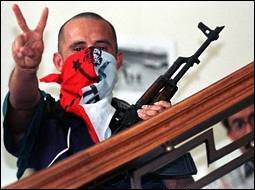
On this date in 1997, Peruvian paramilitaries stormed the Japanese ambassador’s residence held hostage for 126 days by leftist rebels.
Peace out.
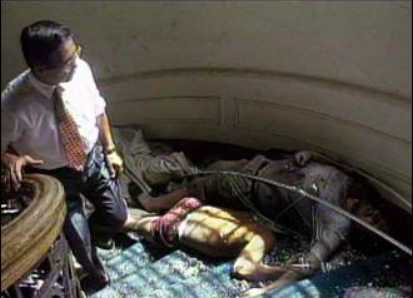
All 14 of the Tupac Amaru Revolutionary Movement (MRTA) were slain in the raid,* along with two of the commandos and one hostage. Officially, there were no “executions” at all.
Unofficially?
It’s pretty well-documented that some — perhaps most — of the terrorists were taken alive, and thereafter summarily executed. (pdf of Defense Intelligence Agency cable hosted by the National Security Archive)
However untoward the outcome and however unimpressive the foe, the operation was a master stroke for then-President Alberto Fujimori. Peru’s neoliberal taskmaster had introduced the world to the auto-golpe, the “self-coup”, a Cromwellian maneuver of shuttering parliament in order to rule as dictator, and he thereafter made ruthless suppression of Peru’s ruinous internal conflict the calling card of his presidency.
The DIA cable linked above claims Fujimori himself ordered the commandos to take no prisoners. He did not scruple to show himself in the middle of the bloodbath.
Alberto Fujimori made sure to get himself snapped standing over the bodies of the guerrillas, including MRTA leader Nestor Cerpa Cartolini.
El Presidente banked the political capital from having restored civic order, but it wasn’t the only capital he was banking. Three and a half years later, with a corruption scandal darkening his door, Fujimori absconded to Japan, faxed in his resignation, and became a fugitive.
Even there, he continued to justify his authoritarian governance.
Many Peruvians have always agreed with Fujimori’s self-assessment, even many who regret his well-publicized disregard for human rights.
But human rights researcher Michael Baney calls this day’s executions “pointless.”
“The MRTA was a spent force by the time of the embassy takeover,” said Baney. “The takeover was an act of total desperation, which is evidenced by the fact that the leader of the movement, Nestor Cerpa Cartolini, personally participated in it.”
After spending the best part of a decade in exile, Fujimori returned to the headlines by boldly returning to the hemisphere — to Chile, specifically, which arrested him and extradited him on a Peruvian warrant.
Just days ago as of this writing, Fujimori was convicted in his own former courts of authorizing death squads,** and sentenced to 25 years in prison. (Here’s some legal analysis.)
In the court of public opinion, it’s a different matter.
Fujimori’s daughter Keiko, a Peruvian congresswoman, figures to be a leading contender for the presidency in 2011, and has said she would pardon her father if given the opportunity.
“A majority of Peruvians think that Fujimori was guilty of serious human rights violations, but a majority also believe that he was a good president,” Baney observed. “And Fujimori really does believe that he single-handedly saved his country from economic and political collapse, and that Peru needs him around.”
* “Operation Chavin de Huantar”, profiled in several Spanish-language documentary videos available online. (Such as this one.)
** Not specifically related to this day’s MRTA killings, although these could be prosecuted in the future.
On this date* in 1881, five members of the Russian terrorist organization Narodnaya Volya were publicly hanged in St. Petersburg, where they had slain the tsar Alexander II a few weeks before.
“The People’s Will” etched in blood its place in the dangerous late 19th century ferment of Russian revolutionaries. In time they would read as the politically immature forerunners of the Bolsheviks, whose turn into terrorism was a political dead end.
But as of this date, they were at the top of their arc.
Every St. Petersburg tourist sees the place Alexander II died: the spot received a picturesque church that is now one of the city’s principal attractions.
On March 13, 1881, Narodnaya Volyaassassinated the former tsar with a suicide bombing on the streets of St. Petersburg. With the death of the monarch who had emancipated the serfs, and was on the very day of his murder tinkering with plans to introduce an Assembly, liberalism arguably lost its weak purchase on Russia’s future.
Their dramatic gesture failed to ignite a social revolution or topple the autocracy, and they would find in Alexander III an implacable foe.
But while this spelled the end for the old man’s five assassins,‡ and even the end of Narodnaya Volya as an effective organization as the 1880’s unfolded, Alexander III’s efficacious repression was a Pyrrhic victory for the Romanov dynasty.
Refusal of Confession (Before Execution), by Ilya Repin, 1879-1885. (Via)
Alexander II’s death in the context of the times and its effect for Russia’s fate receive diverting treatment in a BBC In Our Times broadcast
* April 15 was the date on the Gregorian calendar; per the Julian calendar still in use in Russia at the time, the date was April 3.
** A quick summary of the strains of Russian revolutionary thought of the time here.
† Despite their dramatic tyrannicide, the Nihilists’ letter was angled for the consumption of mainstream post-Enlightenment Europeans. Karl Marx noted its “cunning moderation,” and its call for freedom and civil rights commonplace in more developed countries drew considerable support in the west. The Nihilists even took care to underscore their reasonableness a couple months later by condemning the senseless assassination of American President James Garfield. (See Inside Terrorist Organizations.)


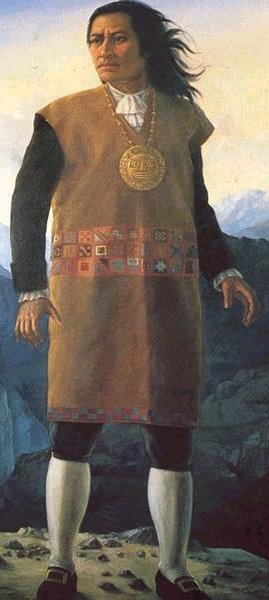 José Gabriel Condorcanqui — rechristened