1794: Jacques Hebert and his followers

On this date in 1794, firebrand revolutionary pamphleteer Jacques Hebert and his eponymous party of Convention radicals mounted the scaffold during the Paris Terror.

As a 32-year-old, Hebert started putting out his foul-mouthed blog radical newspaper Le Pere Duchesne in the Revolution’s early months.

In this increasingly vituperative rag, Hebert — incongruously writing in the voice of “Old Man Duchesne” — savaged first the royal couple, and then (after that pair lost their well-coiffed heads) whatever the retrograde element of the unfolding Revolution happened to be on any given day: the constitutional monarchist Lafayette; the bourgeois liberal Girondists. His paper valorized the Parisian working-class sans-culottes, and lustily demanded heads for the satisfaction of their various grievances.

Here, he literally channels Marat:

All of these thoughts trouble my brain, and the memory of Marat follows me without end. Last night I saw him in a dream: his wound was still bleeding, dammit. Upon seeing it I cried. Friend of the people, I shouted, is it you? Yes, good Père Duchesne, it’s Marat who comes from the dead to talk with you, because — dammit — the love of freedom pursues me even beyond the grave. Content to have lost my life for my republic, there only remains to me the regret of not having seen it delivered, before my death, from all the scoundrels who tear away at its breast. Père Duchesne, you must do what I couldn’t do. You closely followed me in the revolution; like me you consecrated you life to the defense of the rights of the people. You speak the language of the Sans Culottes, and your foul mouth, which makes little mistresses faint, sounds beautiful to free men, for free men shouldn’t be sought among the beautiful souls. Your joy and your anger have done more than all the dreams of statesmen. They know this well, the worthless fucks, and that’s why they’ve persecuted you like they did me. Courage, old man; don’t back off when you suffer the same trials as me, don’t be afraid: is there a more beautiful death than mine? But since you’re useful to your fellow citizens, try to avoid the daggers of statesmen. Live a while longer in order to denounce them and to complete, if you can, the task I’d undertaken.

Yes, Père Duchesne, you have to go after them hammer and tong, and not take it easy on anyone. When three months ago I proposed planting three hundred nooses on the terrace of the Tuileries in order to hang there the perfidious representatives of the people, some took me for a madman, and others as someone thirsty for blood. But nevertheless, if I’d been believed how much bloodshed would have been avoided! More than a million fewer men would have perished! So when I made that proposition I wasn’t speaking as a bloody monster, on the contrary I spoke as a friend of humanity. The moderates have buried more victims than those that fell before the steel of our enemies. Nothing is more harmful in a revolution than half measures. We have finally arrived at the era when we must pare things right down to the bone. … No more quarter for the defeated party, because, dammit, if the statesmen had the upper hand for one moment there wouldn’t exist a single patriot in six months.*

Late in his run, Hebert was on to venting dissatisfaction with the party of Danton, who had followed the monarchists and the liberals off the starboard of acceptable revolutionary opinion. Sensible centrist Maximilien Robespierre would indeed strike that faction down — just two weeks after he’d purged the radical Hebertist gaggle itself.**

Eleven days after Le Pere Duchesne last hit the streets, its author’s head hit the basket.

His printed editorials (like the one above) often assert a modish conviction in his own coming martyrdom, but as proof against a fatal political reversal, Hebert had trusted overmuch to his power base in the Paris commune. When he was carted out this morning, the mob whom his own paper once played to reveled in old Pere Duchesne’s fall just as readily as it had reveled in his enemies’.

some men carrying long sticks, at the end of which were suspended braziers of burning charcoal, symbolical of the “Charcoal-burners” of the “Pere Duchesne,” thrust them into the face of Hebert, insulting him with the same bitter railleries with which he tormented so many other victims (Alphonse de Lamartine)

Hebert was executed at the Place de la Revolution in a batch of 20 fellow-radicals, among whom we also find the eloquent “orator of mankind,” anticlerical† wordsmith Anacharsis Cloots. (Victor Hugo on his revolutionary leader in Les Miserables: “he had too much of Saint-Just about him, and not enough of Anacharsis Cloots.”)

The original La Pere Duchesne was dead, but just as the hot-selling mag had attracted ripoffs in its original run, the name lived on as a symbol of popular revolutionary menace — to be reclaimed by later generations in print and song.


La chanson du pere duchesne (live at RMZ)

* I know, right? Hebert was such a wild man, he thought ill of slavers.

Everywhere and at all times men of commerce have had neither heart nor soul: their cash-box is their God; they only know how to thieve and deceive; they would shave an egg, they would kidnap their own fathers; they traffic in all things, even human flesh; theirs are the ships which sail to the African coasts to capture negroes whom they then treat as worthless cattle.

** These rival factions linked as fellow-victims of Robespierre’s Terror are neatly symbolized by the spouses of their respective antipathetic scribblers: Jacques Hebert’s wife Marie, and Lucile Duplessis, wife of the Dantonist journalist Camille Desmoulins. Marie and Lucile were guillotined together that April, having forged a friendship while awaiting the chop.

† “The personal enemy of Jesus Christ,” Cloots called himself. He also remarked, “What is man’s chief enemy? Each man is his own.” A lot of enemies, this one had.

On this day..

1834: Fusilamientos de Heredia

On this date in 1834, one day after overrunning the Alava village of Gamarra, Carlist General Tomás de Zumalacárregui had 118 of its defenders shot.

Zumalacárregui was the outstanding Carlist (read: conservative, absolute-monarchist) officer of the day. (Here‘s a public-domain memoir of his campaigns.)

We meet him on the march in 1834, adroitly reversing the grim royalist position in the First Carlist War — a liberal-vs.-conservative civil war that also mapped onto ethnicity, geography, and royal succession.

On this occasion, he overwhelmed a contingent of liberals and Basques fighting for the child-queen Isabella II. The survivors were taken prisoner and (despite objections from some of Zumalacárregui’s underlings) given a fusillade the next day in the neighboring town of Heredia.

This pithy diary entry from a Carlist officer comes from the incident’s Spanish Wikipedia page:

Día 17. Permanecimos en Heredia donde se fusilaron 118 peseteros. (“Day 17: We remained in Heredia, where we shot 118 Chapelgorris.”)

The Fusilamientos de Heredia — still notorious to this day — were distinguished by their number, but they were hardly unique. Both sides in the civil war unapologetically carried out summary executions of prisoners they had no resources to detain and did not care to turn loose. (And in the more everyday interests of sowing terror, or avenging the last time the other guys sowed terror.)

An English peer eventually brokered the Lord Eliot Convention, an arrangement by which both Carlists and Cristinos agreed to stop slaughtering prisoners and exchange them so that they could properly slaughter one another on the battlefield instead.

On this day..

37: Some poor wretches, despite the death of Tiberius

The Roman Emperor Tiberius expired at Misenum on this date in 37 A.D.


The Death of Tiberius, by Jean-Paul Laurens. Tacitus records that the aged princeps was thought to have expired, to the great relief of all, when word came that he was reviving. “[Praetorian prefect] Macro, nothing daunted, ordered the old emperor to be smothered under a huge heap of clothes.”

As Tiberius had been spending his last years terrifyingly purging Rome of alleged “traitors,” his death was met with some considerable relief. Great news: charismatic young prince Caligula is in charge now!

Anyway, despite the old man’s unpopularity and the manifest injustice of his treason trials, Tiberius’s death did not quite halt momentum of political butchery. Ever thus with bureaucracies.

According to Suetonius,

The people were so glad of his death, that at the first news of it some ran about shouting, “Tiberius to the Tiber,” while others prayed to Mother Earth and the Manes to allow the dead man no abode except among the damned. Still others threatened his body with the hook and the Stairs of Mourning, especially embittered by a recent outrage, added to the memory of his former cruelty. It had been provided by decree of the senate that the execution of the condemned should in all cases be put off for ten days, and it chanced that the punishment of some fell due on the day when the news came about Tiberius. The poor wretches begged the public for protection; but since in the continued absence of Gaius [Caligula] there was no one who could be approached and appealed to, the jailers, fearing to act contrary to the law, strangled them and cast out their bodies on the Stairs of Mourning. Therefore hatred of the tyrant waxed greater, since his cruelty endured even after his death.

But Tiberius’s cruelty didn’t endure too long after his death. Pretty soon, Caligula’s cruelty would have the stage all to itself and Tiberius survivors would be yearning for the good old days.

The History of Rome podcast covers Tiberius’s crazy years and the transition to Caligula here.

* It’s not completely explicit that it was on this same March 16 that news of the emperor’s death hit Rome; therefore, it’s conceivable that the drama described here played out on a subsequent date.

On this day..

1799: The defenders of Jaffa, at Napoleon’s command

On this date in 1799, Napoleon Bonaparte gave, and saw executed, the dreadful order to slaughter thousands of Muslim prisoners from the Siege of Jaffa.

Having just conquered the city from the Ottomans, the Corsican faced the inconvenience of having a large number of POWs with no way to provision them. What to do?

His private secretary Louis Antoine Fauvelet de Bourrienne later remembered the scene.

The Arnauts and Albanians, of whom these refugees were almost entirely composed, cried from the windows that they were willing to surrender upon an assurance that they would be exempted from the massacre to which the town was doomed; if not, they threatened to fire on the ‘aides de camp’, and to defend themselves to the last extremity. The two officers thought that they ought to accede to the proposition, notwithstanding the decree of death which had been pronounced against the whole garrison, in consequence of the town being taken by storm. They brought them to our camp in two divisions, one consisting of about 2500 men, the other of about 1600.

I was walking with General Bonaparte, in front of his tent, when he beheld this mass of men approaching, and before he even saw his ‘aides de camp’ he said to me, in a tone of profound sorrow, “What do they wish me to do with these men? Have I food for them?–ships to convey them to Egypt or France? Why, in the devil’s name, have they served me thus?” After their arrival, and the explanations which the General-in-Chief demanded and listened to with anger, Eugene* and Croisier [the officers who accepted the Jaffa garrison’s surrender] received the most severe reprimand for their conduct. But the deed was done. Four thousand men were there. It was necessary to decide upon their fate. The two aides de camp observed that they had found themselves alone in the midst of numerous enemies, and that he had directed them to restrain the carnage. “Yes, doubtless,” replied the General-in-Chief, with great warmth, “as to women, children, and old men–all the peaceable inhabitants; but not with respect to armed soldiers. It was your duty to die rather than bring these unfortunate creatures to me. What do you want me to do with them?”

The third day arrived without its being possible, anxiously as it was desired, to come to any conclusion favourable to the preservation of these unfortunate men. The murmurs in the camp grew louder the evil went on increasing–remedy appeared impossible–the danger was real and imminent. The order for shooting the prisoners was given and executed on the 10th of March.

This atrocious scene, when I think of it, still makes me shudder, as it did on the day I beheld it; and I would wish it were possible for me to forget it, rather than be compelled to describe it. All the horrors imagination can conceive, relative to that day of blood, would fall short of the reality.**

… the situation of the army, the scarcity of food, our small numerical strength, in the midst of a country where every individual was an enemy, would have induced me to vote in the affirmative of the proposition which was carried into effect, if I had a vote to give. It was necessary to be on the spot in order to understand the horrible necessity which existed.

War, unfortunately, presents too many occasions on which a law, immutable in all ages, and common to all nations, requires that private interests should be sacrificed to a great general interest, and that even humanity should be forgotten. It is for posterity to judge whether this terrible situation was that in which Bonaparte was placed.† For my own part, I have a perfect conviction that he could not do otherwise than yield to the dire necessity of the case. It was the advice of the council, whose opinion was unanimous in favour of the execution, that governed him, Indeed I ought in truth to say, that he yielded only in the last extremity, and was one of those, perhaps, who beheld the massacre with the deepest pain.

As tends to happen, this sort of thing made future garrisons much less interested in surrender.

Walter Scott, in his biography of the Corsican, judged that the “bloody deed must always remain a deep stain on the character of Napoleon.”

[W]e do not view it as the indulgence of an innate love of cruelty; for nothing in Bonaparte’s history shows the existence of that vice, and there are many things which intimate his disposition to have been naturally humane. But he was ambitious, aimed at immense and gigantic undertakings, and easily learned to overlook the waste of human life, which the execution of his projjects necessarily invvolved … That sort of necessity, therefore, which men fancy to themselves when they are unwilling to forego a favourite object for the sake of obeying a moral precept — that necessity which might be more properly termed a temptation difficult to be resisted — that necessity which has been called the tyrant’s plea, was the cause of the massacre at Jaffa, and must remain its sole apology.

And, Scott adds, “it might almost seem that Heaven set its vindictive brand upon this deed of butchery.”

This city the French wanted so desperately as to “forget humanity” was beset with plague; Antoine-Jean Gros would depict Napoleon on canvas humanely visiting the stricken right around the time he ordered a couple thousand prisoners shot dead.


Bonaparte Visiting the Pesthouse in Jaffa, by Antoine-Jean Gros (1804).

Bourrienne recorded that

[a]fter the siege of Jaffe the plague began to exhibit itself with a little more virulence. We lost between seven and eight hundred, men by the contagion during the campaign of Syria.

* “Eugene” is Napoleon’s adopted son-in-law Eugene de Beauharnais, one of the commanders whose expedient clemency inconvenienced the marshal. Beauharnais’s father was executed himself, during the French Revolution.

** Bourrienne goes light on the atrocity details, and makes it sound like it’s all shootings; Muslim sources record bayonet work.

† [sic!] By “terrible situation … in which Bonaparte was placed,” he of course means the terrible situation in which Bonaparte placed himself by launching his Egyptian campaign.

On this day..

1986: Mamman Jiya Vatsa, warrior-poet

On this date in 1986,* Nigerian Major-General Mamman Jiya Vatsa was shot (along with nine others) by command of his childhood friend — the dictator Ibrahim Babangida, whom Vatsa was allegedly plotting to overthrow.

A gifted writer since youth, Vatsa was just a nameless twenty-something junior officer in the early 1970s when he emerged onto the national literary scene.
In the 15 years before his death, Vatsa churned out 20-plus volumes, mostly poetry. He had a special inclination for writing for children.

Simultaneously, his star ascended in his professional sphere.

Risen to General, Vatsa was part of the Supreme Military Council of the previous dictator.

But by December of that year,
Vatsa and dozens of others were arrested.

Testimony against them — much of it of the speculative or torture-induced variety — described a ring of officers piqued at the Babangida coup (Vatsa was out of the country when it occurred) and keen to undo it. The scheme would have been only one of many such hatched or imagined in an unstable political situation that surely made the new big man nervous.

In the end, “only” ten (the nine others are named here) were stood up against the wall for the alleged plot. Many others, however, were imprisoned or purged, a lasting injury to the Nigerian brass that particularly crippled its air force.

Babangida, of course, rejected clemency appeals from the Vatsa family he knew well. He has since justified his harshness by arguing that Vatsa would have continued plotting against him in prison or in forced retirement. “Rawlings did it in Ghana,” Babangida said. “And you know Vatsa was very stubborn.”

The fatal tribunal’s judge** is less certain, and is hardly the only one to doubt Vatsa’s guilt outright.

I don’t know, nobody ever asked.
That was how some heroes died.
They died.

-Vatsa, “They Died” (Voices from the Trench)

* Some sources give March 6 as the execution date, but contemporaneous western press reports (admittedly an impeachable source) prefer the 5th. For instance, the March 6 Chicago Tribune says the executions occurred on “Wednesday” (the 5th).

** Ironically, Vatsa himself had once sat on a tribunal for another group of failed putschists, the 1976 Dimka coup.

On this day..

1623: Amboyna Massacre

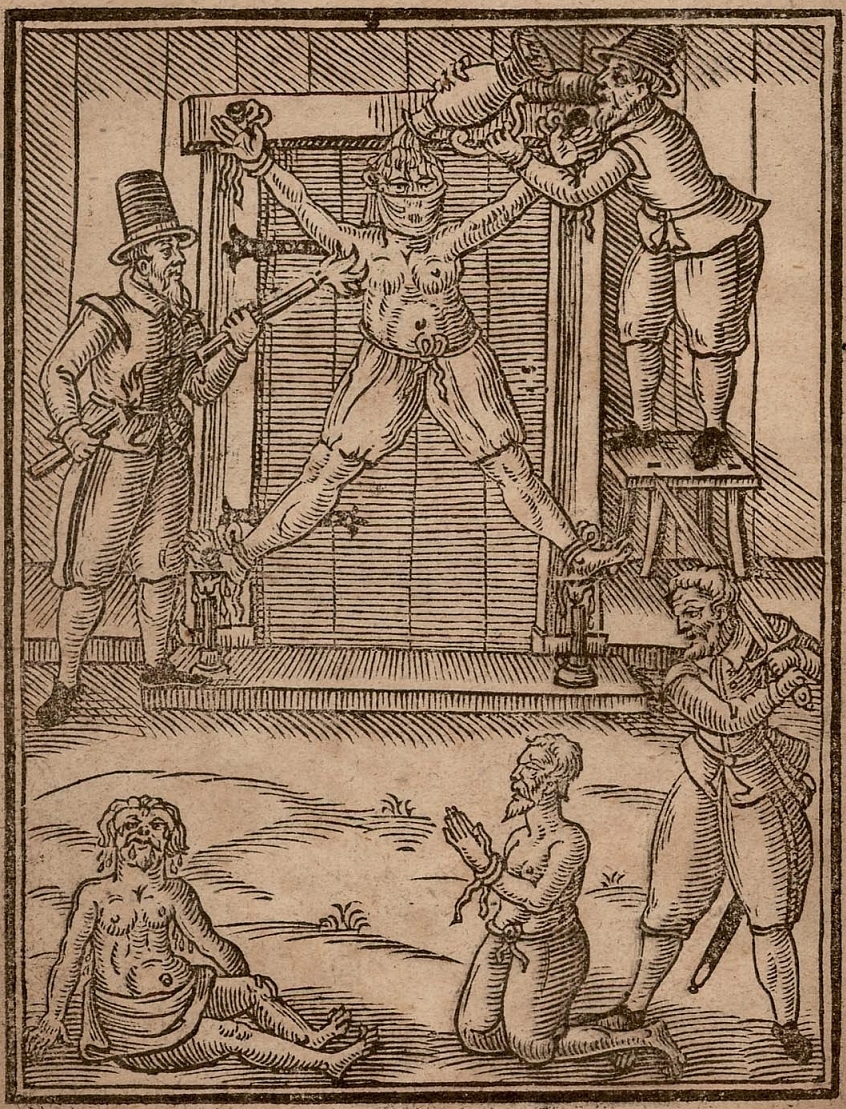
On February 27,* 1623, the Dutch East India Company beheaded twenty who had been waterboarded into confessing to a terrorist plot.

English prisoner suffering “waterboarding” faux-drowning torture, published under the name “A true relation of the unjust, cruell, and barbarous proceedings against the English at Amboyna in the East-Indies 1624”.

The torturers “poured the water softly upon his head until the cloth [wrapping his head] was full, up to the mouth and nostrils, and somewhat higher, so that he could not draw breath but he must suck in all the water.” More nasty description.

(cc) Image from Flickr | BiblioOdyssey

Posh Spice

As in modern times, this scenario originated with resource competition in the Muslim world … in this case, competition for spice, in Indonesia.

European colonialism had pitted the Dutch East India Company against its British counterpart on the archipelago, both scrabbling after the lucrative trade in cloves and pepper, with garnishes of nutmeg, cinnamon, mace, and ginger.

The two rival powers had, as we lay our story, recently come to a tense truce, dividing the commerce between them — and swapping mutual accusations of violating that pact. The arrangement basically gave the Dutch a bigger slice of the pie, so we’ll find them when the cloves hit the fan having the balance of power on their side.

Terrorists

We’re going to oversimplify to set the scene.

On Ambon Island, one of the very “Spice Islands” (i.e., the Moluccas) — at the Dutch-controlled fortification of a trading post also shared by the English — the Dutch merchant-governor Herman van Speult heard that a Japanese mercenary had asked about the Dutch fortifications.

The security-conscious van Speult ordered that unfortunate soldier interrogated under torture.

As tends to happen when the interrogators in such a case are convinced of a ticking time bomb situation, the torture uncovered a ticking time bomb situation.

The mercenary got the Dutch to stop burning and drowning him by “revealing” a highly implausible** English plot to seize the Dutch fort, with 20 guys or so and no prospect of imminent outside aid. Wouldn’t you know it: when the supposed confederates named by the mercenary were similarly tortured, they too admitted the plot. Van Speult’s English opposite number, Gabriel Towerson, was one of them.

The Amboyna Massacre followed anon, with Towerson and nine other British East India Company employees beheaded, along with nine Japanese mercenaries and one Portuguese. (The latter ten worked for the Dutch East India Company, not the British. A fifth column!)

They went to their deaths protesting their innocence, and many smuggled out written recantations to that same effect: “tortured … with that extream Torment of Fire and water, that Flesh and Blood could not endure it, and we take it upon our Salvation, that they have put us to Death Guiltless.”

Anger in the English Street

That last quote comes from Karen Chance, “The Amboyna Massacre in English Politics, 1624-1632,” in Albion: A Quarterly Journal Concerned with British Studies (Winter 1998).

As the title of that piece suggests, the Amboyna Massacre outraged Towerson’s countrymen and -women once word finally made it back to the mothership. (In addition to the torture/wrongful execution dimension, the legal authority of the Dutch trading concern to impose judicial punishment on their English counterparts was questionable at best.)

English demands for satisfaction against the perpetrators continued to complicate Dutch-English relations into the reign of Charles I and beyond. Even Oliver Cromwell required, as the price of peace for the First Anglo-Dutch War in the 1650s, punishment of any surviving offenders. (Which was apparently nobody at all.)

And still later, the burgeoning British Empire’s propaganda arm reached for the Amboyna narrative to justify seizing New Amsterdam on the grounds that the Dutch had attempted to spring a massacre on English settlers — “their Amboyna treacherous Cruelty extended itself from the East to the West Indies, and pursued thus the straight channel of Dutch blood”.

As for the trade-jockeying: the Netherlands’ commanding position in Indonesia ultimately squeezed the English out.** But don’t fret for Old Blighty: she turned attention to gobbling up India, and made a lot more bank than did the Dutch spice racket.

* February 27 was the date according to the Julian calendar in use at this time by the British. By the Gregorian calendar the Dutch were using, the massacre took place on March 9.

** For more on both the fanciful nature of the supposed plot, and the economics of the East Indies trade as it unfolded in the 17th century, see D.K. Bassett, “The ‘Amboyna Massacre’ of 1623”, Journal of Southeast Asian History, September 1960.

On this day..

1942: Boris Vilde, linguist

On this date in 1942, Estonian linguist and ethnographer Boris Vilde was shot with his French Resistance circle at Fort Mont-Valerien.

St. Petersburg-born, Estonian-raised, the young scientist came to Paris at age 25 (French link) with his life in a backpack.

In the eight short years remaining to him before he gave his life for his adopted land’s anti-Nazi resistance, Vilde cofounded the Paris Musee de l’Homme. (When visiting, be sure to look for the skull of Suleiman al-Halabi, a Syrian executed for assassinating one of Napoleon’s Egyptian officers in 1800.)

It says here that Vilde even imported the French word “resistance” into Estonian.

Boris knew whereof he spoke.

His Musee de l’Homme group recruited scientists and intellectuals and published anti-fascist propaganda.

When the Vichy government infiltrated it and had its principals condemned, one of Vilde’s compatriots is said to have bellowed at the firing squad at the last moment,

Imbeciles, it’s for you, too that I die.

On this day..

1810: Pedro Domingo Murillo, for Bolivian independence

Today is the bicentennial of the execution of Pedro Domingo Murillo and eight fellow martyrs to Bolivian independence.

Men like Gregorio Garcia Lanza and Juan Bautista Sagarnaga (both Spanish links) wagered their necks under the leadership of wealthy mestizo Murillo. (all links Spanish)

Something of a career troublemaker, Murillo had had a few scrapes with the crown’s agents over his patriotic aspirations for the territory the Spanish called Upper Peru.

On July 16, 1809, taking advantage of the confused political situation in Spain following Bonaparte’s conquest, he put himself at the head (Spanish) of a breakaway state.

Unfortunately for the self-proclaimed Junta Tuitiva, neither masses nor elites really rallied to their side, and the Spanish swiftly crushed the uprising.

July 16, the date these dreamers declared independence, is still celebrated in La Paz.

And why not? Though militarily overwhelmed, this quixotic enterprise turned out to be one of the opening acts in a (largely successful) generation-long struggle for independence throughout the Spanish possessions in the New World.

On this day..

2010: Five for the assassination of Sheikh Mujibur Rahman

Shortly after midnight this morning — local time at Dhaka Central Jail — five officers who in 1975 assassinated Bangladesh founding father Sheikh Mujibur Rahman (and most of his family) were hanged for the crime.

Justice so long delayed still tasted sweet to a celebratory crowd.

The 34 1/2 years were mostly passed with the killers safe under an Indemnity Act predictably granted by the coup government that profited from the murder. (Though that government wasn’t afraid to hang members of its base.)

That act was revoked after a generation’s military rule with the 1996 election of Mujib’s daughter Sheikh Hasina Wazed, who was lucky enough to be in West Germany when her family was slaughtered.

Even so, the case has had a tortuous path since through the Bangladeshi judiciary.

Once it finally reached the terminus, the government did the hemp necktie routine with dispatch just this side of seemly. Only hours after the doomed men’s last appeal was turned aside, Lt. Col. Syed Faruque Rahman, Lt. Col. Sultan Shahriar Rashid Khan, Lt. Col. Muhiuddin Ahmed, Maj. A.K.M. Mohiuddin Ahmed, and Maj. Bazlul Huda were hanged.

Their hanging does not close the book on the Mujib assassination.

Seven other death sentences in absentia remain; six of those condemned are still alive, and at large abroad. Bangladesh is trying to get them back.

On this day..

1673: Mary Carleton, “German princess”

On this date in 1673 ended the adventures of “German princess” and early modern celebrity Mary Carleton.

Mary vaulted into the ranks of famous-for-being-famous in 1663, when the pamphleteering forerunners of Perez Hilton caught wind of a bigamy scandal wherein Mary, presenting herself as a mysterious German noble, had hitched with 18-year-old law student John Carleton and run through his money.

Once the public made her acquaintance … well, there was just something about Mary.

Over two dozen pamphlets are known sensationalizing her subsequent trial and acquittal for hubby-hopping, including post-acquittal volleys by both John and Mary.

(These pamphlets don’t currently appear to be available in their original forms online, but substantial excerpts from the most famous of them can be found in the public domain 1914 book The Mary Carleton narratives, 1663-1673: a missing chapter in the history of literature. This volume argues the Carleton publications are a stylistic progenitor of the English novel as it emerged in the hands of, for instance, Defoe. We certainly would be remiss not to notice here our real-life anti-heroine’s parallels (pdf) with Moll Flanders.)

Actually the daughter of a Canterbury fiddler, Moll Carleton was accused of having ditched her first spouse (a shoemaker) for a surgeon, then ditched the surgeon for John Carleton.

Having adroitly beat that rap in a court of law (if not exactly in the court of public opinion) “the German Princess” went into show business; that ubiquitous diarist Samuel Pepys caught her on stage, playing herself, remarking

I’ve passed one trial, but it is my fear
I shall receive a rigid sentence here:
You think me a bold cheat, put case ’twere so,
Which of you are not? Now you’d swear I know.
But do not, lest that you deserve to be
Censur’d worse than you can censure me:,
The world’s a cheat, and we that move in it,
In our degrees, do exercise our wit;
And better ’tis to get a glorious name,
However got, than live by common fame.

Well, why not?

In a time with scant social mobility for women, Carleton — which is the name by which she’s been remembered although she was born “Mary Moders” — carved it out with the tools at her disposal, which makes her an irresistible academic subject.*

Carleton/Moders is nearly the anti-Martin Guerre: whereas the male Arnaud du Tilh subsumed his own identity to insinuate himself into the existing social part of “Martin Guerre”, Mary Carleton’s shifty identity excised her from the social circumstances that would otherwise define her. (She was even reported to have taking to masculine cross-dressing.) Paradoxically, her fictitious biography enabled her to be taken for her own self, which explains why she stuck with her blank-slate “German origins” backstory after it had been publicly discredited.

And after the stage gig had run its course and her identity become disposable once again, she easily resumed her marital perambulations.

Mary Jo Kietzman called Carleton’s life “self-serialization.” The Newgate Calendar sanctimoniously records some of her adventures.

After a few years below the Restoration radar, Carleton was caught up for petty larceny and given a death sentence commuted to penal transportation to Jamaica. (England had just seized it from Spain during Cromwell‘s Protectorate.)

Two years later, she returned to England — not the only one to prefer the danger of Tyburn to the rigors (and obscurity) of the colonies.

She could only live as herself at the peril of her life. And on this day, she clinched her lasting fame at the end of a rope.

* e.g., Mihoko Suzuki, “The Case of Mary Carleton: Representing the Female Subject, 1663-73,” Tulsa Studies in Women’s Literature, Vol. 12, No. 1 (Spring, 1993).

Part of the Themed Set: Resistance and Rebellion in the Restoration.

On this day..