1908: Khudiram Bose, teenage martyr

The investigations following upon the recent raids on Anarchist dens here prove the existence of a revolutionary plot on a vast scale and show that there was a systematically organized “college” … where bombs were manufactured and instruction in explosives was given … The prisoners talk freely of their “heroic conduct” and “noble design,” while refusing to impart any informaton incriminating those working behind the scenes and furnishing the funds. They all confess, however, that their minds have been fired by writings in the Press and speeches on platforms.

–London Times

It’s a timeless story, really; with a tweak here or there, the excerpt above could do for reportage on seditious movements by the hundredfold. As it happens, its dateline is May 11, 1908 — Calcutta.

Separatist stirrings on the subcontinent were then manifesting themselves in the explosive revolutionary language of the day, and the chief magistrate of that ancient city of Calcutta — Kingsford by name, as in charcoal — was a character notorious for his harshness toward the movement. The year before, he’d had a 15-year-old flogged for trying to stop a British soldier beating Indian activists.

Among the more militant types excited to wrath against Kingsford was an 18-year-old Bengali who would have the privilege of martyrdom for the cause of national self-determination.

Khudiram Bose sought the judge out in Muzaffarpur and, with another young revolutionary, attempted to assassinate him in April 1908 by tossing a couple of bombs into Kingsford’s carriage.

Minor problem: it was the wrong carriage.

Instead of popping the nefarious judge, the bombs killed the wife and daughter of a barrister.

The other assassin committed suicide when cornered by police, but Bose would meet his end via the judiciary.

Bose played his patriotic martyr’s role to the hilt in the few brief weeks before his hanging, and found himself on the leading edge of a growing movement of anti-British bombers. “People are prepared to do anything for the sake of swarajya [home rule] and they no longer sing the glories of British rule,” one contemporary newspaper (quoted here) put it. “They have no dread of British power. It is simply a question of sheer brute force.” The editor was convicted of seditious libel.

One can now find plentiful Khudiram Bose hagiographies celebrating the youthful freedom fighter … regardless of his target selection.

On this day..

1623: Daniel Frank, the first hanging in the USA

On this date in 1623 one Daniel Frank was condemned to hang for theft in the Jamestown colony. It was the first hanging to take place in that part of the British North American colonies that eventually broke away as the United States.

Frank is actually not the very first entry in Watt Espy’s encyclopedic 15,000-plus catalogue of “American” executions — he’s the second. In 1608, George Kendall had been shot for a mutinous plot, also in Jamestown, Virginia. We don’t have a firm date for that event.

But rigorous calendaring, like lenient penal theories, took a back seat in the tiny and tenuous New World colony. Jamestown was the successor to Walter Raleigh‘s failed Roanoke settlement, which disappeared without a trace — and planted in harsh and distant environs, Jamestown had a couple of brushes with the very same fate.


Jamestowne, surrounded by Indian settlements and illustrated wilderness. Excerpt from 1608 map of John Smith (yes, the Pocahontas guy) found here.

Still, this was a delicate balance: Jamestown didn’t have the resources to countenance potential recidivism, but it also didn’t have the resources to go killing productive colonists — or scaring away potential productive colonists. A draconian 1612 Laws Divine, Moral and Martial evidently never sent anyone to the gallows, but was rolled back all the same in 1619 for fear of disaffecting investors.

Sithence we are not to bee a little carefull, and our young Cattell, & Breeders may be cherished, that by the preservation, and increase of them, the Colony heere may receive in due time assured and great benefite … so profitable succeeding a Commodity, as increase of Cattel, Kine, Hogges, Goates, Poultrie &c. must of necessity bee granted …

wee do strictly charge and command, that no man shall dare to kill, or destroy any Bull, Cow, Calfe, Mare, Horse, Colt, Goate, Swine, Cocke, Henne, Chicken, Dogge, Turkie, or any tame Cattel, or Poultry, of what condition soever; whether his owne, or appertaining to another man, without leave from the Generall, upon paine of death.

-The 1612 legal code, topically.

Daniel Frank — “Daniell Francke” to ye olde time Virginians — drew a hanging sentence for stealing and killing a calf belonging to George Yeardley, a major landowner and the former (and future) colonial governor of the Virginia terrtory. Frank, we can assume, was in a state of agonizing hunger when he undertook this desperate act.

Though Mr. Espy’s register of historical executions is an astounding resource, double-checking the dates is a recommended practice. In this case, I believe he’s used a highly fragmentary original record (pdf) and mistakenly ascribed the legal proceedings to the last previous date heading, March 1, 1622. [This would be March 1, 1623 by current reckoning; see footnote here.] This date has been repeated by any number of sources.*

But the narration very clearly states that “the tryall of Danyell Francke and George Clarke vppon Tewsday the fyfth of August 1623” proceeded on the charge of

felonyously steal[ing] and kill[ing] one Calf ye goodes and Chattles of Sr: George Yardley kn[ight] of the woorth and Pryce of three poundes sterling. And after the saide Daniell Francke had killed the said Calfe, Thow the saide George Clarke as Access[orie] to the saide Felony didst help the saide Daniell Fra[nck] to carry the saide Calfe into thy owne house, a[nd] didst helpe to dress eate and spend the same, contrary to the peace of our Sou’ainge Lorde the Ki[ng] his Crowne and Dignitie.

Both men “Receaved sentenc of Death Accordinge to Lawe. Daniell Francke was executed: George Clarke repriued” — either because Clarke was merely an accessory, or as Martha McCartney plausibly speculates, because the gunsmith Clarke was a lot more valuable to the colony than the indentured laborer Francke.

The latter had to make do with his milestone distinction: The first documented hanging in the future US, and the first known execution under normal criminal law.

* My reading of the date is also corroborated (and Espy’s undermined) by a February, 1623 [i.e., 1624] record of the colony’s deaths “since April last.”

On this day..

1347: Not the Six Burghers of Calais

On this date in 1347, the city of Calais yielded to an English siege.


The siege of Calais, from Jean de Wavrin‘s Chroniques d’Angleterre. (More images)

Edward III had proceeded to invest Calais directly after the previous year’s staggering win at Crecy. The crippled French leadership could not relieve the city, and after fruitlessly probing for an opening, the relief army marched away at the start of August 1347.

By this time reduced to eating vermin and ordure, the starved city had little choice but to capitulate. According to Froissart’s account, the king declared that “the Calesians have done him so much mischief, and have, by their obstinate defence, cost him so many lives and so much money, that he is mightily enraged.” He wasn’t only sore about the city’s holding out over the preceding year: Calais was notorious as a refuge for English Channel pirates who had long bedeviled the commerce of Edward’s realm.

As a condition for sparing the rest of the town, Edward demanded that six of its leading citizens present themselves to him, “with bare heads and feet, with ropes round their necks, and the keys of the town and castle in their hands.” Edward seems truly to have meant (much against the conscience of his own nobles) to put these men to death “for that the Calesians had done him so much damage, it was proper they should suffer for it.”

This information caused the greatest lamentations and despair [in Calais]; so that the hardest heart would have had compassion on them; even the lord de Vienne wept bitterly.

After a short time, the most wealthy citizen of the town, by name Eustace de St. Pierre, rose up and said: “Gentlemen, both high and low, it would be a very great pity to suffer so many people to die through famine, if any means could be found to prevent it; and it would be highly meritorious in the eyes of our Saviour, if such misery could be averted. I have such faith and trust in finding grace before God, if I die to save my townsmen, that I name myself as first of the six.” When Eustace had done speaking, they all rose up and almost worshipped him: many cast themselves at his feet with tears and groans Another citizen, very rich and respected, rose up and said, he would be the second to his companion, Eustace; his name was John Daire. After him, James Wisant, who was very rich in merchandise and lands, offered himself, as companion to his two cousins; as did Peter Wisant, his brother. Two others then named themselves, which completed the number demanded by the king of England.

Wealthy elites sacrificing themselves for the greater good? The past really is a different country.

These six duly presented themselves, nearly naked and haltered and braced to bear the brunt of Edward’s vengeance. The English king had the executioner summoned … and then, Edward’s (very pregnant) queen Philippa dramatically fell to her knees

and with tears said, “Ah, gentle sir, since I have crossed the sea with great danger to see you, I have never asked you one favour: now, I most humbly ask as a gift, for the sake of the Son of the blessed Mary, and for your love to me, that you will be merciful to these six men.”

The king looked at her for some time in silence, and then said; “Ah, lady, I wish you had been anywhere else than here: you have entreated in such a manner that I cannot refuse you; I therefore give them to you, to do as you please with them.” The queen conducted the six citizens to her apartments, and had the halters taken from round their necks, after which she new clothed them, and served them with a plentiful dinner: she then presented each with six nobles, and had them escorted out of the camp in safety.

Edward still had the last laugh when it came to Calesian carnage.

This nigh-unconquerable foothold on the French coast would persist in English hands for two centuries: the first century spanned the Hundred Years’ War, which England was licensed to protract by dint of (and France would not settle because of) the menacing northern base England won this day. “Each will have to take up his shield,” ran a French verse cited in Barbara Tuchman’s A Distant Mirror: The Calamitous 14th Century, “For we’ll have no peace till they give back Calais.”


The Six Burghers persisted even longer than that.

George Bernard Shaw wrote a one-act play standing the story on its head, in which a henpecked Edward exasperatedly yields to his nagging wife’s merciful caprice, to the open derision of the burghers themselves.

A bit more exalted of spirited is Rodin‘s sculpture group Les Bourgeois de Calais — rendering six emaciated, suffering, and courageous figures.

I have, as it were, threaded them one behind the other, because in the indecision of the last inner combat which ensues, between their devotion to their cause and their fear of dying, each of them is isolated in front of his conscience. They are still questioning themselves to know if they have the strength to accomplish the supreme sacrifice–their soul pushes them onward, but their feet refuse to walk.

They drag themselves along painfully, as much because of the feebleness to which famine has reduced them as because of the terrifying nature of the sacrifice … And certainly, if I have succeeded in showing how much the body, weakened by the most cruel sufferings, still holds on to life, how much power it still has over the spirit that is consumed with bravery, I can congratulate myself on not having remained beneath the noble theme I dealt with.

–Rodin

The discriminating connoisseur of Middle English may also enjoy Laurence Minot‘s poetic celebration of the siege of Calais. (Helpful explanatory annotations.)

Part of the Themed Set: Scary Escapes.

On this day..

1798: Anthony Perry and Mogue Kearns, Protestant and Catholic

On this date in 1798,* two Irish rebels — a Catholic and a Protestant — were hanged side by side at Blundell Hill, Edenderry for their parts in that year’s Irish Rebellion.

Their biographies were a study in contrast: Anthony Perry, “a Protestant gentleman of independent fortune, liberal education, and benevolent mind”; Mogue Kearns, the brooding and ordained stock of Catholic farmers. Legend has it that Kearns even survived a mob lynching in Paris during the French Revolution.**

If so, it didn’t dampen his revolutionary ardor.

The two men were major movers in the Wexford Rebellion, one of the more successful and (to the British) surprising centers of insurrection in 1798. Perry, still half-broken by British torture,† returned to the field to help rout the Brits at the Battle of Tuberneering, obtaining the nickname “the Screeching General” for his barbaric vociferations in battle.

But after this successful ambush, the United Irishmen were driven from pillar to post — a failed attack on Arklow followed by the rebels’ defeat at their Vinegar Hill encampment.

A few weeks later, the multiconfessional leaders were captured, and quickly hanged at Edenderry, with “benefit” only of a summary court-martial.

Perry was extremely communicative, and while in custody, both before and after trial, gratified the enquiries of every person who spoke to him, and made such a favourable impression, that many regretted his fate …

Kearns was exactly the reverse of his companion — he was silent and sulk, and seldom spoke, save to upbraid Perry for his candid acknowledgments … [he had] an hypocritical and malignant heart, filled with gloomy and ferocious passions — He seemed rather to be an instrument of Hell, than a minister of Heaven, for his mind was perpetually brooding over sanguinary schemes and plans of rapines, while he assumed the sacred vestments of a servant of Christ!

Their capture marked the final collapse of Wexford’s rebellious “republic”; by September of that same year, all Irish disturbances had been definitively, and bloodily, quelled.

* Some sources have July 12, an apparent transposition of the correct date; both men appear to have skirmished in Clonard on July 11 and again at Knightstown Bog on July 14, and only captured thereafter, followed by several days’ captivity before hanging.

** “The history of the Priest is somewhat extraordinary — he had actually been hanged in Paris, during the reign of Robespierre, but being a large heavy man, the lamp-iron from which he was suspended, gave way, till his toes reached the ground — in this state he was cut down by a physician, who had known him, brought him to his house, and recovered him.”

† Perry’s troops happened to capture two men involved in Perry’s torture in early June. He had his ex-tormenters executed.

On this day..

1946: Public Execution in Debica

On this date in 1946, market day in the southeastern Polish town of Debica, three captured fighters* from the anti-communist Freedom and Independence (WiN) movement were publicly hanged.

This salutary, and surprise, hanging was a nasty public message during the dirty post-war war to consolidate communist authority in Poland.

The message, however, was not exactly meant for a world wider than Poland itself, so the fact that it was captured in a grainy photograph snapped by WiN agent Józef Stec and subsequently smuggled out to the West was not at all to the liking of Polish authorities.

According to a WiN eyewitness report also presumed to have been filed by Stec,

First the MO [local militia], the UB, and the military occupied the execution square holding their machine guns ready to fire. Then, a car came with uniformed individuals who placed the noose on the hook. After a short time the same car brought three condemned men in white shirts. Their hands and legs were tied with barbed wire. A Jewish prosecutor read the sentence and passed the condemned into the hands of the executioner. Before the execution, one of the condemned yelled: “Long live the Home Army. Long live General Anders and General Bor-Komorowski. Down with the commies. Brothers persevere or you’ll die like us. I swear before God that I have never been a bandit [as communist authorities designated them]. I am dying for the Motherland. Lord forgive them [the executioners] because they know not what they are doing.

* The victims were Józef Grebosz, Józef Kozlowski, and Franciszek Noster, according to the 2003 monograph After the Holocaust: Polish-Jewish conflict in the wake of World War II, by Marek Jan Chodakiewicz. This monograph is also the source for Stec’s quoted report on the hanging.

On this day..

1941: Not Shaike Iwensky, “standing in line to be killed”

(Thanks to Meaghan Good of the Charley Project for the guest post. -ed.)

On this day in 1941, seventeen-year-old Shaya “Shaike” Iwensky came within seconds of being shot by the Einsatzgruppen outside the city of Daugavpils, Latvian SSR. Sheer dumb luck — and a slight miscalculation by the Germans — saved his life.

Shaike was born and raised in Jonava, Lithuania and fled to Daugavpils with his brother when the Germans invaded the Soviet Union in June 1941. On June 29, he was arrested along with the other Jewish male adults in town. His brother, who was fifteen years old, was arrested alongside him, but released the same day because of his age.

For the next week and a half, Shaike was held in a crowded prison cell, fed almost nothing, and forced to work during the day.

On July 8, he noted “a change for the worse in our guards, an extraordinary meanness … In my worst fears, I could not have conjured up the kind of hell in which I now found myself.”

That day he and his comrades were stuck in a truly Sisyphean ordeal: forced to roll rocks up a hill, three men to a rock. They kept losing their grip and the rocks would slide back.

That night some other prisoners told him they had been forced to dig huge ditches, which were covered in chlorine.

The next day, the eighteenth day of Operation Barbarossa, Shaike found out what the ditches were for:

A series of shots … a short interruption and again shots … and again … It wasn’t long before we got the confirmation of what we’d been suspecting all along. One of the men in a neighboring cell stuck his head in the doorway, and said, “They are killing Jews. From the washroom window someone saw people lined up in the yard. They are from the first floor.”


Though this testimony specifically concerns a different massacre, in November of 1941, it gives a sense of the environment.

A couple of hours later, Shaike and the others from his part of the prison were ordered to leave and take all their belongings. They were marched down to the basement and made to empty their pockets into the “knee-deep rows of wallets, documents, pictures, watches, trinkets worthless to anyone else.” Then they were marched into the yard and formed into groups of twenty. Hoping to at least die with people he knew, Shaike stuck together with his old friends from Jonava.

The blue sky was almost clear, with only here and there a wisp of cloud. I looked up, and the thought hit me hard: I will never see the sky again.

It is said that, when a person faces death, his whole life flashes before him. But my thoughts were disjointed, disorderly; they tumbled through my mind rather like the flimsy clouds above, forming, changing shape, disappearing and reappearing … Catching myself picking at a hangnail, I thought, How silly. In a few minutes it will make no difference at all …

It occurred to me that reality was often quite unlike what we expect it to be. People standing in line to be killed didn’t look very different from those waiting to buy bread. Their faces, their eyes betray nothing of what is going on in their minds. People stand in line under the hot sun, they move ahead, then their times comes to die, and it is over.

Shaike and his friends waited in line for over two hours in the heat. He had not thrown out his handkerchief and was glad to have it to wipe the sweat from his face. Finally he and his group of twenty arrived at the gate … but when the soldiers came out, they didn’t escort them to the ditches. Instead they ordered everyone to turn around and march back to the prison.

That evening, the prisoners were ordered out again and taken to the killing ground, and then they realized what had happened: the Nazis had spared them because they had run out of ditches. The Jews had to cover the mass graves with earth, stamping down on the bodies and packing them together, and also to dig new trenches, presumably for themselves, until evening when they were sent back to the prison again.

That night, Shaike and some of his friends hid in an empty cell under blankets. The Nazis didn’t find them the next morning when they ordered the survivors out to get shot. They hid in the cell for two days before they were caught. Fortunately the Latvian guards who found them didn’t realize who they were, and merely beat them and tossed them in with some prisoners who’d arrived that same day.

Eventually, Shaike was released from the prison and taken to the Daugavpils Ghetto. He would eventually escape from there and spent some time living in the woods with a Soviet partisan detachment, going back and forth between there and the ghetto. Finally he was captured and taken first to the Stutthof Concentration Camp, then to Dachau. There he was liberated by Americans on April 29, 1945. At twenty years old, he was the sole survivor of his family.

Shaike moved to the United States in 1948 and changed his name to Sidney Iwens. He wrote a book about his experiences, titled How Dark the Heavens: 1400 Days in the Grip of Nazi Terror. Sidney Iwens died in Florida in 2010, at the age of eighty-four.

On this day..

2011: Scott McLaren, Highlander

A year ago today, 20-year-old Scott McLaren of the 4th Battalion (The Highlanders) the Royal Regiment of Scotland was captured by Afghan insurgents and summarily shot.

The baby-faced McLaren, not yet three months in Afghanistan at that point, had left his base in in the Nahr-e-Saraj district of Helmand province during the middle of the night; reports suggest that he’d done so in order to retrieve mislaid night-vision goggles whose loss he would have been punished for. (This detail, while poignant, is not completely certain.)
Whatever the reason for his sortie, it ended with him being captured by Afghan insurgents.

As British, U.S., and Afghanistan forces mounted a 17-hour manhunt for the missing soldier, McLaren was reportedly stripped of his body armor and equipment and, at some point, shot in the head and dumped in a canal. The exact circumstances of his capture and death may never be known.

On this day..

1945: Dr. Achmad Mochtar, quiet hero

On this date in 1945, Japanese forces occupying Indonesia cut off Dr. Achmad Mochtar’s head for a medical experiment gone horribly awry.

Officially, Dr. Mochtar had been responsible for a supposed vaccine whose administration killed hundreds of Indonesian forced laborers.

Latter-day research, however, indicates that it was the Japanese military who administered the vaccine (Indonesian link), an experimental tetanus-cholera-typhoid-dysentery combination shot, getting a trial run before it was administered to Japan’s own soldiers. When this drug proved lethal to most of its recipients, Mochtar and his staff at the Eijkman Institute were arrested in 1944 and subjected to harrowing torture.

According to Jakarta-based British researcher Kevin Baird, Mochtar agreed to take the fall for the experiment in exchange for the release of his colleagues.

“We think of this sort of heroism as the reserve of military men and not learned intellectuals,” Baird told the Guardian. “Achmad Mochtar was not only a hero of Indonesia, but a hero of science and humanity.”


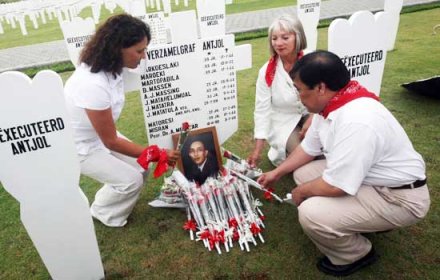
Present-day Eijkman Institute director Sangkot Marzuki (right), and two descendants of the executed man, Monique Mochtar (left) and Jolanda Mochtar (center) lay flowers at a 2010 memorial event after the doctor’s location in a mass grave was discovered. Achmad Mochtar’s name also graces a Sumatran hospital.

On this day..

1799: Admiral Francesco Caracciolo, Neapolitan

On this date in 1799, Admiral Francesco Caracciolo was hanged by the British commander Horatio Nelson from the yardarm of the Sicilian frigate La Minerve in the Bay of Naples.

Poor Caracciolo (English Wikipedia entry | Italian) — and not to be confused with the Italian saint of the same name — got middled by the French Revolution.

He was a trusted admiral from a noble family, and indeed had served with the British Navy (Italian link). Caracciolo got tapped for escort duty to help King Ferdinand IV and his wife Maria Carolina* flee from a Naples threatened by French troops to the safety of a British fleet stationed at Sicily.**

But he seems to have been troubled by that flight by consciousness of a conflict between civic duty and duty to sovereign.

Carraciolo would later tell the drumhead court that condemned him that it was not he who had turned coat; rather, “the King deserted me and all his faithful subjects … The King collected everything that could be converted into specie on pretence of paying [the] army … and fled with it to Palermo, there to riot in luxurious safety. Who was then the traitor — the King or myself?”

With said King a-riot offshore, French conquest initiated in January 1799 the Parthenopean Republic, a fine obscurity for a pub bet today, but for Caracciolo a matter of life and death. He’d returned to Naples, supposedly to tend to his personal affairs; his prominence and popularity, he found, required him to choose between his allegiances.

Under whatever inducement of conscience or calculation, Caracciolo put to sea for the new Republic and engaged the Parthenopeans’ enemies, actually preventing one British landing attempting to restore his former boss.

Alas, the French — by whose arms alone was the puppet Republic supported — soon decamped for greater priorities than Naples, and the royalist elements had the city back in hand by June. While the political revolutionaries would face their own reckoning, the Jacobin admiral was caught attempting to fly and delivered to Nelson for the most summary simulacrum of justice.

“A slight breeze; a cloudy sky,” Lord Nelson’s laconic journal entry for June 29 reads. “Sentenced, condemned, and hung Francesco Caracciolo.”

Fairly or otherwise, this incident is one of the very few blots upon the beloved Nelson’s reputation. That’s partly for the haste with which it was conducted and partly for the jurisdictional matter of the British — to whom Caracciolo owed no loyalty, and against whom he had committed no treachery — doing the Bourbon monarchs’ dirty work by receiving the prisoner, conducting the trial aboard a British ship, and directing the sentence.

And it was all over under that single day’s cloudy sky.

Caracciolo was brought aboard the Foudroyant that morning, a five-member panel of Neapolitan royalist officers rounded up to try him, given a two-hour trial, and condemned to hang that very evening at 5. (Requests for a soldier’s death by shooting, or a day’s time to make peace with one’s maker, went begging.) At sunset, the body was cut down, loaded with weights, and cast into the sea.

They figured that was the last they’d seen of the admiral, but a few days later — with King Ferdinand now having moved onto the Foudroyant — the corpse somehow bobbed up to the surface right beside the ship, like a revenant spirit come to accuse the royal still too nervous to reside in Naples.

“What does that dead man want?” the shocked king is supposed to have exclaimed as he took sight of it.

“Sire,” answered a priest, “I think he comes to demand Christian burial.”


Ettore Cercone, L’ ammiraglio Caracciolo chiede cristiana sepoltura (Admiral Caracciolo requests a Christian burial). Horatio Nelson and Lady Hamilton are in the foreground.

He got it. An 1881 epitaph in the Chiesa di Santa Maria della Catena can still be read in his honor.

“Francesco Caracciolo, Admiral of the Republic of Naples, who fell victim of the hatred and the lack of mercy of his enemies. He was hanged at the mast on 29 June 1799. The people of Santa Lucia took it upon themselves to honour him with a Christian burial. The City Council of Naples, 1881.”

Naples’ harbor-front street, from which one would have had a fine view of Nelson’s fleet back in the day, is today known as the via Francesco Caracciolo. The Republic of Italy’s navy had a Caracciolo-class battleship type in production in the 1910s, but the line was discontinued before any of the four vessels reached completion.

* Sister of Marie Antoinette.

** Where Lord Nelson was banking the proceeds of his recent Egyptian exploits in the famously pleasing form of Emma, Lady Hamilton, the wife of the British envoy to Naples.

† Apropos of the preceding footnote, there’s been some grousing about Lady Hamilton’s role in all this. She was an intimate of the temporarily exiled queen, and the old Encyclopedia Britannica entry on Caracciolo slates her with having exploited her hold over the infatuated Nelson to work Maria Carolina’s vengeful will. We’re inclined to suppose that Nelson’s own reasons of warcraft-slash-statecraft, attempting to swiftly cow any potential Neapolitan resistance, suffice as explanation — whether right or wrong.

On this day..

1844: Gabriel de la Concepcion Valdes, “Placido”

On this date in 1844, Cuban poet Gabriel de la Concepcion Valdes was executed in Matanzas for conspiring to overthrow Spanish authority on the island.

His mother (who gave him up to an orphanage) was a Spanish dancer. His father (who adopted him back) was a “quadroon” barber. Valdes, aka Placido (Spanish link, which is true of most available online resources about him) grew up as a free mixed-race youth in a slave society.

This situated him in the privileged (relative to plantation slaves) but precarious position of the petty bourgeoisie, menaced not only by the prospect of economic reversal but by the vicissitudes of Spanish policy towards his caste — whose growth many colonial officials fretted warily.

Though Placido made his bread apprenticing as a print-maker and later making turquoise combs, he made his fame by dint of literary gift that was celebrated throughout Cuba and abroad. His “La siempreviva” won a literary competition when he was just 25, and led to an invitation to visit Spain (Placido declined it); the Cuban-born, naturalized Mexican poet Jose Maria Heredia visited Cuba in 1836 and made a point to look up Placido; and according to the out-of-print Cuba’s Romantic Poet: The Story of Placido by Frederick Stimson, the young Cuban was wildly popular with North American slavery abolitionists as well.

Placido is less well-remembered beyond his home island today, but arguably rates as Cuba’s most distinguished Romantic poet.

In the 1830s especially, when civil war in Spain put the reigning monarch on the liberal side, Placido was able to exploit the opening to write openly of Cuban political aspirations.

His La Sombra de Padilla, dedicated to Spain’s “wise and exalted Queen”, imagines one of Spain’s martyred comuneros charging him to venture his life for liberty against absolutism.

Better to fall prey to La Parca [the Grim Reaper]
Than to a despotic Monarca

But notwithstanding the war in Iberia, the exalted Queen still put Cuba under special (read: repressive) law. Placido’s prominence, having advocated for much more freedom than Cuba was slated to enjoy, subjected him to automatic Spanish suspicion as more authoritarian governance arrived in the 1840s.

The poet was arrested in the Conspiración de La Escalera (Conspiracy of the Ladder, so named for the structure its accused were tortured upon). This purported plot to raise a slave revolt may or may not (pdf) have really existed, but the crackdown it authorized sure did. Indeed, despite the “slave revolt” bogeyman, it was overwhelmingly free blacks whom the Spanish suppressed in this affair.

Gariel de la Concepcion Valdes, known as “Placido”, was shot with ten others, “miserable instruments of the most depraved machinations of immoral men, men who deserve the curse of the living and the opprobrium of generations to come,” just a week after his conviction.

The appointed lot has come upon me, mother,
The mournful ending of my years of strife,
This changing world I leave, and to another
In blood and terror goes my spirit’s life.

But thou, grief-smitten, cease thy mortal weeping
And let thy soul her wonted peace regain;
I fall for right, and thoughts of thee are sweeping
Across my lyre to wake its dying strains.

A strain of joy and gladness, free, unfailing
All glorious and holy, pure, divine,
And innocent, unconscious as the wailing
I uttered on my birth; and I resign

Even now, my life, even now descending slowly,
Faith’s mantle folds me to my slumbers holy.
Mother, farewell! God keep thee — and forever!

-Valdes, “Farewell to My Mother”

There are volumes of Placido’s poetry (in the original Spanish) freely available via public-domain Google books offerings here and here, with a short thumbnail biography here. For the nonfiction biographical exploration of Placido’s life, and detailed critical analysis of his poetry, this Vanderbilt master’s thesis (pdf) is highly recommended.

On this day..