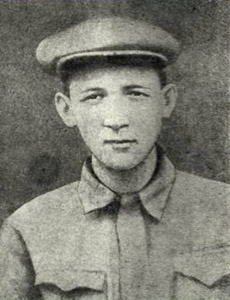
1892: Jozef Lippens and Henri De Bruyne, Congo Free State hostages

On this date in 1892,* Belgian colonial agents Jozef Lippens and Henri De Bruyne were executed by the rebelling native king who had taken them hostage.

The gentlemen were a lieutenant (Lippens) and sergeant (De Bruyne) of the Force Publique colonial deployment in Belgian Congo.

Their misfortune was proximity when in 1892, rivalry over control of the eastern Congo ivory trade brought the European power into war with its erstwhile Zanzibar “Arab”** allies. (The Arabs were slave-traders, affording a classic humanitarian intervention pretext … which obviously is pretty rich coming from Belgium.)

The Congo-Arab War — which in practice was fought on both sides mostly by black Congolese troops — saw in its opening months the defection of one of the Arabs’ best commanders, Gongo Lutete,† a manumitted former slave who had risen to leadership of the Batetela and Bakussu tribes. In revenge when he switched sides to join the Europeans, the Arab leader Sefu bin Hamid seized Lippens, Belgium’s representative Resident at Kasongo, and De Bruyne, Lippens’s aide — demanding the return of his disloyal general and a settlement of hostilities as the price for these European envoys’ lives.

In fact, it was De Bruyne himself who had the honor of delivering the demand. Escorted by his captors to the eastern bank of the Lomami River on November 15, the emaciated De Bruyne shouted across to Belgian officers on the western side the terms of his captivity. The Belgians, who had the river covered by gunners, urged their countryman to leap into the water and swim for it; De Bruyne declined to abandon his comrade. “By this act of self-abnegation he was to go down in the Belgian folklore as a national hero.” (European Atrocity, African Catastrophe: Leopold II, the Congo Free State and its Aftermath)

His flight would have meant certain death for Lippens; instead, both paid the forfeit together after the Belgian commander Francis Dhanis repelled Sefu bin Hamid’s attack and smashed across the Lomani. According to the account of the war by Sidney Langford Hinde, one of many British officers employed by the Force Publique,

News also reached us here of the murder of Lippens and Debruyne, two officers representing the Free State Government, resident at Sefu’s court in Kasongo. We found out later that, after the defeat of Sefu on the Lomami (which resulted in the death of his cousin and several other noted chiefs), an advance party of the retreating Arabs arrived at Kasongo, and, by way of individual revenge, murdered the two Residents. It is probable, since we have no actual proof to the contrary, that this was done without Sefu’s orders. Twelve of these people, armed with knives hidden in their clothing, made some trivial pretext for visiting Lippens at the Residency, who, however, refused to come out and interview them. They then said that news of a big battle had come to them from Sefu; on hearing which Lippens came out, and, while talking in the verandah, was promptly and silently stabbed. Some of the murderers entering the adjoining room, found Debruyne writing, and killed him before he had learned the fate of his chief. When Sefu returned to Kasongo, a day or two afterwards, he gave orders that the pieces of Debruyne’s body should be collected and buried with Lippens, whose body, with the exception of the hands (which had been sent to Sefu and Mohara of Nyangwe as tokens), was otherwise unmutilated. The strong innate respect for a chief had protected Lippens’ body, while that of his subordinate had been hacked to pieces.

A curious fatality followed these twelve murderers. The chief of the band, Kabwarri by name, was killed by us in the battle of the 26th of February with Lippens’ Martini express in his hand. Of the others — all of whom were the sons of chiefs, and some of them important men on their own account — four died of smallpox, one was killed at Nyangwe, one in the storming of Kasongo, and the remaining six we took prisoners at Kasongo. During the trial they one day, though in a chained gang, succeeded in overpowering the sentry, and thus escaped. One was drowned in crossing a river; three more were killed, either fighting or by accident, within a month or two of their escape; and the two remaining we retook and hanged; — which brings to me a curious point. Of the many men I have seen hanged nearly all died by strangulation, and not by having the neck broken. As compared with shooting, hanging seems to me the less painful death; the wretched being becomes insensible in a very few seconds, whereas a man shot will often require a coup de grace, no matter how carefully the firing party is placed.


Monument to De Bruyne and Lippens in Blankenberge. (cc) image from Zeisterre.

* December 1 is the commonly attributed date for the hostages’ butchery but it can’t be documented with certainty.

** As we’ve noted elsewhere, the term “Arabs” as used for eastern Congo by European sources in this period denotes Muslim bantus. We’re following the prevailing term here, whatever its imprecision.

† As a reward for his services, Gongo Lutete was spuriously accused of treason by a Belgian officer in September 1893 and speedily executed without any form of superior approval.

On this day..

1954: Jonas Žemaitis, Lithuanian Forest Brother

Lithuanian anti-Soviet partisan Jonas Žemaitis was shot in Moscow’s Butyrka prison on this date in 1954. He’s one of the big names in the Forest Brothers movement that kept up a hopeless fight against Moscow from 1944 into the 1950s.

An artillerist of Polish ancestry who deserted the retreating Red Army and surrendered himself the Wehrmacht arriving in the summer 1941, Žemaitis is breezily credited in state histories (and as of this writing, both English and Lithuanian Wikipedia pages) of essentially taking the war years off because “he did not want to serve the Nazis.” That was sure considerate of the Nazis! Instead the fellow just mined peat since he preferred not to get involved.

Now, peat production was and is an important economic sector in Lithuania; indeed, even this seemingly innocuous activity hints at exploitation of Jewish slave labor. But there is circumstantial and even eyewitness evidence that Žemaitis’s participation in one of the Reich’s most thorough exterminations was quite a bit more nefarious than vegetation management.

One could turn here to Joseph Melamed, a survivor of the Kovno Ghetto who collected witness testimonies and published thousands of names of alleged Lithuanian “Jew-Shooters” (zydsaudys). Melamed has charged that Žemaitis put his Polish fluency to use facilitating genocide and “having proved his efficiency and diligence in murdering Jews, was rewarded by the SS and promoted to the rank of Colonel” in the Police Battalions, Lithuanian paramilitaries that worked hand in glove with Nazi executioners.*

Or alternatively, one could rely on the plain fact that Žemaitis was a trained, early-30s officer in a desperate war zone where everyone was being pressed into action, and that anti-Soviet fighters afterwards treated him as a General. That’s not the profile of a figure who simply kept his head down while the Great War raged past him.

The post-USSR independent state of Lithuania, which has not been shy about whitewashing Holocaust collaborators, absolutely rejects such inferences and has retroactively elevated Žemaitis to its officially recognized head of state during his postwar resistance; there’s a Vilnius military academy that’s named for him.

* Melamed is now deceased but during his latter years Vilnius accused him of slander. Modern Lithuania is ferociously determined about apotheosizing the Forest Brothers; officially, the Venn diagram between wartime genocidaires and the postwar anti-Soviet resistance consists of two different shapes on two different planets.

On this day..

1883: Mampuru, Sekukuni rival

On this date in 1883, the Boer South African Republic hanged Bapedi chief Mampuru.

Sekukuni

Mampuru is notable as the half-brother and rival — eventually murderous rival — of Sekukuni (also rendered Sekhukhune), the chief of the Pedi or Bapedi people. Their backstory is significant: Mampuru had been the intended heir of their shared father, King Sekwati, but the warlike Sekukuni had seized rulership instead when Sekwati died in 1861.

While Mampuru skulked in exile with the neighboring Swazi, it was Sekukuni who led his people’s resistance to the incursions of the Dutch Boers settling the Transvaal.

In 1876, he successfully fought off the Boer Transvaal Republic — which contributed to it becoming in 1877 the British Transvaal instead, at least according to the British.

Less successful was Sekukuni in the war soon prosecuted against him by the British. Extensively narrated here (also see part 1 of this same article sequence here), the upshot was that the British eventually trapped Sekukuni’s last defenders in a rocky hill remembered as the “Fighting Koppie” and captured him. The Swazi, with that displaced rival Mampuru, fought in this war with the British.

Sekukuni and his surviving family would be marched to Pretoria and imprisoned there until 1881.

In the intervening years, power was rebalanced all around among the players. Mampuru had been able to re-establish himself among the Bapedi with no small help from his British allies — but those British allies had been defeated by a Boer rebellion in the First Boer War.* One article in the settlement ending the Boer-British conflict permitted Sekukuni’s release.

As might be expected the ex-chief’s return to his homeland was scarcely welcomed by his brother. After some months of political acrimony, Mampuru settled the feud by having a team of assassins stab Sekukuni to death in his sleep, on the night of August 13, 1882.

For Mampuru, the sibling rivalry win was as Pyrrhic as it surely was satisfying, for he was immediately branded an outlaw by the Boer Transvaal and himself obliged to flee from the countrymen whom he meant to rule. When the Boers captured him, they had him condemned a murderer and hanged him stark naked for an audience of 200-plus white men in Pretoria. As an added indignity, they botched the hanging and dropped Mampuru to the ground on their first go, when the noose snapped. (In 2013, the jail where he hanged was renamed for Mampuru.)

Cowardly murderer or anti-colonial resistance martyr? That’s still up for debate.

* A result to be avenged/reversed 20 years on.

On this day..

1842: The prisoner-mutineers of the Governor Phillip

On this date in 1842, four men hanged in Australia for the mutiny on the Governor Phillip.*

In this abortive rebellion, a dozen prisoners being carried on the aforenamed brig off the coast of Norfolk Island capitalized on the inattention of their guards and attempted to commandeer the vessel. By every account it was an unpremeditated affair, simply an attack of opportunity when the prisoners realized they’d been carelessly left free on the deck with only two guards, who were speedily thrown into the drink. (One drowned.)

Their aspirations at this moment ran along the lines of Fletcher Christian: merely to escape.

“Captain Boyle, I want to make a proposal with you,” one of the mutineers shouted at the momentarily deposed skipper while the latter was barricaded in his cabin. “Give us provisions and sails, and we’ll take the boat and leave you.” No deal was struck; instead, within a matter of minutes, the crew and guards rallied and took back the ship. It was the least they could do since, as one news article put it, “it certainly says little for their vigilance or prowess that such an attempt could have been made with any chance of success by a handfull of unarmed men.”

Five prisoners and the one drowning guard died in the scrap.

The seven surviving mutineers were left to stand trial for piracy, four — John Jones, John Sayers, Nicholas Lewis and George Beaver — of them ultimately consigned to the gallows at Sydney. (Two reprieves and a non-prosecution spared the remainder.) They arrived thence “so firm, yet in so resigned and devotional a state of mind” for they had “gradually become aware of their awful situation and received … those aids and consolations of religion” whilst “fully acknowledging the justice of the law.”

* The ship was named for Arthur Phillip, who commanded the First Fleet that founded the first British penal colony in Australia in 1788 — the germ of the eventual city of Sydney. (Named for Phillip’s patron, the Viscount Sydney.)

On this day..

1941: Shura Chekalin, Hero of the Soviet Union

Sixteen-year-old partisan Alexander Chekalin earned his martyrs’ crown as a Hero of the Soviet Union when he was executed by the occupying Third Reich on this date in 1941.

“Shura” (English Wikipedia entry | the predictably better-appointed Russian) joined along with his father a unit of guerrillas in the vicinity of Tula just weeks into the terrible German onslaught.

The city of Tula, a transport hub 200 kilometers south of Moscow, was a key target for the German drive on the Soviet capital in those pivotal months; the Wehrmacht’s eventual inability to take it from determined defenders was crucial to thrwarting the attack on Moscow by protecting her from the southern tong of the intended pincer maneuver.*

Chekalin didn’t live long enough to see any of this come to fruition but in his moment he did what any one man could do: ambushes, mining, and other harassment of the occupation army in the Tula oblast (region) with his comrade irregulars. Our principal was found out by the Germans recuperating from illness in a town called Likhvin — see him defending his house of refuge against hopeless odds in the commemorative USSR stamp below — and then suffered the usual tortures and interrogations before he was publicly strung up on November 6. He hung there for 20 days before the Red Army took the town back and buried him with honors

In 1944, the tiny town of Likhvin was renamed in his honor: to this day, it’s still called Chekalin.

* Tula was recognized as a Hero City of the USSR for the importance of its defence.

On this day..

1929: Ilm Deen, blasphemy avenger

On this date in 1929, the Punjabi Muslim youth Ilm Deen was hanged for murdering a blasphemous publisher.

The Rangila Rasul is a pamphlet-length send-up satirizing the “widely experienced”, chortle chortle, Prophet Muhammad for his many wives; Muslim fury at its publication brought the Raj to legislate against “outraging the religious feelings of any class” — a law that’s still on the books in India.

However, there was no such law at the time of the naughty screed’s publication, and as a result the Hindu publisher, Mahashe Rajpal of Lahore, was acquitted of any charge in 1929.

‘Twas a temporary exoneration, for Ilm Deen (or Ilm-ud-din, or Ilmuddin), a 20-year-old carpenter, delivered his verdict extrajudicially by daggering Rajpal in the chest in a Lahore bazaar on April 6, 1929.

The assassin’s speedy trip to the Raj’s gallows thereafter only cinched his place as a sectarian, and later (for Pakistan) national, martyr; the poet Allama Iqbal exclaimed at the young man’s funeral that “this uneducated young man has surpassed us, the educated ones!” To this day, Ilm Deen’s solemn tomb is a place of pilgrimage and veneration.

The case remains a fraught precedent for latter-day sectarian tension, as well as a ready vein of propaganda as with Ghazi Ilam Din Shaheed, a 1978 film released under the Pakistani military government after overthrowing Zulfikar Ali Bhutto.

On this day..

1948: The Eilabun Massacre

This account of a dozen-strong summary execution at the Upper Galilee village of Eilabun by the Israeli Defense Forces during the Arab-Israeli War hails from The Birth of the Palestinian Refugee Problem Revisited by Israel’s best-known “New Historian”, Benny Morris:

Christian villages, traditionally friendly or not unfriendly towards the Yishuv, were generally left in peace. An exception was ‘Eilabun, a mainly Maronite community, which fell to Golani‘s 12th Battalion on 30 October after a battle on its outskirts with the ALA [Arab Liberation Army], in which the Israelis suffered six injured and four armoured cars knocked out. The villagers hung out white flags and the Israelis were welcomed by four priests. The inhabitants huddled inside the churches while the priests surrendered the village. But the troops were angered by the battle just concluded and by reports of a procession in the village, a month before, in which a large number of inhabitants had participated, in which the heads of two IDF soldiers who had gone missing after the attack on 12 September on a nearby hilltop — ‘Outpost 213’ — were carried through the streets, or by the actual discovery in a house of one of the rotting heads. What happened next is described in a letter from the village elders to [Israeli Minister of Police Bechor-Shalom] Shitrit: The villagers were ordered to assemble in the square. While assembling, one villager was killed and another wounded by IDF fire.

Then the commander selected 12 young men and sent them to another place, then he ordered that the assembled inhabitants be led to [the neighbouring village of] Maghar and the priest asked him to leave the women and babies and to take only the men, but he refused, and led the assembled inhabitants — some 800 in number — to Maghar preceded by military vehicles … He himself stayed on with another two soldiers until they killed the 12 young men in the streets of the village and then they joined the army going to Maghar … He led them to Farradiya. When they reached Kafr‘Inan they were joined by an armoured car that fired upon them … killing one of the old men, Sam‘an ash Shoufani, 60 years old, and injuring three women … At Farradiya [the soldiers] robbed the inhabitants of 500 and the women of their jewelry, and took 42 youngsters and sent them to a detention camp, and the rest the next day were led to Meirun, and afterwards to the Lebanese border. During this whole time they were given food only once. Imagine then how the babies screamed and the cries of the pregnant and weaning mothers.

Subsequently, troops looted ‘Eilabun.

Not all the villagers were taken on the trek to Lebanon. The four priests were allowed to stay. Hundreds fled to nearby gullies, caves and villages, and during the following days and weeks infiltrated back. The affair exercised the various Israeli bureaucracies for months, partly because the ‘Eilabun case was taken up and pleaded persistently by Israeli and Lebanese Christian clergymen. The villagers asked to be allowed back and receive Israeli citizenship. They denied responsibility for severing the soldiers’ heads, blaming one Fawzi al Mansur of Jenin, a sergeant in Qawuqji‘s army [i.e., the ALA].

The affair sparked a guilty conscience and sympathy within the Israeli establishment. Shitrit ruled that former inhabitants still living within Israeli-held territory must be allowed back to the village. But Major Sulz, Military Governor of the Nazareth District, responded that the army would not allow them back. He asserted, ambiguously, that ‘Eilabun had been ‘evacuated either voluntarily or with a measure of compulsion’. A fortnight later, he elaborated, mendaciously: ‘The village was captured after a fierce fight and its inhabitants had fled.’ The Foreign Ministry opined that even if an ‘injustice’ had been committed, ‘injustices of war cannot be put right during the war itself’.

However, Shitrit, supported by Mapam’s leaders and egged on by the village notables and priests, persisted. Cisling suggested that the matter be discussed in Cabinet. Shitrit requested that the villagers be granted citizenship (relieving them of the fear of deportation as illegal infiltrees), that the ‘Eilabun detainees be released and that the villagers be supplied with provisions. Within weeks, Shitrit was supported by General Carmel, who wrote that ‘in light of the arguments [about their mistreatment]’ and of the fact that the area was not earmarked for Jewish settlement, the inhabitants should be left in place ‘and accepted as citizens’. Within weeks, the inhabitants received citizenship and provisions, and the detainees were released. At the same time, Shitrit, as Minister of Police, persuaded Yadin, to initiate an investigation of the massacre. During the summer of 1949, the ‘Eilabun exiles in Lebanon who wished to return were allowed to do so, as part of an agreement between Palmon, head of the Arab Section of the Political Department of the Foreign Ministry, and Archbishop Hakim, concerning the return of several thousand Galilee Christians in exchange for that cleric’s future goodwill towards the Jewish State. Hundreds returned to ‘Eilabun.

The abortive attack on ‘Outpost 213’, bizarrely enough, triggered a second atrocity four days after the first massacre. On 2 November,vtwo squads of the 103rd Battalion were sent on a search operation to Khirbet Wa‘ra as Sauda, a village inhabited by the ‘Arab al Mawasi beduins, three kilometres east of the outpost. While one squad kept guard over the villagers, the other — led by Lt. Haim Hayun, veteran of the September assault — climbed up to the outpost, where it discovered ‘the bones of the soldiers lost in the previous action’. The bodies were ‘headless’. The troops then torched the village (and presumably expelled the inhabitants), taking with them to their HQ in Maghar 19 adult males. There, the prisoners were sorted out and 14 were determined to have ‘taken part in enemy activity against our army’. They were taken away and ‘liquidated’ (huslu). The remaining five were transferred to a POW camp.

‘Eilabun and ‘Arab al Mawasi were only two of the atrocities committed by the IDF during Hiram, which saw the biggest concentration of atrocities of the 1948 war. Some served to precipitate and enhance flight; some, as in ‘Eilabun, were part and parcel of an expulsion operation; but in other places, the population remained in situ and expulsion did not follow atrocities.

Details about most the atrocities remain sketchy; most of the relevant IDF and Israel Justice Ministry documentation — including the reports of various committees of inquiry — remain classified. But there is some accessible, civilian documentation — and a few military documents have escaped the censorial sieve. It emerges that the main massacres occurred in Saliha, Safsaf, Jish and the (Lebanese) village of Hule, between 30 October and 2 November. In the first three villages, Seventh Brigade troops were responsible. At Saliha it appears that troops blew up a house, possibly the village mosque, killing 60–94 persons who had been crowded into it. In Safsaf, troops shot and then dumped into a well 50–70 villagers and POWs. In Jish, the troops apparently murdered about 10 Moroccan POWs (who had served with the Syrian Army) and a number of civilians, including, apparently, four Maronite Christians, and a woman and her baby. In Hule, just west of the Galilee Panhandle, a company commander and a sergeant of the Carmeli Brigade’s 22nd Battalion shot some three dozen captured Lebanese soldiers and peasants and then demolished a house on top of them, killing all. Civilians appear to have been murdered in Sa‘saas well.

On this day..

1814: Juan Antonio Caro de Boesi

Above: Cristus Factus Est, composed by the black Venezuelan musician Juan Antonio Caro de Boesi. He was shot on this date in 1814 by the notoriously brutal royalist caudillo Jose Tomas Boves, for his support of independence.

There are oddly conflicting claims that he shared an orchestral martyrdom with Juan Jose Landaeta, the composer of Venezuela’s national anthem; however, most sources date this man’s death to as early as 1812, not in connection with a firing squad but an earthquake. This might be an instance where the unreliable narrator that is Clio has conflated the biographies of two similar figures.

For both of these and others besides from that generation of strife and birth, we submit Caro de Boesi’s Misa de Difuntos (Mass of the Dead).

On this day..

1946: Walter Grimm and Karl Mumm, judicial murderers

Our friends at Capital Punishment UK favored us with an absolutely fascinating story for the post-World War II execution farm manager Walter Grimm and Gestapo officer Karl Mumm for orchestrating the 1942 hanging of one of Grimm’s Polish slave laborers. The pair falsely charged entire story is a fascinating read.

After the war, Szablewski’s brother was able to bring the matter to the attention of the Allied occupation in Germany, which found that Grimm was exacting revenge for Lütten’s spurning his advances; Grimm and Munn were punished by hanging in Hameln prison on October 8, 1946. There’s a memorial plaque to Szablewski — unveiled in 2003 in the presence of the still-surviving Hildegard Lütten — as well as a Stolperstein (stumbling-stone) unveiled in 2016, both at the Hohenbuchenpark in Hamburg where Szablewski was killed.


copyrighted image authorized for general public use by Bully59.

On this day..

2004: Ken Bigley, Iraq War hostage

On this date in 2004, the British civil engineer turned hostage Kenneth Bigley was executed by his captors in one of the Iraq War‘s ghastly beheading videos.

Bigley was kidnapped on September 16 along with two American roommates from their shared house in the Mansour district; the whole trio was employed by a Kuwaiti contractor on construction projects in U.S.-occupied Baghdad.

The Zarqawi-led terrorist group Jama’at al-Tawhid wal-Jihad issued immediate demands on these three men’s lives for the release of women prisoners held by Iraq’s occupiers, and released videos of the beheadings of the Americans, Eugene Armstrong and Jack Hensley, when those demands went unanswered.

Bigley’s situation dragged on much longer, and embroiled Tony Blair’s British government in a damaging political spectacle. The terrified Bigley was made to plead for his life in multiple videos released by his captors. In one, dressed in an orange jumpsuit echoing the notorious American prison at Guantanamo Bay, the 62-year-old prisoner denounced the P.M. with the words, “Tony Blair is lying. He doesn’t care about me. I’m just one person.”

Despite this charge, there were indeed several attempts to free Bigley, short of the red line of actually meeting the ransom demand. The Irish government, which importantly had not dirtied its hands by participating in the war, discovered that Bigley had a claim on Irish citizenship; thinking it might thereby have greater credibility to intercede, Dublin issued Bigley a passport and sent Gerry Adams on the diplomatic offensive, to no avail. It’s also been reported that Bigley was nearly extricated by an MI6 operation that got so far as to load him, armed, into an escape vehicle before the ride was intercepted at a militants’ checkpoint.

Instead, on October 7, the militants read a statement denouncing the occupation of Iraq and then cut off Bigley’s head for the cameras, to great grief in Bigley’s home city of Liverpool. The footage has circulated online.

The Spectator provocateur and (already) M.P. for Henley Boris Johnson — who today occupies Blair’s old digs at 10 Downing Street thanks in no small part to New Labour’s eagerness for the Iraq blunder — filed an editorial notable for its incendiary meanness on the topic of (so the title says) “Bigley’s Fate”, somehow absurdly tied to a shot at Bigley’s hometown for a 1989 crowd crush disaster at a football pitch.

A request by the authorities for a minute’s silence [at a football match] in memory of Mr Ken Bigley, the news of whose murder by terrorists in Iraq had broken the previous day, was largely and ostentatiously ignored. Yet the fact that such a tribute was demanded in the first place emphasised the mawkish sentimentality of a society that has become hooked on grief and likes to wallow in a sense of vicarious victimhood …

we have lost our sense of proportion about such things. There have, as a correspondent to the Daily Telegraph pointed out this week, been no such outbreaks of national mourning whenever one of our brave soldiers is killed serving his country in Iraq.

The extreme reaction to Mr Bigley’s murder is fed by the fact that he was a Liverpudlian. Liverpool is a handsome city with a tribal sense of community. A combination of economic misfortune — its docks were, fundamentally, on the wrong side of England when Britain entered what is now the European Union — and an excessive predilection for welfarism have created a peculiar, and deeply unattractive, psyche among many Liverpudlians. They see themselves whenever possible as victims, and resent their victim status; yet at the same time they wallow in it. Part of this flawed psychological state is that they cannot accept that they might have made any contribution to their misfortunes, but seek rather to blame someone else for it, thereby deepening their sense of shared tribal grievance against the rest of society. The deaths of more than 50 Liverpool football supporters at Hillsborough in 1989 was undeniably a greater tragedy than the single death, however horrible, of Mr Bigley; but that is no excuse for Liverpool’s failure to acknowledge, even to this day, the part played in the disaster by drunken fans at the back of the crowd who mindlessly tried to fight their way into the ground that Saturday afternoon. The police became a convenient scapegoat, and the Sun newspaper a whipping-boy for daring, albeit in a tasteless fashion, to hint at the wider causes of the incident.

On this day..