1823: Rafael Riego, Spanish liberal

On this date in 1823, Rafael Riego was hanged in Madrid.

Riego was a leading exponent of the supine cause of Spanish liberalism during the 1810s reign of the feckless Ferdinand VII, who had reversed Spain’s extraordinarily progressive 1812 constitution.

On the first day of the 1820s, he led an army mutiny that forced the king to restore that constitution.

Feckless Ferdinand went along with the new sheriff, and the result was a three-year interregnum of constitutional government — the Trienio Liberal.

But the Bourbon king was only too pleased to solicit the aid of Europe’s counterrevolutionary monarchs.

In 1823, a French expedition — the “hundred thousand sons of St. Louis — invaded Spain at Ferdinand’s invitation and swiftly crushed Riego’s liberals. Then Ferdinand crushed Riego himself.

Induced like Cranmer to sully his reputation by recanting in the vain hope of a pardon (and by starvation and other coercions), Riego was instead stripped of military honors, given a summary trial, and ignominiously drug to the gallows in a basket.


Text of a propaganda leaflet that circulated in England following Riego’s execution. (Source)

Post-Riego, Spain’s liberal and absolutist factions still had years of bloody fighting and martyr-making yet to go.

And we’re not just talking 19th century. There’s a Himno de Riego, which was also the anthem of the 1930s Spanish Republic that Franco laid low.

On this day..

1600: Ishida Mitsunari, Konishi Yukinaga and Ankokuji Ekei for the Tokugawa Shogunate

On this date in 1600, the emergent Tokugawa Shogunate beheaded three men as rebels in Kyoto after they lost one of the pivotal battles in Japanese history.

The Battle of Sekigahara, on Oct. 21 of that same year, had pitted the shogunate’s founder Tokugawa Ieyasu against a coalition known as the Western Army.

This was the culmination of Japan’s bloody process of national unification.

The preceding ruler, Toyotomi Hideyoshi, had more or less unified Japan under central authority to end a century of civil war. But when Hideyoshi shuffled off leaving a five-year-old heir, a squabbling coterie of regents began elbowing for position.

The political scene eventually crystallized into one of those regents — the said Tokugawa Ieyasu — against all the others. Give yourself a gold star if you guessed that the guys who had their heads lopped off by the Tokugawa Shogunate played for the “all others” team.

Ishida Mitsunari

Ishida Mitsunari, a daimyo who served the late national unifier Hideyoshi, became the focal point of the opposition to Ieyasu.*

Mitsunari failed in a 1599 assassination bid on Ieyasu, and so the two came to outright warfare the following year — a war that Ieyasu economically won by routing Mitsunari at the Battle of Sekigahara.

That, in turn, cleared the way for Tokugawa Ieyasu eventually to take the title of shogun and found his eponymous dynasty — a dynasty whose intellectuals circled that decisive battle as the keystone in the arch.

“Evildoers and bandits were vanquished and the entire realm submitted to Lord Ieyasu, praising the establishment of peace and extolling his martial virtue. That this glorious era that he founded may continue for ten thousands upon ten thousands of generations, coeval with heaven and earth!”

–Hayashi Gaho, a little on the optimistic side

Captured after Sekigahara, the “evildoer” Mitsunari was beheaded this date alongside two of his allies: a Christian convert named Konishi Yukinaga, and Ankokuji Ekei of the powerful Mori clan.

* Ishida Mitsunari wasn’t one of the regents; rather, the anti-Ieyasu regents ended up adhering to him.

On this day..

1818: Matthew Clydesdale, galvanic subject

On this date in 1818, murderer Matthew Clydesdale was publicly hanged at Glasgow’s High Court building, along with a habitual burglar named Simon Ross.*

This was the city’s first hanging in a decade and accordingly drew a throng of gawkers.

But they weren’t there only to mete out justice to the killer of elderly Alexander Love: there as another attraction, too. Ross, the small-timer, was done for after his hanging and buried away unceremoniously.

But Clydesdale’s body “was put into a coffin, and was forthwith conveyed, for the purpose of dissection, to the Professor of Anatomy. The cart was followed by a large portion of the crowd.” (London Times, Nov. 11, 1818)

Before a mob of rubbernecking — sometimes fainting — onlookers, the flesh that had lately belonged to Matthew Clydesdale was subjected to the fashionable and creepy science of galvanism.

Andrew Ure and James Jeffray hooked up a galvanic battery and for an hour excited the corpse with various electrically-charged proddings. Ure, at least, dreamt of the hypothesis that the right jolt to the right spot might in principle achieve a Frankenstein-like reanimation.

We are almost willing to imagine, that if, without cutting into and wounding the spinal marrow and blood-vessels in the neck, the pulmonary organs had been set a-playing at first … life might have been restored. This event, however little desirable with a murderer, and perhaps contrary to law, would yet have been pardonable in one instance, as it would have been highly honourable and useful to science.

I mean, you’d have to think it would at least be good enough for tenure.

Regrettably failing in this honourable endeavor, the gentlemen of science did make such grisly sport with their subject as to strike awe and terror into the astonished crowd.

every muscle of the body was immediately agitated with convulsive movements … the leg was thrown out with such violence as nearly to overturn one of the assistants, who in vain attempted to prevent its extension …

Every muscle in his countenance was simultaneously thrown into fearful action: rage, horror, despair, anguish,and ghastly smiles united their hideous expression in the murderer’s face …

When the one rod was applied to the slight incision in the tip of the forefinger, the fist being previously clenched, that finger extended instantly; and from the convulsive agitation of the arm, he seemed to point to the different spectators, some of whom thought he had come to life.

* Two others condemned for the same date’s harvest of souls — James Boyd (housebreaking) and Margaret Kennedy (passing forged notes) — were reprieved.

On this day..

1324: Petronilla de Meath, the first Irish woman burned for heresy

On this date in 1324, Ireland entered the witch-burning club by burning to death servant Petronilla de Meath for the infernal traffickings of her escaped mistress.

Alice Kyteler, the stock of a successful family in the prosperous medieval trading hub, was the real target of what Jeffrey Burton Russell reckoned “complex machinations prompted by politics and greed.”

Kyteler was on to her fourth husband and had done well from her previous matches: a little too well, in fact. The various stepchildren from Kyteler’s various marriages were aggrieved that she took the assets she married into, and lavished them on her own son from the first union — a lad sporting the unfortunate handle of William Outlaw, and the unfortunate profession of moneylender.

When these restive relations presented to the local bishop a complaint couched in a supernatural hocus-pocus, family spat met an emerging and violent continent-wide jurisprudence around hunting impiety. That bishop was English-born and French-trained Franciscan Richard de Ledrede, who saw behind the tissue of rumor and folklore a diabolical hand bent on tearing down the edifice of faith.

In this he was merely a man before his time. Civil law in these parts had previously treated witchcraft as a petty criminal offense, but in the century to come it would be promoted to existential menace, with the body count to match. That transformation was already well underway closer to Europe’s continental heart.

A veritable witches’ brew of dangerous charges against Alice ensued: that she spellbound men to steal their money; that she conducted arcane magical rituals to summon demonic aid; that she took a supernatural familiar to bed; and more. Alice and William had their own clout, however, and the case graduated into a rousing political donnybrook against the controversial bishop, “this vile, rustic vagabond from England”** — who, not obtaining the cooperation expected, outraged and/or terrified his congregants further by placing his diocese under an interdict.*

Alice eventually escaped Ireland no worse the wear — at least bodily — while William Outlaw got off with a penance.

But their politically punchless servant Petronilla (or Petronella) de Meath was left holding the bag and achieving an unwanted milestone. She would be made to confess to a litany that, while familiar by now, must have been exotic stuff in 1324 Kilkenny — a brand-new import courtesy of the church hierarchy. We’ll give this as translated from the Latin Contemporary Narrative of the proceedings by William Renwick Riddell in “The First Execution for Witchcraft in Ireland,” Journal of the American Institute of Criminal Law and Criminology, Mar. 1917

On this same day was burned Petronilla of Midia, the heretic, one of the accomplices of the said Dame Alice, who after she had been flogged by the Bishop through six parishes for her sorceries, then being in custody, confessed publicly before all the clergy and the people that at the instance of the said Alice she had wholly denied the faith of Christ and of the Church, and that she had at Alice’s instigation sacrificed in three places to devils, in each of which places she had sacrificed three cocks at cross-roads without the city to a certain demon. who called himself Robert Artson (filiam Artis) one of the inferior order from Hell, by shedding their blood and tearing them limb from limb, from the intestines of which, with spiders and black worms like scorpions with a certain plant called millefoil and other plants and disgusting worms along with the brain and the swaddling bands of a child dead without baptism, she, in the skull of a certain thief who had been beheaded, and on the instruction of the said Alice, made many confections, ointments, and powders for afflicting the bodies of the faithful, and for producing love and hatred and for making the faces of certain women on the use of certain incantations appear to certain persons to be hored like goats. She also confessed that many times she at the instance of the said Alice and sometimes in her presence had consulted devils and received responses; and that she had agreed with her (Alice) that she (Alice) should be the mediator between her and the said devil Robert, her (Alice’s) friend.

She also confessed publicly that with her own eyes she was a witness when the said demon in the form of three Ethopians carrying three iron rods in their hands appeared to her said mistress (Alice) in broad daylight and (while she was looking on) knew her (Alice) carnally, and after such a shameful act he with his own hand wiped clean the place where the crime was committed with linen from her bed.

Amongst other things she said that she with her said mistress often made a sentence of excommunication against her own husband with wax candles lighted and repeated expectoration, as their rules required. And though she was indeed herself an adept in this accursed art of theirs, she said she was nothing in comparison with her mistress, from whom she had learned all these things and many more; and indeed in all the realm of the King of England there was none more
skilled or equal to her in this art …

Publicly confessing her detestable crimes, she was burned in presence of an infinite multitude of people with due solemnity.

And this was the first heretical sorceress burned in Ireland.

A podcast about this case for Irish Heritage Week can be found here or here. (Two different links, but the same podcast.)

Feminist artist Judy Chicago set a place for this unfortunate woman at her Dinner Party, an installation piece featuring dining places for 39 notable women from history.

Here’s a picture of Petronilla’s place setting at the “dinner party”, and an interpretive description from the Brooklyn Museum.

* More on the political jousting in Bernadette Williams, “The Sorcery Trial of Alice Kyteler,” History Ireland, Winter 1994.

** Comment by one of Dame Kyteler’s kinsmen and allies.

On this day..

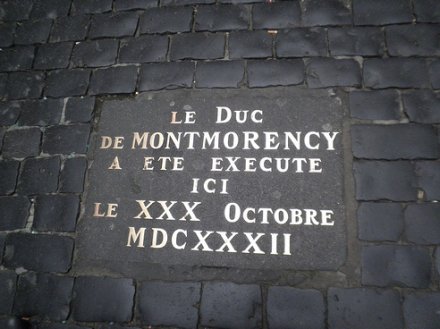
1632: Henri II de Montmorency

On this date in 1632, French noble Henri II de Montmorency was beheaded at Toulouse for rebellion against Louis XIII.

The lordly Montmorency (English Wikipedia page | French), sister to a famous knockout whom Henri IV wooed, was a Grand Admiral for his achievements knocking heads during the 1620s’ Huguenot rebellions. (It was Montmorency who, in the naval battle to capture Re Island, commanded the English ships controversially supplied by the Duke of Buckingham.)

His undoing? He hated Cardinal Richelieu‘s guts.

The red eminence had just attained his rank as Louis XIII’s consigliere, and set about using it to centralize the state in the king’s hands.

Toward that end, Richelieu pressed Montmorency to give up his “grand admiral” title, fearing that “grand” military generals running around the realm were liable to become a locus of sedition sooner or later. Similarly, Richelieu reduced Montmorency’s power as governor of Languedoc.* He wanted, altogether, fewer stumbling-blocks of leftover feudal authority laying about his absolute monarchy.

A seething Montmorency finally jumped — or was he pushed? — into outright rebellion in the party (French) of treacherous royal brother Gaston, duc d’Orleans. The rebel force barely materialized, and was easily beaten at Castelnauday.

Orleans fled the country, not half so committed to his revolt as Montmorency — who assailed the king’s lines practically alone. The latter, captured wounded on the battlefield, was attested to have given a ferocious account of himself in a hopeless cause: “seeing a single man charge through seven ranks and still fight at the seventh, he judged that that man could be only M. de Motmorency.”

Jolly good show, and all the more reason for Richelieu to take his head, to make an example of the man to other powerful men who demanded clemency for the rebellion as if it were Montmorency’s birthright. Richelieu would argue in his memoirs that this pitiless act to pacify the realm at the risk of his own popularity was the height of patriotism.


Plaque at the spot of Montmorency’s execution in Toulouse. Image (c) [Cova] and used with permission.

The Montmorency title eventually became that of the Dukes of Enghien, in which guise it’s associated with an altogether more famous execution.

* Among Montmorency’s other titles, less obnoxious to Richelieu, was viceroy of New France — that mysterious land across the Atlantic. There’s a Montmorency Falls in Quebec, named for him by Champlain.

On this day..

1628: John Felton, assassin of the Duke of Buckingham

The rack, or question, to extort a confession from criminals, is a practice of a different nature: this being only used to compel a man to put himself upon his trial; that being a species of trial in itself. And the trial by rack is utterly unknown to the law of England; though once when the dukes of Exeter and Suffolk, and other ministers of Henry VI, had laid a design to introduce the civil law into this kingdom as the rule of government, for a beginning thereof they erected a rack for torture; which was called in derision the duke of Exeter’s daughter, and still remains in the tower of London: where it was occasionally used as an engine of state, not of law, more than once in the reign of queen Elizabeth but when, upon the assassination of Villiers duke of Buckingham by Felton, it was proposed in the privy council to put the assassin to the rack, in order to discover his accomplices; the judges, being consulted, declared unanimously, to their own honour and the honour of the English law, that no such proceeding was allowable by the laws of England.

–William Blackstone, Commentaries on the Laws of England, vol. iv (via Harper’s)

Although the jurisprudence of 17th century England with its proscription of legal torture* still stacks up favorably next to that of Berkeley law professors, it certainly did not stand in the way of assassin John Felton‘s execution on this date in 1628.

Felton, an army officer passed over for promotion, stabbed to death nobby royal favorite George Villiers, Duke of Buckingham at Portsmouth — a private grievance fused to a widespread public one. Reams of laudatory verse churned out in the two months between crime and punishment suggest the popular opprobrium for the duke.**

Or you, late tongue-ty’d judges of the land,
Passe sentence on his act, whose valiant hand
Wrencht off your muzzels, and infranchiz’d all
Your shakl’d consciences from one man’s thrall?
But O! his countrie! what can you verdict on?
If guiltie; ’tis of your redemption.

Felton’s victim, the Duke of Buckingham — portrayed in 1625 by Rubens.

Villiers, “handsomest-bodied” scion of the minor gentry, had parlayed his comeliness into power as the favorite (and possibly the lover) of King James I. He had, as Alexandre Dumas put it in The Three Musketeers (in which adventure Buckingham is an important character) “lived one of those fabulous existences which survive, in the course of centuries, to astonish posterity.”†

Buckingham latched himself to the king’s 20-something son and heir Charles I and became a dominant influence in foreign policy as well as wildly unpopular in England. He raised Protestant hackles with Machiavellian statecraft like angling for a Spanish queen and aiding the French against the Huguenots, and since he exercised a share of the royal power he vigorously upheld the rights of the crown as against those of the commons. An opponent once compared him to Sejanus.

Indeed, Buckingham helped the youthful Charles, king since March of 1625, set the tetchy tone for his relationship with Parliament that would define his rule and ultimately cost the monarch his own head. When Parliament demanded Buckingham “be removed from intermeddling with the great affairs of State” as a condition for coughing up any more money, Charles haughtily dissolved Parliament rather than give up his favorite.

That forced the king into sketchy expedients like the “forced loan” and, when the money disputes continued after Buckingham’s death, the king’s eventual legislature-free Personal Rule that set up the Civil War.

So one can see how the sudden 1628 murder of this resented courtier, to whom was imputed every fault and abuse of Charles himself, would have been celebrated. “Honest Jack” — the assassin’s widely-honored nickname — was likewise credited with every perceived virtue of the Parliamentarian party. Juridically, the man was doomed — but in the popular eye,

[t]he passage of Felton to London, after the assassination, seemed a triumph. Now pitied, and now blessed, mothers held up their children to behold the saviour of the country; and an old woman exclaimed, as Felton passed her, with a scriptural allusion to his short stature, and the mightiness of Buckingham, “God bless thee, little David!” Felton was nearly sainted before he reached the metropolis. His health was the reigning toast among the republicans.

In fact, the man who had recently tutored future literary giant (and future Cromwellian agent) John Milton was sentenced by the Star Chamber have an ear cut off for drinking Felton’s health. (The sentence was remitted thanks to some pull with Archbishop William Laud.)

While he’s sometimes described — or dismissed — as merely a disgruntled careerist, the assassin’s own ideological commitment ought not be downplayed. Whatever Felton’s personal pique, the assassination was unambiguously political: our killer had returned from war wounded and melancholy and proceeded to marinate in the era’s anti-monarchical currents. In time, Felton came to understand — surely in concert with many of his countrymen now forgotten by time — that there was a greater good to be served by the sin of murder.

He had left behind in his trunk a few propositions that underscored his state of mind: “There is no alliance nearer to any one than his country” and “No law is more sacred than the safety and welfare of the commonwealth.” He justified himself at trial in similar terms, and did so without desiring to escape the extremities of the law that his crime demanded.

Felton had really expected to be killed in the act of the assassination himself. To that end, he had left a note pinned in his hat that is as good an elegy for him as any a republican ballad. “That man is cowardly and base and deserveth not the name of a gentleman that is not willing to sacrifice his life for the honor of his God, his king, and his country. Let no man commend me for doing it, but rather discommend themselves as to the cause of it, for if God had not taken away our hearts for our sins, he would not have gone so long unpunished.”

While Felton played his part in the generations-long struggle to subordinate king to parliament, the most immediate beneficiary of this affair was not so much the Commons as it was the noble rival who usurped the late Buckingham’s power — the Earl of Strafford.

* Certain though we are of the human rights commitment of Felton’s prosecutors, the man himself made sure of it by dint of a deft bit of interrogatory jujitsu. Menaced with the prospect of torture, he cheerfully resigned himself to it — “Yet this I must tell you by the way,” he added. “That if I be put upon the rack, I will accuse you, my Lord of Dorset, and none but yourself.”

That’s the way to convince judges not to torture you.

** An entirely less negative remembrance commemorates Buckingham and “accursed” Felton at the Portsmouth Cathedral.

† Felton also appears in The Three Musketeers, committing the murder of Buckingham at the instigation of the seductive fictional villain Milady de Winter just days before the musketeers execute Milady herself.

On this day..

1440: Gilles de Rais, unholy

On this date in 1440, the wealthiest man in France, a noble who had once fought under Joan of Arc‘s banner, was hanged for an outlandishly demonic crime spree.


This dashing Gilles opposite Milla Jovovich in The Messenger; you’d never think he would sodomize hundreds of children.

Rivaling Hungarian blood-bather Erzsebet Bathory for the reputation of most bewitchingly depraved aristocratic sex-killer of early modern Europe, Gilles de Rais (or de Retz) hanged for abducting numberless legions of anonymous young commoners (boys, mostly) for rape and murder.

It’s a rap sheet trebly astounding given that a decade before, de Rais’s reputation for posterity would have figured to be his role as Saint Joan’s chief lieutenant when she raised the siege of Orleans, culminating with elevation to the rank of Marshall of France on the very day Charles VII was crowned in Reims. Talk about a fall from grace.

A 1440 investigation triggered by de Rais’s attack on a priest during an intra-aristocracy dispute turned up a Gacy‘s floorboards’ worth of Nantes-area kids allegedly disappeared into the Marechal’s creepy castle. Remarkably detailed trial records preserve a heartbreaking cavalcade of parents who entrusted their children to de Rais’s service or just sent them out one morning never to be heard from again. “It is notorious,” one added, “that infants are murdered in the said chateau.” (Many of these depositions and other original trial records can be read here.)

His servants and co-deviants Henriet and Pouitou admitted the most shocking stuff —

that de Rais then raped [the typical captive] as he was hanged from a hook by the neck. Before the child died, Gilles took him down, comforted him, repeated the act and either killed him himself or had him slain.

Poitou testified that the child victims were murdered sometimes by decapitating them, sometimes by cutting their throats, sometimes by dismembering them, sometimes by breaking their necks with a stick …

Gilles de Rais rarely left a child alive for more than one evening’s pleasure, Poitou claimed.

Now, it needs to be said that the servants were induced to these confessions by the threat of physical harm — and that when de Rais reversed his own denials he had likewise been menaced with torture. Nobody had been tortured, mind. But they had been given to understand that they would be corroborating the witnesses with self-incriminating statments, and we can do this the easy way or the hard way. In a world without dispositive forensics, confessions were the evidentiary gold standard … and torturing to obtain them was standard operating procedure.

It’s for that reason that there has also long persisted a revisionist thesis that de Rais was actually innocent, framed up by elite rivals who cannibalized the man’s estates. A 1992 “rehabilitation tribunal” re-tried the affair, and returned an acquittal.

Arguably, the populace — font of all those damning accusations — did likewise on the day de Rais hanged with his two servants. A crowd one might expect to be frenzied with rage actually sympathized with the doomed noble, even rescuing his hanged body from the fire. A monument his daughter put up became an unsanctioned popular pilgrimage site until it was destroyed during the French Revolution.

Whether as fact or fable, there’s something gorgeously baroque about de Rais’s dungeon mastering — especially when considered vis-a-vis his historical casting call opposite the abstemious Maid.

As a text for our latter-day edification, de Rais appears a carnivore devoured by his own appetites (and not only sexual: he also blew through the gargantuan family fortune). Reduced from hero to beast, he’s almost a literal werewolf or vampire; he’s often cast as such in video games and the like.

And he transfixes us because he personifies this uncanny bridge from the atomized digital age with its iconic serial killers, alone and psychologically deconstructed, back into the medieval — feudal, irrational, communal, violent and physical but also suffused with an omnipresent alien-to-us paranormal spirit world. It is enough to glance to experience the pull of the abyss gazing back.

Sabine Baring-Gould anticipated the modern afterlife of Gilles de Rais in the mid-19th century Book of Were-Wolves — which incorporated an extended account of de Rais’s trial into a wider narrative of folklore shapeshifting.

De Rais himself shapeshifts even within the brief arc of his dramatic trial: from indignant defendant into contrite supplicant, every drop sincere so far as one can perceive. His very prosecutors, indeed his very victims, wept for the fallen Marechal, and the “monster” reversed with this display his excommunication. (This may have been the part of the punishment de Rais feared most: again, we encounter the alien cosmology.)

“Nothing seems to me to be more beautiful –- and farthest away from our mentality of today — than the crowd of parents of the victims praying for this soul’s salvation,” one modern observed. “That is spiritual nobility.”

Agonizing ecstacist Georges Bataille wrote a whole book about de Rais, characteristically taken by the intersection of repugnance and transcendence. For Bataille, Christianity even reconciles our prisoner’s stupendous villainy with his unfeigned anticipation of spiritual salvation that “ultimately summarize the Christian situation.”

“Perhaps,” Bataille mused, “Christianity is even fundamentally the pressing demand for crime, the demand for the horror that in a sense it needs in order to forgive.”

A Few Books About Gilles de Rais

There are also several free public-domain books, such as Bluebeard: an account of Comorre the cursed and Gilles de Rais, with summaries of various tales and traditions and (already alluded to, the one with the original trial documents) Blue-beard, a contribution to history and folk-lore. Gilles de Rais is popularly, though I think not very persuasively, believed to have helped inspire the “Bluebeard” legend of the murderous aristocrat.

On this day..

330 B.C.E.: Philotas, Alexander the Great Companion

Around this time — October, or at any rate autumn — of 330 B.C.E., Alexander the Great authored “one of the two greatest crimes of his life”* with the execution of his comrade-in-arms Philotas.

Philotas was one of Alexander’s “companions”, the elite cavalry who joined Alexander personally in battle. He had fought by Alexander’s side in the epic Battle of Gaugamela, which brought down the Achaemenid Empire and opened Persia to the legendary conqueror.

A year later, Alexander, and therefore also those companions, were winding down campaign season all the way on the other side of the late empire they had so stunningly dismantled. It’s the region of Drangiana on the present-day Iran-Afghanistan frontier. The Macedonians would name the city Prophthasia, Anticipation, in recognition of their chief’s narrow escape; we know it today as Farah, Afghanistan.

Unlike many of the “companions” who joined the young Macedonian king, Philotas wasn’t a bosom buddy of Alexander.

He was, instead, a bit of a political appointee who owed his position to the fact that his father Parmenion, a great Macedonian general, had backed the disputed succession of Alexander. Parmenion continued as one of Alexander’s generals; his kid — not particularly popular of himself but nevertheless a loyal and competent officer — got a plum gig in Alexander’s vanguard.

In this capacity so close to the royal person, Philotas was warned by a conscientious slave of an assassination plot going against Alexander. And rather incredibly, he didn’t bother to pass it on.

When the slave realized, a couple of days on, that the conspiracy hadn’t been busted, he proceeded to tell somebody else … and Philotas had some explaining to do.

For posterity, it’s as open a question as it was then: Philotas initially convinced Alexander that he had merely considered the whole thing so insubstantial as not to merit the king’s attention — but by the next day, Alexander had better inclined himself to the more damning reading, that Philotas was perfectly amenable to seeing Alexander eliminated.** If that were the truth, it would herald a conflict that would soon come to define the Macedonian’s coruscating and paradoxical career: the army’s rising discontent with its march so far from home, and its leader’s ever more visible habit of arraying himself in the alien habits of oriental despotism.

Philotas got a “proper” if farcically rigged trial before fellow-generals who were all too happy to be rid of him, and was tortured into confessing. He was executed either by stoning (actually the traditional Macedonian execution method, even for the likes of generals) or spearing.

(The scene is dramatized in the 2004 Oliver Stone film Alexander; the relevant bit can be viewed here.)

Parmenion, a greater character than his son, would also pay the forfeit of his son’s alleged misprision.

At the time of Philotas’s execution, Parmenion was commanding a large army several days’ ride from Alexander. Fearing that the torture and execution of his last remaining son (the other two had also died on campaign) might inspire the august general to do something rash, Alexander dispatched a few trusted officers to outrace the news: they murdered an uncomprehending Parmenion as soon as they reached him. Whatever one makes of the child, the father’s loyalty both to Alexander and his predecessor Philip II had never previously been impeached in a long and brilliant career. Alexander ought to have counted himself fortunate to have avoided any wider disturbance in the army from the rough handling of this beloved general.

The whole affair was sufficiently distasteful that it remained a sensitive matter of state security hundreds of years and hundreds of miles distant: An Elizabethan play about Philotas by Samuel Daniel earned its author some uncomfortable official scrutiny for its perceived commentary on the contemporaneous execution of the Earl of Essex … the fallen courtier whose prosecution of a Jewish doctor arguably informed Shakespeare’s Merchant of Venice.

* The other — later and greater — crime was Alexander’s drunken murder of his friend and loyal commander Cleitus. (He’s the guy shown stabbing Parmenion to death in the clip from Alexander, a circumstance that plays better as drama than history.)

** It doesn’t help anyone’s fact-finding that the main alleged plotter committed suicide when they came to arrest him.

On this day..

2003: Two Palestinian collaborators

On this date in 2003, Samer Ufi and Mohamed Faraj (some sources give the latter’s name as Suleiman) were publicly shot by masked al-Aqsa gunmen in the West Bank town of Tulkarem (or Tulkarm) for Israeli collaboration.

A videotape of the two admitting to supplying Israel information which led to militants’ assassination was played in the camp on the eve of their shooting. The dead men’s families contended that they had been tortured into the confession.

Tulkarem in 2003 was a place easy to feel under siege.

Recently prosperous, the fertile district close upon the Israeli border was suffering the effects of the ongoing Palestinian rising.

Tulkarem was in the process of being riven by Israel’s “apartheid wall” — splintering communities and devastating a recently prosperous economy.

Isabel Kershner reports in Barrier: The Seam of the Israeli-Palestinian Conflict:

Some eighteen to twenty-two thousand Palestinian laborers from the Tulkarm district used to go and work in Israel every day. Now they are prevented by the security barrier that went up during 2003 … an eight-meter-high concrete wall complete with round gray watchtowers, built to prevent Palestinian snipers from shooting at passing cars on the Trans-Israel Highway that skirts Tulkarm to the west. Additional stretches of fence hermetically seal the surrounding villages off from Israel, as well as from some of their agricultural land.

Meanwhile, as elsewhere in the West Bank and Gaza, a a fast-growing list of assassinations struck militants in the community.

We don’t know in these parts whether the executed men truly were informers, but Israel is known to obtain many such targets by way of informers — often reluctant Palestinians it blackmails or bribes. Accused informers are regularly executed in the Palestinian territories.

“For myself, if I were Palestinian, I would hate them to death,” an Israeli intelligence advisor told the BBC of the collaborators recruited by Tel Aviv. “He is a traitor — I need him — but he’s a traitor”.

Part of the Themed Set: Illegitimate Power.

On this day..

1859: Danford Balch, inadvertent PDX benefactor

On this date in 1859, five to six hundred folks braved a dreary Portland morning to witness the first execution in the state of Oregon — Oregon having graduated into statehood just that very year, as it says on the flag.

Danford Balch, who would surely merit an entry in these pages for his name alone, had staked out a 345-acre land claim near the small settlement of Portland, but all that money couldn’t buy his daughter’s love.

Anna, the eldest of nine kids at a blossoming 15, was amenable to a suit by the farmhand, one Mortimer Stump — this is a Dickensian roster of characters — and in the face of Papa Balch’s opposition, eloped with him over the Columbia River to Vancouver, Wash.

So Danford Balch stewed, and drank, and was allegedly incited by his shrewish wife Mary Jane — this one has an ironically innocent moniker — until, encountering the Stumps in town for supplies one day, Danford Balch tried to retrieve his daughter and ended up shotgunning his unwanted son-in-law, right in the face.

Ka-blamo.

Bystanders tackled Balch immediately, though it took nine more months to bring the killer to trial: in these sparsely-populated frontier precincts justice was being administered on the old “assize” model of wandering judges who dropped in for a spell to try everything at one go. It was enough time for Balch to bust out of a rain-rotted jail cell once and get recaptured (once on the lam, he returned to his own home).

When court was finally in session, conviction was a mere formality. He’d done the deed in public, after all. But the offended father seemed genuinely bewildered by the outcome: apart from the shooting being accidental (so he said), he clearly expected that a court would uphold the dominion of the family patriarch over his wayward progeny.

Heaven knows what fumes he was fuming by the time he climbed the scaffold and beheld that naughty daughter Anna turned up to witness his hanging — sitting in the front row with the [rest of the] Stump family in what you have to think was a somewhat uncomfortable party for all concerned.

Little more affectionate was the post-mortem behavior of the allegedly un-alienated part of the Balch clan.

That widow Mary Jane, whom Danford hinted gave him quite a goading over their wanton daughter, shafted the remaining rugrats out of inheriting their chunks of the family land and instead routed most of it to her next husand.

Balch Creek in Lower Macleay State Park. (cc) image from Brad Reber.

Though pretty difficult to admire by the yardstick of human decency, that behavior turned out to be Danford Balch’s redeeming legacy.

Having passed through several hands, the lion’s share of his former land was in 1897 donated to the city by its then-owner Donald Macleay, who was sick of paying taxes on the unprofitable parcel. That was the time the famously green PDX received its first land gift designated by the donor for parkland: Macleay Park. (Including a Balch Creek.)

Today, it’s all part of the larger Forest Park, and it’s a lovely hiking space for a city that grooves on its outdoor rec … complete with a gorgeously ruined Depression-era stone ranger station that’s popularly believed to be haunted, maybe by the spirit of poor old Danford Balch himself.


The haunted house … (cc) image from Adam Gaumont.

There’s a Balchipedia for chronicling Balch family notables, so you know the first guy executed in Oregon is going to rate a mention.

On this day..