1942: The village of Lidice, for the assassination of Reinhard Heydrich

On this date in 1942, the Germans visited upon the Czechoslovakian village of Lidice one of the most notorious butcheries of World War II: the physical destruction of the town, and the execution of most of the adult population, in revenge for the assassination of Reichsprotektor Reinhard Heydrich.

Heydrich had power of life and death in Nazi-occupied Bohemia and Moravia, and did not scruple to use it.

“The Hangman of Prague” was no mere functionary, but a Nazi grand wizard from way back, who’d had a hand in the Third Reich’s most terrifying greatest hits — the Night of the Long Knives, Kristallnacht. Just four months before this date, Heydrich had chaired the Wannsee Conference.* (Watch Kenneth Branagh as Heydrich ride herd over a gaggle of bureaucrats to get the Final Solution up and running in Conspiracy.) Hitler called him his “man with the iron heart.”

So he was a natural target for the Czechoslovakian army-in-exile and their British handlers, made more so by his lordly disdain for common-sense security safeguards.

Zipping along a predictable route in an open car, he was a sitting duck for a hit squad, who gave the Nazi bastard a mortal shrapnel wound from a grenade that had him lingering painfully at death’s door for several days before he finally died of blood poisoning.

The 1964 Czechoslovakian film Atentat (“Assassination”) chronicles the plot to kill Heydrich and its aftermath.

For this effrontery, Czechoslovakians would pay a dreadful price.

Naturally, the Nazis mercilessly hunted down and slaughtered those with any connection to the plot.

But the Reich also exacted collective reprisals to make plain that the entire “protectorate” could be considered hostage against such plots in the future.

Special transports of Jews marked “Attentat auf Heydrich” were shipped to the camps, and 152 were executed on the day Heydrich succumbed. But then, the Nazis were brutalizing Jews anyway. Something more headline-grabbing would be needed.

Enter Lidice.

After gaudy funerals for the slain Reichsprotektor, the Reich settled upon the small town of Lidice north of Prague — trumping up a few connections to resistance to “justify” collective punishment.

On this date, German troops stormed it, summarily executed all the men and boys** old enough to bear arms and a fair number of women, deported the others, and then physically destroyed and buried the town.

Lidice was intended as a demonstration — boldly published to the world as proof against a repeat,† it became the byword of Nazi cruelty towards subject nations. Though not by quantitative standards the greatest crime of the occupation, not even the greatest crime in reprisal for Heydrich, its three syllables distill all the evil of Hitler’s conquest for Czechoslovakia.

Lidice did live, and does yet, as an emblem par excellence those terrible years.

Less alive: Heydrich’s right-hand man Karl Hermann Frank, who was hanged in Prague after the war for engineering this monstrous crime. Those survivors of Lidice able to make the trip enjoyed priority seating.

* Heydrich’s aide at the Wannsee Conference, and taker of cleaned-up minutes, was Mr. Banality of Evil himself, Adolf Eichmann.

** Only three men of Lidice survived the destruction: two who were in England at that time, and one who was imprisoned in Prague for killing his son. The sentence for this crime, it turned out, was life.

† An effective proof — the calculated wholesale slaughter apparently did cool both the conquered populace and the enemies of Germany on enthusiasm for further assassinations.

On this day..

1864: Doctor Edmond-Désiré Couty de la Pommerais, poisoner

At dawn this morning before the walls of La Roquette, a homeopath convicted of poisoning his mistress was beheaded for one of Paris’s most sensational crime dramas of the 1860’s.

The ill-fated Madame de Pauw had fallen suddenly ill and expired in the doctor’s care; means and opportunity were obvious, and motive readily adduced from the handsome life insurance policies of the expired woman.

La Pommerais was convicted on this basis of killing his paramour in the midst of a farcical insurance scam, with noted forensic scientist Ambroise Tardieu establishing to the court’s satisfaction the presence of the poison digitalin.

(One can read a detailed 1865 critique of Tardieu’s conclusions and testimony, a reminder that the criminal justice system’s struggles with the uses and limitations of forensic science are a longstanding concern. This (if one takes it as such) murder, which reads in retrospection like a classic in the genre of comedic criminality, might have been the perfect crime absent an obvious pecuniary design: the death was put down to a routine cause and only scrutinized when an anonymous tip and/or the suspicious insurance adjusters led the authorities to exhume the body 13 days after burial.)

American newsman George Alfred Townsend chanced to be abroad in Paris on this occasion, and recorded the scene as “thousands of Parisians bent their steps the night before the execution” in Campaigns of a Non-combatant — excerpted at length here for its topicality to this blog.

The news had gone abroad that la Pommerais would not be pardoned. It was also generally credited that this would be the last execution ever held in Paris, since there is a general desire for the abolition of capital punishment in France, and a conviction that the Legislature, at its next session, will substitute life-imprisonment.* This, with the rarity of the event, and that terrible allurement of blood which distinguishes all populaces, brought out all the excitable folk of the town; and at dusk, on the night before the expiation, the whole neighborhood of La Roquette was crowded with men and women. All classes of Parisians were there, — the blouses, or workingmen, standing first in number; the students from the Latin Quartier being well represented, and idlers, and well-dressed nondescripts without enumeration, — distributing themselves among women, dogs, and babies.

Venders of galeaux, muscles, and fruit were out in force. The “Savage of Paris,” clothed in his war plumes, paint, greaves, armlets, and moccasins, was selling razors by gaslight; here and there ballad-mongers were singing the latest songs, and boys, with chairs to let, elbowed into the intricacies of the crowd, which amused itself all the night long by smoking, drinking, and hallooing. At last, the mass became formidable in numbers, covering every inch of ground within sight of the prison, and many soldiers and sergeants de ville, mounted and on foot, pushed through the dense mass to restore order.

At midnight, a body of cavalry forced back the people from the square of La Roquette. A number of workmen, issuing from the prison-gates, proceeded to set up the instrument of death by the light of blazing torches. The flame lit up the dark jail walls, and shone on the helmets and cuirasses of the sabre-men, and flared upon spots of the upturned faces, now bringing them into strong, ruddy relief, now plunging them into shadow. When the several pieces had been framed together, we had a real guillotine in view, — the same spectre at which thousands of good and bad men had shuddered; and the folks around it, peering up so eagerly, were descendants of those who stood on the Place de la Concorde to witness the head of a king roll into the common basket. Imagine two tall, straight timbers, a foot apart, rising fifteen feet from the ground. They are grooved, and spring from a wide platform, approached by a flight of steps. At the base, rests a spring-plank or bascule, to which leather thongs are attached to buckle down the victim, and a basket or pannier filled with sawdust to receive the severed head. Between these, at their summit, hangs the shining knife in its appointed grooves, and a cord, which may be disconnected by a jerk, holds it to its position. Two men will be required to work the instrument promptly, — the one to bind the condemned, the other to drop the axe. The bascule is so arranged that the whole weight and length of the trunk will rest upon it, leaving the head and neck free, and when prone it will reach to the grooves, leaving space for the knife to pass below it. The knife itself is short and wide, with a bright concave edge, and a rim of heavy steel ridges it at the top; it moves easily in the greased grooves, and may weigh forty pounds. It has a terrible fascination, hanging so high and so lightly in the blaze of the torches, which play and glitter upon it, and cast stains of red lights along its keen blade, as if by their brilliance all its past blood-marks had become visible again. A child may send it shimmering and crashing to the scaffold, but only God can fasten together the warm and throbbing parts which it shall soon dissever. And now that the terrible creature has been recreated, the workmen slink away, as if afraid of it, and a body of soldiers stand guard upon it, as if they fear that it might grow thirsty and insatiate as in the days of its youth. The multitude press up again, reinforced every hour, and at last the pale day climbs over the jail-walls, and waiting people see each other by its glimmer. The bells of Notre Dame peal out; a hundred towers fall into the march of the music; the early journals are shrieked by French newsboys, and folks begin to count the minutes on their watches. There are men on the ground who saw the first guillotine at work. They describe the click of the cleaver, the steady march of victims upon the scaffold-stairs, the rattle of the death-cart turning out of the rue Saint Honore, the painted executioners, with their dripping hands, wiping away the jets of blood from the hard, rough faces; nay! the step of the young queen, white-haired with care, but very beautiful, who bent her body as she had never bent her knee and paid the penalty of her pride with the neck which a king had fondled.

At four minutes to six o’clock on Thursday morning, the wicket in the prison-gate swung open; the condemned appeared, with his hands tied behind his back, and his knees bound together. He walked with difficulty, so fettered; but other than the artificial restraints, there was no hesitation nor terror in his movements. His hair, which had been long, dark, and wavy, was severed close to his scalp; his beard had likewise been clipped, and the fine moustache and goatee, which had set off his most interesting face, no longer appeared to enhance his romantic, expressive physiognomy. Yet his black eyes and cleanly cut mouth, nostrils, and eyebrows, demonstrated that Couty de la Pommerais was not a beauty dependent upon small accessories. There was a dignity even in his painful gait; the coarse prison-shirt, scissored low in the neck, exhibited the straight columnar throat and swelling chest; for the rest, he wore only a pair of black pantaloons and his own shapely boots. As he emerged from the wicket, the chill morning air, laden with the dew of the truck gardens near at hand, blew across the open spaces of the suburbs, and smote him with a cold chill. He was plainly seen to tremble; but in an instant, as if by the mere force of his will, he stood motionless, and cast a first and only glance at the guillotine straight before him. It was the glance of a man who meets an enemy’s eye, not shrinkingly, but half-defiant, as if even the bitter retribution could not abash his strong courage … he seemed to feel that forty thousand men and women, and young children were looking upon him to see how he dared to die, and that for a generation his bearing should go into fireside descriptions. Then he moved on between the files of soldiers at his shuffling pace, and before him went the aumonier or chaplain, swaying the crucifix, behind him the executioner of Versailles — a rough and bearded man — to assist in the final horror.

It was at this intense moment a most wonderful spectacle. As the prisoner had first appeared, a single great shout had shaken the multitude. It was the French word “Voila!” which means “Behold!” “See!” Then every spectator stood on tiptoe; the silence of death succeeded;** all the close street was undulant with human emotion; a few house roofs near by were dizzy with folks who gazed down from the tiles; all the way up the heights of Pere la Chaise, among the pale chapels and monuments of the dead, the thousands of stirred beings swung and shook like so many drowned corpses floating on the sea. Every eye and mind turned to the little structure raised among the trees, on the space before La Roquette, and there they saw a dark, shaven, disrobed young man, going quietly toward his grave.

He mounted the steps deliberately, looking towards his feet; the priest held up the crucifix, and he felt it was there, but did not see it; his lips one moment touched the image of Christ, but he did not look up nor speak; then, as he gained the last step, the bascule or swingboard sprang up before him; the executioner gave him a single push, and he fell prone upon the plank, with his face downward; it gave way before him, bearing him into the space between the upright beams, and he lay horizontally beneath the knife, presenting the back of his neck to it. Thus resting, he could look into the pannier or basket, into whose sawdust lining his head was to drop in a moment. And in that awful space, while all the people gazed with their fingers tingling, the legitimate Parisian executioner gave a jerk at the cord which held the fatal knife. With a quick, keen sound, the steel became detached; it fell hurtling through the grooves; it struck something with a dead, dumb thump; a jet of bright blood spurted into the light, and dyed the face of an attendant horribly read; and Couty de la Pommerais’s head lay in the sawdust of the pannier, while every vein in the lopped trunk trickled upon the scaffold-floor! They threw a cloth upon the carcass and carried away the pannier; the guillotine disappeared beneath the surrounding heads; loud exclamations and acclaims burst from the multitude; the venders of trash and edibles resumed their cheerful cries, and a hearse dashed through the mass, carrying the warm body of the guillotined to the cemetery of Mt. Parnasse. In thirty minutes, newsboys were hawking the scene of the execution upon all the quays and bridges. In every cafe of Paris some witness was telling the incidents of the show to breathless listeners, and the crowds which stopped to see the funeral procession of the great Marshal Pelissier divided their attention between the warrior and the poisoner, — the latter obtaining the preponderance of fame.

(This attention-getting execution attracted an apocryphal story† (pdf) that the severed head of La Pommerais was subject to a “wink test” to determine whether consciousness survived the fall of the blade.)

The doctor bequeathed the world a book on homeopathic medicine, which the discerning reader of French can peruse free.

* Actually, the last execution in France was still 113 years away.

** Rashomon-like, not all observers concurred as to the event’s quiet solemnity. The New York Times reported that

[t]he language of those non-official persons who assembled to witness this expiation of a great crime was brutal to the last decree. They hissed and hooted as the convict was about to mount the ladder, and were loudest in their brutal demonstrations when the crucifix was pressed to his lips. The blade had scarcely severed his head from his body, when a rush was made to do violence to the trunk. The troops were obliged to interfere, and had some difficulty in repelling the crowd, which was excited by the sight of a ‘gentleman criminal’ to a pitch of savage ferocity … The Pays, in noticing this expiation of a great crime, states that the crowd retired in silence. But I am in a position to affirm that the contrary was the cxase.

† Put about — as a hoax? — by Auguste Villiers de l’Isle-Adam.

On this day..

1405: Richard le Scrope and Thomas de Mowbray, without color of law

On this date in 1405, Henry IV had two rebellious peers beheaded on his authority at York.


The lower panels of this stained glass in St. Andrew’s Church, Bishopthorpe, depict the trial of Archbishop Scrope. Image (c) Roger Walton and used with permission.

Richard le Scrope, Archbishop of York, and Thomas de Mowbray, Earl of Norfolk, had both become estranged from Henry Bolingbroke, the noble who had wrested control of the English crown as Henry IV.

Since Henry’s legitimacy was dubious, he faced even more than a monarch’s usual ration of plots and rebellions — most famously that of young Sir Henry Percy, remembered as “Hotspur” in Shakespeare’s Henry IV part 1.

That particular enemy met his end in 1403, but old man Percy was soon back to fomenting from his expansive holdings in the north.

Mowbray, a disaffected teenager, and Scrope, a seasoned prelate who should have known better, were drawn into the next intrigue — by “the odor of French promises or rewards,” their enemies charged. A noble loyal to Henry intercepted their modest force and (so the story goes*) by representing to accept Scrope’s offer to parley induced the rebels to disband, whereupon the ringleaders were arrested.

Henry demanded their immediate condemnation; Chief Justice William Gascoigne insisted upon their right to be judged by other peers of the realm (and upon the inviolability of the archbishop**). The hot-blooded† Henry was inclined not to bother, and simply had their heads lopped off on his own authority.

Shakespeare treats this episode in Henry IV, part 2:

HASTINGS [another rebellious lord, who shared the same fate]

Our Army is dispers’d:
Like youthfull Steeres, unyoak’d, they tooke their course
East, West, North, South: or like a Schoole, broke up,
Each hurryes towards his home, and sporting place

WESTMORLAND

Good tidings (my Lord Hastings) for the which,
I doe arrest thee (Traytor) of high Treason:
And you Lord Arch-bishop, and you Lord Mowbray,
Of Capitall Treason, I attach you both

MOWBRAY

Is this proceeding just, and honorable?

WESTMORLAND

Is your Assembly so?

BISHOP SCROPE

Will you thus breake your faith?

JOHN

I pawn’d thee none:
I promis’d you redresse of these same Grievances
Whereof you did complaine; which, by mine Honor,
I will performe, with a most Christian care.
But for you (Rebels) looke to taste the due
Meet for Rebellion, and such Acts as yours.
Most shallowly did you these Armes commence,
Fondly brought here, and foolishly sent hence.
Strike up our Drummes, pursue the scatter’d stray,
Heaven, and not wee, have safely fought to day.
Some guard these Traitors to the Block of Death,
Treasons true Bed, and yeelder up of breath.

(See this scene played here.)

Scrope’s execution in particular played very badly as an arrogation of secular power over the ecclesiastical authorities. The pope was persuaded not to excommunicate Henry — that step would be reserved a later King Henry — but many contemporaries viewed the monarch’s subsequent (and ultimately fatal) bouts with disfiguring “leprosy” as a judgment from above St. Peter’s throne.

This Google books freebie has much more on the cast of characters at the center of this day’s action.

* This popular version has its opponents; the rebels may have simply surrendered when they recognized their hopeless military disadvantage.

** Interestingly, the very uncle of the noble who effected the arrest of Scrope and Mowbray had been implicated a traitor a generation before by the Merciless Parliament. Unlike many, Alexander Neville was spared a death sentence for his perceived proximity to Richard II … because he was, as Scrope would become, the Archbishop of York.

† Henry was making noises about destroying York altogether as punishment for its disloyalty as he rode there following the “Battle” of Shipton Moor. Residents of that northern city met him in poses of desperate submission — dressed in sackcloth, ropes about their necks, offering up their weapons.

On this day..

1862: William B. Mumford, flag desecrator

On this date in 1862, a 42-year-old gambler hanged at the New Orleans mint where, six weeks before, he had pulled down the Stars and Stripes of the arriving Union occupiers to the delight of a Confederate mob.

Moving to secure the Mississippi, Northern forces had the Big Easy encircled and about to surrender when, an advance team landed in the undefended city and pulled down the Stars and Bars over the mint on Esplanade Avenue.

William Bruce Mumford was among the Confederate loyalists who took exception to the Yankee flag, so he chopped it down and dragged it through the street (provoking a cannonade from a Union warship). The flag was little but tatters by the time he had through with it.

Although the city was not officially occupied at the time of this incident, the mint was a federal building. Army General Benjamin Butler resolved to make a salutary example out of the incident to quell any possible civil unrest.

I find the city under the dominion of a mob. They have insulted our flag — torn it down with indignity. This outrage will be punished in such a manner as in my judgment will caution both the perpetrators and abettors of the act, so that they will fear the stripes, if they do not reverence the stars of our banner.

Butler, it should be allowed, had some reason for this conclusion. The Picayune exulted the act as, well, a call to resistance.

The names of the party that distinguished themselves by gallantly tearing down the flag that had been surreptitiously hoisted, we learn, are W. B. Mumford, who cut it loose from the flag-staff amid the shower of grape. Lieutenant N. Holmes, Sergeant Burns and James Reed. They deserve great credit for their patriotic act. New Orleans, in this hour of adversity, by the calm dignity she displays in the presence of the enemy, by the proof she gives of her unflinching determination to sustain to the uttermost the righteous cause for which she has done so much and made such great sacrifices, by her serene endurance undismayed of the evil which afllicts her, and her abiding confidence in the not distant coming of better and brighter days — of speedy deliverance from the enemy’s toils — is showing a bright example to her sister cities, and proving herself, in all respects, worthy of the proud position she has achieved. We glory in being a citizen of this great metropolis.

This free book argues that Butler’s clemency a few days before to a group of condemned southern enlisted men made mercy politically impossible in the Mumford case, lest the citizenry interpret executive weakness as an invitation to lawlessness.

If that was Butler’s calculus, Confederate die-hards did not appreciate it.

Accordingly, when Mumford was “hung … from a flag-staff projecting from one of the windows under the front portico” of the mint, he won promotion into the pantheon of southern martyrs.

Confederate President Jefferson Davis issued an order condemning General Butler, and even his officers, to death, along with some outsized bluster about embargoing prisoner exchanges that the Confederacy had not the manpower to seriously intend:

William B. Mumford, a citizen of this Confederacy, was actually and publicly executed in cold blood by hanging alter the occupation of the city of New Orleans by the forces under the command of General Benjamin F. Butler when said Mumford was an unresisting and non-combatant captive, and for no offense even alleged to have been committed by him subsequent to the date of the capture of the said city …

the silence of the Government of the United States and its maintaining of said Butler in high office under its authority for many months after his commission of an act that can be viewed in no other light than as a deliberate murder, as well as of numerous other outrages and atrocities hereafter to be mentioned, afford evidence only too conclusive that the said Government sanctions the conduct of said Butler and is determined that he shall remain unpunished for his crimes:

Now therefore I, Jefferson Davis, President of the Confederate States of America, and in their name do pronounce and declare the said Benjamin F. Butler to be a felon deserving of capital punishment. I do order that he be no longer considered or treated simply as a public enemy of the Confederate States of America but as an outlaw and common enemy of mankind, and that in the event of his capture the officer in command of the capturing force do cause him to be immediately executed by hanging; and I do further order that no commissioned officer of the United States taken captive shall be released on parole before exchange until the said Butler shall have met with due punishment for his crimes.

And whereas the hostilities waged against this Confederacy by the forces of the United States under the command of said Benjamin F. Butler have borne no resemblance to such warfare as is alone permissible by the rules of international law or the usages of civilization but have been characterized by repeated atrocities and outrages

… (examples of atrocities omitted) …

I, Jefferson Davis, President of the Confederate States of America and acting by their authority, appealing to the Divine Judge in attestation that their conduct is not guided by the passion of revenge but that they reluctantly yield to the solemn duty of repressing by necessary severity crimes of which their citizens are the victims, do issue this my proclamation, and by virtue of my authority as Commander-in-Chief of the Armies of the Confederate States do order-

1. That all commissioned officers in the command of said Benjamin F. Butler be declared not entitled to be considered as soldiers engaged in honorable warfare but as robbers and criminals deserving death, and that they and each of them be whenever captured reserved for execution.

2. That the private soldiers and non-commissioned officers in the army of said Butler be considered as only the instruments used for the commission of the crimes perpetrated by his orders and not as free agents; that they therefore be treated when captured as prisoners of war with kindness and humanity and be sent home on the usual parole that they will in no manner aid or serve the United States in any capacity during the continuance of this war unless duly exchanged.

3. That all negro slaves captured in arms be at once delivered over to the executive authorities of the respective States to which they belong to be dealt with according to the laws of said States.

4. That the like orders be executed in all cases with respect to all commissioned officers of the United States when found serving in company with armed slaves in insurrection against the authorities of the different States of this Confederacy.

The Confederates never got a chance to enforce the order; he resumed his colorful political career and died in 1893 hailed as Massachusetts’ greatest citizen-soldier. Complain (pdf) as they might of his iron-heeled rule, the residents of New Orleans had good cause to appreciate the relatively early and orderly occupation of their city, which spared it the flames visited on more recalcitrant rebel strongholds.

For the South, the loss of its largest city and the gateway to the Mississippi was a severe blow. As the rebel position crumbled in the months to come, Jefferson Davis must have had a worry for his own neck.

Somehow, he and every other Southerner escaped execution for their treasonable design, which leaves William Bruce Mumford, the riverboat gambler who tore down Old Glory, as the only American since at least the War of 1812 to be put to death for treason against the United States.*

* Anti-slavery rebel John Brown was hanged for treason in 1859, but it was treason against the state of Virginia — not against the U.S. Julius and Ethel Rosenberg were electrocuted for espionage, not treason.

On this day..

1814: Four of five deserters, in Buffalo

On this date* in 1814, an American army in Buffalo, N.Y., shaken by desertions lined up five absconding soldiers for execution.

The memoirs of one Jarvis Hanks, a drummer, recalled the singular scene that ensued.

In this alternative history of the war of 1812, the sergeant commanding the firing party and the soldier not executed make their way down the continent as an odd couple and fight in the Battle of New Orleans.

During the time we remained at Buffalo, five men were sentenced to be publicly shot for the offence of desertion. They were dressed in white robes with white caps upon their heads, and a red target fastened over the heart. The army was drawn up into a hollow square to witness the example that was about to be made of their comrades who had proved recreant to the regulations of the service. Five graves were dug in a row, five coffins placed near them, also in a line, with distance between coffins and graves to enable the criminals to kneel between them. About twelve men were assigned to the execution of each offender. Their guns were loaded by officers, and they were not permitted to examine them afterwards until they had fired.

All things being in readiness, the chaplain made a prayer, the caps were pulled down over the eyes of the poor culprits, and the word of command given: “Ready! Aim! Fire!” They all fell! Some into their graves, some over their coffins. One struggled faintly and the commanding officer ordered a sergeant to approach and end his misery. He obeyed by putting the muzzle of his piece within a yard of his head, and discharging it. This quieted him perfectly!

At this time one of the condemned slowly arose from his recumbent position to his knees and was assisted to his feet. His first remark was, “By God, I thought I was dead”. In consequence of his youth and the peculiar circumstances of his case, he had been reprieved, but the fact was not communicated to him until this moment. He had anticipated execution with his comrades, and when the report of the guns took place, he fell with them, though not a ball touched him. The platoon assigned to him had guns given to them which were not charged, or at least had nothing but powder in them.

Even Dostoyevsky didn’t get to the point where the mock executioners actually “fired”.

These executions took place during the Niagara campaign in the latter stages of the war — the Americans’ last push in their unsuccessful bid to conquer Canada.

* This execution, which obviously has a folklorish quality, has somewhat slippery particulars. The not-necessarily-dependable dating of the Espy file (pdf) places it on this date, as does The Rivers of War, which squares with the quoted soldier’s account of timing and the known troop movements. Hanks’ writings (and that of two other War of 1812 soldiers) is published in Soldiers of 1814: American Enlisted Men’s Memoirs of the Niagara Campaign. (Review.)

Espy names the executed soldiers as John Black, Mahlon Christie, George Orcote, and Isaac Kent.

On this day..

1076: Waltheof II, Earl of Northumbria

On this day in 1076, William the Conqueror had Northumbrian Earl Waltheof II beheaded for treachery — the only major noble executed by the Norman king.

Waltheof in the comics! (Or see him trade up to battle-axe here.) According to Reality Fiction, Waltheof had a colorful afterlife as a literary character whose reputed exploits grew more prolific with age; he was a popular saint in the next generations. Some also consider Waltheof a possible ancestor of Robin Hood.

When the Norman Conquest brought William the Conqueror to power, the nobles didn’t know the Normans would be able to keep what they’d won … and being nobles, they started plotting.

Multiple revolts shook the northern marches where Waltheof had his domain, and the burly Northumbrian, according to skald Thorkill Skallason, was a Norman-killing machine.

Waltheof burned a hundred
Of William’s Norman warriors
As the fiery flames raged;
What a burning there was that night!

Our day’s principal made nice with the Conqueror and even got dynastically wedded to William’s niece, Judith.

But his fame as a warrior and strategically positioned estates soon had conspirators wooing him for another run at rebellion — the Revolt of the Earls, which would turn out to be the last serious resistance to the last successful invasion of Britain.

Waltheof either (accounts are radically at odds) signed on and then got cold feet, or got entrapped into it, or didn’t join but also didn’t report it when he found out, or got shopped for political reasons by his Norman bride. (Judith, suspiciously, got to keep his huge tracts of land after Waltheof lost his head for the property-confiscating offense of treason.)

Whatever the case, he was soon obliged to throw himself on the mercy of the king. He got a royal wife as his first prize for a brush with treason. His second prize was, he was decapitated.

Waltheof is supposed to have made such a delay at the scaffold with the Lord’s Prayer that the headsman got impatient and lopped off his dome after the words “Lead us not into temptation.” Devotional legend says that the severed head completed the prayer.

Thorkill Skallason remembered the last English earl still keeping it real under William’s rule.

William crossed the cold channel
and reddened the bright swords,
and now he has betrayed
noble Earl Waltheof.
It is true that killing in England
will be a long time ending;
A braver lord than Waltheof
Will never be seen on earth.

Another quarter-millennium elapsed before another English earl — Thomas Plantagenet, Earl of Lancaster — was put to death in the realm.

Waltheof’s story is told in detail in the context of The history of the Norman conquest of England, available free from Google books, and directly from the relevant primary documents here.

On this day..

1871: The Paris Commune falls

On this date in 1871, the last barricade of the Paris Commune fell to the onslaught of the army — and a legion of Parisians fell to the army’s firing squads.

On the evening of that bright Sunday when the insurrection finally collapsed, a Sunday when the streets of central Paris were crowded with returning bourgeois, all expressing their satisfaction that the struggle was at last over, the city’s walls were placarded with a proclamation emanating from MacMahon. “Inhabitants of Paris,” said he, “the Army of France has come to save you. Paris is delivered. At four o’clock our soldiers carried the last position occupied by the insurgents. Today the struggle is over, order, work and security will now revive.

I read that announcement in the Rue de Rivoli, not far from the Hotel-de-Ville. A moment later, however, I heard a discharge of musketry … Several insurgents who had been taken fighting were being shot. (My Adventures in the Commune, Paris, 1871, an anti-Commune source)

The day was climax and curtains for the first working-class seizure of power in industrial Europe, but in truth indiscriminate reprisal executions had been underway since troops of the conservative Versailles government first breached rebellious Paris on May 21.

What followed was semaine sanglante, the “bloody week” — each barricade’s surviving defenders executed summarily, and anyone in the city liable to a similar fate if the nearest French officer disliked the cut of his or her jib. Rumors swept the city that women of the Commune were torching buildings, for instance, and suddenly any woman in the street could be killed as an arsonist; some firefighters were shot as saboteurs when the “water” they threw on such flames failed to speedily quench them,* and was consequently adjudged to be kerosone.

And heaven help he who should chance to resemble one of the wanted Communard leaders!

Any passer-by calling a man by a revolutionary name caused him to be shot by soldiers eager to get the premium … Members and functionaries of the Commune were thus shot, and often several times over, in the persons of individuals who resembled them more or less.


Un rue de Paris en 1871, by Maximilien Luce.

The total body counts are guesswork: the killing ran far ahead of the record-keeping. Twenty thousand, or thirty, or more are thought to perished by summary execution. Even the press of the bourgeoisie, whose sword arm the Versailles men comprised, was aghast. London’s Times filled its broadsheets with calumnies upon the Commune, but noted on May 29:

“The Revolution is crushed;” but at what a cost, and amid what horrors! … the Communists seem not very much worse than their antagonists. It sounds like trifling for M. Thiers to be denouncing the Insurgents for having shot a captive officer “without respect for the laws of war.” The laws of war! They are mild and Christian compared with the inhuman laws of revenge under which the Versailles troops have been shooting, bayoneting, ripping up prisoners, women and children, during the last six days.

Whatever the true death toll, it massively surpassed that of the much more eagerly commemorated Revolutionary Terror.

Not for Executed Today to number what the butchers themselves could not. In a city turned charnel house in the midst of a Week of Blood, a few scenes of mortality from the day the Commune fell. (Heavily sourced to the very pro-Commune — hence potentially sensational — History of the Commune of 1871)

This people, heroes in the face of the foreigner, must therefore by called assassins, criminals, wretches, because they died for the Universal Republic, because in defense of their beliefs, their conscience, their idea, they preferred, in their fierce enthusiasm, to bury themselves in the ruins of Paris rather than abandon it to the coalition of despots a thousand times more cruel and more lasting than any foreigner.

-Lissagaray

The 147 Fédérés at Communards’ Wall

At a wall still consecrated to leftists in the Pere Lachaise cemetery of Belleville, 147 were summarily shot.

The 147 are acclaimed as the last defenders of the Commune.

the Commune is in its death throes. Like the dragon of fairy lore, it dies, vomiting flames … What must these men feel who are killing and being killed in the cemetery! To die among the dead seems horrible. But they never give it a thought; the bloody thirst for destruction which possesses them allows them only to think of one thing, of killing! Some of them are gay, they are brave, these men. That makes it only the more dreadful; these wretches are heroic! Behind the barricades there have been instances of the most splendid valour. A man at the Porte Saint-Martin, holding a red flag in his hand, was standing, heedless of danger, on a pile of stones. The balls showered around him, while he leant carelessly against an empty barrel which stood behind. — “Lazy fellow,” cried a comrade. ‘”No,” said he, “I am only leaning that I may not fall when I die.”

–Paris Under the Commune, an anti-Commune source

Communard Eugene Varlin

Varlin, alas! was not to escape. On Sunday the 28th May he was recognized in the Rue Lafayette, and led, or rather dragged, to the foot of the Buttes Montmartre before the commanding general. The Versaillese sent him to be shot in the Rue des Rosiers. For an hour, a mortal hour, Varlin was dragged through the streets of Montmartre, his hands tied behind his back, under a shower of blows and insults. His young, thoughtful head, that had never harboured other thoughts than of fraternity, slashed open by the sabres, was soon but one mass of blood, of mangled flesh, the eye protruding from the orbit. On reaching the Rue des Rosiers, he no longer walked; he was carried. They set him down to shoot him. The wretches dismembered his corpse with blows of the butt-ends of their muskets.

Varlin was shot along with a nameless batch of others to whom the March 18 execution of Generals Lecomte and Thomas had been hastily imputed (they were held at the generals’ execution site, to contemplate their sin). A pro-government paper allowed that Varlin “died game.”
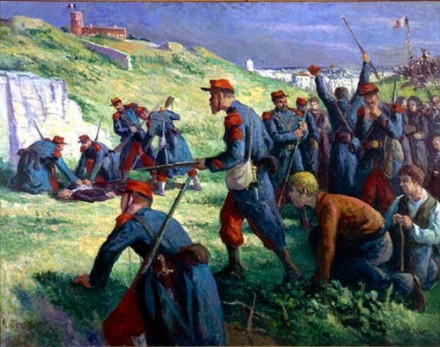

L’execution de Varlin, another Maximilien Luce scene.

Many at the stock exchange

According to the Paris Francais as quoted by this Marxist review of the events

It is at the Bourse that there was to-day the largest number of executions. The doomed men who attempted to resist were bound to the iron railing.

The stock exchange is “a fit place, to be sure, for this sort of business,” observes our interlocutor.

Eighty-plus defenders of Belleville, at the Arc de Triomphe

The London Times editorialized on May 31 upon this incident when the Marquis de Gallifet plucked from the mass of Belleville’s May 28 captives “eighty prisoners, principally soldiers of every arm, linesmen, artillerymen, and Zouaves, [who] were set apart and afterwards led to the right of the rampart to be shot.”

The French are filling up the darkest page in the book of their own or the world’s history. The charge of ruthless cruelty is no longer limited to one party or to one class of persons. The Versailles troops seem inclined to outdo the Communists in their lavishness of human blood. The Marquis de Gallifet is escorting a column of prisoners to Versailles or Satory. He “picks out eighty-two of them, and shoots them at the Arc de Triomphe.” Next came a lot of 20 firemen, then a dozen women, one aged 70. On another spot our Correspondent came upon “80 corpses, piled upon each other, a mass of arms and legs and distorted faces, while the roads and gutter literally flowed with blood.” About 1,000 are said to have thus suffered. By this wholesale and summary execution of prisoners in batches of 50 and 100, not only must the innocent perish with the guilty, but many must bear the penalty of imaginary guilt.

An utterly disconnected Englishman, according to the paper’s correspondent, was accidentally among the four score at the Arc, and only saved by the fortuitous intervention of a Belgian attache.

an English officer somehow got mixed up in the procession, and was forced to keep in it by the escort, who, out of 5,000 prisoners, could not, of course, be expected to recognize one innocent man … it so happened that some of the prisoners tried to escape, and to make an example the leader of the cavalry escort, the Marquis de Gallifet, a man who is not prone to err on the side of mercy, had then and there 81 shot, and the English officer was all but one of them, his explanations being at first refused the slightest attention. Human life has, in fact, become so cheap that a man is shot more readily than a dog.

Socialist physician Tony Moilin

One single fact was Tony Moilin reproached with: that of having on the 18th March taken possession of the mairie of his arrondissement, and having thus had a share in giving the signal for the insurrection …

The court-martial condescended to tell him that the fact of the mairie, the only one he could be reproached with, had in itself not much importance, and did not merit death, but that he was one of the chiefs of the Socialist party, dangerous through his talents, his character, and his influence over the masses; one of those men, in short, of whom a prudent and wise Government must rid itself when it finds a legitimate occasion to do so …

[A] respite of twelve hours was granted him in order that he might make his testament, write a few words of farewell to his father, and finally [marry his pregnant lover] … on the 28th May, in the morning, Tony Moilin was led into the garden a few steps from the palace and shot. His body, which his widow claimed, the surrender of which had been at first promised, was refused her. (History of the Commune of 1871)

The unnumbered dead of Lobau Barracks

Since morning a strong cordon is being formed round the theatre (Châtelet); where a court-martial is permanently established. From time to time one sees a band of fifteen to twenty individuals coming out, composed of National Guards, civilians, women and children fifteen to sixteen years old.

These individuals are condemned to death. They march two by two, escorted by a platoon of chasseurs, who lead and bring up the rear. This cortege goes up the Quai de Gevres and enters the Republican Barracks in the Place Lobau. A minute after one hears from within the fire of platoons and successive musketry discharges; it is the sentence of the court-martial which has just been executed.

The detachment of chasseurs returns to the Chatelet to fetch other prisoners. The crowd seems deeply impressed on hearing the noise of the shootings.

This is another publication’s story cited in the History of the Commune of 1871, which itself also details the court-martial procedures of this drumhead tribunal:

Thousands of prisoners who were led there were first of all penned in upon the stage and in the auditorium, under the guns of the soldiers placed in the boxes; then, little by little, like sheep driven to the door of the slaughter-house, from wing to wing they were pushed to the saloon, where, round a large table, officers of the army and the honest National Guard were seated, their sabres between their legs, cigars in their mouths. The examination lasted a quarter of a minute. ‘Did you take arms? Did you serve the Commune? Show your hands.’ If the resolute attitude of a prisoner betrayed a combatant, if his face was unpleasant, without asking for his name, his profession, without entering any note upon any register, he was classed. ‘You?’ was said to the next one, and so on to the end of the file, without excepting the women, children, and old men. When by a caprice a prisoner was spared, he was said to be ordinary, and reserved for Versailles. No one was liberated.

The classed ones were at once delivered to the executioners, who led them into the nearest garden or court. From the Châtelet, for instance, they were taken to the Lebau Barracks. There the doors were no sooner closed than the gendarmes fired, without even grouping their victims before a platoon. Some, only wounded, ran along by the walls, the gendarmes chasing and shooting at them till they fell dead. … There were so many victims, that the soldiers, tired out, were obliged to rest their guns actually against the sufferers. The wall of the terrace was covered with brains; the executioners waded through pools of blood.


Summary executions — death squads — continued for days or weeks afterwards in Paris; martial law throttled left organizing in the city; and those “fortunate” enough to have been captured alive were processed in a steady stream of judicial executions over the months yet to come.

The Commune, a palpably subversive example even in the present day, was destroyed in every way possible for the Versailles government. But its example could hardly be forgotten.

Marx would write The Civil War in France of the only proletarian revolution he would actually witness in his lifetime.

The next generation’s subversives also took inspiration from the Parisian example … and lessons from its mistakes. Lenin — a fond student of the Commune, who was eventually buried wrapped in a Communard banner — said that

two mistakes destroyed the fruits of the splendid victory. The proletariat stopped half-way: instead of setting about “expropriating the expropriators”, it allowed itself to be led astray by dreams of establishing a higher justice in the country united by a common national task; such institutions as the banks, for example, were not taken over … The second mistake was excessive magnanimity on the part of the proletariat: instead of destroying its enemies it sought to exert moral influence on them; it underestimated the significance of direct military operations in civil war, and instead of launching a resolute offensive against Versailles that would have crowned its victory in Paris, it tarried and gave the Versailles government time to gather the dark forces and prepare for the blood-soaked week of May.

“The lesson learnt by the proletariat will not be forgotten,” Lenin vowed, and his own revolution gained a vital object lesson in the Bloody Week of Paris, and an anthem besides: Communard Eugene Pottier, fleeing the Versailles army’s slaughter, wrote the verses that have been sung ever since by millions dreaming of a better world — the Internationale.

* Water can accelerate a fire, under the right circumstances.

On this day..

1831: Mariana de Pineda Muñoz, Spanish liberal

On this date in 1831, Mariana Pineda died for her flag.

The problem, in the eyes of feckless royal troglodyte Ferdinand VII, was that Pineda’s flag stood for “Equality, Freedom and Law.”

The widowed 27-year-old (English Wikipedia page | the much more detailed Spanish) had become a devotee of the liberal Zeitgeist that contended in post-Napoleonic Europe with absolutism.

Spain had had the briefest of flings with liberal government in 1812, only to have Ferdinand reverse Spain from one of the most progressive governments in Europe to one of its most backward. The man even reintroduced the Spanish Inquisition.

By the 1830’s, tensions between constitutional liberals and unreconstructed royalists had Spain on the point of civil war, which would in fact erupt upon Ferdinand’s death two years hence.

Mariana Pineda swam with liberal circles, even helping a death-sentenced cousin escape prison. In 1831, the authorities found a flag in her home embroidered with the “Equality, Freedom and Law” slogan.

Pineda refused to name accomplices, and Ferdinand threw the book at her. Pineda remained adamant.

Before suffering public garrotting in her native Granada (while the offending flag was burnt before her), Pineda declared,

“The memory of my ordeal will do more for our cause than all the flags in the world.”

Her prediction wasn’t so far off.

Pineda’s posthumous repute as heroine has migrated from the particular cause of her day to the general pantheon of Spain. These days, a Granada public holiday (festivities held in the square named in Pineda’s honor) commemorates her sacrifice. Her name is also a byword for the struggle of women to win full political participation (there’s a Centro Europeo de Las Mujeres “Mariana de Pineda”). And martyred playwright Federico García Lorca turned her story into a theatrical classic — his first successful play.

On this day..

1832: Samuel Sharpe, “I would rather die upon yonder gallows than live in slavery”

On this date in 1832, Jamaican national hero Samuel Sharpe died upon the gallows for instigating the slave revolt that would (help to) end slavery.

Samuel Sharpe, an educated slave who was also a Baptist deacon, was the moving spirit behind the attempted general strike that became the Christmas Rebellion.

That time of year was less than festive for Jamaica’s enormous slave population, for Saint Nick opened the short window for harvesting the island’s sugar cane.

Samuel Sharpe and collaborators had the wit to realize that being depended upon to bring in the cash crop that made life comfortable for their owners put the slaves’ hands upon a potent economic lever. In the last few days of 1831, they pressed it.

The “passive resistance” thing didn’t last long, however, and the “strike” transmuted into a rebellion — the cause swiftly taken up by thousands of slaves around the island who torched crops. Given the small (less than 20) white body count,* the “violence” appears to have been directed against the instruments, rather than the perpetrators, of their enslavement.

Not so the reprisals.

The rebellion was suppressed within days, and over 300 put to death for it (in addition to 200 slave casualties during the pacification itself). There’s an absorbing BBC Witness episode about this affair available as a podcast here.

Sharpe was the last of those executed.

But his revolt is widely thought to have given impetus to the British parliament’s deliberations over the ensuing months that ultimately led to the Slavery Abolition Act (1833).

What [abolitionist MP William] Wilberforce was endeavoring to win from the British senate by his magic eloquence the slaves themselves were endeavoring to gain by outbreaks and violence. The combined action of one and the other wrought out the final result. While one showed that slavery was wrong, the other showed that it was dangerous as well as wrong. Mr. Wilberforce, peace man though he was, and a model of piety, availed himself of this element to strengthen his case before the British Parliament, and warned the British government of the danger of continuing slavery in the West Indies. There is no doubt that the fear of the consequences, acting with a sense of the moral evil of slavery, led to its abolition. The spirit of freedom was abroad in the Islands. Insurrection for freedom kept the planters in a constant state of alarm and trepidation. A standing army was necessary to keep the slaves in their chains. This state of facts could not be without weight in deciding the question of freedom in these countries … I am aware that the insurrectionary movements of the slaves were held by many to be prejudicial to their cause. This is said now of such movements at the South. The answer is that abolition followed close on the heels of insurrection in the West Indies, and Virginia was never nearer emancipation than when General Turner kindled the fires of insurrection at Southampton.

–Frederick Douglass

Sharpe, today, is an official national hero of Jamaica. The place in Montego Bay that he hanged is known as Sam Sharpe Square, and his face adorns the currency.

* Contrast with the much smaller, much bloodier rebellion of Nat Turner in the U.S., which preceded the Christmas Rebellion by a few months.

On this day..

1946: Karl Hermann Frank

On this date in 1946, the Sudeten German whose fifth column had paved the way for the Nazi conquest of Czechoslovakia expiated his war crimes at Prague’s Pankrac Prison.

Karl Hermann Frank (English Wikipedia page | German) had been a prewar mover and shaker in the Sudeten German Party, increasingly the Reich’s stalking-horse as it bluffed European rivals into acceding to Czechoslovakia’s dismemberment.

The onetime Czechoslovakian MP did well by the Anschluss, gaining the rank of Obergruppenführer and becoming one of Bohemia and Moravia’s top evildoers.

Notably, he helped orchestrate (though the orders for it came from above) the notorious massacre of Lidice in revenge for the assassination of Reich Protector Reinhard Heydrich.

The Lidice operation formed a war crimes charge against Herr Frank after the war, and Frank’s own lasting badge of infamy: the systematic destruction of the entire male population of an arbitrarily chosen village remains the emblematic crime of the Nazi occupation to this day.

(Source of the video)

Thousands of spectators came to see the former “Protector of Bohemia and Moravia” executed in Prague’s Pankrac Prison by the Austro-Hungarian “pole hanging” method, as depicted in the film above.

Those of Lidice’s widows who were able to come — and widows of some of the 30,000 other Czechs for whose executions Frank had been adjudged indirectly responsible — occupied the second row of seats. …

Not the slightest gleam of compassion could be seen in that long row of unforgiving eyes as Frank, garbed in a ragged Nazi Elite Guard uniform, walked quietly between two guards. …

As the noose was adjusted about his neck, Frank muttered: “Deutschland wird leben auch wenn wir nicht leben” (“Germany will live even if we do not live.”)

The spectators, admitted by special cards, watched quietly in the bright sunshine. (New York Times)

On this day..