On this date in 1944, Dutch Resistance hero Boy Ecury was shot by the occupying Germans.
Ecury (English Wikipedia entry | Dutch) grew up in Oranjestad, capital of the Dutch-controlled Caribbean island of Aruba, but had packed off to the Netherlands to finish school by the time World War II broke out. He spent the early Forties with a Resistance group sabotaging German assets and the like.
This insurgent clique eventually got rolled up, and Boy Ecury was arrested on November 5, 1944. He had only that one night to enjoy the legendary hospitality of the occupiers before he and several others of his group were shot the next day.
The young martyr’s body was repatriated to Aruba after the war and buried with honors; a public memorial still stands to him in Oranjestad.
Boy’s sister, the venerable poet Nydia Ecury, just passed away earlier this year.
It was 2 Oct 1629, Dutchman Jeronimus Cornelisz was noosed along with 15 other men by the Dutch East Indies Company for a reign of terror that included mutiny and murder off the coast of Australia.* Six others would eventually hang in the infamous affair, two marooned on the Australian mainland, and many more punished for the gruesome atrocities committed on the Southern Ocean.
Cornelisz was not such an assuming character when he boarded the vessel Batavia in 1628.
Rather, he was a marginally failed merchant, someone who could buy his way on board as an under-merchant** and sail to the southern seas for the prospect of a new life. It has been speculated (here, for instance) that his move to Indonesia was motivated by a desire to put oceanic distances between himself — an apothecary who couldn’t make it in Haarlem — and prosecutors pursuing Anabaptists and other heretics. It didn’t help, either, that his infant child had recently died of the disgracing condition of syphilis. All that is enough to send a man to Indonesia, apparently.
Though Cornelisz was not a successful businessman, he was an energetic protagonist from his own station in life and could, eventually, win over any suggestible person with his intelligence and wit. It didn’t take long to do just that to the ship’s skipper, Ariaen Jacobsz — who already held a grudge against the Batavia‘s upper-merchant (and fleet commander), Francisco Pelsaert.
In due time their thoughts turned to the ship’s valuable cargo — silver and trade goods headed for the Mughal Empire. As night follows day, the next thoughts turned to mutiny.
Cornelisz pulled in people from each of the major groups onboard† to help with his mutiny without attracting the attention of the Pelsaert. All the plot needed was a kickstart to turn enough people against the commander.
In the part where the villain reveals his plot, Cornelisz’s goes like this: A group of hooded mutineers assaults the mostly widely lusted-after woman among the socialite passengers, Lucretia (Creesje) Jans; once the assault is reported, the commander must respond; but if the assailants are well-hidden, he must make an example arbitrarily, which pushes his men towards mutiny.
And, like a movie villain’s evil plot, Cornelisz’s didn’t come off.
The captain punished nobody for the assault, as Creesje could not identify the assailants. The shipboard mutiny withered on the vine. But lucky for Cornelisz, the captain had no inkling that the ship’s under-merchant was involved — though he was pretty sure the skipper and boatswain had something to do with it.
In the midst of those days of planned insurrection, the Batavia hit a slightly larger speed bump. On June 4, the vessel ran aground on Morning Reef.
There were few casualties from the initial crash, and the remainder escaped in groups, crammed onto small coral islands in the remote but plausibly survivable Houtman Abrolhos chain off the west coast of Australia.
The ship’s complement was eventually transferred to Beacon Island and Traitors Island — with limited water (but plenty of silver!), it was clear to Pelsaert there would be few people left if they didn’t get some help. Off went the captain with 47 crew and passengers in a longboat, leaving more than 250 behind to fend for themselves on the isles.
Two months later, Pelsaert found himself in the colonial city Batavia (today, the Indonesian capital Jakarta) appealing to the local authorities at the Dutch East Indies Company for a ship to rescue his stranded crew and passengers. He was quickly given the Sardam — another vessel in his fleet — with a skeleton crew to pick up the passengers (oh, and all that silver).
But he wasn’t going to need all those passenger quarters.
Cornelisz, as under-merchant, had technical rank in the emergency, and he had taken over the situation at the islands when the commander left. The refugee pharmacist reveled in the power, certainly amplified by the dozen chests of treasure the Batavia carried.
So here’s your motivation: a fortune in booty and the South Seas as your playground. This is the stuff of rum wishes and buccaneer dreams.
And Lord of the Flies nightmares.
Sensing the the time was ripe to lighten the group’s victual needs, Cornelisz‡ sent 15 men to search a larger island visible to the west for water. This journey, Cornelisz was convinced, would be fruitless, so any possible power rivals he could find went off. As well, Cornelisz shipped a larger group to Long Island to get more space.
And then began the killing.
Detail view (click for the full image) of a 1647 engraving of the carnage on Beacon Island. Cornelisz had a good 110 homicides on his soul’s account by the time it was all said and done.
Some 20 mutineers formed a tight inner circle with fantasies of having their way on the island until the rescue boat could be commandeered for piracy. The purpose of the killings was simply to knock the number of residents down closer to 40 or 45 so that the mutineers would be overwhelmingly dominant when the rescue boat came. That’s a tough task when starting with almost 200 people.
At first, killings proceeded under faux-juridical cover: theft and slander were enough to endanger everyone in these cramped quarters, so Cornelisz would have his men claim illegal activities were afoot and kill one or more of the people he considered either threats or non-entities among the group.
A few loyal footsoldiers did most of the killing, along with some pressed into service with the threat of violence; pretty soon the numbers on the island had dwindled noticeably.
With vague ideas of riches and a growing bloodlust, killing essentially became sport. Families were done to death wholesale, by whatever means were available — drowning, slitting throats, bludgeoning. Those liable to fight back might be jumped by a group at the beach, sometimes getting all of the above.
And before you go thinking murder was the only thing the mutineers had on their minds, they retained at least a few women (including Creesje) as private consorts.
Now is the time to mention that Cornelisz was personally acquainted with notorious (and then-imprisoned) degenerate artist Johannes van der Beeck. This is van der Beeck’s Faun and Nymphs.
But remember those doomed guys searching for water two islands over?
Turns out they found it, along with ample food, and they were now occupying the largest island in the chain.
They, along with 30 or so who escaped Cornelisz’s clutches over the course of two months, were the Resistance, and they were full of incriminating knowledge about what had been going down over on psycho isle.
One of the original group, Wiebbe Hayes, had taken charge of the island’s affairs, and he had done quite well. Those living on what is now known as West Wallabi Island were far better off than their Beacon counterparts.
Back on Beacon, Cornelisz was forced to ration water — even to his favorites — and had thoughts that the High Islanders might scupper his search party takeover plot. So late in July, he sent an amphibious landing team to attack High Island. Cornelisz’s men were met with a line of opposition at the beach, armed with pikes made of driftwood with nails. The mutineers retreated.
Weeks later, Assault II began; like most sequels, it fell on its face. Assault III, Cornelisz decided, should include cunning, cunning like an ostensible negotiation to trade the clothing Cornelisz had hoarded for water and food.
Hayes was even a little more cunning that that, and when Cornelisz and his four top lieutenants came ashore and began sweet-talking, he and his men seized four of them. (The fifth, Wouter Loos, escaped.)
Knowing that having mutineers on his island would be trouble, Hayes convened his council, which swiftly decided to dispatch any prisoner not named Jeronimus: that one was tossed in a pit and given birds to pluck for Hayes’ army.
Two weeks went by before the mutineers (now led by Loos) got up the courage to attack again, but by the time they took to the channels and began a long-range gun assault, the Sardam was in the archipelago. Hayes got to Pelsaert first and informed him of the planned mutiny. Pelsaert trained all his weapons on the mutineers’ boat until they decided to disarm.
The trials were done in the Dutch way, including some amount of torture. Pelsaert finally decided he had enough evidence against the mutineers, and his small tribunal passed 16 death sentences. (One was commuted to exile.) That included a half dozen who had one or more hands lopped off before their passage to the gallows.
Detail view (click for the full image) of the mutineers’ execution.
Three weeks later, when the Sardam returned to Batavia, five more of the rescued mutineers were executed, and a sixth — the boatswain involved in the assault on Creesje — was put to death while Pelsaert was out.
Once word got out, Cornelisz’s heinous crimes were known around the world and Southern sailors heard the tales for hundreds of years to come.
Pelsaert, meanwhile, was partly blamed for the incident and saw the Company seize his assets: he was dead within a year. As for Hayes, he was promoted, but his further adventures are unknown.
The remains of the shipwreck that commenced this hecatomb are still visible at Houtman Abrolhos, from cannons off the original Batavia to the fort built by Wiebbe Hayes and his men — everyday monuments to a hellish ordeal.
* Technically the first European settlers in Australia.
** Dutch merchant vessels were headed by an upper-merchant, who had control over decisions on the ship and represented the overriding interest of the Dutch United East India Company. In addition, an under-merchant was taken aboard as his second-in-command Company man. The skipper was considered head of the crew and placed in charge of navigational concerns, but his role was subordinate to the upper-merchant.
† Like all Dutch merchant vessels, the Batavia featured four major classes of people on board:
a standard crew to run the vessel;
a complement of soldiers who were generally kept below-decks but could be recruited to maintain order and would disembark at the destination;
a group which tended to shipboard needs (surgeon, cook, and so on);
and merchants and passengers, who had social standing over the rest.
‡ Technically, Cornelisz was part of a three-member council in charge of the shipwrecked. The initial council was selected from among the socially significant survivors, but Cornelisz used his rank to quickly dissolve that group and appoint two of his own future mutineers as his cohorts. Needless to say, the judiciary wasn’t independent after that.
Like everyone else on that parchment, they were in a world of hurt when Oliver Cromwell died and Charles II returned to the throne. And like a great many of those who figured to reap the whirlwind, they sensibly fled the realm.
Had they stayed hunkered down in Germany, they might have died in their beds.
Instead, they trusted a friend … and died half-hanged, emasculated, disemboweled, and chopped to pieces on a scaffold.
It was an ugly sight from start to finish. The capture of these fugitives was a dirty business mixing treachery, diplomatic subterfuge, and dubious legality, all in the service of violent statecraft. Sort of like it was ripped from the Downing Street memo.
This guy was coming into the prime of his continent- and polity-spanning career: from Puritan New England, to the West Indies, to a gig in Cromwell’s army during the English Civil War. (It was John Okey himself who hooked Downing up: Downing matriculated with Harvard University’s first graduating class thanks to Okey’s sponsorship, and it was in Okey’s regiment that Downing was retained as chaplain.)
An able diplomat for the Protectorate, Downing was able to communicate his discreet abjuration to the exiled Charles II once the handwriting was on the wall, and he therefore effected a convenient volte-face and went right to work for the new boss … even when it meant hunting down his own friends and patrons. You might say it was the zeal of the converted, but maybe it was better-expressed by Downing’s own pledge to secure the refugees with vigor “as much as if my life lay at stake in the busines.”
Sound policy, considering his history. And he couldn’t have pulled it off with an ounce less.
Officially, the Low Countries had agreed not to give refuge to regicides: in reality, regicides could rest pretty easy there. Pro-immigrant, pro-Protestant,* and jealous of their sovereignty, the Dutch had little desire to enforce such clauses at any level of government; and, thanks to a federal structure, multiple state organs each held effective veto over enforcement. Moreover, a silly legalistic fetish required that fugitivies have warrants sworn out against them — warrants that would cause regicides’ many friends and sympathizers to raise the alarm before the target could be taken, which is exactly what happened when Downing tried to get Edward Dendy arrested in Rotterdam.
Downing cogitated all manner of extra-legal options to black-bag a few of the Protectorate personnel for his Majesty’s pleasure. What he ended up with was cunning, vicious, and just barely legitimate.
Turning one of the regicides’ contacts with threats and bribery, he secured advance warning of Barkstead, Corbet, and Okey’s planned visit to Delft in early March 1662. He then waited until the very day he planned to spring his trap to procure a general arrest warrant (concealing the names of his prey) from the Estates General’s capable leader Johan de Witt, and pounced within hours — using a force of his own men and a little more payola to circumvent the inevitable reluctance of the local bailiffs.
Now that the regicides were in irons, Downing had to double down on duplicitous diplomacy by maneuvering to get them delivered to the English — and that against a growing popular resistance as their capture became known. The Delft aldermen dilated; sympathetic local worthies visited the prisoners in their cells; petitions on the Englishmen’s behalf circulated nationwide. The notion of actually marching these guys out into English hands seemed to promise a riot.
Downing spread more palm grease around, maneuvered to frustrate legal aid for the prisoners, posted his own men to watch the prisoners 24-7, and after several tense days finally made arrangements
in the dead of the night to get a boate into a litle channell which came neare behinde the prison, and at the very first dawning of the day without so much as giving any notice to the seamen I had provided … forthwith to slip them downe the backstaires … and so accordingly we did, and there was not the least notice in the Towne thereof, and before 5 in the morning the boate was without the Porto of Delft, where I delivered them to Mr. Armerer … giving him direction not to put them a shoare in any place, but to go the whole way by water to the Blackamore Frigat at Helverdsluice.
Downing was exultant.
“This is a thing the like thereof hath not been done in this country and which nobody believed was possible to be done,” he gloated in his correspondence. “And there is not a thing that hath happened these many yeares that hath occasioned so much discourse here, saying that they are now no longer a free Countrey, and that no man is now sure here.” De Witt and the Dutch Estates General, having never had any intention to actually deliver a regicide to condign punishment in England, had been embarrassingly played. Ordinary Hollanders were infuriated and ashamed at having been a party to the whole business.
Nobody could dispute the excellence of Downing’s operation. But anybody on either side of the channel who wasn’t a dyed-in-the-wool Royalist was somewhere between discomfited and revolted by it, especially as it was achieved against his own personal benefactor by a guy who had once urged Cromwell to make himself king.
Diarist Samuel Pepys (who witnessed the executions, reporting the victims “very cheerful” on that occasion) recorded the mood of the English burgher upon the news
that Sir G. Downing (like a perfidious rogue, though the action is good and of service to the King, yet he cannot with a good conscience do it) hath taken Okey, Corbet, and Barkestead … all the world takes notice of him for a most ungrateful villaine for his pains. (Pepys’s March 12 and March 17 entries for this year)
See: Ralph C.H. Catterall, “Sir George Downing and the Regicides,” The American Historical Review, Vol. 17, No. 2 (Jan., 1912)
* Dutch affinity for religious dissent and for foreigners was all of a piece with its prosperous mercantile empire. One liberal Englishman (quoted by James Walker in “The English Exiles in Holland during the Reigns of Charles II and James II,” Transactions of the Royal Historical Society, Fourth Series, Vol. 30 (1948)) proposed that “Liberty of Conscience would be a more serious blow to Holland than all the victories yet gained.”
Art history footnote: notice that the cadaver’s navel is a stylized “R”: the artist was playing around with his signatures during this period. Also, note the hand under dissection. The scene was actually re-enacted in 2006 to establish that Rembrandt’s done the forearm tendons incorrectly — it does look wonky. Additionally, the very fact that the anatomist is beginning with the arm rather than the usual trunk has led to speculation over whether this was an artistic choice or the doctor’s actual procedure in the thrall of a temporary medical vogue.
The 25-year-old painter had only moved to Amsterdam at the end of the previous year.
He broke through almost immediately with a commission — it was his first major group portrait and it would become known as his first major masterpiece (source), instantly establishing his preeminence in the city’s art scene — from the Amsterdam Guild of Surgeons to render one of its most important events: the annual public dissection of a criminal.**
Prior to the systematic medicalization of the corpse, when anatomizing a human was still a fraught and transgressive act, Netherlands cities were permitted only one such exposition per year. Its subject could only be a male criminal who would be given a Christian burial thereafter. (Contrary to the English model, posthumous dissection was not used to intensify a death sentence with a further terror.)
The affair would have been crowded not only with other doctors but city council members, intellectuals, and well-dressed respectable burghers. Anyone, in short, who was anyone (they paid for the privilege).
And, of course, its overseer, Nicolaes Tulp; Rembrandt’s framing will leave you no doubt as to which figure in the painting is in charge. The city’s most respected surgeon, Tulp was the Guild’s Praelector Anatomiae, “reader in anatomy”, dignified with the responsibility of publicly lecturing on the unfolding dissection.
The silent but essential final party was Aris Kindt, the alias of a Leiden†-born criminal around Rembrandt’s own age named Adriann Adriannsz. His life was forfeit as a recidivist thief who had lately mugged a gentleman for his cloak.
This common crook’s ghastly lifeless image‡ is more alive for us in posterity than nearly any of his more law-abiding contemporaries. The expressive composition surrounding him is pregnant with all of the moment’s paradoxes: the advance of humanism on the back of a cruel penal regime; the exaltation of the mind with the unsentimental commodification of the flesh; excellence and status bowing over that old emblem of mankind’s final equality in the tomb.
Evil men, who did harm when alive, do good after their deaths:
Health seeks advantages from Death itself.
Rembrandt must have agreed: he painted the Guild’s criminal dissection again in 1656.
* Some sources give January 16, 1632 for the execution. This possibility appears to me to be disbarred by the apparent January 17 dating of a Rembrandt portrait of Marten Looten; indeed, confusion over this Rembrandt-related January date may even be the ultimate source of the misattribution, if January 16 is indeed mistaken. Scholarly sources overwhelmingly prefer the 31st, apparently from primary documentation that both the hanging and a Tulp lecture took place on that date. (See, e.g., the out-of-print seminal academic work.)
** The 17th century Dutch left a number of similar “anatomy lesson” works. That same Amsterdam guild commissioned a new one every few years as part of its keeping up appearances; the last had been a 1619 portrait from Nicolaes Eliaszoon Pickenoy, The Osteology Lesson of Dr Sebastiaen Egbertsz.
† Speaking of Leiden: see this pdf thesis for a very detailed excursion into the anatomizing scene as practiced in that city.
‡ Needless to say, we can hardly presume that this painting is strictly representational. Still, this is Kindt for us, even if Kindt looked nothing like the fellow being taken apart.
One was the Sun King, Louis XIV of France, whose decades-long rivalry with William tracked William’s interesting career all the way to the throne of England.
William III, equestrian. Consider yourself foreshadowed.
Another was Sir John Fenwick, an English nobleman whom William supposedly slagged* when they were fighting together in the Low Countries — and who likewise still carried the enmity when William had become his sovereign.
On this date in 1697, the latter rivalry came to a fatal end for John Fenwick on the headsman’s block. The funny thing was that the stroke turned out to cost King William III his own life as well.
You couldn’t say that Fenwick came late to the Jacobite cause; he’d been a strong adherent of the beleaguered Catholic-esque Stuart dynasty, and signed off on the 1685 execution of its previous Protestant challenger Monmouth.
But if it prosper, none dare call it treason. In 1688, the Low Countries prince with the low estimation of Baronet Fenwick hopped the channel and successfully overthrew the last Stuart monarchking James II.
With the Glorious Revolution, Fenwick’s personal and political were very conveniently aligned in loyalty to the exiled James … except that his formerly patriotic loyalty to James was now the traitorous cause of Jacobitism.
Fenwick kept up his Jacobiting in the 1690s, got arrested and released once, and then finally found himself implicated in a plot to murder William. Though his allies managed to spirit one of the potential witnesses against him away to the continent, Parliament passed — ever so narrowly — a bill of attainder to condemn Fenwick to death. (There’s a more detailed account of the legal and political maneuverings here and here.)
A failed assassin in life, Fenwick would blunder Gavrilo Princip-like into accidental success … but only after his own execution.
As a condemned traitor, Fenwick’s estate was seized by the crown, and the king personally claimed his prey’s equine ride (either a horse with a sorrel coat, or a horse named Sorrel, or both).** Not long after Fenwick’s death, this horse stumbled on a molehill, throwing its royal rider. William broke his collarbone in the accident, developed pneumonia, and died — leading Jacobite sympathizers to dote on the animals (both horse and mole) who had authored their enemy’s misfortune.
Illustrious steed, doubtless most worthy of the sky,
To whom the lion, bull, and bear would give place;
What happy meadows bore thee happily?
What happy mother gave you her nutritious teats?
Is it from the land of Erin you are come to oblige your country,
Or is it Glenco or the Fenwick race which produced you?
Whoever thou art, mayst thou prosper, I pray memorable one: and
May saddle never more press thy back, nor bit thy mouth.
Avenger of the human race, when the tyrant dies,
Mayst thou thyself enjoy the liberty thou wilt give to others.
A lovely sorrel enjoys the liberty of a happy meadow. (Nutritious teats not pictured.) (cc) image from SMALLORBIGOFMEN.
* During the Dutch campaign, William “had reflected very severely upon his [Fenwick’s] courage, which occasioned his making returns that provoked the Prince to say, that if he had been a private person he must have cut Sir John’s throat.” Just your basic primate poo-flinging.
** Leaving aside his ultimate fate, quite an understandable move by William: the Fenwicks were famous for their horse husbandry.
On this date in 1635, Domingos Fernandes Calabar was garroted at Porto Calvo.
A mulatto plantation owner, Calabar (Portuguese Wikipedia page) did his patriotic duty according to the dictates of Brazil’s Portuguese colonizers when an expansionist Netherlands showed up hungry for a bite of Brazil.
But after rounding up a volunteer militia and helping repel Dutch incursions in 1630 and 1632, Calabar switched sides and joined Holland.
Why he switched sides remains permanently obscure. Popular explanations include: the seductions of Netherlander lucre (Calabar’s detractors like this one); a politically mature calculation that the Dutch would make more progressive colonizers than the Portuguese (this was Calabar’s own defense: “I spilled my blood for … the slavery of my homeland … With its actions, the Dutch have proven better than the Portuguese and Spanish”);* or … somewhere in between
He was rewarded for his devotion [to the Portuguese] by the contempt of his countrymen, who were envious of his prowess. Wounded by this conduct, he left the Portuguese and joined the Dutch.
Whatever the reason(s) for it, Calabar’s switch was efficacious: he knew the lay of the land, and he was vigorous in helping the Dutch foothold of “New Holland” expand. The Dutch commissioned him a Major, and he gained a reputation for his ambushes.
I never met a man so well-adapted to our purposes … the greatest damage he could cause to his countrymen, was his greatest joy.
-English mercenary in the Dutch service
The Portuguese official Matias de Albuquerque eventually turned the tables and captured Calabar in a Portuguese ambush. He not only had the disloyal subject strangled, but quartered the body for public display.
This gruesome warning against collaboration did not prevent New Holland from growing to around half the Brazilian territory … but since Brazilians don’t speak Dutch today, you might have an idea how this is going to end.
After “New Holland” was re-conquered and re-re-conquered, the Dutch Republic under Johan de Witt — preferring a commercial empire to a territorial one — gave up its untenable position in exchange for 63 tons of gold.
As the (eventual) winners of this imperial affray, the Portuguese wrote a distinctly unflattering history of Domingos Fernandes Calabar, the disreputable traitor. He’s a sort of Benedict Arnold character synonymous with disloyalty for any Brazilian schoolchild.
But other interpretations are available.
During Brazil’s Cold War military dictatorship, when traitorousness might seem downright reputable after all, the “official version” was slyly subverted in several different stage productions, the best-known of which is a musical called Calabar: In Praise of Treason.**
Most of the information about Calabar online is in Portuguese; for instance, biographies here and here.
* Let it not be implied that the Dutch were out for anything other than the plunder of empire themselves: Calabar’s own home region of Pernambuco was desirable precisely because of its sugar cane cultivation.
Incidentally, the vicissitudes of war enabled many African slaves to escape to Maroon communities like Palmares — just a few miles away from Porto Calvo.
** See Severino Jaão Albuquerque, “In Praise of Treason: Three Contemporary Versions of Calabar,” Hispania, Sept. 1991. “Less interested in settling the issue of Calabar’s martyrdom than in provoking serious debate about the meaning of loyalty and national identity in times of political repression and in the context of a dependent culture, these plays … bring to the fore the manifold ambiguities the colonized face reacting to the hegemonic rule of the colonizer.”
On this date in 1714, a slave and his mistress — “mistress” in both senses of the word — were put to death in the Dutch Cape Colony for murdering her husband.
A decade and a half’s passage finds her a young woman wed to one Franz or Frans Joost/Jooste/Joostens, to whom she bore two sons … and, evidently, a homicidal grudge.
Early in 1714, Maria and her lover, a slave named Titus Bengale, murdered Frans, in consequence of which crime,
[s]he [Maria] is sentenced to be half strangled, after that to be scorched,* and after that strangled unto death. Titus to be empaled and to remain so, until death. After that his head and right hand are to be cut off and fixed on a pole, beyond the limits of his late master’s property. Fortuin, an accomplice, is also to have his right hand cut off, and without receiving the coup de grace, is to be broken on the wheel. After that he is to be placed on a grating until death takes place. After that his head is to be cut off, and with his hand placed on a pole, together with the head and hand of Titus. After that the bodies are to be taken to the outside place of execution, and there left exposed to the air and the vultures.
She’s the only white woman to be executed in 18th century South Africa.
September 3 — The slave Titus, above mentioned, died about midday, having lived in his misery about 48 hours; something horrible to think of, to say nothing of personally beholding the misery. It is said that 4 hours after his empalement he received a bottle of arrack from which he drank freely and heartily. When advised not to take too much, lest he should get drunk, he answered that it did not matter, as he sat fast enough, and that there was no fear of his falling. It is true that whilst sitting in that deplorable state, he often joked, and scoffingly said that he would never again believe a woman. A way of dying, lauded by the Romans, but damnable among the Christians.
* Literally, blaker. “To ‘blaker’ someone,” notes Nigel Penn in “The wife, the farmer and the farmer’s slaves: adultery and murder on a frontier farm in the early eighteenth century Cape,” Kronos, vol. 28 (2002), “was to hold burning straw to their face and to blacken it … a reference to the earlier practice of burning at the stake victims found guilty of heresy, witchcraft and sodomy. Surely we may also see, in the case of the blackening of Maria Mouton, a reference to her crime of cohabiting with slaves.”
** After another slaveowner was murdered later in the year, the chronicle laments that “crime is rapidly assuming large dimensions, in spite of the means used to prevent or suppress it. A clear proof that this Colony mainly consists of evil disposed, head-strong slaves and the refuse of convicts.”
On the 20th of August, 1672, the city of the Hague, always so lively, so neat, and so trim that one might believe every day to be Sunday, with its shady park, with its tall trees, spreading over its Gothic houses, with its canals like large mirrors, in which its steeples and its almost Eastern cupolas are reflected,–the city of the Hague, the capital of the Seven United Provinces, was swelling in all its arteries with a black and red stream of hurried, panting, and restless citizens, who, with their knives in their girdles, muskets on their shoulders, or sticks in their hands, were pushing on to the Buytenhof, a terrible prison, the grated windows of which are still shown, where, on the charge of attempted murder preferred against him by the surgeon Tyckelaer, Cornelius de Witt, the brother of the Grand Pensionary of Holland was confined.
…
the whole town was crowding towards the Buytenhof, to witness the departure of Cornelius de Witt from prison, as he was going to exile; and to see what traces the torture of the rack had left on the noble frame of the man who knew his Horace so well.
Yet all this multitude was not crowding to the Buytenhof with the innocent view of merely feasting their eyes with the spectacle; there were many who went there to play an active part in it, and to take upon themselves an office which they conceived had been badly filled,–that of the executioner.
There were, indeed, others with less hostile intentions. All that they cared for was the spectacle, always so attractive to the mob, whose instinctive pride is flattered by it,–the sight of greatness hurled down into the dust.
That ominous mob got its spectacle this date in 1672, lynching the Dutch Republic’s longtime de facto head of state, Johan de Witt along with his brother Cornelis/Cornelius.
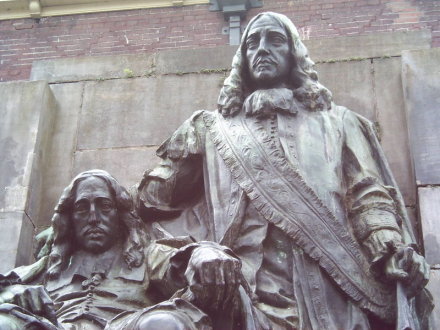
A statue of Johan (standing) and Cornelis de Witt in their native Dordrecht.
The mercantile powerhouse that was the 17th century Dutch Republic was the stage for a long-running conflict between the Orange monarchists (hence the soccer uniforms) and the Republican merchant class.
With the sudden death of the young William II, Prince of Orange in 1650, leaving the (non-hereditary) executive office of stadtholder vacant, the Republicans became ascendant.
And the outstanding figure of the First Stadtholderless Period was Johan de Witt, scion of a Dordrecht merchant family powerful enough that William II had imprisoned de Witt’s own father during a power struggle.
While all these guys were landing themselves in their respective canons, Johan de Witt was trying to keep the age Golden.
Having only relatively recently broken free of Spain, the small country was an up-and-comer on the horns of a serious security dilemma: its leading commercial position put it into maritime competition with England, while its continental location made it vulnerable to the enormous army of the neighboring continental hegemon, France. Ultimately, even with its trade wealth, it did not have the resources to keep up with both of western Europe’s leading powers.
For a generation, de Witt’s statecraft kept the men of the Low Countries out of that predicament, while his brother Cornelis chipped in with a couple of timely naval victories. (Actually authored by Michiel de Ruyter, but Cornelis rode shotgun.)
In 1654, Johan brought the First Anglo-Dutch War to a close, making with Oliver Cromwell a secret pact he was only too happy to enforce never to allow William II’s son, the eventual William III, to be named stadtholder. Reason being: William III was the grandson of the Stuart king Cromwell beheaded, Charles I, and thus a potential claimant to the English throne. Both Protestant Republics had a distinct interest in keeping this monarchist well away from power. (Both would be sorely disappointed.)
A decade and a Stuart Restoration later, de Witt maintained (mostly) Dutch dominance of the seas in the Second Anglo-Dutch War, then held off France (with the help of a timely alliance with the recent adversary, England) in the War of Devolution.
In each case, he kept at least one of England or France on the sideline, or in his own camp.
But the Third Anglo-Dutch War was the charm — as it was also the Franco-Dutch War, and therefore 1672 was Rampjaar: disaster year. While the Dutch were aces on the waves, a massive French invasion easily overwhelmed them on terra firma.
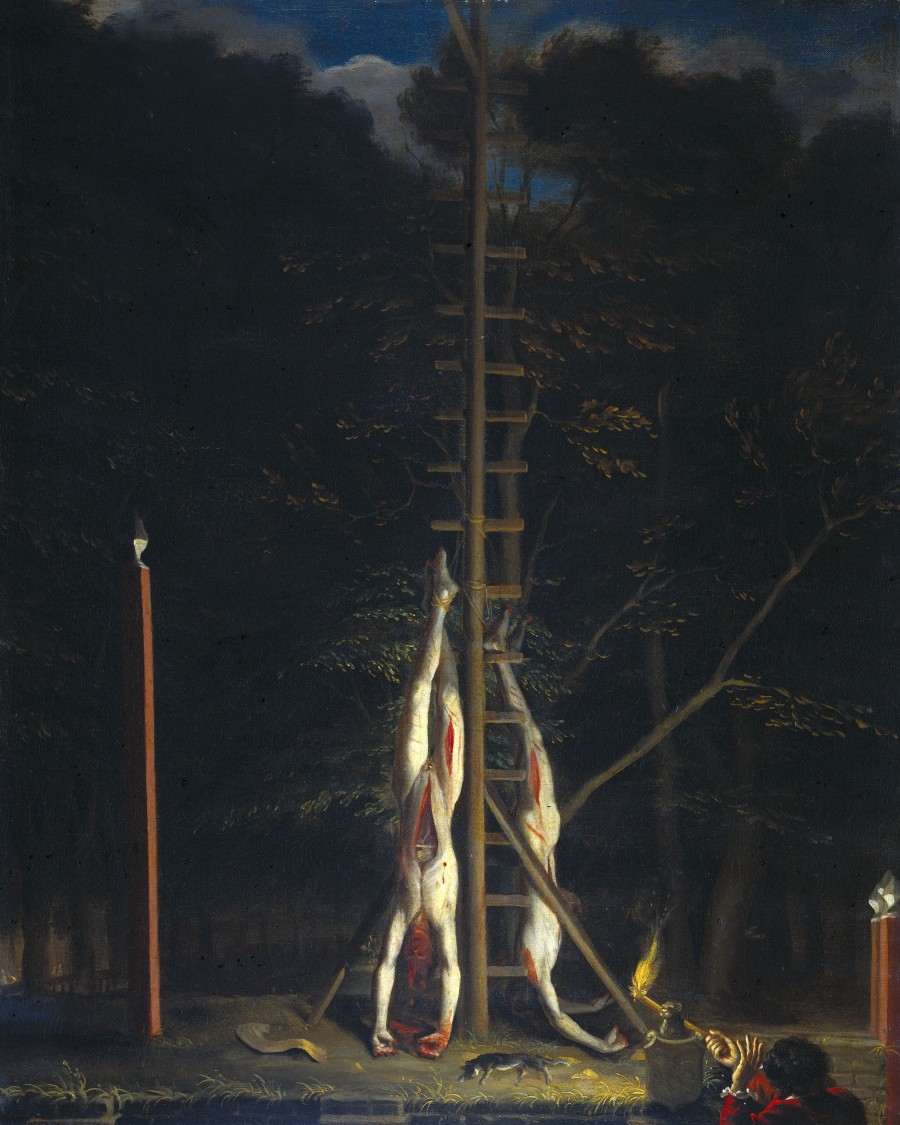
Detail view (click for the full image) of a grisly painting of the mutilated de Witt brothers strung up at The Hague. It’s attributed to Jan de Baen, who in better times took Johan de Witt’s portrait.
De Witt’s never-beloved mercantile oligarchy speedily collapsed with the military reverses, and the now all-grown-up William III was there to pick up the pieces to popular acclaim. Arrested for treason, Cornelis sustained torture without confessing, but when Johan visited him in prison — and William III incriminatingly withdrew the cavalry protecting the brothers — the mob quenched its fury with the de Witts’ blood.
every one of the miscreants, emboldened by his [Johan’s] fall, wanted to fire his gun at him, or strike him with blows of the sledge-hammer, or stab him with a knife or swords, every one wanted to draw a drop of blood from the fallen hero, and tear off a shred from his garments.
And after having mangled, and torn, and completely stripped the two brothers, the mob dragged their naked and bloody bodies to an extemporised gibbet, where amateur executioners hung them up by the feet.
Then came the most dastardly scoundrels of all, who not having dared to strike the living flesh, cut the dead in pieces, and then went about the town selling small slices of the bodies of John and Cornelius at ten sous a piece.
-Dumas
The word “ungrateful” comes to mind.
De Witt stood altogether on a lower plane than Cromwell. We regard him rather as a man of rare and singular talent, than as one of the chosen great ones of the earth, which Cromwell was. He stands far above the common run of men; and he was head and shoulders above nearly all the notable men of his time. He would have been greater if the movement of his limbs had been less burdened with the Dutch governing apparatus … He is not one whom the world can ever greatly admire or love.
(Here’s another, and here’s a 17th century volume de Witt himself coauthored.)
The rise of William III came with the decline of that Dutch Golden Age: the country fended off the immediate military threat, but it increasingly slipped behind its larger neighbors. Costly as was the Franco-Dutch War, it is a step on the path towards the present-day Europe, and this gives us enough excuse to notice that the Eurovision lead-in tune is actually from a Te Deum composed to mark its end.
But William’s own ascent to this wealthy sovereignty was just the beginning for him. Sixteen years later, the House of Orange’s champion vindicated Cromwell’s trepidation about him and gained a far more satisfactory position from which to do battle with his Gallic rival Louis XIV by stunningly overthrowing the Stuart dynasty and becoming King of England in the Glorious Revolution.**
* The Dutch remained the sole western contact of closed Japan until 1854, which is why Japan’s eventual period of scientific advancement became known as ‘Dutch Learning’.
** Albion did not forget the de Witts, either: according to this 1785 cant dictionary, the term “dewitted” had a 17th-18th century run in English to denote — well, exactly what happened to Cornelis and Johan.
Dutch-born and of Scottish descent, Stedman was a soldier who volunteered to serve in the West Indies and found himself in Suriname fighting those “revolted negroes” — Maroons fled from slavery who had established independent communities and episodically (most of the 1770s were one such episode) fought the white colonies.
Maroon settlements in Suriname still pesist to this day.
Though that was Stedman’s business on the Caribbean coast of South America, the culprits whose deaths he witnessed today were not among the “revolted”, but more prosaic criminal fare. Prosaic, that is, until Neptune’s insouciantly comedic discourse in the midst of the most appalling torture.
Stedman sets the scene for us with the more everyday depravities prevailing in the colonial capital, Paramaribo
If, as I have just mentioned, cruelties were become less common in the rivers by the rebels, barbarities still continued in a shocking degree in the metropolis; where my ears were deafened with the clang of the whip, and the shrieks of the negroes. Among the most eminent of these tyrants was a Miss Sp—n,who lived next door to Mr. de Graav, and who I saw with horror from my window give orders that a young black woman should be flogged principally across the breasts, at which she seemed to enjoy peculiar satisfaction. To dissipate the impression this scene had left on my mind, I got into a whiskey, and rode out; when the first thing I saw was a negro girl fall naked from a garret window on a heap of broken bottles: this was indeed an accident, but she was so mangled, though not dead, that she exhibited a spectacle nearly as wretched as the other.—Cursing my unlucky fate, I turned the horses, and drove to the beach, as the only place to avoid every scene of cruelty and misery; but here I had the mortification to see two Philadelphia sailors (while they were fighting on the forecastle of their vessel) both fall over the ship’s bow into the stream, where they sunk, and were no more seen. On board another American brig, I discovered a little tar defending himself from the cross-trees with a hatchet, against a serjeant and four armed men, for a considerable time; till they threatening to shoot him out of the rigging, he at last surrendered, and being brought ashore, was dragged to Fort Zelandia, in company with two others, by a file of musketeers, where, for having been drunk on duty, they received a fire-cant each, at the captain’s request; that is, they were bastinadoed or beaten on the shoulders by two corporals with bamboo canes, till their backs were black, and swelled like a cushion. However arbitrary this mode of correction, the captain endeavoured to explain the necessity of it; the private American sailors being of a turbulent spirit indeed when drunk, although when sober they may be fairly classed among the best seamen in the world.
But the narrator is just getting warmed up, and after a good night’s sleep …
Early the next morning, while musing on all the different dangers and chastisements to which the lower class of people are exposed, I heard a crowd pass under my window. Curiosity made me start up, dress in a hurry, and follow them: when I discovered three negroes in chains, surrounded by a guard, going to be executed in the savannah. Their undaunted look, however averse I may be to the sight of cruelties, so attracted my attention, as to determine me to see the result, which was thus:— The sentence being read in Low Dutch (which they did not understand) one was condemned to be flogged below the gallows, and his accomplice to have his head struck off with an axe, for having shot a slave who had come to steal plantains on the estate of his mistress. The truth however was, that this had been done by that lady’s absolute command; but the murder being discovered, she, in the hopes of saving her character, besides the expence of paying the penalties, gave up her valuable slave, and permitted the unhappy man to be thus sacrificed. He laid his head upon the block with great indifference, stretching out his neck; when, with one blow of the axe, it was severed from his body.
The third negro, whose name was Neptune, was no slave, but his own master, and a carpenter by trade; he was young and handsome, but having killed the overseer of the estate Altona, in the Para Creek, in consequence of some dispute, he justly forfeited his life. The particulars, however, are worth relating: This man having stolen a sheep, to entertain a favourite young woman, the overseer, who burnt with jealousy, had determined to see him hanged; to prevent which, the negro shot him dead among the sugar canes; for these offences of course he was sentenced to be broken alive upon the rack, without the benefit of the coup de grace or mercy-stroke. Informed of the dreadful sentence, he composedly laid himself down on his back on a strong cross, on which, with arms and legs expanded, he was fastened by ropes: the executioner, also a black man, having now with a hatchet chopped off his left hand, next took up a heavy iron bar, with which, by repeated blows, he broke his bones to shivers, till the marrow, blood, and splinters flew about the field; but the prisoner never uttered a groan nor a sigh. The ropes being next unlashed, I imagined him dead, and felt happy; till the magistrates stirring to depart, he writhed himself from the cross, when he fell on the grass, and damned them all, as a set of barbarous rascals; at the same time removing his right hand by the help of his” teeth, he rested his head on part of the timber, and asked the by-standers for a pipe of tobacco, which was infamously answered by kicking and spitting on him; till I, with some American seamen, thought proper to prevent it. He then begged that his head might be chopped off; but to no purpose. At last, seeing no end to his misery, he declared, “that though he had deserved death, he had “not expected to die so many deaths: however, (said he) you christians have missed your aim at last, and I now care not, were I to remain thus one month longer.” After which he sung two extempore songs (with a clear voice) the subjects of which were, to bid adieu to his living friends, and to acquaint his deceased relations that in a very little time he should be with them, to enjoy their company for ever in a better place. This done, he calmly entered into conversation with some gentlemen concerning his trial; relating every particular with uncommon tranquillity—”But,” said he abruptly, “by the sun it must be eight o’clock; and by any longer discourse I should be sorry to be the cause of your losing your breakfast.” Then, casting his eyes on a Jew, whose name was De Vries, “A-propos, sir,” said he, “won’t you please to pay me the ten shillings you owe me ?” — “For what to do ?” — “To buy meat and drink, to be sure—don’t you perceive I am to be kept alive?” Which speech, on seeing the Jew stare like a fool, this mangled wretch accompanied with a loud and hearty laugh. Next, observing the soldier that stood sentinel over him biting occasionally on a piece of dry bread, he asked him ” how it came to pass, that he, a white man, should have no meat to eat along with it ?” — ” Because I am not so rich,” answered the soldier. — “Then I will make you a present, sir,” said the negro; “first, pick my hand that was chopped off clean to the bones, next begin to devour my body, till you are glutted; when you will have both bread and meat, as best becomes you;” which piece of humour was followed by a second laugh; and thus he continued, until I left him, which was about three hours after the dreadful execution.
Wonderful it is indeed, that human nature should be able to endure so much torture, which assuredly could only be supported by a mixture of rage, contempt, pride, and the glory of braving his tormentors, from whom he was so soon to escape. [ here a footnote is marked in the original text, whose content is: “At Demerary, so late as October, 1789, thirty-two wretches were executed in three days, sixteen of whom suffered in the manner just described, with no less fortitude, and without uttering one single complaint.” -ed. ]
Though I never recal to my remembrance, without the most painful sensation, this horrid scene, which must revolt the feelings of all who have one spark of humanity, I cannot forbear exhibiting to the public the dreadful spectacle in the annexed drawing.
Detail view of William Blake‘s illustration of Neptune’s breaking on the rack. (Click for full image.)
If the reader, however, should be offended with this shocking exhibition, and my dwelling so long on this unpleasant subject, let it be some relief to his reflection, to consider this punishment not inflicted as a wanton and unprovoked act of cruelty, but as the extreme severity of the Surinam laws, on a desperate wretch, suffering as an example to others for complicated crimes; while at the same time it cannot but give me, and I hope many others, some consolation to reflect that the above barbarous mode of punishment was hitherto never put in practice in the British colonies.
I must now relate an incident, which, as it had a momentary effect on my imagination, might have had a lasting one on some who had not investigated the real cause of it, and which it gave me no small satisfaction to discover. About three in the afternoon, walking towards the place of execution, with my thoughts full of the affecting scene, and the image of the sufferer fresh in my mind, the first object I saw was his head at some distance, placed on a stake, nodding to me backwards and forwards, as if he had really been alive. I instantly stopped short, and seeing no person in the savannah, nor a breath of wind sufficient to move a leaf or a feather, I acknowledge that I was rivetted to the ground, where I stood without having the resolution of advancing one step for some time; till reflecting that I must be weak indeed not to approach this dead skull, and find out the wonderful phenomenon, if possible, I boldly walked up, and instantly discovered the natural cause, by the return of a vulture to the gallows, who perched upon it, as if he meant to dispute with me for this feast of carrion ; which bird, having already picked out one of the eyes, had fled at my first approach, and striking the skull with his talons, as he took his sudden flight, occasioned the motion already described. I shall now only add, that this poor wretch, after living near six hours, had been knocked on the head by the commiserating sentinel, the marks of whose musket were perfectly visible by a large open fracture in the skull.
Stedman’s work details a number of other atrocities against Suriname’s African (primarily slave) population, many of them powerfully illustrated by William Blake with near pornographic effect. These sorts of things were of ancient vintage in the realm.
The Narrative itself became both an important anti-slavery text, and an invaluable historical reference. (Where I have clipped the text, Stedman is about to segue into a discourse on the local vulture population, just the sort of detail that present-day researchers might have a hard time sourcing for 18th century Suriname.)
But even though contemporary abolitionists made use of the Narrative, Stedman’s 18th century publisher actually played down the author’s tone on the subject. A version much more overtly critical of slavery and the savage corporal punishments that upheld it has recently been published from the original manuscripts. (An abridged version of that original is also available.)
* Stedman’s narrative mingles chronological journal-style entries with general observations about his environs. The text is slightly ambiguous as to the date, but the chapter in question begins by situating the action on Aug. 12, digresses into a description of the regional landscape, then returns to the narrative where this blog entry picks it up. It’s not completely explicit that the metropolitan atrocities he witnesses also occur on the 12th, but the text invites that inference — with the execution taking place the next morning after.
The next date explicitly named is Aug. 24, the birthday of the Prince of Orange, so if Neptune did not die on Aug. 13, it was within only a very few days after.
Dutch schoolchildren learn the occasion with the punny rhyme — bril, “glasses”, is a near-homophone for Brielle —
“Op 1 april verloor Alva zijn bril”
On April 1st, the Duke of Alva lost his glasses
The mailed fist of imperial Spain in the Low Countries, the Duke of Alva (or Alba) would be forced by Calvinist gains this year onto the back foot; despite a vigorous counterattack that regained some lost territory in 1573, he was soon forced into retirement.
So, small surprise that weeks after nicking the Duke of Alva’s glasses, Dutch rebels conquering other towns started making prisoners of Catholic clergy whose loyalties were suspiciously Habsburgish. Our day’s principals (here are their names; a batch of Franciscans taken are the largest contingent, to which various lay brothers, parish priests, and others were appended) were seized at and around Gorkum (Gorinchem).
The author of this intrepid iconoclastic incursion, William II de la Marck, was likewise the author of these Catholic martyrs’ doom once they had been removed back to Brielle. They were hanged without benefit of trial at an abandoned monastery.
Every sectarian propagandist of 16th century Europe made lurid heroes of his own side’s martyrs, and these were no exception to the pattern; we read in this Catholic source (perhaps while contemplating this devotional image) that
[i]t was on the 9th July 1572 when the execution of the pious sufferers began. On their side they had fully prepared themselves for it by confession and prayer. The executioner went so slowly to work that two hours had elapsed ere the last of the martyrs had taken his place on the gallows, and many of them still lived when morning broke. But the fury of the soldiers was not yet satisfied. They mutilated the dead bodies, cut off their noses and ears, and other limbs, and, alas, shame seems to touch the pen with which we write, bound them to their hats, and returned with these melancholy trophies in triumph into the city!
The location where this day’s unfortunates suffered became a pilgrimage destination, and they were formally enrolled in the minor leagues of Rome’s competitive hagiography circuit in the 19th century.

 Ecury (English Wikipedia entry | Dutch) grew up in Oranjestad, capital of the Dutch-controlled Caribbean island of Aruba, but had packed off to the Netherlands to finish school by the time World War II broke out. He spent the early Forties with a Resistance group sabotaging German assets and the like.


 A mulatto plantation owner, Calabar (