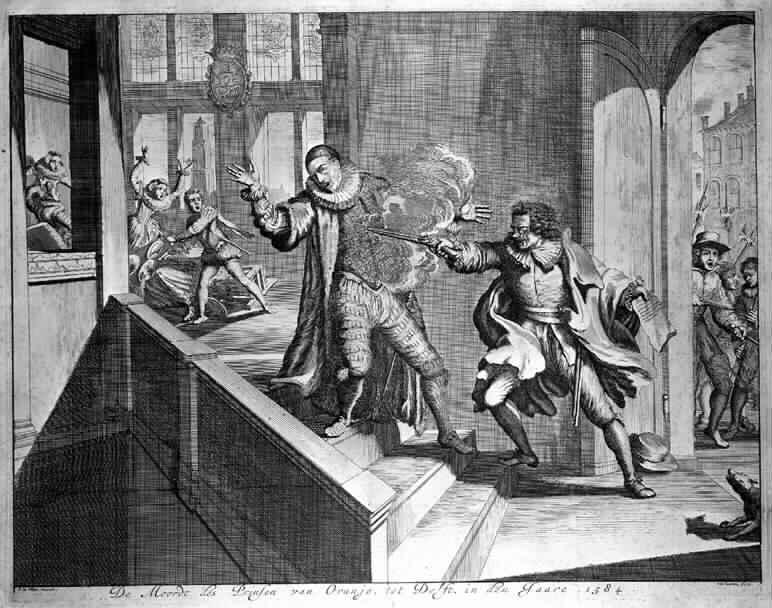
1814: Vicente Salias, Venezuelan national anthem author

On this date in 1814, the Venezuelan doctor and writer Vicente Salias was shot in San Felipe castle at Puerto Cabello by the Spanish who meant to run the place.

Salias (English Wikipedia entry | Spanish) was a founding member of the Sociedad Patriotica de Caracas and editor of the nationalist publication El Patriota de Venezuela.

He worked for the First Republic of Venezuela, a short-lived (1810-1812) attempt to break away from a Spanish empire preoccupied by the Napoleonic Wars. In 1810, Salias is said to have* composed the lyrics for Gloria al Bravo Pueblo (Glory to the Brave People),

Captured attempting to escape the approaching royalist forces of Jose Tomas Boves, Salias was shot with the spectacularly defiant last cry of “God Almighty, if the Heavens admit Spaniards, then I renounce the Heavens!”

* There are some revisionist hypotheses postulating other authors.

On this day..

1936: Manuel Goded Llopis

On this date in 1936, the Spanish Republic executed Gen. Manuel Goded Llopis, who mounted an unsuccessful nationalist attack in the heart of Republican Spain, Barcelona.

Goded (English Wikipedia entry | Spanish) was born of Catalan ancestry in Puerto Rico. His family moved back to the mother country when the United States stripped that territory away in the Spanish-American War.

Goded advanced rapidly through the armed forces, becoming dictator Miguel Primo de Rivera‘s chief of staff by 1927. He was dismissed from this post for intriguing against the government, but soon found his way back to command and became (Spanish link) one of the circle of officers conspiring to check the advance of the left.

When the anti-Republican military mounted the revolt that became the Spanish Civil War, Goded was in Catalonia — freshly arrived on a mission to snatch Barcelona for the fascists at the revolt’s outset. Forces loyal to the Republican government, however, defeated Goded in the streets of Barcelona on 19 July. The general himself was captured on 11 August. A Republican court had him shot at Montjuic the very next day, along with another officer, Alvaro Fernandez Burriel.

His defeat, in the long run, might have been a gift by the Republicans to their conquerors: Goded was a partner but also a rival of Francisco Franco’s, and Goded’s presence in the postwar settlement among the nationalist victors might have introduced a fault line into the Franco regime.

On this day..

1936: Josep Sunyol, FC Barcelona President

FC Barcelona is many a sportive leftist’s major European football side of choice, thanks to the club’s longtime identification with its city’s Catalan anti-Francoism.

That identification, stretching all the way back to the club’s formative early-20th century years (“History of FC Barcelona” enjoys its own voluminous Wikipedia page) put the Barca president at the end of fascist guns on this date in 1936.

Josep Sunyol was born into the Catalan elite, and had a varied career in the public eye: left activist, parliamentary deputy, newspaper founder, and, come 1935, president of FC Barcelona. He’d been serving on the Barca board of directors since 1928. There’s a lengthy Sunyol biography here.


At the center of the rail, Sunyol (left) chats with Catalan president Lluis Companys. (Source)

It was in his political, rather than his footballing, capacity that in August 1936 — just days into the Spanish Civil War — Sunyol traveled from Barcelona to Madrid to meet with fellow Republicans.

He never made it back.

On the return trip from Madrid, Sunyol’s chauffeured car flying the Catalan senyera was stopped by pro-Franco Falangist forces in the Sierra de Guadarrama north of Madrid. It may have been only inadvertently that Sunyol crossed this checkpoint of nationalists, who were already gathering for an attack on Madrid that would eventually inspire For Whom The Bell Tolls. (Indeed, this novel is set in the Sierra de Guadarrama.)

Whatever Sunyol’s intention, he was quickly recognized and detained by his foes on the evening of August 6. Shortly thereafter, they decided to shoot him out of hand.

The civil war and the era of Franco are still sensitive topic in Spain, but FC Barcelona’s politically engaged supporters have pushed the present-day club (with partial success) to more overtly embrace its anti-fascist “martyr president”.

On this day..

Feast Day of St. James the Greater

It’s a big day today in the Galician city of Santiago de Compostela, because the twenty-fifth of July is the feast of its patron and namesake* St. James the Great.

One of the original Apostles (literally, he and his brother John are the first two whom Jesus calls in the Gospels), James also had the distinction of apparently being the first Apostle to die for Christ.** His execution at the hands of Herod Agrippa† is reported in Acts 12:2;‡ it’s the only apostolic execution in the New Testament.

This, of course, occurred on the southeastern fringe of the Mediterranean, so it’s a wonder that James’s bones came to repose at a Spanish city literally situated on Finisterre, the far western edge of the world as far as Europeans saw it. The Lord works in mysterious ways.

It’s certainly plausible — though impossible to substantiate — that James evangelized in Spain prior to his execution. The whole Mediterranean was a Roman lake. More towards the outlandish is the patriotic story (pdf) that James’s relics were miraculously discovered there in 813 at the moment when Muslim expansion into Iberia gave the hard-pressed Christian kingdoms the greatest possible need for a morale boost.§

James became for those souls Saint James Matamoros, Moor-slayer, and started turning the tide of fictional battles and blessing his own very real chivalric order.


Saint James gets his Moor-slaying on.

“A knight of Christ’s squadrons,” Cervantes wrote. “St. James the moorslayer, one of the most valiant saints and knights the world ever had, and that now the heavens have … this great knight with the vermilion cross has been given by God to Spain for its patron and protection.”

James’s martial prowess is entirely posthumous: when the Son of God recruits him, he’s a humble piscator at labor mending his nets (there are some less-bellicose present-day churches going under the name “Saint James the Fisherman”). Gibbon could not but marvel at the “stupendous metamorphosis [that] was performed in the ninth century, when from a peaceful fisherman of the Lake of Gennesareth, the apostle James was transformed into a valorous knight, who charged at the head of Spanish chivalry in battles against the Moors. The gravest historians have celebrated his exploits; the miraculous shrine of Compostella displayed his power; and the sword of a military order, assisted by the terrors of the inquisition, was sufficient to remove every objection of profane criticism.”

But mythmaking exercises a historicity all its own, and the James legends offered a rallying-point for Spain’s Christians. He stands to this day the patron of Spain as well as a number of places colonized by Spain.

Pilgrims have ever since that stupendous metamorphosis of the 9th century made the journey to the apostle’s purported resting-place; this Way of St. James, actually comprising several different possible routes covering hundreds of kilometers on foot, has in recent years emerged as a major tourist draw. The Way terminates, of course, at Santiago de Compostela and the enormous cathedral there where repose James’s relics.

Saint James’s Day, 25 July, is its celebratory culmination.

James so overawes July 25 on the liturgical calendar that it’s a mere footnote to add that this same day also pays homage to Saint Christopher, a historically dubious Christian martyr from the third or early fourth century Roman Empire.

Christopher is rather nifty, because he’s sometimes depicted in iconography as cynocephalic — that is, having the head of a dog. At least the rest of him is human, unlike Saint Guinefort the Greyhound. (No lie. It’s a doggie saint, albeit of the distinctly unofficial variety. To stamp out folk veneration, an incensed preacherhad the dead dog disinterred, and the sacred wood [where it received offerings] cut down and burnt, along with the remains of the dog.”)

* The name “Santiago” derives from our saint’s name in Latin, Sanctu Iacobu. This is also the source, and James the intended honorary, for other places on the map named Santiago, such as Santiago, Chile.

** Assuming you don’t count Judas Iscariot, of course.

† Herod Agrippa is not to be confused with his grandfather Herod the Great — the Biblical Massacre of the Innocents guy — nor with his uncle Herod Antipas — the guy who punted Jesus’s prosecution back to Pontius Pilate. Three different Herods; three different New Testament heavies.

‡ James’s death in Acts 12 is followed immediately by Saint Peter staging a supernatural jailbreak out of the same prison. The latter goes on to evangelize for another 20-odd years.

§ The holy remains reached that resting point, goes the legend, only by perilously navigating a path of dragons, pagans, and wagons.

On this day..

1584: Balthasar Gerard, assassin of William the Silent

“If you succeed in your enterprise, the King will fulfill all his promises, and you will gain an immortal name besides.”

Christoffel d’Assonleville, to Balthasar Gérard

After 4 days of torture, on this date in 1584, Balthasar Gérard (Geeraerts) finally met his end by beheading on the wheel.
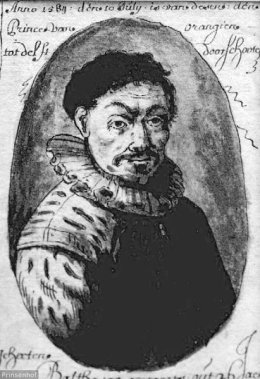
Gérard managed to be both historically important and wholly forgettable: an assassin working for Spain against the Netherlands, his regicide was met with a predictably stiff punishment. Then, no fault of his own, the subsequent course of history** pushed the assassin into obscurity while elevating his prey.

A lawyer by trade, Gérard was a fervent Catholic and supporter of the Spanish crown, which controlled the territory up the coast through the present-day Netherlands. At the peak of its power, Spain’s monarchy — led by King Philip II — had significant cause for concern at the rise in Protestantism.

The Spanish were Europe’s paladins of staunch Catholicism, and the sight of her troops did little to endear Spain to her colonized neighbors to the North.

For both religious reasons and political ones, the Dutch were looking for a way out from under the Spanish thumb, and a former noble named William, Duke of Orange, was a major instigator in the struggle. In his collected letters and addresses from the period, An apology or defence of William the First of Nassau, William states that, starting in 1559, he became increasingly concerned with plans against Protestants by the Spanish monarchy.

That also happens to be the year William was bestowed with stadtholdership of Holland, Zeeland, and Utrecht; in effect, he controlled the Dutch coast.

Though he was known as William the Silent, the Duke was endowed with both financial resources and widespread popularity, and he didn’t keep his mouth shut when it came to Inquisition courts in his realms.†

When the head enforcer of that policy, Cardinal Antoine Perrenot de Granvelle, left town, William got even noisier — declaring before the Council of State that Spanish policies were squelching religious freedom.

In 1566, the nobleman signed onto the Compromise of Nobles and began funding insurgencies across the northern provinces. As religious unrest grew, Calvinists and Protestants in the French and Germanic portions of Spain’s holdings quickly formed up behind William. An early attempt in 1568 to invade the Netherlands using German mercenaries and French Huguenots failed, but the resultant executions of Egmont and Hoorn put Spain on a long and winding road toward defeat.

The Dutch War was afoot, with William leading the way.

It would take and dozens of small-scale military victories over the next 15 years (during which William declared himself a Calvinist and fully broke his Spanish ties) for the Dutch to move to independence. The 1580 Union of Utrecht and 1581 Act of Abjuration officially ousted King Phillip II from the Netherlands and installed a new government.

Needless to say, Phillip reciprocated William’s love.

In 1580, Spain’s top man put a price on William’s head. Juan de Jáuregui tried to collect two years later by shooting the stadtholder, but the man holding the new title of Prince William I of Nassau recovered, while de Jáuregui was killed on the spot.

With 25,000 crowns at stake, there were bound to be other takers.

Our man Balthasar Gérard started looking for a close encounter with William the Target. At first, he joined the army in Luxembourg, which didn’t get him very far. It was time to gin up a real plot, which Gérard shopped to the Duke of Parma, Alessandro Farnese, in April 1584. Though the Duke offered no funding for the operation — Gérard ponied up the startup money he needed for the trip — and held out little hope that the lawyer would be successful, he gave Gérard assurances that his family would be taken care of in case of disaster.

Gérard first presented himself to William in June as the son of a martyred Calvinist from France. On 8 July, he returned and, badly in need of new clothes, managed to beg 50 crowns for a new set.

Instead, he bought a pair of pistols and, on 10 July, made history with a point-blank shot to William’s chest.
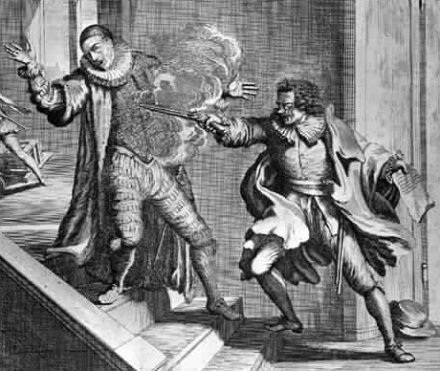

Detail view (click for the full image) of William the Silent’s 1585 assassination at the hands of Balthasar Gerard.

This assassination attempt didn’t fail. William became the second head of state to be killed by an assassin’s bullet,† — and his shooter the first such man to be juridically punished for the deed.

And, oh, how he was punished.

The regicide was beaten immediately after his capture, then subjected to a variety of cruelties, from wet leather boots which, when heated, both crushed and burned the feet, to daily floggings while hanging on a post outside the jail.

But on this day, his time of torture was up, and Gérard was finally put to death. You know, the usual:

It was decreed the right hand of Gerard should be burned off with a red-hot iron, that his flesh should be torn from his bones with pincers in six different places, that he should be quartered and disembowelled alive, that his heart should be torn from his bosom and flung in his face, and that, finally, his head should be taken off.


Gerard’s execution.

For all that he suffered as a regicide, Gérard left his family an impressive inheritance. Making good Parma’s assurances, King Phillip II gave them William’s former lands in three French provinces and took his siblings and their issue into his peerage.

Gérard’s cause carried on for another 60 years, until it was finally extinguished by the signing of the Peace of Münster by the Republic of the Seven United Netherlands and Spain.

* Foucault mistakenly identifies the torture as lasting 18 days, and the additional details he lays down for Gérard’s time on death row may be less-than-believable. However, all sources indicate that the tortures Gérard endured were quite spectacular, even by the standards of the day.

** See Dissident identities in the early modern Low Countries for a complete treatment of this period in The Netherlands and Belgium.

† For example, the city of Antwerp (Belgium), then under possession of the Spanish crown and considered the mercantile center of Europe for its vast sugar trade, featured over 100 executions for heresy from 1557-1562, twice as many as in all of Spain during that time.

‡ The first was James Stewart, 1st Earl of Moray, then Regent of Scotland. Stewart’s shooter, James Hamilton, escaped into exile, though others of the Hamilton clan answered for the murder.

On this day..

1940: Cayetano Redondo, former mayor of Madrid

On this date in 1940, Cayetano Redondo was shot at Madrid’s largest cemetery.

Cayetano Redondo (English Wikipedia page | Spanish | Esperanto), a former journalist and editor, was the socialist onetime mayor of Madrid — having ascended that position during the Spanish Civil War when the previous mayor fled for Valencia as Franco attacked Madrid. Redondo was the guy with his name on the letterhead during the bloody November 1936 Battle of Madrid, when the Luftwaffe tried out terror bombing (Guernica followed in April 1937).

This “hombre de una bondad inagotable” (Manuel Albar, quoted here) was also a leading esperantist — an advocate of building international solidarity through the extension of the constructed language Esperanto.

Disdaining escape as the war ended, he was arrested when Franco’s forces finally took Madrid in 1939 and shot a year later as a rebel. (His tombstone evidently records the wrong date.)

Though Redondo was long a neglected figure, the Madrid city council recently named a street for him. So he’s got that going for him.

On this day..

1937: Camillo Berneri, anarchist intellectual

On this date in 1937, the Italian anarchist Camillo Berneri was kidnapped from his home by in Barcelona by armed paramilitaries. Berneri was shot that night.

Berneri (English Wikipedia entry | Spanish | timeline) had once been a University of Florence professor, but was forced into exile for opposing the fascist conquest of power in Italy.

When a coup threatened a similar right-wing conquest of power in Spain, Berneri organized the first column of Italian volunteers to oppose it.

International brigades poured into Spain to fight for the Republican government, but not everybody in the “popular front” was on the same side — a fact which became horrifyingly clear during Barcelona’s “May Days”, a week of internecine bloodletting in Republican Catalonia.

Anarcho-syndicalists of the CNT party and anti-Stalinist communists of POUM were the ones whose blood was mostly let; indeed, it might better be called a purge. The Moscow-backed Communist Party opposed the power of its putative comrades as much as or more than that of Franco. During the May Days, the Communists’ Catalan ally, a party called the PSUC, essentially took over Barcelona with the help of thousands of Assault Guards and killed, arrested, or dispersed the anarchists and Trotskyites.

Berneri clearly saw it coming, quoting Pravda in an April 1937 letter to the anarchist Health Minister criticizing his participation in the Popular Front government: “As for Catalonia, the purging of Trotskyist and anarcho-syndicalist elements has begun; this work will be carried out with the same energy with which it was done in the USSR.”

The British writer George Orwell served in a POUM unit, and the last third or so of his Spanish Civil War memoir Homage to Catalonia attempts to make sense of the chaotic scene.

Smitten when he arrived in Barcelona the previous December — “the first time that I had ever been in a town where the working class was in the saddle”* — the writer scoffed at the Communists’ official justification that anarchists and friends were a “counter-revolutionary” element, or even in actual league with their nationalist enemies.

It seemed queer, in the barber’s shop, to see the Anarchist notice still on the wall, explaining that tips were prohibited. ‘The Revolution has struck off our chains,’ the notice said. I felt like telling the barbers that their chains would soon be back again if they didn’t look out.

I wandered back to the centre of the town. Over the P.O.U.M. buildings the red flags had been torn down, Republican flags were floating in their place, and knots of armed Civil Guards were lounging in the doorways. At the Red Aid centre on the corner of the Plaza de Cataluña the police had amused themselves by smashing most of the windows. The P.O.U.M. book-stalls had been emptied of books and the notice-board farther down the Ramblas had been plastered with an anti-P.O.U.M. cartoon — the one representing the mask and the Fascist face beneath.

Down at the bottom of the Ramblas, near the quay, I came upon a queer sight; a row of militiamen, still ragged and muddy from the front, sprawling exhaustedly on the chairs placed there for the bootblacks. I knew who they were — indeed, I recognized one of them. They were P.O.U.M. militiamen who had come down the line on the previous day to find that the P.O.U.M. had been suppressed, and had had to spend the night in the streets because their homes had been raided. Any P.O.U.M. militiaman who returned to Barcelona at this time had the choice of going straight into hiding or into jail — not a pleasant reception after three or four months in the line.

Also a fighter of the liquidated POUM, Orwell too was proscribed: he had a job to make it out of Barcelona without winding up in someone’s dungeon or firing range. His disgust with what revolutionary Barcelona had come to would help to inform his subsequent anti-Soviet literary efforts.

Berneri, too, was an outspoken anti-Communist. Long a major intellectual in the anarchist camp, he was clearly targeted by name, and hauled from his house along with his brother-in-law Francesco Barbieri by a death squad. Their bodies turned up riddled with bullet holes the next morning.

There’s a collection of Berneri’s writings in English translation here, including one piece dated to the very day of his disappearance; also see this pdf of Berneri’s work. He was survived by his daughter, Marie-Louise Berneri, who herself became a noted anarchist activist of the 1940s.

* Orwell on Barcelona circa December 1936: “Practically every building of any size had been seized by the workers and was draped with red flags or with the red and black flag of the Anarchists; every wall was scrawled with the hammer and sickle and with the initials of the revolutionary parties; almost every church had been gutted and its images burnt … Waiters and shop-walkers looked you in the face and treated you as an equal. Servile and even ceremonial forms of speech had temporarily disappeared. Nobody said ‘Señor’ or ‘Don’ or even ‘Usted’ … Tipping was forbidden by law … revolutionary posters were everywhere, flaming from the walls in clean reds and blues that made the few remaining advertisements look like daubs of mud. Down the Ramblas, the wide central artery of the town where crowds of people streamed constantly to and fro, the loudspeakers were bellowing revolutionary songs all day and far into the night. And it was the aspect of the crowds that was the queerest thing of all. In outward appearance it was a town in which the wealthy classes had practically ceased to exist. Except for a small number of women and foreigners there were no ‘well-dressed’ people at all. Practically everyone wore rough working-class clothes, or blue overalls, or some variant of the militia uniform. All this was queer and moving. There was much in it that I did not understand, in some ways I did not even like it, but I recognized it immediately as a state of affairs worth fighting for.”

On this day..

1946: Cristino Garcia, Spanish Republican and French Resistance hero

On this date in 1946, ten* Spanish Republicans were shot — most famously including Cristino Garcia.

Garcia, a Communist veteran of the Spanish Civil War, had put his guerrilla skills to good use by joining the French Resistance during World War II.

Garcia ultimately held the rank of Lieutenant Colonel in the Resistance, and was perhaps the most individually famous of the numerous Spaniards** who fought as maquisards. His unit broke out hundreds of people before potential deportation to German death camps, and Garcia helped orchestrate the guerrilla-led liberation of Foix in August 1944. (There’s a lengthier roundup of Garcia’s career in the field in Spanish, here.)

The French had nothing but good feelings for this guy, but Garcia wasn’t looking to take a pension from De Gaulle and settle down in a vineyard. As France fell to Allies, Garcia — going on ten years a professional leftist revolutionary — headed back to Spain (Spanish link) to carry on the fight against fascism closer to home.

His tasks over a few months in 1945 ran to the less legendary: bank attacks and the like, blurring the line between “ordinary” and “political” crimes. Garcia was also detailed as a result of intra-party politicking to murder fellow-Communist Gabriel Leon Trilla (Spanish link).†

Garcia and his group were arrested shortly thereafter and faced a military tribunal on January 22, 1946. (Spanish source)

As an agent of the Spanish Communist Party, which was backed by a French Communist Party riding high on its World War II heroics, Garcia’s situation became a national cause celebre. French left parties uniformly protested the planned execution, and the government made repeated diplomatic overtures to Madrid to stay the sentence. Editorialists protested floridly.

Have we forgotten that fascism exists at our border; Was it not against all fascisms that Cristino Garcia and thousands of our Spanish brothers fought with us on our soil? Did they not fall beside us, as at the Eysses prisons, under the same Nazi bullets, for France? And today will we disown their sacrifice, their blood and their martyrdom because the fight against fascism has moved to the other side of the Pyrenees? (from the Franc-Tireur, quoted here

Incensed when Franco ignore their appeals and shot the men anyway, France retaliated by closing its border with Spain on March 1, 1946. Spain did not neglect to point out the irony that, during the war years, innumerable resistance fighters and others fleeing Naziism or the Vichy regime had taken refuge by crossing that very border. (Less stress was understandably laid on the Francoists’ onetime demand — not honored by Paris — that France close its border against escaping Republicans in 1939.)

* I believe from press reports that there were 12 total executions of Republicans Feb. 21-22, 10 of which took place on Feb. 21. However, I might be mistaken about the overall numbers or their distribution by dates. Garcia’s, certainly, took place on Thursday the 21st.

** The Resistance was blessed by with no small amount of foreign blood. (French)

† Garcia delegated this task to two subalterns, one of whom (Francisco Esteban Carranque) was shot with him on this date. The other man, Jose Olmedo, was arrested in 1947 and executed in 1948.

On this day..

1892: Four anarchists in Jerez

On this date in 1892, four anarchists named Burique, Lamela, Lebrijano and Zarzuela were publicly garroted on a large stage in front of the prison at the Andalusian city of Jerez (or Xeres).

Spain, like many other European states, grappled with anarchists in the late years of the 19th century.

Revolutionary peasants made the rich agricultural lands of Andalusia among the anarchist strongholds: the shadowy La Mano Negra, the “Black Hand”, had been smashed up with a number of executions in the early 1880s. This was not the end of agitation, however: its successor movement, Los Desheredades, “the Disinherited,” continued to grow.

On the night of January 9, 1892, a band of several hundred agricultural workers boldly raided Jerez in an attempt to free some anarchist prisoners. They were driven off after a night’s fearful fighting — a prototype “anarchist outrage” for headlines the world over. It was, for Federico Urales, “an act of dreams. Sticks and sickles to beat the well-fed lords of Jerez, from the men who starved to keep to keep their lands.” (Source, in Spanish)


From the Melbourne, Australia Argus, Jan. 11, 1892

“We know what the workers are: wicked people! With them, one has the bread in one hand, and the garrote in the other.” -from Vicente Blasco Ibanez’s La Bodega, in which the Jerez mutiny is a central theme. It’s available in the public domain in the original Spanish

Dozens of “outragers” were captured in hot pursuit that next morning. The investigation quickly honed in on the four ringleaders, who were put to death this date. One allegedly left a written statement conveniently renouncing anarchy. Another spoke from the platform, and “declared that he died in the cause of the working classes, and he appealed to the crowd not to respond by expressing sympathy.”*

But many others would suffer lengthy, non-capital sentences on evidence perhaps more expedient than rigorous. The poet Fermin Salvochea spent most of his fifties in prison on a spurious accusation of having conspired in the Jerez attack.

And these executions scarcely quelled Spain’s unrest. Angry cadres demonstrated (or rioted) against the executions throughout Iberia, provoking the familiar cycle of more police raids, more outrages, more martyrs … for years to come, and culminating in the indiscriminate arrests and mass torture of Barcelona anarchists in that city’s Montjuic Castle in in 1896-97

* From the Feb. 11, 1892 New York Times, which proceeds to describe the distinctive execution method thus:

[The garrote] is a brass collar, which is contracted by means of a screw in the back. As the screw is turned the collar shuts upon the neck of the condemned, and at the same time the sharpened steel point of the screw enters the spinal marrow where it joins with the brain, causing instantaneous death.

On this day..

1897: The Bicol martyrs of Philippines independence

On this date in 1897, eleven pro-independence Filipinos were shot at Manila’s Bagumbayan execution grounds.

These eleven,* together with one who was tortured to death on a prison brig and three others who died exiled to prisons elsewhere in the Spanish empire, comprise the Fifteen Bicol (or Bikol) Martyrs.

Spanish suppression of the unfolding Philippine Revolution was in full martyr-making; just days before, the same site had seen the execution of Dr. Jose Rizal. (A few days after this, it made still another batch of martyrs.)

“They died bravely,” a Filipino newspaper reported. “They died like those who are sustained by a sacred ideal.”

They were.

This date’s victims had been rounded up on September 16 at Naga City in the Bicol Region. It was the aftermath of Spain’s discovery of the anti-colonial Katipunan secret society, and mass arrests followed by torture-aided interrogation were the order of the day.

These would not, in the end, avail.

As a result, the “Quince Martires” are still commemorated in independent Philippines every January 4, which is a public holiday in Naga City … and commemorated throughout the year at that city’s Plaza Quince Martires, and its monument.


(c) image courtesy of Wally Ocampo.

* Rev. Fr. Gabriel Prieto; Gabriel’s brother, Thomas Prieto; Rev. P. Severino Diaz; Rev. P. Inocencio Herrera; Manuel P. Abella; Manuel’s son, Domingo I. Abella; Camilo Jacob; Florencio Lerma; Macario Valentin; Cornelio Mercado; and Mariano Melgarejo.

On this day..