On this date in 1938, linguist and politician Branislaw Tarashkyevich was shot at the Kommunarka execution range outside Moscow: another victim of Stalin’s purges.
That’s the familiar name for Tarashkyevich’s 1918 grammar (Belarusian link) that standardized the tongue, or rather the collection of related “Belarusian” dialects.
Its creator also happened to be a political leftist; he served briefly in the parliament of Poland (which then controlled West Belarus), then became a leader of the Belarus Peasant and Worker Masses, a communist movement. Tarashkyevich was arrested in 1928 and subsequently exchanged for a Belarusian journalist whom the Soviets had imprisoned.
His career as a Soviet appartchik in Moscow was short-lived, however, before those guys clapped him in prison, too, with the outcome typical to that frightening time and place.
A like deletion was supposed to befall taraskevica when the Stalin-era Belarus SSR ordered a standardization with grammar and orthography that more closely resembled Russian; this version (“narkomawka”) still remains the official “Belarusian” to this day.
However, the taraskevica variant has established a stubborn foothold among users who consider it more authentic than its Russified rival.*
* See Curt Woolhiser, “Communities of Practice and Linguistic Divergence: Belarusophone Students as Agents ofLinguistic Change,” Harvard Ukrainian Studies, Vol. 29, No. 1/4 (2007).
The 29-year-old mother of three was beheaded for her refusal to renounce the Chinese Communist Party and Mao Zedong. She was technically Mao’s second wife; a previous marriage had been arranged for Mao by his parents, but he and the woman never lived together and the marriage was never consummated.
Yang and Mao grew up together in Changhsa — she was the daughter of one of his teachers — and fell in love as young adults. Yang, like Mao, was an enthusiastic Communist. She joined the CCP in 1921, becoming one of its earliest members. She never held any official position in the CCP, however, and wasn’t terribly active in the movement, since she had to raise the children.
Mao and Yang truly loved one another. Phillip Short, in his biography of Mao, writes of this period: “Perhaps for the only time in Mao’s life, he had a truly happy family to come home to … It was a surprisingly traditional Chinese household.”
But Mao became more and more absorbed in dangerous revolutionary work, and he and Yang were often separated when he traveled. The last time she saw her husband was in 1927, the year the Chinese Civil War started and Mao became a guerrilla leader, hiding in the mountains, far from his family. They maintained sporadic contact after that, but often what little she knew about his activities came from the papers.
During the final years of her life, Yang missed her husband desperately and had thoughts of suicide. “No matter how hard I try,” she wrote once, “I cannot stop loving him.”
Yang predicted she might meet with a violent death. She was right: on October 24, 1930, a warlord loyal to the nationalists captured her and one of her sons.
She did not break under threats and torture, and refused to give in and publicly repudiate her husband and Communism, even though her captors offered to spare her life if she did so. She became one of the CCP’s earliest martyrs.
Yang was executed more for being Mao’s wife than she was for anything she’d done herself. She wasn’t the only woman who would be killed for being married to a prominent member of the CCP; the wife of Zhu De had met with the same fate in 1929.
Mao, who had always called Yang his true love, was reportedly devastated by her death and wrote, “the death of Kaihui cannot be redeemed by a hundred deaths of mine!” He wrote a poem about her in 1957 that suggests he still grieved for her even then. But it must be noted that he never tried to rescue her or his sons when he knew their home had turned into a battleground and their lives were in danger.
Propaganda poster of Yang and Mao.
Tragedy followed the lives of Yang and Mao’s three sons.
The youngest boy, Anlong, died of dysentery in Shanghai at the age of four, soon after his mother’s execution. The oldest, Anying, was killed in the Korean War. Middle child Anqing lived to be 83, but perhaps as a consequence of watching his mother being put to death as a youth, he suffered bouts of mental illness throughout his life. He died quietly in China in 2007.
On this date in 1848, a day short of his forty-second birthday, the German revolutionist Robert Blum was summarily shot in Vienna — a tragic victim of Germany’s Revolutions of 1848.
Marker at Robert Blum’s birthplace in Cologne reads “I die for the German liberty that I fought for. May the fatherland remember me.” (cc) image from Elke Wetzig.
Blum grew up in a penniless proletarian family but drifted into the literary set. He spent the 1830s penning liberal-minded plays, poetry, newspaper correspondence. He uncovered a magnetic personality and a gift for organization.
By the 1840s he was a — maybe the — preeminent left-liberal in the Kingdom of Saxony: pro-parliamentary democracy, anti-violence, for a wide grant of civil liberties and mass education.
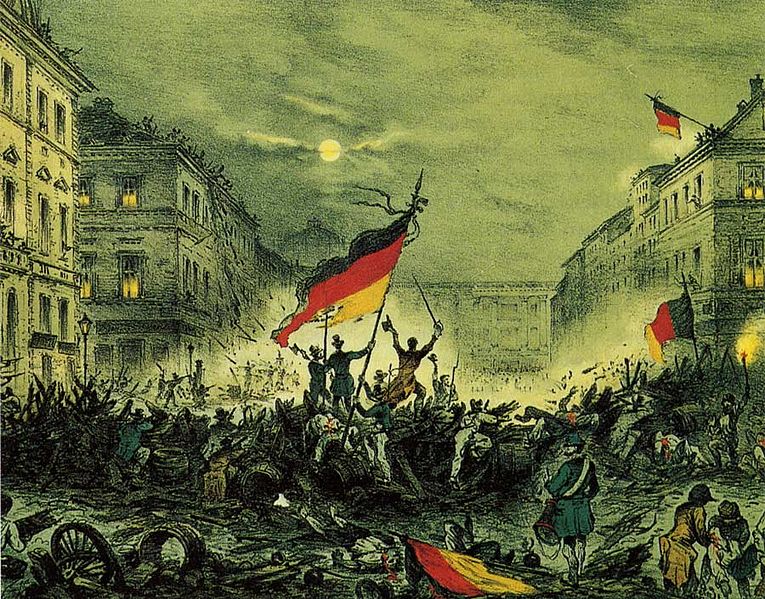
The pressures, both liberal and radical, pushed to the brink the small realms in the German Confederation, as well as the neighboring Austrian Empire. Both struggled to handle even the liberals’ demands like expanding the franchise and freedom of the press, with old hereditary polities that might not be up to changing times. Germany, Marx and Engels wrote in the Communist Manifesto (1847), “is on the eve of a bourgeois revolution.”
Right on cue…
That pregnant year of 1848 found Blum in the Frankfurt parliament, and his neither-fish-nor-fowl leftism — a little too out there for mainstream liberals; a little too bourgeois for real radicals — made Blum the perfect pick for a solidarity mission.
When in September 1848 the Austrian army was defeated trying to crush a Hungarian rebellion, the Habsburg capital of Vienna took the example and mounted a revolution of its own, putting the government to flight.
Blum was sent as sympathetic delegate to this abortive Viennese commune, but found himself trapped in the city when the Austrian army encircled it in late October.
The Austrians, when they caught him, sent their own message back by denying him any form of deference for his parliamentary rank. Blum’s direct condemnation was a stark warning by the Habsburg state to agitators, but also to their putative brethren dreaming of a Greater Germany. Austria wasn’t buying what the Großdeutsche people were selling.
Detail view (click for the full image) of Carl Steffeck’s painting of Robert Blum’s execution. Here’s a YouTube recreation (in German).
Blum went on to a posthumous career as a star liberal martyr among the German circles who had use for such a character.
Blum’s seven-year-old son Hans grew up to follow his father’s literary footsteps … but from quite the other side of the aisle. He was a pro-Bismarck nationalist.
“No incident of the dreadful story” of Morant Bay, wrote Edward Underhill, “produced a more painful impression than the arrest, trial, and execution of Mr. G.W. Gordon” this date in 1865.
The son of a white planter and a mulatto slave, George William Gordon was an able businessman and became a Jamaican assemblyman.
In that capacity, he was a vocal critic of British colonial maladministration, an advocate for blacks, and a political foe of Jamaica’s governor, Edward John Eyre. He’d already had government commissions canceled because of his politics.
Gordon had nothing to do with the Morant Bay outbreak. He was away from the disturbance altogether, in Kingston, when it broke out.
But he was regarded by many white elites as a class enemy, and Eyre did not intend to miss this opportunity to eliminate him. A few years later, a French tribunal would express the rationale as it cracked down on the Paris Commune: guilty or no, “a prudent and wise Government must rid itself [of troublemakers] when it finds a legitimate occasion to do so.”
Accordingly, Gordon was arrested by civil authorities in Kingston — he actually turned himself in when he heard there was a warrant out on him — and then transferred into the hands of the drumhead military tribunals that were operating in the conflict zone, obviously with the intent of terminating a gadfly.
[Kingston authorities] were not the ministers or apparitors of the martial authority, and did not possess the power to take up Mr. Gordon for the purpose of handing him over to the martial law. Nevertheless, they did it. They did it by the exercise of the strong hand of power, because it was thought that a conviction could not be got at Kingston. It was altogether unlawful and unjustifiable. To Mr. Gordon it made the difference of life or death.
Gordon, in his last letter to his wife, took it all in an understandably contemptuous stride:
General Nelson has just been kind enough to inform me that the court-martial on Saturday last has ordered me to be hung, and that the sentence is to be expected in a hour hence, so that I shall be gone from this world of sin and sorrow.
I regret that my worldly affairs are so derranged: but it cannot be helped … I never advised or took part in any insurrection. All I ever did was to recommend the people who complained to seek redress in a legitimate way … It is however the will of my heavenly Father that I should thus suffer in obeying His command, to relieve the poor and needy, and to protect, as far as I was able, the oppressed …
do not be ashamed of the death your poor husband will have suffered. The judges seemed against me; and from the rigid manner of the Court, I could not get in all the explanations I intended. … It seemed that I was to be sacrificed.
Much of what Governor Eyre did in those desperate days skirted, at best, the edges of what might be legally colorable. But at least those instances, in the main, were directed at people alleged to have been actual rebels or rioters. Eyre could safely expect wide latitude where the security of the realm was at stake.
In Gordon, however, there was a man whose crime was nothing other than to have sympathized with the real and crushing plight of the lower orders and advanced their cause politically. Eyre’s magistrates made that fact alone into sedition, and twisted the rules of their own courts-martial to pin it on Gordon.
Given the exceptionally lawless nature of this scenario — and Gordon’s own visibility as a colonial elite — his became the lightning-rod case for English liberals incensed at Eyre’s behavior. John Stuart Mill, Charles Darwin, Herbert Spencer, and others demanded Eyre’s prosecution for the affair, Thomas Huxley writing for the faction,
the killing of Mr. Gordon can only be defended on the ground that he was a bad and troublesome man; in short, that although he might not be guilty, it served him right.
I entertain so deeply-rooted an objection to this method of killing people — the act itself appears to me to be so frightful a precedent, that I desire to see it stigmatised by the highest authority as a crime.
It can hardly surprise the reader, versed as we are by this late date in official impunity, that not Eyre nor any lieutenant was ever thus stigmatised.
While Eyre evaded due punishment, Gordon could not escape the plaudits of posterity. He’s been honored as a Jamaican National Hero, and the very building where the present-day parliament sits is called the Gordon House in his honor.
On the evening of this date* in 1707, Pierre Fatio was secretly shot by arquebusers in a Geneva prison.
This Swiss Gracchus — classically-minded contemporaries could hardly fail to draw the parallel — was a magistrate and a rising member of the patrician oligarchy that ran nominally democratic Geneva.
But despising the side his class bread was buttered, Fatio (English Wikipedia page | French) took up the standard of the masses … or at least the masses of the bourgeoisie, whose universal-propertied-male suffrage was belied by the power exercised by Geneva’s magnates club, the “Petit Conseil” of 25 who actually ran the city-state.
Pierre Fatio really looks less like a revolutionary and more like a would-be liberal reformer. What started all the trouble was Fatio’s January 1707 sponsorship of a measure for a secret ballot and a little less nepotism: a modest downward redistribution of power.
Then as now, the powerful resisted.
From the pulpit the ministers cried at the top of their lungs against the people … accusing the people of rebellion against the magistrates, of insubordination to the laws, of enjoying only disorder and fomenting divisions, violating the oath which promises to be good and loyal to the city. (Source)
Oligarch apologists went on and on about these secret-balloteers having “broken all the bonds of society” (Benedict Calandrini) as the popular clamor for a bit of state accountability grew. In political-philosophy terms, this manifested itself as a debate between whether the sovereignty of the people (again, meaning the propertied male people) actually implied that these sovereigns were entitled to govern.
And the Little Council won the debate the old-fashioned way: by crushing its opponents as seditious, with the military aid of their brother-oligarchs at neighboring Swiss cantons. Several popular-sovereignty types were killed or exiled (French link) in mid-1707.
Its government is a mixture of Aristocracy and Democracy; but as the principal and most ancient families use their utmost endeavours to derogate from, and by slow degrees destroy the privileges of the citizens, in order to draw the power over to themselves, and perpetuate themselves in their posts, this practice is attended with frequent murmurings, and in these last times an insurrection had began, which would have broken out into a great fire, if Zurich and Bern had not sent wise and able deputies to extinguish it, and afterwards a good number of troops to garrison the city, which at present seems to keep quiet, though with evident prejudice to the liberty of its citizens. (Vendramino Bianchi in Relazi one del paese de Svizzeri (1708), quoted in this book
Fatio was the last and most noteworthy to go, and the council was so nervous about the “murmurings” if it should behead him in public, it determined its death sentence in secret: apt climax for a struggle over state accountability.
Rather than risk further disturbances, it simply dispatched its agents directly to Fatio’s cell where they informed him that he was condemned, and had him shot inside the prison without further ado.
“I would look with great honor on being the martyr of liberty,” a cool Fatio is said (by his party, naturally) to have remarked upon hearing his condemnation.
Martyr he may have been, but unlike the Roman Gracchi, Pierre did not have a brother to catch up his falling torch: Pierre’s, who was already among the Little Council, went ahead and voted for his sibling’s execution.
The martyr had more impressive family in cousin Nicolas Fatio de Duillier, a mathematician and Isaac Newton collaborator. Still more noteworthy heirs were kin of spirit, not of blood: one David Rousseau lost his state job for supporting Fatio’s movement … and Rousseau’s famous Genevan grandson would become the favored philosopher of the coming revolutionary age.
* I really hate to contradict the 7 September date that’s carved into marble, but as best I can interpret the documentation, Fatio’s sentence was finalized on the day of 6 September and executed within just a few hours that very evening. See e.g. the 6 September document excerpted in fn 1 here.
On this date in 1987, Moses Jantjies and Wellington Mielies — “political prisoners” in the estimation of their supporters — hanged along with five common criminals at Pretoria for the murder of Ben Kinikini and five others.*
The killing of Kinikini occurred in an environment of bitterly escalating hostilities in the eastern cape city of Uitenhage and especially the KwaNobuhle township. Anti-apartheid school boycotts dating back to September 1984 (part of a spreading revolt in the townships at that time) had metastasized into violent confrontations when protesters were denied meeting space by the black KwaNobuhle councillors.
Kinikini was such a councillor, and he and the others had been under popular pressure to resign, and even had their homes stoned, since the last weeks of 1984.
Protesters stoned vehicles. Riot squads roamed the streets. Police shootings became everyday events, and more enraged crowds gathered at the resulting funerals of their victims.**
On March 21, 1985,† police opened fire on one such funeral procession, slaying some 20 people in a single go — the Langa Massacre.
Riots erupted following the Langa massacre, and it was on March 23 that Kinikini was dragged from his house and murdered: black township councillors were liable to be seen as apartheid collaborators. Defense witnesses for Jantjies and Mielies were quite a bit more specific, slating Kinikini with direct links to murderous vigilantes who liked to beat up and rape protesters in the creepy privacy of Kinikini’s apt personal business, a mortuary.
And as one memoir of the period puts it, “the government knew black councillors would not participate in a democratic charade unless their lives and property were protected and avenged. Some two and a half thousand black councillors, policemen and informers, real and rumoured, had been killed in the unrest that had begun in 1984.”
For South African president and white-rule stalwart P.W. Botha, those were far more pressing constituencies than mercy appeals from usual suspects like black activists and the West German government. These were also the first two township-rising convicts to come up for execution, out of some 33 then on death row, so their treatment figured to set the precedent for even higher-profile cases on the horizon like the Sharpeville Six. (In the event, apartheid collapsed before the Six could actually be hanged.)
The message was hardly lost on its internal audience.
“We have come to terms with the fact that the enemy has declared war,” Winnie Mandelatold a Johanessburg memorial service for Jantjies and Mielies hanged. “We accept the challenge. The blood of the comrades has not flowed in vain.”
* Ben Kinikini, his four sons and nephews, and one other person were stabbed and burned to death. Some reports term at least Ben Kinikini’s killing a “necklacing” — the brutal method of popular execution that arose in the 1980s in which the “jewelry” was a rubber tire filled with flaming petrol. It sounds from the widow’s secondhand description as if this could indeed characterize it, though the fact that the Truth and Reconcilation Commission called a July 1985 killing the country’s first necklacing might indicate otherwise. News stories suggest that photographs and video exist of, if not the murder, at least the aftermath: perhaps these are dispositive on the point.
** See Thole Majodina, “A Short Background to the Shooting Incident in Langa Township, Uitenhage,” Human Rights Quarterly, August 1986.
At the time, Nigeria was liable to put to death condemned prisoners without warning at any time, like Japan does today … except that Nigeria carried out such executions by the dozens. In one instance Angel witnessed, there were 58 executions in a single day.
On August 2, 1994, a Tuesday, that occasion finally arrived for Arthur Judah Angel — or so it seemed.
“I was chained; I was given my last meal that was August 2, 1994,” Angel said in an interview. “38 others were executed that very day. Only God knew how I was spared. He was the one that made my name disappeared in the book. I did not know how it happened. But it happened. I died, in fact, every person on the death row dies every day.”
Who exactly it was that saved Angel on that date I have not seen conclusively documented, but they say that God helps those who help themselves. In this case, Angel helped himself with his charcoal sketches on death row, which soon brought him to the attention of some well-placed people in the prison bureaucracy, a Catholic bishop — even a British arts organization which organized exhibitions of his work in 1993 and 1994.
Angel’s death sentence was commuted in 1995, and he was released outright in 2000. He well knows that, like those other 38 people who hanged this date, he’d be forgotten if not for his fortuitous escape. Life is just too damn cheap for exonerating the dead.
“I am able to clear my name because I am alive,” Angel said. “If I had been executed, nobody would believe that I was innocent. If I didn’t make it, no one would know. I knew many people who were innocent in prison. Yet they died in prison. Only people like me, who were close to them until their death, knew they were innocent. The rest of the world learnt that armed robbers were executed on so and so day; nobody knew they were innocent.”
But Angel did survive, and is remembered — not only for his exoneration, but for the 51 startling sketches he made of Nigeria’s death row. They (and other anti-death penalty art Angel has created since) have been exhibited worldwide by human rights NGOs.
Angel, who’ll turn 50 this November, continues to work as an artist from a studio outside Lagos — and uses his art to campaign against the death penalty, as one might imagine. He has written a book, I Refused to Die; unfortunately for its prospective international readership, the book requires expensive shipping from Nigeria.
(There’s also a bit of video from a news report here.)
On this date in 1768, a year of tremendous labor agitation in London, seven coal-heavers were hanged near the Shadwell dock.
With food prices surging,* the city’s hard-pressed urban proletariat was at peak militancy — which also lent violent energy the cause of hunted radical politician John Wilkes, who had returned from exile this year to stand for Parliament. Two principal loci of labor insurgency in 1768 were the Spitalfields weavers, whose struggle we have already observed, and the “coal heavers” — the men who did the grueling labor of offloading coal from Thames barges.
Coal-heaving was ill-paid and dangerous, and it was notoriously sensitive to fraud: workers (largely Irish: they’d been imported to hold down wages) being paid by the “sack” or the “vat” fought supervisors at riverside over just how fully loaded with coal such a sack or vat should be. Workers had their own recourse to “indirect Practises,” pilfering a few coals on the side to supplement pay up to within hailing distance of subsistence. The boss would call “theft” this grey-area practice harkening to labor traditions ancient and still-current. The rope would help him define it so.
Peter Linebaugh’s magisterial social history The London Hanged dramatically treats the fraught and violent months of the spring of 1768, when Irish workingmen were “bringing river traffic to a stand-still … [and] stopped the imperialist artery.”
Dockside taverns doubled as fraternal entities and regiments in the unfolding dock war. One John Green, keeper of a pub on New-Gravel Lane (not as scenic as the nearby Cutthroat Lane)
organized scab labour from [his] Roundabout Tavern. It was attacked in April with gunfire. A shoemaker bled to death on the pavement, a coal-heaver took a bullet in the head, ‘dropped down backwards, and never stirred’. The taverns were besieged, their furnishings destroyed. Gunfire was frequent. Green was acquitted of murder. Those testifying for him were mobbed and one witness had her jaw broken. The coal-heavers were as violent in word as in deed. ‘They would have Green’s Heart and Liver and Do for him’; ‘they would have him joint from joint’; ‘they would have his heart and liver, and cut him in pieces and hang him on his sign’; ‘they would hang him over his sign Post & cut him into Beef Stakes’.
Our seven — by name John Grainger, Daniel Clark, Richard Cornwall, Patrick Lynch, Thomas Murray, Peter Flaharty, and Nicholas McCabe — were indicted on grounds that they “with force and arms, with certain guns loaded with gunpowder and leaden bullets, feloniously, wilfully, and maliciously did shoot off at John Green.” Not quite cut into Beef Stakes, but it’ll get the job done.
Though the trials of Green, and then of Green’s assailants, were weeks apart, they concerned the very same disturbance on the night of April 20-21, when Green’s residence had been besieged by angry coal-heavers and Green with others had shot out the windows and killed at least two … but managed to hold his foes at bay during what must have been a harrowing night. Green wasn’t hurt, and gave evidence at the “shooting off” trial.
The London Irish had by 1768 an unparalleled knowledge of arms and armed struggle. They contributed to an insurrectionary impulse within the London working class. At the same time, as a consequence, the Irish had close knowledge of violent death. The intimacy of that knowledge was expressed in vivid euphemisms designed to reduce the terror of hanging. Seven coal-heavers received the ‘cramp jaw’ at the Old Bailey only after a new interpretation was placed upon the Waltham Black Act. The seven danced ‘a new jig without music’ on 26 July 1768. This particular ‘crack neck assembly’ was located in Sun Tavern fields, Shadwell … The move from Tyburn was designed to terrify the poor and working people of the river parishes. The ‘breath stopper’ was witnessed by 50,000 spectators, perhaps the largest crowd at such a scene since the hanging of the Earl of Ferrers eight years earlier. The Government anticipated disorders, if not rescue attempts, when these seven were to dance ‘tuxt de ert and de skies’. From 6 a.m. more than 600 soldiers patrolled the streets of Wapping and Shadwell. The Sheriff ordered all the constables of the Tower and Holborn divisions to assemble at the hanging site and to come armed with their staves. Thomas Turlis, the hangman, had stolen coal from a neighbour’s cellar five years earlier. But, that his work might not be interrupted, the Sheriff quickly obtained a pardon for him. He did his duty upon the coal-heavers, sent ‘a-spinning like a whirligig’. Once they had ‘peacably’ exited the world, many of the spectators may have gone for a drink as was customary:
Wid a facer we coddled our blood
For de wind id blows cold from de gibbett.
… The hanging at Sun Tavern Fields … taught a hard lesson about collective bargaining: attempts to counteract the rise in the price of provisions by improving wage rates would not be allowed. … the insurrectionary vanguard of the river proletariat was broken.
Or, as a more sanguine observer put it, after the hangings “the tumults immediately ceased, and peace and industry was happily restored.” And they all lived happily ever after.
* Bread prices doubled in 1768, leading to work stoppages, hoarding, and food riots throughout the city. Representative slogan shouted by desperate rioters: “We might as well be hanged as starve.” (George Rude, “The London ‘Mob’ of the Eighteenth Century,” The Historical Journal, Vol. II, no. 1 (1959))
On this date in 1844, Cuban poet Gabriel de la Concepcion Valdes was executed in Matanzas for conspiring to overthrow Spanish authority on the island.
His mother (who gave him up to an orphanage) was a Spanish dancer. His father (who adopted him back) was a “quadroon” barber. Valdes, aka Placido (Spanish link, which is true of most available online resources about him) grew up as a free mixed-race youth in a slave society.
This situated him in the privileged (relative to plantation slaves) but precarious position of the petty bourgeoisie, menaced not only by the prospect of economic reversal but by the vicissitudes of Spanish policy towards his caste — whose growth many colonial officials fretted warily.
Though Placido made his bread apprenticing as a print-maker and later making turquoise combs, he made his fame by dint of literary gift that was celebrated throughout Cuba and abroad. His “La siempreviva” won a literary competition when he was just 25, and led to an invitation to visit Spain (Placido declined it); the Cuban-born, naturalized Mexican poet Jose Maria Heredia visited Cuba in 1836 and made a point to look up Placido; and according to the out-of-print Cuba’s Romantic Poet: The Story of Placido by Frederick Stimson, the young Cuban was wildly popular with North American slavery abolitionists as well.
Placido is less well-remembered beyond his home island today, but arguably rates as Cuba’s most distinguished Romantic poet.
In the 1830s especially, when civil war in Spain put the reigning monarch on the liberal side, Placido was able to exploit the opening to write openly of Cuban political aspirations.
Better to fall prey to La Parca [the Grim Reaper]
Than to a despotic Monarca
But notwithstanding the war in Iberia, the exalted Queen still put Cuba under special (read: repressive) law. Placido’s prominence, having advocated for much more freedom than Cuba was slated to enjoy, subjected him to automatic Spanish suspicion as more authoritarian governance arrived in the 1840s.
The poet was arrested in the Conspiración de La Escalera (Conspiracy of the Ladder, so named for the structure its accused were tortured upon). This purported plot to raise a slave revolt may or may not (pdf) have really existed, but the crackdown it authorized sure did. Indeed, despite the “slave revolt” bogeyman, it was overwhelmingly free blacks whom the Spanish suppressed in this affair.
Gariel de la Concepcion Valdes, known as “Placido”, was shot with ten others, “miserable instruments of the most depraved machinations of immoral men, men who deserve the curse of the living and the opprobrium of generations to come,” just a week after his conviction.
The appointed lot has come upon me, mother,
The mournful ending of my years of strife,
This changing world I leave, and to another
In blood and terror goes my spirit’s life.
But thou, grief-smitten, cease thy mortal weeping
And let thy soul her wonted peace regain;
I fall for right, and thoughts of thee are sweeping
Across my lyre to wake its dying strains.
A strain of joy and gladness, free, unfailing
All glorious and holy, pure, divine,
And innocent, unconscious as the wailing
I uttered on my birth; and I resign
Even now, my life, even now descending slowly,
Faith’s mantle folds me to my slumbers holy.
Mother, farewell! God keep thee — and forever!
There are volumes of Placido’s poetry (in the original Spanish) freely available via public-domain Google books offerings here and here, with a short thumbnail biography here. For the nonfiction biographical exploration of Placido’s life, and detailed critical analysis of his poetry, this Vanderbilt master’s thesis (pdf) is highly recommended.
Yue Minjun, who still lives in China, says Tiananmen was “the catalyst for conceiving” of his Execution but that it is most certainly not about the famous protest and ensuing crackdown.
Although 1989 protests toppled dictatorships in Eastern Europe, this pregnant year’s great rally in China brought a bloody (pdf) crackdown.
The student-led Tiananmen Square protests packed hundreds of thousands into that Beijing plaza — with sympathy protests in other major cities — demanding liberalization.
For seven weeks, they seemed on the brink of making another world.
The masters of China must have been holding their breath that day: would the soldiers follow their orders? Would the rebellion shrink away, or metastasize? You really never know.
By night, the masters of China could exhale.
Judicial reprisals were mere days in commencing … and June 21 appears to mark the first known executions* resulting from that tragic movement. And while most “perpetrators” didn’t die for the affair, it seems from the distance of a generation as if their cause did.
There was likewise, it was noticed in the American press, no comment on this date’s signal executions from the United States president. Washington and Beijing, these regimes west and east, alike weathering the end of the Cold War — they had a future in common.
Despite the harsh crackdown on protest, Chinese leaders and mass media have been almost desperately urging foreign businesses to maintain their ties with the country.
The New China News Agency carried a whole series of reports aimed at promoting international economic ties. These included:
— A report that foreign businesses will in the future be permitted to set up officially recognized chambers of commerce in China.
— An announcement that 10 large international industrial exhibitions will be held this year in Shanghai.
— A report that a Japanese businessman said investors from his country have confidence in China’s economy. “Some businessmen from the United States and the European Community have expressed their desire to continue to invest in China,” the report added.
— A statement by Ma Shizhong, vice governor of Shandong province, stressing that his part of China has “a favorable environment for import of foreign capital and introduction of up-to-date overseas technology.”
Only eleven days after the June 4th massacre that cleared Beijing’s Tiananmen Square, the first trial of pro-democracy protesters saw three workers condemned to death in Shanghai.
According to this pdf on the aftermath of Tiananmen, Xu Guoming, a brewery worker, Bian Hanwu, unemployed, and Yan Xuerong, a factory worker, were all convicted of “setting fire to a train and indiscriminate destruction of transport and transport equipment in a serious riot at the Guangxin Road Rail Crossing of Huning Railroad on June 6.”
According to Nick Kristof, that “riot” had been a sit-in on a rail line to protest the June 4 military incursion — until a train actually rammed the demonstrators, who retaliated by torching the machine. Some firefighters were beaten in the disturbance, but nobody was killed.
For their part in this — whatever part that was — Xu, Bian and Yan were deprived of their political rights, and expeditiously shot on June 21. Eight other people got prison sentences shortly thereafter for the same “riot”, having pleaded guilty (all but one of them) to “smashing railway cars, setting fire to nine railway cars and six public security motorcycles, turning over police boxes, beating up firemen to impede them from putting the fire out and fabricating rumors to mislead the people.”
Lin Zhaorong, Zhang Wenkui, Chen Jian, Zu Jianjun, Wang Hanwu, Luo Hongjun, and Ban Huijie, meanwhile, were sentenced for “vandalism and arson in a counter-revolutionary riot” on June 17, 1989, by the Beijing Intermediate People’s Court — stuff like burning a military vehicle, looting supplies from it, and beating up (although again, not killing) a soldier.
(This pdf gives the execution date as June 22; most other sources list June 21.)
An eighth member of their same party, Wang Lianxi, received a suspended death sentence instead. She was spared.
“An undetermined number of anti-government demonstrators,” according to a UPI report, were among 17 prisoners publicly convicted and immediately shot in Jinan on a generic charge of endangering public order on June 21. (UPI is explicit as to the date, but some reports say June 20.)
State radio reported that 10,000 people attended the trial, which meted out 45 sentences in all on a variety of charges and is said to have mixed political prisoners with common criminals.
We note in passing a gentleman who has never qualified for an entry in this blog, and we hope never will.
The identity and fate of the figure at the center of those protests’ most indelible images, the so-called “Tank Man”, remain an enduring mystery.
There exist widespread rumors and ill-substantiated press reports of his execution. But who Tank Man was and what really became of him remains utterly unknown.
* Amnesty International’s appeal for the three workers — and this is the Spanish version; if the English is available, I have not found it — very plausibly alleges that secret, summary executions were already underway before this date’s grim milestone.


 The 29-year-old mother of three was beheaded for her refusal to renounce the


 The son of a white planter and a mulatto slave,
  This Swiss


