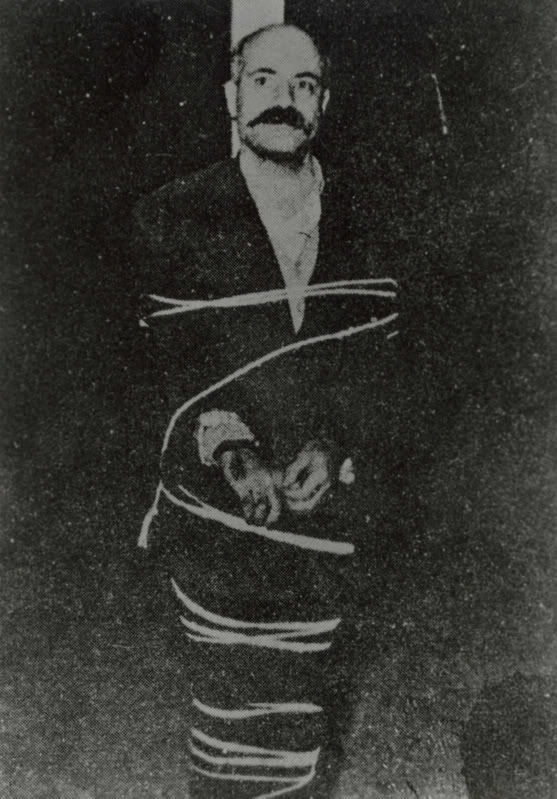
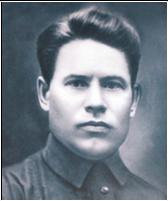
1915: 20 Hunchakian gallows

On this date in 1915, twenty activists of the Armenian Hunchakian political party were publicly hanged in Istanbul’s Beyazit Square.


A couple of other very grainy (newspaper?) images are here.

These unfortunates had participated in a 1913 convention that resolved — secretly, so they thought — upon treating to a programme of political assassinations of the nationalist Young Turks then driving belligerent policy against Armenians.

Unfortunately for them, the Sublime Porte had sublime ears.* It pounced on the prospective terrorists at the first opportunity, and gave them a couple of years in a dungeon before a wartime show trial days just days after Armenian genocide had commenced.

Paramaz, who’s probably the most individually famous of the twenty, has a recently-erected monument in Meghri. He’s also credited with a movingly humane exchange with an Ottoman judge, each reflecting on their respective impasse vis-a-vis nationhood and self-determination.

“The attributes of history in our reality are arranged in such a way that what constitutes ‘patriotism’ for one is viewed as destructive treason by the other,” quoth the judge (!!!) to the defendants.

And thus the mutual relations between nations living together amount to the negation of international law and social concepts. Today is the last session of these trials … There was something unusual and unqualifiable in these trials. Unqualifiable because neither you nor us had enough wisdom to penetrate each other’s [worlds].

You cannot imagine, effendis, that it is with such grief that I will pronounce the depth of my conviction regarding the patriotism accumulated in you. What can be more heartbreaking tht warm blooded beings like you full of life have sacrificed logic to sentiments … What great deeds vigorous individuals like you could have accomplished, if the ideal of a common welfare had been pursued under one banner … What benefits could have been borne from a mutual understanding that eluded [us], the other end of which is sad and dark. You languished with the idea that you are struggling against injustice; while have felt, every minute, that the rules of the world are abasing higher tendencies under the weight of cruel necessities.

This reflection led Paramaz, who today is an Armenian national hero for his martyrdom at the Turks’ hands, to reciprocate:

I, who has never cried in my life … I am not ashamed to say that I was deeply moved by the sincerity of [the judge] Khurshid Bey’s speech … and I cried, I, Paramaz, because Khurshid Bey put his finger on the wound when he stated, ‘What good deed could have been accomplished …’ I cried because in those words I found the brilliance of truth.

[Yet] we would be asking the same question, and add, What was left that we did not do for the welfare of this country. We accepted such sacrifices, we spilled so much blood and spent so much energy to bring about the brotherhood of Armenians and Turks; we lived through such suffering to elevate each other through trust. And what did we see? Not only did you condemn our gigantic efforts to sterility but also consciously pursued our annihilation …

Gentlemen, judge people by their work, by their traditions, within the realm of their ideas. I am not a separatist from this country. On the contrary it is [this country] that is separating itself from me, being incapable of coming to terms with the ideas that inspire me.

(Both quotes are as cited by Gerald Libaridian’s chapter exploring the Hunchak party’s history and doctrine, from A Question of Genocide: Armenians and Turks at the End of the Ottoman Empire.)

Mutual empathy notwithstanding, the end for these twenty was indeed sad and dark.

* An Armenian informant named Arshavir Sahagian attended the conference and finked out its design. He was killed for his troubles on December 25, 1919, according to Raymond Kevorkian.

On this day..

1944: Johanna Kirchner, Frankfurt antifascist

“Keep Goethe‘s words in mind. ‘Die and become’. Don’t cry for me. I believe in a better future for you.”

-Johanna Kirchner’s last letter to her children

On this date in 1944, former social worker Johanna (“Hanna”) Kirchner was beheaded in Plotzensee Prison for treason.

(cc) image from Fran Behnsen of a Kirchner commemoration plaque in Frankfurt’s St. Paul’s Church.

Kirchner English Wikipedia entry | German) co-founded with Marie Juchacz after World War I the still-extant Workers’ Welfare organization: Arbeiterwohlfahrt, or “the self-help of the workers.”

These self-helping workers — both members of the socialist Social Democratic Party; Juchacz was a Reichstag member — had to flee to League of Nations-administered Saarland with the rise of the Nazi dictatorship … and from there, soon enough, on to France.

There the Vichy government arrested her in 1942 (Juchacz got out to the United States), and deported Kirchner to Germany to answer as a traitor.

She had a sentence of “only” ten years at hard labor, but the case was unexpectedly reopened in 1944 so that the cartoon villain of fascist jurisprudence, Roland Freisler, could give her a spittle-flecked death sentence for having “treasonably rooted herself in the evilest Marxist high-treason propaganda.”

Kirchner’s native Frankfurt has a Johanna-Kirchner-Straße, and in the 1990s awarded a Johanna-Kirchner-Medaille to anti-fascists.


View Larger Map

On this day..

1958: Khosrow Roozbeh

On this date in 1958, Iranian communist Khosro(w) Roozbeh was shot in Qezel Qal’eh prison.

“A popular teacher at the Military Academy, Rouzbeh was the author of a number of pamphlets on chess, artillery warfare, and, together with Ovanessian, the country’s first political lexicon,” blurbs Tortured Confessions: Prisons and Public Recantations in Modern Iran.

He was also not only a communist, but a radical within the context of Iran’s communist Tudeh Party.

After the 1953 CIA-backed coup restored the Shah of Iran, his government persecuted Tudeh activists as a fifth column.

Thousands were arrested, and brutally tortured into betraying their comrades. While most weren’t put to death, Roozbeh was both a true militant — he opposed moderates’ attempt to make common cause with the liberal Mossadegh government that the Shah had deposed — and the organizer of a network of military infiltrators. The British embassy called him the “Red Pimpernel” for his uncanny talent for slipping traps and getting about in disguise. But that act never has a long shelf-life.

Roozbeh was finally winged in a 1957 shootout and taken into custody, where he was tortured into his own confessions (e.g., that he had assassinated Tudeh members who were too willing about their police collaboration). After spending his last night on this planet putting NaNoWriMo to shame by cranking out a 70-page political manifesto, he’s supposed to have met his executioners defiant to the last, refusing a blindfold and crying “Long Live the Tudeh Party of Iran! Long Live Communism! Fire!”

But the volley that silenced Roozbeh’s cry can be seen in retrospect to mark the definitive elimination of communism from Iran’s political stage, the piece de resistance for SAVAK’s campaign of suppression.

After Roozbeh, Tudeh slipped into irrelevancy (Spanish link) … leaving little but the outsized myth of its most renowned martyr.

On this day..

1861: Anton Petrov, of Bezdna

On this date in 1861,* a peasant rebel was shot for demanding a little too much emancipation.

The scene is a village — aptly named Bezdna, which is Russian for abyss — in the Kazan Province, and the time is the critical reign of tsar Alexander II.

This reformer, who ascended the throne in 1855, saw his historic task as modernizing and liberalizing Europe’s most backward great power (fresh off a salutary clock-cleaning at British hands in the Crimean War). Ultimately, he wouldn’t advance Russia’s feudal despotism far enough, fast enough before revolutionaries murdered him, and his descendants suffered the consequences.

Here in 1861, all that bloodshed remains many years to the future, and a young Alexander is reordering Russia with the landmark emancipation of the serfs.


Reading the Manifesto, by Boris Kustodiev. (Also see this version)

Big. Change.

But, you didn’t really think the power and property interests that nobles held in their serfs were just going to be thrown over willy-nilly, did you?

Quite the contrary. Emancipated serfs got small plots of land** along with obligations to pay off their lords, restrictions on using lands designated to aristocrats, and new bureaucracies to answer to. In short, this wasn’t exactly the freedom of the open road. This was swapping an old set of onerous legal encumbrances for a new set. Sort of tsarist Russia’s 40 acres and a mule moment.

The Bezdna unrest started when a charismatic local peasant named Anton Petrov started convincing his neighbors that the the local officials interpreting the new reforms were lying, and that volya, a true open-ended liberty, had been proclaimed. One should bear in mind here that most serfs were illiterate, and both depended upon and distrusted the legal interpretations bandied about by literate country squires who also happened to be directly interested parties in the law they were announcing. Russia had some issues.

Some form of this grumbling must have been common throughout the Empire, but in Bezdna it became even more serious than that. Transported by Petrov’s “perverse interpretation” of the law, emancipated serfs refused to fulfill their alleged obligations to nobles or recognize the legal authorities who were those nobles’ handmaidens.


Klavdy Lebedev‘s painting of Alexander II personally announcing emancipation to serfs. Maybe it’s a good thing he didn’t actually do that.

This experience of volya was as short-lived as it was intoxicating. Within days, troops arrived to “emancipate” the peasantry properly.

On April 12 (April 24 by the “New Style” Gregorian calendar), thousands of unarmed and peaceful ex-serfs were confronted by a detachment of the Russian army. According to a report to the Minister of Internal Affairs translated and excerpted in Daniel Field’s Rebels in the Name of the Tsar, the troops demanded Petrov’s surrender — but

the people kept replying the same thing: “We will not surrender him, we are united for the tsar, you will be shooting at the Sovereign Alexander Nikolaevich himself.” The soldiers, drawn up in ranks, made five or six volleys; they shot the first few without aiming, so that at a distance of 300 paces [only] three or four men fell, but then they became outraged by the peasants’ stubbornness, and hit with every shot on the fourth volley. The poor people stood motionless like a wall and continued to shout, “We will not yield, it is the tsar’s blood that is flowing, you are shooting at the tsar.” After the last volley they wavered and fled, and then Anton Petrov appeared, holing the [Emancipation] Statute on his forehead, and was arrested.

It must have been a riveting spectacle, to see this peaceable and resolute mass of humans fired by the promise of freedom, absorbing volley after volley from their savior tsar’s own foot soldiers. Well over 50 civilians died.

These people, at least, did not endure the last volley of a judicial massacre. Petrov only was punished, lashed to a telegraph pole and shot in public.

Publishing from exile in England, Russia socialist Alexander Herzen lamented the martyred serfs’ suicidal adherence to that venerable myth of the good tsar.

If only my words could reach you, toiler and sufferer of the land of Russia!… How well I would teach you to despise your spiritual shepherds, placed over you by the St. Petersburg Synod and a German tsar…. You hate the landlord, you hate the official, you fear them, and rightly so; but you still believe in the tsar and the bishop … do not believe them. The tsar is with them, and they are his men. It is him you now see — you, the father of a youth murdered in Bezdna, and you, the son of a father murdered in Penza…. Your shepherds are as ignorant as you, and as poor…. Such was another Anthony (not Bishop Anthony, but Anton of Bezdna) who suffered for you in Kazan…. The dead bodies of your martyrs will not perform forty-eight miracles, and praying to them will not cure a tooth ache; but their living memory may produce one miracle — your emancipation.

* The officer sent to suppress the revolt reported that “the military court passed sentence on April 17, I confirmed it the same day, and it was carried out on the 19th” — referring to the Julian dates, which correspond to April 29 and May 1, respectively. However, this is quoted by Field, who believes that officer is himself mistaken about the 19th; since I don’t have access to the primary documents which lead him to that conclusion, and all the secondary sourcing on the execution date is pretty squishy, I’m just going with the self-reported April 19/May 1 date.

** Serfs who hadn’t been working in agriculture were pretty well hosed: they got emancipation without the land.

On this day..

1916: Joseph Hani, abandoned

“Mr Joseph Hani was hanged for treason in the Burj at 5 a.m. At 8 a.m. 40 families deported.

-Diary of Mrs. Harry Dorman, April 5, 1916*

The unfortunate Joseph Hani — Yusuf al-Hani — was among the worthies of Beirut’s Maronite Christian community to petition the French consulate for western aid in detaching Lebanon from the Ottoman Empire.

With the development of World War I, the French ambassador Francois Georges-Picot abandoned the embassy … without removing or destroying this sort of incriminating correspondence. As a result, the Turks ransacked the embassy and identified several dozen of reproachable loyalty to the Porte to put to death.

May 6 — Martyrs’ Day — honors these victims, but Hani was among the very first of them.

While most of the other Maronite signers were able to fly, Hani stuck around to face the music. A British agent was able to contact the implicated characters in Aley Prison, and received the plaintive answer,

‘Where are the English? Where are the French? Why are we left like this?’

* I believe an ancestor of the current president of the American University of Beirut, Peter Dorman. The source of the diary citation is Nicholas Z. Ajay Jr.’s “Political Intrigue and Suppression in Lebanon during World War I” in International Journal of Middle East Studies, Apr., 1974.

On this day..

2010: Modise Mokwadi Fly, Botswana pol

(Thanks to Meaghan Good of the Charley Project for the guest post. -ed.)

On this day in 2010, reggae artist, politician, activist and convicted child killer Modise Mokwadi Fly was hanged in Botswana’s capital city of Gaborone.

He was the second person to be executed under the administration of President Ian Khama; the first was also a child killer.

Fly, a South African national, had been general secretary of the Botswana Congress Party Youth League. On November 27, 2006, he killed his two-year-old son, Tawana Mosinyi, with an ax while the toddler slept. Fly maintained until his death that Tawana’s death was accidental and he’d actually been trying to throw his ax at the police who were firing shots at his house from outside. The prosecution believed Fly deliberately killed his son to spite the child’s mother, whom he’d recently quarreled with.

After his conviction on October 17, 2008, Fly apologized to Tawana’s family for his death. He sentenced to hang five days later, then he waited a year and a half for his date with death. Witnesses reported he seemed oddly cheerful and gregarious in court, smiling and chatting amiably with his friends and relatives who attended the trial.

In February 2010, the month before his execution, Fly made an attempt to escape from prison. He was the first prisoner to succeed in escaping from Botswana’s death row — but he was only free for fifteen minutes. After his capture, it was alleged, he was brutally beaten by the guards and then placed in solitary confinement so no one could see his injuries.

If the prison did in fact do this, it didn’t work: the news of the alleged mistreatment became public on March 23. Whether the timing had anything to do with his secretive execution the next day is unclear. Predictably, Botswana’s Department of Prisons and Rehabilitation denied that the prisoner had been abused or placed in isolation.

On this day..

1956: Jesus Maria de Galindez

(Thanks to Meaghan Good of the Charley Project for the guest post. -ed.)

On this date in 1956 or very shortly thereafter, Jesus Maria de Galindez was probably executed in the Dominican Republic.

Jesus Maria de Galindez

The previous day, he had vanished without a trace from New York City. According to unconfirmed but highly credible accounts, he was killed on orders from — and in the presence of — Dominican dictator Rafael Leonidas Trujillo.

Galindez’s disappearance caused an international incident. It was covered in numerous newspapers and periodicals, including Time and Life, and was the subject of much speculation and many conspiracy theories. In spite of an extensive search, his body has never been found. The case has remained in memory into the 21st century, however, as this 2001 New York Press article demonstrates.

Who was Galindez?

Born in Spain in 1915, he was a political activist, a committed anti-fascist and Basque nationalist. As a result, he ran into trouble with Spain’s dictator, Francisco Franco, and had to run for his life.

In 1939, Galindez set up shop in the Dominican Republic, only to find fascism polluting this country as well. He had to run again in 1946, this time to New York City.

While working on his Ph.D in political science from Columbia University, Galindez found the time to teach college classes, write a newspaper column which was syndicated throughout Latin America, and represent the Basque government-in-exile. He was a busy man.

He was also very afraid, and with good reason. Like most despots, Rafael Trujillo held grudges for a long, long time, and his henchmen kidnapped and/or killed many of his enemies, even those outside the country. One of Galindez’s friends was killed by Trujillo’s agents in Manhattan in 1952.

Galindez then wrote a letter to be opened in the event of his death or disappearance, stating that if he should come to harm, Trujillo was surely behind it.

On March 12, 1956, Galindez taught a class at Columbia and a student gave him a lift to the subway. This was the last time he was seen alive. When he was reported missing five days later, all his belongings were found undisturbed in his apartment. The FBI and the New York Police Department searched for him without result.

According to an investigation by Life magazine, which published its conclusions in 1957, Trujillo’s agents forcibly abducted Galindez on March 12, drugged him and bundled him aboard a small private plane piloted by an American, Gerald Murphy.

Early in the morning on March 13, Murphy stopped in Miami for fuel, then continued southward, stopping at Monte Cristi in the Dominican Republic. From there another pilot, Octavio de la Maza, took over. De la Maza was a tough character who had already committed one murder, in England. He flew Galindez to Ciudad Trujillo. Galindez was then shot to death in Rafael Trujillo’s presence and buried.

The Dominican government tried to buy off Murphy with a plum job as a flight captain, but pretty soon he started blabbing about his mysterious plane trip and its passenger, whom he’d at first thought was a wealthy invalid.

Pilot Octavio de la Maza: mopped up.

Thus was a second assassination necessary to cover the first: in December 1956, Murphy vanished without a trace in the Dominican Republic, only days before he was due to fly home to America. His body was never found. Now, his co-pilot had to be silenced, and a very neat job it was too: Octavio de la Maza was arrested and charged with Murphy’s murder. He had just enough time to get his parents out of the country before the ax fell, but never came to trial because he was found hanged in his cell in January … conveniently leaving a full confession in writing: Murphy had hit on him, and De la Maza lost his temper and pushed him off a cliff.

The world smelled a rat. Trujillo, of course, denied everything and went so far as to hire an American lawyer, Morris Ernst, to conduct his own investigation into Galindez’s disappearance. After ten months, Ernst issued a report predictably exonerating his employer. He claimed Galindez had stolen money earmarked for the cause of Basque Nationalism and simply walked out of his life.

And there the matter rests.

No charges were brought against anyone in Galindez’s disappearance. Columbia awarded him his Ph.D in absentia and his thesis, published as The Era of Trujillo, became a bestseller throughout Latin America.

What goes around comes around: Trujillo was himself assassinated in 1961. One of the men who plotted his murder was Antonio de la Maza, Octavio’s brother.

On this day..

1794: Jacques Roux, the Red Priest, cheats the guillotine

On this date in 1794, French Revolution firebrand Jacques Roux committed suicide to avoid execution during the Terror.

Roux was a Catholic vicar on the eve of the Revolution, and “of the many priests who had left the church to join the Revolution none was more articulate and socially aware.”

He became a leading exponent of the radical enragés, a faction that really took the Revolution’s purported egalite to heart.

In early 1793, Roux was an official representative to the execution of Louis XVI — one can read his minimalistic report here; knowing that Roux was a priest, Louis tried to press him for some spiritual aid, and was rebuffed. “I am only here,” Roux answered icily, “to lead you to the scaffold.”

The man’s invective against the merchant classes packed considerably more heat.

Roux’s Manifesto of the Enrages minced no words:

Freedom is nothing but a vain phantom when one class of men can starve another with impunity. Equality is nothing but a vain phantom when the rich, through monopoly, exercise the right of life or death over their like. The republic is nothing but a vain phantom when the counter-revolution can operate every day through the price of commodities, which three quarters of all citizens cannot afford without shedding tears.

For the last four years the rich alone have profited from the advantages of the Revolution. The merchant aristocracy, more terrible than that of the noble and sacerdotal aristocracy, has made a cruel game of invading individual fortunes and the treasury of the republic; we still don’t know what will be the term of their exactions, for the price of merchandise rises in a frightful manner, from morning to evening.

Unfavorably contrasting the new haves with the ancien regime is the sort of thing that gets you into trouble in a bourgeois revolution.

Burdened by multiple wars, and then by poor harvests, France’s economy was a mess. Later that same year, Paris’s urban poor, the sans-culottes, invaded the Convention to force anti-hoarding and price control measures. Roux didn’t create that situation: he just had the nerve to risk his neck talking about it.

But by then, that prim ascetic Robespierre had already begun hounding Roux. He would hound him to his death.

Kropotkin‘s anarchist history, The Great French Revolution, 1789-1793, valorizes the courageous former priest. In Kropotkin’s narration, we find Roux ordered transferred out of ordinary police court to the Revolutionary Tribunal on some spurious charge of financial impropriety.*

Knowing what that meant, Roux stabbed himself in court thrice with a knife. The president of the court hastened to his assistance and displayed much friendliness towards him, even giving him the kiss of civic brotherhood, before he was removed to the Bicetre prison. In the prison infirmary Roux “tried to exhaust his strength,” as it was reported to the procurator of the Revolutionary Tribunal, Fouquier-Tinville, by opening his wounds; and finally he succeeded in stabbing himself once more, this time mortally, through the lung.

In terms of present-day iconographic potential, the French Revolution probably did not produce a more outstanding radical leftist; Roux’s direct critique of economic power clearly marks him as a forerunner of subsequent generations’ communist and anarchist movements … as well as even more contemporary voices.

And undoubtedly, Roux’s project remained (and remains) unfinished. Surveying the scene after the Terror, Roux’s onetime ally Jean-Francois Varlet remarked, “In my country there has only been a change of dress.”

There’s more of Roux’s writing on Marxists.org.

* A much more serious graft charge would likewise be deployed to topple Danton.

Longtime readers may recall that this post was briefly (and mistakenly) up on this date in 2011. Oops.

On this day..

1937: Martemyan Ryutin, for his affair

On this date in 1937, Martemyan Ryutin was condemned to death and immediately executed in Stalinist USSR.

Ryutin (English Wikipedia entry | Russian | another Russian bio) was a revolutionary from the Far East who by the late 1920s was in the Bolsheviks’ heretical right wing; his affiliation with Bukharin and Rykov got him temporarily booted out of the Communist party in 1930.

Not content to keep his head safely down as Stalin’s star ascended, Ryutin typed out an anti-Stalin pamphlet and the 200-page “Ryutin Platform” denouncing Josef Djugashvili as “the gravedigger of the Revolution” and urging that he be removed — even by force.*

Weeks after Ryutin began circulating this incendiary samizdat the secret police busted him.

Though open discussion of the so-called Ryutin Affair was nonexistent in the Soviet Union until the Gorbachev era, it was a matter of dire importance for the Politburo in 1932; indeed, fleeting as it was, it’s one of the few organized elite attempts to thwart Stalin discernible during the 1930s. Stalin wanted Ryutin executed, but he was outvoted; this is a small milepost on the way to the Yezhovschina indicating that Stalin’s power still had its limits … and Bolsheviks still recoiled at the prospect of killing other party members.** These constraints were not very long for the scene.

Even so, Ryutin got a 10-year prison sentence and anyone else who had read the Ryutin platform without informing on it to the Party was in seriously hot water. Twenty-four were expelled from the party in October 1932 for this reason, including once-proud and soon-doomed Old Bolsheviks Zinoviev and Kamenev.

Ryutin, for his part, had only a few years to wait before the deteriorating political climate dispensed with those taboos about internecine bloodletting. The Supreme Court signed off on his execution this day with just a few minutes’ hearing, and it was immediately carried out.

Ryutin’s two sons were also executed in 1937, and his wife died in a labor camp. Only his daughter Lyubov survived the Ryutin Affair — which convictions were posthumously reversed in 1988.

* Bukharin’s widow later wrote that Stalin’s agents later added the most inflammatory material — like that violent overthrow stuff.

** Had Stalin had his way in 1932, Ryutin would have had the distinction of being the first Central Committee member to be executed, according to Suzi Weissman.

On this day..

2010: Two Iranian political prisoners

Two politically sensitive cases, otherwise unrelated to one another, were joined in hanging at Iran’s Evin Prison on this day last year, possibly in a tit for tat following the November assassination of a nuclear physicist.

Ali Saremi

Ali Saremi cut the highest profile of the two, a 63-year-old member of the People’s Mujahedin of Iran (PMOI, aka MEK or MKO).

The PMOI/MEK/MKO, originally a Marxist revolutionary group opposing the dictatorship of the Shah, split with the theocratic Iranian Revolution.

It’s led an interesting life since then.

After creating the still-extant National Council of Resistance of Iran, the PMOI set up camp in Saddam Hussein‘s Iraq, which readily deployed it in the Iran-Iraq War.

Camp Ashraf was still there when the U.S. invasion rolled into Baghdad in 2003. (As of this writing, it’s only just now being closed.) While MEK has long been considered a terrorist organization, including by the U.S. State Department,* Iraq’s new occupiers also found this nest of exiles a convenient ally for its own campaign against Iran’s mullahs.

The organization has been much in the news of late both as a bargaining chip in regional diplomacy, and for lavishly bankrolling a lobbying campaign to get off everybody’s official terrorism lists — positioning itself as simply an Iranian opposition group. (It claims to have renounced violence.)

From Tehran, of course, there’s much less gray shading: the MEK is an enemy.

Saremi, a longtime member, was arrested four times for his association with the group.

The first time was in 1976; the last, and ultimately fatal, in 2007. He had just returned from Camp Ashraf to visit his son and commemorate the anniversary of Iran’s late-1980s mass execution of prisoners, an atrocity that claimed a large share of MEK sympathizers in apparent retaliation for the organization’s aforementioned wartime aid to Baghdad.

Saremi got the all-purpose mohareb death sentence — roughly, “waging war against God,” which can potentially compass any resistance to the Islamic Republic — basically for having a going association with PMOI. According to NCRI, Saremi’s prosecutor alleged that

[h]e visited Ashraf and during that he received necessary trainings and returned to the country … and eventually he was arrested in August 2007 for his repeated activities and participation in counter revolutionary ceremonies and gatherings in support of PMOI and dispatching reports to this grouplet (PMOI). During a search in his house some CDs, films, pictures from PMOI and hand written organizational documents linked to the grouplet were found and confiscated.

Iran carried out the execution without notice.**

Ali Saremi’s portrait and memory are now powerful props for the MEK terrorism de-listing campaign.

Ali Akbar Siadati

Also hanged this day was a man named Ali Akbar Siadati, about whom only sketchy information appears to be available.

Siadati was condemned for spying for Israel from 2004 until his arrest in 2008, allegedly supplying Iran’s foe a wide range of sensitive military information — a crime to which Siadati confessed, according to the state news agency IRNA.

Who Siadati was, how he had access to military intelligence, and why (apart from money) he might have betrayed it seems to be publicly obscure.

* In fact, the charge of sheltering MEK — guilty of “terrorist violence against Iran” — even appears on the Bush administration’s justification for war with Iraq.

** Iranian law requires 48 hours’ notice of an imminent execution be given to a defendant’s lawyer. This rule is routinely ignored.

On this day..