1909: The Pollet gang, breaking the French moratorium

Warning: Graphic severed head pictures await at the bottom of this post.

On this date in 1909, the guillotine returned France after an absence of more than three years.

The sitting president was a staunch death penalty opponent and had blocked all executions since his term began in 1906. That was about the same span of time that the Pollet gang had, in the words of a New York Times wire report,* “infested the Belgian-French frontier, robbing churches, houses, and inns, holding up stage coaches and belated travelers, and torturing and slaying their victims according to the old piratical adage that dead men tell no tales.”

Abel Pollet had been a smuggler who put his native gift for leadership to good use organizing his fellow traffickers into a more lucratively violent line of work. Thanks, presumably, to the syndicate’s pre-existing professional aptitude for evasion, it persisted for years and authored a quantity of robberies and murders that authorities could only guess at. (The official homicide estimation ran north of 50.) It was a spree so atrocious that it helped force the end of the whole death penalty moratorium since sentiment was so strong against the Hazebrouck gang .

Incited by the many depredations and perhaps starved from years without the bloody spectacle of public execution, a vast concourse of 30,000 mobbed the guillotine at Bethune.

“At midnight there were 2,000 watchers in the square,” one report ran. “The main street of the town was crowded as on the eve of a fete. Soon after midnight men brought ladders and benches to the square and mounted them to obtain an uninterrupted view. Others climbed into the branches of trees, where their presence was revealed by the glow of cigarettes and pipes in the dark among the branches.”

Undeterred by the steady winter’s drizzle, they would wait all the night through, their numbers continually augmented as road-trippers arrived by train.

At four in the morning the dread traveling executioner Anton Diebler, who had already plied this trade for a generation and more and would continue in the role for another 30 years, arrived with four assistants to set up the guillotine. It was only with difficulty that police restrained the pawing mob.

By half-past five the public prosecutor officially informed the condemned men what they surely already knew — that there would be no mercy. The crowd on the square would have its prey.

As the first robber, Theophile Deroo, emerged at 7:25 a.m., “there was a painful silence, and then an outbreak of hoots and curses from the crowd.” A wilting Deroo had to be hustled to the board amid the jeers. “A mort! A mort!” came the howls.

Three times in the next eight minutes the executioners furiously scrubbed the apparatus clean while guards (per the Times) “held the crowd back with main force.”

Canut Vromant followed coolly; Auguste Pollet was third, fighting and shouting. His brother, the leader Abel Pollet, went under a rain of curses that he answered with the words “Down with the priests! Long live the Republic!”

People are ghoulish. Far be it from us to deny them.


Top: the heads of the Pollet brothers. Middle: The heads of their two accomplices. Bottom: Canut Vromant’s headless trunk awaits autopsy. All images from the invaluable Bois de Justice, via this goregrish forum.
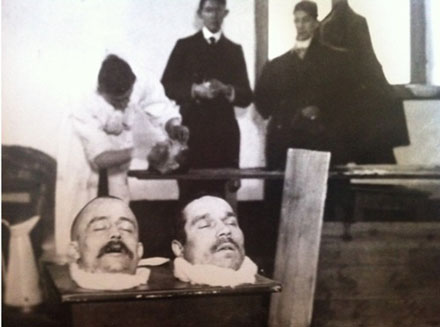

After the quadruple executions, the heads are cleaned up. (Source)

Perhaps, dear reader, you find the public exhibition of these severed heads objectionable. If so, you have an ally in the French state that did the severing.

For years, French elites had been fretting the indecorous behavior of the crowd at what was supposed to be a solemn occasion. The advent of photography only made matters worse, for now the discomfiting head-chopping exercise could be shared with those indisposed to sitting up all night smoking pipes in trees.

But as the moratorium gave way, the rising media form of cinema promised even more debased exhibitions. Enterprising cinematographers were already staging execution re-creations; now there was the prospect for film audiences to be incited to countless bloodlust frenzies by on-the-scene deathporn footage of hated criminals going under the blade. It was in response to just this fear that France a bit later in 1909 promulgated (French link) its first film censorship rules — forbidding in this case the public display of film liable to disturb the public tranquility.

* Jan. 16, 1909 … under the excited headline “THIRST FOR BLOOD AMONG THE FRENCH”,

On this day..

1778: Josiah Phillips, attainted by Thomas Jefferson

There is one example of this violation in Virginia, of a most striking and shocking nature; an example so horrid, that if I conceived my country would passively permit a repetition of it, dear as it is to me, I should seek means of expatriating myself from it. A man, who was then a citizen, was deprived of his life thus: From a mere reliance on general reports, a gentleman in the house of delegates informed the house, that a certain man had committed several crimes, and was running at large perpetrating other crimes; he, therefore, moved for leave to attaint him; he obtained that leave instantly … Without being confronted with his accusers and witnesses, without the privilege of calling for evidence in his behalf, he was sentenced to death, and was afterwards actually executed. Was this arbitrary deprivation of life, the dearest gift of God to man, consistent with the genius of a republican government? Is this compatible with the spirit of freedom? This, sir, has made the deepest impression in my heart, and I cannot contemplate it without horror.

Edmund Randolph (Source)

On this date in 1778, attainted Revolutionary War-era outlaw Josiah Phillips was hanged in Virginia.

Contrary to Randolph’s recollection, the execution took place according to a regular jury verdict convicting Philips for stealing 28 hats and five pounds of twine — felony theft by the Bloody Code inherited from England.

Even so, it was the Act of Attainder voted unanimously by the Virginia legislature that stuck in the popular memory, so much so that even the likes of Randolph, a lawyer by trade and later the first Attorney General of the independent United States, misstated* it as the proximate cause of Phillips’s execution.

Another inheritance from the mother country, Acts of Attainder — wherein the legislature declares some party guilty of a crime and declares punishment without benefit of trial — were going right out of style in the twilight of the 18th century. The eventual U.S. Constitution would flatly abolish the practice; Britain herself has not enacted one since 1798.

So it comes as some surprise to see that Phillips was outlawed** at the instigation of no less a person than old Mr. Inalienable Rights himself, Thomas Jefferson. Jefferson’s Bill of Attainder gave Philips and his band a June 1778 deadline to turn themselves in voluntarily, or else they

shall stand and be convicted and attainted of high treason, and shall suffer the pains of death, and incur all forfeitures, penalties and disabilities prescribed by the law against those convicted and attainted of High-treason: and that execution of this sentence of attainder shall be done by order of the General court to be entered as soon as may be conveniently after notice that any of the said offenders are in custody of the keeper of the public gaol …

And that the good people of this commonwealth may not in the mean time be subject to the unrestrained hostilities of the said insurgents, be it further enacted that from and after the passing of this act it shall be lawful for any person with or without orders, to pursue and slay the said Josiah Philips and any others who have been of his associates or confederates at any time.

Now in fairness, Josiah Phillips was no ordinary hat-thief, regardless of what the charge-sheet read. He was a Tory marauder who led a gang of outlaws/guerrillas/terrorists who lurked in the Dismal Swamp and had just weeks before repelled a Commonwealth militia dispatched by Governor Patrick Henry.

For Henry, who sought the attainder, and for Jefferson the Phillips band looked like a clear security threat. “The delays which would attend the proceeding to outlaw the said offenders according to the usual forms and procedures of the courts of law would leave the said good people for a long time exposed to murder and devastation,” in the words of the attainder. And indeed, the rebellious colonies — ultra-patriotic Pennsylvania especially — had had regular recourse to Acts of Attainder against Tory loyalists over the span of the American Revolution. (Actual executions under attainders were extremely rare.)

However, the inconsistency of such an instrument long associated with monarchical tyranny with its author’s more usual Rights of Man fulminations had Jefferson still defending the Phillips attainder as late as 1815.

Whatever might have best suited Josiah Phillips, the last word on the matter in American jurisprudence has belonged to the overwhelming sentiment of his fellow-Founders … like James Madison, whose Federalist no. 44 flatly avers that Bills of Attainder “are contrary to the first principles of the social compact, and to every principle of sound legislation.”

* Randolph himself, as Virginia’s attorney general, made the call not to use the attainder against Phillips because of Randolph’s own discomfort with it. But his “misremembering” was convenient to a later interest in excoriating Patrick Henry.

** Arguably contravening Virginia’s existing 1776 Declaration of Rights. “In all capital or criminal prosecutions a man has a right to demand the cause and nature of his accusation, to be confronted with the accusers and witnesses, to call for evidence in his favor, and to a speedy trial by an impartial jury of twelve men of his vicinage, without whose unanimous consent he cannot be found guilty; nor can he be compelled to give evidence against himself; that no man be deprived of his liberty except by the law of the land or the judgment of his peers.”

On this day..

1690: An infanticide, a coiner, and a highwayman

Hanging day — and burning day, and drawing-and-quartering day — at Tyburn this date in 1690 saw a dozen souls condemned to shuffle off this mortal coil.

Nine of these were reprieved, mostly various shoplifters and thieves. (One, Constance Wainwright, was just 16 years old: she stole a silver teapot and a petticoat.)

Mercy Harvey — named only M– H– in her Old Bailey indictment — was a domestic servant and “a very Ignorant Silly Girle” who bore a son out of wedlock. A young woman in such a predicament in 1690 London could be liable to lose her position, and in a city swelling up daily with new arrivals there could be very far to fall indeed.

The Ordinary of Newgate devotes the most space in his account to her, suggesting that she was the most amenable of the condemned to his ministry. Mercy Harvey described to him a timeless predicament.

I discoursed with her, and ask’d, Whether she had any Promise of Marriage with him who begat it? She answered no. Or whether he did promise any Maintenance for herself? She replyed no: but by often soliciting her she yielded to his Desires. She said that when she proved with Child, she dispaired how to provide for it, and so Satan tempted her to expose the Child to Death.

The young woman confessed her crime on hanging-day, but in a state of near collapse, and she was “very sick, and unfit for Discourse.”

What added torture Harvey must have experienced with the rough hemp rope around her neck as the Ordinary with “unwearied industry” dilated to volley “all manner of Godly Exhortations” at her two male counterparts.

Thomas Castle and Thomas Rowland both refused to play their part, clinging by their obdurance to a last remnant of dignity or to fleeting extra moments of life.

Castle had suffered the added indignity of being dragged to the fatal tree on a sledge. Condemned a traitor under England’s bloody code for coining 50 counterfeit shillings (coin-clipping materials were found stashed up his chimney in an iron box), Castle was fortunate enough to have the disemboweling-and-quartering part of his sentence remitted.

The last character of the bunch was one of those stock characters of a passing age, the highwayman. Thomas Rowland had skipped out two decades prior on an apprenticeship in the exciting field of bricklaying and taken to the roads, where according to a colorful Newgate Calendar record he “always robbed in women’s apparel, which disguise was the means of his reigning so long in his villainy.” (But he made his getaways, we are assured, riding astride his mounts — not sidesaddle.)

We don’t know if Rowland caught any flak in Newgate for this abrogation of masculinity, but Rowland “was so abominably wicked that the very morning on which he died, lying in the Press Yard, for he wanted for no money whilst under confinement, a common woman coming to visit him, he had the unparalleled audaciousness to act carnally with her, and gloried in the sin as he was going to execution.”

On this day..

1812: Hölzerlips, Blood Court prey

On this date in 1812, the German bandit Hölzerlips — that’s just “Philip of the Woods”, despite what your dirty mind was thinking — was beheaded with three compatriots at Heidelberg.

They were part of a gang of six vagrant souls (the other two were spared on account of youth) who, finding everything displaced in the time of the Napoleonic wars, made their daily bread robbing around the Spessart in southern Germany.

In this capacity they racked up at least 15 known incidents of highway robbery, going so far as to kill a Swiss merchant on the road in 1811.

Captured shortly thereafter, Heidelberg grandees considered them (in)famous enough to merit a staged Blutgericht (“Blood Court”) followed by beheading this date, a spectacle that drew 30,000 gawking spectators in its day.


Friedrich Rottmann: Blutgericht über Hölzerlips Bande, 1812

On this day..

1913: Bonnot Gang members, anarchist illegalists

A century ago today, Raymond Caillemin, Elie Monnier and André Soudy were guillotined in Paris for their exploits with Third Republic France’s most celebrated band of anarchist bank-robbers, the Bonnot Gang.

It was actually not Bonnot but Octave Garnier who was the original moving spirit for the gang, which took shape in 1911 around a core of anarchist adherents to the philosophy of illegalism — criminality as resistance. The outlaws were revolutionaries, vegetarians, working-class. Though respectable anarchist communists fled from them, the philosophy bit wasn’t a pose.

“It’s because I didn’t want to live this life of present-day society, because I didn’t want to wait and maybe die before I’d lived, that I defended myself against the oppressors with all the means at my disposal,” Garnier wrote in a memoir discovered after he was killed in a police shootout.

To Garnier the gang owed its signature innovation of using automobiles: they were the first ever to use this novel machine to flee the scene of a crime after knocking over a Paris bank in December 1911. Between their internal combustion engine and their repeating rifles, they had a decided technological advantage on the police who pursued them.

For obvious reasons they were initially dubbed the “Auto Bandits.” But Jules Bonnot stole the marquee by marching into the office of La Petit Parisien in January 1912 to indignantly correct some of its reporting. The newspaper gave him an interview, and started branding the outlaws the “Bonnot Gang” (La bande a Bonnot), a name which has stuck for posterity and titles a 1968 film about them.

And the “Bonnot Gang” moved plenty of papers.

For the next three months, they would repeatedly crash the headlines on either side of the French-Belgian border by stealing cars to perpetrate new robberies, often shooting policemen and bank tellers into the bargain.

Meanwhile, they magnetized admirers and enemies alike with their Gallic intrepidity and self-confessedly impossible struggle. Garnier mailed his fingerprints to the police chief. Ground-down proletarians fell into their orbit, cracking bitter fatalistic jokes. Under the pen name La Retif, a young writer extolled the masculine, doomed outlaws: he was the Russian expatriate Victor Serge, at the start of a long revolutionary career.*

To shoot, in full daylight, a miserable bank clerk proved that some men have at least understood the virtues of audacity.

I am not afraid to own up to it: I am with the bandits. I find their role a fine one; I see the Men in them. Besides them I see only fools and nonentities.

Whatever may result, I like those who struggle. Perhaps it will make you die younger, or force you to experience the man-hunt and the penal colony; perhaps you will end up beneath the foul kiss of the guillotine. That may be! I like those who accept the risk of a great struggle. It is manly.

Besides, one’s destiny, whether as victor or vanquished, isn’t it preferable to sullen resignation and the slow interminable agony of the proletarian who will die in retirement, a fool who has gained nothing out of life?

The bandit, he gambles. He has therefore a few chances of winning. And that is enough.

The bandits show strength.

The bandits show audacity.

The bandits show their firm desire to live.

By April and May the authorities were finally overcoming the audacious bandits, though desires to live showed firm to the last: both Bonnot and Garnier were overcome and killed only after holding off protracted sieges against overwhelming numbers.

Although the headline attractions were gone, the ensuing massive trial soon fitted four for death:

  • Raymond Callemin, Serge’s own friend and reading-companion since childhood
  • Elie Monier (or Monnier), the onetime refugee draft-dodger whose will grandiloquently bequeathed to the Paris library his copy of Darwin, and to the Paris museum the pistol he was arrested with, provided it be engraved with the phrase “Thou Shalt Not Kill”
  • The sickly Andre Soudy, reckless in his outlaw adventure since tuberculosis that he was too poor to fend off already had him coughing his way to an earl grave
  • The joiner Eugene Dieudonne, a friend and compatriot of the gang members but not an actual bank-robber himself. Dieudonne was reprieved on April 20th and dispatched instead to the French penal colony at Devil’s Island

Other prison sentences from a few years up to a lifetime at hard labor were meted out to various other Bonnot gang members and fellow-travelers, several of whom showed themselves dedicated enough to their heroic fatalism to take their own lives. One who attempted an escape only to find himself stymied when he attained the roof of the prison worked fellow-inmates into a frenzied chant of Viva l’anarchie as he hurled slate shingles at the guards who treed him, then wrapped up the performance by hurling himself off the roof, too.

“I would have liked to eat black bread with black hands,” that man’s last testament read. “But I was forced to eat white bread with red hands.”

* Serge got himself in some hot water as an anti-Stalinist in the Soviet Union. Serge’s mature (1945) appraisal of his youthful infatuation with the Bonnot gang, as well as his first-person recollections of the Bonnot gang trial (which got Serge himself a five-year sentence) can be read here

On this day..

1928: Charles Birger, bootlegger

On this date in 1928, colorful gangster Charles Birger was hanged in Benton, Illinois.

A sort of social bandit for the Prohibition era, Birger was born Shachna Itzik Birger to a Russian Jewish family that immigrated to the U.S.

Birger was a young saloon-keeper on the make when the U.S. decided to make a go of its first foolish drug war, Prohibition. And in the immortal tradition of drug wars, it made the enterprising purveyor a whole lot richer, and a whole lot violent-er.

While Al Capone‘s Tommy Guns were tearing up Chicago, Birger set up shop in southern Illinois. A literal shop: from his famous speakeasy Shady Rest, he did three-way battle with the (pro-Prohibition) Ku Klux Klan and the rival Shelton Brothers Gang.

This cinematic affair of armored car shootouts, aerial bombings, and gangland assassinations comes off with verve in A Knight of Another Sort: Prohibition Days and Charlie Birger. The bon vivant Birger, bursting with charisma, entertains at his gin joint, aids the misfortunate, corrupts the police, and merrily mobs up Williamson County.

That story reached its conclusion when Birger was arrested for ordering the murder of Joe Adams, mayor of a nearby town who had taken the Shelton Gang’s armored “tank” car in for repairs.

Birger said he hadn’t actually done that, but he went to the gallows grinning, and humorously chatted up reporters before the big show — cementing his myth with that legend-quality indifference to death.

“I’ve played the game and lost, but I’ll lose like a man,” Birger philosophized. “I’m convicted of a crime I didn’t commit, but I’ve committed a lot of crimes. So I guess things are even. We got too strong against the law, and the law broke it all up.” (From the Chicago Tribune, April 20, 1928.)


Birger shakes hands with so-called “humanitarian hangman”
Phil Hanna.


Birger insisted on hanging in a black, not a white, hood — owing to his hatred of the Ku Klux Klan.

Birger is still a legend in southern Illinois, and a live one at that: he’s been in the news lately due to a weird custody fight over the rope used to hang him.

This macabre historical memento also happens to be the last rope ever used for any public execution in Illinois.

On this day..

1811: Adam Lyal, highwayman

On this date in 1811, Adam Lyal was hanged as a highwayman in Edinburgh.

Adam Lyal went on trial with his brother John on January 3.

John’s counsel went with the insanity defense — you know, the classic; he’d been raving incoherently in prison and seemed not in his right mind. A doctor ruled that John “laboured under a state of idiotism … incapable of knowing the right hand from the left.”

So, despite the jailer’s suspicion that Lyal was simulating (he testified that John Lyal knew a hawk from a handsaw when he was first captured and didn’t start with the crazy talk for a few days), John Lyal was ruled unfit for trial.

That left Adam alone to answer for both. Maybe he should have requested a psychological evaluation too, because he was crazy to go on trial.

In that proceeding, he faced the detailed testimony of Matthew Boyd that on Oct. 25 previous, he was returning from the fair when the pair approached him.

On coming up, one of them laid his arm over the bridle, and having both pistols in their hands, they presented them, and desired him to deliver up his pocketbook, or they would blow his brains out.

Boyd boldly tried to bluff his way out of this at the risk of his life, but the robbers thrashed him until he coughed up a parcel of small notes … and then, most begrudgingly, another £100 of large notes he had stashed in his vest.

He’d relinquished his cash, for now, but this Matthew Boyd was an intrepid soul.

As he had been robbed in broad daylight, Boyd had plenty of time to get to Stirling, procure a warrant, and track Boyd’s assailants all the way to Edinburgh where the next day he finally found them in the streets and personally collared them.

Conclusion: do not rob Matthew Boyd.

Adam Lyal’s defense, considerably less effective than that of his brother, was to argue that the indictment charged a robbery in the shire of Perth, but it was actually done in the county of Stirling.

That … did not help.

Adam Lyal’s unfortunate fate has not precluded his latter-day career as an Edinburgh tour guide with an active Twitter account.

On this day..

1881: George Parrott, future footwear

(Thanks to Meaghan Good of the Charley Project for the guest post. -ed.)

On this date in 1881, George Parrott, a cattle rustler popularly known as Big Nose George, was lynched in Rawlins, Wyoming.

His story doesn’t end with his death, however: as his Wikipedia entry notes, Parrott was notable for “Banditry, Murder, being made into a pair of shoes.” Oh, and being pickled.

The series of events that lead to Parrott’s death began on August 19, 1878, when he and his gang tried to wreck a train near Medicine Bow, Wyoming so they could rob it. They loosened a rail and waited patiently, but an alert section foreman spotted the loose rail and notified railroad authorities, who came and fixed it before the train arrived.
Realizing the law would be after them, Parrott’s gang fled toward Elk Mountain and hid in Rattlesnake Canyon, waiting to ambush the posse they knew would be coming.

As soon as the lawmen were within their rifle sights, the bandits opened fire. Parrott killed Tip Vincent, a Union Pacific Railroad agent; one of the other fugitives, “Dutch” Charley Bates, killed Deputy Sheriff Robert Widdowfield. The gang then fled and hid out in Montana for a span, eventually reaching Canada — and all the while continuing their criminal ways.

Parrott couldn’t keep his mouth shut about his outlaw exploits and bragged everywhere he went. Inevitably, someone who’d heard one of his stories went to Rawlins and happened to mention the hook-nosed man who’d tried to derail a train, then killed two people when their plan failed.

“Dutch” Charley Bates was arrested in Green River, Wyoming in December 1878 and put on a train bound for Rawlins to face trial. Ironically, it was the same train he’d tried to derail earlier that year.

But Bates never made it to Rawlins: when the train made a stop at Carbon City, a group of masked vigilantes overpowered Bates’s guards, hauled him off the train, forced him to confess to his crimes and then hoisted him up on a rope to slowly strangle to death.

Parrott remained at large and the reward for his capture grew to $2,000 before his big mouth got him into trouble again. He and his gang had held up several stagecoaches and pulled off a particularly lucrative job in July 1880. He bragged about it to a lady friend, who told other people, and eventually word reached the ears of the Rawlins sheriff. Within hours he was under arrest.

In a repeat of the Bates lynching, a posse forced Parrott from his Rawlins-bound train in Carbon City. R. Michael Wilson, in his book Frontier Justice in the Wild West, writes what happened next:

They escorted him onto the station platform, put a noose around his neck, yanked him up, then lowered him and asked for a full confession. When he hesitated the men pulled him up several times and then promised that if he confessed, he would be given a fair trial — but if he did not confess, he would be hung. Parrott talked, and once he began, he gave every detail of his various criminal ventures, some of which were quite a surprise to the vigilantes. The mob, true to their word, then returned the prisoner to the custody of Sheriff Rankin.

That’s touching behavior for a vigilante mob, but it sure feels like Carbon City could stand to tighten up its railroad security.

At any rate, Parrott was tried for Tip Vincent’s murder in the fall of 1880, convicted, and sentenced to death.

However, on March 20, 1881, thirteen days before he was scheduled to hang, he made a desperate escape attempt. Though Parrott managed to knock Sheriff Rankin unconscious, Mrs. Rankin foiled the breakout by locking up the cells before Parrott could get out. Extra guards were assigned to watch him after that.

As Wilson records,

Sheriff Rankin asked the townsmen to wait the short time remaining before the prisoner was to be legally hanged, but the general opinion was that the sheriff had taken enough abuse from the prisoner and that Parrott might yet escape if left to await his fate on April 2. On March 22 at 10:55 p.m., a party of thirty masked men went to the jail and removed Parrott. They marched him to the telegraph pole … A rope was placed over the crossbeam of a telegraph pole, the noose was secured around the prisoner’s neck, and Parrott was forced to stand upon a barrel. Parrott begged piteously to be shot and cried out that it was cruel to hang him, but his pleas were ignored.

They kicked the barrel out from under him, but it was too short: the rope and Parrott’s neck stretched enough so that his toes touched the ground.

The mob cut him down and went and got a ladder. Parrott climbed it and said he would jump off and break his neck, but as far as the vigilantes were concerned, that was too good for him: they pulled the ladder away instead, and he slowly strangled to death, tearing off one of his ears in the process.

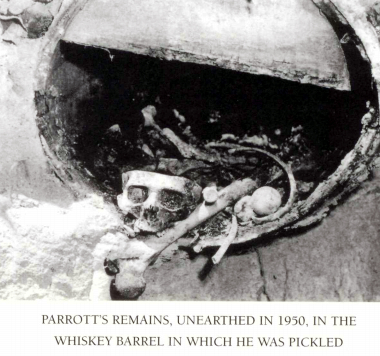
Drs. Thomas Maghee and John Eugene Osborne conducted the autopsy, examined Parrott’s brain, and could find no apparent abnormalities. Osborne then removed a large piece of skin from the dead man’s chest, kept the skullcap, and put the rest of the body in a whiskey barrel full of saline solution, effectively pickling it. The barrel was buried without ceremony, and Dr. Osborne had the skin tanned. He sent the leather to a shoemaker, who made him a pair of shoes with it.

Dr. Osborne was disappointed that Parrott’s nipples weren’t on the tips of the toes like he’d requested (!!!), but you can’t have everything you want in life.

He wore the human leather shoes on special occasions, including at his inaugural ball when he was elected governor of Wyoming in 1890. The skullcap he gave to his fifteen-year-old female assistant, Lillian Heath, who used it variously as a doorstop and an ashtray. (She would grow up to become the first female doctor in Wyoming.)

Parrott’s pickled remains were dug up at a construction site in 1950, and identified after some confusion. His skull, as well as the shoes, are now on display at the Carbon County Museum.

On this day..

1866: John Dunn, teenage bushranger

On this date in 1866, 19-year-old Australian bushranger John Dunn was hanged at Darlinghurst Gaol.

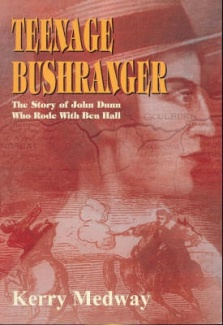
Young master Dunn, deft hand with a horse and a firearm, in 1864 joined a notorious outlaw gang then under the leadership of Ben Hall and John Gilbert.

This gang very quickly came to grief as both Hall and Gilbert were shot dead by police in May 1865. They’d been outlawed under new anti-bushranger legislation (pdf) enacted in 1865 by a parliament impatient with “the constant outrages on person and property of which the interior has for years been the scene.”

This new Felons Apprehension Act — despite its name — empowered people to kill alleged bushrangers without attempting to detain them. It did this by setting up a fast-track process to legally outlaw (pdf) individuals by name.

Dunn done did his own part to stir up this legal hornet’s nest by killing a constable named Samuel Nelson (father of eight children!) during a hotel stickup at the New South Wales hamlet of Collector.


(cc) image from AYArktos.

But the kid had better elusiveness than his bosses.

Dunn managed to escape the shootout that killed Gilbert and disappear for the best part of a year. Only in December of 1865 was he finally recognized and captured. (Then he escaped from detention, and had to be re-captured.)

Once they could keep him long enough to try him, Dunn was done for. It took a jury ten minutes to order him to hang.

Dunn’s godmother buried him at Sydney’s Devonshire Street Cemetery under a headstone reading, “He has gone to his grave but we must not deplore him though sorrow and darkness encompass his tomb — the Saviour has passed through its portals before him and the light of his love was the lamp through his doom.”

On this day..

1925: Jovan Stanisavljevic Caruga, Slavonian hajduk

On this date in 1925, the Serbian outlaw Jovan “Jovo” Stanisavljevic, better known by his nickname Caruga (Charuga), was hanged before a crowd of 3,000 in Osijek.

Caruga was born to peasant stock within the Kingdom of Croatia-Slavonia within the Hungarian Kingdom within the Austro-Hungarian Empire, and at just the right age for service at arms when World War I came along to wreck that agglomeration.

Caruga soon deserted the front lines on a false pass — but his unauthorized leave became permanent when he came across a Hungarian soldier paying court to the innkeeper’s daughter whom Caruga, too, desired. Caruga shot him dead.

He did a short turn in prison but escaped in 1919 and shortly thereafter established himself the captain of a posse of brigands styled the “Mountain Birds”. From roosts in the Papul and Krndija mountains they preyed on the nearby Slavonian plains — ducking away freely when needed to Dalmatia or Bosnia in what was now the independent (and quite unsettled) Kingdom of Serbs, Croats and Slovenes. (This polity would become Yugoslavia four years after Caruga’s execution.)

Caruga et al obtained a reputation as a Robin Hood-esque character who revenged himself on the rich. He was a late throwback to the classical hajduk character, a complex thief-with-the-heart-of-gold archetype who straddled the line between freebooting highwayman and rebel partisan during the era of Ottoman ascendancy in the Balkans. (The term’s roots trace to a caste of independent Hungarian footsoldiers in the 1600s.)

While the Turks were out of the picture at this point, the romance of the road and the social resentments rife in the fractious young kingdom were still sufficient to support a legendary bandit. Sentiment and fair fortune only turned against him after a botched raid on the estate of one Count Eltz of Vukovar, which resulted in an armed standoff with the local gendarmerie and the death of an innocent forester caught in the crossfire. Caruga was taken with some of his gang not long after.

Caruga is the subject of the so-called “last Yugoslavian film” before that country split apart. The movie Caruga stars the Croatian actor Ivo Gregurevic in what could arguably read as an allegory for the banditry of the outgoing communist years.

Most information about this date’s subject is in Serbo-Croatian; see for instance this .doc file.

* A number of present-day sports clubs in the former Yugoslavia use the name “Hajduk”, not unlike the way “Spartak” (Spartacus) brands Bulgarian and former-USSR teams. For instance, HNK Hajduk Split in Croatia, and FK Hajduk Kula in Serbia.

On this day..