1775: Yemelyan Pugachev

On this date in 1775, the Russian Empress Catherine the Great had Cossack rebel Yemelyan Pugachev chopped to pieces in Moscow for sustaining a major insurrection whose effects would haunt Russia for decades to come.

Pugachev’s Rebellion was the most spectacular specimen in populous family tree of 18th century peasant uprisings.

Most such disturbances were local and fundamentally unthreatening. Pugachev’s was neither.

The Cossack commander raised a revolt in the Urals in 1773, styling himself the long-lost tsar Catherine had overthrown a decade before.

Catherine was slow to see the import, but this hinterlands pretender set up a state-like bureaucracy and began issuing ukases as tsar — and one can readily discern from their content why he attracted a following:

We bestow on all those who formerly were peasants and in subjugation to the landowners, along with Our monarchic and paternal compassion … tenure of the land and the forests and the hay meadows and the fisheries and the salt lakes, without purchase and without obrok, and we liberate all the aforementioned from the villainous nobles and from the bribe takers in the city–the officials who imposed taxes and other burdens on the peasants and the whole people … [T]hose who formerly were nobles living on estates are enemies to Our power and disrupters of the empire and oppressors of the peasantry, and they should be caught, executed and hanged, they should be treated just as they, who have no Christianity, dealt with you peasants.

The insurrection speedily metastasized, and by the time a force sufficient to quash it was deployed, it had stretched itself from the Urals to the Volga.

Alexander Pushkin used the story of Pugachev’s rebellion for The Captain’s Daughter (text in English | Russian), which has been adapted to film several times — most recently in 2000.

Catherine the Great, for her part, was deeply shaken by the affair, and the “enlightened despot”, while maintaining traffic with the era’s liberal intellectual ferment, decisively turned against any reform to serfdom. Catherine’s choice, reinforced by her successors, to uphold their security with nothing but repression maintained Russian serfdom until 1861 on a staggering scale — an anchor dragging down the economy just as industrializing western Europe opened a development gap whose effects persist to this day.

On this day..

2006: Saddam Hussein

One year ago today, Saddam Hussein was hanged in “the hell that is Iraq” — his riposte to the mob scene at his gallows, transmitted worldwide by way of illicit footage shot with a cell phone.

Caution: This video contains graphic footage. You knew that already.

How it was then:

Who could follow in his footsteps?

On this day..

1989: Nicolae and Elena Ceausescu

On this date in 1989, 71-year-old dictator Nicolae Ceausescu and his wife Elena were condemned by a secret military tribunal and immediately shot in Targoviste as Communism in Romania suddenly, stunningly collapsed.

The last of the Revolutions of 1989 that toppled Communism through much of Eastern Europe in a matter of weeks left the indelible image of the man who had dominated Romanian politics since the mid-60’s bewildered as a party-summoned mass rally at Bucharest’s Revolution Square turned against him.

It was to be Ceausescu’s last public address. Within a day, the country had slipped from his control; before week’s end, he would face a firing squad with “The Internationale” on his lips at the conclusion of a drumhead trial.

In a confused political situation — the police who intercepted Ceausescu and his wife held them for several hours, attempting to divine which way the winds were blowing before handing them over to the mutinous army — Romanian state television would soon broadcast footage of the trial and the first couple’s corpses (though not the execution itself).

Caution: This video contains graphic footage

Immediately afterwards, Romania abolished the death penalty. Nicolae and Elena Ceausescu remain the last people executed in that country.

On this day..

1948: Amir Sjarifuddin

On this date in 1948, leftist former Indonesian Prime Minister Amir Sjarifuddin was summarily executed by forces of the infant Indonesian Republic for his participation in an attempted coup d’etat three months before.

A Dutch-educated Communist politician who had adhered to an anti-fascist “common front” position, Sjarifuddin was a vigorous activist against the Japanese occupation during World War II — and lucky to avoid execution for it.

Indonesia’s declaration of independence following the war sparked the National Revolution, during which Sjarifuddin emerged a leading player of the left as rival factions maneuvered against each other within Indonesia under pressure from the Dutch colonial power looking to reassemble its old dominions.

Sjarifuddin briefly served as the fledgling state’s second prime minister, but resigned in January 1948 after an unpopular diplomatic foray to calm tensions with the Dutch. His support for a botched and premature revolt by Communist officers in September sealed his end as a political factor and eviscerated left influence in the revolution, confining the latter’s character to an essentially nationalist one.

The rising’s suggestion of internal division may also have encouraged the Dutch incursion into Java on this date. There was a touch of poetic justice if that was the case: Republican troops, melting away from superior firepower for an insurgency campaign, opted to execute Sjarifuddin and about 50 other captured leftists before retreating rather than free them.

According to George Kahin, Sjarifuddin rendered with his death one last service to his nationalist — if not his Communist — ambitions:

[O]nce the [Indonesian] government … had put down the [September] rebellion and shot its leaders, it was no longer possible for the Dutch to make American officials and the US Congress believe — as previously many of them had — that most leaders of the Republic were under strong Communist influence and that their government was providing a bridge to an ultimately Communist Indonesia.

Its Marshall Plan aid threatened, the Netherlands recognized Indonesian independence in 1949.

On this day..

401 B.C.E.: Clearchus of Sparta

Around this time in the late autumn or early winter some weeks following the Battle of Cunaxa, the general of a Greek mercenary army — along with most of its other commanders — was treacherously seized by a Persian satrap and summarily beheaded.

In the train of the Peloponnesian War‘s devastation, sturdy Greek hoplites with bills to pay found a lucrative gig backing a Persian prince‘s bid to seize the throne.

The prince marched the Hellenes deep into Persia before falling in battle at Cunaxa in Mesopotamia, a discomfiting scenario alike for the stranded but still-potent invading army and the somewhat outclassed Persians.

The seizure around this day of the veteran soldier and former tyrant of Byzantium Clearchus — lured under color of friendship — aimed to crush the Greeks’ morale, but instead feathered the laurels of “the Ten Thousand”. This “marching Republic” hastily self-organized and proceeded upon an astonishing escape, intrepidly fighting its way north over the ensuing year to the Black Sea, and thence to hearth and home.

The Greeks’ perseverance offers one of classical antiquity’s stock testimonies to the resilient polis — and at this stage, practically the last breath of that dying spirit. More to the immediate point, it illustrated strikingly the Persian army’s vulnerability to the phalanx, exploited to decisive effect in the century to come by Alexander the Great.

One of the replacement generals, Xenophon, immortalized the Greeks’ march in the Anabasis.

After the generals had been seized, and the captains and soldiers who formed their escort had been killed, the Hellenes lay in deep perplexity — a prey to painful reflections. Here were they at the king’s gates, and on every side environing them were many hostile cities and tribes of men. Who was there now to furnish them with a market? Separated from Hellas by more than a thousand miles, they had not even a guide to point the way. Impassable rivers lay athwart their homeward route, and hemmed them in. Betrayed even by the Asiatics, at whose side they had marched with Cyrus to the attack, they were left in isolation. Without a single mounted trooper to aid them in pursuit: was it not perfectly plain that if they won a battle, their enemies would escape to a man, but if they were beaten themselves, not one soul of them would survive?

Haunted by such thoughts, and with hearts full of despair, but few of them tasted food that evening; but few of them kindled even a fire, and many never came into camp at all that night, but took their rest where each chanced to be. They could not close their eyes for very pain and yearning after their fatherlands or their parents, the wife or child whom they never expected to look upon again. Such was the plight in which each and all tried to seek repose.

The tale’s motif was borrowed for a 1965 novel of a New York gang struck leaderless making its way out of hostile territory, later adapted for a cult 1970’s film:

On this day..

41 B.C.E.: Arsinoe IV, Cleopatra’s sister

On an unknown date late in 41 B.C.E., Cleopatra’s younger sister and rival Arsinoe was put to death in Asia Minor as the famous queen cemented her fatal alliance with Mark Antony.

Like Cleopatra herself, Arsinoe lived her short life in the internecine maelstrom of Ptolemaic politics under the sway of a Roman Empire itself immersed in civil strife. Violent death was something of an occupational hazard.

Nevertheless, had some flash of prescient irony visited her when Antony’s legionaries unsheathed their blades, she might well have wondered at the small happenstances of fate that left her a nigh-forgotten footnote in her sister’s story, rather than the other way around.

Three siblings had grasped at the Egyptian throne during the Alexandrian War, and whether it was charm or cold calculation won Caesar’s backing for Cleopatra, Arsinoe and her brother Ptolemy XIII still pressed the Roman garrison of Alexandria with a vastly superior force in a battle that was said to have set the Library of Alexandria aflame.

Timely Roman reinforcements decided the matter, and Arsinoe was marched in chains at Caesar’s sumptuous quadruple Triumph of 46 B.C.E. — though she was spared the execution that typically concluded such an ignominy and instead packed off to a temple on the coast of modern-day Turkey.*

In Margaret George’s historical novel The Memoirs of Cleopatra, the danger of maintaining an enemy who has styled herself Queen is neatly summarized in a conversation between Caesar and Cleopatra set after the Triumph:

“I have spared Arsinoe.” [said Caesar]

My [Cleopatra’s] first feeling was a rush of relief. My second was worry. Arsinoe the proud would not retire quietly.

“Where is she to go?”

“She has requested sanctuary at the great Temple of Diana in Ephesus,” he said. “And I will grant it, if you agree.”

Ephesus! Too close to Egypt! Better send her to Britain! Yet … I would gamble, and be merciful. Perhaps I was not enough of a Ptolemy after all. Arsinoe would not have granted it.

“Yes, I will allow it.”

That very perception of her potential danger hung over Arsinoe like the sword of Damocles.

The sword fell — figuratively and literally — five years later after Cleopatra seduced Mark Antony at Tarsus in the autumn of 41. Her terms for Egypt’s alliance supposedly included elimination of this lingering rival — though if Arsinoe had made common cause with Caesar’s Republican assassins, Antony may well have had his own reasons to dispatch the young woman.

Arsinoe’s death helped seal a pact that was itself destined for a bloody end. Distracted by his foreign paramour, Antony steadily lost political ground to his adversary Octavian. In another decade’s time, open war broke out again.

The Egyptian fleet would gather at Ephesus, not far from Arsinoe’s final resting place, bound for the catastrophic Battle of Actium whose outcome added Cleopatra’s and Antony’s blood to the soil from which sprung the long reign of Octavian — soon to be styled Augustus Caesar, the first emperor of Rome.

* A Temple of Artemis — either in Miletus (as Appian has it), or the wonder of the world in Ephesus (as Josephus has it). She met her death at the temple — whichever it was — dragged to its steps and put to the sword. Ephesus seems to be the more generally accepted locale, and an octagonal tomb there has been speculatively identified as Arsinoe’s.

Part of the Themed Set: The Fall of the Roman Republic.

On this day..

63 B.C.E.: Publius Cornelius Lentulus

On this date in 63 B.C.E., Publius Cornelius Lentulus was executed by strangulation in Rome’s Tullianum for conspiring to overthrow the Roman Republic.

He was one of the key figures in the Catiline conspiracy, a political intrigue set against a ruinous social crisis that pushed the country to the precipice of civil war.

Roman had fought Roman intermittently over much of the preceding 70 years in episodes underpinned by a class conflict pitting wealthy landowners (politically represented by the Senate) against the growing populations of plantation slaves who tilled their fields and urban plebeians displaced from independent farming on the other. Debt was choking the Roman economy.

Catiline, an ambitious politician from a fading patrician family, had sought the consulship on a populist platform of debt forgiveness; failing to win the office through legal channels, he maneuvered to take it by force. The affair is known mostly through the testimony of its enemies, so it is difficult to gauge the true mixture of opportunism and conviction that informed the conspirators.

A cliffhanger sequence of moves and countermoves against the consul Cicero ensued, highlighted most spectacularly by one of Cicero’s famous orations driving every Senator to seat himself away from Catiline — who nevertheless rose passionately in his own defense.

Catiline left Rome to raise an army in the countryside, leaving Lentulus (himself a former consul) to manage the intrigue within Rome.

Lentulus made the least of the moment, dilating when he could have acted and exposing the plot by dint of a ham-handed attempt to involve visiting Gauls with grievances of their own.

The arrested conspirators’ fate was debated in the Senate this very morning. The young Gaius Julius Caesar, then conducting an affair with Cicero’s Cato’s [correction] sister, stood against (illegal) summary execution, but the victories he would enjoy over Cicero yet lay some years into the future; fearing an attempted rescue, the Senate’s grim sentence was carried out immediately. Cicero personally escorted Lentulus to his death.

Lentulus’ failure likewise doomed Catiline, whose army shrunk from desertions before its commander hurled it into martyrdom with a stirring speech that recalled in passing “how severe a penalty the inactivity and cowardice of Lentulus has brought upon himself and us.”

Part of the Themed Set: The Fall of the Roman Republic.

On this day..

1922: Six Greek former ministers of state

On this date in 1922,* on the morning after a revolutionary tribunal held them liable for treason in the catastrophic Greek loss of Smyrna, six former high-ranking political and military officials of the Greek government were shot in Athens.

The long-running national conflict between liberals and monarchists had boiled over during World War I, setting the stage for increasingly bitter internecine conflict played out against the backdrop of a misbegotten foreign adventure.

Greece’s territorial aspirations after World War I.

As the Ottoman Empire — Greece’s neighbor and historical rival — collapsed in the aftermath of the world war, Athens under liberal colossus Eleftherios Venizelos set her sights on a vast pan-Hellenic domain spanning Constantinople, western Anatolia, and the Black Sea coast.

In 1919, backed — even pushed — by the British, Greece occupied Smyrna, a multiethnic economic hub in Asia Minor. But cruelty towards the Turkish population sparked immediate resistance which soon blended insensibly into the burgeoning Turkish National Movement, already on the path towards its destiny of forging the modern state of Turkey.

As the Greek army pressed outwards from Smyrna, it became drawn into full-fledged war. In 1920, the Greek government turned over (as it was often wont to do) and under the ascendant monarchists whose irredentism was not to be upstaged “fantasy began to direct Greek policy” — like a quixotic scheme to march on Constantinople rather than hold a defensible position. Greece’s European allies and sponsors began to cut bait.

September 14, 1922: Smyrna burns.

Far from threatening Constantinople, the Greeks suffered one of their greatest disasters — the “Catastrophe of Asia Minor”, when Ataturk drove them back to, and then out of, Smyrna, emptying the once-cosmopolitan city of thousands of Greek (and Armenian) refugees fleeing a sectarian carnage. Some swam out of the burning city only to be refused aid by ships of nations unwilling to be drawn into the affair politically.

In the dismayed Greek capital, anti-monarchist officers who had been purged by the new government revolted and rounded up the opposition’s leadership. “The Six” who faced public trial for treason included three former Prime Ministers:

With two other ministers of state and a general, they comprised all but one member of the offending monarchist government, a bloody thoroughness the New York Times compared to Robespierre. Western governments temporarily broke off relations.

After the day’s bloody deeds, Venizelos returned from exile to conclude the war on Turkish terms, including “population exchange” — fragrant euphemism — to solidify each government’s demarcation as a nation-state and ratify the destruction of Smyrna (renamed Izmir) as a multiconfessional melting pot.

Today, Smyrna is largely forgotten by those to whom it is not intensely remembered — and among the latter, its meaning is ferociously contested. To Turks, a chapter in their founding expulsion of foreign occupation; to Greeks, the calamitous end of the ancient Hellenic presence in Asia Minor; to each, a touchstone for one another’s atrocities; to others of a less parochial frame of mind, a parable of the perfidy of an entire enemy faith, or a subplot in the great game for Ottoman oil, or as Henry Miller conceived it writing in the antechamber of the second World War, the avatar of a stunted and cynical moral sense among European powers that would lead them to their next great reckoning:

Even the most ignorant yokel knows that the name Attila is associated with untold horrors and vandalism. But the Smyrna affair, which far outweighs the horrors of the first World War or even the present one, has been somehow soft-pedalled and almost expunged from the memory of present day man. The peculiar horror which clings to this catastrophe is due not alone to the savagery and barbarism of the Turks but to the disgraceful, supine acquiescence of the big powers.

Smyrna, like the Boxer Rebellion and other incidents too numerous to mention, was a premonitory example of the fate which lay in store for European nations, the fate which they were slowly accumulating by their diplomatic intrigues, their petty horse-trading, their cultivated neutrality and indifference in the face of obvious wrongs and injustices.

*Greece did not adopt the Gregorian calendar until 1923, the last European country to do so — so the date in Greece on the day of the execution was actually November 15.

On this day..

1695: Zumbi dos Palmares

On this date in 1695, Zumbi dos Palmares, the last leader of Brazil’s most famous free colony of fugitive slaves, was captured by the Portuguese and summarily beheaded.

From the very beginning of European settlement in the New Wold, Maroon communities of escaped slaves, free-born blacks, Indians, poor whites, and mixed-race outcasts formed at the fringes of slave states.

Colonial power did not welcome their presence.

Consequently, the community of Palmares faced repeated harassment from the Portuguese and the Dutch West Indies Company from the time of its establishment around 1600 — even as it burgeoned into a kingdom of over 30,000 inhabitants.

Zumbi, a black free-born in Palmares, was kidnapped by such a sortie and raised with a missionary priest who taught him Portuguese and Latin. At 15, he escaped and returned to Palmares, quickly rising to prominence and in 1678 overthrowing his adoptive uncle King Ganga Zumba when the latter attempted to accept peace under Portuguese rule.

Zumbi’s skepticism was vindicated when the followers of Zumba who had defected to Portugal were re-enslaved, but free Palmares soon faced intensified Portuguese pressure. In 1694, artillery finally battered its largest settlement into submission — forcing its ruler into the bush, where he long eluded capture.

In Zumbi’s honor, November 20 is a Brazilian celebration of national pride and especially pride for those of African descent … while the king who would not be a slave has lent his name, somewhat paradoxically, to an international airport.

On this day..

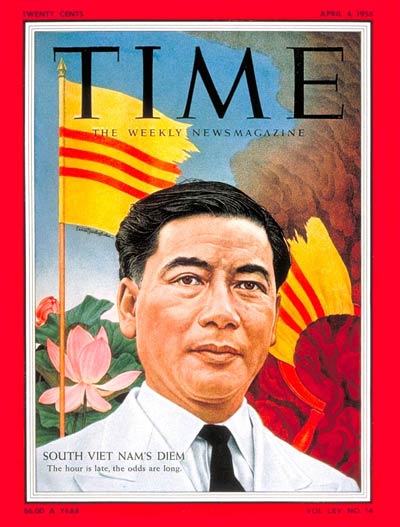
1963: Ngo Dinh Diem

On this date in 1963, Ngo Dinh Diem, the first president of South Vietnam, was executed in the back of an armored personnel carrier along with his younger brother and secret police chief, Ngo Dinh Nhu, the day after their government had been overthrown in a military coup.

Born into the Buddhist country’s Catholic elite, Diem was brought up as a French colonial administrator but fled Vietnam in 1950 under a death sentence from Ho Chi Minh’s nascent Vietminh. Over several years living and lecturing in the United States, he established his anti-communist bona fides with influential conservatives and was returned to his native country as Prime Minister when the U.S. inherited the foundering French war against nationalist guerrillas.

Fearing communist victory at the polls, Diem blocked scheduled 1956 elections to unify North and South Vietnam, making an interim division permanent. But Diem made an inconsistent American client, often spurning Washington’s advice and alienating the Buddhist majority with heavy-handed authoritarianism that eventually prompted Buddhist monks to begin public self-immolation as a form of protest.

The government responded by arresting monks.

By now more a liability than an asset, Diem was ousted with the blessing of a fellow Catholic head of state, John F. Kennedy.

This first successful coup — Diem had already quashed attempted putsches in 1960 and 1962 — began a cycle of internecine revolts in which weak South Vietnamese governments were toppled in rapid succession … leaving Saigon ever more visibly the puppet of Washington, and dragging the United States ever more deeply into the Vietnam War.

On this day..