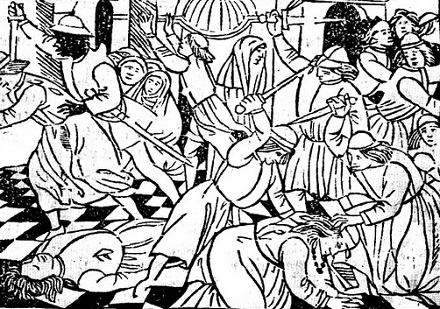
On this date in 1322, Bartholomew de Badlesmere, the first (of only two) Baron Badlesmere, lost his head.
The barons in the dangerous age of Edward II were marked by where they made their political allegiances between the king and his rival the Earl of Lancaster.
The man could tack to the wind with the very best of them, or the very worst; he was reviled as the Benedict Arnold of 14th century England for chickenheartedly failing to protect the Earl of Gloucester when the latter impetuously charged to his death at Bannockburn. As a bard of the time put it,
This is the traitorous man Bartholomew, whom in all victories may God confound, because he has been to his master as changeable as a pharisee. Hence, as the representative of Judas, he shall be condemned to death … because he refused to come to his master’s support this traitor has deserved to be put to the rack … deserved to suffer judgment of decapitation.
As the 1320s began, he was a stalwart of what has been termed the “Middle Party”, whose position vis-a-vis Edward and Lancaster was what you would expect from the name.
Badlesmere badly misplayed a strong hand by defecting in the so-called “Despenser War” to the anti-Edwardian party, even though Lancaster pretty much hated his guts — and now the king did, too,* dissipating any mutual goodwill that might have been earned a few years before when the king’s favorite (and the war’s namesake) Hugh Despenser went and rescued Badlesmere’s wife from an attack.
And unlike at Bannockburn, Badlesmere here stepped into the trap rather than out of it.
Days after the battle, Badlesmere was caught skulking in a glade by the Earl of Mar and shipped to Canterbury for trial. He was condemned to death on this date, and sent directly from court to a hurdle dragged by a horse to Blean three miles away, where he was hanged and beheaded. He was one of 20 or so lords and knights Edward had put to death.
* In an affair that Edward II biographer Kathryn Warner thinks was neatly contrived by the king, his Queen Isabella called on Badlesmere’s wife when the latter held Leeds Castlesans husband. Lady Badlesmere refused to admit the queen, giving Edward a welcome excuse for besieging a fortress holding out against its sovereign.
In an admittedly borderline “execution”, Louis de Bourbon, the Hugueunot Prince of Conde, was killed summarily at the end of the Battle of Jarnac on this date in 1569.
This nobleman’s conversion to Protestantism had been attended with the zeal so usual to that period. In the case of Conde (English Wikipedia link | French), that meant dipping his beak into some dramatic plotting.
Though nothing could be proved about him, the Catholic faction suspected him of being a leading spirit in the 1560 Amboise Conspiracy, a plot to kidnap King Francis II.
Nothing daunted by its failure, he spearheaded the even riskier Surprise de Meaux, a design to seize not only King Charles IX but the rest of the royal family in 1567. This time, failure triggered a whole new installment of the on-again, off-again Wars of Religion.
The Year of Our Lord 1569 found Conde at the head of the principal Huguenot army in an extremely tense country. On March 13, that army met the Catholic force of Marshal Gaspard de Saulx at the Battle of Jarnac.*
The result was a smashing victory for the Catholics. As the disaster unfolded, Conde, wounded and alone, tried to offer his surrender to an enemy guardsman. He was instead shot on the spot — and his body borne back to Catholic lines for jeering.
This crippling defeat set the stage for the uneasy truce that quelled religious bloodshed in 1570 — the truce that would be shattered by the 1572 St. Bartholomew’s Day Massacre.
* The teenage Walter Raleigh fought at this battle on the Huguenot side.
On this date in 1601, Queen Elizabeth’s last great favorite became the last man beheaded in the Tower of London.
Vain and dashing Robert Devereux rolled into the royal court in 1584 around age 19 and immediately established himself as the new favorite of the monarch, 30-some years his senior. They spent long walks and late nights in enchanted private company, and Devereux “commeth not to his owne lodginge tyll the birdes singe in the morninge.” Ye olde walke of shayme.
In becoming the (presumed) lover* of the aging Virgin Queen, the Earl of Essex was only following the family** trade: his stepfather Robert Dudley was the younger Elizabeth’s longtime intimate.
It is up to the artists to postulate the relative measures of passion and cynicism in these dalliances; many have tried, inspired by the scaffold sundering of one of history’s great May-December affairs. The Essex-Elizabeth drama was a popular topic for broadsides, ballads, and stage treatments from the 17th century to the present day.
He was wildly popular in London, but Essex was also afflicted by the follies of youth. Rash, temperamental, vainglorious; he aspired to leverage the favor of his sovereign into statesmanship and he achieved heroic repute for his swashbuckling raid on Cadiz.
Yet Essex reads like a whelp who never quite grew into a man’s boots. Every sketch of Essex includes, because it seems so starkly illustrative of his unstable character, the story of the time his impertinence led the queen to box his ears publicly — and the hothead’s hand flew instinctively to his sword-hilt. Everyone reconciled over this brush with lese-majeste, but only after Essex scribbled some skulking reproaches (“What, cannot princes err? cannot subjects receive wrong? is an earthly power or authority infinite?”) that he had the petulance to actually send to Elizabeth.
Essex chased martial glory with mixed results. His last great enterprise was an ill-starred 1599 offensive in Ireland to bring Gaelic rebels to heel in the Nine Years’ War.
Not for the last time an Englishman found this conquest more easily aspired than achieved. Essex liberally overused his authority to knight men as a reward for their service, but his soldiers mostly slogged to and fro with little headway to show for it. After a frustrating campaign season chasing his tail, Essex defied the increasingly strident directives to attack issuing from Elizabeth’s irate pen, and made terms with the Irish commander Hugh O’Neill, Earl of Tyrone. Then he defied Elizabeth’s order to remain in Ireland and hastened back to London to justify himself. It was said of him that he “never drew sword but to make knights.”
This was the beginning of Essex’s end. Elizabeth’s fury at the aimless military campaign was compounded when her churlish captain turned up from Ireland unbidden and burst into her private chambers while she was still dressing to report on his unauthorized summit. Cecil et al, whose ascendance Essex had meant to reverse with the triumph of his arms, now murmured that the earl had strayed near outright treason to parley with the rebel whom he was supposed to be routing. The Privy Council put him under house arrest.
Heaped in debt and deprived of the prestigious proximity to power he had enjoyed literally throughout his adulthood, the man’s turbulent spirit stirred strangely in York House. We have seen that Robert Devereux, Earl of Essex, was a man to abhor an indignity even past the point of self-preservation. He unwisely sent secret missives to try to turn the ongoing succession negotiations‡ against Robert Cecil; when the Privy Council caught wind of this intrusion, he refused its demand that he present himself to account for his actions. Instead, he made matters worse by mounting a pathetic march through London with his supporters.
This “Essex Rebellion” was meant to rally the citizenry to him and turn some sort of coup against Robert Cecil. It seems so foolhardy and ill-considered that it’s difficult to think what was in the earl’s head. If you squint at it just so, it perhaps had a big-R Romantic quality, a gallant band of brothers saving the nation from its duplicitous ministers; the night before the rebellion, Essex (a liberal arts patron in his time) splurged to have William Shakespeare’s company§ stage a special performance of Richard II — a play wherein the English monarch is deposed. Presumably this was his inspirational pregame speech.
Thinking much more clearly than Essex, Londoners vigorously ignored his summons and the marching party trudged alone — and surely increasingly frightened — through the city until it was stopped by a barricade. Its participants then fled back to Essex House where they soon found themselves surrounded.
Whatever the fancy that led the Earl of Essex on his fatal February 8 march, and whatever the extent of his ambitions for that occasion, the careless threat to the public peace went several bridges beyond a boyish foible that Elizabeth could overlook in her impulsive courtier. He was prosecuted for treason within days and Elizabeth signed his death warrant on February 20th. The only mercy extended the ex-favorite was to suffer the noble execution of beheading, rather than a traitor’s drawing and quartering. Essex also successfully appealed for a private execution within the walls of the Tower, away from the gawks of those London masses who had so signally failed to rebel along with him.
My sins are more in number than the hairs on my head. I have bestowed my youth in wantonness, lust and uncleanness; I have been puffed up with pride, vanity and love of this wicked world’s pleasures. For all which, I humbly beseech my Saviour Christ to be a mediator to the eternal Majesty for my pardon, especially for this my last sin, this great, this bloody, this crying, this infectious sin, whereby so many for love of me have been drawn to offend God, to offend their sovereign, to offend the world. I beseech God to forgive it us, and to forgive it me — most wretched of all.
He prayed a Psalm. Then, stretching out his neck on a low block and thrusting his arms from his sides, he bid the headsman strike. The executioner had to oblige his patient in triplicate in order to sever the puffed-up head.
The Earl of Essex has the distinction of being the last person beheaded on the Tower Green, within the walls off the Tower of London — the last name on the little placard of headless notables photographed by tour groups. Note that Essex was not the last person beheaded at the Tower, when the adjacent Tower Hill is included (that distinction belongs to Jacobite rebel Simon Fraser); nor was he the last person executed within the Tower (that distinction belongs to World War II spy Josef Jakobs, who was not beheaded but shot).
Weary and depressed, Elizabeth died little more than two years afterwards.
* There’s a mind-bending speculative hypothesis out there — cousin to the Shakespeare-focused Prince Tudor theory — that Essex was actually Elizabeth’s secret, illegitimate son. This secret history is obviously more congenial with the queen’s early favoritism for Essex than with her eventually chopping off his head.
** Essex was also a distant cousin of Elizabeth herself: his maternal great-grandmother was Mary Boleyn, sister of Anne Boleyn — who was Elizabeth’s mother.
† Walter Raleigh was a notable Cecil ally in this factional conflict. Raleigh attended Essex’s execution … and, of course, shared that fate many years afterwards.
‡ Elizabeth was nearing age 70; her childless death was imminent. James VI of Scotland was being vetted by Robert Cecil as the successor. Essex tried to stick his thumb in the pie by warning James that the Cecil faction would conspire to foist the English crown on the Spanish infanta — daughter of the Spanish king who had been the Catholic Mary Tudor’s husband. (The infanta was not Mary’s own daughter.) This was no idle threat, as at this point it was only a few years since the Spanish Armada had sallied for English seas.
§ Another noteworthy Shakespeare connection: one of the participants in the Essex Rebellion was the Earl of Southampton (he was spared execution). Southampton, whose given name was Henry Wriothesley, is often identified as the “Fair Youth” to whom Shakespeare dedicated numerous love sonnets. (Some of those are directly addressed to a Mr. “W.H.”)
On this date in 1937, Ethiopian prince Desta Damtew — the son-in-law of Emperor Haile Selassie — was captured by the Italian troops occupying his country, and summarily executed.
When Italy invaded Ethiopia in 1935, it committed a disproportionate quantity of its forces to the northern reaches of its target. Consequently, resistance was stronger in the south — and Ras Desta was one of its chiefs. In January 1936 he led Ethipoian forces at the Battle of Ganale Doria.
Though the two sides had forces of similar sizes, Italy’s was the mechanized, industrial army — and the Ras was routed by Gen. Rodolfo Graziani. It was a milepost for Graziani on his way to lasting infamy in Ethiopia as the conquered realm’s brutal Viceroy for 1937. (He was recalled at year’s end.) Graziani vowed that Italy would dominate Ethiopia “at whatever cost” and threatened “extreme severity towards anyone who resisted.”
On February 19, 1937 — Yekatit 12 by the Ethiopian calendar — two ethnic Eritreans expressed their resistance by pelting Graziani with grenades. He had shown his viceregal person at a hearts-and-minds almsgiving, and having been received with such cordiality, he returned immediately to the Extreme Severity plan.
While doctors dug shrapnel out of Graziani, somehow saving his life, an aide named Guido Cortese condemned untold numbers of humans to punitive death with a dread order:
Comrades, today is the day when we should show our devotion to our Viceroy by reacting and destroying the Ethiopians for three days. For three days I give you carte blanche to destroy and kill and do what you want to the Ethiopians.
For the next several days, Italian forces delivered a punitive rampage to their new subjects, claiming up to 30,000 lives.**
Desta Damtew, who had been lucky to flee the battlefield slaughter after Ganale Doria, was not directly a casualty off this three days’ bloodbath, but when he was captured in the bush along with fellow insurgent commander Beyene Merid, no-quarter treatment was a given. Both men were immediately shot.
The flow’r of a nation’s strength
Had thrown their valour and their might
Against the charging hordes of death
In history’s most unequal fight!
One man remained — the last of them —
To stand for Ethiopia:
All else surrendered, died or fled
But, he, the lion-hearted-Ras Desta.
Graziani, Italian butcher
Had valiant Desta quickly shot,
To seal his lips and tie his hands
In fear of what he called a plot.
With death of such a noble man,
A reign has passed to history;
But time will bring to us again
More men to fight for victory.
* Ras is a title, literally meaning “Head” and akin to “Prince” or “Duke”. Before he was royalty, Haile Selassie was born Tafari Makonnen, and then eventually known as Ras Tafari … hence, rastafarianism.
** According to Ethiopian figures. Italy’s numbers put the post-Yekatit 12 casualties “merely” in the hundreds.
Around this time in 904, Pope Sergius III allegedly had one or both of his deposed predecessors put to death in prison.
Sergius held the throne of St. Peter for seven years, which was a longer incumbency than achieved by his seven immediate predecessors combined:* they march speedily through the Vatican’s annals like so many third-century Caesars, acclaimed by one faction within Rome’s political vipers’ nest only to offer flesh for their rival factions’ fangs; most are eminently forgettable save when they are utterly insane.
So pell-mell turned the scepter from one pretender to the next that the Church has even waffled in its official histories on just who was legitimate. Officially, Leo V is considered Sergius’s immediate predecessor; in reality, Leo was deposed and imprisoned two months after his July 903 election by a fellow named Christopher who was counted as a pope on canonical papal rolls until the 20th century. Today, he’s considered an antipope who was illegitimately elected.
“Legitimacy” in this period meant little but who had the muscle make their election stick. And though Sergius was the beneficiary, the man doing the flexing in this instance was Theophylact, Count of Tusculum along with his wife Theodora. For the next century the papacy would be a bauble of the Theophylacti family, who liberally plundered its perquisites. It is this Count who is thought to have forced the murder of Pope Leo — and possibly (Anti)pope Christopher, although Hermannus Contractus says Christopher was merely exiled to a monastery.
The resulting stability (relatively speaking) was the ascent with Sergius of the so-called “pornocracy”, or “Harlot State”.** The harlots in question are the Theopylacti women in a vicious bit of historiographical branding sourced ultimately (since there are very few to choose from) to the highly partisan histories of Liutprand of Cremona.
The count’s wife, Theodora, elevated to the unprecedented rank of “senatrix”, was the first voracious woman so designated and the possibly spurious charge that it was she who steered the Count’s hand is of course meant to redound to the detriment of both. Theodora’s daughter, Marozia, is alleged to have become Pope Sergius’s concubine at age 15.
As Marozia grew into womanhood, she would succeed as the de facto ruler of Rome, and become for propagandists the principal Pornocrat: “inflamed by all the fires of Venus,” gaped Liutprand; “a shameless whore … [who] exercised power on the Roman citizenry like a man.” She married the Duke of Spoleto and later the Margrave of Tuscany and was reputed to have manipulated numerous other paramours with her charms.
“A more inquisitive age would have detected the scarlet whore of the Revelations,” mused Edward Gibbon, who speculated that Marozia’s domination of the papacy might have sparked the later legend of a female “Pope Joan”. Our age might better see a ruthless conqueror entitled to indulge a Triumph or two. She made and unmade pontiffs in her own lifetime, and no fewer than six men tracing lineage directly to Marozia were Bishop of Rome in the next century and a half:
Marozia’s son (by either Pope Sergius or by the Duke of Spoleto) John XI, whose election Marozia forced in 931 when John was all of 21 years old;
Her grandsons John XII and Benedict VII;
Her great-grandsons (we’re into the 11th century for these) Benedict VIII and John XIX; her great-great-grandson Benedict IX
* In fact, you have to go back to Nicholas the Great (858-867) to find a longer-serving pope than Sergius.
** Saeculum obscurum, or Dark Ages, is historiography’s less colorful term.
On January 23, 1751 Lhasa … witnessed another horrible example of Chinese justice. Lobsang Trashi and six other leaders of the rebellion were executed by cutting them into pieces. Other people were beheaded or strangled. The heads of the executed were mounted on spikes. The other leaders were exiled and stripped of their property.
–Luciano Petech, China and Tibet in the Early XVIIIth Century
China’s domination of Tibet, dating to 1720, has generated resistance, intermittently violent, down to the present day.
The incident at hand here was a November 1750 Lhasa riot sparked by the assassination of Tibet’s prince by China’s plenipotentiary, who had caught wind of the local ruler’s intention to detach his kingdom from Qing domination.
The royal chamberlain, Lobsang Trashi (German Wikipedia entry | Dutch) managed to escape the scene and found himself at the head of a furious rabble that sacked the Qing embassy, looted a treasury, and killed dozens of Chinese soldiers — and dozens more Chinese civilians.
But the popular furor burned itself out within days, most Tibetan elites sagely declining to get involved in the pogrom pending the likely — and soon, actual — overwhelming Qing response. These guys got the fire-eaters arrested (they’d be handed over to the arriving Chinese army) and installed the Dalai Lama as the new secular as well as religious authority.
On this date in 205, the Roman patrician Gaius Fulvius Plautianus was put to summary execution for aspiring to the purple.
Maternal cousin and longtime ally to Septimius Severus, Plautianus had helped himself to a generous slice of power and wealth when his friend became emperor. He got his bristly mug onto imperial coinage and even dynastically married his daughter to Severus’s nasty son and heir* Caracalla.
And so liberally did Plautianus wet his beak on the perquisites of this power that, Cassius Dio reports, “the populace in the Circus once exclaimed: ‘Why do you tremble? Why are you pale? You possess more than do the three.'” The three meant Severus himself and his two sons.
Severus for a time blithely ignored his friend’s aggrandizement, and Plautianus made the political personal by appropriating for himself the estates of numerous senators whose proscription he helped Severus implement.
But the enormous influence of his prefect soon began to present a threat that the emperor could not afford to ignore. In the coming years of the Third Century Crisis, this pattern would repeat itself with numbing regularity: the prestige of some figure would raise the prospect of his seizing the throne; the mere possibility would then thrust sovereign and potential usurper into a destructive mutual dash towards pre-emptive violence.
It’s anyone’s guess whether Plautianus was already contemplating a putsch as the natural progression of his authority, but the decision was made for him by the contempt with which Caracalla treated that daughter he’d been made to marry. The heir “was exceedingly hostile to the the girl, and to her father too,” and even “daily promised to kill her and her father as soon as he became sole ruler of the empire.” (Herodian of Antioch)
Resolving to strike before the young hothead was in a position to effect his threats, Plautianus allegedly engaged one of his loyal servants to assassinate the imperial family.**
The plot was instead betrayed, and Plautianus was produced before his former colleague to be handled as they had once handled those proscribed senators. After his immediate execution, his body was cast into the streets and Caracalla’s unwanted wife sent to a miserable exile.†
The History of Rome podcast covers the reign of Severus and the fate of Plautianus in episode 101, “And All Was of Little Value”.
* Co-heir, with his brother Geta — whom Caracalla murdered at the first opportunity after dear old dad died.
** The would-be assassin presented Severus with a written order for his death in the hand of his master. Cassius Dio quite justly suspects this a stitch-up: “These circumstances in particular betrayed the fraud; for Plautianus would never have dared to give such instructions either to ten centurions at once, or in Rome, or in the palace, or on that day, or at that hour, and especially not in writing.”
Dramatization of events in this post for the video game-derived film Assassin’s Creed: Lineage.
On this date in 1477, the assassins of the Duke of Milan suffered bitter death for fame eternal.
Famous for both his astute political machinations and for cruelty verging on the sadistic, Galeazzo Maria Sforza inherited leadership of Milan in at the age of 22 with the passing of his father, the great condottieroFrancesco Sforza.
Francesco, the founder of the Sforza dynasty, had dynastically married himself to one Bianca Maria Visconti, a daughter of Milan’s previous ruling house.* But not all of the Visconti were at home with the Sforza.
A brash young man of that noble family, Carlo Visconti, as full of humanistic idealism as he was of bile for the licentious Duke’s alleged violation of his sister, joined a conspiracy also compassing two other gentlemen, Giovanni Andrea Lampugnani and Gerolamo Olgiati, to do Galeazzo Sforza to death.
At a St. Stephen’s Day service in a basilica christened to Stephen Lampugnani approached the prince feigning supplication for some audience, then produced a hidden blade and stabbed Galeazzo Sforza. Visconti and Olgiati then rushed on Sforza as well and before anyone realized what was happening the Duke, croaking some half-heard invocation of Mary, was falling dead on the church floor.
Illustration of Galeazzo Sforza’s murder on the title page of a 1476 Lament for the Duke decrying the assassination.
Pandemonium ensued, and in the ensuing helter-skelter, Sforza’s bodyguards fell on Lampugnani and killed him on the spot, while Olgiati managed to escape.**
“It now only remains for us to consider those dangers which follow after the execution of a plot,” Machiavelli mused in his “Of Conspiracies” typology of his Discourses. “These in fact resolve themselves into one, namely, that some should survive who will avenge the death of the murdered prince. The part of avenger is likely to be assumed by a son, a brother, or other kinsman of the deceased.”
Well, yeah.
The assassins of the Duke of Milan appear not to have burdened themselves overmuch with advance consideration of this danger, possibly indulging the dream of Brutus that by a dagger’s stroke alone they could restore the lost republic.
Needless to say, this beautiful hope vanished in the bloody revenge carnival that actually ensued the murder. Just a few days after the assassination, having taken refuge with a priest — his justly frightened family had closed its door on him and needed to make theatrical denunciations of his treason for their own safety — Olgiati was captured, put to a torturous interrogation, and publicly butchered. He had outlived the Duke by only a week, and his gashed carcass was hung up in sections around town by way of warning. The rotting heads of the conspirators remained impaled on lances on the city’s bell tower well into the 1490s.
According once again to Machiavelli, Olgiati “exhibited no less composure at his death than resolution in his previous conduct, for being stripped of his apparel, and in the hands of the executioner, who stood by with the sword unsheathed, ready to deprive him of life, he repeated the following words, in the Latin tongue, in which he was well versed
“‘Mors acerba, fama perpetua, stabit vetus memoria facti.'”
That is,
‘Death is bitter but fame is eternal, and the memory of the deed will endure.’
This attempt, quixotic and doomed, to depose an Italian tyrant by murdering him in church might well have formed the blueprint for a similar plot in Florence in 1478, the Pazzi conspiracy. That version was even less successful than its Milanese predecessor: at least Olgiati and company could say that they actually managed to kill their target before everything else hit the fan.
And republic or not, Sforza’s murder did shake up the polity. It put the Duchy of Milan in the hands of his wife, as the unsteady regent of a seven-year-old heir. A few years later, the late duke’s brother Ludovico displaced the regent and effectively bossed Milan until the French imprisoned him in 1500 during the Italian Wars.
While he had the run of the place, Ludovico Sforza commissioned of Leonardo da Vinci a monumental equestrian statue in memory of his brother that da Vinci never finished.† Quite strangely, the master’s notes were plumbed by a 20th century Pennsylvania airline pilot who dedicated the latter part of his life to actually casting “Leonardo’s Horse”.
** There is a positively maddening inconsistency, thus far irresolvable for this author, between accounts (here’s one example | and another) asserting that Carlo Visconti was slain by Sforza’s bodyguards directly after the assassination, and other accounts (like Gregory Lubkin’s 1994 history of Sforza’s Milan) that put Visconti on the scaffold beside Olgiati.
† Da Vinci’s ponderously slow progress on this high-profile project led Michelangelo to cattily impugn the rival artist’s bronze-casting aptitude.
On the 31st of December in 1460, the Earl of Salisbury was beheaded the day after the Lancastrians routed the Yorkists at the Battle of Wakefield.
Salisbury — Richard Neville by name — was brother-in-law to the Yorkist claimant (and namesake) Richard Plantagenet, Duke of York, so you can guess which side Neville backed during these Wars of the Roses.
Actually, although your guess is spot on for the instance at hand, overlapping kin networks and cutthroat politicking made for an indistinct border between Lancastrians and Yorkists that some actors willingly crisscrossed. Richard Neville’s cousin Thomas Neville, for example, was a Lancastrian, who switched to the Yorkists, and then switched back to the Lancastrians. All this goes to show the treacherous environment for nobles who could go from the orbit of royal power themselves straight to the headsman’s block with each new battlefield reversal. And Salisbury, he was Team White Rose* right on down the line.
(The Neville family’s running feud with their fellow northern magnates, the Percys, helped to catalyze the York-Lancaster rivalry into open warfare.)
Salisbury led the Yorkist side to a notable early victory at the September 1459 Battle of Blore Heath, cunningly baiting the Lancastrians into a disadvantageous charge across a brook by feigning retreat. Then, runs Hall’s chronicle, “the Earl of Salisbury, which knew the sleights, strategies and policies of warlike affairs, suddenly returned, and shortly encountered with the Lord Audley and his chief captains, ere the residue of his army could pass the water … [and] so eagerly fought, that they slew the [Lancastrian commander] Lord Audley, and all his captains, and discomfited all the remnant of his people.”
The Yorkists didn’t do as well at the Battle of Ludford Bridge three weeks later and their leaders (Salisbury included) had to flee England to regroup.
This 1459-1461 period has especially rapid reversals of fortune for the contending parties in the Wars of the Roses, who seemed to alternate between them the results of the latest battle and with it the leadership of England.
As the most recent losers, Salisbury and his son, the Earl of Warwick — known as the “kingmaker”, this younger Richard Neville was one of the pivotal figures of the dynastic wars — had to flee England with many of the Yorkist leaders. But they mounted a re-invasion from Calais where Warwick was constable and the Nevilles pere and fils led separate columns that overran London, and captured the Lancastrian King Henry VI. Suddenly, the ex-fugitive York was the Lord Protector, England’s de facto ruler, and its de jure successor.
But as had been the case one year before, fickle Fortune abandoned the House of York almost immediately after raising it up. Two months later, their forces ventured battle with a much larger army of the regrouping Lancastrians; as night fell on December 30, 1460, York himself lay dead in his armor while his kinsman Salisbury was a prisoner with just hours left to live.
This was, of course, very far from the end for the Yorkist party, for both men left their causes to capable heirs. York’s 18-year-old son Edward inherited his father’s claims to the throne of England; together with Warwick, they counterattacked and crushed the Lancastrians at Towton on March 29, 1461** — finally deposing Henry VI and enthroning York’s eldest son as King Edward IV.
** The undercard fight to Towton was February’s Battle of Mortimer’s Cross, which also featured a crushing defeat of the Lancastrians — led on that occasion by a commander whom the Yorkists subsequently put to death, Owen Tudor.
Against any odds one could care to name, it was this Owen Tudor’s descendant who would eventually emerge from the Wars of the Roses as England’s legitimate-ish king, Henry VII — founder of the Tudor dynasty so very fruitful for this here execution blog.
On this date in 1936, the Spanish Republicans shot Don José Antonio Primo de Rivera y Sáenz de Heredia, 1st Duke of Primo de Rivera, 3rd Marquis of Estella, Grandee of Spain.
The son of Spain’s 1920s dictator, Primo de Rivera founded in 1933 the Falange, Spain’s native fascist movement.
At the October 29 founding convention that year at Madrid’s Theatre of Comedy, Primo de Rivera scathingly pilloried the wan democratic rituals that coming years’ conflict would sweep aside. “The most ruinous system of wasted energy,” he jeered at liberal democracy, where men with leadership waste their talents in hollow electoral hustling and parliamentary rigmarole while the nonsensical ephemeral whims of a formless plurality pass for the vision he attributed to the time before Rousseau ruined everything. “What alone mattered to the liberal state was that a certain number of gentlemen be sitting at the polling station, that the voting start at eight o’clock and end at four, that the ballot boxes not get smashed — when being smashed is the noblest aspiration of all ballot boxes.” (The full speech is available in Spanish here.)
Primo de Rivera espoused for Falangismo the same impulses — of unity, of destiny, of national rebirth, of the triumphant collective — that animated Europe’s similar extreme right stirrings in those years. Only 35 years before, Spain had lost her empire, near enough in memory to inform an acute ache of loss.
In a poetic sweep we will raise this fervent devotion to Spain; we will make sacrifices, we will renounce the easy life and we will triumph, a triumph that — you know this well — we shall not obtain in the upcoming elections. In these elections vote the lesser evil. But your Spain will not be born out of them, nor does our frame for action reside there. That is a murky atmosphere, spent, like a tavern’s after a night of dissipation. Our station is not there. I am a candidate, yes, but I take part in these elections without faith or respect. And I say this now, when so doing may cost me every vote. I couldn’t care less. We are not going to squabble with the establishment over the unsavory left-overs of a soiled banquet. Our station is outside though we may provisionally pass by the other one. Our place is out in the clear air, beneath a moonlit sky, cradling a rifle, and the stars overhead. Let the others party on. We stand outside vigilant; earnest and self-confident we divine the sunrise in the joy of our hearts.
Unlike the Naziism in Germany or Fascism in Italy, Falangism never grew into a force capable of conquering state power itself. Just thirty-three months after Primo de Rivera’s founding address, the Spanish Civil War erupted. The Falangists’ alliance with Francisco Franco — after the war, they would be combined with the Carlists into the only legal political association* in Francoist Spain — spelled great gains for their membership rolls but it was still the General who called the shots.**
Primo de Rivera’s share in this alliance was a voluptuous cult of personality as Spain’s preeminent right-wing martyr, fine posthumous work if you can get it mitigated only by the necessity of undergoing the martyrdom. The fascist prophet was already in prison at the time Franco struck the first blow of the war: he’d been arrested in Madrid on weapons charges. From his cell he carried on a brazen correspondence with Nationalists conniving to subvert the hated Spanish Republic, and when his activities were discovered and prosecuted that autumn in light of Franco’s July revolt they could scarcely have been better framed to incur the utmost measure of judicial wrath.
In consequence of his martyrdom, November 20 remains down to the present a hallowed day for the far right in Spain.
“Cara al Sol” (“Facing the Sun”) is the Falangist anthem; the lyrics are generally credited to Primo de Rivera.
* The Falange Española Tradicionalista y de las Juntas de Ofensiva Nacional-Sindicalista, or “Spanish Traditionalist Phalanx of the Assemblies of National-Syndicalist Offensive” (FET y de las JONS) — or less exhaustingly, the Movimiento Nacional (National Movement).
** Primo de Rivera and Franco didn’t like each other much personally, either.

 This nobleman’s conversion to Protestantism had been attended with the zeal so usual to that period. In the case of Conde (
 Vain and dashing
  An aristocrat who married Selassie’s