1660: Major-General Thomas Harrison, the first of the regicides

On this date in 1660, the restored House of Stuart began a week of bloody justice against Charles I‘s regicides by hanging, drawing and quartering Thomas Harrison at Charing Cross.

Stuart Little

Charles’ son and heir Charles II had been stuck on the continent during the 1650’s, until the Commonwealth came apart from its own internal contradictions after the death of Oliver Cromwell.

With anarchy looming, suddenly monarchy didn’t look so bad — and Charles II had a way back into the saddle.

Beheads I Win …

The first thing on everyone’s mind was what to do about the little matter of having lopped off his dad’s head.

Political reality drove the settlement: nearly everyone in the English gentry had in some manner acquiesced to the Commonwealth during its decade-plus turn steering the ship of state; an expansive line on treason would be a nonstarter. At the same time, His Soon-To-Be-Royal-Again Majesty expected a few examples made to do right by the old man and keep king-killing well off his future subjects’ agenda.

Result: the Indemnity and Oblivion Act, granting a free pardon to all supporters of the Commonwealth save a handful of those most directly implicated in Charles I’s execution.

Weeks of frantic negotiating between the parties and private settlements of borderline cases with the royalist camp preceded the action. But Thomas Harrison wasn’t part of any of it.

… Entrails you Lose.

The rigid Puritan, one of 59 who signed the last king’s death warrant and at one time the commander of England’s armies, had been on the outs with everyone since Cromwell set up the Protectorate in 1653. Godly Tom was a “Fifth Monarchist,” anticipating the imminent return of Christ perhaps in conjunction with the imminent year 1666 … and no government felt safe about these millenarians. He’d been imprisoned several times by the Protectorate, too.

Though many attainted regicides fled for Europe or America, Harrison (possibly motivated by age and infirmity) hung out, waited for arrest, and took his punishment stolidly.

God hath covered my head many times in the day of Battle. By God I have leaped over a wall, by God I have runned through a Troop, and by my God I will go through this death.

Specifically meaning, drawn on a hurdle from Newgate to Charing Cross (with a fine vantage for the doomed on Whitehall, where Charles I had met his end), hanged but revived, his genitalia cut off and bowels carved out and burned while still conscious, and finally beheaded and his body divided into quarters for gruesome public display around town.

You have selected regicide.

Harrison died on a Saturday, and his was the opening act of a busy week in the bowel-burning business; nine other fellow regicides condemned with him would share that fate during the week ahead:

  • John Carew, on Monday the 15th;
  • John Cook and Hugh Peters, on Tuesday the 16th;
  • Thomas Scot, Gregory Clemen, Adrian Scroop and John Jones, on Wednesday the 17th;
  • Francis Hacker and Daniel Axtel, on Friday the 19th.

Harrison was chosen as the first partly, perhaps, because the Fifth Monarchists were (justifiably) considered a still-extant menace, and partly because, as one account had it,

[h]e was a fierce and bloody enthusiast. And it was believed, that, while the army was in doubt, whether it was fitter to kill the king privately, or to bring him to an open trial, that he offered, if a private way was settled on, to be the man that should do it. So he was begun with. But, however reasonable this might be in itself, it had a very ill effect: for he was a man of great heat and resolution, fixed in his principles, and so persuaded of them, that he never looked after any interests of his own, but had opposed Cromwell when he set up for himself. He went through all the indignities and severities of his execution, in which the letter of the law in cases of treason was punctually observed, with a calmness or rather a cheerfulness that astonished the spectators.

“As cheerful as any man could do in that condition”

And this coda is attested by the age’s famous diarist, Samuel Pepys, whose neat and oft-quoted summation of Harrison’s fate runs thus:

I went out to Charing Cross, to see Major-General Harrison hanged, drawn, and quartered; which was done there, he looking as cheerful as any man could do in that condition … Thus it was my chance to see the King beheaded at White Hall, and to see the first blood shed in revenge for the blood of the King at Charing Cross.

Who overcomes by force hath overcome but half his foe

As might be expected, vindicated royalists sought more blood than the handful of exemplars could furnish. What compromise could expiate the sin of regicide?

Poet and polemicist John Milton, having been propagandist-in-chief for the now-abortive revolution, endured the jeers of his enemies for the conspicuously apolitical stuff (a grammar book!) by which he would set his table in the years ahead.

Upon John Milton’s not suffering for his traiterous Book when the Tryers were executed, 1660.

That thou escaped’st that vengeance, which o’ertook,
Milton, thy regicides, and thy own book,
Was clemency in Charles beyond compare:
And yet thy doom doth prove more grievous far.
Old, sickly, poor, stark blind, thou writest for bread:
So for to live thoud’st call Salmasius from the dead.

(Claudius Salmasius was a French intellectual whose defense of the Stuart royal rights had been savaged by Milton during the Protectorate.)

It’s thanks to the Indemnity and Oblivion Act’s not sending Milton the way of General Harrison that we have Paradise Lost.

On this day..

1967: Ernesto “Che” Guevara

As of 1:10 p.m. Bolivia time this date in 1967, Ernesto “Che” Guevara was no longer a man: he was only a god.

The Argentinian-born doctor turned Cuban revolutionary icon and the man who wrote the book on guerrilla warfare had put abroad to foment insurgency. His efforts in the Congo foundered; his bid to replicate the Cuban revolution in Bolivia was doing likewise when he was captured.

After holding him overnight, the government sent a coded order to execute him in the field. Che had done the same thing with his own hands to several who betrayed the Sierra Maestra guerrillas.

Soldier Mario Teran drew the short straw for a footnote to destiny; when he hesitated, Che chastised him with the legendary parting words “that someone invented or reported”:

“Shoot, coward, you’re only going to kill a man.”

Maybe so, but the man looked Christ-like when they put his body on display for the press. As certain as they made his death, still Che lives.

CIA asset (and George Bush Sr. confidante) Felix Rodriguez took his watch as a trophy. The rest of Che Guevara belongs to the world.*

This site could hardly attempt a definitive rendering of such a towering and controversial figure, a task fit for two, three, many biographies.

Lengthy video documentaries are here and here. Many of Che’s own words are collected here. Declassified U.S. National Security Archive documents relating to his capture and death are here.

And highly recommended is SovMusic.ru’s huge library of Che Guevara mp3 files — like this Francesco Guccini song:

[audio:Che_Guevara_Francesco_Guccini.mp3]

“We cannot be sure of having something to live for unless we are willing to die for it.”

-Che Guevara

* Especially, of course, its marketers.

On this day..

1849: Lajos BatthyƔny and the 13 Martyrs of Arad

On this date in 1849, the shining lights of Hungary’s 1848 revolution met the Austrian Empire’s firing squadsexecutioners. (Correction: Most were hanged, not shot. See comments.)

Probably no polity in Europe stood more fundamentally in danger from the wave of 1848 revolutions than the Habsburg Empire. While governments would be overthrown and power renegotiated across the continent, the Austrian state’s dynastically welded hodgepodge of mingled ethnicities appeared existentially at odds with the nationalist stirrings afoot.

And none of those ethnicities answering to Vienna stirred as vigorously as the Hungarians.

The Hungarian Diet established a national government under Lajos BatthyƔny (English Wikipedia page | Hungarian) (or Louis Batthyani) in the spring of 1848* and soon pushed for more self-determination than Austria was prepared to countenance.

When Austrian troops turned on Hungary, the aspiring nation issued an 1849 declaration of independence full of vituperation for the ancient noble line.

[T]he house of Hapsburg-Lorraine, as perjured in the sight of God and man, has forfeited its right to the Hungarian throne …

Three hundred years have passed since the Hungarian nation, by free election, placed the house of Austria upon its throne, in accordance with stipulations made on both sides, and ratified by treaty. These three hundred years have been, for the country, a period of uninterrupted suffering.

This dynasty … which can at no epoch point to a ruler who based his power on the freedom of the people, adopted a course toward this nation from father to son, which deserves the appellation of perjury.

The house of Austria has publicly used every effort to deprive the country of its legitimate independence and constitution, designing to reduce it to a level with the other provinces long since deprived of all freedom, and to unite all in a common link of slavery.

Guess how that turned out.

Lajos Batthyany portrait by Hungarian painter Miklos Barabas.

It wasn’t much of a contest in the field, leaving this day’s doings the shooting of Batthyany at Pest (the city later merged with Buda and Obuda to form Budapest) and 13 Hungarian generals — the so-called 13 martyrs of Arad — in a Translyvanian city that is today part of Romania.

This was not, however, the last the Habsburg dynasty would hear of Hungary’s frustrated national aspirations.

Three years later, a Hungarian nationalist attempted to assassinate the youthful Emperor Franz Joseph,** and the strength of the Magyar lands’ self-determination movements would eventually drive a formal ratification of Hungarian privileges that rechristened the state as the Austro-Hungarian Empire, or simply Austria-Hungary.

All that stuff we said about you Habsburgs? Bygones.

While becoming half of a dual capital opposite Vienna meant a late 19th-century renaissance for Budapest, this cure by the Empire for its internal pressures proved almost as harmful as the disease. The pressures immediately discharged would pale in comparison to the conflicts Hungarians’ now-privileged status helped provoke with Slavs and other ethnic minorities (exacerbated by Hungarians’ ability to block Austrian foreign policy). In an early preview of a now-familiar pattern, the proto-nation-state of Hungary was a nastier piece of work for its ethnic minorities than the decadent old melting-pot ruled from Vienna … and the road from this day’s executions to the Austro-Hungarian Compromise ran straight on to 1914 Sarajevo and the graveyard of Habsburg history.

As for the executions this day, Batthyany was saluted by the great Hungarian composer Franz Liszt in his Funerailles:

More prosaically and much more pervasively, a legend that Austrians were jovially toasting the death of the 13 Martyrs as they were being executed translated into a still-active tradition against clinking beer glasses in Hungary.


The Martyrs of Arad (Sixth of October) by Janos Thorma

* Hungary’s March 15 National Day derives from this period.

** Franz Joseph was no mere abstract emblem of imperial absolutism: he had assumed the Austrian throne in December 1848 upon the abdication of his feebleminded uncle specifically to free the crown from the oaths his predecessor had taken to various reforms. From the Hungarian perspective — and the declaration excerpted above dwells at length on the perfidy of this maneuver — he was installed to crush the revolution.

On this day..

1979: Francisco MacĆ­as Nguema, President for Life

In the early afternoon this date, Equatorial Guinea’s former President for Life was sentenced to death with six aides at the end of a four-day trial for murder, treason, embezzlement, and genocide.

That evening, the seven were shot at Malabo’s Blabich Prison.

Nguema Biyoto Masie, nee Francisco MacĆ­as Nguema, rose from the Spanish colonial bureaucracy to win the first post-independence presidency of the minuscule African state.

He quickly created a one-party state and increasingly nutty cult of personality, answering to such horror-comic nicknames as “Unique Miracle”.

Nguema’s Unique Miracle for Equatorial Guinea was a Pol Pot-style catastrophe, killing or driving out most of the population (including Nguema’s own wife), eviscerating the economy, and getting into military brinksmanship with neighboring Nigeria.*

His nephew, Teodoro Obiang Nguema Mbasogo, overthrew him a few weeks before this date. Despite the speedy resolution of the case, international observers on the scene considered it a fair enough trial and the dictator’s guilt duly established; procedurally, the execution happened immediately because he was tried by the highest court in the land and there was nowhere to appeal.


Francisco Macias Nguema during his trial.

Still, the shooting itself was handled by hired Moroccan troops, rather than citizens of Equatorial Guinea: Nguema had convinced quite a lot of people that he had magic powers, and the locals weren’t eager to be the ones to test the proposition.

Bloody but necessary first step to parliamentary democracy?

Not quite. Teodoro Obiang Nguema Mbasogo, one of the worst dictators you’ve never heard of, still runs Equatorial Guinea in much the manner of his predecessor to this day.


Did we mention that Equatorial Guinea has oil?

* Francisco Macias Nguema’s daughter, “Empress Bella Syttam Macias”, lives in Utah and defends her dad. She seems to have been too young to have been personally involved in anything unsavory in the 70’s.

On this day..

1589: Dietrich Flade, for leniency towards evildoers

On Sept 18, 1589, a magistrate and deputy governor in Trier, a city embroiled in a witch-burning campaign, was himself delivered that fate.

The winds of the Reformation swirled mercilessly at that time, and Dietrich Flade sat on the bench charged with maintaining order in Trier. Flade held a Doctorate of Civil and of the Canon Law, and he was well-connected in the magisterial Germany of the day. He just happened to be alive at the wrong time. George Lincoln Burr provides an extensive account of Flade’s ill-fated time on the bench, including this foreboding look:

But the storm that was to rob him of fortune, fame, and life was already brewing all along the horizon. The witch-trials, which, during the earlier part of the century, had appeared only sporadically, were settling here and there into organized persecutions. In the neighboring Lorraine, the terrible Nicolas Remy was already exercising that judgeship, as the fruit of whose activity he could boast a decade later of the condemnation of nine hundred witches within fifteen years; and just across the nearer frontier of Luxemburg, now in Spanish hands, the fires were also blazing. Nay, the persection had already, in 1572, invaded the Electorate itself.

In six years, the diocese of Trier oversaw the execution of 368 witches, many of whom confessed only under torture. The anti-witchcraft campaign was so expansive that some towns were left with few if any women. The hysteria was widely reviled by the academics of the time, including both Flade and Cornelius Loos.

Loos was so disturbed by the events occurring around him that he wrote a book in objection; before it could gain distribution, however, Loos was arrested and jailed. It was four years before he was released, only after recanting his entire treatise and acknowledging the authority of the Pope.

Flade (German Wikipedia link) was not as lucky.

As judge, he was too light with suspected witches and allowed many to go free or get off with light sentences. Worst of all, he let the unsettled Reformation continue without his intervention on behalf of the church. His “trial” was brutal*, with an extracted confession from five heinous torture sessions serving as evidence against him. As high-ranking as Flade was, though, he was executed rather mutedly in Treves.

Not without reason, Burr suspects the motive was entirely political on the part of Archbishop Johann von Schƶneburg. Von Schƶneburg immediately stepped up his campaign to ensure his dominion, moving to larger mass executions and damning the populace to a generation of loss — except the executioner, of course, who was paid handsomely for the deed.

The persecutions were spurred on by both similar events elsewhere in the world and the writings of those directly involved. France, and, of course, Spain both featured notable witchcraft courts. One bishop under Von Schoeneburg, Peter Binsfield, was tasked with scribing works to defend the practice, which he dutifully discharged in 1589 and 1591; these were followed shortly by Jesuit Peter Thyraeus** (1594) and the aforementioned Nicholas Remy (1595). By that time, however, the furor in Trier had, in more ways than one, burned itself out: by 1593, with too few people to tend the land and sustain the towns, the area around Trier had become an economic crater, and the persecutors put a reluctant end to the madness.

Badly damaged page from Flade’s original trial transcription, courtesy of the Cornell University Library’s Witchcraft Collection.

* One of the founders of Cornell University, A.D. White, joined forces with Burr to acquire the one known copy for that university’s library in 1883. Burr intended to transcribe the text but apparently never completed the job, instead delivering several talks and writing an tract on the subject that includes extensive footnotes.

** Thyraeus also wrote one of the age’s definitive considerations of lycanthropy, shapeshifting and werewolfism — another demonic manifestation simultaneously afoot in Germany.

On this day..

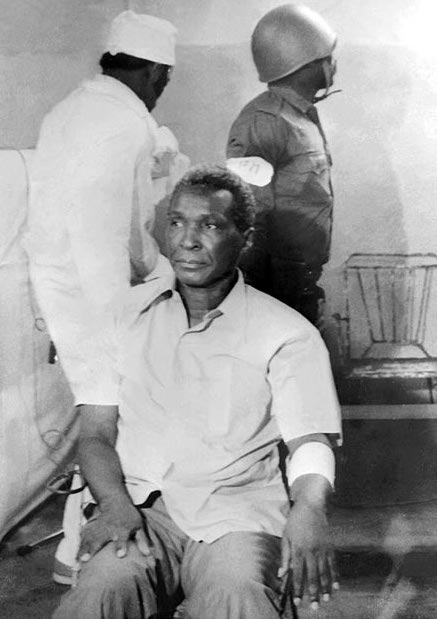
1990: Samuel K. Doe

On this date in 1990, deposed Liberian strongman Samuel Kanyon Doe was tortured and summarily executed in Monrovia by the putschists that overthrew him … and gruesomely filmed in the process.

Doe had come to power killing his predecessors — personally murdering, some sources say, President William Tolbert in 1980, then executing his chief aides.

That coup toppled civilian authority in the west African country now permanently prefixed with the adjective “troubled.” “The first of the monsters,” the War Nerd called him: Doe’s murderous rule through the 1980’s set up the succession of current war crimes prisoner Charles Taylor.

Samuel Doe’s turn in the obituaries arrived in particularly grisly fashion, with Taylor rival/semi-ally* Prince Johnson swilling beer as he interrogated — and ordered the ear sliced off — the groveling former head of state before having him executed. (Or if you like, just plain murdered.) The video shot of Doe’s ordeal became an international sensation … so it’s a little surprising that only this paltry excerpt seems to be readily available online:

* And current Liberian Senator! He feels just awful about the whole torturing-the-President-to-death thing.

On this day..

1944: Eight July 20 plotters

On this date in 1944, Nazi Germany’s juridical vengeance against Hitler’s near-assassins commenced.

Barely two weeks after Col. Stauffenberg‘s bomb had barely missed slaying the Fuhrer, eight of his principal co-conspirators stood show trials at the Volksgerichtshof (People’s Court) before hectoring prig Roland Freisler.

The outcome, of course, was foreordained.

Apparently orders had come down from on high to make the deaths as degrading as possible; this batch, convicted August 7-8, was hanged naked this day at Berlin’s Plotzensee Prison on thin cord (piano wire, say some sources, although it’s not clear to me whether this is literally true) suspended from meathooks while cameras rolled. Video and stills from the ghastly scene were shipped back to Hitler’s bomb-damaged Polish outpost for the edification of the powers that be.

The eight fitted for those nooses were:

Many hundreds more would follow, both at Plotzensee and throughout the Reich where persons distantly connected to the plotters and various miscellaneous resistance figures were swept up in the purge.

On this day..

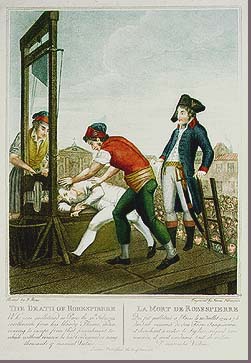
1794: Maximilien Robespierre, Saint-Just and the Jacobin leadership

On this date in 1794, the curtain — and the blade — fell on the Terror.

Maximilien Robespierre, who had breakfasted the previous day as master of France, was guillotined this evening with his chief lieutenants and partisans.

His fall came as sudden and inevitable as his rise had been unpredictable.

Five years before, Robespierre was an unprosperous Arras attorney of fashionably liberal philosophies, and you wouldn’t have given a sou for the prospects of his being remembered five minutes after he died. Yet it would come that his inseparable lieutenant Saint-Just would remark with understatement, “The words we have spoken will never be forgotten on earth.”

The historic convocation of the Estates-General thrust him onto the political stage where he would make the dread name that follows him, starting off in the Revolution’s inception as a far-left deputy. He took a notable early stand against the death penalty, with several arguments that are quite familiar by our day:

The first obligation of a legislator is to form and preserve public morals, the source of all freedom, source of all social happiness. When in running to a particular goal he turns away from this general and essential goal he commits the most vulgar and dire of errors. The king must thus present to the people the purest model of justice and reason. If in place of this powerful, calm and moderate severity that should characterize it they place anger and vengeance; if they spill human blood that they could spare and that they have no right to spread; if they spread out before the people cruel scenes and cadavers wounded by torture, it then alters in the hearts of citizens the ideas of the just and the unjust; they plant the seed in the midst of society of ferocious prejudices that will produce others in their turn. Man is no longer for man so sacred an object: we have a less grand idea of his dignity when public authority puts his life at risk. The idea of murder inspires less fear when the law itself gives the example and the spectacle. The horror of crime is diminished when it is punished by another crime. Do not confuse the effectiveness of a penalty with the excess of severity: the one is absolutely opposed to the other. Everything seconds moderate laws; everything conspires against cruel laws.

For Robespierre, it was an abomination for the nation to deal out death within its community, but his Rousseauan elevation of the collective and abstract People made extirpating existential threats to the community itself an altogether different matter.

The future tyrant’s anti-death penalty case for executing the deposed Louis XVI, flowing directly from those principles, makes interesting reading and is excerpted at length (all emphases added) here for its topicality:

When a nation has been forced to resort to the right of insurrection it returns to a state of nature as regards its tyrant. How can the latter invoke the social compact? He has annihilated it. The nation can preserve it still, if it thinks fit, in whatever concerns the interrelations of its citizens: but the effect of tyranny and insurrection is to break it entirely as regards the tyrant; it is to throw them into mutual war; the tribunals, the judiciary procedures, are made for the members of the city. … The right to punish the tyrant and that to dethrone him are the same thing. The one does not admit of different forms from the other. The tyrant’s trial is insurrection; his judgment is the fall of his power; his penalty, whatever the liberty of the people demands.

Peoples do not judge like judiciary courts. They pass no sentences; they hurl the thunderbolt. They do not condemn kings: they thrust them back into oblivion; and this justice is not inferior to that of courts. If they arm themselves against their oppressors for their own safety, why should they be bound to adopt a mode of punishing them which would be a new danger to themselves?

As for me, I abhor the penalty of death so lavish in your laws, and I have neither love nor hatred for Louis. Crimes only I hate. I have asked the Assembly, which you still call Constituent, for the abolition of the death penalty, and it is not my fault if the first principles of reason seem to it moral and political heresies. But if you never bethought yourselves to invoke them in favor of so many unfortunates whose offenses are less their own than those of the government, by what fatality do you remember them only to plead the cause of the greatest of all criminals? You ask an exception to the death penalty for him alone against whom it can be legitimate! Yes, the penalty of death generally is a crime, and for that reason alone, according to the indestructible principles of nature, it can be justified only in cases when it is necessary for the safety of individuals or the social body. Public safety never demands it against ordinary offenses, because society can always guard against them by other means and make the offender powerless to harm it. But a dethroned king in the bosom of a revolution which is anything but cemented by laws, a king whose name suffices to draw the scourge of war on the agitated nation, neither prison nor exile can render his existence immaterial to the public welfare: and this cruel exception to ordinary laws which justice approves can be imputed only to the nature of his crimes.

It is with regret that I utter this fatal truth. But Louis must die, because the country must live.

“Pity is treason.”

Months later, as head of the Committee of Public Safety — the Orwellian name harkens to the body’s power to judge who lay inside the community and who, lying outside, made war upon it — he would find an inexhaustible fifth column of kindred threats to the Revolution.

But Revolutionary France really was in a war for its survival, against external and internal foes alike. The monarchist for whom crime multiplied upon crime every day after the Tennis Court Oath has the easiest time of this period, for every step brings a new monstrosity. And it is well enough to call Robespierre illiberal, to shudder at his prim and icy persona.

But if the French Revolution’s liberte, egalite, fraternite is a legacy for celebration — as it is to much of the west, and much of the world — one must grapple with the place of this man and his methods.

Merely because they are the paths not taken, one hardly seems entitled to assume that at that tumultuous moment the rule of a constitutional monarchy heir to all the monstrosity of the ancien regime, the government of the Girondins who had launched the nearly fatal war against Austria, or that of Danton‘s haute bourgeoisie would necessarily have delivered France to a better place, or even a different one.

For a Dickens, Robespierre’s Terror is simply the appalling wrong turn of a high-minded movement. For Trotsky, “the Incorruptible”* is the admirable sword of France’s bourgeois revolution who effects the needful task of annihilating the feudal nobility, who presses fearlessly forward seeing that the only alternative is the slide into Bonaparte. Between the two lie many readings of the man.

Whether an aberration, a visionary, or a necessity, he waded a sea of blood for his frightening twins Virtue and Terror.

The fall of 9 Thermidor preceded Robespierre’s execution by a full — and very eventful — day. Arrested by the Convention, he was promptly liberated by his base in the Paris Commune which came within a whisker of overthrowing the Convention at that very moment. Instead, a frantic few hours of marshaling the armed power of the Revolution’s rival claimants to leadership ensued ending in a fray which saw the Robespierrists overpowered.

Robespierre was shot through the jaw in the process of signing an appeal to arms — some say a botched suicide, but a wound from the invading national guard is more generally believed; at any rate, the bloodied document with his signature begun “R-o-” is one of the age’s most arresting historical artifacts.

Horrifically injured, he lay most of the following day exposed for public derision before he was hauled with his party to the guillotine, re-erected in the Place de la Revolution for this most memorable execution. In Carlyle’s florid (and free) narration:

Robespierre lay in an anteroom of the Convention hall, while his Prison-escort was getting ready; the mangled jaw bound up rudely with bloody linen: a spectacle to men. He lies stretched on a table, a deal box his pillow; the sheath of the pistol is still clenched convulsively in his hand. Men bully him, insult him: his eyes still indicate intelligence; he speaks no word. … -O reader, can thy hard heart hold out against that? His trousers were nankeen; the stockings had fallen down over the ankles. He spake no more word in this world.

Fouquier had but to identify; his Prisoners being already Out of Law.** At four in the afternoon, never before were the streets of Paris seen so crowded. From the Palais de Justice to the Place de la Revolution … it is one dense stirring mass; all windows crammed; the very roofs and ridge-tiles budding forth human Curiosity, in strange gladness. … All eyes are on Robespierre’s Tumbril, where he, his jaw bound in dirty linen, with his half-dead Brother, and half-dead Henriot, lie shattered; their “seventeen hours” of agony about to end. The Gendarmes point their swords at him, to show the people which is he. A woman springs on the Tumbril; clutching the side of it with one hand; waving the other Sibyl-like; and exclaims: “The death of thee gladdens my very heart, m’enivre de joie;” Robespierre opened his eyes; “Scelerat, go down to Hell, with the curses of all wives and mothers!” — At the foot of the scaffold, they stretched him on the ground till his turn came. Lifted aloft, his eyes again opened; caught the bloody axe. Samson wrenched the coat off him; wrenched the dirty linen from his jaw: the jaw fell powerless, there burst from him a cry; — hideous to hear and see. Samson, thou canst not be too quick!

Samson’s work done, there bursts forth shout on shout of applause. Shout, which prolongs itself not only over Paris, but over France, but over Europe, and down to this generation. Deservedly, and also undeservedly. O unhappiest Advocate of Arras, wert thou worse than other Advocates? Stricter man, according to his Formula, to his Credo and his Cant, of probities, benevolences, pleasures-of-virtue, and such like, lived not in that age. A man fitted, in some luckier settled age, to have become one of those incorruptible barren Pattern-Figures, and have had marble-tablets and funeral-sermons. His poor landlord, the Cabinet-maker in the Rue Saint-Honore, loved him; his Brother died for him. May God be merciful to him, and to us!

Part of the Themed Set: Thermidor.

* Even his enemies agreed — sometimes adding it to the bill of particulars against him — that Robespierre lived a life of personal moderation; he lived as a boarder with a working-class family, and disdained to avail the politician’s typical harvest of political graft.

** The Convention had decreed Robespierre’s outlawry when he escaped custody; his immediate execution was, of course, akin to the logic he had once turned against the king.

On this day..

1794: Not Thomas Paine

An avidity to punish is always dangerous to liberty. It leads men to stretch, to misinterpret, and to misapply even the best of laws. He that would make his own liberty secure must guard even his enemy from oppression; for if he violates this duty he establishes a precedent that will reach to himself. -Thomas Paine

On this date in 1794, revolutionary firebrand Thomas Paine got a date with the guillotine when the public prosecutor Antoine-Quentin Fouquier-Tinville put his name on the list for the next batch of heads.

Paine — “Mad Tom” to foes of his fire-eating opposition to despotic church and crown — is best-known for his part in the American Revolution; his pamphlet “Common Sense” made an incendiary and influential case for revolution.

More so than any other high-profile compatriot in the cause of American independence, Paine took to heart the age’s revolutionary spirit, the fine principles of solidarity, the zeal to put life and fortune at liberty’s service.

Not content to retire to the estate granted him for his services to the fledgling United States of America — Paine coined that name, by the way — the hellraiser sailed for the Old World to help overthrow the sclerotic Bourbon despotism whose geopolitically-minded aid* had had such material effect for American liberty.

Paine served in France’s National Convention, one of the highest-profile and least-impeachable members of that body as well as one of only two foreigners. These distinctions offered him some safety in the Revolution’s internecine tempests — some, but not quite enough. He drew the ire of the Montagnards by opposing the execution of Louis XVI.

The terrible gears of mass fratricide which apparently doomed Paine as the Terror unfolded turned out to be his refuge, and that of three fortunate fellows with him. Had he gone to the scaffold as a single high-profile traitor, there would have been no mistake about it; now, at the height of the Terror, jailers marked dozens for death by the fallible expedient of chalking their cell doors. If the guillotine made mass execution feasible, the bureaucratic apparatus to manage it was still catching up.

Here’s the version of a Paine’s preservation that he himself later related — albeit second-hand, since he was suffering this day “a violent fever which had nearly terminated my existence” and “was not in a condition to be removed, or to know of what was passing, or of what had passed, for more than a month. It makes a blank in my remembrance of life. The first thing I was informed of was the fall of Robespierre.”

[T]he manner in which I escaped that fate is curious, and has all the appearance of accident.

The room in which I was lodged was on the ground floor, and one of a long range of rooms under a gallery, and the door of it opened outward and flat against the wall; so that when it was open the inside of the door appeared outward, and the contrary when it was shut. I had three comrades, fellow-prisoners with me, Joseph Vanhuile, of Bruges, since president of the municipality of that town, Michael Robins, and Bastini, of Louvain.

When persons by scores and hundreds were to be taken out of prison for the guillotine, it was always done in the night, and those who performed that office had a private mark or signal by which they, knew what rooms to go to, and what number to take. We, as I have said, were four, and the door of our room was marked unobserved by us with that number in chalk; but it happened, if happening is a proper word, that the mark was put on when the door was open and flat against the wall, and thereby came on the inside when we shut it at night, and the destroying angel passed by it. A few days after this Robespierre fell, and the American ambassador arrived and reclaimed me and invited me to his house.

During the whole of my imprisonment, prior to the fall of Robespierre, there was no time when I could think my life worth twenty-four hours, and my mind was made up to meet its fate.

Presumably this would have been a short reprieve, had not Jacobin rule (and rulers) promptly expired.

We noticed two days ago the U.S. mission’s willingness to exert itself for Lafayette’s wife, who surely had not done better service for the American Revolution than had Paine himself.

Paine waited in vain for American intervention, and was incandescent with rage at George Washington and his envoy Gouverneur Morris for abandoning him (Morris was replaced by the more Paine-friendly James Monroe a few weeks later). In a wide-ranging 1796 denunciation of Washington’s conduct and American political tilt towards Britain and away from France, Paine accused his country** of giving the Jacobins the green light to cut off a gadfly’s head.

Could I have known to what degree of corruption and perfidy the administrative part of the Government of America had descended, I could have been at no loss to have understood the reservedness of Mr. Washington toward me, during my imprisonment in the Luxembourg. There are cases in which silence is a loud language.

Soon after I was put into arrestation and imprisonment in the Luxembourg, the Americans who were then in Paris went in a body to the bar of the Convention to reclaim me. They were answered … that I was born in England, and … their reclamation of me was only the act of individuals, without any authority from the American Government.

A few days after this, all communication from persons imprisoned to any person without the prison was cut off by an order of the police. I neither saw, nor heard from, anybody for six months; and the only hope that remained to me was that a new Minister would arrive from America to supersede Morris …

One hundred and sixty-nine were taken out of the Luxembourg one night, in the month of July, and one hundred and sixty of them guillotined. A list of two hundred more, according to the report in the prison, was preparing a few days before Robespierre fell. In this last list I have good reason to believe I was included. A memorandum in the hand-writing of Robespierre was afterwards produced in the Convention, by the committee to whom the papers of Robespierre were referred, in these words:

Demander que Thomas Payne soit de decrete d’accusation pour les interets de l’Amerique, autant que de la France.

I had then been imprisoned seven months, and the silence of the Executive part of the Government of America (Mr. Washington) upon the case, and upon everything respecting me, was explanation enough to Robespierre that he might proceed to extremities.

This venomous open letter and the deistic tract The Age of Reason he was banging out during the Revolution, combined with the frightening turn of the French Revolution itself, helped send Paine’s public regard into decline. “Atheist,” they tutted, and he’s been the most untouchable Founding Father ever since.

Next year is the bicentennial of his death in obscurity and pauperhood; his homelessness, so to say, in the annals of political thought and national pantheons testifies in some ways to the defeat his principles suffered in his very lifetime. The American Revolution turned conservative; France’s fell to despotism; England’s was strangled in its crib.

Even so, he fired the imaginations of many troublemakers still to come. A man of no wealth or position who etched in fire the spirit of his times, Paine saw further and spoke plainer than most of his contemporaries. If a prophet is not welcome in his own country, it scarcely diminishes the power of the prophecy.

And/or, enjoy this free biography at Google Books.

* Given by the French crown in opposition to France’s great rival Britain, of course.

** Paine certainly considered himself American, though he wouldn’t have made that inconsistent with being French, too. The matter of his citizenship between England (where his pamphlets had him attainted in absentia on a capital charge), France and the United States was a contested one at a time when the very notion was being reforged in the heat of revolution; at any rate, as diplomatic pretext for failing to ask for his life, citizenship makes a feeble excuse.

Republican radicals in England didn’t mind claiming him as their own, developing this alternate lyric sheet to the national anthem:

[audio:God_Save_the_Queen.mp3]

God save great Thomas Paine
His ‘Rights of Man’ explain
To every soul.
He makes the blind to see
What dupes and slaves they be,
And points out liberty,
From pole to pole.

Thousands cry ‘Church and King’
That well deserve to swing,
All must allow:
Birmingham blush for shame,
Manchester do the same,
Infamous is your name,
Patriots vow.

Part of the Themed Set: Thermidor.

On this day..

1794: Alexandre de Beauharnais, widowing Josephine for Napoleon

On this date in 1794, Napoleon Bonaparte’s future Empress became a widow.

Alexandre de Beauharnais — excuse me, that’s Alexandre FranƧois Marie de Beauharnais, Vicomte de Beauharnais to you — a liberal noble from Martinique who had served as a general in the American Revolution, was a pol with some juice in the earlier stages of the French Revolution, even declining to become Minister of War in June 1793.

It was a long fall to a short chop when he was accused of allowing Mainz to fall to the Germans through incompetence and/or insufficient revolutionary ardor. His brother Augustin was also among the day’s batch.

Just another forgettable aristocrat, shaved by the national razor.

But surviving Beauharnais — in prison herself at this moment, and in some danger of following his footsteps were it not for the imminent coup of Thermidor — was his wife by arranged marriage, 31-year-old sugar plantation heiress Josephine, later immortalized by remarrying the officer who would go on to bend all Europe to his will, Napoleon Bonaparte.

Thanks to his widow’s well-chosen conquest, Beauharnais’ children, dynastically married off under Napoleon’s adoption, would go on to sire a plethora of European royalty.

Part of the Themed Set: Thermidor.

On this day..