On this date in 472, one of the last “twilight emperors” of the western Roman Empire — and the last of any conspicuous ability — was beheaded by his rebellious general Ricimer.
Here in Rome’s dying days, the dangerous, centuries-old game for the purple was played with the twist of political triangulation with barbarian kings who had set up permanent shop within the old empire’s borders.
Maybe it was his closet paganism, or his Greek patrician breeding, or the way he slung his toga — whatever it was, Anthemius didn’t have the knack for winning them over.
Born and reared in Constantinople, Anthemius was being groomed for succession in the relatively less treacherous eastern empire when his royal patron (and father-in-law) suddenly got gangrene and died.
The Alan commander who held military power in the east wasn’t into Anthemius, so he got the Al Gore treatment and Leo I got the laurels. Interestingly, although barbarian tribes were establishing themselves as the power behind the throne — and this was even more true in the west — they were not yet prepared to assert the imperial majesty in their own names. That last feeble cultural bulwark, however, would not hold out much longer.
Leo “rewarded” Anthemius for taking it all in stride by appointing him emperor of the perilous west. (He also rewarded the kingmaking barbarian chieftain by having him murdered. “Leo the Butcher,” he’s called.)
That pissed off legendary Vandal king Genseric (or Gaiseric, or Geiseric), who had sacked Rome in 455 and settled into a long career lucratively plundering the Mediterranean. And with good reason: Leo’s idea was for the two emperors jump Genseric.
Now, before this time Leo had already appointed and sent Anthemius as emperor of the west, a man of the senate of great wealth and high birth, in order that he might assist him in the Vandalic war. And yet Gaiseric kept asking and earnestly entreating that the imperial power be given to Olybrius, who was married to Placidia, the daughter of Valentinian, and on account of his relationship well-disposed toward him, and when he failed in this he was still more angry and kept plundering the whole land of the emperor. (Procopius)
That war was a debacle and left Genseric merrily raiding Italy, but Anthemius’ real problem was domestic: his new realm had its own Germanic commander who also preferred to pick his own emperors, and he took an instant dislike to the foreign ponce. Anthemius and Ricimer managed a brief detente, during which the new guy tried to take Gaul back from the Visigoths (no dice), but the two fell to fighting in 472. After a brief siege, Ricimer overran Rome and set up in Anthemius’ place that Genseric-favored Olybrius (who would last all of 39 days).
Anthemius took refuge in one of Rome’s churches — either St. Peter’s or Santa Maria in Trastevere — where he was betrayed, and beheaded by (naturally) Ricimer’s Burgundian nephew.
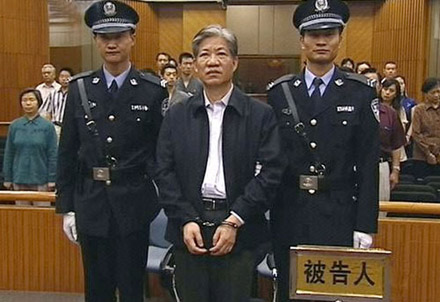
One year ago today, China made to clean up its image — with public health advocates, if not with human rights advocates — by executing* its former Food and Drugs minister for economic crimes.
Zheng Xiaoyu, China’s drug regulation capo from 1994 to 2005 and only (“only”?) the fourth minister-level official to be put to death in China since the immediate aftermath of Mao Zedong’s reign, was sentenced for extracting bribes from pharmaceutical companies he nominally regulated in exchange for approving their worthless and/or unsafe products.
One bogus antibiotic he rubber-stamped killed ten in China before it was pulled from the market, but it was dangerous Chinese products exported abroad — including lethal pet food ingredients to the United States and a cough syrup that killed dozens in Panama — that lit a fire under the export-driven colossus. The court that rejected his appeal explicitly referenced Zheng’s danger to China’s international reputation — simultaneously shifting focus from structural weaknesses by individualizing them to Zheng’s personal failings.
On this same day it announced Zheng’s death, China anxiously unveiled plans to safeguard the food supply for its upcoming turn under the Olympic klieg lights. That acid test is now upon it: opening ceremonies are mere weeks away as of this writing.
It may have been a politically-driven execution and an unusually heavy sentence, but Zheng’s passing was exulted in China. Someone even tried to put his name on a rat poison — rejected for that most distinguished reason of modern capitalism, Zheng’s own intellectual property in his name.
For an interesting dive into the social and legal currents surrounding this case, check out this .pdf edition of Criminal Bar Quarterly.
* The method of execution was not announced, and to my knowledge has not been conclusively documented. Gunshot was the longtime standby for Chinese executions, but China has shifted heavily towards lethal injection in recent years; it’s generally assumed that Zheng suffered the latter fate.
On this date in 1535, Sir — later Saint — Thomas More kept his conscience at the expense of his head on Tower Hill.
For all More‘s greatness — as intellectual, polemicist, lawyer, statesman, father — none of his many gifts at the end could avail him beside his commitment to Catholicism at the dawn of the English Reformation.
Yet it is for those gifts that he cut such a commanding presence in his times, for those very reasons that his sovereign hounded his first citizen to assent to the divorce and remarriage he was fixed upon.
A devotee and friend of Erasmus from years before, More was in Henry’s more orthodox youth the king’s very scourge of Protestantism. His scatological invective against Martin Luther in Responsio ad Lutherum — much in the impolite tenor of Catholic-Protestant rhetoric continent-wide, it should be noted — is of the sort to crimson the cheeks of the milquetoast modern:
Since he has written that he already has a prior right to bespatter and besmirch the royal crown with shit, will we not have the posterior right to proclaim the beshitted tongue of this practitioner of posterioristics most fit to lick with his anterior the very posterior of a pissing she-mule until he shall have learned more correctly to infer posterior conclusions from prior premises?
Over that hairshirt, he wore the robes of state. But his engagement with the world had a selective bent that must have exasperated his colleague and predecessor as Lord Chancellor, Cardinal Wolsey. Orson Welles and Paul Scofield spar here in the definitive More hagiography A Man for All Seasons over the intellectual’s delicate refusal to dirty his gloves with the great matter of state before them — the annulment the king demanded of his marriage to the Queen (and More’s friend) Catherine of Aragon:
Peas in a pod, these two: Wolsey, the cleric grounded in realpolitik; More, the barrister who trusts to God. (More considered holy orders as a young man.)
Our man’s reputation for honesty in a den of hypocrites has certainly outrun Wolsey’s. Still, all More’s disdain for the deal-making that invests the sovereign majesty and all his foreboding for the relationship he had with his dangerous king were not quite enough to stop him accepting the Chancellorship and the opportunity to stamp out Lutheranism … knowing perfectly well the simultaneous thrust of Henry’s boudoir policy.
It all cuts quite a contrast to More’s (barely) pre-Reformation text, Utopia (available free from Project Gutenberg), which named a literary genre and described an imagined society of tolerant primitive communism that surely would have blanched at its inventor’s coming role in the state’s machinations:
I can have no other notion of all the other governments that I see or know, than that they are a conspiracy of the rich, who, on pretence of managing the public, only pursue their private ends, and devise all the ways and arts they can find out; first, that they may, without danger, preserve all that they have so ill-acquired, and then, that they may engage the poor to toil and labour for them at as low rates as possible, and oppress them as much as they please
…
[E]very man might be of what religion he pleased, and might endeavour to draw others to it by the force of argument and by amicable and modest ways, but without bitterness against those of other opinions; but that he ought to use no other force but that of persuasion, and was neither to mix with it reproaches nor violence* …
It’s not a given that More himself agrees with every (or even any) sentiment expressed in Utopia, but his most famous work’s criticism of the death penalty too liberally applied makes interesting reading.
[E]xtreme justice is an extreme injury: for we ought not to approve of those terrible laws that make the smallest offences capital … God has commanded us not to kill, and shall we kill so easily for a little money [i.e., execute petty thieves]? But if one shall say, that by that law we are only forbid to kill any except when the laws of the land allow of it, upon the same grounds, laws may be made, in some cases, to allow of adultery and perjury: for God having taken from us the right of disposing either of our own or of other people’s lives, if it is pretended that the mutual consent of men in making laws can authorise man-slaughter in cases in which God has given us no example, that it frees people from the obligation of the divine law, and so makes murder a lawful action, what is this, but to give a preference to human laws before the divine? and, if this is once admitted, by the same rule men may, in all other things, put what restrictions they please upon the laws of God.
This insistence on the supremacy of divine law over human institutions forms the basis of his objection to parliament’s overthrowing the papacy — which he expressed openly only after he was convicted by obviously perjured “jailhouse snitch” testimony
[Y]ou have no authority, without the common consent of all Christians, to make a law or Act of Parliament or Council against the union of Christendom.
Paul Scofield bears enjoying in the role in A Man for All Seasons:
More is sometimes suspected of desiring martyrdom since he marched so unerringly into it, but he also made every attempt to survive Henry’s demand the he affirm the royal remarriage and the king’s ecclesiastical supremacy by withdrawing silently from the public sphere rather than openly opposing it. More had by every account an enviable, downright happy life at his own hearth, and a tender and intellectual relationship with his favorite daughter Meg. (Meg corresponded with her father in prison, collected his works, and retrieved his head from London Bridge.)
But by his way of thinking — Meg tried to talk him out of it — he couldn’t swear to the Act of Succession acknowledging the king’s right to divorce Queen Catherine and disinherit her daughter Mary if Henry decided to force the choice. And in the king’s eyes, there was no middle ground for someone of the ex-Chancellor’s stature.
Henry could see to it, though, to cut his old friend a break and commute the sentence from drawing and quartering to “mere” beheading, here depicted in the past season of the Showtime series The Tudors.
More’s last moments as rendered here — the ironic remark at the foot of the scaffold, “See me safe up: for my coming down, I can shift for myself”;** his generous answer to the headsman’s plea for forgiveness — are well-documented. Undoubtedly, his sturdy martyr’s bearing, the extension of a life of joyful piety, helped cement for posterity the fame he held in life.
And that dying address — “I die the King’s good servant, but God’s first” — gathers in one sentiment free of bombast or self-pity the irreconcilable demands of conscience that would lead many thousands besides More to Henry VIII’s scaffolds, and rings equally true to less lethal challenges to the conscience in every land and time since.
Anne Boleyn, who caused More’s fate, shared it less than a year afterwards.
Thomas More was canonized by the Catholic Church in 1935 — the patron saint of politicians. Rather bizarrely, July 6 is also his feast day on the Anglican calendar, a tribute to the nearly universal regard his memory enjoys.
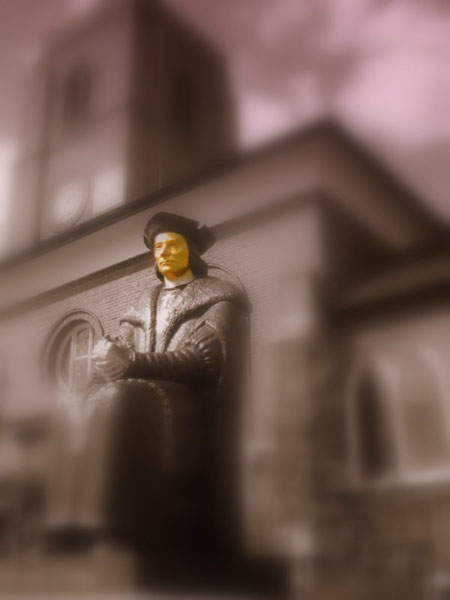
Chelsea resident Thomas More’s statue at the (Anglican) Chelsea Old Church.
* Despite its religious tolerance, More’s Utopia — anticipating Dostoyevsky — maintains:
a solemn and severe law against such as should so far degenerate from the dignity of human nature, as to think that our souls died with our bodies, or that the world was governed by chance, without a wise overruling Providence … since a man of such principles must needs, as oft as he dares do it, despise all their laws and customs: for there is no doubt to be made, that a man who is afraid of nothing but the law, and apprehends nothing after death, will not scruple to break through all the laws of his country, either by fraud or force, when by this means he may satisfy his appetites.
On this date in 1947, Ding Mocun was shot for “conspiring with a foreign government to overthrow China” in Shanghai by the Kuomintang.
This former Communist turned right-wing radical may be most readily recognizable outside China as the real-life inspiration behind Ang Lee’s steamy 2007 art-house menace to undergarments Lust, Caution.
That incident was authored by Ding’s young plaything, who turned out to have a very serious side indeed. (Ding had her shot.)
While the attempt on the turncoat spy’s life really happened, there’s some dispute over whether Chang really had this particular woman strongly in mind over the twenty-plus years she composed her story. There’s more about the evolution of the fictional story here, but you’ll need Chinese skills to follow the links to Chang’s evolving text.
At any rate, Ding’s actual death would come by order of a more august character: Chiang Kai-shek.
Why so many people out to get him?
Despite his nationalist credentials, when Ding lost a party struggle in 1938, he found a gig with the collaborationist government of Japanese-occupied China running a nasty intelligence unit that made nationalists and Communists disappear. That’s the sort of resume anyone would be touching up come the mid-1940’s, and Ding went with a revision (not widely credited, though it has its advocates) that he was secretly passing information to the nationalist resistance all along. And as the nationalists and Communists turned on one another in the postwar power vacuum, it looked like his usefulness to the Kuomintang might get him off the hook after all.
It worked for a while, but Chiang — or so goes the story — caught a tabloid expose about Ding catching R&R at a lake when he’d used a medical pass to get out of prison, and impulsively ordered him shot.
Perhaps Ding’s status as official evildoer vis-a-vis a China whose messy birth many are old enough to remember helps account for the resonance of literary works that engage him as a human being. In a nonfiction vein, Konrad Lawson’s layered critique of the pro-Ding apologia linked above thoughtfully evokes the complexity of Ding’s era and the challenges it poses for historiography.
On this date in 1950, Milada Horakova was hanged with three others in Prague’s Pankrac Prison as a spy and traitor to the Communist Czechoslovakian government.
Not (yet) as internationally recognizable as Rudolf Slansky,* the Communist General Secretary in Horakova’s time who would run afoul of Stalin and die on the same gallows two years later, Horakova (English Wikipedia page | Czech | the detailed French) is a potent symbol domestically of her country’s Cold War nightmare.
Lawyer, social democrat, and a prominent feminist in the interwar and postwar periods — her life’s work, rather overshadowed by an end that was memorable for different reasons — Horakova survived Nazi imprisonment and was a member of parliament when the Communists seized power in 1948.
She spurned counsel to flee the country, and found herself the headline attraction at a show trial for a supposed plot to overthrow the government. In a hopeless scenario, she distinguished herself with off-script defiance despite having broken under torture and signed a confession; Albert Einstein, Winston Churchill and Eleanor Roosevelt all pleaded in vain for clemency.
Horakova left the world clear in her purpose. In a letter to her teenage daughter awaiting execution, she justified her own dangerous choices:
The reason was not that I loved you little; I love you just as purely and fervently as other mothers love their children. But I understood that my task here in the world was to do you good … by seeing to it that life becomes better, and that all children can live well. … Don’t be frightened and sad because I am not coming back any more. Learn, my child, to look at life early as a serious matter. Life is hard, it does not pamper anybody, and for every time it strokes you it gives you ten blows. Become accustomed to that soon, but don’t let it defeat you. Decide to fight.
Hours before her hanging, she wrote a few last words for her loved ones:
I go with my head held high. One also has to know how to lose. That is no disgrace. An enemy also does not lose honor if he is truthful and honorable. One falls in battle; what is life other than struggle? (Both excerpts cited here)
The only woman among Czechoslovakia’s postwar political executions was abortively rehabilitated during the 1968 Prague Spring. Since the fall of the Iron Curtain, her resistance to both Naziism and Communism — worthy of an opera (topical interview) and a forthcoming film — have elevated her into her country’s official pantheon.
As a result, this date is “Commemoration day for the victims of the Communist regime” in the Czech Republic.
Meanwhile, Horakova’s now-octogenerian prosecutor Ludmila Brozova-Polednova, whose repulsive legal barbs at trial (“Don’t break her neck on the noose. Suffocate the bitch — and the others too.”) were probably the consequence of the foregone conclusion more than the cause, was convicted late last year for her role in the trial. That verdict has kept in the news these past several months — most recently, the Czech Supreme Court returned it for retrial after an appeals court overturned the sentence — a tangible symbol of the challenges inherent to confronting the past. (Brozova-Polednova, for her part, is unapologetic.)
* One of the goons who tortured confessions out of the conspirators in Horakova’s “terrorist center,” Karel Svab, was among those later hanged with Slansky.
On this date in 1979, the putschist government of Ghana shot former military rulers Frederick William Kwasi Akuffo and Akwasi Amankwaa Afrifa along with four others at the Teshie Military Range for corruption.
Twenty-two years before, Ghana had become the first black sub-Saharan former colony to gain independence, but after a 1966 coup it had staggered through political and economic chaos. Six different men had been head of state in that span, three of them deposed by coups. By 1979, General Fred Akuffo‘s government was the target of explosive anger.
Enter Flight Lieutenant Jerry Rawlings, who had actually failed in a coup attempt in May and was in line for execution himself before his mates toppled the government on June 4.
Seeking to stabilize the situation — and, Rawlings himself has said, riding the tiger of popular fury — the new government served up a few high-profile morsels on charges of pilfering the treasury in order to forestall a general slaughter of senior officers by the armed forces’ lower ranks.
There was no alternative. We had to contain it within the military so it didn’t spill into the civil front — if it had it would have been terrible.
We had no choice but to sacrifice the most senior ones — the commanders.
Another former head of state, Gen. Ignatius Kutu Acheamphong, had been shot earlier in the month; on this date, Akuffo and Gen. Akwasi Afrifa, one of the original 1966 plotters who had ruled Ghana in 1969-70, followed him. Afrifa, ironically, had written to Acheamphong worrying that political upheaval and military discipline could find them … well, where it eventually found them:
I feel greatly disturbed about the future after the government … In order to discourage the military from staging coups in the future, how about if they line all of us up and shot us one by one? I do not certainly want to be arrested, given some sort of trial and shot.
All these shootings had an unseemly character of haste and summary justice; charges against the four senior ministers* shot along with the former rulers have struck an especially sour note. Rawlings has claimed that he only wanted the two former heads of state shot and tried unsuccessfully to stop the other four executions.
I attempted to prevent it and sent an officer but the firing squad shot the officers before their commander could give the order … you must understand our country was in a state of rage then, not different from what Russia was when it had its revolution.
…
I was a partial hostage to that situation. I had no force. The authority that I enjoyed was my moral authority with the people. Their action (the execution of the senior officers by the boys) was to curtail the anger of the nation.
Rawlings would hand power over to a civilian government, which he then overthrew again in 1981 — looking like this:
He would run Ghana for the next two decades, the last eight years after winning elections. Rawlings’ legacy is much up for debate, but to many he cuts the figure of a benevolent dictator (how many former strongmen have fan pages?) whose human rights abuses were mild in the scheme of things and helped usher in a relatively prosperous and democratic Ghana that stands a very far cry from the country he took over in 1979.
Rawlings himself has graduated to a sort of global elder statesman — for instance, he recently called for fair elections in Zimbabwe. And he has not been hesitant to justify his political actions, as in this interesting BBC interview from 2005 — in which, pressed on the executions of the former state ministers, he concedes:
There were some of them who probably deserved it. Pardon me for putting it that way. There were some of them who did not — very brilliant, beautiful officers. But we had no choice but to make that sacrifice.
The bodies of all the officers executed in June of 1979 were exhumed for “fitting burial” under Rawlings’ successor in 2001.
* One of the aides held the Ghanaian high jump record at the time of his death, a mark not surpassed until 1996.
Fifty years ago today, the onetime Hungarian Prime Minister and three others associated with the country’s shattered 1956 revolution were hanged in Budapest for treason by the Soviet-backed Hungarian government.
A moderate Communist, Imre Nagy assumed leadership of Hungary from 1953 to 1955, a period of ideological thawing after the death of Joseph Stalin.
Nagy charted a “new course” towards Austrian-style neutrality or Yugoslavian-style “national Communism” not yoked to Moscow, opposed domestically by his predecessor and rival Matyas Rakosi, who eventually ousted the reform-minded minister.
But Nagy’s anti-Soviet credentials saw him elevated back to the office by popular acclamation during the 1956 Hungarian Revolution — an interval of the nation’s history still deeply cherished in Hungary today. Here’s a recollection by newsreel montage to the strains of Beethoven’s salute to the national martyrs of another time and place.
Nagy held the office for only ten days before Soviet intervention crushed the revolution. He issued this radio appeal to the world (in Hungarian, followed by the English version at about 0:34) on November 4, 1956:
[audio:Imre_Nagy_broadcast.mp3]
It was an appeal against all geopolitical realities; Hungary was the Soviet Union’s sphere, and western counter-intervention could have precipitated World War III. Verbal outrage abounded, of course:
But Khrushchev gibed that the United States had “supported” the revolution “in the nature of the support that the rope gives to a hanged man.”
For all that, the abortive revolution has won the benediction of history: still venerated in Hungary, and arguably a turning point in the postwar world when the Soviet Union set itself unmistakably and, eventually, fatally against the legitimate aspirations of its subjects.
Nagy’s statue in Budapest’s Martyrs’ Square. Creative Commons photo by Martin Ujlaki.
Less the leader of this stirring movement than carried along by it, Nagy nevertheless embraced the revolution fully.
His government hardly had the opportunity to implement any sort of programme, but it gestured towards multiparty parliamentary democracy. Nagy attempted to withdraw Hungary from the Warsaw Pact. And to the fame of his memory, he refused Soviet blandishments after his capture to recant and accede publicly to the new Hungarian government.
For these principles, Nagy, his defense minister Pal Maleter, and revolutionary officials Miklos Gimes and Jozsef Szilagyi underwent a weeklong trial June 9 to 15, culminating in execution on this date — all strictly hush-hush, and not announced until the bodies were cold.
Though secret, the trial was tape-recorded in its entirety. This past week, to coincide with the anniversary of the affair, the full 52 hours of audio were publicly aired for the first time — over the same June 9-15 span, and at the location of the original trial. The recordings are held by the Open Society Archives, which maintains a wealth of information on the 1956 revolution (such as, topically, this ‘death circular’ issued by anti-Soviet Hungarians). Formerly held under lock and key, the audio files are not yet published for public distribution at this point, but one would expect that it’s only a matter of time.
Nagy and his companions were officially rehabilitated and, on this date in 1989, reburied with honors; tens of thousands turned out to pay respects that had been officially prohibited for 33 years. In this chaotic period as Soviet domination of eastern Europe crumbled, their fellow-traveler Bela Kiraly (who gives a fascinating account from the inside of the Revolution in this 1996 interview) returned from exile for the reinternment ceremony and found that he was technically still under the sentence of death he had received in absentia at Nagy’s trial.
On this date in 1966, the Congo’s last civilian Prime Minister and three former cabinet officials “walked unfalteringly to the gallows in the main square”* of Kinshasa and were hanged before a crowd a hundred thousand strong as Lt. Gen. Joseph-Desire Mobutu consolidated his ruinous Zairian dictatorship.
A cycle of weak governments and nationwide chaos had befallen the resource-rich former Belgian Congo in the early 1960’s after the CIA eliminated the leftist Prime Minister Patrice Lumumba. Evariste Kimba was, when the cycle ended in the fall of 1965, the most recent man to succeed to Lumumba’s title — though hardly his stature — in the tottering government of Joseph Kasavubu (or Kasa-Vubu).
Acting once again with western support, the general later to rename himself Mobutu Sese-Seko overthrew civilian rule on November 25, 1965.
To judge by either tenure (he ruled for more than 31 years) or personal enrichment (rumored to be $5 billion sapped from the poverty-ridden country during that time), Mobutu would rate as one of the 20th century’s most successful evil dictators.
But nobody knew at first that he wouldn’t be another forgettable here-today, shot-tomorrow general. And to see that didn’t happen, Mobutu showed the iron fist early, and made clear that he would brook no resistance, especially not from the old regime’s politicos. A true post-partisan, he declared in 1966 a five-year ban on party activity.
That formed the backdrop, or the pretext, or both, for squelching the “Pentecost Plot”, a supposed attempt by Kimba, along with former ministers Jérôme Anany, Emmanuel Bamba and André Mahamba, to mount a coup of their own.
Pentecost was Sunday, May 29 that year. The four were arrested on May 30 — “[o]n the morning of their arrest the Information Service of the Congo announced, in the name of the government, that they would ‘now appear before a military tribunal which will condemn them to death and they will be hanged.'” (source) When you know the result already, there’s no sense dragging things out: the Pentecost Plotters were tried, convicted and sentenced on June 1 (they denied the charges and received a six-minute deliberation), and hanged on June 2.
Kinshasa’s major football arena, Kamanyola Stadium, was renamed Stade des Martyrs de la Pentecôte in honor of this day’s victims shortly after Mobutu was ousted by guerrilla commander Laurent Kabila in 1997.
He makes a complex character, with a streak of flawed greatness even his contemporary enemies recognized; his anti-Renaissance theology was severe but not dour, fired as it was by a genuine spiritual passion that spoke to real needs of his audience and a real crisis growing in the Church. And he did not disdain the revolutionary real-world implications of his faith.
Savonarola instituted Republican government with a touch of the Taliban — a vice squad of young hooligans to rough up rouged ladies and card-players;* a famous Bonfire of the Vanities in which Botticelli incinerated some of his own work — but also a populist economic touch.
For reasons both internal (the killjoy factor of busting up dice games wore out its welcome) and external (his French ally Charles VIII was driven from Italy, and Savonarola made a dire enemy of the corrupt Borgia pontiff Alexander VI), the priest’s grip on Florence weakened. In April 1498, he was arrested with two other clerics; all three were tortured into signing confessions, then hanged in the Piazza della Signoria by an insolent executioner.
The doomed Savonarola anguished that he had not been strong enough to resist the tortures of the rack, and penned in contrition the Latin meditation Infelix ego:
Alas wretch that I am, destitute of all help, who have offended heaven and earth — where shall I go? Whither shall I turn myself? To whom shall I fly? Who will take pity on me? To heaven I dare not lift up my eyes, for I have deeply sinned against it; on earth I find no refuge, for I have been an offence to it…
Like Savonarola’s memory and teachings, it spread — often illicitly — in a Europe ready for religious reform. Infelix ego has been frequently set to devotional music, like this version by Orlande de Lassus:
[audio:Infelix_Ego_Lassus.mp3]
Savonarola might have been in himself a dead end, an unsuccessful prophet quickly rolled back, but he nonetheless possesses a recognizable essence that distills both the Zeitgeist of his time and the immemorial hunger for simplicity and virtue that coexists with the equally human celebration of pleasure and beauty. He left complex legacies to both the Church and the city his reforms sought (and ultimately failed) to scourge.
In religion, his castigation of the vice and sin of the Church (a position of which he was an outstanding but hardly a lonely advocate) prefigured the coming Reformation. But Savonarola also never left off the most devout affiliation to Catholicism, nor sought institutional schism even when he had been excommunicated.** What to make of such a man? He is both depicted (at the base of a Martin Luther statue) at the Worms Reformation Monument, and proposed for present-day Catholic canonization.
So too his secular legacy — the theocrat who burned books and expelled the Medici and was reduced to ashes for his reactionary principles — merits a respectful recollection in Florence, even if few would actually want to live in his republic. He repelled Machiavelli, a libertine counselor of the post-Savonarola Florentine Republic, but perhaps fascinated him as well, as a prince with a precisely backward grasp of his own power.
This stone marking the site of the execution stands at a crossroads of tourist traffic in a thicket of statuary, mostly nude and/or classically inspired, outside the entrance to one of Europe’s principle collections of Renaissance art.
One wonders what the old Dominican would have made of it.
Books about Savonarola’s Florence
* Savonarola also made sodomy punishable by death.
** Alexander VI tried first to get him (in Lyndon Johnson’s fragrant phrase) inside the tent pissing out by making him a cardinal, which Savonarola spurned.
Any queen decapitated by her king would of course rate an entry in these grim pages. But this does not quite explain Anne Boleyn‘s enduring appeal, relevance and recognizability for the most casual of modern observers, and her concomitant footprint in popular culture, even with the “Greek tragedy” quality of her life.
Anne stands at the fulcrum of England’s epochal leap into modernity. Whether she was that fulcrum might depend on the reader’s sympathy for the Great Man theory of history, but little more do we injure our headless queen to regard her as the woman for her time and place — the accidental hero (or villain) raised up and thrown down by the tectonic forces of her milieu.
Through Anne was born — for reasons of momentary political arrangements of long-forgotten dynasts, which seems a shockingly parochial proximate cause — the English Reformation, and through the Reformation was born the crown’s decisive triumph over the nobility, the broad middle class nurtured on the spoils of Catholic monasteries, the rising Britannia fit to rule. Most would take as an epitaph historical accidents of such magnitude.
Of course, by those same accidents, Anne was the instrument of thousands of deaths herself, and little did she appear troubled in life by the corpses upon which she ascended the throne.
Her own family maps the change wrought on England. An ancestor was beheaded in the Wars of the Roses, medieval England’s last great breakdown; her uncle Thomas Howard was one of the throwback scheming Dukes, mastered by his sovereign to the extent of issuing Anne’s capital sentence from his own lips;* the beheaded woman’s daughter, Queen Elizabeth I, set a recognizably centralized English state on the path of empire.
Fitting tribute that, from the Tower where she met her end** to lands undreamt-of in her time, people still, like Henry, find her captivating.
* Anne’s father also declared for her guilt. Unprincipled as these men undoubtedly were, it cannot have been a pleasant responsibility; the question of whether she was actually guilty of adultery-cum-treason, the fatal charge extracted from a supposed lover by torture, has been hotly and inconclusively disputed by posterity.
** With a solemn speech submissive to Henry but not admitting any guilt — in an earlier moment of levity, she had famously remarked of the French swordsman hired to do the job, “I heard say the executioner was very good, and I have a little neck.”


 Based on


 Anne stands at the fulcrum of England’s epochal leap into modernity. Whether she was that fulcrum might depend on the reader’s sympathy for the Great Man theory of history, but little more do we injure our headless queen to regard her as the woman for her time and place — the accidental hero (or villain) raised up and thrown down by the tectonic forces of her milieu.