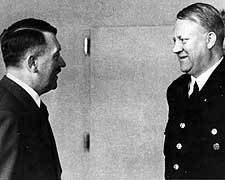
1948: Hideki Tojo and six other Japanese war criminals

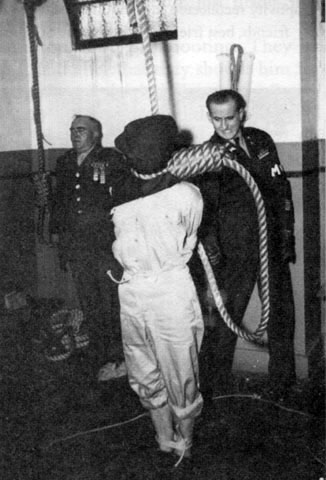
On this date in 1948, seven “Class A” war criminals, including Japan’s wartime Prime Minister Hideki Tojo, were hanged at Sugamo Prison by the American occupation authorities.

Like other Axis heads of state, Tojo was in for a bad end: he shot himself in the chest before American troops could arrest him, but missed his heart even though a doctor had helpfully marked the spot on his chest for him.


Fail.
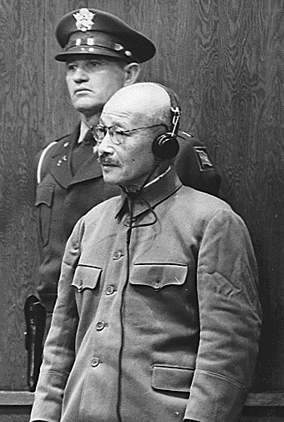
However inevitable Tojo’s postwar fate, however, he was not exactly of a kind with the likes of Hitler and Mussolini. Indeed, he’d been cashiered from his Prime Ministerial gig in 1944 by the real power behind the throne — the Japanese military.

Unlike the “Fuhrer” and “Il Duce,” Tojo was a reflector, not a creator, of national thought. His word was not law. It was not his command or dictate. He was one among many and not even the first among equals. He was a militarist — misguided, naive, and narrow in outlook; he regarded war as a legitimate instrument of national policy; he apparently believed what he told the court, and failed to recognize the patent contradictions between his contentions and the facts. This had been his undoing.

That’s Robert Butow in Tojo and the Coming of War. Butow argues that the titular authority in Japan (he became Prime Minister shortly before the bombing of Pearl Harbor), a dedicated, patriotic officer of adequate talents but limited vision, came much too late and controlled much too little to be seen as the equal of the European theater’s villains.

The Japan of which General Hideki Tojo became premier was operated by remote control. It was a country in which puppet politics had reached a high state of development, to the detriment of the national welfare. The ranking members of the military services were the robots of their subordinates — the so-called chuken shoko, the nucleus group, which was active “at the center” and which was composed largely of field-grade officers. They, in turn, were influenced by younger elements within the services at large and by ultranationalists outside military ranks. The civilian members of the cabinet were the robots of the military — especially of the nucleus group, working through the service ministers and the chiefs of the army and navy general staffs. The Emperor himself, through no fault of his own, was the robot of the government — of the cabinet and the supreme command, a prisoner of the circumstances into which he was born … Finally, the nation — the one hundred million dedicated souls, the sum and substance of Japan, from whom the blood and toil and tears and sweat of Churchill’s phrase were wrung — the nation was the robot of the throne.

He was the man for his time and place. He fit right in.

Even when being fitted for a noose.
Once Tojo had recovered from his errant self-inflicted wound,* and even though he had been among those opposing surrender even after the atomic bombings, he played ball with the International Military Tribunal for the Far East (whose trial transcripts run to 50,000 pages).

The former premier embraced responsibility, diligently shielding the Emperor from any intimation of guilt (some argue this was the procedure’s entire raison d’etre, from the perspective of both the prosecution and the defense), and walked a dignified and honorable last mile in the courtrooms of the victor’s justice, presenting his perspective as he knew it in the context of a wish for peace between the late antagonists.

1. I deny that Japan “declared war on civilization.”

2. To advocate a New Order was to seek freedom and respect for peoples without prejudice, and to seek a stable basis for the existence all peoples, equally, and free of threats. Thus, it was to seek true civilization and true justice for all the peoples of the world, and to view this as the destruction of personal freedom and respect is to be assailed by the hatred and emotion of war, and to make hasty judgments.

3. I would like to point out their [my accusers’] inhumane and uncivilized actions in East Asia ever since the Middle Ages.

4. In the shadow of the prosperity of Europe and America, the colored peoples of East Asia and Africa have been sacrificed and forced into a state of semi-colonization. I would point out that the cultural advance of these people has been suppressed in the past and continues to be suppressed in the present by policies designed to keep them in ignorance.

5. I would point out that Japan’s proposal at the Versailles Peace Conference on the principle of racial equality was rejected by delegates such as those from Britain and the United States.

6. Of two through five above, which is civilization? Which is international justice? Justice has nothing to do with victor nations and vanquished nations, but must be a moral standard that all the world’s peoples can agree to. To seek this and to achieve it — that is true civilization.

7. In order to understand this, all nations must hate war, forsake emotion, reflect upon their pasts, and think calmly.

The “Class A” convicts not executed along with Tojo were freed afterwards.

Tojo has enjoyed a bit of a latter-day resurgence in the public regard, product of the nationalist right’s resurgence in Japan. The hanged man’s granddaughter Yuko Tojo has waged a tireless campaign to clear him.

Further to that end, his ashes — and those of the other Class A convicts — were covertly added to the controversial Yasukuni Shrine, and remain there to this day. That public tribute to principals of Japan’s bloody foreign occupations has become a hot political football between Japan and other nations, especially China.

But after all, Tojo the man was never a leper, but part and parcel of his times. Small wonder that we moderns hear an echo of the general’s postwar justification for the War in the Pacific from the country that hanged him.

Japan … faced considerable military threats as well.

Japan attempted to circumvent these dangerous circumstances by diplomatic negotiation, and though Japan heaped concession upon concession, in the hope of finding a solution through mutual compromise, there was no progress because the United States would not retreat from its original position. …

Since events had progressed as they had, it became clear that to continue in this manner was to lead the nation to disaster. With options thus foreclosed, in order to protect and defend the nation and clear the obstacles that stood in its path, a decisive appeal to arms was made.

The problematic nature of the war crimes proceedings in postwar Japan (especially vis-a-vis those in Germany) is examined in Yuma Totani’s The Tokyo War Crimes Trial: The Pursuit of Justice in the Wake of World War II. The author discussed her research on the New Books In History podcast.

[audio:http://newbooksinhistory.com/podpress_trac/web/720/0/Totani%20Interview.mp3]

* According to John Dower’s Embracing Defeat, the suicide scenario angered some nationalists because Tojo only “belatedly summoned the will to die,” and “chose the foreigner’s way of the bullet rather than the samurai’s way of the sword, and then botched even this.”

On this day..

2003: Liu Yong, for corruption

On this date in 2003, Liu Yong’s situation took a very abrupt turn for the worse.

The wealthy Communist Party member and Shenyang city legislator had been sentenced to death 20 months before in a corruption case for ordering the murder of a tobacco vendor as part of a mafioso racket of graft, extortion, black marketeering, and kindred mayhem.

When that sentence was reduced on retrial on a showing that Liu’s confession was extracted by torture, public outcry at the appearance of a well-connected insider getting off scot-free led the Supreme Court to take the unprecedented step of yet again re-trying a criminal case itself.

“According to China’s legal system, a criminal case can usually be tried only twice,” as China Daily lightly put it.

Amnesty International is less measured, and alleges that the irregular Supreme Court hearing was ordered by political insiders to buttress the credibility of the country’s anti-corruption drive — and to avoid setting any precedent that evidence of torture should mitigate criminal sentencing. (China certainly found defenders for the trial (the link is to an ugly layout of raw HTML).)

The high court handed down its sentence this very day, after which Liu was immediately hailed to one of China’s mobile execution vans, given a lethal injection, and cremated.

On this day..

1922: Robert Erskine Childers, for carrying the gun of Michael Collins

On this date in 1922, Robert Erskine Childers was shot by the Irish Free State for carrying a gun its founding colossus had gifted him.

Many Irishmen were executed on either side in this terrible time, but Childers cuts a unique figure among them.

To begin with, he wasn’t all that Irish — “that damned Englishman,” fellow Republican turned Civil War enemy Arthur Griffith called him. The London-born son of a British scholar and an Irish mother, Childers was a lifelong Protestant, itself an anomaly since Irish nationalism mapped (and still maps) strongly to Catholicism.

You’d think he’d be a loyal man of the empire. Early on, that’s just what he was.

In his twenties, Childers volunteered for the Boer War, and he would later say the rank savagery and underlying injustice of England’s war “changed the whole current of my life and made me a Liberal and a Nationalist.” (Source.)

Laying down the sword, Childers took up the pen and wrote several books of military history. (Long since into the public domain, at least two can be read free online: War and the Arme Blanche, German Influence on British Cavalry.) He also wrote a novel, The Riddle of the Sands, that has a (debatable) claim as the first spy novel. Riddle has never gone out of print since it was published in 1903, though it is also available free online.

Both in fiction and nonfiction, Childers’ warnings against the German challenge to British hegemony were prophetic, but he was himself becoming a man divided. 1914 saw him running German guns to Irish nationalists aboard his yacht Asgard … and then signing up for the royal navy when World War I erupted.

The British crackdown on the Easter Rising during the war completed his radicalization; he moved to Dublin and turned his eloquence against the British.

Here, Childers was swept into the tragedy of the Irish War of Independence, and the civil war that followed it; though both were in the delegation that produced the contentious Anglo-Irish Treaty, Childers broke with Michael Collins over it and backed the IRA nationalists who fought the Irish Free State.

After Collins’s assassination, emergency laws promulgated the death sentence for anyone caught armed without authorization. Childers was a writer, not a partisan, but he was arrested in early November with a small sidearm — a gift Michael Collins had given him, back when they were on the same side. It was a time of bloody justice, and they threw the book at him.

Childers knew as well as Collins had that the internecine conflict would have to end. He checked out with awe-inspiring forgiveness; summoning his 16-year-old son to prison the night before his execution, Childers extracted a promise that the boy would find everyone who signed his death warrant … and shake their hands. (Young Erskine Hamilton Childers eventually became President of Ireland.)

Childers himself likewise shook the hands of his own firing squad, one by one. His last words (reported in a number of slightly different variations) were lightheartedly addressed to them:

Take a step or two forwards, lads. It will be easier that way.

On this day..

284: Aper, by Diocletian

On this date* in 284, one of Rome’s greatest emperors claimed the purple by summarily executing his rival before the approving army in Anatolia.

The Emperor Diocletian christened his reign with a bit of scaffold theatricality, but he might have been the real perp.

For half a century, the Roman Empire had waded through crisis. In its political manifestation, a parade of forgettable emperors had marched through the throne room, each to be assassinated, overthrown, or otherwise disposed of by some equally forgettable aspirant en route to a similarly unenviable end.

At length, out of this unpropitious bunch, rose one Diocles, a low-born Dalmatian of classical education whose martial gifts saw him rise through the legions. His opportunity came when the emperor Carus, barely a year on from succeeding his assassinated predecessor, died on campaign against Persia allegedly struck by lightning (quite possibly a euphemism for something more dagger-like), leaving his son Numerian in charge.

As the army meandered back to the friendly confines, Numerian secluded himself in his litter. And after a while, the litter started to stink.

Sometime on the journey, he’d been secretly killed — but by whom?

The principals this day are our leading suspects. (And it’s a little mystifying in either case just what was gained by leaving the body hidden so long.) We turn to Gibbon to narrate what must have been a riveting — not to mention definitive — proceeding adjudicating between them a few kilometers past Nicomedia (moder Izmit, Turkey) towards Chalcedon (now the Kadikoy district of Istanbul).

A general assembly of the army was appointed to be held at Chalcedon, whither Aper was transported in chains, as a prisoner and a criminal. A vacant tribunal was erected in the midst of the camp, and the generals and tribunes formed a great military council. They soon announced to the multitude that their choice had fallen on Diocletian, commander of the domestics or body-guards, as the person the most capable of revenging and succeeding their beloved emperor. The future fortunes of the candidate depended on the chance or conduct of the present hour. Conscious that the station which he had filled exposed him to some suspicions, Diocletian ascended the tribunal, and raising his eyes towards the Sun, made a solemn profession of his own innocence, in the presence of that all-seeing Deity. Then, assuming the tone of a sovereign and a judge, he commanded that Aper should be brought in chains to the foot of the tribunal. “This man,” said he, “is the murderer of Numerian;” and without giving him time to enter on a dangerous justification, drew his sword, and buried it in the breast of the unfortunate praefect.** A charge supported by such decisive proof was admitted without contradiction, and the legions, with repeated acclamations, acknowledged the justice and authority of the emperor Diocletian.

Though there isn’t any direct evidence of it, posterity is entitled to suspect on grounds of means, motive and opportunity, that the eventual beneficiary of Numerian’s demise — the emperor henceforth known as Diocletian — was its true author.

Whether obtained by fair means or foul, Diocletian put the laurels of state to good use, stabilizing government by introducing the “Tetrarchy” — the rule of the empire’s eastern and western halves by two emperors (“Augusti”) each aided by a “Caesar” who was also the heir apparent.

Diocletian’s two decades in power before his anomalous voluntary retirement constitute a watershed in the late history of Rome, and not only because the cycle of imperial assassinations and civil war took a welcome generation-long hiatus.

Although he’s also remembered for initiating the last major persecution of Christians, his administration set the stage for the rise of Constantine the Great, the Galilean’s first imperial champion. Constantine’s father was one of the original tetrarchs, the Caesar of the west.

And in the longer term, Diocletian’s division of the empire between east and west would sow the seed of the later separation of Byzantium and Rome, and the corresponding division in the Christian world. No surprise, then, that the first ruler profiled in Lars Brownworth’s 12 Byzantine Rulers podcast is this date’s executioner:

[audio:http://www.12byzantinerulers.com/audio/02-Diocletian.mp3]

More audiophilia about Diocletian and the tetrarchs in this lecture from Isabelle Pafford’s UC-Berkeley course on Roman history. (The first 6:45 or so consists of class business and carryover from previous lectures.)

[audio:http://webcast.berkeley.edu/media/s2008/hist106b/hist106b_20080425.mp3]

* As with much in the ancient world, sourcing is tenuous, and there is some scholarly debate over whether the events in this post should be ascribed to November 20, or to November 17, or to September 17, or to some other date. Since this blog, notwithstanding its title, embraces the occasional execution whose date is uncertain, I am prepared to wave aside textual uncertainty in the interest of a ripping good story.

** According to the Historia Augusta, Diocletian had a superstitious reason to carry out this bloodthirsty act personally.

This story my grandfather related to me, having heard it from Diocletian himself. “When Diocletian,” he said, “while still serving in a minor post, was stopping at a certain tavern in the land of the Tungri in Gaul, and was making up his daily reckoning with a woman, who was a Druidess, she said to him, ‘Diocletian, you are far too greedy and far too stingy,’ to which Diocletian replied, it is said, not in earnest, but only in jest, ‘I shall be generous enough when I become emperor.’ At this the Druidess said, so he related, ‘Do not jest, Diocletian, for you will become emperor when you have slain a Boar (Latin: Aper).’ ” … It is now well known and a common story that when he had killed Aper, the prefect of the guard, he declared, it is said, “At last I have killed my fated Boar.” My grandfather also used to say that Diocletian himself declared that he had no other reason for killing him with his own hand than to fulfill the Druidess’ prophecy and to ensure his own rule. For he would not have wished to become known for such cruelty, especially in the first few days of his power, if Fate had not impelled him to this brutal act of murder.

Part of the Themed Set: The “Ex” Stands For “Extrajudicial”.

On this day..

1954: Hossein Fatemi, before the blowback

At dawn this date in 1954, the last Foreign Minister of democratic Iran was shot in Tehran.

It was a year since the dramatic events of 1953, when a CIA-backed coup d’etat overthrew Iranian Prime Minister Mohammed Mossadegh (or Mosaddegh, or Mossadeq, or Mosaddeq) for contemplating oil nationalization.

Over several chaotic days of “Operation Ajax” (or TPAJAX), the Mossadegh government repulsed a first coup attempt, then succumbed to another.

After Mossadegh initially appeared to have maintained his hold on power, the autocratic Shah Mohammad Reza Pahlavi fled for his life to Iraq and thence to Rome. Fatemi, Mossadegh’s forceful young foreign minister, excoriated the Shah in words that themselves raised the specter of execution.

A traitor is afraid. The day when you, O traitor, heard by the voice of Teheran that your foreign plot had been defeated you made your way to the nearest country where Britain has an embassy. (Quoted in the New York Times.)

Either way, it was high stakes for all concerned in oil country. There’s been contentious debate over the extent to which the affair was also a Cold War proxy conflict — or whether the involvement of the country’s Communist party was incidental, a smokescreen, or an outright stalking-horse for the west.

The coup against Mossadegh has emerged as a major historical turning point — and after the Shah was himself dramatically overthrown in the 1979 Iranian Revolution, not necessarily so successful for American foreign policy goals as it seemed at the time.

Appropriately — in fact, with eerie prescience given the events that then lay a generation in the future — a recently declassified 1954 CIA report on the coup made the first known use of a neologism that has since grown increasingly familiar: blowback.

Possibilities of blowback against the United States should always be in the back of the minds of all CIA officers involved in this type of operation. Few, if any, operations are as explosive as this type.

Maybe those possibilities should be in the front of the mind.

Today, there’s a street named for Fatemi in Tehran, and — strange to say — still some number of Americans who anticipate the greeting due liberators should they ever manage to roll a tank down it.

On this day..

1793: The Girondists

On this date in 1793, in a revolutionary Paris where the machinery of the Terror was clattering to life, five tumbrils bore to the guillotine twenty former Girondist ministers to the National Convention — plus the corpse of their late colleague Dufriche de Valazé, who had cheated the executioner by killing himself.

Named for the region of Aquitaine from which their leading lights hailed, the Girondists (or Girondins) had in the compressed history of the Revolution ascended from fringe democratic party to governing party even as the political facts shifted under their feet. Finding themselves the conservative party in an assembly increasingly dominated by radical Montagnards and the Paris mob, the Girondists’ tactlessness and stubborn refusal to deal with Georges Danton after his (still historically murky) involvement in the riotous slaughter of prisoners during the September Massacre eroded their position.

As the terrible year of 1793 unfolded, the Girondins discovered themselves successively overthrown, expelled from the Convention, proscribed, and hunted. Though many more — Girondists and others — were to follow in their steps, the trial of these 21 before the Revolutionary Tribunal and subsequent guillotining, the first notable mass-execution of the Revolution, raised the curtain on the Terror.


L’ultime adieu des Girondins le 31 Octobre 1793, by Paul Delaroche

Decades later, the English historian Lord Acton remembered the faction’s doomed heroism.

[The Girondins] stood four months before their fall. During that memorable struggle, the question was whether France should be ruled by violence and blood, or by men who knew the passion for freedom. The Girondins at once raised the real issue by demanding inquiry into the massacres of September. It was a valid but a perilous weapon. There could be no doubt as to what those who had committed a thousand murders to obtain power would be capable of doing in their own defence.

Almost to the last moment Danton wished to avoid the conflict. Again and again they rejected his offers. Open war, said Vergniaud, is better than a hollow truce. Their rejection of the hand that bore the crimson stain is the cause of their ruin, but also of their renown. They were always impolitic, disunited, and undecided; but they rose, at times, to the level of honest men.

They were easily beaten and mercilessly destroyed, and no man stirred to save them. At their fall liberty perished; but it had become a feeble remnant in their hands, and a spark almost extinguished. Although they were not only weak but bad, no nation ever suffered a greater misfortune than that which befell France in their defeat and destruction.

That Pierre Vergniaud who scorned the hollow truce was the last to mount the scaffold this day — a shining orator of the Revolution who captured the calamity engulfing his nation in another well-remembered aphorism, “the Revolution devours its own children.”

On this day..

1618: Walter Raleigh, age of exploration adventurer

On this date in 1618, schemer, explorer, and lover Walter Raleigh fell permanently out of favor.

One of the biggest wheels of Elizabethan England, Raleigh (who also rendered his name Rawleigh, Rawley, and most commonly, Ralegh) charmed his way into the Queen’s inner circle, and possibly her pants, and was even thought to be a contender for her hand.

In between gorging on royal monopolies, scribbling poetry, popularizing tobacco, and introducing the potato to Ireland [allegedly], Raleigh got his New World on by attempting to colonize Virginia,* helping fund it with privateering operations against England’s rivals in the land-grab game. The city of Raleigh, North Carolina — present-day North Carolina was part of the Virginia Colony back in the day — is named for him.

Proud, powerful, and the queenie’s pet. Just the sort of courtier other noble suckups loved to hate.

When the palace fave secretly dallied with one of the Queen’s ladies-in-waiting, he went on the royal outs and got real familiar with the Tower of London. Though he managed to patch up with Elizabeth, things were never quite the same for Sir Walter. Elizabeth’s successor James I put him back in prison (suspending a death sentence) for supposedly participating in the Main Plot.

Raleigh passed the time under lock and key burnishing his Renaissance man rep by writing various poetry and treatises, including an account of his voyage to Guyana. Convinced the legendary city of El Dorado was in the vicinity, Raleigh eventually prevailed upon James to release him to make another run at it.

But a dust-up with a Spanish outpost in South America left his son dead, and the Spanish ambassador hopping mad. Raleigh was arrested upon his return, and the death sentence reinstated.

At 66 years of age or so, Walter Raleigh had had a pretty good run.

He took his punishment with equanimity, writing tenderly to his wife, and examining the blade that would take off his head on the scaffold with the observation,

“This is a sharp Medicine, but it is a Physician for all Diseases.”

His wife creepily kept the severed head for the remaining 29 years of her life.

There’s a more detailed tour of Raleigh’s life here, and a site linking many works by and about Raleigh here.

* As Governor of Virginia, Raleigh forbade injuring Indians on pain of death, according to Giles Milton’s Big Chief Elizabeth. Raleigh’s “imperialism with a human face” policy had exchange programs of Indians visiting England, most notably Pocahontas.

On this day..

1945: Vidkun Quisling, who made his name as a traitor

On this date in 1945, eponymous Nazi collaborator Vidkun Quisling was shot at Oslo’s Akershus Fortress for high treason.

By the time of his death, the Nazi collaborator (English Wikipedia page | Norwegian) had already given his surname to English and other languages as a synonym for traitor.

Just deserts for his efforts as chief of the fascist party Nasjonal Samling to aid the Nazi conquest of his home country. Quisling interrupted a radio broadcast on April 9, 1940 to proclaim himself Prime Minister* and order cooperation with invading Germans.

Although Quisling’s lack of popular support compromised his value even as a puppet, he remained as Minister President of Norway through the war — a crucial tool in Germany’s counter-encirclement jousting with Britain, nicely explained at the outset of Frank Capra’s American propaganda flick Why We Fight:

He enjoyed public regard commensurate with his station.


A 1944 cartoon in Sweden (which remained tenuously neutral and unoccupied during the war) indicates that Quisling had already made his name a byword for treachery. The caption reads:
“I am Quisling.”
“And the name?”

Norway had abolished capital punishment in 1905, but its government-in-exile reinstated it expressly for dealing with high-level collaborators.

Though Quisling himself may have deserved this and worse, the justice and legality of so doing has been controversial ever since.


The site of Quisling’s execution. Some other shots from his trial are in this 60-year Norwegian-language retrospective.

* Thought to be the first on-air putsch in history.

On this day..

Feast Day of Boethius

(Thanks to Jeffrey Fisher [jeffreyfisher at me.com] for the guest post.)

Today is the feast day of Neoplatonic philosopher and Christian theologian Boethius (Anicius Manlius Severinus Boethius), author of The Consolation of Philosophy, and according to tradition martyred in 524 or 525, or possibly 526, by the Ostrogothic king Theodoric.

Well, maybe.

We know roughly as much about why Boethius was killed as when or how. We do know that he came from a line of prominent Romans (including a couple of popes back there, depending on who you count as “pope”), was himself consul in 510, and his sons were rather astonishingly joint consuls in 522. At that time he moved up to Ravenna accepting an appointment at Theodoric’s court as the Master of Offices, something like the equivalent of chief of staff, managing the work of Theodoric’s officers.

But then things went horribly wrong.

There is a long tradition, going back at least to the eighth century, regarding Boethius as having been executed for maintaining the Catholic faith against the Arian Theodoric. While Theodoric was probably paranoid about spies representing the Catholic eastern emperor-in-waiting Justinian (who would, in fact, later “reconquer” the Italian peninsula), and Boethius claims in the Consolation that he was hated for being smarter than everyone else, the truth is probably that he was caught up in the usual machinations of an imperial court.

A member of the Senate was accused of treasonably conspiring with Justinian’s predecessor Justin I against Theodoric. Boethius defended the accused (apparently the only person to do so, although the charges were surely trumped up), and in the Consolation, Boethius says he was only defending the Senate (implying that the accusations were meant to undermine the authority of the Senate by challenging its loyalty to the king).

In any event, the sources we have say that Boethius was condemned by the Senate (who appear to have thrown him under the bus) without being able to speak in his own defense. After an indeterminate time of imprisonment, he was executed.

It was while he awaited death that he wrote his most famous and arguably most influential work, The Consolation of Philosophy.

A few of the many editions of The Consolation of Philosophy available. Others are available free at Project Gutenberg (here, here and a Latin one here), as is a podcast version.

Boethius’ translations of and commentaries on ancient Greek philosophy were the only such texts available in Europe for much of the Middle Ages, but the Consolation was translated and widely read even outside of the philosophical circles in which his other work was so important.

Written in the form of Menippean satire (alternating verse and prose) as a dialog between Boethius and Philosophy, the Consolation is Boethius’s attempt to think through and make sense of the sad state of his affairs.

Ultimately, it was both the universal nature of the problem (why are these horrible things happening to me?) and the compelling way in which he tackled the problem (a combination of Plato, Aristotle, and Stoicism) that have made this text so widely read and imitated.

There is no way in this space to do justice to the Consolation, which addresses the very idea of philosophical discourse (“would you like us to clash together our arguments, for perhaps out of a conflict of this kind some beautiful spark of truth my fly out?”), the nature of time and God’s perspective outside of time, the difference between providence and fate, and the nature of and way to the Good itself.

But the gist of Boethius’s argument about the sufferings of the good person maybe be quickly summarized. In short, Boethius has forgotten his true nature, which never changes, and gotten caught up in the things of this world, which come and go. If he but remembers himself, he will have something no injustice, no turning of the wheel of fortune, can take away from him. And as for the unjust and the evil, they also have their “reward”:

But since goodness confers on each man his reward, he will only lack it when he has ceased to be good. [ . . . Now] since the good itself is happiness, it is clear that all good men are made happy for this reason, that they are good. But those that are happy, it is agreed, are gods; and therefore that is the reward of good men, which no time can lessen, no man’s power diminish, no man’s wickedness obscure, to become gods. These things being so for good men, no wise man can doubt either of the punishment inseparable from evil men; for since good and evil, and also punishment and reward, are directly opposite to one another, what we see added in the case of the good man’s reward must necessarily be reflected in an opposite manner in the evil man’s punishment. As therefore goodness itself is the reward for good men, so for wicked men wickedness is itself the punishment.

On this day..

31: Sejanus, captain of the Praetorian Guard

Over the course of this day in 31, Lucius Aelius Seianus went from virtual master of the Roman Empire to strangulation at the order of the Senate.

Patrick Stewart as Sejanus in I, Claudius.

Known simply as Sejanus, he was of equestrian stock who rose to prefect the Praetorian Guard when Tiberius succeeded Augustus as Rome’s first citizen.

It was not yet the “infamous Praetorian Guard”. Sejanus would make it so: his were the institutional aggrandizement — long outliving Sejanus — that would position the Guard to arbitrate imperial succession; his the persecutorial internal policing that made it a swords-and-sandals Gestapo.

Sejanus maneuvered skillfully towards supreme power in Rome — and ruthlessly enough that he is suspected of having murdered Tiberius’s son and heir Drusus. Though the Emperor refused a dynastic marriage with Drusus’s widow that would have set Sejanus up for official succession, the Praetorian had the purple in all but name in the late 20’s when Tiberius decamped for the dissolution of Capri.

The usual sort of thing ensued: spies, informers, purges and political murders.

The Republic had been down this road before. After the peace of Augustus, it was a chilling preview of Imperial Rome’s coming attractions.

Unlike most of those, the Sejanus issue was ultimately resolved without civil war. Finally wise to his captain’s game, Tiberius snuffed out the threat in a single blow without bestirring himself from his island retreat by sending word to convoke Sejanus and the Senate to elevate the soldier to the tribunate … and having a letter there read which demanded the soldier’s arrest.

That august old body — “men fit to be slaves,” in Tiberius’s estimation — took it from there. Sejanus was summarily executed this very evening, his body torn apart by the mob, and a witch hunt for his lieutenants and supporters immediately began.

Nice coverage of Sejanus and Tiberius on the History of Rome podcast.

[audio:http://c1.libsyn.com/media/17332/58-_Partner_of_my_Labors.mp3]

On this day..