1985: Major Zin Mo, failed assassin

On this date in 1985, North Korean Major Zin Mo was hanged in Buma’s Insein prison.

Eighteen months earlier nearly to the day, a huge bomb ripped apart Rangoon’s monumental mausoleum tribute to martyred founding hero Aung San.

The bomb was meant for visiting South Korean president Chun Doo-hwan,* who planned to lay a wreath at the site. But the infernal machine detonated too early, sparing its target — though 21 others lost their lives, 17 of them Korean, including Foreign Minister Lee Beom-seok.

The ensuing manhunt turned up three North Korean commandos, each of whom had been detailed short-fused grenades to commit spectacular suicide to evade capture.

Zin Kee-Chu started pulling stuff out of his bag. First a pile of money came out and while the policemen were temporarily distracted by the cash he then pulled out a hand grenade and detonated right there.

Their hand grenades had short 1 second fuses unlike our M-36 hand grenades with the longer 4 seconds fuses. So the explosion was immediate and some policemen and Captain Zin Kee-Chu himself were killed there. (Source)

But Major Zin Mo survived his explosives, albeit with devastating injuries, and fellow-captain Kang Min Chul lacked the fortitude to make the suicide attempt at all. Under none-too-gentle interrogation, Zin Mo kept his mouth shut and accepted his secret execution for the People’s Republic. Zin Kee-Chu didn’t have any better stomach to hang for his country than to blow himself up for it; he didn’t hang and lived out his life in Burmese captivity, having apparently cut a deal to tell all in exchange for his life.

There’s a phenomenal firsthand retrospective on these events, liberally illustrated, here, written by a present-day Burmese exile who was in Rangoon on the day the mausoleum was bombed.

* Chun was the guy who emerged in charge after Korea’s intelligence chief bizarrely assassinated President Park Chung-hee in 1979.

On this day..

1560: Baron de Castelnau, for the Amboise Conspiracy

On this date in 1560 the second Baron de Castelnau, Jean Boileau, was beheaded as a Huguenot traitor. His was one of the opening casualties of France’s devastating Wars of Religion.

We find Castelnau’s end before war began, when the Huguenot party — although it had been pressed sorely enough for martyr–making in the years of the Reformation — was perhaps not yet quite steeled for the measure of purposeful violence it would require to conquer state power. After the events in this post, the great Huguenot leader Gaspard de Coligny would remonstrate at a royal Council of Notables protesting the loyalty of the realm’s Protestant subjects. Two years later, he was commanding rebels in the field; a decade later, he would be murdered in the St. Bartholomew’s Day Massacre.

“Rashly designed and feebly executed,”* the plan of these 1560 pre-rebellion Huguenots was to tilt France’s religious policy by muscling out the top Catholic.

If it were possible to imagine such a gambit it was amidst the flux following King Henri II‘s sudden death at the jousts in 1559. his sickly 15-year-old heir Francis was dominated by the staunchly Catholic Duke of Guise; policy accordingly trended away from religious accommodation for the Calvinist Huguenot minority.

Considering the new king’s youth and Guise’s prestige, here was the potential to lock in for decades to come a situation intolerable to France’s Protestants. (In actual fact, Francis had not long to live himself and the country soon fell into civil war … but the characters in this post did not have the benefit of hindsight.)

So the muscling-out plan was born: the Amboise conspiracy. Named for the castle where the attempt was unsuccessfully executed, this plot aimed to seize the Duke of Guise by main force and begin forcing a more satisfactory policy direction on the malleable sovereign.

This scheme became very widely known among Protestant nobles and even bourgeois, who variously signed on or demurred; no surprise, someone in the ever-widening circle of confidantes eventually leaked it to the court. Guise quietly made ready the castle at Amboise to repel the putsch, and when the attempt was made in mid-March it was not the Catholics but the attacking Huguenots who were surprised and routed. Over 1,000 men involved in the attempt were slaughtered in the ensuing days — by the rope, the sword, or the waters of the Loire. Its chief architect, La Renaudie, was killed in the skirmishes but his corpse was still posthumously mutilated.


Castelnau’s beheading is foregrounded

The Lord Castelnau’s detail for the conspiracy was to seize the nearby Chateau Noizay. He did so only to discover himself in a most embarrassing position when his comrades were crushed. The Guise-allied young Duke of Nemours persuaded Castelnau to surrender under safe conduct:

“Lay down your arms then,” said Nemours, “and if you wish to address the king as becomes a faithful subject, I promise you, upon my faith, to enable you to speak to the king and to bring you back in safety.”

Castelnau, in consequence, surrendered the castle of Noizai to the Duke of Nemours, who took an oath and signed it, that no harm should happen to him or his followers. They went together to Amboise, where the unfortunate baron found that the promise which had been made him was not binding, for the Duke of Nemours had exceeded his orders.

Castelnau’s bravery did not forsake him on the scaffold, where he died a martyr to his religion; the Duke of Nemours felt very indignant at the circumstance, as he had given his signature, which tormented him probably much more than it would have done if his word alone had been passed. (Source)

This traitorous conspiracy — and the ferocity of its destruction — helped to initiate the ensuing years‘ tit-for-tat confessional violence that plunged France headlong into the Wars of Religion (and got Guise himself assassinated in 1563). “A morbid desire to witness the shedding of blood seized upon society,” one historian wrote. “D’Aubigne the eminent historian of the French Reformation, was an eye-witness of such incidents, and though but ten years of age, swore like young Hannibal before his father, to devote his life to vengeance of such atrocities.”

A century-plus after events in this post, when France revoked the Edict of Nantes and resumed official harassment of Huguenots, the Baron Castelnau of that time (our Jean Boileau’s great-grandson) was clapped in a dungeon. His son and heir Charles escaped to England where the family continues to this day — the Boileau Baronets.

* Cambridge Modern History, vol. 14.

On this day..

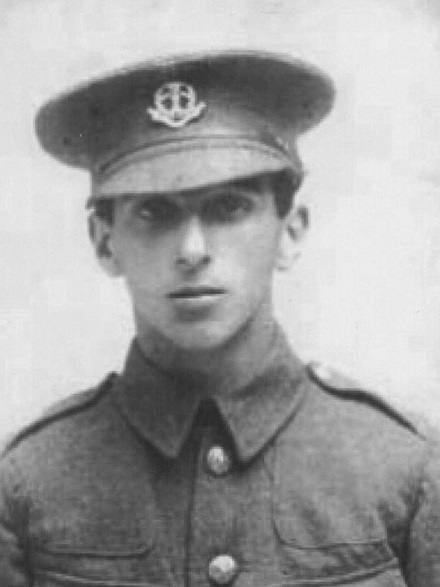
1916: Abraham Bevistein, child soldier

One century ago today, a Polish Jew from east London named Aby Bevistein was shot for cowardice in Calais — four weeks shy of his 18th birthday.

Abraham Bevistein was among an estimated quarter-million Brits who bore arms as minors in World War I. Fired by patriotism, these boys dodged the military’s 18-year-old minimum by … telling their recruiters they were 18. No documentation necessary.

Bevistein, whose family had moved to London from Warsaw when he was a small child, was British through and through enough to surge into the army with the first wave of pie-eyed volunteers in September 1914. He had 16 years and four months, and if he was like many of his new comrades in arms he probably reckoned on being back home by 17 — a bonny hero of a speedy war.

Instead, he spent most of 1915 navigating the labyrinth of trenches in France, and all their attendant horrors. He was wounded in December of that year but soon passed fit for duty again. On February 12-13, 1916, shellshocked and deafened by German grenades, he again sought medical help but was directed back to the lines by a harried medical officer. Instead, Bevistein wandered away to the rear, and took temporary refuge at a French farm.*

“We were in the trenches and I was ill so I went out,” he wrote to his mother by way of all-too-nonchalant explanation. “They’ve taken me to prison and I’m in a bit of trouble now.”

Anti-war suffragette Sylvia Pankhurst took up Bevistein’s cause when she learned about his execution, prominently publishing a sympathetic feature story in her newspaper, Women’s Dreadnought. Like 305 other British and Commonwealth soldiers shot at dawn during the Great War, Bevistein was posthumously pardoned and added to war memorials in the 21st century.

* The farm owner’s later testimony to Bevistein’s court-martial that the young tommy had expressed an intent to return to England sealed his fate as a deserter.

On this day..

1706: Matthias Kraus, Bavarian rebel

On this date in 1706, Bavarian butcher Matthias Kraus was beheaded and quartered for an anti-Austrian rebellion.

This commoner was the victim at several orders’ remove of distant imperial politics; as such, he will enter this story only as a coda. Instead, we begin in the 1690s, in Spain, with the approaching death of the childless Spanish king Charles II.

The question of who would succeed Charles presented European diplomats the stickiest of wickets: there were rival claims that augured civil war, which was bad enough, but such a war’s potential winners could themselves be scions of the French Bourbons or the Austrian Habsburgs … which meant that Spain’s world empire could become conjoined with that of another great European power and unbalance everything.

Now, it just so happened that the Elector of Bavaria Maximilian II Emanuel had a ball in this game — because his marriage to a Habsburg princess had produced a kid who could plausibly receive the throne, Joseph Ferdinand of Bavaria. (The mom died in 1692, but had she been alive, she would have stood to inherit Charles II’s throne.)

For a while this whelp looked like the answer the continent’s schemers were searching for, since neither the state of Bavaria nor his father’s House of Wittelsbach was already a great power — and thus, they could be elevated without creating a new hegemon. But in 1699, months after the infirm Charles had designated the little boy “my legitimate successor in all my kingdoms, states and dominions,” Joseph Ferdinand too dropped dead.

The boy was only seven years old — but he had lived long enough to whet his father’s appetite for a more substantial patrimony. When Charles II finally died in 1700 with the inheritance situation still unresolved, Max Emanuel entered the resulting continental war — the War of Spanish Succession — allying himself with France with the intent of supplanting the Habsburg dynasty on the Austrian throne.

This was a bold gambit to be sure but in the war’s earliest years it looked like it might really work. The Elector of Bavaria parlayed his strong position on the Danube (and ample French support) into a menacing thrust into Austria that threatened to capture Vienna. For the Wittelsbachs, this would mean promotion to a higher plane of dynastic inbreeding; for France, it would mean a lethal blow to the rival Austrian-English-Dutch “Grand Alliance”.

But things went pear-shaped in 1704.

Marlborough mounted a famous march to Austria’s rescue and trounced the Bourbons and Bavarians at the Battle of Blenheim, completely reversing the tide of events. Bavaria now came under Austrian occupation, as Max Emanuel hightailed it to the Low Countries.

All this statecraft brings us as a postscript the unhappy fate of our butcher, Herr Kraus.

The Austrian occupation of Bavaria — complete with punishing wartime levies — triggered in 1705 a peasants’ revolt grandly titled the Bavarian People’s Uprising. Matthias Kraus was a leader in this rising.


Matthias Kraus in Kelheim (Via)

Like the Wittelsbach pretension writ small, Kraus was intrepid but doomed. Having seized the town of Kelheim with a force of 200 or so, he held it for just five days. Austrian forces appearing at the gate negotiated for a peaceful surrender of the city, but as soon as they got the gates open they ran amok in a general massacre.

Kraus himself, interrogated under torture in Ingolstadt, was returned to Kelheim for public execution — his body’s quarters to be mounted around the city as a warning.


Detail view (click for a full image) of an Austrian leaflet publicizing the fate of the rebellious Kraus.

His martyrdom at the hands of a foreign occupation has stood Kraus in good stead in posterity. There is a Matthias-Kraus-Gasse in Kelheim, as well as a fountain memorial put up to celebrate the 1905 bicentennial of his his fleeting moment of heroism.

On this day..

1868: Eleven samurai, for the Sakai Incident

On this date in 1868,* eleven samurai committed seppuku before the French consul in Japan spared their nine comrades.

The affair was stunning punishment for what’s known as the Sakai Incident — an offense eight days prior that occurred during Japan’s Boshin War, a last rearguard battle of loyalists to the (now officially ended) Tokugawa Shogunate against the rising imperial party of the Meiji Restoration.

What’s noteworthy for our purposes in this period is that the Meiji espoused an anti-foreigner policy — one that was not the less intently felt by the Meiji base for being entirely insincere on the part of elites.

It was in this tense context that a boat full of French sailors from the corvette Dupleix called on March 8 at Sakai — a port city whose shogunate forces had routed. It had been recently occupied by imperial troops.

Japan had only been opened to the west 15 years before, and access was still quite restricted; there might have been a misunderstanding between the French sailors and Sakai’s Tosa clan occupiers over whether this city was open at all. There was definitely a misunderstanding once the tourists ran into samurai on shore, and before you know it high words and suspicious glares turned into a street skirmish that left eleven Frenchmen dead.


Illustration from Le Monde Diplomatique (1868)

This Sakai Incident (English Wikipedia entry | French) incensed western powers, and not only the French: the British, Dutch, Prussians, Italians, and Americans all pulled down their embassy colors in solidarity pending adequate satisfaction for the French. Japan at this moment was not at all in a position to take a stand against foreign gunships over this dust-up, and it met the conditions — which consisted of some personal groveling by a state minister, the payment of a 150,000-piastres indemnity, and the execution of the officers and soldiers involed. The punishment would be self-administered by seppuku at a Sakai shrine. This set the scene for a powerful climax, in which the soldiers one by one tore out their own guts in a ceremony that must have played as defiance no less than submission.

Quoting the Moniteur, the London Morning Post of May 19, 1868 (news was slow in those days) describes the operatic punishment.

On the 15th [a Japanese] high functionary brought a written reply from his Government conceding all the satisfaction required. On the following day Captain du Petit-Thouars, commander of the Dupleix, landed at Sakai to witness the execution of two officers, a subaltern, and 17 Japanese soldiers, condemned to death as the principal authors of the aggression. The two chiefs were the first put to death, after which nine others perished successively. Captain du Petit-Thouars then seeing that the Japanese Government was decided on carrying out its engagements to the end, and ceding to a feeling of humanity, stayed the execution, declaring that he considered the reparation sufficient, and that he proposed to ask the Minister of France to intercede for a commutation of punishment in favour of the other condemned.

The last nine beneficiaries of the captain’s clemency were sent into internal exile instead.

The Japanese writer Mori Ogai wrote a short story about this affair, Sakai Jiken. (See Suicidal Honor: General Nogi and the Writings of Mori Ogai and Natsume Soseki.)

* There are some citations that give the date as the 23rd. The original reporting I have located unambiguously asserts that the execution occurred on the 16th.

On this day..

1988: Dmitri Polyakov, Cold War spy

Although it would not be publicly known until two years later, the retired Soviet Gen. Dmitri Polyakov was on March 15, 1988 executed for treason.

A World War II artillerist, Polyakov (English Wikipedia entry | Russian) was a military intelligence officer working as an embassy attache when he made contact with American agents in New York in 1961. For the next quarter-century — across assignments to Burma, India, the U.S., and back in Moscow — he would ship to the CIA and FBI some of its choicest morsels of the Cold War.

“Polyakov was the jewel in the crown,” former CIA chief James Woolsey lamented of his loss. Polyakov-supplied documents underscoring the extent of Russia’s split with China have been credited with spurring Richard Nixon’s overtures to Beijing.

The spy code-named Bourbon, Roam, and Top Hat had idiosyncratic motivations; he was not an ideological true believer like a Sorge nor a man afflicted by demons like a Vetrov. He accepted only a little bit of money from his handlers, mostly to support an innocuous wordworking hobby.

This Russian article indulges a variety of hypotheses — contempt for Khrushchev, the death of a son, an appetite for risk-taking — but nothing his U.S. contacts could learn of him rebutted the presentation he made of himself as a Russian patriot chagrined at the prospect that the corrupt Communist state could win the Cold War.

His revelations did much to check that possibility.

Polyakov retired as a general in 1980, having operated under the Kremlin’s nose for a phenomenally long period of time. (His U.S. contacts made sure to feed him some career-advancing secrets, too.) But he was betrayed in the 1980s by the USSR’s own moles, Robert Hanssen and Aldrich Ames and arrested in 1986.

His fate, imposed by the Military Collegium of the Soviet Supreme Court, thereafter was a mystery to his former handlers. Two months after his secret execution, U.S. President Ronald Reagan sought Polyakov’s pardon or his exchange for a captured Soviet mole at his May-June 1988 arms control summit with Mikhail Gorbachev. The solicitation was politely deferred.

On this day..

1951: Ants Kaljurand, Estonian Forest Brother

On this date in 1951, the Estonian anti-Soviet partisan Ants Kaljurand was executed by the NKVD with comrades Arved Pildin and Juhan Metsäären.

Renowned for his ferocity and derring-do, “Ants the Terrible” was among 12,000 to 15,000 or so Estonian “Forest Brothers” who organized armed resistance to the Soviet Union.

The small Baltic state had won a two-decade interwar independence rudely terminated by Soviet occupation in 1940 under the carving-up done by the Molotov-Ribbentrop Pact. Moscow did not have long to enjoy its mastery of the place before Germany’s invasion swapped one occupation for the other.

German mastery appeared the more congenial than Russian,* and vice versa: Tallinn-born Nazi race theorist Alfred Rosenberg celebrated “the true culture bearer for Europe … the Nordic race. Great heroes, artists and founders of states have grown from this blood. It built the massive fortresses and sacred cathedrals. Nordic blood composed and created those works of music which we revere as our greatest revelations. … Germany is Nordic, and the Nordic element has had an effect, type forming, also upon the western, Dinaric and east Baltic races.”**

Germany had some traction recruiting SS volunteers locally, and Estonia’s small Jewish population was exterminated so efficiently with the aid of right-wing militias that the country was officially Judenfrei by the time of the Wannsee Conference. (Kaljurand himself was an Omakaitse paramilitary.)

Once Germany was pushed back out by the Red Army in 1944 there were thousands of far-right Estonian fighting-men prepared to bear arms against the new-old boss: one part a desperate hope of resuming the pre-war independence, two parts fatalistic principle. “We understood that it is better to die in the forest with a weapon in your hands than in a Soviet camp,” an ex-Forest Brother pensioner told the New York Times in 2003.

For a few years** after World War II, the harassment of Forest Brothers pricked Soviet authority, but as elsewhere in the Baltics the contest was impossibly unequal for guerrillas far from any hope of aid in a post-Yalta world. Ants the Terrible was captured in 1949 by which time the movement, ruthlessly hunted, was waning away. It was finally stamped out in the early 1950s, but in the post-Soviet Estonia — independent once again — these resisters have been belatedly celebrated as patriots.

* “In Estonia it was hard for us to live, much less operate,” a Soviet partisan in Estonia reported. “At partisan training, they told us that the people were waiting for us to drive out the Germans … But we were never told that we’d be assaulted by the Estonians themselves.” (From War in the Woods: Estonia’s Struggle for Survival 1944-1956, a source extremely laudatory of the Forest Brothers.)

** From Rosenberg’s magnum opus, The Myth of the Twentieth Century. It’s not all sunshine for the eastern Baltic race in Rosenberg’s cosmology; “mixed as it is with a Mongol element,” these types are “pliant clay either in the hands of Nordic leadership or under Jewish and Mongol tyrants. [The eastern Baltic] sings and dances, but as easily murders and ravages.”

† One of the last Forest Brothers in the field, August Sabbe, was only caught in 1978 at the age of 69. He died in the arrest, either murdered by his KGB pursuers or resolutely quick-witted enough to drown himself to escape interrogation.

On this day..

1748: William Whurrier, War of Austrian Succession veteran

From the Newgate Calendar:


WILLIAM WHURRIER
Executed at Tyburn for murder, March 7, 1748, and his body hung in chains on Finchley common. (A Hard Case.)

We cannot so clearly see by the report of this trial, as the jury might have done by the evidence adduced, the malice propense necessary to constitute the conviction of murder. But, though we are by no means disposed to question a verdict of the country, yet we cannot avoid saying, that the case added to the services which the unfortunate man had rendered the king, should have proved a strong recommendation to royal mercy.

This soldier was a native of Morpeth, in Northumberland, and brought up as a husbandman; but having inlisted in General Cope‘s regiment, he served five years and a half in Flanders; when, some horses being wanted for the use of the army, he and another man were sent to England to purchase them.


General Cope is most famous today as the subject of a Scottish folk song commemorating a rout the Jacobites inflicted at the Battle of Prestonpans.

On the 11th of February, 1748, as Whurrier and his companion were walking over Finchley Common towards Barnet, the latter, being wearied, agreed with a post-boy, who went by with a led horse, to permit him to ride to Barnet, leaving Whurrier at an alehouse on the road. Whurrier having drank freely, met with a woman who appeared to be his country-woman, and with her he continued drinking till both of them were intoxicated, when they proceeded together towards Barnet; but they were followed by some sailors, one of whom insulted Whurrier, telling him that he had no business with the woman.

Whurrier suspecting there was a design to injure him, asked the woman if she had any connection with those men. She said she had not: but in the meantime the other Sailors coming up, said they came to rescue the woman; on which Whurrier drew his sword; but returned it into the scabbard without annoying any one.

A soldier riding by at this instant, Whurrier told him that the sailors had ill-treated him, and begged his assistance, on which the soldier getting off his horse, the sailors ran away, and Whurrier pursuing them, overtook the first that had assaulted him, and drawing his sword, cut him in such a manner that he was carried in a hopeless condition to a house in the neighbourhood, where he languished till the Sunday following, and then died.

the skull … was divided, as if a butcher had taken a chopper and divided the skull, so that the brains lay open.

… I judged the wound to be mortal; and upon his head being shaved, there appeared six other wounds upon the head, which went through the skin, but not into the skull; but the bone was bare, and I dressed them all. Then I made an inspection into the arm, and I found as many wounds there, from the wrist to the scapula, as I did upon the head. Upon the back part, what we call the scapula or shoulder bone, there were two wounds more … the bone of the arm was fractured by the incision, as if it had been done by a sword.

… I believe there were fifteen [wounds], and they were all at that distance from one another, that they must all have been made by separate strokes, and from these wounds the man must be in a very weak and languishing condition, and I found him so.

–Surgeon’s testimony at Whurrier’s trial

It appeared by the testimony of a surgeon that the deceased had received a cut across the skull, as if done with a butcher’s chopper; so that the brains lay open; besides a variety of other wounds.

Whurrier being taken into custody for the commission of this murder, was brought to trial at the next sessions at the Old Bailey and being capitally convicted on the clearest, evidence, was sentenced to die.

After conviction he said he thought there was a combination between the woman he had met with and the sailors; and a day or two before he suffered, he procured the following paper to be published, which he called, “Whurrier’s Declaration.”

This is to let the world know that I have lived in good credit, and have served his Majesty eight years and two months. In the time of my service, I have stood six campaigns, and always obeyed all lawful commands: I have been in three battles, and at Bergen-op-zoom, during the time it was besieged. The first battle was at Dettingen, June, 1743, when his Majesty headed his army: the second was in the year 1745, April 30, at Fontenoy; the third was at Luckland, by siege; besides several skirmishes, and other great dangers.

I had rather it had been my fate to have died in the field of battle, where I have seen many thousand wallowing in their blood, than to come to such disgrace: but, alas! I have escaped all these dangers to come to this unhappy fate, to suffer at Tyburn, and afterwards to hang in chains on a gibbet, which last is the nearest concern to me; and I cannot help expressing, that it would be more beneficial to the public to employ blacksmiths to make breast-plates for the soldiers, than irons to inclose their bodies to be exposed to the fowls of the air.

I have been a true subject and faithful servant, as is well known to the officers of the regiment to which I belonged. If I had been a pick-pocket, or a thief, I should have suffered much more deservedly, in my own opinion, than I now do; for what I did was in my own defence: I was upon the king’s duty, and was assaulted by the men in sailors’ habits, who gave me so many hard blows, as well as so much bad language, that I could no longer bear it, and was obliged to draw my sword in my own defence; and being in too great a passion, as well as too much in liquor, I own I struck without mercy; as thinking my life in danger, surrounded by four men, who I thought designed to murder me; who, or what they were the Lord knows; it is plain they had a false pass, as it was proved: and that they had travelled but seven miles in nine days; but I forgive them, as I hope forgiveness: and the Lord have mercy on My soul, and the poor man’s whom I killed.

   W. WHURRIER.


Whurrier was executed at Tyburn in a group comprising six souls all told: the others were Robert Scott and Samuel Chilvers, smugglers; William Stevens and Francis Hill, housebreakers; and John Parkes, forger. Stevens was only 17 years old: “young, and entirely unacquainted with the Nature of the World,” in the words of the Newgate Ordinary who prepared the boy’s soul for its ordeal.

On this day..

845: The 42 Martyrs of Amorium

March 6 is the feast date of the 42 Martyrs of Amorium, the day in the year 845 when they submitted to the caliphate’s executioners in preference to conversion.

Though they were people of rank in their lifetimes, most of them are not known to posterity by name or even position. Devotionally, they govern no special sphere of intercession; iconographically, they have no special device. When depicted (itself unusual) it is simply as a gaggle of generic courtiers.*

It seems a fitting fate for mere individuals ground up between states and faiths; even so, their weedy tombs mark a fork on the path trod by Byzantium.

The 42 earned their martyrs’ crowns at the end of seven years’ imprisonment, so it is to the Byzantine war with the Abbasid Caliphate in 837-838 that we must return to unravel their story. This war was itself merely the resumption of a conflict that had been ongoing between the civilizations for two centuries since Arab conquerors emerged from the desert to found an empire.

With the connivance, encouragement, or cajoling of anti-caliphate rebel Babak Khorramdin, the young Byzantine emperor Theophilos broke four years of tense peace with destructive effect in 837, ravaging the Upper Euphrates.

“He captured and burned the fortress of Zapetra, putting to death the male population and carrying off the women and children,” John Bury wrote in A History of the Eastern Empire from the fall of Irene to the Accession of Basil I. Upon his return to the mandatory official Triumph, “[t]roops of children with garlands of flowers went out to meet the Emperor as he entered the capital. In the Hippodrome he competed himself in the first race, driving a white chariot and in the costume of a Blue charioteer;** and when he was crowned as winner, the spectators greeted him with the allusive cry, ‘Welcome, incomparable champion!'” Because the one thing 200 years of engaging the Arabs in back-and-forth raids, counterattacks, and suits for peace had taught Byzantium was that victories would surely prove durable.

In truth this war was also politics by other means — domestic politics, that is.

Theophilos really did aspire to incomparable championhood of something far more important than the position of the frontier: in matters religious, he was a stringent iconoclast and he meant to win Christendom firmly over to this philosophy.

The century-old schism within the communion — pitting iconoclasts, like Theophilos, who condemned as idolatrous the veneration of religious imagery against iconophiles or iconodules who embraced it — itself likely owed much to the stunning march of Arab arms and the wound Caliphate success had inflicted on a state and faith that had formerly presumed itself hegemonic. It was certainly the case that Roman superstition† perceived in the battlefield results of imperial adherents to the rival icon’isms a going divine referendum. God says go with whichever icon policy starts beating Islam!

Well might the triumphant Theophilos preen, then — right before the fall, like the Good Book says. Gibbon charged that Theophilos “was rash and fruitless” and “from his military toils he derived only the surname of the Unfortunate.”

The caliph al-Mu’tasim counterattacked the Unfortunate ruthlessly in 838, invading Anatolia in two huge columns that converged on a major city, Amorium.‡ There, they penetrated the city’s walls and put her to the sack — slaughtering unnumbered thousands and carrying away most survivors as slaves, outrageously unmolested by the chastisement of any Byzantine army.


12th century illustration from the Madrid Skylitzes, an edition of the chronicle written by 11th century Greek historian John Skylitzes. The volume was produced in Sicily; it’s got “Madrid” in the name because that’s where the sole surviving copy of it resides today.

Byzantium might have been fortunate on this occasion that, before he could extend his conquest, al-Mu’tasim’s domestic politics promptly recalled him to the caliphate to deal with plots against his own throne. But the raid devastated the martial credibility of Theophilos the incomparable champion, and with it the credibility of iconoclasm. Nor can there have been much fortune reckoned by the thousands of prisoners marched out of the smouldering ruins of Amorium to the new Arab capital Samarra — among whom we find this post’s titular 42 martyrs.

They were, or at least seemed, the crown jewels among the captives, meaning the ones with cash value. Constantinople and Samarra would engage in periodic negotiations over the next several years to exchange them; the Caliphate’s insistence on obtaining for their return a treasure equal to the cost it had incurred to attack Amorium in the first place put an unbridgeable gap between the sides.

The nameless and rankless commoners among them went to their nameless destinies; undoubtedly their experience was cruel and many died or were killed, but for those who endured the tribulations there was a return to hearth and home in a prisoner exchange in 841.

For the VIPs, deliverance sank into the Mesopotamian mud.

Both Theophilos and al-Mu’tasim died in 842 and sometime around there the respective empires seem to have given up trying to resolve the impasse about the Amorium ransom. A few more years on with no apparent relief forthcoming from the annoyance of maintaining these now-useless prisoners of war, someone in Samarra decided to dispose of them with the ultimatum.

Their martyrs’ glory assured their afterlife in Byzantine religious propaganda. Yes, these two Christian sects had made martyrs of one another within the empire. But iconoclasm really hinged on one crucial argument fatally undone by the 42 martyrs: victory. The pro-icon emperors from 797 to 813 had been associated with retreat and humiliation;§ one had even been killed on campaign in the Balkans leaving the Bulgar king Krum to fashion the imperial skull into a ceremonial goblet. That the iconoclast rulers of the succeeding generation had at least stabilized the situation was their ultimate scoreboard taunt. Amorium dispelled that glow of providential favor, especially when followed by the years-long abandonment of that razed city’s noble hostages to the heathen dungeon.

Little could the monk Euodios know that his iconoclasm-tweaking hagiography of these martyrs would prove a redundant step.

The late Theophilos had only an infant son, so governance after his death fell to a regency led by the empress Theodora. Despite her dead husband’s scruples, Theodora didn’t mind an icon one bit, and restored icon veneration to a favor it would never again lose for the six centuries remaining to Byzantium.

* See for example the leftmost group on the second row in this image. (Located here)

** One of the principal charioteering teams/factions that had, centuries before, nearly overthrown Justinian and Theodora.

† Among the Romans themselves for whom supernatural causation was an assumed fact on the ground, superstitio had a more attenuated meaning, contrasting with religio. That is far afield for this post; I use the term here advisedly from a post-Enlightenment cosmology.

‡ Amorium is no more today: just a ruin buried under a village. But not because of this siege.

§ Charlemagne being crowned “Holy Roman Emperor” in 800 was also a gesture of disregard for a weakened (and at that moment, female-ruled) Byzantium, which dignified itself the Roman Empire despite having long since abandoned Rome itself.

On this day..

1968: Two Jordanians, a sergeant and a civilian

Soldier and Civilian Hanged By Jordan as Spies for Israel

AMMAN, Jordan, Feb. 29 — Two Jordanians, an army sergeant and a civilian, were publicly hanged at dawn today after having been convicted by a military tribunal on charges of spying for Israel.

The authorities said they had been caught in April, 1966, when the civilian, Mahmoud el-Haihi, 30 years old, was crossing into Jordan from Israel near his home in Tulkarm. He was said to have been carrying a message and money from Israeli military intelligence officer to Sgt. Fawzi Abdullah, 32, also from the Tulkarm area.

The death sentence was pronounced in January, 1967, and approved last month by King Hussein.

-New York Times, March 1, 1968

On this day..