1911: Dmitry Bogrov, Stolypin’s assassin

On this date in 1911,* Dmitry Bogrov was hanged in Kiev for assassinating Russian Prime Minister Pyotr Stolypin.

Many could diagnose the long-advancing rot of the Russian state, but few had the physic to abate it. Stolypin, a resolute conservative landowner, might have been tsarism’s last, best hope.

During the cataclysmic 1905 revolution, Stolypin was governor of Saratov and kept his province notably free from disturbances.

That earned him a kick upstairs in 1906 in hopes that he could work the same magic on the turbulent country. To a greater extent than most, he did: Stolypin was tsarist Russia’s last great statesman, notably introducing capitalistic land reforms in an effort to germinate a new rural middle class of small, freeholding landowners with skin in the Romanov dynasty. To break liberal obstruction, he also mounted a coup to weight the Duma in favor of propertied classes. “Give me 20 years of peace,” he vowed, “and you won’t recognize Russia.”

It’s left to the speculation of posterity whether he could have pulled the trick: in the event, Stolypin did not get 20 years and Russia did not get peace.

For some, like Solzhenitsyn, Stolypin is the lost chance for a Russia without either despotism or revolution: “He brought light to the world and the world rejected him.” For many others, that Great Man theory is a bit much. Russia’s issues with class and governance were a pretty long-term concern.

One of its long-term products was Russia’s energetic radical underground, and this Stolypin harried Russia’s revolutionaries from pillar to post, greatly intensifying police surveillance and infiltration of agitators’ circles to prevent a repeat of 1905. His secret courts meted out punishment with a greater regard for swiftness than certainty; a staggering 3,000 radicals were hanged for alleged involvement in terrorism from 1906 to 1909, generating worldwide condemnation and causing the phrase “Stolypin’s necktie” to enter the lexicon as a synonym for the noose.

Of course, there was plenty of real terrorism, no small part of it directed at Stolypin himself. He survived or avoided several assassination attempts, including a bomb that took the life of his daughter. In turn-of-the-century Russia, though, there was always a next man or woman up when it came to the propaganda of the deed.

In September 1911, at festivities marking the quinquagenary of the liberation of the serfs, Stolypin attended the Kiev opera’s performance of The Tale of Tsar Saltan.


The (obviously non-operatic) cartoon adaptation of The Tale of Tsar Saltan; the source material for both opera and cartoon is a Pushkin poem.

As the third intermission drew to a close, a young bourgeois approached Stolypin, drew a Browning pistol, and shot the Prime Minister. Legend has it that Stolypin opened his bloodied waistcoat and addressed the close-enough-to-witness-it sovereign with the words, “I am happy to die for the tsar.” The prime minister would linger on and die a few days later; his murderer did not long outlive him.

Despite Stolypin’s reputation as public enemy no. 1 for revolutionaries, the reason for Dmitry Bogrov to commit this particular murder has long remained murky. (pdf)

Bogrov (English Wikipedia entry | Russian) was a revolutionary, but he was also an informer for the Okhrana, the tsarist secret police whose augmentation had been a key Stolypin priority. Just where Bogrov stood at any given time in the vast foggy marches between compromised true believer and agent provocateur is difficult to pinpoint.

The Kiev opera on the night Bogrov shot Stolypin was thick with military personnel, but nobody at all stood watch on the oft-targeted politician — even though there was specific intelligence of a possible threat, issued in his capacity as an informer by the Janus-faced Bogrov himself. The eventual assassin was admitted to the theater that night on a ticket provided by his police handlers.

Considering Bogrov’s very swift execution, and the fact that the tsar suspiciously shut down the investigation (Russian link), many believe that elements of the state security apparatus were the true authors of Stolypin’s death, whether or not Bogrov himself realized it. Russia’s great landholders, never noted for farsightedness, widely opposed the reductions of their estates demanded by Stolypin’s agricultural reforms and rightly saw him as about the only man with the clout to move policy against their considerable opposition. They weren’t sorry to see him go.

As for Bogrov, his departure was a mere footnote. He asked for a rabbi before his hanging, but when he found out that this presumably confessional meeting would be monitored by the public prosecutor, he withdrew the request. (London Times, September 26, 1911) He reportedly died almost indifferently, his last words a disarmingly casual inquiry to the executioner about how best to position his head within his Stolypin’s necktie.

* September 12 by the local Julian calendar; September 25 by the Gregorian calendar.

On this day..

1944: Three Soviet infiltrators, the last in Finland

The last executions in Finland occurred on this date in 1944, claiming the lives of three Soviet spies who had been parachuted behind Finnish lines.

I have been unable to locate the names of these men. They’re invariably presented simply in connection with — or as the denouement following — the September 2 execution of Finnish deserter Olavi Laiho.

The next morning (Russian link), Finland announced its disengagement from its problematic German alliance, an arrangement brokered by the western Allies who wanted to keep Finland democratic and non-communist despite sitting in Russia’s back yard and joining the wrong team in World War II. The Soviet Union immediately redeployed its forces away from the Finnish theater; a formal armistice was signed before September was out and prisoner transfers began in October.

Finland abolished the death penalty for all peacetime crimes in 1949, for all crimes full stop in 1972, and wrote the abolition into its constitution in 2000.

On this day..

1944: Durga Malla

Seventy years ago today, the British in Delhi hanged Gurkha soldier Durga Malla for spying against them — and on behalf of the army of the Japanese-backed nationalist provisional government, the Azad Hind.

World War II catalyzed India’s long-running national movement and helped lead directly to postwar independence. But during the war itself, it was a delicate relationship with the British Empire that still ruled the Raj.

Activists at the time took different views of how to proceed in wartime. For Gandhi, and this was also the predominant position of his Congress Party, India’s national rights overrode the mother country’s wartime exigencies: India must be free to choose her own part in the affair, as a coequal nation.

Unsurprisingly, London saw it differently. (The Raj sent over two million soldiers into the British ranks in these years.)

This led in August of 1942 to the Quit India movement, an attempted civil disobedience campaign against continued British rule. It was suppressed with difficulty — and with mass detentions, including of Gandhi himself. But hours before the arrest that would land him in British custody for the balance of the war, he delivered his Quit India speech, which warned in part against

hatred towards the British among the people. The people say they are disgusted with their behaviour. The people make no distinction between British imperialism and the British people. To them, the two are one. This hatred would even make them welcome the Japanese. It is most dangerous. It means that they will exchange one slavery for another.

Which brings us to Durga Malla.

For Gandhi himself, there was no question of going so far as to collaborate with Britain’s wartime enemies to force the issue. But not everyone eschewed the “enemy of my enemy” line, and behavior at once treasonable and intensely patriotic has excited controversy from the moment the guns stilled down to the present day. Azad Hind established itself as a government-in-exile in Japanese-occupied Singapore, making plans to invade British India. The fervidly patriotic Durga Malla joined that exile government’s army, and was eventually caught reconnoitering British deployments, then given a military tribunal and hanged. His last words on the gallows affirmed his purpose, and would be vindicated with the passage of just a few years.

“I am sacrificing my life for the freedom of my motherland … The Sacrifice I am offering shall not go in vain. India shall be free. I am confident, this is only a matter of time.”

There are public monuments in present-day India to Durga Malla.

On this day..

1943: Red Orchestra members, in the Nazi Paradise

From 7 to 8 p.m. on the evening of August 5, 1943 the Fallbeil at Plotzensee Prison destroyed 17 members of the Berlin Red Orchestra resistance circle.

We have touched previously on Die Rote Kapelle in the context of the first 11 executions that claimed its leadership on December 22, 1942.

But the Gestapo had a much wider network than that to break up; ultimately, there would be nearly 50 death sentences associated with Red Orchestra, for activities ranging from outright espionage to merely dissident leafletting, and other rounds of executions had taken place over the preceding months.

The executions this date were more of the sad same, and noteworthy for some sincere and ordinary citizens so sympathetic that even the Reich Military Court recommended mercy for some. Adolf Hitler refused it across the board. The victims, predominantly women who had been moved to Plotzensee for execution that very morning, included

  • Cato Bontjes van Beek, an idealistic 22-year-old ceramicist.
  • Liane Berkowitz. Two days short of her 20th birthday when she was beheaded, Berkowitz had given birth to a child while awaiting execution.
  • Eva-Maria Buch, who translated propaganda leaflets destined for illicit distribution to the forced laborers employed in German munitions factories.
  • Else Imme, an anti-fascist whose sister had emigrated to the Soviet Union.
  • Ingeborg Kummerow.
  • Anna Krauss, a 58-year-old businesswoman.
  • Klara Schabbel, a Comintern agent who in her youth had fought against the French occupation of the Ruhr after World War I.
  • Rose Schlosinger.
  • Oda Schottmuller, a dancer and sculptor who used her arts-related trips to act as a courier.
  • Writer Adam Kuckhoff. His widow Greta would go on to head the East German central bank.
  • Emil Hubner, an 81-year-old retiree, along with his daughter Frida Wesolek and her husband Stanislaus.

Besides the above, at least three others among the condemned in this group paid with their lives for an arts activism attack on Das Sowjetparadies (The Soviet Paradise), a Reich exhibition in May-June 1942 that used photographs and captured artifacts from the war’s eastern front to depict “poverty, squalor and misery” in the USSR. This associated propaganda film gives a taste of the vibe:

The Orchestra orchestrated an “attack” littering the exhibition with counter-propaganda


“Permanent Exhibition
The NAZI PARADISE
War Hunger Lies Gestapo
How much longer?”

This act of wehrkraftzersetzung was a factor in the sentences of —

  • Hilde Coppi, one of the circle’s principal members and the wife of the previously executed Hans Coppi. Like Liane Berkowitz, she was spared the first rounds of executions to bear and nurse her child.
  • Maria Terwiel, a Catholic barrister with a Jewish mother.
  • Ursula Goetze.

On this day..

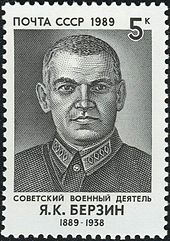
1938: Janis Berzins, Soviet military intelligence chief

On this date in 1938, the Soviet intelligence agent Janis Berzin(s) was shot in the basement of Moscow’s Lubyanka Prison.

A Latvian radical back to Riga’s chapter of the 1905 revolution,* Berzins became a trusted associate of Lenin in exile, and transitioned with the 1917 Revolution into a variety of political-security-military leadership positions in the new Soviet state.

For most of the 1924-1937 period, Berzins directed — indeed, practically createdSoviet military intelligence. He’s credited with personally recruiting the legendary World War II spy Richard Sorge; in 1936-1937 he was the chief Soviet military advisor in the Spanish Civil War under the nom de guerre “Grishin”. Russians fighting in Spain just referred to him as “the old man.” (Source)

Of course, no degree of seniority was sufficient safety during the frightful purging years of the Yezhovshchina. Once back in Moscow, Berzins fell instantly, almost randomly, over a spurious accusation of internal espionage.

His conviction was reversed after Stalin died.

* But not one of the Latvian revolutionaries who ended up in a shootout with London police.

On this day..

1905: An unknown spy in the Russo-Japanese War

In the late 1890s and early 1900s, Russia’s imperial ambitions in the east drew it inexorably towards conflict with Japan. This was the period when Russia began constructing the continent-spanning Trans-Siberian Railway linking Moscow to the Pacific port of Vladivostok.

Russian troops came right along with the rails.

On the pretext of protecting its construction gangs, Russian troops occupied Manchuria — and the weakened Chinese Qing dynasy couldn’t do much about it.

But the Japanese could.

Manchuria and Korea (which Russia’s presence also threatened) Tokyo conceived as her sphere of influence. The rising hegemon in East Asia would serve notice in the 1904-1905 Russo-Japanese War that it had now to be reckoned among the world’s great powers.

The decisive land battle in this conflict was the Battle of Mukden, February 20 through March 10, 1905 — a gigantic engagement involving more than 600,000 troops.

In it, Japan cleaned the Russian clock.

The defeat sent a shattered Russian army on a disordered retreat north, to the city of Tieling. The Japanese followed in hot pursuit, so defensive regrouping became impossible and within a couple of days the Russians abandoned Tieling, too.

We are everywhere driving the Russians before us to Kaiyuan,” gloated an official Japanese telegram of Thursday, March 16.

The underwhelming Russian general Aleksey Kuropatkin was there just long enough to get word that Moscow had relieved him of command. By Saturday, March 18, Kaiyuan too was in Japanese hands.*

So it was likely on or about this date in 1905 that a handful of those Japanese forces harrying the Russian flight paused on the outskirts of Kaiyuan to behead an alleged spy.

If this individual’s name is known, I have not been able to locate it — but small wonder. In the charnel house of Russia’s catastrophic defeat, the dead were too numerous to bury.

After Mukden, there would not be many more. It was the last major land battle, and after Japan followed it up with a crushing naval victory that May, hostilities came to a close.


“On the Hills of Manchuria”, a mournful 1906 waltz by Ilya Shatrov.

* The pursuit didn’t last much longer; Japanese forces were themselves too battered and exhausted from the Battle of Mukden.

On this day..

1947: Henry Rinnan, Norwegian collaborator

On this date in 1947, a firing squad shot Henry Rinnan for treason at Trondheim’s Kristiansten Fortress.

Standing just 5′ 3″ on tippytoe, Rinnan (English Wikipedia entry | Norwegian) stands tall as Norway’s most notorious World War II collaborator this side of Vidkun Quisling.

That physique got him turned away when he tried to volunteer to fight the Soviets in the Winter War, but it didn’t put the Gestapo off him after Germany occupied Norway in 1940. He formed an informants’ network known as the Rinnanbanden which infiltrated the resistance movement and entrapped anti-occupation Norwegians — a “game in the negative sector,” as Rinnan described it.

The “game” got more than a thousand people arrested and something like 100 killed, including one of the more notorious episodes of the occupation, the Majavatn affair. (Norwegian link) It also eventually got Rinnan a German rank and the opportunity to kill some people personally.

Twelve people in all from the Rinnanbanden were sentenced to death after the war, counting Rinnan. Ten of those did indeed pay the penalty.

There’s a Norwegian page about the Rinnanbanden here.

On this day..

2008: Wo Weihan, spy?

On this date in 2008, Chinese biochemist and businessman Wo Weihan was shot for espionage along with his alleged co-conspirator Guo Wanjun.

Wo had been resident in Austria since 1990, and his daughters Chen Ran and Chen Di were Austrian citizens. In 2004, he returned to his native soil to launch a medical equipment firm in Beijing.

Wo was arrested in China in January 2005 and accused of passing “state secrets” to Taiwan and the U.S. He didn’t have a lawyer until 2006 — by which time he had produced a coerced confession that he tried in vain to retract — and the 2007 trial took place in secret, so the case against him was troublingly opaque at the time of his execution. The verdict publicly released in March 2008 even included such trifles as “discussing the health of senior Chinese leaders” — an actual crime in China but awfully difficult to accept as a factor in a capital case.

“The lack of transparency does nothing to reassure us that the court’s conclusion was the right one,” said a Dui Hua Foundation spokesman.

Allegedly, Wo got information about Chinese ICBMs from missile expert Guo Wanjun, and passed drawings to Taiwanese and American intelligence. Chinese state media have claimed that Wo’s wife was able to open a restaurant in Austria with the payoffs.

His daughters mounted a last-ditch clemency campaign involving European Union officials, Austrian President Heinz Fischer, and U.S. Secretary of State Condoleeza Rice, all to no avail.

On this day..

1955: Elli Barczatis and Karl Laurenz, East Berlin spies

On this date in 1955, the East German Prime Minister’s own chief secretary was beheaded as a spy, along with her lover.

You’ll find this affair blurbed in the Historical Dictionary of Sexspionage, so you’d figure it’s got to be good — but it wasn’t quite James Bond. (They never really are.)


Elli Barczatis (top) and Karl Laurenz

Elli Barczatis hooked up in 1949 with Karl Laurenz when both worked in the DDR Ministry of Industry. (Both these links are in German, as are most that follow.)

Their careers went in opposite directions thereafter. Barczatis scored a plum appointment as Prime Minister Otto Grotewohl‘s administrative aide while Laurenz got booted out of the Communist party altogether for political unreliability: he’d been a mere social democrat before the communist takeover.

Laurenz started scratching out a living as a freelance journalist in both East and West Berlin, prior to Berlin Wall days, and was recruited by West Germany’s intelligence service to brief them on the goings-on in the East.

In December 1950, a former coworker saw Barczatis and Laurenz at a cafe rendezvous — and saw Barczatis pass the reporter a sheaf of papers. The coworker reported it to East Germany’s secret police, the Stasi.

Because of Barczatis’s proximity to the head of government, the Stasi had to investigate the tip with great delicacy. But no matter; the East German spooks could be patient as death when the occasion demanded. So over the course of four-plus years, they cautiously surveilled, and eventually entrapped, the lovers.

At last, on March 4, 1955, those grim security men arrested Barczatis at her apartment in the suburb of Kopenick. Laurenz, returning laster that day to the East from a West Berlin meeting with intelligence officers, was nabbed as well.

Laurenz confessed to espionage right away; it might have been a cathartic experience for him. “The accused became provocative, comparing the State Secretariat for State Security of the German Democratic Republic with the fascist Gestapo and the Nazi SD,” a Stasi officer reported after marathon interrogation sessions. “He remarked that the treatment of prisoners by the State Secretariat for State Security is worse than the treatment by the SD and the Gestapo.” But the doomed spy still stubbornly protected his contacts, sources — and Elli Barczatis. He insisted that she was more leaker than spy, and gave him information thinking only that it was background for his reporting.

According to John Koehler’s Stasi: The Untold Story of the German Secret Police, there might have been something to that.

What was the extent of Elli Barczatis’s espionage? What did she betray that justified her execution? Incredibly, the interrogation record reveals not a single instance in which she furnished Laurenz with material so sensitive that it could be interpreted as having endangered the security of the communist state. She betrayed no military or defense secrets. She merely told her friend about letters her office received from the populace complaining about food shortages; mismanagement that created problems in industry; government personnel changes; and Westerners who visited Prime Minister Grotewohl. The absurdity of all communist regimes was that such tidbits of information were considered state secrets.

Baczatis’s and Laurenz’s beheading on the fallbeil was the culmination of a mid-Fifties security crackdown by East Germany that also eliminated (although not by execution) at least two other highly-placed West German assets, Hermann Kastner and Walter Grosch. (Source.)

On this day..

1918: Roman Malinovsky, tinker, tailor, soldier, spy

In the early morning hours this date in 1918, Roman Malinovsky was shot in the Kremlin on the verdict of his trial the previous day.

In the years before the Russian Revolution Malinovsky (English Wikipedia entry | Russian) was a steelworker who was actually a Bolshevik revolutionary, who was actually an Okhrana agent codenamed “Tailor”.

After a stint in the army in the first years of the 20th century, the Polish Catholic Malinovsky went to work as a lathe operator in a St. Petersburg factory, in one of the militant pockets of Russia’s small urban proletariat.

Malinovsky proved a gifted labor organizer — enough that under the Stolypin crackdown, he was arrested in 1909 and expelled from St. Petersburg. Then he was arrested in 1910 in Moscow.

No later than this point, though possibly even before it, he was recruited by tsarist Russia’s secret police. Now Malinovsky’s considerable energies were turned to spying on the communists, and to deepening mistrust between Mensheviks and Bolsheviks. “The whole purpose of my direction [to Malinovsky] is summed up in this: to give no possibility of the Party’s uniting,” the police director Beletsky later explained.

Malinovsky was an adroit mole.

He got himself elected to the Bolsheviks’ Central Committee, and ingratiated himself with Lenin so thoroughly that when Malinovsky was openly accused of spying for the Okhrana in 1913, Lenin came to his defense.

Malinovsky’s proximity to Lenin enabled him to cc the police on the latter’s correspondence, but for posterity the mystery is on the other side of the relationship. Was Lenin in denial? Or did he already know that Malinovsky was a spy?

The double games being played around Malinovsky fade into a fog in the 1910s. The Okhrana mysteriously forced Malinovsky to resign from the state Duma — another powerful seat he had obtained — which was such a grievous loss for the Bolsheviks that it further multiplied the suspicions of his leftist comrades. Did the Okhrana take this seemingly counterproductive step because Malinovsky was compromised as a spy, or was this just a change of policy? When Malinovsky was taken prisoner by the Germans during World War I, his agitations among fellow-POWs earned Lenin’s admiration. Was this sincere conviction after all, or a maneuver?

Accounts of associates paint Lenin as horribly torn on the accusations against a man whom Lenin plainly admired, even rationalizing that Malinovsky’s organizational talents on behalf of the movement had still outweighed the injury he might have done it by spying.

Nor was this merely a personal consideration, since accusations against Malinovsky — an uncompromising Bolshevik in his party persona, further to the cause of preventing intra-party reconciliation — had emerged earliest from Mensheviks. Their eventual vindication on this matter was an obvious irritant to Lenin, and even late in the war years Lenin downplayed the spying charges.

Most mysteriously of all — at least in retrospect — Malinovsky voluntarily returned to post-Revolution Moscow knowing that his role as an informant had been definitively exposed in Russian newspapers following a sack of the Okhrana offices and its revealing files. It was to “wash away the sins of his life with blood,” he told his interrogators, agents of the new secret police — the Cheka. Or was it that he thought he had, via Lenin (who had even sent clothes to the disgraced Malinovsky’s POW camp) an angle on rehabilitation?

Maybe in the end Malinovsky was the victim of his own con. Ralph Carter Elwood’s biography suggests that Malinovsky took Lenin’s surprisingly congenial behavior to mean that he had been forgiven since the fact could no longer be denied … when it might really have meant that Lenin was in denial about the fact itself, almost to to the last. “The last” being, in this case, the courtroom* of Nov. 5 which Lenin himself attended. Malinovsky defended himself for hours, but admitted all; if he anticipated clemency, he did not receive any more of it than the few hours necessary to put his affairs in order.

More tantalizing still, though well into the realm of speculation, is the idea that Lenin did indeed understand what Malinovsky was up to, but wanted to keep the door closed on espionage and counter-espionage vis-a-vis the tsarist police for fear of disgracing old Bolshevik revolutionaries with compromised pasts who had now become men of state. Stalin himself might have been in this same boat, perhaps making this moment yet another missed opportunity to pre-empt the terrifying era yet to come.

“I couldn’t see through that scoundrel Malinovsky,” Lenin later told Gorky, a sentiment we might today echo in retrospect. “It was a very fishy affair, that Malinovsky business.”

* His prosecutor was former comrade Nikolai Krylenko. Krylenko ultimately died in 1938; you may well guess how.

On this day..