1944: Noor Inayat Khan, SOE operative

(Thanks to Meaghan Good of the Charley Project for the guest post. -ed.)

On either September 12 or (as we’re going with here) the early hours of September 13* in 1944, 30-year-old French spy Noor Inayat Khan (also known as Nora Baker, or by her code name Madeleine) was executed at Dachau for her activities on the behalf of the Resistance in Nazi-occupied France.

Noor, the first woman radio operator to be sent into France, came from a rather unusual background: her father was a Sufi religious leader descended from Indian royalty, and her mother an American from New Mexico.

Born in Russia, raised in England and France, Noor studied psychology and wrote poetry and a book of Buddhist-inspired short stories before the war intervened and her she and her family fled to England.

Although Noor had strong pacifist leanings, she decided to join in against Nazi Germany. Because she was fluent in French and English and was a good radio operator, they decided to send her to France. She went in June 1943.

Many of those who had trained her had grave doubts about her suitability as a spy. As part of her Sufi upbringing she had been taught that lying was the worst of all sins. Leo Marks, who taught her cryptography, later wrote his initial impressions of her in his book Between Silk and Cyanide:

She was cycling towards her ‘safe-house’ to practice transmitting when a policeman stopped her and asked what she was doing.

“I’m training to be an agent,” she said, “here’s my radio — want me to show it to you?” She then removed it from its hiding place and invited him to try it. […]

She’d been so startled by an unexpected pistol-shot that she’d gone into a Sufi-like trance for several hours, and finally emerged from it to consult a Bible.

Once in France, however, she displayed lion-like courage.

Even when the Nazis were making mass arrests of the French agents she associated with and the British forces offered to let her come home, she refused to desert her post.

After three and a half months she was betrayed, and pacifism notwithstanding she fought so furiously on arrest that her Nazi guards were afraid of her. In spite of considerable pressure (and we know what that means) she refused to provide them with any information about herself or her Resistance colleagues. On top of all that, she also made two escape attempts.

They decided to send her to Germany to better keep an eye on her.

Noor spent the rest of 1943 and most of 1944 in prison in KahrsruleKarlsruhe, subject to repeated interrogations by the Gestapo. She never gave anything away. In September 1944 she was sent to Dachau and shot to death with three other female agentsYolande Beekman, Madeleine Damerment, and Eliane Plewman — their bodies cremated.

Her last word? “Liberté.”

After her death she was awarded with the French Croix De Guerre and the British George Cross, and made a Member of the Order of the British Empire. Shrabani Basu published her biography, Spy Princess, in 2007 … and there’s a memorial in the works for her for London’s Gordon Square.

* Not everyone buys these dates or the story of these SOE agents’ execution.

On this day..

1628: Milady de Winter, Three Musketeers villainess

Late this night* in 1628 was the fictional execution of The Three Musketeers antagonist Milady de Winter.

Milady de Winter, as the heroine of Agnes Maupre’s revisionist French graphic novel series (Author interview | Another (Both in French)).

This conniving minx bears the fleur-de-lis brand of a teenage crime upon her shoulder — a very naughty beauty-mark indeed — but becomes a secret agent of Cardinal Richelieu. (Richelieu is a point of friction for the Musketeers right from the start.)

This novel — which has long been in the public domain (Text at Gutenberg.org or ClassicReader.com | Free audio book at Librivox.org) — features Milady continually bedeviling the protagonist d’Artagnan. He loves her; she keeps trying to kill him. Pretty typical for these grim annals. (She also used to be Athos’s wife, years ago, until he tried to murder her. Long story.)

To skip to the end of things, Milady is portrayed as having orchestrated at Richelieu’s behest the (actual, historical) assassination of the Musketeers’ buddy the (actual, historical) Duke of Buckingham, which Milady accomplishes by seducing and manipulating his (actual, historical) assassin, John Felton. In reality, Felton was motivated by the stirring Republican sentiment that would soon generate a revolution; in Dumas, he’s a horny dupe who beholds his seductress escaping by sea even as he’s placed under arrest.

Buckingham was (actually, historically) murdered on August 23.

The fictional narrative picks up on August 25, when the escaped Milady writes to Cardinal Richelieu from the safety of Boulogne. Unbeknownst to her, her hours are numbered.

Milady proceeds the next morning to a convent in Bethune where she chances to encounter the mistress of her old foe d’Artagnan … and, by that night, to slay said mistress with poison just ahead of the arrival of the Musketeers.** But the Musketeers are able to track the escaping murderess down by the next evening. There, they subject her to a snap “trial”:

“We wish to judge you according to your crime,” said Athos; “you shall be free to defend yourself. Justify yourself if you can. M. d’Artagnan, it is for you to accuse her first.”

D’Artagnan advanced.

“Before God and before men,” said he, “I accuse this woman of having poisoned Constance Bonacieux, who died yesterday evening.”

He turned towards Porthos and Aramis.

“We bear witness to this,” said the two Musketeers, with one voice.

D’Artagnan continued: “Before God and before men, I accuse this woman of having attempted to poison me, in wine which she sent me from Villeroy, with a forged letter, as if that wine came from my friends. God preserved me, but a man named Brisemont died in my place.”

“We bear witness to this,” said Porthos and Aramis, in the same manner as before.

“Before God and before men, I accuse this woman of having urged me to the murder of the Baron de Wardes; but as no one else can attest the truth of this accusation, I attest it myself. I have done.” And d’Artagnan passed to the other side of the room with Porthos and Aramis.

“Your turn, my Lord,” said Athos.

The baron came forward.

“Before God and before men,” said he, “I accuse this woman of having caused the assassination of the Duke of Buckingham.”

“The Duke of Buckingham assassinated!” cried all present, with one voice.

“Yes,” said the baron, “assassinated. On receiving the warning letter you wrote to me, I had this woman arrested, and gave her in charge to a loyal servant. She corrupted this man; she placed the poniard in his hand; she made him kill the duke. And at this moment, perhaps, Felton is paying with his head for the crime of this fury!”

And so forth.

Then these obviously impartial judges judge her guilty, and have the executioner of Lille — whom they have thoughtfully procured in advance — chop off her head and dump her in a river.

“The executioner may kill, without being on that account an assassin,” said the man in the red cloak [i.e., the executioner himself], rapping upon his immense sword. “This is the last judge; that is all. Nachrichter, as say our neighbors, the Germans.”

Extrajudicial is as extrajudicial does. And in this case, Richelieu is just as happy to be rid of his duplicitous agent and, admiring the protagonist’s moxie, commissions d’Artagnan a lieutenant in the Musketeers. D’Artagnan is the fourth of the titular “three Musketeers”, so this denouement means that he’s finally made it … and he should stand by for duty in sequels continuing to mix-and-match Dumas’s fictional characters with actual, historical events.

Indeed, in the next volume of the series, Twenty Years After, it’s Milady’s vengeful son Mordaunt who acts as Charles I‘s executioner.

This date’s captivating femme fatale has appropriately been portrayed by a ravishing host of silver screen sirens including Lana Turner, Mylene Demongeot, Antonella Lualdi, Faye Dunaway, Rebecca de Mornay, Emmanuelle Beart, and (most recently as of this writing), Milla Jovovich.

* August 27-28, right around midnight. Dumas isn’t specific as to pre- or post-midnight.

** In the novel, it’s Madame de Chevreuse who has arranged this rendezvous of d’Artagnan with his lover — another actual, historical person whom we have met elsewhere in these pages.

On this day..

1941: Josef Jakobs, the last executed in the Tower of London

In its day, the Tower of London has seen off with many an illustrious head.*

Its last use as an execution grounds occurred, all but invisibly, on this date in 1941, with the shooting of German spy Josef Jakobs.

It’s safe to say that Jakobs won’t be competing with Anne Boleyn in the book sales department any time soon. He was, truth be told, barely a spy at all: parachuted into Huntingdonshire on January 31, 1941 with intent to reconnoiter, the guy was observed in his descent by (undoubtedly excited) local defense volunteers. They raced to the landing point but needn’t have: Jakobs was practically immobile, having broken his ankle upon landing. So that was the end of the espionage mission.

After a secret trial under the Treachery Act of 1940, Jakobs was shot at a small rifle range where a number of his countrymen and predecessors from the First World War had met their own ends.

To: The Constable of H.M. Tower of London. 13th August 1941.

Sir,

I have the honour to acquaint you that JOSEF JAKOBS, an enemy alien, has been found guilty of an offence against the Treachery Act 1940 and has been sentenced to suffer death by being shot.

The said enemy alien has been attached to the Holding Battalion, Scots Guards for the purpose of punishment and the execution has been fixed to take place at H.M. Tower of London on Friday the 15th August 1941 at 7.15am.

Sgd. Sir Bertram N. Sergison-Brooke,

Lieutenant-General Commanding London District.

The Royal Armouries artefacts store still preserves the chair (pdf) Jakobs was strapped to for this historic execution. All subsequent executions of World War II spies took place by hanging at Pentonville Prison or Wandsworth Prison.

* It should be added that the Tower’s bloody reputation correctly associates more with the doomed men and women it held than with actual executions: only a very few, mostly high-ranking, folk actually got the chop in the Tower prior to 20th century spies: people such as Thomas More, Thomas Cromwell, and Monmouth were more commonly put to death at the adjacent (and public) Tower Hill.

On this day..

2010: Two Iranian political prisoners

Two politically sensitive cases, otherwise unrelated to one another, were joined in hanging at Iran’s Evin Prison on this day last year, possibly in a tit for tat following the November assassination of a nuclear physicist.

Ali Saremi

Ali Saremi cut the highest profile of the two, a 63-year-old member of the People’s Mujahedin of Iran (PMOI, aka MEK or MKO).

The PMOI/MEK/MKO, originally a Marxist revolutionary group opposing the dictatorship of the Shah, split with the theocratic Iranian Revolution.

It’s led an interesting life since then.

After creating the still-extant National Council of Resistance of Iran, the PMOI set up camp in Saddam Hussein‘s Iraq, which readily deployed it in the Iran-Iraq War.

Camp Ashraf was still there when the U.S. invasion rolled into Baghdad in 2003. (As of this writing, it’s only just now being closed.) While MEK has long been considered a terrorist organization, including by the U.S. State Department,* Iraq’s new occupiers also found this nest of exiles a convenient ally for its own campaign against Iran’s mullahs.

The organization has been much in the news of late both as a bargaining chip in regional diplomacy, and for lavishly bankrolling a lobbying campaign to get off everybody’s official terrorism lists — positioning itself as simply an Iranian opposition group. (It claims to have renounced violence.)

From Tehran, of course, there’s much less gray shading: the MEK is an enemy.

Saremi, a longtime member, was arrested four times for his association with the group.

The first time was in 1976; the last, and ultimately fatal, in 2007. He had just returned from Camp Ashraf to visit his son and commemorate the anniversary of Iran’s late-1980s mass execution of prisoners, an atrocity that claimed a large share of MEK sympathizers in apparent retaliation for the organization’s aforementioned wartime aid to Baghdad.

Saremi got the all-purpose mohareb death sentence — roughly, “waging war against God,” which can potentially compass any resistance to the Islamic Republic — basically for having a going association with PMOI. According to NCRI, Saremi’s prosecutor alleged that

[h]e visited Ashraf and during that he received necessary trainings and returned to the country … and eventually he was arrested in August 2007 for his repeated activities and participation in counter revolutionary ceremonies and gatherings in support of PMOI and dispatching reports to this grouplet (PMOI). During a search in his house some CDs, films, pictures from PMOI and hand written organizational documents linked to the grouplet were found and confiscated.

Iran carried out the execution without notice.**

Ali Saremi’s portrait and memory are now powerful props for the MEK terrorism de-listing campaign.

Ali Akbar Siadati

Also hanged this day was a man named Ali Akbar Siadati, about whom only sketchy information appears to be available.

Siadati was condemned for spying for Israel from 2004 until his arrest in 2008, allegedly supplying Iran’s foe a wide range of sensitive military information — a crime to which Siadati confessed, according to the state news agency IRNA.

Who Siadati was, how he had access to military intelligence, and why (apart from money) he might have betrayed it seems to be publicly obscure.

* In fact, the charge of sheltering MEK — guilty of “terrorist violence against Iran” — even appears on the Bush administration’s justification for war with Iraq.

** Iranian law requires 48 hours’ notice of an imminent execution be given to a defendant’s lawyer. This rule is routinely ignored.

On this day..

1799: Isaac Yeshurun Sasportas, anti-slavery insurrectionist

On this date in 1799, Portuguese Jew Isaac Yeshurun Sasportas was publicly hanged in Kingston for attempting to incite a slave revolt in the British colony of Jamaica.

Here in a revolutionary age, probably no insurrection could terrify Europe’s ancien regimes like the Haitian Revolution.

History’s most successful slave revolt, the rising that seized Saint-Domingue from the French conceivably threatened — if it should spread — the entire material foundation of Europe’s colonial exploitation, and the racist intellectual superstructure that justified it.

This nightmare of crowned heads was also the dream of the epoch’s visionaries, and the subject of a struggle whose victims included Isaac Yeshurun Sasportas among many, many others.

Domingue if I do

An insurrection of Caribbean slaves against European exploiters had obvious appeal to their brethren groaning at the bottom of the Atlantic economy. In “Saint Domingue in Virginia: Ideology, Local Meanings, and Resistance to Slavery, 1790-1800” (Journal of Southern History, Aug. 1997) James Sidbury explores the (to whites) nerve-wracking arrival in that U.S. state of both news and refugees from revolutionary Saint-Domingue.

In 1793 Willis Wilson complained to Governor Lee of the “defenceless situation” of the town of Portsmouth, whose militia lacked arms and whose streets contained “many hundreds [of] French Negroes” including, Wilson had been “inform’d,” many who “belong[ed] tothe insurrection of Hispaniola.” … a commander at the state arsenal of Point of Fork — located on the James River west of Richmond and southesat of Charlottesville — reported dangerous “conversations amount the “people of colour” … “particularly since the Arrival of the French from C[ap] F[rancois],” Saint Domingue.

While these currents carried along Gabriel Prosser and a young Denmark Vesey, they also swept up men who were not slaves at all.

Isaac Sasportas, the nephew of a prominent Charleston trader (said trader’s 200-year-old home still stands there), was himself a wealthy Caribbean shipper who in the 1790s seems to have taken a nearly professional interest in revolution. After trying and failing to re-ignite a rebellion in Dutch Curacao, he started zeroing in on Haiti’s next-door neighbor, the brutal British sugar colony of Jamaica. Distinguished as it was by a running history of slave revolts, it was a natural target for the fin de siecle‘s savvy revolution-exporter.

Sasportas landed there in 1799 under cover of his gadabout-merchant act to reconnoiter British defenses and make contact with the island’s maroons.

Diplomatic L’Ouverture

The Haitian Revolution’s progress through the 1790s and into the first years of the 19th century was itself a complicated political process entailing the realest of realpolitik. Here was a colony surrounded by rival empires’ outposts, whose home country was itself engulfed in revolution. This could, and did, cut a lot of different ways.

Legendary national liberator Toussaint L’Ouverture agreed to work with the French revolutionary government in April 1793 to repel the inroads of Brits, who smelled an opportunity to swipe the lucrative colony. Alliance with the French (L’Ouverture’s black regiments served under French colors) came in exchange for the French recognizing emancipation. Win-win.

But the script had flipped by the last years of the decade.

Toussaint L’Ouverture reveals to British officer Thomas Maitland papers from the French representative d’Hedouville.

In 1798, the British were evacuating their Saint-Domingue enclaves … and L’Ouverture, now the Bonaparte figure of a somewhat autonomous polity, had to maneuver it regionally vis-a-vis its neighbors.

Fomenting slave rebellions willy-nilly was not on his agenda. Indeed, “one could even describe Louverture, in the diplomatic field, as an active impediment to the spread of emancipation.”*

So far was the former slave L’Ouverture from anti-slavery firebrand that in 1798-99 he made arrangements with the slave powers Britain and the United States, helping them oppose the French. And when the French envoy went to work on the grab-Jamaica scheme with Sasportas as an agent — Paris now being the one to smell an opportunity to steal a rival’s colony — L’Ouverture found it expedient to play along whilst quietly tipping the British to the whole plot. In effect, L’Ouverture shopped Sasportas.

Louverture could have used his newfound power to advocate independence and emancipation across the Caribbean; he decided otherwise.

Napoleon Bonaparte and other French leaders hoped that Louverture would turn Saint-Domingue into the centerpiece of a revolutionary French empire in the Americas. With an army of twenty thousand veteran black soldiers, Louverture could have threatened France’s enemies in North America, most notably British Jamaica and the United States. But Louverture declined the offer, choosing instead to sign secret treaies of nonaggression and commerce with these two countries in 1799 …

That same year, the French agent Roume drafted an ambitious plan to use part of Louverture’s army to invade British Jamaica. After the landing, Roume redicted, Jamaica’s slaves would revolt and join local maroons and Dominguian liberators on a victorious march to Kingston. Dominguian troops would become heralds of freedom, France would acquire a lucrative colony at little cost, and the expedition would deal a mortal blow to British commerce. Louverture acquiesced in public, but in private he notified British and U.S. authorities of Roume’s bellicose plans. England subsequently captured France’s secret agent in Jamaica, a French Jew named Isaac Sasportas, and the entire venture foundered. Having apparently concluded that an expedition would divert key troops and resources that were needed to secure his power base in Saint-Domingue, Louverture chose to sacrifice the Jamaiacans’ freedom on the altar of his own ambitions. Jamaican slaves would remain in bondage until 1834.

– From Haiti: The Tumultuous History — From Pearl of the Caribbean to Broken Nation

Haiti the Game

Whether one rates it as dextrous statecraft or unconscionble betrayal, L’Ouverture’s maneuvering to maintain a scope of action for himself and his fledgling nation would continue until 1802. It featured brutal continuation of Haiti’s cash crop plantation economy — now worked by cultivateurs supporting black elites, instead of slaves supporting French elites — rough suppression of labor protests, high-minded assertion of racial equality, and unsentimental diplomatic skullduggery shifting arrangents among France, Britain, and the U.S. He even bought slaves to regenerate the half-island’s labor force, decimated by years of warfare.

In the end, this Bonaparte of Haiti was undone by the Bonaparte of France** in 1802, with the full support of the British. During a lull in those nations’ hostilities, they found frank agreement that “Toussaint’s black empire” was to neither’s liking — and “We both want to destroy Jacobinism, especially that of the blacks”.† L’Ouverture played the diplomatic game very adroitly, but he had no card to match a mutual agreement of white privilege among his opposite numbers.

Toussaint L’Ouverture died of pneumonia in a French dungeon … but his countrymen rallied against the French incursion and completed the Haitian Revolution. Its independence day is January 1, 1804.‡

* Philippe R. Girard, “Black Talleyrand: Toussaint Louverture’s Diplomacy, 1798-1802,” The William and Mary Quarterly, Jan. 2009

** Napoleon’s wife Josephine was herself of Caribbean aristocratic stock: she grew up on her family’s sugar plantation in Martinique.

† Prime Minister Henry Addington, as quoted in The Slaves Who Defeated Napoleon: Toussaint Louverture and the Haitian War of Independence, 1801-1804. Thomas Jefferson, fretting “another Algiers in the seas of America,” also kinda-sorta went along with the idea, although Jefferson was at least equally concerned about a potential French resurgence keyed by its unruly Caribbean base; for America, this politicking set up the Louisiana Purchase, and that transaction was considerably facilitated by the French failure to re-establish control in Haiti after arresting L’Ouverture.

‡ In one last warped expression of colonialism — and a dreadful preview of the ruinous debt peonage more familiar to our present day — Haiti had to pay “reparations” to France for the loss to the French empire of itself, Haiti. It made these payments until 1947. France has no plans to repair the reparations.

On this day..

1655: Henry Manning, Protectorate spy

“There certainly can be no doubt,” wrote a Venetian diplomat late in the rule of Oliver Cromwell, “that Charles [II] is betrayed by some of those who stand about him, otherwise it would be impossible for Cromwell to find out the secret plans he meditates.”

And indeed, on this date* in 1655, just such a one was shot by the exiled royalists as a Protectorate spy.

Henry Manning, the son of a royalist colonel who died fighting for Charles’s late beheaded father, had impeccable credentials for the Stuarts. The alleged English king was now parked on the continent, trying to conjure up some route back to the throne.

So when the pedigreed Manning turned up at exile camp, packing “a considerable sum of money” he was willing to give to the cause, he was welcomed with open arms.

Too open.

While royalist courtiers blabbed, Manning was filing enciphered reports for Cromwell’s spy chief (and the source of that considerable sum of money) John Thurloe. And these reports disclosed royalist collaborators in England who were rounded up in great numbers in 1655 — a year in which Cromwell dissolved parliament and resorted to direct military rule, growing correspondingly more worried about plots against his person.

It seems that Cromwell’s intelligence men lacked a certain subtlety, however. After an English traveler illicitly met with Charles on the continent during the dead of night, and was picked up for questioning when he returned to the island, the Stuart men naturally reasoned that only the small handful of people involved in that meeting could have been the mole. Manning was done for as soon as his apartments were searched.

Under interrogation, Manning gave up everything he knew, trying desperately to save his skin by offers of turning double-agent and exploiting his relationship with the Protectorate for the royalists’ benefit.** As late as December 14 the captured spy — hearing “sad rumours of a sudden end intended me, nay, to-morrow morning” — addressed a letter to royal aide Edward Nicholas, “humbly crav[ing] you would once more try his most gratious Majesty.”

His Majesty’s concern, however, was of fading into ridiculousness and irrelevance, and the play here was to make an example of treachery. Without apparent legal sanction — the word of the shadow king Charles was law enough here, and his German hosts were content to look the other way — Manning was pistoled to death in a woods outside of Cologne, and the fact made known abroad.

Everyone who’s had a look at Henry Manning agrees that the guy was a small and abject man, easy prey for these great ministers of state. But then, when Thurloe himself was arrested for treason upon the monarchy’s eventual restoration, he procured his own parole by spilling his secrets to King Charles.

* The Gregorian date, per the Holy Roman Empire where Manning was shot — not the Julian date still in use in England. Note as well that the 15th is the most readily inferred date from the available evidence, particularly Manning’s letter of the 14th, but that the event itself does not appear to have been affirmatively recorded on this (or any) specific date by contemporaries. There’s little room for variance, as correspondents are commenting on the death of Manning by the end of December.

** “The end and aim of spying in all its five varieties is knowledge of the enemy; and this knowledge can only be derived, in the first instance, from the converted spy. Hence it is essential that the converted spy be treated with the utmost liberality.” –Sun Tzu

On this day..

2003: Two Palestinian collaborators

On this date in 2003, Samer Ufi and Mohamed Faraj (some sources give the latter’s name as Suleiman) were publicly shot by masked al-Aqsa gunmen in the West Bank town of Tulkarem (or Tulkarm) for Israeli collaboration.

A videotape of the two admitting to supplying Israel information which led to militants’ assassination was played in the camp on the eve of their shooting. The dead men’s families contended that they had been tortured into the confession.

Tulkarem in 2003 was a place easy to feel under siege.

Recently prosperous, the fertile district close upon the Israeli border was suffering the effects of the ongoing Palestinian rising.

Tulkarem was in the process of being riven by Israel’s “apartheid wall”splintering communities and devastating a recently prosperous economy.

Isabel Kershner reports in Barrier: The Seam of the Israeli-Palestinian Conflict:

Some eighteen to twenty-two thousand Palestinian laborers from the Tulkarm district used to go and work in Israel every day. Now they are prevented by the security barrier that went up during 2003 … an eight-meter-high concrete wall complete with round gray watchtowers, built to prevent Palestinian snipers from shooting at passing cars on the Trans-Israel Highway that skirts Tulkarm to the west. Additional stretches of fence hermetically seal the surrounding villages off from Israel, as well as from some of their agricultural land.

Meanwhile, as elsewhere in the West Bank and Gaza, a a fast-growing list of assassinations struck militants in the community.

We don’t know in these parts whether the executed men truly were informers, but Israel is known to obtain many such targets by way of informers — often reluctant Palestinians it blackmails or bribes. Accused informers are regularly executed in the Palestinian territories.

“For myself, if I were Palestinian, I would hate them to death,” an Israeli intelligence advisor told the BBC of the collaborators recruited by Tel Aviv. “He is a traitor — I need him — but he’s a traitor”.

Part of the Themed Set: Illegitimate Power.

On this day..

1782: David Tyrie, the last hanged, drawn, and quartered

On this date in 1782, a crowd contemporaries pegged at 100,000 mobbed the gruesome public execution of David Tyrie — the last man hanged, drawn, and quartered in British history.

Tyrie was a Scotsman clerking at a Portsmouth naval office, who was caught in a treacherous correspondence with the French. He lacked political pull of his own and either the means or inclination to shop confederates, and therefore faced the full weight of the treason statute.

Said venerable statute, a theatrically bloody relic of the Middle Ages popularized by Edward I for terrorizing malcontent subjects, had persisted for half a millennium or so and in its grisly Tudor efflorescence crowned the careers of saints, terrorists, lovers, fighters, and Shakespeare characters.

Tyrie might have been small time by those standards, but he wore it well this date — “played the man,” in the old parlance — before the throng on Southsea Common.

From the time he was put on the sledge, till be came to the gibbet, he continued in an unconcerned conversation with the gaoler, in which he expressed that he thought there were not three better, sounder, or honester hearts in the kingdom, than his own, which was just going to be burnt. That there was only one thing which gave him concern, which was, that his father was living, and he feared this misfortune would bring his grey hairs with sorrow to the grave. He declined saying a word to the populace, observing, that he knew not why he was to feed or gratify the idle curiosity of the multitude. He never hung his head the whole time. — When arrived at the place of execution, no halter was provided, upon which he smiled, and expressed astonishment as the inattention and neglect of his executioners; and indeed the business would have been retarded for some time, had not a rope and pulley been procured out of a lugger that lay under shore, during which time he read several passages in a bible he carried in his hand. – Before he was drawn up, he delivered a paper, setting forth, that he had authorised no person to publish any account of his life, nor was there any one who knew sufficiently of him to give any genuine particulars of his transactions in the world.

After hanging exactly twenty-two minutes, he was lowered upon the sledge, and the sentence literally put in execution. His head was severed from his body, his heart taken out and burnt, his privities cut off, and his body quartered. He was then put into a coffin, and buried among the pebbles by the sea-side; but no sooner had the officers retired, but the sailors dug up the coffin, took out the body, and cut it in a thousand pieces, every one carrying away a piece of his body to shew their messmates on board. — A more dreadful, affecting execution was perhaps never seen.


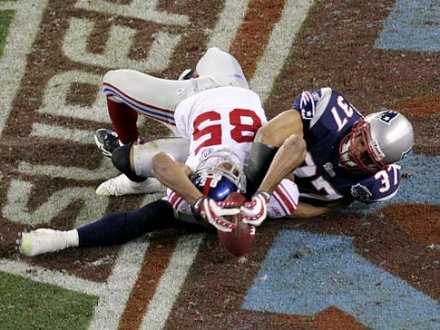
Before disemboweling, he was probably stretched out somewhat like David Tyree.

In fact, it was so dreadful (including many injuries in the distasteful rush for souvenirs) that they stopped doing it. Only gradually: Edward Marcus Despard, for instance, was sentenced to drawing and quartering, but they only hanged him to death and cut off his head posthumously. In 1814, that sentence — hanging plus posthumous beheading — formally replaced the old disemboweling-and-quartering bit as the penalty for treason.

(The invaluable CapitalPunishmentUK.org says that one James O’Coigley suffered hanging, drawing, and quartering in 1798 for that year’s Irish Rebellion; however, the Newgate Calendar’s record says that O’Coigley was “merely” hanged and beheaded, like Despard.)

On this day..

1965: Eli Cohen, Israel’s man in Damascus

On this date in 1965, Israel’s greatest spy suffered an ignominious public hanging in Martyrs Square, Damascus.


The signage swaddling the body denounces his crimes.

Eliahu Ben Saul Cohen — you can call him Eli(e) — was an Egyptian Jew who got recruited by Israeli intelligence to put his Arabic credentials to use in the cloak and dagger game.

You could say he’d found his calling.

After a spell establishing his cover story credentials in Argentina, he “returned” to Syria posing as a prodigal returning emigrant. There, he became the Zionist Richard Sorge.

Brazenly infiltrating the ascendant Ba’ath party and Syrian elite circles as wealthy businessman “Kamel Amin Thaabet”, Cohen piped years of high-quality intelligence to Israel from the very pinnacle of its enemy’s power structure.

(As described in this account, Eli’s own brother, another Mossad agent, was at one point charged with deciphering the spy’s communiques — thereby accidentally catching up with the family business.)


The trusted Eli Cohen in a snapshot with Syrian officials in the Golan Heights, overlooking Israel.

Cohen’s information on Syrian positions in the Golan has been credited with helping Israel win the Six-Day War in 1967.

But he wasn’t around to see it.

By that time, Syrian and Soviet intelligence had finally traced the damaging radio transmissions to “Kamel’s” apartment. He was purportedly — the matter is disputed, and smacks of hagiography — so influential and well-trusted at that point that he was on the verge of being named Deputy Minister of Defense.

Instead, he had a future in the martyr business.

A few books about Eli Cohen

After Cohen’s January 1965 arrest, events moved with implacable dispatch, and neither spy swaps nor diplomatic arm-twisting would avail an agent so embarrassingly, damagingly accomplished. Thousands turned out to cheer the spy’s public hanging, or gawk at the body as it remained hanging throughout the morning. Thousands more watched the live telecast of the execution.

(Six Syrians drew prison sentences for their parts in Cohen’s spy ring.)

Israel is still on about getting his body back from the Syrians. Whether or not that ever happens, the man lives on as a hero for his side. His story is the subject of the 1987 TV movie The Impossible Spy.

On this day..

1942: Anton Schmid

(Thanks to Meaghan Good of the Charley Project for the guest post. -ed.)

On this day in 1942, Sergeant Anton Schmid was executed for high treason. His crime: saving the lives of Jews in Nazi-occupied Vilna, Poland (now part of Lithuania and called Vilnius).

Schmid was born in Vienna and owned a radio shop there before he was drafted into the German Army following the Anschluss in 1938.

After Germany’s invasion of Russia in mid-1941, Schmid was put in charge of a unit in Vilna, tasked with collecting and reassigning soldiers who had been separated from their units. He witnessed the sufferings of the Jewish population in the Vilna Ghetto and was so horrified, he decided to take action.

Schmid used his position in the military to help Jews by employing them as workers for his unit, forging papers to get them out of prison and out of the ghetto, and using Army trucks to escort them away from the city.

At great personal risk, he would go into the ghetto to hand out food and warn the inhabitants when the Germans were planning roundups. In dire situations he would even hide people in his own apartment to protect them from the Nazis. He maintained close contact with Jewish resistance organizations and assisted their activities in a variety of ways.

According to one account by a Jewish woman who was herself killed later in 1942,

[Schmid] would mock the Jews and say how easily they could be fooled, and at the same time tried to find out what the Germans were planning. As soon as he learned something new, he would tell his Jews and order them to tell their friends so that they could hide until the situation stabilized … He negotiated on their behalf like a dedicated father, without fear of being punished if he was found out. He put them in his working place and provided them with food and drink. He gave them soup and bread. In short, in those chaotic days of massacres he managed to save dozens of Jews …

Although the Jewish Underground warned Schmid that his activities had become too widely known and he was in great danger, he refused to put a stop to his effort to save the Vilna Jews. In response to their concerns he reportedly said that if given a choice between “living as a murderer and dying as a rescuer,” he would choose to die.

He saved an estimated 250 to 300 people before his arrest in January or February 1942.

At his court-marshal, his attorney tried to say Schmid had taken the Jews out of the Vilna Ghetto because he thought they could better serve the Reich elsewhere. Schmid refused to allow this, however, openly proclaiming that he had been trying to save Jewish lives. He was convicted on February 25 and sentenced to die.

In a letter to his wife and daughter, just days before his death, he tried to explain himself:

Here there were a great many Jews who were being rounded up by the Lithuanian militia and shot to death in a meadow outside the city, groups of 2-3,000 at a time. On the way there, they were smashing children against trees and such like. You can imagine how I felt … You know how I am with my soft heart. I couldn’t think otherwise and helped them… This is a heavy blow for us, but please forgive me. I was just behaving like a human being and didn’t want to hurt anyone.

In 1967, twenty-five years after his death, Schmid was honored as a Righteous Gentile by Yad Vashem. His widow attended the ceremony on his behalf and accepted a medal reading “Whoever saves one life, saves the entire world.”

A street in Vienna and a military base in Germany are named after him.

On this day..