1957: Dedan Kimathi, Mau Mau commander

At a Nairobi prison this morning in 1957, the most famed and feared of the so-called Mau Mau was hanged under emergency measures permitting the death penalty for illegal firearms possession.

The armed Mau Mau uprising against British colonialism was by this time on its last legs militarily, having been ground down by years of murderous anti-insurgent operations and pleasantries like mass internment.

It had been an ugly fight on all sides, with overlapping conflicts — within the Kikuyu tribe, between Kenya’s native populations, and between the British Empire and her faraway subjects — brutally settled.

Certainly the Mau Mau’s depredations had garnered voluptuous press coverage in the mother country; accordingly, the capture of “Field Marshal” Kimathi, the biggest name in the insurgency, was a plume in the British lion’s cap.

(An earlier propaganda piece along the same lines sounded the war tocsin “so that peace may come to this troubled colony.”)

Notwithstanding the (still) official London take on Kimathi and the Mau Mau, their fight for the independence Kenya would soon attain has made Kimathi a hero to many Kenyans.* He was honored on the 50th anniversary of his death with a bronze statue in Nairobi.

And more than that: the Mau Mau would metastasize into a sort of floating signifier for implacable racialized anti-colonialism, a powerful symbol for an age of decolonization. Malcolm X frequently invoked the Mau Mau example. Frantz Fanon saw in the Mau Mau the potency of spontaneous rural resistance in generating white interest in “compromise” with the moderate who

never stop saying to the settlers: ‘we are still capable of stopping the slaughter; the masses still have confidence in us; act quickly if you do not want to put everything in jeopardy.’ … as the settlers cannot discuss terms with these Mau-Mau, he himself will be quite willing to begin negotiations.

* Although many surviving Mau Mau themselves are nonplussed by their post-independence treatment.

On this day..

1894: Auguste Vaillant, bomb-throwing anarchist

“For too long a time, our voice is responded to with prison, the rope or the fusillade, but don’t delude yourselves: the explosion of my bomb is not only the cry of Vaillant in rebellion, but is the cry of an entire class that calls for its rights and will soon join its acts to its words.”

–Auguste Vaillant

On this date in 1894, bomb-throwing anarchist — literally — Auguste Vaillant was beheaded in France.

The preceding December, the young Vaillant (French Wikipedia link) went from impoverished obscurity to national bogeyman by hurling a bomb into the Chamber of Deputies — reprisal for the 1892 execution of the anarchist Ravachol.

This bomb’s symbolic effect greatly exceeded its injury to life and limb: Vaillant said he had not been intending to kill, and in fact he did not. (Vaillant himself was among the wounded. His nose was blown off.)

But his political affiliations brought a suppression of anarchists and their press, and, of course, this day’s operation of the guillotine.*

“Mort à la société bourgeoise! Vive l’anarchie!”

Vaillant’s dying sentiment was taken up by Emile Henry, who bombed a Paris cafe the next week, and Sante Geronimo Caserio, an Italian immigrant who assassinated French President Marie Francois Sadi Carnot four months later.

* “Between the time of Vaillant’s arrival at the guillotine and the closing of the baskets containing his remains,” says the New York Times’ account, “scarcely more than twenty seconds elapsed.”

On this day..

1915: Veljko Cubrilovic, Danilo Ilic and Misko Jovanovic, Archduke Ferdinand’s assassins


“Executions as a consequence of the Sarajevo assassination”. From the Visual Archive of Southeastern Europe.

On this date in 1915, three of the Black Hand conspirators who had assassinated Archduke Franz Ferdinand in Sarajevo the previous June were hanged for treason and murder as the World War that assassination ignited engulfed Europe.

You could say it was too little, too late.

Ironically, the gunman who actually got the Archduke, Gavrilo Princip, was too young to receive the death penalty under Austro-Hungarian law — barely short of his 20th birthday,* a more liberal standard for capital responsibility than even present-day human rights standards require.

In fact, that was true of five of the eight student nationalists convicted; the Slavs’ barbarous oppressor accordingly punished them for murdering the heir to its throne and involving it in a ruinous war with prison sentences of no more than 20 years. Three of the underaged five (Princip included) contracted fatal tuberculosis cases in custody during World War I; the other two, Cvijetko Popovic and Vaso Cubrilovic, outlived the Habsburg Empire by decades.

Three remained, old enough to swing for turning Europe into a charnel house: Vaso’s older brother Veljko (a schoolteacher), Danilo Ilic (a newspaper editor) and Misko Jovanovic (a businessman).

But if their names aren’t familiar, and their comedy assassination plot succeeded almost in spite of themselves, these forgotten radicals still rank among the midwives of modernity for the global cataclysm unleashed by their deed, for its calamitous aftershocks of nationalism and ideology, and for the second war that succeeded the horrors of the first.

According to John S. Craig’s Peculiar Liaisons, Gavrilo Princip left his poetry scrawled on the wall of his cell.

Our ghosts will walk through Vienna
And roam through the palace
Frightening the lords

All things considered, he sold himself short.

* There seems to be some uncertainty as to Princip’s actual date of birth, so he might in fact have been 20 years old. The court, at any rate, took him for 19.

On this day..

1980: Islamic extremists for the Grand Mosque seizure

At dawn this date in 1980, the kingdom of Saudi Arabia publicly beheaded over 60 Islamic extremists who had seized Mecca’s holy Al-Masjid al-Haram the preceding November — one of the formative and strangely forgotten events in the birth of radical Islam.

Saudi Arabia’s uneven but unmistakable modernization generated friction extending to the royal family itself.

On November 20, 1979, with 100,000-plus pilgrims bustling in Islam’s holiest shrine on the hajj, a few hundred multinational messianic militants took it over with a cache of smuggled firearms.

For two embarrassing weeks, the Saudi government struggled to respond, bumbling a couple of military operations and delicately negotiating the ecclesiastical permission it would require to commit violence within the Grand Mosque. (Strict Moslim prohibitions against same had left the kingdom’s unarmed guards essentially defenseless against the initial takeover.)

In exchange for that fatwa, the House of Saud struck a Faustian bargain: agreeing to roll back secularization and impose strict Islamic law.

The balance of military materiel, of course, would prove to be no contest at all; Riyadh had troops, heavy armament, and now, permission to use them (and to damage the mosque … which they did). Most of the Mahdists were slain in the decisive assault; the survivors* (except for a few who were underage) were publicly beheaded in various cities around Saudi Arabia on this date, including the operation’s leader, Juhayman al-Otaibi.

But their deed — second-tier news at the time in a United States distracted by the Iranian Revolution — would have dramatic long-term repurcussions. Though intimations of deeper bin Laden family involvement** seem sketchy, it certainly appears to have inspired the 22-year-old Osama bin Laden; he soon made his way to fight the Soviets in Afghanistan, a war that began in earnest just days after the end of the siege and to whose prosecution Saudi Arabia and the west would gratefully direct Islamist energies.

Meanwhile, the Saudi government’s pact with the clergy that gained it permission to assail the Grand Mosque saw it subsequently bankroll Wahhabi religious instruction in Saudi Arabia and beyond … arguably the hand that rocked the cradle of present-day Islamic radical movements like al-Qaeda.

Much of what is latterly recalled about this affair by Anglophones comes courtesy of journalist Yaroslav Trofimov’s recent book The Siege of Mecca: The 1979 Uprising at Islam’s Holiest Shrine. (Review | Another | Book home page).

In this clip, the author discusses the legacy of the siege with Fareed Zakaria.

* The Saudi government put out the figure of 63 executions. Some sources now report 67.

On this day..

1922: Seven Republican guerrillas in the Curragh of Kildare

(Thanks to author and historian James Durney for the guest post, an excerpt from On the One Road: Political Unrest in Kildare 1913-1994. -ed.)

Seven men were executed in the Glasshouse, in the Curragh Camp on December 19 in the biggest official executions of the Civil War. They were Patrick Bagnall and Patrick Mangan, Fairgreen, Kildare; Joseph Johnston, Station Road, Kildare; Bryan Moore and Patrick Nolan, Rathbride, Kildare; Stephen White, Abbey St. Kildare and James O’ Connor, Bansha, Co. Tipperary. These seven men, along with Comdt. Thomas Behan were found in a dug-out at Mooresbridge, on the edge of the Curragh, on the night of December 13. They were under the command of Comdt. Bryan Moore, 38, a veteran IRA officer, and comprised a section of the 6th Battn. Column. They were armed with rifles bought from a soldier stationed in Naas Barracks.

A detachment of troops from the Curragh searching a farmhouse at Mooresbridge, about one-and-a-half miles from the Curragh Camp, “found the proprietress in possession of a fully loaded Webley revolver.” A subsequent search disclosed a dug-out underneath a floor. The dug-out was surrounded by National soldiers who called on the men to come out. Eight men were in the dug-out, which was also found to contain 10 rifles, a quantity of ammunition, one exploder, a roll of cable and food supplies. When they surrendered Tom Behan was struck with a rifle butt and had his arm broken. When the captives were ordered into the back of a truck Tom Behan could not climb aboard because of his broken arm. He was struck again on the head with a rifle butt and died at the scene. Behan was a veteran IRA man and at the time of his death was Intelligence Officer, 1st Eastern Division. The Free State authorities claimed that Behan was shot while trying to escape through a window in the Glasshouse (so called because of its roof), issuing a statement saying: “One of the party of men arrested when trying to make his escape from the hut in which he was detained at the Curragh, ignoring the warning of the sentry to desist, was fired on and fatally wounded.” Mick Sheehan was in the Glasshouse at the time and thought it highly unusual that an experienced volunteer like Tom Behan would try to escape through such a small window. It was only years later that he found out the truth. The Glasshouse was a small stone and brick military prison up the hill where the military usually housed their own prisoners. It consisted of two floors enclosed within a twelve foot high walled enclosure with cells for 64 prisoners. During the Civil War, and after, it was used as a punishment block for Republican prisoners.

The remaining seven men were executed by firing squad on the morning of December 19. The following official report was issued from Army Headquarters, GHQ, on that evening: “Stephen White, Abbey Street, Kildare, labourer; Joseph Johnson, Station Road, Kildare, railway worker; Patrick Mangan, Fair Green, Kildare, railway worker; Patrick Nolan, Rathbride, Kildare, railway worker; Brian Moore, Rathbride, Kildare, labourer; James O’Connor, Bansha, Tipperary, railway worker; Patrick Bagnel, Fair Green, Kildare, labourer who with others, were arrested at Rathbride, Co. Kildare, on the 13th inst., were charged before a Military Committee with being in possession, without proper authority, of – 10 rifles, 200 rounds of ammunition therefor, 4 bomb detonators, 1 exploder.

“They were found guilty and sentenced to death. The sentence was duly executed this morning, 19th inst., at 8.30 a.m.”

This stone at Grey Abbey commemorates the seven IRA men. Image courtesy of Mario Corrigan.

They were all veteran IRA men and belonged to a column of ten which operated against railways, goods trains and some shops in the vicinity of Kildare. Five of them were on the derailment of engines at Cherryville on December 11 when they made a serious attempt to dislocate the whole railway service on the Great Southern and Western Railway Line. Two engines were taken out of a shed at Kildare and sent down the line by Cherryville. One engine ran out of steam and did no harm, while the other overturned and blocked the line for a considerable time. The column was also responsible for an ambush on National troops at the Curragh Siding on November 23 when a large party of troops were returning to Dublin after escorting prisoners to the Curragh Internment Camp. On their return journey the troops were fired on at the Curragh Siding and two were wounded. In the confusion a policeman was accidentally shot by a National soldier. Father Donnelly, chaplain to the troops, administered to the seven volunteers before their executions. They were shot one by one and were buried in the yard adjacent to the Glasshouse.

The last letters from the seven men were printed in the Republican paper Eire. /The Irish/ /Nation/. James O’Connor of Bansha wrote to his mother: “I am going to Eternal Glory tomorrow morning with six other true-hearted Irishmen.” Patrick Mangan wrote to his mother: “I am to be shot in the morning. I fought for Ireland and am sorry I could not do more… I have made my peace with God and was never so happy as tonight.”

On March 31 1923 Eire (The Irish Nation) printed the last poignant letters from Bryan Moore, Patrick Bagnell and Paddy Nolan under the title ‘Last letters of “executed” soldiers of the IRA.’*

Letter of Bryan Moore to his Brother.

Hare Park Prison, 18-12-22.

Dear Pat, – I am about to die for the Cause of Ireland as many did before. Pray for me and get the children to pray for me. I’ve just had the priest and will see him again in the morning at 6.30 and receive Holy Communion. He says we are to be envied the deaths we are about to meet, as we shall go straight to Heaven.

Do all you can for Father and Mother. Tell Mary and Kathleen to say a prayer for me every night,

Bryan.

Letter of Bryan Moore to Mother and Father.

Hare Park Prison, 18-12-22.

Dear Mother and Father, – I am about to be executed in the morning and I wish to bid you good-bye, and to ask you to pray for me and the rest of the boys.

I had the priest this evening and will see him again to night. I am resigned to die. God comfort you both.

Tell Johnny to pray for me. – Your loving Son.

Bryan.

Letter of Bryan Moore.

Hare Park Prison, 18-12-22.

Dear Johnny, – Good-bye, and be good to Father and Mother. Pray for me. – Bryan.

P.S. – You can do a man’s part by looking after Father and Mother. Tell them not to worry for me, as I am better off. God bless you.

Dear Annie, – Good-bye. God bless you. Pray for me.

Bryan.

Letter of Patrick Bagnall to his Uncle.

Hare Park Prison, 18-12-22.

Dear Jimmy, – I hope you and Willie are well. Tell all the boys and girls I was asking for them. I am writing to my sister and father. I am to be shot in the morning, 19th December, at 8.15. Mind Mary and do what you can for her. I know this will nearly kill her. We had a priest who heard our confessions. We are all here, seven of us – Johnston, Mangan, White, Moore, Nolan, Connor, and I. We are all to go “West” together, so don’t forget to pray for us. I know you and Willie will be sorry, but it is all for the best, and I hope it sets old Ireland free. We are not afraid to die.

Tell them all in Kildare I was asking for them. Don’t forget Harry Moore. We are dying happy anyway. So good-bye old Kildare, good-bye Jimmy and God bless you. I will meet you in Heaven. Tell Tom Byrne I was asking for him. – Your loving nephew, Paddy Bagnall.

The priest’s name and address is Father_____, Curragh Camp, a very nice man: you can write him if you want to. He said we will die like men anyway.

Letter of Paddy Nolan to his Father and Mother.

Curragh Camp Prison, 18-12-22.

Dear father and Mother, – I am writing my last few lines to you. I am to be executed to-morrow morning, and I hope you will bear it with the courage of an Irish Father and Mother. I am proud to die for the Cause I loved and honoured, and for which I give up my young life.

Six more of my comrades are to be executed. We have all been to confession and Holy Communion. Father ______ told us we would go straight to Heaven, so do not worry.

Dearest Mother, there are a few pounds in my suitcase, you can have them, or anything else in the house belonging to me.

Loving Father and Mother , good-bye for ever, – Your fond and faithful Son.

Paddy.

Father _____, Curragh Camp, sends his sympathies and prayers.

Letter of Paddy Nolan to his Elder Brothers and Sisters.

Curragh Camp Prison, 18-12-22.

My Dear Brothers and Sisters.

Now that I’m about to part from this world, I ask you for one favour – be kind and good to Father and Mother, and never dishonour the Cause for which I die – a Free and Independent Ireland. I bear no ill will to any person. Fond Sisters and Brothers, pray for me. Good-bye forever.

Paddy.

Letter to his Young Brothers and Sisters.

My Dear little ones, – I, your fond brother about to pass out of this world, ask you loving little ones to offer up your innocent prayers for me and my comrades on Christmas morning. Be good children, and always obey your parents and do everything in your power to make them happy. God bless you little ones. Good-bye for ever. – Paddy.

The executions caused a lot of bitterness locally. Both Mick Sheehan’s uncles, who had taken the pro-Treaty side, left the National Army. One, Capt. Patrick Kelly, who had served in the Republican Police, resigned his commission and went to the Civic Guards.

* The last letter of 18-year-old Stephen White, which seems not to have been printed at the time, can be read on this history of the day’s executions. -ed.

On this day..

1878: John Kehoe, king and last of the Molly Maguires

On this date in 1878, John “Black Jack” Kehoe was hanged in Pottsville — as Pennsylvania’s anthracite trusts took a victory lap around the corpses of the Molly Maguires.

Even to say what the Mollies were is to take a side in their life-and-death struggle. Irish immigrants fleeing the potato famine had poured into Pennsylvania’s coal mining country in the mid-19th century, where life in the mines was nasty, brutish and short, and the pay wasn’t anything to write home about either.

In a time when capital ruthlessly hunted any intimation of labor organizing and the Irish were a distinctly second-class people, the (apparent, or at least alleged) response of the Mollies was natural: form a secret society, and wring by threat of bodily harm the concessions it could not pursue by collective bargaining. For the recent Irish transplants, the tableau of a Catholic underclass working for a Protestant landlord who owned (and gouged on) everything in sight had a certain familiar feel.

Terrorists? They certainly used violence to achieve political objectives, at least if the testimony of their foes is credited. But they weren’t the only ones.

Mine owners turned public and private violence on Irish radicals pushing for things like the eight-hour day. The notorious strike-breaking Pinkerton Detective Agency was detailed to infiltrate the Mollies.

The main blow against the Mollies was struck over a period of (extrajudicial) vigilante justice in the mid-1870’s, culminating in “Pennsylvania’s Day of the Rope” in 1877, when ten supposed members were (judicially) hanged around the Keystone State.

Kehoe, a power broker in mining country with some sway at the capital who was reputed to call the shots among the Maguires, faced the hangman singly a year later for an 1862 cold-case murder so doubtfully ascribed to Kehoe that the governor hesitated to sign the death warrant.

He signed it just the same, marking a sort of ceremonial “end to Molly-ism.” The New York Times exulted two days hence “that the widely-extended and long-continued tyranny and terror of this association is at an end,” and all because the resolute executive had gone and sent a hempen message to “the savage and benighted population of the coal region.”

The lesson taught by the punishment of the Molly Maguires would have been shorn of much of its terror and impressiveness if the energetic and persistent efforts made in behalf of KEHOE, the reputed king of that organization, had resulted in rescuing him from the gallows. If they had even so far succeeded as to have caused his punishment to be commuted to imprisonment for life, the admonitory influence of his fate upon the murderous clain of whom he was the last surviving chief would have been greatly lessened, and the snake of Molly Maguire-ism, of which he was the forked tongue and fangs, might haply have been only scotched, not killed. … The law has shown that it has subtlety enough to hunt [the Molly Maguires] through every possible labyrinth of refuge and strip from them every artifice of disguise, and power enough to wring them out of the desperate grasp of sympathizing constituencies and crush them.

Florid.

Like we said, violence wasn’t the exclusive resort of one side. But the monopoly of violence … that was held, as always, by the same hands that held the monopolies. Sean Connery as Kehoe reflects on the uneven contest while awaiting his fate in a (fictional) exchange with the Pinkerton mole who condemned him from the 1970 film The Molly Maguires.*

Pennsylvania Gov. John Hartranft left office a few weeks later, and reflected in his outgoing address on the lessons “the manufacturers and operators” ought to draw from the late unpleasantness.

The Mollie Maguire murders, like the agrarian murders in Ireland, and the trades-union outrages, arsons, and machine-breakings in England, were not the work of the so-called criminal classes. They were essentially class murders … If some of the leading spirits of the class had been members of a board of arbitration as representatives of labor, with some of the employers or their agents as representatives of capital, it is not unreasonable to suppose that most of the disagreements that have kept the coal regions in a state of turmoil might have been amicably adjusted, and many of those who were assassinated and of those who have been hanged living to-day.

101 years later, Kehoe received what was thought to be the first and only posthumous pardon in the state’s history. The Mollies’ true extent, purpose and actual actions — even their very existence as anything but a stalking-horse for the more thorough conquest of surplus labor — remain hotly debated to this day, since the public record of this tight-lipped society consists of little beyond the courtroom testimony of a handful of parties thoroughly prejudiced to hostility by class interest or payoffs.

* Written by Walter Bernstein, who had only recently emerged from the Hollywood blacklist for his Communist proclivities.

On this day..

1859: John Brown’s body starts a-moulderin’ in the grave

That line between “martyr” and “terrorist” is often a matter of historical perspective or even accident.

Were the person’s actions justified?

If not justified, were they at least historically significant?

If not historically significant, did they at least inspire some really great songs?

Or, movies?

John Brown, abolitionist, father of 20 children, advocate of armed insurrection as a direct means of ending slavery, is just such a figure. Before looking at how his actions influenced history, however, it is instructive to consider how history influenced him.

Born into a devout family opposed to slavery on religious and moral grounds, Brown grew up in a vehemently anti-slavery district of Ohio and, as a young man, began training in New England to become a Congregationalist minister.

When money ran out, he returned to Ohio and began a series of variously successful business ventures and married his first wife, with whom he would have seven children. When his businesses failed, he moved to Pennsylvania, buried his wife, married his second, and started a tannery, which began to founder as one of his sons died and Brown fell ill. He moved his family –- now with more than a dozen children –- back to Ohio, where he was hit hard by the economic crisis of 1839 (PDF link). In 1842, he was declared bankrupt; the following year, four more of his children died of dysentery.

In spite of these setbacks, Brown remained dogged in his pursuit of ventures to get himself out of debt, becoming a seasoned expert among small sheep farmers and acting as a self-appointed crusader for their empowerment against the encroaching interests of manufacturers. While this backfired and Brown remained impoverished into the 1850s (thought not as much as when he was declared bankrupt), it solidified his interest in helping the underdog.

Bleeding Kansas

Moral and religious interest in the abolition of slavery had been part of Brown’s upbringing, but it wasn’t until 1855, when five of Brown’s adult sons began sending word of often violent pro-slavery machinations in the Kansas territory, that Brown first became committed to drastic action on behalf of the cause. His strategy wasn’t at first overtly violent, but was rather convinced that the anti-slavery cause could win by the ballot box; over the course of the next year, however, he became convinced that the only sure way of preserve Kansas as a free territory was by “fighting fire with fire” (historical opinion as to the precise extent of the pro-slavery violence in relation to Brown’s later actions is divided).

In 1856, with tensions reaching a boiling point, Brown, four of his sons, and a band of other abolitionists killed five pro-slavery settlers in Franklin County, Kansas in what became known as the Pottawatomie Massacre. No legal retribution was possible or likely; Brown and his party escaped handily (although one of his sons was killed the following August), and Brown spent the next three years using various aliases to travel among abolitionists raising funds to launch an all-out assault on slaveowners back East.

“The crimes of this guilty land will never be purged away but with blood.”

That he chose the federal arsenal in Harpers Ferry, Virginia (now West Virginia) for his historic attack was no accident; it “evinced federal power stained by slavery.”

Brown believed his actions would be the start of a lasting insurrection in which slaves would rise up against their owners in an insurrection that would quickly spread to neighboring counties and throughout the South. While violence was expected, it was to be minimized, and, after the initial raid, used only in self-defense.

Twenty-one men, in total, took part in the raid; Brown’s expected hundreds of recruits never materialized. The slave population never got a chance to rise up against their masters, as townspeople promptly began firing on the raiders; by the morning after the start of the raid, the invaders were surrounded by a company of US Marines.* Brown was captured, along with seven of his men; ten were killed, and four escaped.

Tried in Virginia for murder, treason and conspiracy, Brown was convicted on November 2, just weeks after his failed insurrection, and sentenced to be hanged within a month. His often-cited speech in Court in response to this sentence would become a rallying cry for the abolitionist movement:

This court acknowledges, as I suppose, the validity of the law of God. I see a book kissed here which I suppose to be the Bible, or at least the New Testament. That teaches me that all things whatsoever I would that men should do to me, I should do even so to them. It teaches me, further, to “remember them that are in bonds, as bound with them.” I endeavored to act up to that instruction… Now, if it is deemed necessary that I should forfeit my life for the furtherance of the ends of justice, and mingle my blood further with the blood of my children and with the blood of millions in this slave country whose rights are disregarded by wicked, cruel, and unjust enactments, I submit; so let it be done!

“Make the gallows glorious like the Cross.”

During his last month on Earth, Brown seemed well-aware that he was on his way to be a martyr. Refusing rescue by a supporter who had managed to infiltrate the prison, he wrote letters of valor and conviction which were increasingly picked up by the Northern abolitionst press, and attracted pleas of clemency from sources as removed as Victor Hugo.


Christ-like: The Last Moments of John Brown, by Thomas Hovdenden.

John Brown hanged at Charles Town, Virginia (present-day West Virginia — another thing Virginia lost during the Civil War). This 19th-century drawing is from the Virginia Military Institute archive of the event, which includes eyewitness accounts of soldiers who attended the hanging, including Thomas “Stonewall” Jackson.

Hanged in the mid-morning of December 2, 1859, Brown stated ominously: “I, John Brown, am now quite certain that the crimes of this guilty land will never be purged away but with blood. I had, as I now think, vainly flattered myself that without very much bloodshed it might be done.”

Brown’s dramatic enactment of an attempted armed insurrection –- even an abortive one –- stoked longstanding Southern fears of slave rebellions, leading the South to reorganize and equip its outdated militias, and the Union to increasingly valorize a man who held, with sheer and utter clarity, the very convictions in which they must needs believe to fight and win the coming War Between the States.

Called a “misguided fanatic” by the man who would lead that war, Brown’s actions nonetheless both hastened the inevitable schism already drawn so dramatically across a nation in which one out of every ten human beings was held in legal bondage, as well as gave moral and spiritual courage to those who would ultimately rise to eradicate it.

“His soul goes marching on…”

Or in the words of Frederick Douglass:

Did John Brown draw his sword against slavery and thereby lose his life in vain? And to this I answer ten thousand times, No! No man fails, or can fail, who so grandly gives himself and all he has to a righteous cause. No man, who in his hour of extremest need, when on his way to meet an ignominious death, could so forget himself as to stop and kiss a little child, one of the hated race for whom he was about to die, could by any possibility fail.

Did John Brown fail? Ask Henry A. Wise in whose house less than two years after, a school for the emancipated slaves was taught.

Did John Brown fail? Ask James M. Mason, the author of the inhuman fugitive slave bill, who was cooped up in Fort Warren, as a traitor less than two years from the time that he stood over the prostrate body of John Brown.

Did John Brown fail? Ask Clement C. Vallandingham, one other of the inquisitorial party; for he too went down in the tremendous whirlpool created by the powerful hand of this bold invader. If John Brown did not end the war that ended slavery, he did at least begin the war that ended slavery. If we look over the dates, places and men for which this honor is claimed, we shall find that not Carolina, but Virginia, not Fort Sumter, but Harpers Ferry, and the arsenal, not Col. Anderson, but John Brown, began the war that ended American slavery and made this a free Republic. Until this blow was struck, the prospect for freedom was dim, shadowy and uncertain. The irrepressible conflict was one of words, votes and compromises.

When John Brown stretched forth his arm the sky was cleared. The time for compromises was gone – the armed hosts of freedom stood face to face over the chasm of a broken Union – and the clash of arms was at hand. The South staked all upon getting possession of the Federal Government, and failing to do that, drew the sword of rebellion and thus made her own, and not Brown’s, the lost cause of the century.

For more John Brown:

* Under the command of future Confederate General Robert E. Lee.

On this day..

1887: Parsons, Spies, Fischer and Engel, the Haymarket Martyrs

On this date in 1887, the Chicago political machine hanged four at Cook County Jail to defend civilization from the eight-hour day.

The Haymarket martyrs, as they would be remembered ere the hysterical atmosphere of their sentencing had passed, were four from a group of eight anarchist agitators rounded up when a never-identified person threw a bomb at Chicago police breaking up a peaceful rally. The bomb killed one cop; the indiscriminate police shooting that followed killed several more in friendly fire, plus an uncertain number of civilians.

The incident occurred just days after nationwide strikes began on May 1, 1886, in support of the eight-hour day. Nowhere were the tensions greater than Chicago, an epicenter of militant organizing. When tens of thousands poured into the streets on May 1, the Chicago Mail darkly said of high-profile radicals Albert Parsons and August Spies,

Mark them for today. Hold them responsible for any trouble that occurs. Make an example of them if trouble does occur.

Sure enough …

Most of the eight hadn’t even been present at the time the bomb was thrown, but the state put anarchism itself on trial under the capacious umbrella of “conspiracy,” in a proceeding so absurdly rigged that a relative of a slain cop was on the jury. Quoth the prosecutor,

Law is upon trial. Anarchy is on trial. These men have been selected, picked out by the grand jury and indicted because they were leaders. They are no more guilty than the thousand who follow them. Gentlemen of the jury; convict these men, make examples of them, hang them and save our institutions, our society.

That was the argument for hanging them. And right-thinking burghers applauded it.

Seven of the eight were condemned to die; two had their sentences commuted, but the other five refused to ask for clemency on the grounds that, innocent, they would “demand either liberty or death.” One of those five, Louis Lingg, painfully cheated the hangman by setting off a blasting cap in his mouth the night before his execution. (Lingg might have made, though seemingly not thrown, the mysterious bomb.)

The others — Parsons and Spies, along with Adolph Fischer and George Engel — hanged together, with their epitaphs upon their lips — literally so for Parsons, whose parting remark is at the base of the Haymarket Martyrs Monument*

“The time will come when our silence will be more powerful than the voices you are throttling today.”

“Throttle” was right, as the Chicago Tribune reported the next day, taking up when the trap was sprung:

Then begins a scene of horror that freezes the blood. The loosely-adjusted nooses remain behind the left ear and do not slip to the back of the neck. Not a single neck is broken, and the horrors of a death by strangulation begin.

Six years later, Illinois Gov. John Altgeld granted the free pardon the hanged men had demanded to the three surviving Haymarket anarchists. There is no institutional mechanism to determine erroneous executions in American jurisprudence — a fact that occasionally leads to smugly circular avowals that nobody recently executed has ever been “proven” innocent — and death penalty researchers Michael Radelet and Hugo Bedau believed as of this 1998 paper (pdf) that Altgeld’s executive statement flatly asserting the injustice of the Haymarket convictions was the most recent official acknowledgment of a wrongful execution in U.S. history. If true, its uniqueness would be understandable: the gesture cost Altgeld his political career.

Long gone as all these principals are, the legacy of Haymarket remains very much with us, and not just as a magnet for digital archives like this, this and this (don’t miss the brass gallows pin).

May 1, now rich with the symbolism of the Haymarket Passion, was soon selected by the international labor movement as the date to resume the eight-hour-day push — thus becoming the global workers’ holiday it remains to this day.

* Opposing interpretations of the Haymarket affair — which can be the “Haymarket riot” or the “Haymarket massacre,” depending on where you line up — were marked by opposing memorials. The police memorial was itself eventually bombed by the Weather Underground, and subsequently squirreled away from easy public view. Paradoxically, the Haymarket Martyrs Monument has been federally dignified as a National Historic Landmark.

On this day..

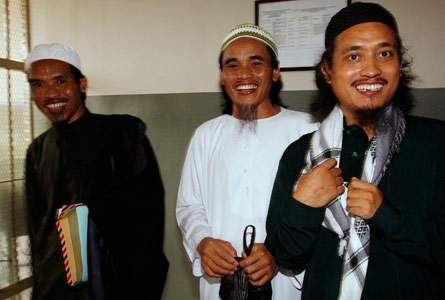
2008: The Bali Bombers

On this date — mere hours ago as of this writing — three of the most infamous terrorists in two nation’s histories were shot in a jungle clearing on Indonesia’s Nusa Kambangan Island.

“At around 00:15 am (1715 GMT Saturday) the three convicted men on death row, Amrozi, Mukhlas and Imam Samudra, were executed by firing squad,” said attorney general’s office spokesman Jasman Panjaitan.

“The autopsy results show that all three are dead. The family members are now bathing the bodies.” (Source.)

The men were taken from prison and tied to wooden crosses in the Indonesian prison island’s forest, where they were shot simultaneously by three separate firing squads for the October 12, 2002 bomb attack on the island of Bali that claimed 202 lives.

Though taking place in Indonesia, the strike was aimed at westerners vacationing at a tourist hot spot. Eighty-eight Australians were slain, along with 76 other (predominantly European) foreigners. The only shred of regret the late executees ever betrayed was that the infidel body count wasn’t higher.


The mediagenic murderers display a range from insouciant to jocular in most of their photos. The ever-grinning Amrozi — in the middle — was known as the “smiling assassin.”

The three facing death today* have occupied most of the intervening six years endeavoring to transmute their criminal celebrity into the dearer coinage of martyrdom through the doubtful influence of the Philosopher’s Stone mass media.

Despite their body count, burial disturbances, and even the prospect of some follow-up strike by at-large members of Jemaah Islamiyah, a base metal the late bombers will remain. Picture the most fanatical devotee of any cause you care to conjure drawing any enduring inspiration from this juvenile twaddle.

Indonesia has appeared to sidle towards this execution, ginger at inflaming Islamic radicals; Australia, which has no death penalty itself, has been controversially mum and bombing victims and their families conflicted.

It remains to be seen whether the high-profile case has legs among militants. But its undertones of race, religion and national sovereignty are being very closely watched by one group of Australians in particular: the Bali Nine, Australian nationals in Indonesian custody for drug smuggling.

Three of the nine are currently on death row, reportedly “somber” at this day’s shootings — no doubt aware that they could be next.

Update: True to the publicity-savvy rep, Imam Samudra reportedly knocked out a nasheed or nasyid just before his execution that’s now a hot ringtone download.

[audio:Imam_Samudra.mp3]

* A fourth man was also death-sentenced, but that sentence was vacated on appeal.

On this day..

1865: Champ Ferguson, Confederate guerrilla

On this date in 1865, Champ Ferguson was controversially hanged at Nashville for the “murders” he committed as a Confederate guerrilla.

There seems to be some slight difference of opinion (and do click that link) over Champ‘s role in the War Between the States.

Had the Confederate cause prevailed, he probably would have been a hero. Since history is written by the winners … here he is instead.

For reasons that lie in the uncertain junction between personal enmity and sectional loyalty, the war’s start saw Ferguson terrorizing Union supporters in the Kentucky-Tennessee borderlands, operating primarily around Sparta, Tenn.

These were not only state borders, but borders between the rival federal and Confederate territories. Civil War borders, obviously, were hazy and violently contested affairs: Kentucky was northern-controlled but claimed by both sides (it had rival governments); Tennessee seceded only after Fort Sumter.

Loyalties within Kentucky and Tennessee were divided as well. Ferguson’s own brother died fighting for the Union, and his cousin was killed by Ferguson’s own men. But the main battles were fought far away, leaving the conflict to play out locally.

In many cases … guerrillas identifying with the Confederacy operated well outside Confederate lines and Confederate control, leading to a certain ambiguity in official attitudes, since they did have their uses.

…

Guerrilla activity was … a feature of those up-country or back-country areas of states like North Carolina, Georgia, Alabama, Tennessee and Kentucky, in which there were significant internal divisions in terms of sympathy for Confederacy or Union … guerrilla conflict was the only direct face of war experienced by many in Tennessee and Kentucky, since the movements of the main armies remained distant from them throughout. Unionist guerrillas, for example, controlled many of the counties of eastern Tennessee, while Confederate guerrillas disputed Union control of western Kentucky and middle Tennessee. One of the ironies of the situation in the Appalachians, the Cumberlands and the Ozarks was that, while these areas of rugged terrain were favoured by Confederate guerrillas, they were also the very areas within the Confederacy which most Union sympathisers inhabited

-Ian Beckett, Modern Insurgencies and Counter-Insurgencies

That was Ferguson — a “legendary Confederate partisan and guerrilla” or little better than a bandit, depending on your point of view. Either way, he was feared by area Unionists and renowned for killing prisoners. Stories of his savagery — severing heads and the like — made the rounds. Ferguson would argue (and did) that he did nothing his enemies weren’t also doing. (The New York Times printed a lengthy account (.pdf) of Ferguson’s versions of the many killings he was accused of — disputing some, frankly acknowledging many.)

That brings us back to winners and losers.

Ferguson, of course, got the losers’ treatment after the war; while vendettas against rank and file Confederate officers were not on the agenda, Ferguson’s irregular status and unbecoming reputation set him up for a war crimes trial. All attempts to claim wartime protections were rejected.

The Times account of his hanging this day — witnessed by his wife and 16-year-old daughter; their alleged rape is sometimes given as the reason for Ferguson’s campaign — is picturesque. (.pdf)

He stood composedly on the drop some twenty minutes, while the charges, specifications and sentence were read by Col. Shafter. He nodded recognition to several persons in the crowd, and shifted his position in an impatient manner while the sentence was being read. To some specifications he inclined his head in assent. To others he shook his head. That about Elam Huddleston caused him to say, “I can tell it better than that.” When the speaker read, “To all of which the prisoner pleads not guilty,” he said, “I don’t now.”


An 1865 Harper’s illustration of the hanging. See the way the troops surround the scaffold? There’s a bit of folklore that the military did that in order to fake the hanging and cut him down still alive.

Along with Henry Wirz, commandant of the notorious Confederate prison Andersonville, Ferguson was the only Confederate executed for Civil War “war crimes.”

Arguably somewhat neglected as a Civil War figure, Ferguson still has a few books detailing his life. An interview with the a author of the newly-published Cumberland Blood: Champ Ferguson’s Civil War is here.

A few books about Champ Ferguson

On this day..