1653: Sakura Sogoro, righteous peasant

Perhaps on this date in 1653 — it is, at any rate, the date saluted by a festival that honors him — the peasant Sakura Sogoro was crucified for protesting the oppressive taxation of his local lord.

Sogoro — familiarly known as Sogo-sama — was a village head man who dared to take his complaints about his daimyo‘s heavy hand right to the shogun himself. As punishment for this effrontery, the daimyo had the peasant executed (which punishment the sacrificial Sogoro anticipated in making his appeal) along with his wife and sons (which was an outrage).

As classically described, Sogoro from the cross damns the cruelty of the punishment and promises to revenge himself as a ghost, destroying the daimyo‘s house within three years. A century or so after his death, a shrine was erected to his memory which attracted pilgrims throughout the realm and made Sakura Sogoro “the patron saint of protest” (Anne Walthall, whom we shall hear more from later.) The tale has earned popular staging in Japanese culture from the kabuki stage to television.


The great 19th century kabuki actor Ichikawa Kodanji as the avenging specter of “Asakura Togo”, the Kabuki character based on Sakura Sogoro. Image from this gorgeous collection.

As one might infer from the sketchy account here, the story’s historicity is shaky despite its popularity down the centuries in Japan. According to an academic paper by Walthall,*

The archetype of the peasant martyr, a man who deliberately sacrificed himself on behalf of his community.”

More has been written about Sakura Sogoro than about any other peasant hero, but the evidence of his existence is extremely circumstantial. Written accounts of him remain fragmentary until the 1770s …

The first mention of the Sogoro legend appears in Sakura fudoki (a record of provincial lore on Sakura), compiled by a Sakura domain bureaucrat, Isobe Shogen. He recounts how an old man had told him that Sogoro’s vengeful spirit caused the downfall of a seventeenth-century lord. This emphasis on revenge after death is common to many Japanese folktales. Its constant recurrence as a theme in Japanese history reflects a widely held belief in the power of strong emotions to wreak havoc after a person has died. At this point Sogoro was hardly a martyr for the peasants — they remembered not his own deeds, if any, but what had happened to the lord.

By the middle of the eighteenth century, the story gains more detail. After the death of the just lord, Hotta Masamori, his retainers take control of domanial administration, treat the peasants unjustly, and increase the land tax. To save the people, Sogoro makes a direct appeal to the shogun … becom[ing] an exemplar of righteous action, a man who placed community welfare above individual self-interest …

In narratives from the late eighteenth and early nineteenth centuries, the plot becomes still more elaborate. Sogoro is described as a man of scholarship, deeply religious, respectful of his superiors, mindful of his subordinates, esteemed by his neighbors. “He was intelligent, tactful, and did not look like he was peasant born. Everyone said he must be the descendant of a warrior” … As the savior of his village, he represented the peasants’ aspirations; as an angry spirit, he reflected their resentment of those in authority.

The most modern version of the legend omits all reference to revenge by angry spirits. Now the story depicts the courage of Sogoro and his supporters among the peasants and his heartrending renunciation of his family when he resolves to sacrifice himself for the community. He still puts his appeal directly in the hands of the shogun, even though modern historians have long argued that a meeting with the shogun was impossible for a peasant. In contrast to the “good king,” (the shogun Ietsuna) the villain, Hotta Masanobu, executes not merely Sogoro, but his four children. Even the cruelty of this command has become further elaborated. To evade the bakufu prohibition on the execution of women, officials pretend that Sogoro’s three daughters are actually sons and cut off their heads. In short, today people know only a lachrymose tale of tyranny and heroism.

English speakers can grab a couple renderings of this story in the public domain:

* Walthall, “Narratives of Peasant Uprisings in Japan,” The Journal of Asian Studies, May 1983.

On this day..

1828: Annice, a slave

(Thanks to Meaghan Good of the Charley Project for the guest post. -ed.)

On this date in 1828, a slave named Annice was executed on a public gallows in Liberty, Missouri. She was probably not the first female slave to face capital punishment in Missouri, a U.S. state since 1821, but she is the first one whose case can be adequately documented.

Annice had drowned five slave children in Clay County on some unspecified date in the summer of 1828; she was indicted on July 27. All six of them — Annice and five victims — were the property of Jeremiah Prior. Those victims were Ann, Phebe, and Nancy, whose age and parentage are not specified, plus Annice’s own children Billy, five, and Nelly, two. It was reported that she was discovered whilst attempting to drown yet another of her children.

According to the indictment, Annice “pushed the said [children] into a certain collection of water of the depth of five feet and there choaked, suffocated and drowned of which the said [children] instantly died.”

In her book Slavery and Crime in Missouri, 1773-1865, author Harriet C. Frazier writes of Annice’s case,

Because the records contain no statement from her, her motivation may only be surmised. Most likely, it was the same as Missouri’s many slave mothers … who either attempted or accomplished the murder of their offspring. Without “the curse of involuntary servitude” … almost certainly, Annice would never have systematically drowned one child after another, thereby depriving her owner of no fewer than five potentially valuable properties.

On this day..

1471: Giovanna Monduro, Piedmont witch

On this date in 1471, Giovanna Monduro, wife of Antoniotto Marandolo, burned at the stake in her native Piedmontese village of Miagliano.

Michael Tavuzzi, whose very specific title Renaissance Inquisitors: Dominican Inquisitors and Inquisitorial Districts in Northern Italy, 1474-1527 is our main source for this post, describes the case as “representative of the witch-trials conducted by Dominicans, both conventual and observant, in northern Italy during the Renaissance” which “seem to have been procedurally very similar.”

The story begins with a trial that we don’t know about, the trial at a nearby village of a witch called Maddalena who at some point offered Giovanna’s name to her tormentor.

Said tormentor, one Giovanni Domenico da Cremona, arrived in January 1470 to the beautiful Piedmont hamlet of Salussola* bearing a frightful boon: the offer of leniency for anyone who would gift the Inquisition their comprehensive confessions, and the names into the bargain of anyone else who was up to something sub-orthodox.

More than likely Giovanna’s name was actively solicited on the basis of Maddalena’s accusation; in either event, it was certainly supplied by family and neighbors to whom the woman had a witchy reputation. After an incriminating attempt to flee, she was brought to trial in the village church on February 13, 1470.

This time was very early days yet for the great witch-hunts yet to disgrace Europe, but it is recognizably of a piece with them. Over the course of the preceding generations, jurists and scholars had painstakingly constructed the edifice to support the many stakes and scaffolds: the conflation of folk magic, superstition, and holdover pagan customs with a literal network of flying, Satan-fucking warlocks bent on the destruction of Christendom.

For many centuries, “the Church, as the civilizer of nations, disdained these old wives’ tales,” Hugh Trevor-Roper put it in The European Witch Craze. But come the antechamber of modernity, “to deny the reality of night-flying and metamorphosis would be officially declared heretical; the witches’ sabbat would become an objective fact.”

Inquisitors’ preconceptions of the menace came to structure the trials they conducted, to insinuate themselves through questioning by turns sly and violent into the mouths of their prey, whose admissions would then compound not only upon the next town over but to the confirmation of the entire diabolic schema. It’s difficult to know where were the heads of long-gone peasants and townsfolk in all this but Giovanna’s attempt to escape suggests that whatever beliefs they might have held, all knew to dread the inquisitor.

Back to Tavuzzi’s treatment of the Salussola case:

The list reproduced in the trial’s transcript of the predetermined questions that were to be put to Giovanna by Giovanni Domenico during the course of the trial is instructive, for it reveals very well indeed the conceptual baggage that an inquisitor brought to such a task at this time. The questions amount to a kind of primer of the diabolic interpretation of witchcraft and allude to almost all its essential components: the sect of the witches, repudiation of the Christian faith, the pact with the devil, sexual congress with him, abuse of the sacraments, the performance of malevolent magic. Inquisitors invariably compiled such a list of points, known as articuli or capituli inquisitionales, to guide them in their interrogations, and it is through these that their own witch-beliefs and demonology would have impinged upon the course and outcome of a witch-trial.

Woe betide she who faced such questions … for the answers were already written.

Though Giovanna met this dreadful interrogation with some steadiness, human fortitude but rarely equaled the ordeal. Interrogated twice, she denied all repeatedly, even remaining steadfast through her third session that introduced torture to the proceedings.

Days later, the Inquisitor broke her.

A fourth interrogation took place on 20 February, and at that point she began to confess: she admitted that she had indeed belonged to the sect of the witches for twenty-three years, recapitulated all the elements of the stereotype of diabolic witchcraft, including shapeshifting and transvection that are not mentioned in Giovanni Domenico’s initial list of questions, and admitted to having caused the deaths of several persons.

She started coughing up names — some local women, some residents of a nearby village, a local priest — and when in fear for flesh or soul she attempted to walk back her confessions and accusations, she was tortured afresh until she adhered to the preferred story.

For unknown reasons it was not until almost 18 months later that

on 17 August 1471, the deputy of the local feudal lord, the count of Tollengo, in whose dungeon she must have been incarcerated since the trial, emitted the sentence whereby Giovanna was to be burned at the stake in nearby Miagliano — her birthplace — and it was carried out the same day.

* A display at a museum there commemorates the event.

On this day..

1941: Sheyna Gram and the Jews of Preili

(Thanks to Meaghan Good of the Charley Project for the guest post. -ed.)

On this date in 1941, less than two months after Germany invaded the Soviet Union, fifteen-year-old Sheyna Gram and her parents and younger brother were murdered, together with approximately 1,500 Jewish people from the town of Preili in the occupied Latvian SSR. Nearly the entire Jewish population of Preili was wiped out by the ever-diligent Einsatzgruppen.

During World War II the Nazi death squads moved from town to town in Poland and Eastern Europe. They had one job and they performed it very well, slaughtering Jews and other “undesirables” by their thousands, most notably at Babi Yar outside of Kiev in Ukraine, where 33,771 people were killed in two days.

Preili, one of the oldest Jewish settlements in Latvia, was a much smaller community than Kiev; when the German invasion began, it had a population of less than two thousand, around half of whom were Jewish.

Latvia as a whole had a prewar Jewish population of just under 100,000. Only a few thousand of them survived, mostly those who were evacuated deep into Soviet territory and beyond the reach of the Wehrmacht. Of all the Jews in Preili, only six survived the war.

Preili was no different than any of the other Soviet Jewish communities wiped out in the Holocaust, but we know details about what happened there because Sheyna Gram left a diary behind. She chronicled the day-to-day events of the German occupation from June 22, the day the Nazis invaded the USSR, until August 8, the day before she and her family were killed.

Shortly after the war, noted Soviet journalists Ilya Ehrenburg and Vasily Grossman traveled all around the USSR, interviewing people and collecting eyewitness testimonies, letters, diaries, and other documents to bear witness to the Soviet Jewish experience during the German occupation. The result, titled The Complete Black Book of Russian Jewry, was the first major documentary work on the Holocaust. However, it wasn’t actually published until 1993, and even then it was nowhere near “complete.” In 2008, Indiana University Press translated and published The Unknown Black Book: The Holocaust in the German-Occupied Soviet Territories, which consists of accounts and documents that didn’t make it into the first Black Book; the second book is nearly as long as the first.

Among the documents included in the second volume is Sheyna Gram’s diary, translated from Yiddish. It somehow survived the war even though its author had not, and even seventy-plus years later, Sheyna has not been forgotten. Several books about the Holocaust in Latvia have referenced her diary, comparing its writer to Anne Frank, and at least one play based on the diary was performed in Latvia in around 2012.

Per The Unknown Black Book, the Gram family consisted of Itzik, a 60-year-old tailor, his 52-year-old wife, and their four children: sons Gutman, 18, and Leyba, 12, and daughters Freya, 20, and Sheyna. Evidence in the diary suggests they were not a particularly observant Jewish family.

The Unknown Black Book reports that Gutman survived the war, serving in the Red Army, but Yad Vashem’s Central Database of Shoah Victims has a page of testimony for him stating he was killed in military service. Although Mrs. Gram is unnamed in The Unknown Black Book, a search of the Database of Shoah Victims turns up a Sara Gram née Zangvil who lived in Preili and was the right age. The same person, Shmuel Latvinskiy, submitted Sara and Gutman Gram’s testimonies, and Sheyna’s as well; he names himself as Sara Gram’s nephew, Gutman’s cousin, and Sheyna’s relative, making it all but certain that Sara Gram was Sheyna’s mother.

What little information is available about Sheyna indicates she was an ordinary enough teenager. She was a good student, “an intelligent girl of good spiritual development,” and had just finished the sixth grade at school when war broke out. She started her diary that very day with a few sentences, and wrote entries regularly until her death:

June 22. At twelve o’clock, the radio announced, “Germany has declared war on the USSR. At four o’clock this morning, German aircraft bombed several Russian cities.”

Toward evening, I went to Ribenishki [seven kilometers from Preili]. I sit by the radio all the time until midnight. They tell you how to protect yourself from an air raid.

The next day, Sheyna recorded that Daugavpils* had been bombed and “a state of siege has been declared.” Wanting to do her part to help with the war effort, she signed herself up for first aid lessons. “New people are coming into town all the time,” she wrote. “Each person has something new to report. The Germans are successfully advancing.” Over the following days there was an 8:00 p.m. curfew and various new rules: radios were confiscated, freedom of assembly was curtailed, and windows had to be covered.

By July 2, the Germans had arrived in Preili. The following day Sheyna wrote,

The first day went quietly. On the second day, the Germans smashed the shops and looted everything. They broke into the synagogue, hauled out the Torah scrolls, and trampled on them. In other streets, they go on various sorts of rampages. […] We are living in a state of great fear. Many Germans have stopped in our town. There are some proper gentlemen among them as well. They keep on reassuring us that they are not going to touch the workers. A decree is published that Jews and Russians do not have the right to fly their national flags. Walking on the street is permitted until 10:00 p.m., but no one dares poke their head out the door.

As per standard operating procedure, the Nazis ordered Jews to wear a six-pointed yellow star, “twelve centimeters wide and long. Men are to wear it on their backs, their chests, and their legs, just above the knee. Women will wear them on their chests and on their backs.” For the rest of the month, Jews were regularly rounded up for forced labor. Sheyna was assigned to a work party cutting peat; roll call was at five in the morning and work didn’t stop until 7:00 p.m.

Except when she was working, she didn’t leave home. She whiled away the empty hours sleeping, studying Russian, reading back issues of the Jewish magazine Yidishe bilder, and writing in her diary.

On July 27, she wrote:

This is a bloody Sunday for the Latvian Jewish people.

Morning. All the Jews in Dvinskaya Street are ordered to put on their best clothes, take some provisions with them, and go out into the street. Searches of the homes are carried out. At twelve o’clock, all the Jews are herded into the synagogue. One group of young Jews is sent to dig graves behind the cemetery. Then the Jews of two more streets are driven into the synagogue.

It is 3:30 in the afternoon. All the Jews are chased out beyond the cemetery and shot there. All 250 Jews: men, women, and children.

This is terrible. We did not expect things to end this way. The handful of survivors expects death at any moment.

Iossif Rotchko’s untranslated book about the Holocaust in Latvia describes in detail what happened that terrible day. According to his account, the killers were not German but Latvian, local collaborators, and he names names:

The unfortunate [Jews] were ordered to stop at a stone quarry. They were ordered to take off their clothes and remain in underclothes, then they were led to the edge of the pit by groups of 8-10 persons. The executioners killed them by firing at their backs, as if they were afraid to look in their eyes a final time. After all, they were neighbors. The killers were conducted to the killing ground by carts driven by the farmers I. Prikulis, J. Litaunieks, as well as others…

Whomever the perpetrators were, this was the first such massacre Sheyna was personally affected by, although she’d probably heard rumors of others. One of her friends had been among the victims, and she was understandably terrified. “We look at each other,” she wrote, “and are amazed that we are still alive.”

On July 30, she reported that the Germans had said “they are not going to touch the Jews again. They are satisfied with the 250.” She was skeptical, however, writing the next day:

Every day there are new persecutions, and there is no end in sight. We have lived this long, but we do not know whether or not we will manage to survive. They send Jewish girls to clean freed-up Jewish apartments for those who have been killing them. They do not take me. But when they clean out the apartment of my murdered friend Mery Plagova, which they are preparing for a police officer, I go. I gather up her photos and keep them with me. I cannot believe that my friends the Plagovas are dead.

The Jewish holiday of Tisha B’av on August 3 found the young diarist still contemplative.

I have never fasted on this day or ever fasted at all. Today, however, a week after the great catastrophe, after that bloody Sunday, when so many innocent victims fell, I have decided, keeping it a secret from the authorities, of course, to fast the entire day. At 1:30, they come to see me and register me for the peat work. Mama orders me to eat something, otherwise I will not be able to work. I obey her. Then they change the list and send my little brother instead of me.

Three days later the Gram family was ordered out of their apartment, but “there are no apartments to move to. It is as though we are living up in the air … Yet another commission comes and decides that we can stay where we are.”

August 8 was her last entry:

The peasants say that lots of airplanes flew over during the night. At seven o’clock we go to wash the floors of the police station. The boss is in a bad mood today. It rains the entire time. At twelve o’clock they arrest three Jewish representatives. They demand that they send thirty people out to work. Twenty-one turn up, leaving nine short. The commandant demands the nine; otherwise things will go badly. The nine have hidden themselves. We are all dreadfully worried.

Rain the entire day. They want to select nine other Jews, but he insists only on the ones from before. From the moment, the representatives are under arrest. No one knows when our sufferings will end. I feel as though the next awful thing is getting closer and closer to me.

Her intuition was right: the next day, the 1,500 Jews from Preili and the surrounding area were murdered in the Jewish cemetery, among them Sheyna, Itzik, Sara and Leyba Gram. The Unknown Black Book notes that Freya Gram survived for another week: she was “kept back after work that day by the commandant, who, when he had had his fill of her, had her killed on August 16.”

A memorial with Latvian, Hebrew and English text, marks the spot where the Preili Jews died. It was funded by David Silberman, a Holocaust survivor from Preili, and dedicated on August 8, 2004, sixty years almost to the day after the massacre. The central obelisk has a quote from Sheyna Gram’s diary, and buried beneath it is an urn with a list of the names of the victims, pieced together by the aforementioned Shmuel Latvinskiy, who wrote pages of testimony for the Gram family. Additional photos of the memorial can be seen at the bottom of this page.

* Sheyna calls this city by its Yiddish name, Dvinsk. An 832-page list of Jewish people from Daugavpils who died in the Holocaust can be found here.

On this day..

1944: The Wola Massacre begins, during the Warsaw Uprising

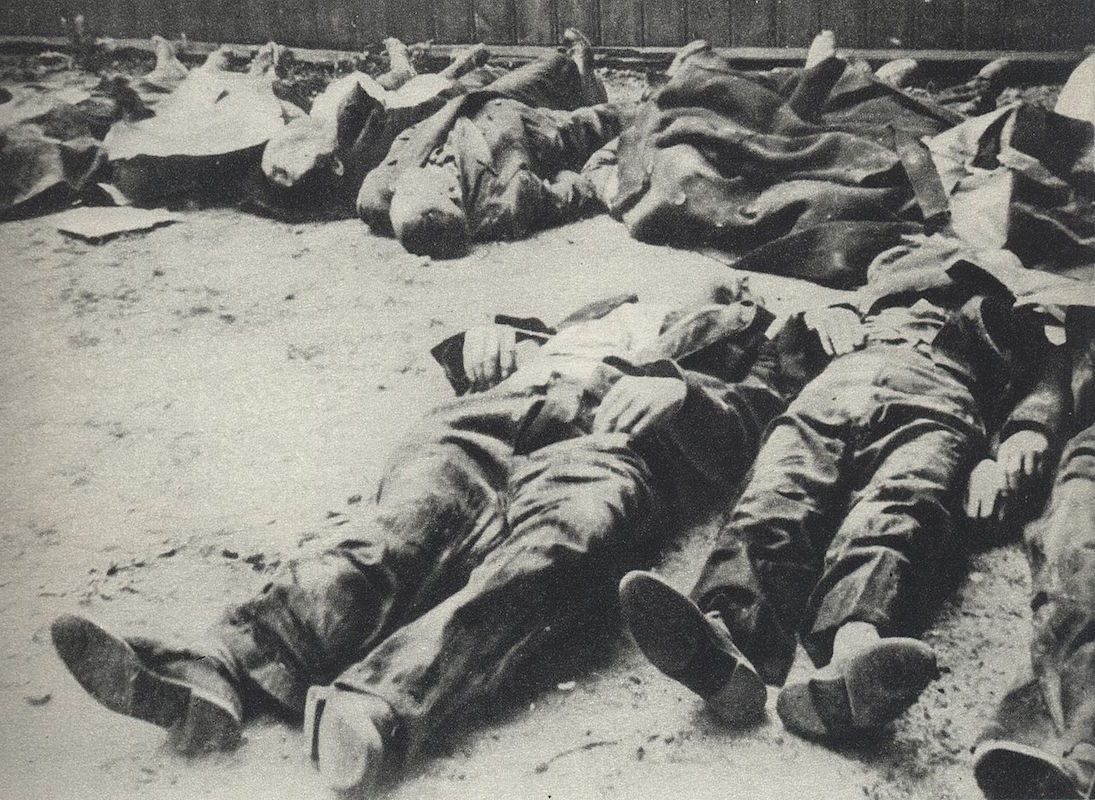
On this date in 1944, a weeklong German slaughter of Polish civilians and resistance fighters began in the Wola district of the capital city Warsaw.

The Wola Massacre marked the start of the Reich’s counterattack against the Warsaw Uprising, the heroic and suicidal rising mounted by the Polish Home Army as the Red Army’s summer offensive brought it to the banks of the Vistula.

Aiming to claim some foothold upon which to influence events in the soon-to-be Soviet-occupied Poland, the Home Army enjoyed initial success in the first days of August. But German reserves from the Replacement Army — the vehicle by which the Valkyrie plotters had attempted their coup against Hitler just days before, and now as a consequence answering directly to Heinrich Himmler — were quick to the scene and would turn back the rising in weeks of bloody urban warfare. Himmler’s authority in crushing the Warsaw Uprising would also allow him to give rein to his SS for a campaign of atrocities intended to cow the populace into speedy submission.

Himmler wasn’t a battlefield commander, of course. Chief on the scene would be Erich von dem Bach-Zelewski; for this purpose he would enlist some of the more notorious units on the eastern front, such as the lawless Sonderbataillon Dirlewanger and the “Russian National Liberation Army” of Bronislav Kaminski. They were just the types to implement Himmler’s brutal orders* for a city they were soon to lose anyway:

  1. Captured insurrectionists shall be killed whether or not they fight in accordance with the Hague Convention.
  2. The non-fighting part of the population, women, children, shall also be killed.
  3. The whole city shall be razed to the ground, i.e. its buildings, streets, facilities, and everything within its borders.

The outcome rates as perhaps the largest battlefield massacre of World War II.

On August 5, Bach-Zelewski’s forces began a coordinated push into the western suburb of Wola. Himmler’s orders were implemented immediately, as attested by numerous civilian witnesses and lucky survivors:

I lived in the Wola district at No. 8, Elekcyjna Street. At 10 a.m. on Aug. 5, 1944 a detachment of SS-men and Vlassov’s men entered. They drove us from the cellars and brought us near the Sowinski Park at Ulrychow. They shot at us when we passed. My wife was killed on the spot: our child was wounded and cried for his mother. Soon a Ukrainian approached and killed my two-year-old child like a dog; then he approached me together with some Germans and stood on my chest to see whether I was alive or not – I shammed dead, lest I should be killed too. One of the murderers took my watch; I heard him reloading his gun. I thought he would finish me off, but he went on further, thinking I was dead. I lay thus from 10 a.m. until 9 p.m. pretending to be dead, and witnessing further atrocities. During that time I saw further groups being driven out and shot near the place where I lay. The huge heap of corpses grew still bigger. Those who gave any sign of life were shot. I was buried under other corpses and nea rly suffocated. The executions lasted until 5 p.m. At 9 p.m. a group of Poles came to take the corpses away. I gave them a sign that I was alive. They helped me to get up and I regained sufficient strength to carry with them the body of my wife and child to the Sowinski Park, where they took all the dead. After this sad duty had been performed they took me to St. Laurence’s Church at Wola, where I remained till next day. I cannot state the exact number of the victims, but I estimate that those among whom I lay amounted to some 3,000 (three thousand). I met a friend in the church who had gone through the same experience as I, having lost a boy of 8, who had been wounded and died calling for his father. I am still in hospital and the image of death is constantly before my eyes.

And another:

On August 5, 1944, between 12 and 2 p.m., I saw from a window on the first floor of Wola Hospital Germans dragging women out of the cellars of No. 28, Plocka Street. They shot them in the courtyard with machine-guns. Almost at the same time, I saw in the courtyard of No. 30, Plocka Street the hands of more then 20 people raised and visible over the fence (the people themselves could not be seen). After a volley of shots these hands fell down: this was another of the executions in Wola.

And the agonizing testimony of Wanda Lurie:

I stayed in the cellar of No. 18 until August 5, when, between 11 and 12 noon, the Germans ordered all of us to get out, and marched us to Wolska Street. This march was carried out in dreadful haste and panic. My husband was absent, taking an active part in the Rising, and I was alone with my three children, aged 4, 6 and 12, and in the last month of pregnancy. I delayed my departure, hoping they would allow me to remain, and left the cellar at the very last moment. All the inhabitants of our house had already been escorted to the “Ursus” works in Wolska Street at the corner of Skierniewicka Street, and I too was ordered to go there. I went alone, accompanied only by my three children. It was difficult to pass, the road being full of wire, cable, remains of barricades, corpses, and rubble. Houses were burning on both sides of the street; I reached the “Ursus” work’s with great difficulty. Shots, cries, supplications and groans could be heard from the factory yard. We had no doubt that this was a place for mass executions.

The people who stood at the entrance were led, no, pushed in, not all at once but in groups of 20. A boy of twelve, seeing the bodies of his parents and of his little brother through the half-open entrance door, fell in a fit and began to shriek. The Germans and Vlassov‘s men beat him and pushed him back, while he was endeavouring to get inside. He called for his father and his mother. We all knew what awaited us here; there was no possibility of escape or of buying one’s life; there was a crowd of Germans, Ukrainians (Vlassov’s men), and cars. I came last and kept in the background, continuing to let the others pass, in the hope that they would not kill a pregnant woman, but I was driven in with the last lot. In the yard I saw heaps of corpses 3 feet high, in several places. The whole right and left side of the big yard (the first yard) was strewn with bodies. We were led through the second. There were about 20 people in our group, mostly children of 10 to 12. There were children without parents, and also a paralysed old woman whose son-in-law had been carrying her all the time on his back. At her side was her daughter with two children of 4 and 7. They were all killed. The old woman was literally killed on her son-in-law’s back, and he along with her. We were called out in groups of four and led to the end of the second yard to a pile of bodies. When the four reached this point, the Germans shot them through the backs of their heads with revolvers. The victims fell on the heap, and others came. Seeing what was to be their fate, some attempted to escape; they cried, begged, and prayed for mercy. I was in the last group of four. I begged the Vlassov’s men around me to save me and the children, and they asked if I had anything with which to buy my life. I had a large amount of gold with me and gave it them. They took it all and wanted to lead me away, but the German supervising the execution would not allow them to do so, and when I begged him to let me go he pushed me off, shouting “Quicker!” I fell when he pushed me. He also hit and pushed my elder boy, shouting “hurry up, you Polish bandit”. Thus I came to the place of execution, in the last group of four, with my three children. I held my two younger children by one hand, and my elder boy by the other. The children were crying and praying. The elder boy, seeing the mass of bodies, cried out: “they are going to kill us” and called for his father. The first shot hit him, the second me; the next two killed the two younger children. I fell on my right side. The shot was not fatal. The bullet penetrated the back of my head from the right side and went out through my cheek. I spat out several teeth; I felt the left side of my body growing numb, but I was still conscious and saw everything that was going on around me.

I witnessed other executions, lying there among the dead. More groups of men were led in. I heard cries, supplications, moaning, and shots. The bodies of these men fell on me. I was covered by four bodies. Then I again saw a group of women and children; thus it went on with group after group until late in the evening. It was already quite, quite dark when the executions stopped. In the intervals between the shootings the murderers walked on the corpses, kicked them, and turned them over, finishing off those who still gave any sign of life, and stealing valuables.

German soldiers too recorded wholesale executions in their diaries and correspondence; while the accounts above are all specifically attributable to the 5th of August, those that follow are undated snapshots of environment:

Policemen with rifles under their arms trudged along. All of the police from occupied Poland came together there to show off their bravery and also to enrich themselves on the side. I did not see this activity, but others did. They saw how these policemen executed those from the procession who could not keep up, those who were sick and lagging behind, and right in front of their compatriots. What was particularly troubling about this misery is that unlike in Russia what was occurring was not a matter of a completely poor, and in any event already moaning, mass of people; rather these were people of our own social class, women in fur coats, cute children who up until two days before had been fully cared for. This memory has always caused me anguish during my short stopovers in Warsaw: the look from so many hostile eyes, people of our culture, who knew exactly what I knew. For that reason I was always glad never to have been deployed in the West. And now I stood beside these people in bitter agony, and I was shocked.

Now we arrived at the command post of the SS-commander. There were two buses parked on the right side of the street. We reported to the SS-commander, a medium-built stringent man with a sharply chiseled face. With a cold glance at the procession of women and children that was passing no farther than 10 meters from us, he said, “You see, this is our biggest problem. These refugees! I don’t have enough ammunition to kill them all!” He said this quietly and with a remorseful shrug of the shoulders, this elegant officer with the Iron Cross and pleasant manners. Meanwhile tears fell down my cheeks. What kind of human being was he?

Hans Thieme

And another:

Before each daily operation I reported to the SS commander. During one visit I witnessed an event, which sickened me to my very core. The SS officer’s office was on the upper floor of a building and had a balcony that overlooked a large courtyard. The SS had lined up near a wall about 40 or so Polish men, women, and children of all ages. I distinctly recall a young woman holding hands with two small children. It was clear to me what was about to happen. I confronted the SS commander as to why these people were about to be shot. His reply was that they were being executed as a reprisal for the Germans that had been killed in the Uprising. He informed me that it was also none of my concern. Shortly, thereafter the hostages were shot before my eyes. I was disgusted by what I had witnessed and after 60 years later it still haunts me.

Eberhard Schmalz

And another:

I was setting explosives under big doors, somewhere in Old Town. From inside we heard Nicht schiessen! Nicht schiessen! (Don’t shoot! Don’t shoot!). The doors opened and a nurse appeared with a tiny white flag. We went inside with fixed bayonets. A huge hall with beds and mattresses on the floor. Wounded were everywhere. Besides Poles there were also wounded Germans. They begged the SS-men not to kill the Poles. A Polish officer, a doctor and 15 Polish Red Cross nurses surrendered the military hospital to us. The Dirlewangerers were following us. I hid one of the nurses behind the doors and managed to lock them. I heard after the war that she has survived. The SS-men killed all the wounded. They were breaking their heads with rifle butts. The wounded Germans were screaming and crying in despair. After that, the Dirlewangerers ran after the nurses; they were ripping clothes off them. We were driven out for guard duty. We heard women screaming. In the evening, on Adolph Hitler’s Square [now Pilsudzki Square] there was a roar as loud as during boxing fights. So I and my friend climbed the wall to see what was happening there. Soldiers of all units: Wehrmacht, SS, Kaminski’s Cossacks, boys from Hitlerjugend; whistles, exhortations. Dirlewanger stood with his men and laughed. The nurses from the hospital were rushed through the square, naked with hands on their heads. Blood ran down their legs. The doctor was dragged behind them with a noose on his neck. He wore a rag, red maybe from blood and a thorn crown on top of the head. All were lead to the gallows where a few bodies were hanging already. When they were hanging one of the nurses, Dirlewanger kicked the bricks she was standing on.

Mathias Schenk

A much larger catalogue of atrocity accounts awaits at warsawuprising.org.

The massacre at Wola would run on to about the 13th at which point Bach-Zelewski abated the civilian massacre order as counterproductive: too many soldier-hours needed for focused bloodbaths were being squandered orchestrating gratuitous ones. Nevertheless, weeks of hard urban warfare lay ahead, and policy continued to embrace the summary execution of captured fighters and of all fighting-age men, resistance or no. Some 200,000 civilians are thought to have died during the Warsaw Uprising.

One legacy was eerily and unknowingly captured by a LIFE magazine photographer in 1948, of a young girl in a school for disturbed children in Poland. Her face a scramble of innocence and madness as it peers into the lens, she illustrates her “home” as an incoherent chalk vortex. It wasn’t known until many years after this photo became emblematic of a generation wracked by horror, but “Tereska” — Teresa Adwentowska — was an orphaned survivor of Wola.

* Per Bach-Zelewski’s evidence to the Nuremberg tribunal. By dint of cooperation, he saved his own life from the Nuremberg gallows.

On this day..

A day in the executions of Franz Schmidt

The free imperial city of Nuremberg has been a regular feature on this site thanks to the detailed journal of executions kept by its legendary executioner Franz Schmidt.

We have profiled many of the more remarkable cases individually. Today, we’ll pause for a few of central Europe’s lesser criminals whose deaths at Schmidt’s hand on various August Fourths were more representative of the everyday malefactors who paid the last penalty on early modern scaffolds. All block text records Schmidt’s own words.


August 4, 1586: Hans Weber and Lienhardt Hagen

Hans Weber, of the New Town, a potter and thief, whom I whipped out of Neunkirchen ten years ago; Lienhardt Hagen, of Teusslen, a bath-keeper, alias der Kaltbader, a thief and robber, who with his companion helped to attack people by night, tortured them, burnt them with fire, poured hot grease on them and wounded them grievously; also tortured pregnant women, so that one died at Schwertzenbach; stole all manner of things everywhere. The potter was hanged, the bath-keeper executed on the wheel. The bath-keeper had broken into the church at Lohndorff and stolen the chalice, also helped once to steal 500 florins. (a list of many other small sums follows.)


August 4, 1607: Margaret Marranti

Margaret Marranti, a country girl from the knackers’ sheds, who was in service with the innkeeper there, had intercourse with a carrier whom she did not know, and became pregnant. Took service with the farmer at Dorrenhof at Candlemas, concealing her pregnancy. When she was haymaking in the meadows, was seized with pains and contortions, and when the farmer’s wife said she would send for the midwife, the girl made an excuse, and remaining behind at night, gave birth to a child near a shed by the river Pegnitz. She immediately threw the child into the water and drowned it, though it stirred and struggled. Beheaded with the sword here on this account.


August 4, 1613: Matthew Werdtfritzn

Matthew Werdtfritzn of Furth, a Landzknecht, alias ‘Eightfingers,’ a robber. With the help of a companion he attacked the carrier from Regensburg in the Neuenwald, wounded him and his son mortally, and took about 800 florins’ worth of money and goods. Took 84 florins from the baker woman of Lauff, and wounded her lad in the same way, so that he was thought likely to die. Took 40 florins from a carter and 18 florins from the fisherman of Fach; in all twelve highway roberies. For these crimes he was executed on the wheel as a robber.

On this day..

1789: Giovanna Bonanno, la Vecchia dell’Aceto

On this date in 1789, the Sicilian poisoner Giovanna Bonanno was hanged in Palermo.

Portrait of an Old Woman, by Giorgione (c. 1500-1510)

Bonanno (English Wikipedia entry | Italian) had borne the unremarked burdens of the poor into her ninth decade; her life prior to the brush with infamy is all but dark to us save a suspected marriage record from 1744. She seems to have scrabbled her way by beggary and folk magic.

In 1786, she chanced upon the formula to concoct a lethal yet subtle draught from white wine vinegar and arsenic. (She never divulged its precise composition.)

For a few years in the late 1780s this vinegar of our latter-day Locusta became the hit choice for the choice hit. It was the ideal concoction: victims couldn’t detect it and doctors couldn’t diagnose it — so dissatisfied spouses, overeager heirs, rivalrous lovers, keepers of grudges, and all other manner of winnowers beat a path to her door.

Inevitably this business was betrayed as word got about; although it would surely have occurred by means of some other leak soon enough, in the event it happened when Bonanno’s delivery-woman realized that her parcel was intended for someone that she knew, and warned him.

As usual, it was the purveyor who bore the brunt of the law, as suppliers and clients alike damned her for a sorceress as well as a poisoner. Although hanged for her crimes, La Vecchia dell’Aceto — “The Old Vinegar” — entered instantly into Sicilian folklore; Italian speakers might enjoy Luigi Natoli‘s novel of that title.

On this day..

1817: Eleanor Gillespie

Two hundred years ago today, Bath County, Kentucky housewife Eleanor (sometimes spelled Ellenor) Gillespie hanged “at the forks of the road on Mt. Sterling pike” for strangling her abusive husband.

The best account we’ve found of this affair is the Gillespie family lore as related in a letter to the Bath County News-Outlook on Nov. 4, 2009.

The family version of events was that [second husband, and sheriff, John] Hawkins was a drunkard who was both physically and sexually abusive to Eleanor and her children. She couldn’t turn to “the law” for help as he was the law. She took matters into her own hands on the night in question. He was drunk and up to the usual. Luckily for little 7 yr. old Rebecca Gillespie, he passed out before he was able to abuse her. Eleanor had had enough. With the help of her son [Jacob Gillespie, aged about 14 years and therefore lightly handled by the law] they tied a rope around the man’s neck and as the family version goes, “One went one way and the other went the other way.” …

The acting sheriff after the murder was none other than the son of John Hawkins … Hawkins, Jr. is the one who quite possibly started the rumor that Hawkins was murdered over money, not wanting to real reason to get out.

It seems that Eleanor still enjoyed some public sympathy notwithstanding; local magnate George Lansdown(e) was involved in a caper to spring her from jail, perhaps owing a debt of inspiration to the cross-dressing flight of Jacobite Lord Nithsdale: Lansdown called on the jail as a visitor and there stripped himself so that Eleanor could put on his civilian men’s clothing and just stroll on out of lockup.

She just about accomplished this but a do-gooder or do-badder guard named David Fathey recognized her on the way out and arrested her; evidently our disrobed rescuer was counting on some look-the-other-wayism via what must have been a sentiment widely abroad in the community, for “Lansdown was incensed at Fathey for not permitting her to escape; a fight ensued and Fathey whipped Lansdown.”

On this day..

2008: Two alleged prostitutes, by the Taliban

On this date in 2008, the Taliban executed two women whom it claimed were running a prostitution ring for U.S. soldiers based in the city of Ghazni.

The Taliban invited a journalist who gives us a disarmingly placid picture of the two burka-clad women seemingly conversing even as armed men surrounding them in the nighttime gloom prepare to take their lives.

On this day..

1794: Rosalie Filleul, painter

Pastel painter Rosalie Filleul (English Wikipedia entry | the far more detailed French) was guillotined on this date in 1794, during the Paris Terror.

The prodigy daughter of a Paris, young Rosalie Boquet — as she was born — exhibited several times in the 1770s when she was barely out of her teens.

Famous for her beauty as well as her brushstrokes, she married into a comfortable sinecure held by the Superintendant of the Chateau de la Muette. As this fine post by history writer Melanie Clegg describes, Filleul cultivated an Enlightenment artist’s friendships with both revolution (Benjamin Franklin, whose portrait she painted) and ancien regime (Marie Antoinette, who commissioned more canvasses — like this one, of children of the Comte d’Artois).


The baby of this eldest trio of kids of the future King Charles X has been sighted on this here blog for his 1820 exit at an assassin’s hands.

Moved like many whom the Revolution would come to devour by hope in its possibilities, she declined to flee France. She came within a month of surviving the crucible but her relationship with the beheaded king and queen played fatally against her in the end.

We catch a glimpse of this woman and her vanished possibilities through the memoirs of her fellow-artist contemporary Madame Lebrun:

drew from nature and from casts, often working by lamplight with Mlle. Boquet, with whom I was closely acquainted. I went to her house in the evenings; she lived in the Rue Saint Denis, where her father had a bric-à-brac shop. It was a long way off, since we lodged in the Rue de Cléry, opposite the Lubert mansion. My mother, therefore, insisted on my being escorted whenever I went. We likewise frequently repaired, Mlle. Boquet and I, to Briard’s, a painter, who lent us his etchings and his classical busts. Briard was but a moderate painter, although he did some ceilings of rather unusual conception. On the other hand, he could draw admirably, which was the reason why several young people went to him for lessons. His rooms were in the Louvre, and each of us brought her little dinner, carried in a basket by a nurse, in order that we might make a long day of it.

Mlle. Boquet was fifteen years old and I fourteen. We were rival beauties. I had changed completely and had become good looking. Her artistic abilities were considerable; as for mine, I made such speedy progress that I soon was talked about

On Sundays and saints’ days, after hearing high mass, my mother and my stepfather took me to the Palais Royal for a walk. The gardens were then far more spacious and beautiful than they are now, strangled and straightened by the houses enclosing them. There was a very broad and long avenue on the left arched by gigantic trees, which formed a vault impenetrable to the rays of the sun. There good society assembled in its best clothes. The opera house was hard by the palace. In summer the performance ended at half-past eight, and all elegant people left even before it was over, in order to ramble in the garden. It was the fashion for the women to wear huge nosegays, which, added to the perfumed powder sprinkled in everybody’s hair, really made the air one breathed quite fragrant. Later, yet still before the Revolution, I have known these assemblies to last until two in the morning. There was music by moonlight, out in the open; artists and amateurs sang songs; there was playing on the harp and the guitar; the celebrated Saint Georges often executed pieces on his violin. Crowds flocked to the spot.

We never entered this avenue, Mlle. Boquet and I, without attracting lively attention. We both were then between sixteen and seventeen years old, Mlle. Boquet being a great beauty. At nineteen she was taken with the smallpox, which called forth such general interest that numbers from all classes of society made anxious inquiries, and a string of carriages was constantly drawn up outside her door.

She had a remarkable talent for painting, but she gave up the pursuit almost immediately after her marriage with M. Filleul, when the Queen made her Gatekeeper of the Castle of La Muette. [Marie Antoinette designated the position to Madame Filleul after her husband’s death. -ed.] Would that I could speak of the dear creature without calling her dreadful end to mind. Alas! how well I remember Mme. Filleul saying to me, on the eve of my departure from France, when I was to escape from the horrors I foresaw: “You are wrong to go. I intend to stay, because I believe in the happiness the Revolution is to bring us.” And that Revolution took her to the scaffold! Before she quitted La Muette the Terror had begun. Mme. Chalgrin, a daughter of Joseph Vernet, and Mme. Filleul’s bosom friend, came to the castle to celebrate her daughter’s wedding – quietly, as a matter of course. However, the next day the Jacobins none the less proceeded to arrest Mme. Filleul and Mme. Chalgrin, who, they said, had wasted the candles of the nation. A few days later they were both guillotined.

On this day..