1936: Charlotte Bryant

(Thanks to Meaghan Good of the Charley Project for the guest post. -ed.)

At around 8:00 a.m. on this day in 1936, Charlotte Bryant was hanged at Teeter Prison by Thomas Pierrepoint for poisoning her husband with arsenic the previous year.

“Dying of arsenical poisoning,” writes Stephen Wade in his book Notorious Murders of the Twentieth Century: Famous and Forgotten British Cases,

…has got to be one of the most agonizing exits from the world we can imagine… Its effects are horrific… The sensations experienced have been described as the sense of having a burning ball of hot metal in the gut; on top of that, the victim has vicious diarrhea, vomiting and spasms in the joints, dizziness and consequent depression.

Frederick Bryant was to die that way.

Charlotte was born and raised in Ireland. She and Frederick met there in 1922, where he was serving with the military police. Charlotte, who was only about nineteen at the time, had the reputation as a girl who would sleep with anyone. Frederick didn’t seem to mind her reputation, though, and they so they married and moved to a tiny, rural village in Dorset, and he sought work as a farm laborer.

Charlotte’s open promiscuity continued, and soon evolved into prostitution. Everyone in the neighborhood knew her for her gallantries. It was said that, when someone asked Frederick how he felt about this, he pointed out he was earning less than said £2 a week as a cowman and said, “Four pounds a week is better than thirty bob [shillings]. I don’t care a damn what she does.”

Charlotte ultimately bore five children, some of whom may have been Frederick’s.

This situation continued until 1933, when Charlotte met Leonard Edward Parsons, a man who was himself married, and fell in love. Not only did the easygoing Frederick accept this relationship, he actually invited Parsons to live with them. Parsons did, and things actually went quite well for some time. Parsons paid the Bryants room and board, which made Frederick happy. Parsons and Charlotte got to have sex all the time, which made them happy. Win-win.

But finally Frederick asked Parsons to move out.

Frederick Bryant became inexplicably ill in May 1935 after drinking tea Charlotte had prepared for him. He recovered within a few days and he and his doctor shrugged and passed it off as gastroenteritis. In August he got sick again with the same symptoms as before, and as before, he soon recovered.

In November, Leonard Parsons told Charlotte he was going to leave her and find another job somewhere else. She was devastated.

By the time the Christmas season rolled around, Frederick was sick again. This time his symptoms were serious and he writhed in agony, “saying there was something inside him like a red-hot poker that was driving him mad.” He was sent to Sherbourne Hospital for treatment, but died a few days before Christmas.

Frederick’s doctor, who had treated him through these mysterious bouts of gastric illness, was suspicious: the symptoms the dead man had complained of corresponded exactly to arsenic poisoning, and like everyone else in the area he knew Charlotte as something less than the good wife. The doctor refused to sign a death certificate and notified the police of his suspicions.

A very thorough investigation began. A chemistry expert from Scotland Yard was given

complete organs, including the stomach and contents, small and large intestines, urine in the bladder, vomit and excreta, complete lungs, portions of skin and hair, brain and nails. In addition, these were taken from the area around the body: samples of soil from above the coffin, below the coffin and from the adjacent ground, sawdust from the coffin, and a portion of the shroud.

Sure enough: the results showed that Frederick’s flesh and the environs of his corpse were positively dripping with arsensic. Altogether 4.09 grains were discovered. Anywhere between 2 and 4 grains comprises a fatal dose.

While the chemist was at work analyzing his myriad of evidence, the police were questioning Charlotte. She denied having harmed her husband and said she had not recently purchased arsenic or anything containing it. However, a friend of the couple had some interesting things to say: Charlotte had a tin of arsenic-laced Eureka brand weed killer and said “I must get rid of this … If nothing is found, they can’t put a rope round your neck!”

After a search, the police found a partially burned tin of Eureka weed killer. Dirt and ash samples from the rubbish heap where it had been discarded tested positive for elevated levels of arsenic.

But they still had to prove Charlotte bought that tin of weed killer.

The Scotland Yard analyst had a look at Charlotte’s coat and found arsenic dust in the right-hand pocket at a staggering 58,000 parts per million. (By comparison, the average amount of arsenic found in ordinary soil is about 18 parts per million.)

Records showed that someone had purchased Eureka weed killer from a local chemist’s shop at around the right date, signing their name on the poison register with only an X. Charlotte was illiterate and could not have signed her name, but would have used her mark instead. The chemist said he knew the woman who came in to buy the poison but claimed that in spite of this, he would be unable to identify her now. He was probably trying cover his own tracks: it was illegal for a chemist to sell arsenic to anyone they didn’t know.

Parsons was questioned about Frederick’s murder. He had an alibi and was cleared of suspicion, but the police decided they’d accumulated enough against Charlotte, and arrested her for murder.

At her trial in May 1936, her attorney stressed the circumstantial nature of the evidence and warned the jury not to take Charlotte’s promiscuity into account. After all, she was on trial for murder, not for sleeping around. No one had seen Charlotte poison any food or give poisoned food to her husband, and the chemist still couldn’t or wouldn’t identify her as the woman who bought the weed killer at his shop.

Nonetheless, the verdict was guilty. Desperate efforts were made on her behalf to get her a new trial; some people believed the chemistry expert’s evidence had been faulty. These efforts came to nothing. Charlotte wrote a letter to the King, begging for a royal pardon, but this was ignored. She died protesting her innocence.

A footnote to this sad and sordid story: Charlotte left a pitiful estate worth 5 shillings, 8½ pence and willed it all to her five children. (She’d learned to write her name in jail; her will was the first legal document she signed with her name rather than her mark.) Her children were trucked off to an orphanage. Mrs. Violet van der Elst, a noted anti-death penalty activist, heard of their plight and vowed to make sure they were cared for. (Van der Elst featured this case among numerous others in her 1937 tract On the Gallows.)

She also started a charitable fund for the children of executed convicts. The first donation to the fund, from van der Elst herself, was £50,000. As for the Bryant children, nothing further is known of them.

On this day..

1948: Tessie Hutchinson, Lottery winner

June 27 — of 1948, implicitly — was the setting for Shirley Jackson‘s classic short story “The Lottery”.


Before we dive into the grim stuff, here’s a hilariously campy pulp cover (mis)interpretation.

Less an “execution” than a human sacrifice — the village old feller’s folksy “Lottery in June, corn be heavy soon,” evokes a primal flash of blood trickling off the maize-god’s altar — the titular event is an annual tradition for a tiny American town. Though unnamed, the town and some of its denizens were patterned on North Bennington, Vermont, where Jackson was living as the wife of a professor at Bennington College.

The setting was entirely contemporary to the story’s publication, right down to the day: it hit print in the June 26, 1948 edition of The New Yorker magazine. And what took Jackson two hours to write has continued to disturb and perplex generations of readers.

In “The Lottery” (available online here (pdf)), friendly townsfolk gather “in the square, between the post office and the bank” to enact a curious civic ritual dating to a time and purpose they no longer even remember.

We see each household’s father draw a slip of paper from a battered old box and although we do not understand the reason we grasp from the dark atmosphere afoot in the crowd that something ominous is unfolding.

After the last slip is drawn,

there was a long pause, a breathless pause, until Mr. Summers. holding his slip of paper in the air, said, “All right, fellows.” For a minute, no one moved, and then all the slips of paper were opened. Suddenly, all the women began to speak at once, saving. “Who is it?,” “Who’s got it?,” “Is it the Dunbars?,” “Is it the Watsons?” Then the voices began to say, “It’s Hutchinson. It’s Bill,” “Bill Hutchinson’s got it.”

“Go tell your father,” Mrs. Dunbar said to her older son.

People began to look around to see the Hutchinsons. Bill Hutchinson was standing quiet, staring down at the paper in his hand. Suddenly. Tessie Hutchinson shouted to Mr. Summers. “You didn’t give him time enough to take any paper he wanted. I saw you. It wasn’t fair!”

“Be a good sport, Tessie.” Mrs. Delacroix called, and Mrs. Graves said, “All of us took the same chance.”

“Shut up, Tessie,” Bill Hutchinson said.

Tessie has good cause to fear. A second drawing now ensues among the five members of the Hutchinson family — Tessie and Bill, plus their three children.

And as soon as Tessie reveals the slip of paper with the black spot, her friends and even her family (“someone gave little Davy Hutchinson a few pebbles”) immediately turn on her and stone her to death.

“I hoped, by setting a particularly brutal ancient rite in the present and in my own village to shock the story’s readers with a graphic dramatization of the pointless violence and general inhumanity in their own lives,” Jackson explained.

On this day..

1621: Christenze Kruckow, philanthropic witch

On this date in 1621, Christenze (or Christence) Kruckow was beheaded as a witch — the only known noblewoman to suffer that fate in Danish history.

Kruckow first came under the witchsmeller’s nose in the 1590s. As a young woman, she lived in the household of a man named Eiler Brockenhuus — common practice at the time in Danish high society. The supposition is that when the lady of the house died in 1582, Kruckow might have aspired to make a permanent move. Instead, the position of wife no. 2 went to another woman named Anne Brille.

From the sound of it, Anne Brille spent the ensuing decade-plus in a state of continual pregnancy, punctuated only by periods of mourning as all 15* of her prospective progeny miscarried or died in infancy. Pick your environmental toxin or genetic abnormality of choice, but it’s no surprise this started to give the poor would-be mother the heebie-jeebies. Eventually, two of the estate’s servants got caught up in a 1596 witchcraft interrogation and were burned at the stake — but not before implicating Christenze Kruckow as part of the coven.

On that occasion, the usual reticence to visit on elites the sanctions intended for their lessers prevailed, and Christenze simply had to relocate to a sister’s household in Alborg.

But a reputation for black magic wasn’t the best thing to have to one’s name in early 17th century Europe, when witch-hunting reached a horrifying acme. Like his brother-in-law James VI of Scotland (also James I of England), the long-reigning Danish king Christian IV developed a personal obsession with the diabolical, leading to an effusion of witchcraft trials in the 1610s and early 1620s.

Now, Kruckow’s elite status served to attract instead of deflect attention; it didn’t help that she was become a never-married hexagenarian. When a neighbor’s wife fell ill in witch-spooked Alborg, the accusations against her snowballed into their customary colorful forms, such as that she’d been seen delivering a pregnant woman (Danish link) of a troll or ogre at some fell sabbath. King Christian took a personal interest in seeing her case prosecuted, and in the end it was his own Privy Council that tried her, and then sentenced her to the privileged death by the sword instead of the stake: the last deferences to her social rank. She confessed at that time to having attempted to lay a curse on the wedding-bed of her long-ago rival, Anne Brille.

In between her witch episodes, Christenze Kruckow had taken an interest in education for poor children in Alborg. She carried her philanthropy (more Danish) even beyond the scaffold, bequeathing 1,000 rigsdalers to a university scholarship that the University of Copenhagen was still awarding into the 20th century — popularly known as the “beheaded virgin grant”.

* Or 17. Sources vary, but you’d lose count too.

On this day..

90: Cornelia, Vestal Virgin

How happy is the blameless Vestal’s lot!
The world forgetting, by the world forgot:
Eternal sunshine of the spotless mind!
Each prayer accepted, and each wish resign’d.

Alexander Pope

June 9 in ancient Rome was the festival of the Vesta, the acme of the Vestalia festival extending until June 15.*

We hope this hearth-goddess will accept the homage Pluto‘s emissaries here propose to pay her most famous servants, the Vestal Virgins.

An ancient order of priestesses reaching back to Rome’s mythical founding period, perhaps even rooted in Rome’s matriarchal Etruscan predecessors, the Virgins by the time of the classical era numbered six — selected from among candidate girls aged 6 to 10 who would be whisked away from their families to serve for thirty years.

Vestal Virgins enjoyed great prestige and a number of social prerogatives (they had the power to pardon condemned prisoners, among other things). In exchange, they were tasked with maintaining Rome’s favor with her temperamental gods by tending diligently to the city’s most cherished religious observances.


The remains of the House of the Vestals on the Roman Forum ((cc) image from Milos Kravcik.) Here’s a reconstructed view of what the residence might have looked like in its glory.

From the moment of their selection, Vestal Virgins became a sort of personification of Rome itself — Rome’s civic virtue; Rome’s standing with the gods. Rome and the Vestals, joined by the sacred eternal hearth-flame whose perpetual kindling was the virgins’ chief ceremonial duty, drew succor from one another. Pliny wrote that they “have the power, by uttering a certain prayer, to arrest the flight of runaway slaves, and to rivet them to the spot, provided they have not gone beyond the precincts of the City” — but Rome’s greatness, too, was attributed to the citizenry’s dutiful maintenance of the Vestals through the centuries.

For such an empyreal creature to indulge the fleeting pleasures of the flesh was quite beyond question. Vesta, said Ovid,

was always unable to tolerate men.
What wonder if a virgin delights in virgin servants,
And only allows chaste hands to touch her sacred relics?
Realize that Vesta is nothing but living flame,
And you’ll see that no bodies are born from her.
She’s truly a virgin, who neither accepts seed
Nor yields it, and she loves virgin companions.

But over the centuries, not all of Vesta’s servants kept that same hard line on unchaste hands** — and in so doing risked punishment by an unusual execution of living burial. Even defiled Vestals were inviolate in their persons: their blood could not be shed, and the hands of the common executioner could not touch them. They had to be dispatched without direct violence, by immuring them alive under the earth. (Not so their seducers: getting busy with a Vestal Virgin would cost a man as many strokes of a scourge as required to kill him.)

Back to Ovid:

Now sacred flames you shine brightly under Caesar’s rule:
The fire on the Ilian hearths is there, and will remain,
It won’t be said that under him any priestess disgraced
Her office, nor that she was buried alive in the earth.
So the unchaste die, being entombed in what they
Have violated: since divine Earth and Vesta are one.

We have no specific calendar dates to go with any of these, but the British Museum antiquarian G.H. Noehdon compiled the available information about Vestals’ executions at some length in this public domain text:

a subterraneous chamber or cell of small dimension was formed, into which you descended from above. There were placed in it a couch or bed, a burning lamp, and a few necessaries of life, such as bread, water, milk, and oil. It would have been impious, according to Plutarch, to destroy by hunger, a life that had been consecrated by the most holy rites. The wretched victim, it is to be imagined, chiefly perished by suffocation. For the cell was closely shut, and overlaid with earth, as soon as she was descended.

The whole proceedings were terrific. The delinquent was conveyed to that place of horror in a litter, so fastened up and covered from without, that not even a sound or groan could escape from it. She was thus carried through the market-place, while the people, in fearful silence, made way, and followed speechless, impressed with the awe of this frightful ceremony. No sight, says Plutarch, could be more shocking, nor was there ever a day at Rome more gloomy and sorrowful.


Detail view (click for the full image) of Execution of a Vestal Virgin, by Heinrich Friedrich Fuger.

Per Noehdon, the oldest case on record was of one Pinaria, executed for impurity under Tarquin the Elder. A Vestal named Minucia suffered the same fate in the 4th century BCE; two more, Opimia and Floronia, were condemned in the 3rd century, though one committed suicide in preference to immurement. Dionysius of Halicarnassus attributes a plague to the incontinence of the Vestal Urbenia, and its abatement to her punishment. Cassius Dio credits no fewer than three Vestals with execution for unchastity in 114 BCE — but one can hardly fail to note that this is a period of deepening class tension in Rome in the aftermath of the Gracchi. One wonders if carnal indulgences were merely a pretext to purge Aemilia, Licinia, and Marcia for the wrong factional alignment.

Probably the best-attested and best-known Vestal Virgin executed was Cornelia, the Virgo Maxima (chief Vestal) entombed by order of the notorious tyrant Domitian. (Domitian had also executed three other Vestals some years prior.) Pliny the Younger recorded her going to her death effecting (as did her purported lover) a persuasive mien of indignant innocence.

Domitian generally raged most furiously where his evidence failed him most hopelessly. That emperor had determined that Cornelia, chief of the Vestal Virgins, should be buried alive, from an extravagant notion that exemplary severities of this kind conferred lustre upon his reign.

Accordingly, by virtue of his office as supreme pontiff, or, rather, in the exercise of a tyrant’s cruelty, a despot’s lawlessness, he convened the sacred college, not in the pontifical court where they usually assemble, but at his villa near Alba; and there, with a guilt no less heinous than that which he professed to be punishing, he condemned her, when she was not present to defend herself, on the charge of incest, while he himself had been guilty, not only of debauching his own brother’s daughter, but was also accessory to her death: for that lady, being a widow, in order to conceal her shame, endeavoured to procure an abortion, and by that means lost her life.

However, the priests were directed to see the sentence immediately executed upon Cornelia. As they were leading her to the place of execution, she called upon Vesta, and the rest of the gods, to attest her innocence; and, amongst other exclamations, frequently cried out, “Is it possible that Caesar can think me polluted, under the influence of whose sacred functions he has conquered and triumphed?” Whether she said this in flattery or derision; whether it proceeded from a consciousness of her innocence, or contempt of the emperor, is uncertain; but she continued exclaiming in this manner, til she came to the place of execution, to which she was led, whether innocent or guilty I cannot say, at all events with every appearance and demonstration of innocence. As she was being lowered down into the subterranean vault, her robe happening to catch upon something in the descent, she turned round and disengaged it, when, the executioner offering his assistance, she drew herself back with horror, refusing to be so much as touched by him, as though it were a defilement to her pure and unspotted chastity: still preserving the appearance of sanctity up to the last moment; and, among all the other instances of her modesty, “She took great care to fall with decency.”

Celer likewise, a Roman knight, who was accused of an intrigue with her, while they were scourging him with rods in the Forum, persisted in exclaiming, “What have I done? — I have done nothing.”

The Vestal Virgins were finally suppressed (and their eternal flame quenched) by the Christian emperor Theodosius, in 394.†

A few years later, Rome was sacked for the first time in 800 years.

* There are mixed accounts as to whether June 9 or June 7 was the first day of the Vestalia, but the 9th was unquestionably the most important.

** Legend has it that Rome’s founders, Romulus and Remus, were sons of a Vestal Virgin, Rhea Silvia: again, this tradition could well be the refracted memory of Etruscan priestesses, or princesses, or both. The man who was to kill these unholy offspring instead took pity on them and cast them adrift on the Tiber — and that’s how they ended up being famously suckled by wolves.

† Eliminating pagan holdovers was a great sport in this period for Rome’s now-Christian emperors. Theodosius also ended the Olympic Games; his son Honorius got rid of gladiatorial combat.

On this day..

1691: William Fielding, scammer

Four men and four women stretched their necks at Tyburn on this date in 1691.

Among them we find one William Fielding, condemned for robbing three houses by using a 17th century variant of the Nigerian prince email scam:

The Prisoners came to all the Prosecutors and pretended that there was a Lady Dead who had left them Legacys, and Wheedled them to go to look after it, and the whilest Robbed their Houses; which was lookt upon as a very wicked Invention.

Proving that even confidence men are vulnerable to their own trick, however, the Ordinary of Newgate‘s dispatch from the foot of the gallows reports that Fielding

said, That he was afraid that if he might be spared that he should be tempted to Rob again, because of his extream poverty: Therefore he now submitted to dye willingly, that he might not add sin to sin, and so encrease his future punishment.

Well might he fear hellfire if he took the judiciary for his example. In a time when property was far dearer than life, Fielding himself and all but one of the other seven to hang with him (the one was an infanticidal mother) died for felony thefts of various types — ranging from the pathetic (“stealing from Charles Thurston, on the 4th of this Instant May, one Linnen Bag, value 1 d. and 20 l. in Mony”) to the ludicrous (“Robbing Daniel Leery, on the 12th Instant, in the Street, as he was going along, in St. James’s Parish, snatching his Hat and Perrywig off his Head, in the Night”).

On this day..

1806: Polly Barclay, accessory in the murder of her husband

On May 30, 1806, Polly Barclay of Wilkes County, Georgia was “taken by a proper officer to a gallows previously to be erected in or near the town of Washington, and then and there on the day aforesaid, between the hours of ten o’clock in the forenoon and two o’clock in the afternoon … hung by the neck until you are dead.”

And may God have mercy on her soul.

The purported triggerman, Polly’s brother, had been acquitted of murdering Polly’s husband; then, said assassin turned right around and testified against his sister — who was duly condemned for hiring him. (They do say that Justice is blind.)

But don’t take Executed Today‘s word for it. For this sordid all-in-the-family homicide, we’re pleased to recommend a visit to the annals of Washington, Ga., we gladly defer to genealogist and historian Stephanie Lincecum‘s Peachy Past post.

On this day..

1616: Margaret Vincent, “Pitilesse Mother”


(Via)

A pitiless mother, that most unnaturally at one time murdered two of her own children, at Acton within six miles from London, upon Holy Thursday last 1616, the ninth of May. Being a gentlewoman named Margaret Vincent, wife of Mr. Jarvis Vincent of the same town. With her examination, confession and true discovery of all proceedings in the said bloody accident.

How easy are the ways unto evil, and how soon are our minds (by the Devil’s enticement) withdrawn from goodness. Leviathan, the archenemy of mankind, hath set such and so many bewitching snares to entrap us that unless we continually stand watching with careful diligence to shun them, we are like to cast the principal substance of our reputation upon the rack of his ensnaring engines. As for example, a gentlewoman, ere now fresh in memory, presents her own ruin amongst us, whose life’s overthrow may well serve for a clear looking-glass to see a woman’s weakness in, how soon and apt she is won unto wickedness, not only to the body’s overthrow but the soul’s danger. God of his mercy keep us all from the like wilfulness.

At Acton, some six miles westward from London, this unfortunate gentlewoman dwelled, named Margaret Vincent, the wife of Mr. Jarvis Vincent, gentleman, who by unhappy destiny marked to mischance I here now make the subject of my pen and publish her hard hap unto the world, that all others may shun the like occasions by which she was overthrown.

This Margaret Vincent before named, of good parentage, born in the county of Hertford at a town named Rickmansworth, her name from her parents Margaret Day, of good education, graced with good parts from her youth that promised succeeding virtues in her age, if good luck had served. For being discreet, civil, and of modest conversation, she was preferred in marriage to this gentleman Master Vincent, with whom she lived in good estimation, well beloved and much esteemed of all that knew her for her modesty and seemly carriage. And so might have continued to her old age, had not this bloody accident committed upon her own children blemished the glory of the same.

But now mark (gentle reader) the first entrance into her life’s overthrow, and consider with thyself how strangely the Devil here set in his foot and what cunning instruments he used in his assailments. The gentlewoman being witty and of a ripe understanding desired much conference in religion, and being careful, as it seemed, of her soul’s happiness, many times resorted to divines to have instructions to salvation, little thinking to fall into the hands of Roman wolves (as she did) and to have the sweet lamb, her soul, thus entangled by their persuasions.

Twelve or fourteen years had she lived in marriage with her husband well beloved, having for their comforts diverse pretty children between them with all other things in plenty, as health, riches, and such like, to increase concord and no necessity that might be hindrance to contentment. Yet at last there was such traps and engines set that her quet was caught and her discontent set at liberty. Her opinion of the true faith (by the subtle sophistry of some close Papists) was converted to a blind belief of bewitching heresy. For they have such charming persuasions that hardly the female kind can escape their enticements, of which weak sex they continually make prize of and by them lay plots to ensnare others, as they did by this deceived gentlewoman. For she, good soul, being made a bird of their own feather, desired to beget more of the same kind and from time to time made persuasive arguments to win her husband to the same opinion, and deemed it a meritorious deed to charge his conscience with that infectious burden of Romish opinions, affirming by many false reasons that his former life had been led in blindness, and that she was appointed by the Holy Church to shew him the light of true understanding. These and such like were the instructions she had given her to entangle her husband in and win him if she might to their blind heresies.

But he, good gentleman, over-deeply grounded in the right faith of religion than to be thus so easily removed, grew regardless of her persuasions, accounting them vain and frivolous, and she undutiful to make so fond an attempt, many times snubbing her with some few unkind speeches, which bred in her heart a purpose of more extremity. For having learned this maxim of their religion that it was meritorious, yea, and pardonable, to take away the lives of any opposing Protestants were it of any degree whatsoever, in which resolution or bloody purpose she long stood upon and at last (only by the Devil’s temptation) resolved the ruin of her own children, affirming to her conscience these reasons: that they were brought up in blindness and darksome errors, hoodwinked (by her husband’s instructions) from the true light, and therefore to save their soul (as she vainly thought) she purposed to become a tigerous mother, and so wolfishly to commit the murder of her own flesh and blood. In which opinion she steadfastly continued, never relenting according to nature but casting about to find time and place for so wicked a deed, which unhappily fell out as after followed.

It so chanced that a discord arose between the two towns of Acton and Willesden about a certain common bordering between them, where the town of Acton, as it seems, having the more right unto it, by watching defended it a time from the other’s cattle. whereupon the women of the same town, having likewise a willingness to assist their husbands in the same defence, appointed a day for the like purpose, which was the Ascension Day last past, commonly called Holy Thursday, falling upon the 9th of the last past month of May. Which day (as ill chance would have it) was the fatal time appointed for her to act this bloody tragedy, whereon she made her husband fatherless of two as pretty children as ever came from woman’s womb.

Upon the Ascension Day aforesaid, after the time of divine service, the women of the town being gathered together about their promised business, some of them came to Mistress Vincent and according to promise desired her company. Who having a mind as then more settled on bloody purposes than country occasions, feigned an excuse of ill at ease and not half well, desired pardon of them, and offering her maid in her behalf, who being a good, apt, and willing servant was accepted of, and so the townswomen, misdoubting no such hard accident as after happened, proceeded in their aforesaid defences. The gentlewoman’s husband being also from home, in whose absence, by the fury and assistance of the Devil, she enacted this woeful accident in form and manner following.

This Mistress Vincent, now deserving no name of gentlewoman, being in her own house fast locked up only with her two small children, the one of the age of five years, the other hardly two years old, unhappily brought to that age to be made away by their own mother, who by nature should have cherished them with her own body, as the pelican that pecks her own breast to feed her young ones with her blood. But she, more cruel than the viper, the envenomed serpent, the snake, or any beast whatsoever, against all kind, takes away those lives to whom she first gave life.

Being alone (as I said before) assisted by the Devil, she took the youngest of the two, having a countenance so sweet that might have begged mercy at a tyrant’s hand, but she regarding neither the pretty smiles it made nor the dadling before the mother’s face, nor anything it could do, but like a fierce and bloody Medea she took it violently by the throat, and with a garter taken from her leg, making thereof a noose and putting the same about her child’s sweet neck, she in a wrathful manner drew the same so close together that in a moment she parted the soul and body. Without any terror of conscience she laid the lifeless infant, still remaining warm, upon her bed and with a relentless countenance looking thereon, thinking thereby she had done a deed of immortality. Oh, blinded ignorance! Oh, inhumane devotion! Purposing by this to merit Heaven, she hath deserved (without true repentance) the reward of damnation.

This creature not deserving mother’s name, as I said before, not yet glutted nor sufficed with these few drops of innocent blood, nay, her own dear blood bred in her own body, cherished in her own womb with much dearness full forty weeks. Not satisfied, I say, with this one murder but she would headlong run unto a second and to heap more vengeance upon her head. She came unto the elder child of that small age that it could hardly discern a mother’s cruelty nor understand the fatal destiny fallen upon the other before, which as it were seemed to smile upon her as though it begged for pity, but all in vain, for so tyrannous was her heart that without all motherly pity she made it drink of the same bitter cup as she had done the other. For with her garter she likewise pressed out the sweet air of life and laid it by the other upon the bed sleeping in death together, a sight that might have burst an iron heart asunder and made the very tiger to relent.

These two pretty children being thus murdered, without all hope of recovery, she began to grow desperate and still to desire more and more blood, which had been a third murder of her own babes, had it not been abroad at nurse and by that means could not be accomplished. Whereupon she fell into a violent rage, purposing as then to shew the like mischief upon herself, being of this strange opinion that she herself by that deed had made saints of her two children in Heaven. So taking the same garter that was the instrument of their deaths and putting the noose thereof about her own neck, she strove therewith to have strangled herself. But nature being weak and flesh frail, she was not able to do it. Whereupon in a more violent fury (still animated foreward by instigation of the Devil) she ran into the yard purposing there in a pond to have drowned herself, having not one good motion of salvation left within her.

But here, good reader, mark what a happy prevention chanced to preserve her in hope of repentance, which at that time stayed her from that desperate attempt. The maid, by great fortune, at the very instant of this deed of desperation returned from the field or common where she had left most of the neighbours. And coming in at the backside, perceiving her mistress by her ghastly countenance that all was not well and that some hard chance had happened her or hers, demanded how the children did.

“Oh Nan,” quoth she, “never, oh never, shalt thou see thy Tom more,” and withal gave the maid a box upon the ear. At which she laid hold upon her mistress, calling out for help into the town. whereat diverse came running in and after them her husband, within a while after, who finding what had happened were all so amazed together that they knew not what to do. some wrung their hands, some wept, some called out for neighbours; so general a fear was struck amongst them all that they knew not whether to go nor run.

Especially the good gentleman her husband, that seeing his own children slain, murdered by his wife and their own mother, a deed beyond nature and humanity, in which ecstasy of grief at last he broke out in these speeches: “Oh Margaret, Margaret, how often have I persuaded thee from this damned opinion, this damned opinion that hath undone us all.”

Whereupon with a ghastly look and fearful eye she replied thus, “Oh Jarvis, this had never been done if thou hadst been ruled and by me converted. But what is done is past, for they are saints in Heaven, and I nothing at all repent it.”

These and such like words passed betwixt them till such time as the constable and others of the townsmen came in and according to law carried her before a justice of the peace, which is a gentleman named Master Roberts of Willesden, who, understanding these heinous offences, rightly according to law and course of justice made a mittimus for her conveyance to Newgate in London, there to remain till the Sessions of her trial. Yet this is to be remembered that by examination she voluntarily confessed the fact how she murdered them to save their souls and to make them saints in Heaven, that they might not be brought up in blindness to their own damnation. Oh, wilful heresy, that ever Christian should in conscience be thus miscarried. But to be short, she proved herself to be an obstinate papist, for there was found about her neck a crucifix with other relics which she then wore about her, that by the justice was commanded to be taken away and an English Bible to be delivered her to read, the which she with great stubbornness threw from her, not willing as once to look thereupon, nor to hear any divine comforts delivered thereout for the succour of her soul.

But now again to her conveyance towards prison. It being Ascension Day and near the closing of the evening, too late as then to be sent to London she was by commandment put to the constable’s keeping for that night, who with a strong watch lodged her in his own house till morning, which was at the Bell in Acton where he dwelled. Shewing the part and duty of a good Christian, with diverse other of his neighbours, all that same night they plied her with good admonitions, tending to repentance, and seeking with great pains to convert her from those erroneous opinions which she so stubbornly stood in. But it little availed, for she seemed in outward shew so obstinate in arguments that she made small reckoning of repentance, nor was a whit sorrowful for the murder committed upon her children but maintained the deed to be meritorious and of high desert.

Oh, that the blood of her own body should have no more power to pierce remorse into her iron natured heart, when pagan women that know not God nor have any feeling of his deity will shun to commit bloodshed, much more of their own seed. The cannibals that eat one another will spare the fruits of their own bodies; the savages will do the like; yea, every beast and fowl hath a feeling of nature, and according to kind will cherish their young ones. And shall woman, nay, a Christian woman, God’s own image, be more unnatural than pagan, cannibal, savage, beast, or fowl? It even now makes a trembling fear to best me to think what an error this unhappy gentlewoman was bewitched with, a witchcraft begot by Hell and nursed by the Romish sect, from which enchantment God of Heaven defend us.

But now again to our purpose. The next day being Friday and the tenth of May, by the Constable Master Dighton of the Bell in Acton, with other of his neighbours, she was conveyed to Newgate in London. Where lodging, in the master’s side, many people resorted to her, as well of her acquaintance as others and as before, with sweet and comfortable persuasions practised to beget repentance and to be sorry for that which she had committed. But blindness so prevailed that she continued still in her former stubbornness, affirming (contrary to all persuasive reasons) that she had done a deed of charity in making them saints in Heaven that otherwise might have lived to destruction in Hell, and likewise refused to look upon any Protestant book as Bible, meditation, prayer book, and such like, affirming them to be erroneous and dangerous for any Romish Catholic to look in. Such were the violent opinions she had been instructed in, and with such fervencies therein she continued that no dissuasions could withdraw her from them, no, not death itself, being here possessed with such bewitching wilfulness.

In this danger of mind continued she all Friday, Saturday, and Sunday. The Sessions drawing near, there came certain godly preachers unto her, who prevailed with her by celestial consolations, that her heart by degrees became a little mollified and in nature somewhat repentant for these her most heinous offences. Her soul, a little leaning to salvation, encouraged these good men to persevere and go forward in so godly a labour, who at last brought her to this opinion, as it was justified by one that came from her in Newgate upon the Monday before the Sessions: that she earnestly believed she had eternally deserved hellfire for the murder of her children, and that she so earnestly repented the deed, saying that if they were alive again not all the world should procure her to do it. Thus was she truly repentant, to which (no doubt) but by the good means of these preachers she was wrought unto.

And now to come to a conclusion, as well of the discourse as of her life, she deserved death, and both law and justice hath awarded her the same. For her examination and free confession needed no jury: her own tongue proved a sufficient evidence, and her conscience a witness that condemned her. Her judgment and execution she received with a patient mind, her soul no doubt hath got a true penitent desire to be in Heaven, and the blood of her two innocent children so wilfully shed (according to all charitable judgements) is washed away by the mercies of God. Forgive and forget her, good gentlewomen. She is not the first that hath been blemished with blood nor the last that will make a husband wifeless. Her offence was begot by a strange occasion but buried, I hope, with true repentance.

Thus, countrymen of England, have you heard the ruin of a gentlewoman who, if Popish persuasions had not been, the world could not have spotted her with the smallest mark of infamy but had carried the name of virtue even unto her grave. And for a warning unto you all, by her example, take heed how you put confidence unto that dangerous sect, for they surely will deceive you.

On this day..

1746: Three Catholic servants

All stories from issues of the Maryland Gazette, datelined Annapolis. (via) Though not explicit in any of these stories, the attack by Catholic servants upon their master while the Jacobite rising was still afoot must have been read by Maryland’s grandees as more menacing than your everyday domestic crime.


Tuesday, April 22, 1746

The following Particulars of the murder of Richard Waters, in Kent Co., on the 5th inst., having been transmitted to us, are here inserted:

About two months ago Hector Grant, a Highland Papist, and James Horney, an Irish one, both Servants to Mr. Waters, communicated to a West Co. convict woman (servant to Mr. Waters, and of the same communion with the other two), and an orphan apprentice girl, their intention to murder their Master; to which the women agreeing, they all swore on a Bible not to make any discovery.

Having been several Times disappointed in their Design to way-lay him on the Road, in order to perpetrate their Villainy, it happened that on Saturday the 5th Instant, Mr. Waters being at a Muster, and having drank too freely; he was conducted home by two of his Neighbours, who had put him to Bed, and left him about an Hour within the Night: When the Woman, having put his two Children to Bed with him, persuaded the Orphan Girl to go over with her to a Neighbour’s.

In the meantime the two Men murder’d the poor Man, overcome with Liquor and Sleep, by giving him a desperate Blow on the Head with an Axe; after which they dragg’d him out of Bed upon the Floor, repeating their Blows, tho’ any one of them would have proved mortal: The Children sleeping sound all the While; it is thought prevented their undergoing the same Fate; tho’ the Highlander proposed setting the House on fire, and burning the Children therein.

The Girls returning, found the Fellows rejoicing in their Villany, who then put the Deceased’s Cloaths on him, and throwing his Body across a Horse carried it to a Branch about half a Mile from the House, and there buried it; They afterwards burnt the bloody Sheets, clean’d away the Blood, and the next Morning gave out, that their Master set out for Annapolis by Day-break. Nobody had any Suspicion of what had been transacted ’til about the Middle of the Week, when one of the Deceased’s Shoes and Buckles were found; and their carousing, buying Rum, and idling about, and the Horse’s being seen at home, gave the Neigbours reason to suspect the Matter; whereupon the Men were apprehended, and a bloody Shirt found, but no further Discovery made ’til Sunday; when the Orphan Girl, after she had at a solemn Examination denied she knew anything of the Fact, privately confess’d that she had been sworn to the Secresy: On being told that her Oath, being extorted by the Fellows, could not be binding, she related all she knew of it.

The same Evening, the Irishman, finding the Girl had made a Discovery, confess’d every Circumstance told; as also where the body was buried, and where he had concealed his Master’s Watch, Ring, Clasps, &c. which were all accordingly found. The two Men and the Woman, were brought in, by the Coroner’s Inquest, guilty of Wilful Murder.

The Highlander received the Sacrament at Mass, the Sunday before this tragic scene was executed; and, notwithstanding his most obstinate denial of knowing anything of the fact, appears to have been the first proposer and principal actor in this tragedy.


Tuesday, May 6, 1746

Friday last was held, at Chester in Kenty County, a Special Court of Oyer and Terminer, for trying the Murderers of Richard Waters; when the two Men and the Woman were found guilty of the Indictment, and received Sentence of Death; Grant and Horney are to hang’d and the Woman (Esther Anderson is to be burnt.)


Tuesday, May 20, 1746

On Friday last, Hector Grant, James Horney, and Esther Anderson, were Executed at Chester in Kent County, pursuant to their Sentence, for the Murder of their late Master. The Men were Hang’d, the Woman Burn’d. They died penitent, acknowleging their Crimes, and the Justice of their Punishment.

On this day..

1751: Anna Schnidenwind, the last witch in Baden-Württemberg

Anna Schnidenwind, nee Trutt, was burned at the stake in Endingen am Kaiserstuhl on this date in 1751 — the last “witch” executed in Baden-Württemberg.

There is next to no archival information surviving that would give us insight into this remarkably late Hexenprozess. However, it seems that Schnidenwind got Willinghamed: when a fire destroyed the village of Wyhl, local grandees immediately assumed that the cause of such a devastating event ware eine Zauberin (“would have been a sorceress,” as an abbot wrote in his diary).

Having begun from the conclusion it was simply a matter of finding the witchiest character in the vicinity to fit as the Zauberin. Schnidenwind, a 63-year-old peasant, probably had some pre-existing reputation as a possible witch — a reputation that a visit to the rack obligingly confirmed.

On this day..

1635: Elizabeth Evans, “Canonbury Besse”

On this date in 1635, Elizabeth Evans (known as “Canonbury Besse”) was hanged for murder.

Sometimes characterized as one of early modern Europe’s pioneer serial killers, Evans was not driven to slaughter by compulsion — merely by its emoluments. Using an early version of the timeless “Lonely Hearts killer” scheme familiar to a later era of classified adverts and Craigslist postings,* Evans and her beau Tom Sherwood committed at least five homicides via the expedient of Canonbury Besse’s allures.

Once the prospect had been enticed to a private rendezvous, Sherwood — “Country Tom” — would jump him, and the couple would rob the body. A straightforward enterprise, with a straightforward consequence. (Sherwood had already gone to the gallows on April 14th.)

The ballad “Murder Upon Murder” blames Evans for seducing Sherwood, “a man of honest parentage”, both bodily and spiritually:

she sotted so his minde,
That unto any villany,
fierce Sherwood was inclind,
His coyne all spent he must have more,
For to content his filthy (Whoore).

So shocking was the spree these lovebirds carried out — as reflected in nicknames that denote a degree of celebrity — that they were doomed to posthumous terrors as well.

Sherwood was hung in chains near St. Pancras Church where he so notably failed to deter crime that a later group of thieves, frustrated at finding their mark penniless, contempuously lashed him naked to Country Tom’s gibbet.

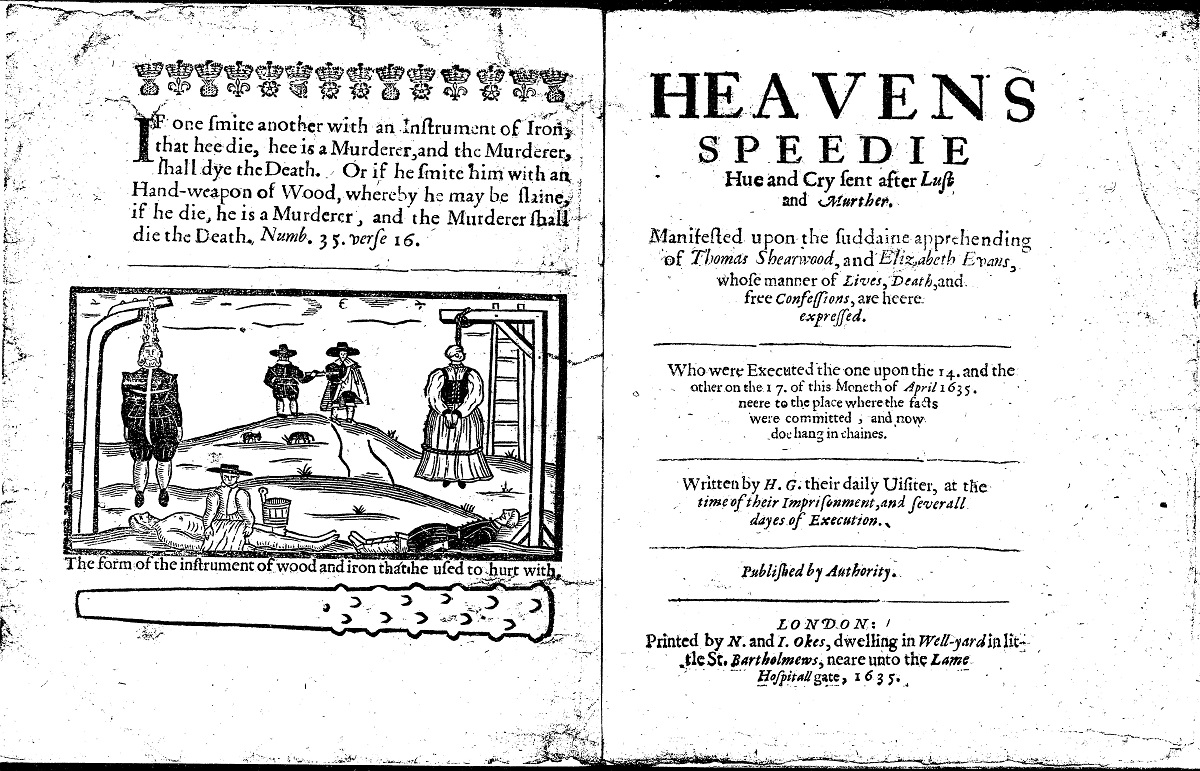
“Oh pity! Still running on to more mischief, having such a fearful spectacle before their eyes as Country Tom, which should rather have frightened and hindered them from doing this bold and insolent act,” laments Henry Goodcole in Heaven’s Speedie Hue and Cry, a narrative pamphlet trading on that same “fearful spectacle.”


Detail view (click for the full image) of Heaven’s Speedie Hue and Cry, a pamphlet narrating the crimes of Sherwood and Evans.

Canonbury Besse was bound over to the surgeons for anatomizing — well before this particular terror became a common extension of murder sentences. According to The Body Emblazoned: Dissection and the Human Body in Renaissance Culture, both Sherwood’s and Evans’s skeletons would ultimately became ornaments on permanent display at Inigo Jones‘s 1636 London anatomy theater,** and could be seen there as late as 1784.

* Consider, for instance, America’s Lonely Hearts Killers, Raymond Fernandez and Martha Beck — or Henri Landru, French predator of World War I widows.

** Diarist Samuel Pepys described a visit to this theater in 1663.

On this day..