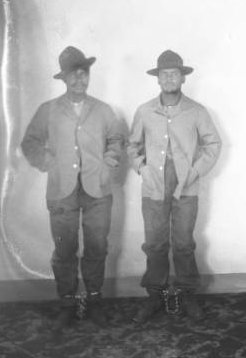
1903: Hilario Hidalgo and Francisco Renteria

Border-related violence and crime due to illegal immigration are critically important issues to the people of our state, to my Administration and to me, as your Governor and as a citizen.

–Statement (pdf) by Arizona Gov. Jan Brewer on signing the anti-immigration law, which went into effect July 29, 2010

Some stories are just plain classics.

In February 1903, two Mexicans shot up Goddard Station stagecoach stop, for motivations that were never plain. (There was no robbery, but it might have been revenge.)

The shooters got away, but law enforcement soon enough decided that a couple of railroad workers on the Mexican side of the border matched their description, and contrived to lure them into Arizona where they could be arrested.

Hilario Hidalgo and Francisco Renteria, were put on trial for their lives in Prescott, Ariz., in June 1903, where they were doomed to hang on the strength of eyewitness testimony and thirty minutes of the jurymen’s time. Appeals forbidden, the sentence was executed on this date — not six months after the crime.

With feelings of profound regret and sorrow, I hereby invite you to attend and witness the private and decent and humane execution of two human beings, namely: Richard Roe and John Doe. Crime — Murder.

Said men will be executed on July 31, 1903 at 12 noon. You are expected to deport yourself in a respectful manner and any flippant or unseemly language or conduct on your part will not be allowed. Conduct on anyone’s part bordering on ribaldry and tending to mar the solemnity of the occasion will not be tolerated.

-Sheriff’s invitation to the hanging, quoted in Frontier Justice in the Wild West: Bungled, Bizarre, and Fascinating Executions

The men cracked wise at the reading of their death warrant — “I have heard that repeated so often that if it was a song I would sing it to you,” reported the Los Angeles Times (Aug. 1, 1903) — and with “perfect nerve” checked out, calling only “Adios! Adios!” from the scaffold.

It was the last hanging in Prescott, Ariz.

On this day..

2009: Hiroshi Maeue, suicide website murderer

One year ago today, Japan hanged three men, among whom the most notorious was Internet suicide-club serial sex killer (you can see why he made the headlines) Hiroshi Maeue.

After a couple brushes with the law over asphyxiation-oriented assaults in the 1990s, Maeue found his medium in hypertext.

Trolling a Japanese “cyber-suicide” site — they’re notoriously popular in Japan — the late-30s Maeue lured two young women and a 14-year-old schoolgirl to separate meetings for the ostensible purpose of committing joint suicides.

M.O.: get the “partner”/victim into a car on the pretext of doing the carbon monoxide poisoning thing together, then tie her up and throttle her. Rape doesn’t seem to have been a part of it, but word was that Maeue “confessed to deriving sexual pleasure from seeing people suffocate.”

He got that treatment himself little more than two years after he was sentenced. Hanged along with Maeue in Osaka this date was Yukio Yamaji, who raped and murdered two sisters in 2005. On the same day in Tokyo, Chinese national Chen Detong got the rope for a 1999 triple homicide.

Perhaps not coincidentally, these high-profile executions occurred just weeks before national elections that were looking bad (and turned out worse) for the then-governing Liberal Democratic Party.

Update: Japan observed the one-year anniversary by hanging two more people this same date in 2010, executions personally witnessed by anti-death penalty Justice Minister.

“It made me again think deeply about the death penalty,” said Keiko Chiba. “and I once again strongly felt that there is a need for a fundamental discussion about the death penalty.”

They were the first executions under the Democratic Party government elected shortly after Maeue’s hanging.

On this day..

1892: Ruggles brothers lynched

On this date in 1892, highway robbers John and Charles Ruggles were shanghaied from a Redding, Calif. jail and lynched.


John and Charles Ruggles, lynched in Redding, Calif.

These two charmers knocked over the Redding & Weaverville stage on May 14, 1892, killing the coach’s guard when he fired back.

Charles Ruggles was wounded in the exchange and soon captured, but John Ruggles got away with the lockbox.

With a price on his head, John secreted the stolen loot somewhere and was not arrested until June 19.

Reunited in jail, the handsome outlaws were evidently a big hit with the ladies. As the Los Angeles Times reported on July 25, 1892,

The recent sentimental attitude of a number of women toward the prisoners as well as the line of defense adopted by their counsel, who has been evidently endeavoring to implicate Messenger [Amos “Buck”] Montgomery [the dead victim] as a party to the crime, had been denounced by a number of persons in the county and it is believed the lynching was due to those causes.

When the vigilantes came for him, John tried to buy the boys’ way out of trouble — or at least, buy Charley’s way out — by offering to reveal the location of his treasure.

The mob wasn’t interested, and the cache has never been found since. On the other hand …

The lynching of a brace of stage-robbers at Redding a few nights ago was not at all in accordance with law and order; but that it will have a discouraging effect on the “hold-up” industry, there is little question. It will be perfectly safe to indulge in stage rides in Shasta county, no doubt, for some time to come.

–Los Angeles Times, July 27, 1892

On this day..

1998: David Wilson

Just after dawn this date in 1998, David Wilson was hanged for murdering a security guard in St. Kitts and Nevis.

Wilson was only the second person executed by the tiny Caribbean nation since it achieved independence in 1983, and he would be the last hanged there until 2008.

The execution of this run-of-the-mill criminal attracted particular attention as a hempen protest against death penalty skeptics on the bench of the British Privy Council. Especially in the 1990s (and since) the exercise by this high court of the commonwealth of an excessively persnickety supervision of Caribbean death sentences attracted regional backlash against colonial meddling for hampering local response to violent crime. (See also the contemporaneous Trinidad and Tobago case of Dole Chadee.)

Wilson was controversially hanged before he submitted his appeal to the Privy Council.

In a bid to shore up national sovereignty, Caribbean countries were even then hammering out a Caribbean Court of Justice to replace these distant and unaccountable magistrates. However, official adoption of the CCJ has been halting.

On this day..

1676: Marie-Madeleine-Marguerite d’Aubray, Marquise de Brinvilliers

This date’s story is amply but succinctly conveyed by the public-domain entry in the 19th century tome Biography, or Third Division of the “English Encyclopedia”.

(Paragraph breaks have been added for readability.)


Brinvilliers, Marie Marguerite, Marquise de (English Wikipedia entry | French) who obtained infamy as a poisoner in the time of Louis XIV, was a daughter of the Dreux d’Aubrai, a lieutenant civil, or judge having a certain limited jurisdiction, at whose hands she received a careful education.

In 1651, whilst still very young, she became the wife of the Marquis de Brinvilliers, with whom she resided at her father’s house, in Paris. Her husband, who was the colonel of the Regiment de Normandie, entertained at his house a young officer of cavalry of the Regiment de Tracy, named Gaudin de Sainte-Croix, a native of Montauban, and the illegitimate member of an illustrious family. He was unprincipled enough to encourage the unlawful passion which the marchioness conceived for him; and her father, in consequence, procured in 1663 a lettre de cachet against Sainte-Croix, who underwent a year’s incarceration in the Bastille.

During his confinement he learned from a fellow-prisoner, an Italian named Exili, the art of preparing subtle poisons; a secret which, upon his enlargement, he communicated to his mistress, who determined to poison her father and the other members of her family. Having first wantonly essayed her art upon the patients of the Hotel-Dieu, she proceeded, with the aid of a servant named Jean Amelin, or La Chaussee, to take the lives of her father, her two brothers, and her sister.

This feat she accomplished gradually between the years 1666 and 1670. More than once she poisoned her husband; but Sainte-Croix, whose prudence shrank from the obligation of marrying the terrible widow, each time preserved the life of the Marquis by the administration of an antidote.

Sainte-Croix died suddenly in July, 1672, in the act, it is said, of compounding a subtle poison, against the effects of which he was left unprotected by the accidental fracture of a glass mask which he wore as a defence against the fumes of his deadly drugs.*

As no relative came forward to claim his property, it was taken possession of by the public authorities, who, instead of complying with the written instructions of Sainte-Croix,** dated May 25th, 1672, that a particular casket should be delivered to Madame de Brinvilliers, examined it, together with above thirty letters which he had received from her. There was also found a promise on her part to pay Sainte-Croix a sum of 30,000 libres, bearing the date of June 20th, 1670, eight days after the poisoning of the “lieutenant civil,” her father. The casket proved to be full of packets of various poisons, to each of which was affixed a label indicating the peculiar effects it was calculated to produce.

The Marchioness, fatally compromised by these and other circumstances, sought safety in flight, repairing first to England, then to Germany, and finally to Liege, where she was apprehended.

Being taken to Paris, she denied her guilt; but after her condemnation made a confession, in which, and in a kind of autobiography, she charged herself with more and greater horrors than had seemed possible to rumour or suspicion.


The Marquise de Brinvilliers, shortly before her execution, by Charles LeBrun

She was executed at seven o’clock on the evening of the 16th of July, 1676, being first beheaded and afterwards burnt. As her application and use of poison, which went by the name of poudre de succession, seemed to be growing prevalent, Louis XIV instituted a special court for the investigation and punishment of this species of crime.


This tale, uniting the attractions of bodice-ripper, true crime, and costume drama, has been adapted to stage and literature numerous times.

Alexandre Dumas pere, a true aficionado of historical crime and scandal, turned it into a much lengthier piece, from which we morbidly excerpt his description of the water torture the criminal endured prior to beheading — beginning with the sentence of the court.


“That by the finding of the court, d’Aubray de Brinvilliers is convicted of causing the death by poison of Maitre Dreux d’Aubray, her father, and of the two Maitres d’Aubray, her brothers, one a civil lieutenant, the other a councillor to the Parliament, also of attempting the life of Therese d’Aubray, her sister; in punishment whereof the court has condemned and does condemn the said d’Aubray de Brinvilliers to make the rightful atonement before the great gate of the church of Paris, whither she shall be conveyed in a tumbril, barefoot, a rope on her neck, holding in her hands a burning torch two pounds in weight; and there on her knees she shall say and declare that maliciously, with desire for revenge and seeking their goods, she did poison her father, cause to be poisoned her two brothers, and attempt the life of her sister, whereof she doth repent, asking pardon of God, of the king, and of the judges; and when this is done, she shall be conveyed and carried in the same tumbril to the Place de Greve of this town, there to have her head cut off on a scaffold to be set up for the purpose at that place; afterwards her body to be burnt and the ashes scattered; and first she is to be subjected to the question ordinary and extraordinary, that she may reveal the names of her accomplices. She is declared to be deprived of all successions from her said father, brothers, and sister, from the date of the several crimes; and all her goods are confiscated to the proper persons; and the sum of 4000 livres shall be paid out of her estate to the king, and 400 livres to the Church for prayers to be said on behalf of the poisoned persons; and all the costs shall be paid, including those of Amelin called Lachaussee. In Parliament, 16th July 1676.

The marquise heard her sentence without showing any sign of fear or weakness. When it was finished, she said to the registrar, “Will you, sir, be so kind as to read it again? I had not expected the tumbril, and I was so much struck by that that I lost the thread of what followed.”

The registrar read the sentence again. From that moment she was the property of the executioner, who approached her. She knew him by the cord he held in his hands, and extended her own, looking him over coolly from head to foot without a word. The judges then filed out, disclosing as they did so the various apparatus of the question. The marquise firmly gazed upon the racks and ghastly rings, on which so many had been stretched crying and screaming. She noticed the three buckets of water prepared for her, and turned to the registrar — for she would not address the executioner — saying, with a smile, “No doubt all this water is to drown me in? I hope you don’t suppose that a person of my size could swallow it all.” The executioner said not a word, but began taking off her cloak and all her other garments, until she was completely naked. He then led her up to the wall and made her sit on the rack of the ordinary question, two feet from the ground. There she was again asked to give the names of her accomplices, the composition of the poison and its antidote; but she made the same reply as to the doctor [namely, that she had no accomplices besides Sainte-Croix and did not know how to make the poison or its antidote], only adding, “If you do not believe me, you have my body in your hands, and you can torture me.”

The registrar signed to the executioner to do his duty. He first fastened the feet of the marquise to two rings close together fixed to a board; then making her lie down, he fastened her wrists to two other rings in the wall, distant about three feet from each other. The head was at the same height as the feet, and the body, held up on a trestle, described a half-curve, as though lying over a wheel. To increase the stretch of the limbs, the man gave two turns to a crank, which pushed the feet, at first about twelve inches from the rings, to a distance of six inches. And here we may leave our narrative to reproduce the official report.

“On the small trestle, while she was being stretched, she said several times, ‘My God! you are killing me! And I only spoke the truth.’

“The water was given: she turned and twisted, saying, ‘You are killing me!’


The torture of the Marquise de Brinvilliers. (Click for a larger image.)

“The water was again given.

“Admonished to name her accomplices, she said there was only one man, who had asked her for poison to get rid of his wife, but he was dead.

“The water was given; she moved a little, but would not say anything.

“Admonished to say why, if she had no accomplice, she had written from the Conciergerie to Penautier, begging him to do all he could for her, and to remember that his interests in this matter were the same as her own, she said that she never knew Penautier had had any understanding with Sainte-Croix about the poisons, and it would be a lie to say otherwise; but when a paper was found in Sainte-Croix’s box that concerned Penautier, she remembered how often she had seen him at the house, and thought it possible that the friendship might have included some business about the poisons; that, being in doubt on the point, she risked writing a letter as though she were sure, for by doing so she was not prejudicing her own case; for either Penautier was an accomplice of Sainte-Croix or he was not. If he was, he would suppose the marquise knew enough to accuse him, and would accordingly do his best to save her; if he was not, the letter was a letter wasted, and that was all.

“The water was again given; she turned and twisted much, but said that on this subject she had said all she possibly could; if she said anything else, it would be untrue.”

* According to Anne Somerset in The Affair of the Poisons: Murder, Infanticide, and Satanism at the Court of Louis XIV, this story of Sainte-Croix’s death by accidental exposure to his own toxins is “a myth” that developed in view of subsequent events.

“In fact,” writes Somerset, “his end was far more prosaic. He died after a long illness, having received the last rites and performed his final devotions with terrible piety.”

** Because Sainte-Croix died in debt, and his possessions were inventoried for his creditors.

On this day..

1953: John Christie, a little late in the day

On this date in 1953, English serial killer John Christie was hanged by Albert Pierrepoint for the murders of six women.

The sex-killer is most infamous, though, for a different death: that of Timothy Evans, a neighbor and fellow client of Pierrepoint whom Christie had stitched up three years before for strangling Evans’s wife and child.

Back then, the respectable Christie was the star witness against Evans. Evans tried in vain to blame Christie (“this perfectly innocent man,” Evans’s prosecutors scoffed) for the murders.

Nobody knew then that Christie had strangled an Austrian prostitute during sex back in 1943, nor that he had done a gassing-strangulation-rape job the following year.

Both their bodies were both buried in the garden at 10 Rillington Place: the first inhabitants of what would be the British Isles’ most notorious corpse hotel.

Strangulation sex killings would become the definitive Christie m.o. after Evans hanged. He got himself a no-fault divorce by throttling his wife in bed late in 1952, then raped and strangled at least three other women whom he had invited back to his pad. The remains of each were secreted in the apartment’s nooks and crannies.

This is Richard Attenborough as Christie doing his thing to Evans’s wife (he’d later confess to that crime) in the 1971 flick 10 Rillington Place.

Christie seemingly could’ve gotten away with it all, if it weren’t for his penny-wise and pound-foolish decision to move out of the charnel house early in 1953 and let someone else stumble upon the remains. (Christie had quit his job the previous December, and hocked his strangled wife’s stuff to make ends meet for a while. He was homeless when the subsequent manhunt tracked him down.) There was even a human femur being used to prop a fence.

Having quite a lot of damning evidence, and Christie’s confession besides, his lawyer went for a hail-Mary insanity defense, but Christie didn’t even bother with an appeal when that didn’t take.

But there was the small matter of that other gentleman hanged back in the day for a strangulation murder, all the while unsuccessfully accusing his then-respectable neighbor Christie.

An inquiry launched by the government very conveniently concluded that (Christie’s confession notwithstanding) Evans was indeed guilty of killing his wife. Two stranglers in the same place at the same time, and the one had just happened to try to blame the other one when he was accused.

For obvious reasons, this whitewash was greeted skeptically and — though the two-killers theory does still have its defenders — officially reversed when Evans was posthumously exonerated in 1966.

On this day..

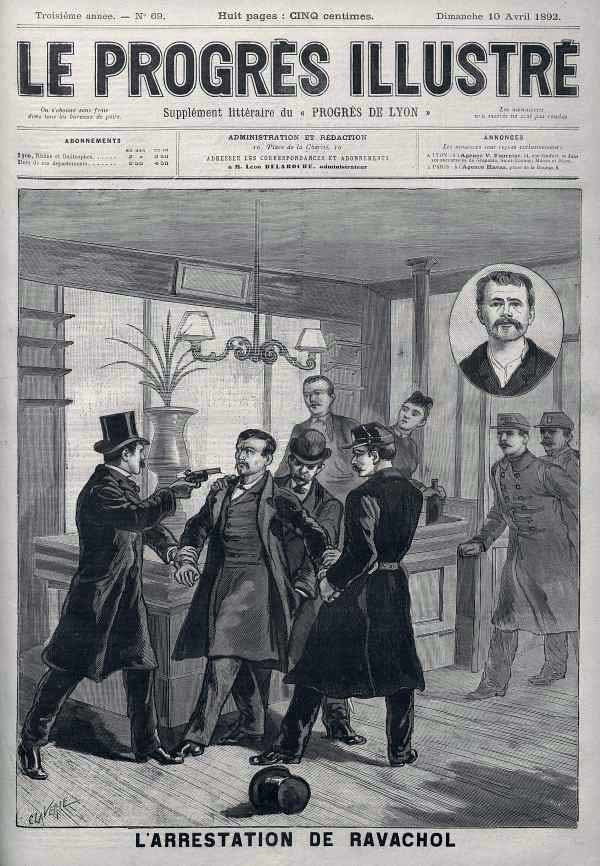
1892: Ravachol, anarchist terrorist

On this date in 1892, French anarchist François Claudius Koenigstein — better known as Ravachol — was guillotined at Montbrison for a series of bomb attacks on right-wing judges.

He took the name “Ravachol”, his mother’s, after his Dutch father ditched his mom, leaving the family in poverty.

Young Ravachol supported himself as best he could in proletarian labor and crime, as he attempted to observe* at his trial.

Ravachol, as painted by Charles Maurin.

There are many people who will feel sorry for the victims, but who’ll tell you they can’t do anything about it. Let everyone scrape by as he can! What can he who lacks the necessities when he’s working do when he loses his job? He has only to let himself die of hunger. Then they’ll throw a few pious words on his corpse. This is what I wanted to leave to others. I preferred to make of myself a trafficker in contraband, a counterfeiter, a murderer and assassin. I could have begged, but it’s degrading and cowardly and even punished by your laws, which make poverty a crime. If all those in need, instead of waiting took, wherever and by whatever means, the self-satisfied would understand perhaps a bit more quickly that it’s dangerous to want to consecrate the existing social state, where worry is permanent and life threatened at every moment.

Personal want segued into political conviction for Ravachol, whose crimes were justified by the principle of reprise individuelle.

And the political led him to reprisals of a less individual nature, when French state violence against radicals caused him to dynamite several magistrates’ homes.

He was caught in a restaurant,** brought to trial, and let off with penal servitude for life. Then another jury, intimidated by public outcry, reversed the decision and sent him to the guillotine.

–The Banquet Years: The Origins of the Avant-Garde in France 1885 to World War I, which argues that anarchists “unsettle[d] the political smugness of the Third Republic … [and] challenge[d] any formulated aesthetic. The dynamism of prewar artistic activity ran a close parallel to anarchism; postwar Dada and surrealism look like its artistic parodies†.”

Anarchism, that revolutionary specter stalking fin-de-siecle Europe, burnt its fuse at both ends, but Ravachol’s falling head‡ left a legacy for his fellow-travelers. The next year, Auguste Vaillant tossed a bomb into the French Chamber of Deputies to avenge Ravachol. (Vaillant was himself guillotined, and himself avenged by Emile Henry and Sante Geronimo Caserio.)

Ravachol was also honored in a song, La Ravachole — set to the jauntily menacing tune of La Carmagnole, it cheers, “Long live the sound of the explosion!”

* This incendiary speech was cut off by the court.

** The table where the terrorist was nabbed got its own inscription: “Here ate Ravachol the day of his arrest.”

† e.g., Dadaist Marcel Janco‘s recollection:

We had lost confidence in our culture. Everything had to be demolished. We would begin again after the ‘tabula rasa’. At the Cabaret Voltaire we began by shocking common sense, public opinion, education, institutions, museums, good taste, in short, the whole prevailing order.

‡ Ravachol was guillotined midway through a parting exclamation, “Vive la Re-“. Initial newspaper reports implausibly rendered this as the patriotic classic “Vive la Republique!” rather than a much more in-character word like, oh, “Revolution”.

Weeks of controversy ensued over some witnesses’ claims that the head post-severing had actually completed the word “-publique”, a notion of a piece with the idea that the severed head survives decapitation by a few seconds. Scienticians countered that obviously excited witnesses were maybe hearing air escaping from the headless trunk and filling in the rest of the scene in their heads.

On this day..

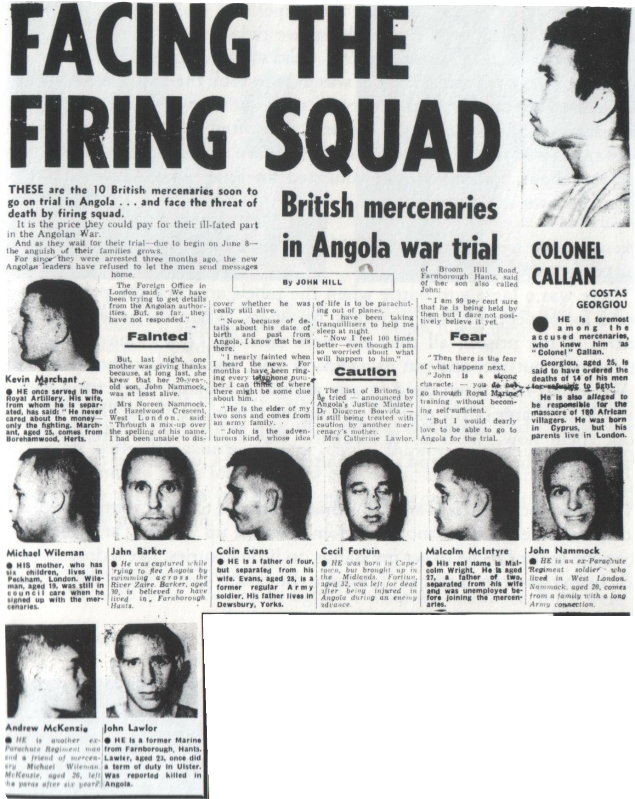
1976: Costas Georgiou and three other mercenaries in Angola

On this date in 1976, three Britons and one American were shot in Angola by a military police squad for murders committed as mercenaries earlier during the year.

Costas Georgiou.

They were among 13 foreigners sentenced at the Luanda Trial, which occurred on the pivot of Angola’s transition from generation-long anti-colonial insurrection on towards generation(s)-long civil war. Between them, more than half a million Angolans died, but this date belonged to a couple of unrepresentative Anglos.

Long story short, the immediate aftermath of Angolan independence in late 1975 was a scramble for control among the several factions who had been fighting the Portuguese … along with a scramble among interested outside states to line up their allies in this resource-rich Cold War prize.

Small wonder that foreign soldiers of fortune soon found their way into the chaotic scene.

Over the course of the first few months of independence, the Popular Movement for the Liberation of Angola (MPLA) more or less consolidated state power, and it proceeded to prosecute supporters of a rival guerrilla movement for their part in the conflict immediately after independence.

Thirteen foreign mercenaries who were captured by MPLA-supporting Cuban troops — the other nine drew long prison sentences — were charged in a show trial with war crimes for their conduct in the field in a case that made the western gun-for-hire an emblem of colonial depravity.

The most notorious of the bunch was Costas Georgiou. A Greek Cypriot emigre to Britain, he had gone to Angola as “Colonel Callan” and was wanted by Scotland Yard for there ordering a mass execution of other British mercenaries — an act he admitted at trial. Even the inevitable London Times editorial against the trial (June 29, 1976) agreed “the proceedings against Callan, if not the rigours of the sentence may be conceded.”

The others looked much less culpable, almost arbitrarily selected for death from among the ranks of unprepossessing, sometimes barely-there mercs. American Daniel Gearhart, a Vietnam veteran drowning in debt, had apparently been in the field for a mere three days and never so much as fired a shot; that he had advertised in Soldier of Fortune magazine was held to aggravate the charges against him, and in vain did the father of four insist that being tried for his life was enough to scare him straight out of the business.

Angolan defense attorneys, while also appealing against the legality of the trial on grounds of both international and domestic law, spoke that revolutionary language of decolonization in defending their charges. Georgiou, according to Maria Teresinha Lopes, was

“a colonized man … [treated in England as] a sub-human, just a Greek, just a ‘boy’.”

Another Angolan defense attorney argued against the death penalty because

“To condemn them to death while ignoring their social origin in terms of revolutionary justice would deny the theory which guided our revolution. My clients are an integral part of the exploited class.” (Both comments from London Times, June 19, 1976)

The era of decolonization was a time for idealism, but not the sort that would shrink from bloodshed.

In denying the doomed men clemency, Angola’s first independent president Agostinho Neto denounced

Mercenarism, instrument of the aggressive designs of imperialism … a scourge of the African continent and a grave threat to the peace, freedom and independence of the peoples …

It is imperative that the practice of mercenarism be banished once and for all from our planet. It is urgent that all states and peace-loving forces fight it most energetically.

We are applying justice in Angola not only in the name of our martyred people but also for the good of the brother peoples of Namibia, Zimbabwe and all the peoples of the world against whom imperialism is already getting ready to prepare new mercenary aggressions.

(Text dated July 9, and reprinted in the July 10 London Times)

You could just about substitute the word “terrorism” for “mercenarism” and read it on today’s campaign trail.

Juridically, Angola pursued these warriors as peoples who had fought unlawfully and could therefore be placed outside the protections conferred on soldiers by the Geneva Conventions — and subjected to the liberating power of revolutionary violence.

That this ad hoc concept of “mercenarism” could be exploited to license an outrage upon humanity was a notion relentlessly denounced by British and American officials,* who had not yet fully explored the utility of the “unlawful combatant” construct in extending the reach of their own security states.

As for all that peace-loving, brother-peoples stuff in the execution order?

What actually happened after the mercenaries were shot was that the two biggest former anti-colonial guerrilla movements in Angola morphed into Cold War proxies — the MPLA of the Warsaw Pact, supported by its control of the country’s oil; UNITA of NATO, supported by its control of the country’s diamonds — and bled the country dry in a horrific civil war.

* Henry Kissinger, then President Gerald Ford’s Secretary of State, complained that Angola’s decision

to ignore both the law and the facts … cannot help but affect adversely the development of relations between the United States and Angola.

On this day..

1917: Gasim, by Lawrence of Arabia

“With Major Lawrence, mercy is a passion. With me, it is merely good manners. You may judge which motive is the more reliable.”

-Alec Guinness as Prince Faisal in Lawrence of Arabia

This date in 1917 was the eve of the Battle of Aqaba, wherein a force of Arabs with famous British officer T.E. Lawrence emerged from the desert to surprise and capture the Ottoman Red Sea port today located in Jordan.*

And that makes this, in the cinematic masterpiece Lawrence of Arabia, the date on which the titular character kept the peace within his fragile coalition by personally executing a malefactor to prevent a tribal blood feud.

The victim, Gasim, is a real figure described in the real T.E. Lawrence’s memoirs —

a gap-toothed, grumbling fellow, skrimshank in all our marches, bad-tempered, suspicious, brutal, a man whose engagement I regretted, and of whom I had promised to rid myself as soon as we reached a discharging-place.

Gasim is most famous as the beneficiary of the movie scene in which Lawrence boldly turns back into the desert to rescue this worthless retainer when Gasim’s camel is found riderless in the caravan. This, too, is based on an actual incident in Lawrence’s memoir, albeit heavily dramatized on celluloid.

In the film, Lawrence’s godlike power to give Gasim life is soon mirrored by the godlike power to deprive it.

Effectively exploiting dramatic license, Lawrence of Arabia portrays the Englishman surveying the scene of the coming triumph when a disturbance breaks out in his camp. Hastening thither, he discovers clan lining up against clan over the destructive right of blood vengeance because of a murder in the camp — a murder committed by the man he has saved.

To forestall a “tribal bloodbath” on the very eve of victory, Lawrence himself volunteers to execute the culprit. Having once risked everything to save Gasim, Lawrence sacrifices him ruthlessly when the occasion demands.** This act underscores the chameleon-like other-ness of the character, one of the film’s principal leitmotifs: “I have no tribe, and no one is offended!”

Though the real Lawrence did no such thing to the real Gasim, this astonishing scene is also related in the memoirs — just at an earlier point, and with a different, less dramatically integral character.

My followers had been quarrelling all day; and while I was lying near the rocks a shot was fired. I paid no attention; for there were hares and birds in the valley; but a little later Suleiman roused me and made me follow him across the valley to an opposite bay in the rocks, where one of the Ageyl, a Boreida man, was lying stone dead with a bullet through his temples. The shot must have been fired from close by; because the skin was burnt about one wound. The remaining Ageyl were running frantically about; and when I asked what it was Ali, their head man, said that Hamed the Moor had done the murder. I suspected Suleiman, because of the feud between the Atban and Ageyl which had burned up in Yenbo and Wejh; but Ali assured me that Suleiman had been with him three hundred yards further up the valley gathering sticks when the shot was fired. I sent all out to search for Hamed, and crawled back to the baggage, feeling that it need not have happened this day of all days when I was in pain.

As I lay there I heard a rustle, and opened my eyes slowly upon Hamed’s back as he stooped over his saddle-bags, which lay just beyond my rock. I covered him with a pistol and then spoke. He had put down his rifle to lift the gear; and was at my mercy till the others came. We held a court at once; and after a while Hamed confessed that, he and Salem having had words, he had seen red and shot him suddenly. Our inquiry ended. The Ageyl, as relatives of the dead man, demanded blood for blood. The others supported them; and I tried vainly to talk the gentle Ali round. My head was aching with fever and I could not think; but hardly even in health, with all eloquence, could I have begged Hamed off; for Salem had been a friendly fellow and his sudden murder a wanton crime.

Then rose up the horror which would make civilized man shun justice like a plague if he had not the needy to serve him as hangmen for wages. There were other Moroccans in our army; and to let the Ageyl kill one in feud meant reprisals by which our unity would have been endangered. It must be a formal execution, and at last, desperately, I told Hamed that he must die for punishment, and laid the burden of his killing on myself. Perhaps they would count me not qualified for feud. At least no revenge could lie against my followers; for I was a stranger and kinless.

I made him enter a narrow gully of the spur, a dank twilight place overgrown with weeds. Its sandy bed had been pitted by trickles of water down the cliffs in the late rain. At the end it shrank to a crack a few inches wide. The walls were vertical. I stood in the entrance and gave him a few moments’ delay which he spent crying on the ground. Then I made him rise and shot him through the chest. He fell down on the weeds shrieking, with the blood coming out in spurts over his clothes, and jerked about till he rolled nearly to where I was. I fired again, but was shaking so that I only broke his wrist. He went on calling out, less loudly, now lying on his back with his feet towards me, and I leant forward and shot him for the last time in the thick of his neck under the jaw. His body shivered a little, and I called the Ageyl, who buried him in the gully where he was. Afterwards the wakeful night dragged over me, till, hours before dawn, I had the men up and made them load, in my longing to be set free of Wadi Kitan. They had to lift me into the saddle.

Peter O’Toole’s Lawrence almost palpably manifests the conflicting aspects of his character as he shoots Gasim to death — and he confirms the transformative effect of his first homicide in subsequent dialogue with Gen. Edmund Allenby.

Lawrence: I killed two people. One was … yesterday? He was just a boy and I led him into quicksand. The other was … well, before Aqaba. I had to execute him with my pistol, and there was something about it that I didn’t like.
Allenby: That’s to be expected.
Lawrence: No, something else.
Allenby: Well, then let it be a lesson.
Lawrence: No … something else.
Allenby: What then?
Lawrence: I enjoyed it.

* Actually, Aqaba is Jordan’s only port. This battle was not so epic as the film depicts.

** In a bit of complex foreshadowing, the cinematic Gasim has told Lawrence at the outset of the expedition that “Allah favors the compassionate.”

On this day..

1983: Phillipa Mdluli, enterprising businesswoman

It was this date in 1983 that the last hanging (so far) in Swaziland took place — that of 48-year-old Phillipa Mdluli, for ritually killing the daughter of one of her restaurant’s employees.

The True Crime Library’s archive of worldwide hangings reports that

after the girl, Thuli Mabaso, was slaughtered, her body parts were removed and served up in Mdluli’s restaurant, where the bodies of small girls were considered by the customers to be a great delicacy.

It may be no coincidence that this last hanging occurred during the run-up to parliamentary elections later that year, and while executive power in this absolute monarchy had devolved to a fractious regency following the death of the previous king.

When the heir to Swazi throne came of age as Mswati III in 1986, he became known both for clemency and for centralizing power in his own person. Between those two phenomena, there’s not much room for politicians to productively demagogue the issue. And with a population barely north of one million, there are only so many cannibal restauranteurs.

Despite the death penalty’s long abeyance in the small kingdom, Swaziland has been obstinate about not repealing the statute; in 2008, it voted against a UN death penalty moratorium resolution despite the fact that it functionally had a quarter-century moratorium of its own at that point.

But Swaziland does still have prisoners on death row. In an apparent show of empty juridical saber-rattling, Swaziland made a very public international search in the late 1990s for a new “hangperson” (“Women are welcome … I therefore advise them to try their luck”).

On this day..