1803: George Foster, and thence to the reanimator

It’s not too often that a typical convicted murderer becomes a source for not just law, but also literature and science. George Foster (sometimes spelled George Forster despite few, if any, contemporaneous spellings as such) managed just that on this date in 1803, and his legacy lives on to this day.

Foster’s case was, in the annals of capital punishment, unremarkable.

He was accused in the drowning of his wife and youngest child in the Paddington Canal, one of the many canals being improved at the time to connect various parts of England by water. Foster was found guilty based on circumstantial evidence and sentenced to hang at Newgate Prison on 18 Jan 1803.

Shortly after 8 a.m., Foster was executed; minutes later, he was a science experiment.

Professor Giovanni Aldini was the nephew of biological electricity guru Luigi Galvani, and he wanted to electrify a body. Galvani had shown that frog legs responded to electricity, twitching when current was passed through the muscle, and he was in academic competition with his associate and sometime dissident Alessandro Volta over why this occurred. Galvani claimed that an electrical fluid flowed through the corpse, activating the muscles; Volta said that the cells passed electrical signals between one another. It was this latter assertion that led to the development of Volt’s first battery, a voltaic pile.* Aldini was convinced that his uncle was right about electrical fluid, but he was keen on Volta’s ideas for creating portable electricity.

His stated reason for delving into what was known as galvanic reanimation was to aid the recently drowned, who, he said, might be resuscitated. Galvani leaned on some earlier experience with beheaded victims in Bologna, as well as animal experiments, to convince British government agents of the viability of the plan. As one witness to those events stated:

A very ample series of experiments were made by Professor Aldini which show the eminent and superior power of galvanism beyond any other stimulant in nature. In the months of January and February last, he had the courage to apply it at Bologna to the bodies of various criminals who had suffered death at that place, and by means of the pile he excited the remaining vital forces in a most astonishing manner. This stimulus produced the most horrible contortions and grimaces by the motions of the muscles of the head and face; and an hour and a quarter after death, the arm of one of the bodies was elevated eight inches from the table on which it was supported, and this even when a considerable weight was placed in the hand.

Which is not to say it was really difficult to get permission.

Aldini’s experiments were a very public roadshow demonstration of Galvani’s ideas. London’s Royal College of Surgeons was, at that time, fascinated with the boundaries of life and death, and Aldini was more than happy to offer his services. As well, the 1751 (or 1752) Murder Act would not allow hanged criminals to be buried, and their corpses were often used for scientific discovery. Foster’s body, which had hung for an hour in slightly sub-zero temperatures, was the first complete corpse Aldini acted upon, but he wasn’t the first to get a chance.**

The Newgate Calendar summarizes the events:

On the first application of the process to the face, the jaws of the deceased criminal began to quiver, and the adjoining muscles were horribly contorted, and one eye was actually opened. In the subsequent part of the process the right hand was raised and clenched, and the legs and thighs were set in motion. Mr Pass, the beadle of the Surgeons’ Company, who was officially present during this experiment, was so alarmed that he died of fright soon after his return home.


An illustration of Aldini’s experiments with executed corpses. His notes of George Foster record that “the jaw began to quiver, the adjoining muscles were horribly contorted, and the left eye actually opened … The action even of those muscles furthest distant from the points of contact with the arc was so much increased as almost to give an appearance of re-animation … vitality might, perhaps, have been restored, if many circumstances had not rendered it impossible.” (cited in Mary Shelley: Her Life, Her Fiction, Her Monsters)

Aldini’s act was yet another public showcase of strange new technologies, this time sparking the imaginations of the Brits. Within a generation, Scottish experimenters were performing similar feats, and the College of Surgeons had, after further attempts similar to Aldini’s, revived the heart of another convicted murderer, John Bellingham. It was the first recorded heart shock revival in modern medical history.† (Even today’s scientists turn to electricity to instantiate life’s precursors in trying to solve the riddle of abiogenesis.)

But even more than that was the effect these results had on popular culture, where Mary Shelley, well aware of Aldini’s work (as well as that of Erasmus Darwin, a proponent of evolution well before the concept of “natural selection” was framed by his more famous grandson), used the idea of reanimation — such as was attempted on her husband’s first wife after she drowned — to inspire her signature characters, Victor Frankenstein and his “monster.”

As a cultural icon, Frankenstein did exceedingly well. Considered a true Gothic novel, the story was remade for stage as early as 1887, turned into a variety of films which were subsequently parodied (c.f. The Rocky Horror Picture Show, “Treehouse of Horror II”, The Re-Animator, etc.), retold on radio, brought up in song, and re-written in novels.

Galvanization was never mentioned directly in that book, but the studies at the College of Surgeons were clearly an inspiration. And galvanization transcended that book, striking a chord in the public imagination. It continued to pop up in publication for decades after the Aldini/Foster event, for instance in the 1836 illustration “A Galvanized Corpse”, in which the editor of the Washington Globe, Francis Preston Blair, is shown being “galvanized” by two demons, who represent the interests of Andrew Jackson.

* The Voltaic pile was originally used to disprove Galvani’s fluids theory. However, the two were largely non-adversarial, so Volta actively advanced Galvani’s name through the word “galvanism” and, by the time of Foster’s death, “galvanize.” The term “galvanized” metal refers to a conductive element coated with something non-conductive and dates from the late 1830s. Volta, of course, is the recognizable source of the the electrical potential unit of the “Volt.”

** Indeed, the College of Surgeons was receiving all hanging victims from London since 1752, and most were put through rigorous postmortems. Such scientific experimentation is also often blamed for the revival of Patrick Redmond in 1767, who received a windpipe incision following his hanging in Cork, Ireland; Redmond, however, was documented as hanging for just nine minutes, only slightly longer than the average person takes to die if deprived of oxygen.

† Those interested in the history of cardiology in general should take a look at Louis J. Acierno’s The History of Cardiology; those interested in the use of human remains in medical science should seek out Human Remains: Dissection and Its Histories by Helen MacDonald.

On this day..

1895: Charles Stokes, in the heart of darkness

On January 15, 1895, a Belgian colonial official in the Congo Free State hanged Charles Stokes for trading illicitly.

A British subject who’d abandoned his humdrum Liverpool desk job to become an missionary in Africa, Stokes eventually became a merchant in the mysterious continent noted for his favorable relationships with the locals. (He had two African wives.)

In 1895, operating out of German East Africa,* his caravan was detained trading into the Congo Free State — King Leopold’s hellish personal reserve — with “Arab” slavers who colonial authorities considered rebels. That “rebel Arab slavers” bit formed the charge against him, but trading outside the royal monopoly was probably at least as egregious in Belgian eyes.

An 1895 Review of Public Events at Home and Abroad sums up the scenario.

It was alleged that [Stokes] had large quantities of arms, ammunition, and ivory, and that he had bought the ivory at a low price from Kibonge, the assassin of Emin Pasha. Captain Lothaire, an official, an official of the Congo State, with a strong force, was then advancing from Stanley Falls to attack this Arab chief Kibonge, in revolt against the Congo State.** On Lothaire’s arrival at Kilunga, Kibonge was already a prisoner in the hands of his own native subordinates, who refused to join him in fighting the State. Stokes applied to Lothaire for protection of his ivory and goods, which he desired to carry towards the East Coast. Lothaire claimed that letters were found among Kibonge’s effects which went to prove that Stokes had sold large quantities of arms and ammunition to this chief, to be used in war against the Congo State. Mr. Stokes was arrested by Captain Lothaire’s orders, brought before a court-martial composed of two non-commissioned officers and Lothaire, and sentenced to be hanged. The execution took place the following morning.

Though not surprising that the summary hanging of a European would provoke an international incident, one would hardly call it equitable given the unnumbered, unmourned multitudes of Africans whose lives were wrung dry and discarded for Belgium’s treasury. Still, the “Stokes Affair” made the headlines in both England and Germany, and for activist types struggling to gain any kind of traction for their tales of colonial horrors, it was something to work with.

Leopold paid off both countries. The trial of Lohaire for naughtily conducting the execution ended in an acquittal. Belgium set up a blue-ribbon commission of missionaries solemnly vowing to investigate abuses, which was never heard from again.

(Look for Charles Stokes’ appearance in this tale of the Belgian Congo’s woe, beginning at about 1:01:25.)

If the Stokes incident didn’t catch fire itself, it became a stick in the accumulating dry tinder that Sir Roger Casement set a spark to in the early 20th century.

And maybe a bit more than that, too.

The horror! The horror!

Stokes’s singular story is often thought to inform (pdf) Joseph Conrad’s great literary critique of colonialism, Heart of Darkness.

The Stokes hanging would be only one data point among many for those who had ears to listen to the horrors emerging from the Congo, to be sure. Still, Molly Mahood and Ian Watt have included Stokes — the gone-native ivory trader — as one of several possible inspirations for the novel and especially the Kurtz character. Lothaire himself probably offered fodder for the petty, tyrannous impunity of colonial officers who the narrator encounters on his way to meet Kurtz.

I gathered in snatches that this was some man supposed to be in Kurtz’s district, and of whom the manager did not approve. ‘We will not be free from unfair competition till one of these fellows is hanged for an example,’ he said. ‘Certainly,’ grunted the other; ‘get him hanged! Why not? Anything — anything can be done in this country.’

* Present-day Rwanda, Burundi and Tanzania.

** Lothaire had spent the early part of the decade wresting Belgian commercial dominance in the eastern Congo from the incumbent Arabo-Swahili elites. (The link is French.) “Arabs” in the context of the Belgian Free State meant these Moslem bantus, not (by and large) ethnic Arabs as we would think of them today.

Neither were “Arab slavers” a distinct enemy class for the Free State; those prepared to play ball with white authorities raided native settlements to obtain slaves for rubber plantations and other Belgian-authorized ventures.

On this day..

1879: James McDonnell and Charles Sharpe

On this date in 1879, two Molly Maguires hanged in Mauch Chunk, Pa., while their reprieve waited for them just outside the door.

John Kehoe may have been the symbolic last chapter in the Mollies‘ suppression, but Pennsylvania didn’t intend to forego its mopping-up operation.

James McDonnell and Charles Sharpe (or Charles Sharp) had been convicted of murdering George Smith in 1863; like other Molly Maguire crimes, this one either (take your pick) languished for 13 years until the criminal enterprise that authored it was toppled, or was plucked from obscurity as a pretext on which to condemn the men on rather doubtful evidence.

It was on the strength of “snitch” testimony from admitted murderers that McDonnell and Sharpe were sentenced to die — McDonnell, a hirsute Irishman straight from barbarian central casting, even tried turning informer himself to save his own life, just as his accusers had done. (He continued to deny responsibility for the Smith murder, including on the gallows in his last statement.)

But as Maguire cases go, these were small fry … and it’s the sad circumstances of their end and the evocative description of the scene under the gallows that attracts our attention today.

An execution which it was thought would be one of the quietest hangings that ever took place in Mauch Chunk has proved the most exciting. A reprieve from Gov. Hartranft arrived here one-half minute after the drop fell — just 30 seconds too late to save the lives of the condemned men.

…

A scene of great excitement took place in the jail; but, although the condemned men had been hanging only a few minutes, there was no movement made toward cutting them down. The telegraph messenger reached the jail door before the drop fell; but no attention was paid to his knocking and ringing, the wife of one of the men having previously been extremely violent outside. When the drop fell the knocking and ringing continued, and the Sheriff sent out a man to arrest the persons whom he imagined to be creating a disturbance. It was then found to be the telegraph messenger with a reprieve. A brother of McDonnell, who had been kneeling by the scaffold, arose and excitedly charged the Sheriff and the bystanders with the murder of his brother. The excitement spread, and the Sheriff appealed to one of the priests, who exonerated him from blame. Amid this excitement and the reproaches of the maddened brother of McDonnell and the wailings of the bereaved families outside, the hanged men were forgotten, and their bodies remained suspended for 30 minutes after the drop fell. There is no reasonable doubt, however, that both were dead when the reprieve came.

It should be noted that the reprieve was not an outright commutation, only a stay of the sentence for a few more days. Nevertheless, the melodramatic affair led the Times to wax lyrical.

“The evil of this whole case,” it began, clearly not speaking from the point of view of McDonnell and Sharpe, “is that the gallows in Pennsylvania is invested with great uncertainty.”

[F]rom this time out the condemned man at the foot of the gallows may not only hope that a reprieve may arrive for him at any moment, but he may take off his thoughts from the certain doom before him and be agonized with the reflection that the boon which he waits for may come when his life has gone past recall. If a stay of proceedings is to be granted at all, it should be granted while the condemned man’s life may be said to keep the case open. It is a refinement of cruelty to keep hope alive and quivering at the foot of the gallows.

On this day..

1928: Ruth Snyder and Judd Gray

On this date in 1928, a suburban femme fatale and the corset salesman who had murdered her husband were electrocuted at Sing Sing prison.

“A cheap crime involving cheap people,” one writer called it.

“Ruthless Ruth,” as the press inevitably called her, was on the wrong side of 30 and married to a wet blanket on the wrong side of 40 from whom she couldn’t even get away during the day because they worked for the same boating magazine.

The banal hell of the bourgeoisie.

Ruth had a banal solution: commence affair with handsome, limp-willed corset salesman (also married) from New Jersey.

Given a large enough metropolis with a large enough pool of adulterous data points, it must be statistically inexorable that a certain proportion will resolve the love triangle by throttling the cuckold with a wire.

But only that remorseless calculator in the sky can compute why these two, of all those thousands, were the ones not to run off together, or let the affair fizzle, or just continue to rendezvous indefinitely into the future. They certainly weren’t constitutionally cut out for crime; they set up the room in a poor simulacrum of a robbery, and told of a couple of unknown Italians* who’d broke in and done poor Albert Snyder to death.

For their poor judgment and for the speedy collapse of their crummy alibi, journalism owes them a debt of gratitude.

The execution of a woman was quite sensational; Ruth Snyder was to be the first electrocuted since 1899.

For the occasion, The New York Daily News hired a Chicago Tribune journalist to witness the execution … and at the moment the current struck, Tom Howard hoisted his pant leg and secretly snapped with a one-use camera one of the most indelible images the death chamber offered the 20th century, to be splashed in a few hours’ time on the Daily News‘ cover under the headline

DEAD!

The Snyder-Gray adulterous melodrama and its violent conclusion inspired novelist James Cain‘s Double Indemnity, and the noir film of the same title with Barbara Stanwyck as the black widow at the center of the web.

It also inspired the state of New York to begin searching official witnesses to its electrocutions.

* Blame-the-Italians here is a Roaring Twenties Queens version of fingering the black man. The murder was committed in May 1927, just as the Sacco and Vanzetti case was approaching its climax.

On this day..

1898: Theodore Durrant, the Demon of the Belfry

The annals of crime will attest that malefaction, like any other history, repeats itself — as tragedy and then as farce and then simply with numbingly grisly monotony.

Which brings us to San Francisco, for another forgotten crime of the century — a theater of the time actually produced a play called Criminal of the Century — that sent the Nancy Graces of the Gilded Age aswoon.

Theodore Durrant‘s basic profile — normal-seeming medical student and Sunday school superintendent with a secret pervy side — might not seem so remarkable with a century’s worth of serial killer profiles in the books, but ponder what programming hours Court TV would fill with mutilated, violated female parishioners found stuffed in the cupboard and belfry at any of the nation’s Emanuel Baptist Churches.

That Durrant was the last person seen with either of them anchored what the Associated Press would call (only a week after the bodies were discovered) a “chain of circumstantial evidence that has been welded link by link … so strong that it seems hardly possible that it can be rent asunder.”

Why,

information poured in … proving that the prisoner was a degenerate of the most depraved class. For obvious reasons, names cannot be given of young ladies to whom he made the most disgusting propositions, and the wonder of it is that he was not killed, or at least exposed before. But in most instances the nature of his insults were such that the young ladies offended feared to inform their relatives, lest they would take the law in their own hands. One young lady told her mother that some time previous to these murders, Durrant had inveigled her into this same library and excusing himself for a moment, returned stark naked and she ran screaming from the church.

The particulars were nationwide news copy from the outset in 1895 to hanging in 1898, and the city had a difficulty scraping together a jury qualified to give the man a fair trial (deliberation time: five minutes).

Durrant, for his part, protested his innocence to the gallows. Few believed him, but he did pick up a married groupie the press nicknamed “Sweet Pea Girl” for the flowers she kept bringing him.*

The more things change …

Even the legal route to hanging was (by 19th century standards) characteristically-for-California tortuous. The “fight for delay,” reported the Los Angeles Times (Jan. 8, 1898), was “vigorously maintained for almost twenty months, not even ceasing with the execution of the death sentence.”

Durrant came within two days of execution twice in 1897; the full narrative of legal maneuvers will be amply suggested by the Times‘ account of those made in the last week alone.

On December 31, an appeal for a writ of supersedeas was made to the State Supreme Court, but was refused. The Federal courts were then vainly appealed to for a writ of habeas corpus. On January 3 a petition was presented to Gov. Budd, praying for executive interference in the case. The petition stated that Durrant was a vital witness in the slander suit brought by his mother against [trial juror Horace] Smyth.**

On January 5 Durrant’s attorneys made another application to the United States court for a writ of habeas corpus. This was denied; also permission to appeal to the United States Supreme Court. On January 6, Attorney Boardman arrived in Washington, and endeavored to persuade Justice Brewer of the Supreme Court to grant permission to an appeal. Justice Brewer declined, and Boardman announced that he would appear before the entire court on Friday and demand to be heard.

In San Francisco on January 6, Attorneys Dickinson and Deuprey asked the United States Circuit Court for leave to file a bill of exceptions. … On the same afternoon, Gov. Budd formally announced that he would not interfere.

Durrant’s beloved sister would change her name to Maud Allan and emerge as a popular dancer in Europe in the early years of the 20th century. Renowned for her sensual portrayal of Salome, Maud strikes an immediate reminder of another character from these grim pages … and like Mata Hari, Durrant’s sister was accused (non-fatally, in Maud’s case) of consorting with German operatives during World War I.

* A paroled murderess also had Durrant’s back.

** According to the story, Smyth publicly called Durrant a “moral monster” and suggested that the condemned had had relations with his mother and sister.

On this day..

1892: Sylvester Henry Bell

The state of Vermont has long since dispensed with the death penalty; it hasn’t had a death penalty law on the books since 1964, and its last execution was a decade before that. (Source)

But back when the traps were dropping on Green Mountain State scaffolds, no consideration of sentiment (or holiday pay) barred hanging a man on New Year’s Day, as occurred in 1892.

You could call Sylvester Bell a ladykiller.

According to family genealogists familiar with the case, the Canadian-born farmer used two of his wife’s relatives as character witnesses in his naturalization proceedings … and eight months later, shot said wife, the mother of his five children. Not only did Sylvester win acquittal for this non-fatal attack, Marcia Farnsworth Bell actually had to fight to get a divorce on the grounds of “intolerable severity”.

Marcia and her unmarried children moved to Randolph, Vt., where the kids opened a major department store.

Nothing daunted, a then-54-year-old Sylvester remarried the decades-younger Emma Lock (or Locke) in 1887.


‘Til death do us part: Sylvester and Emma’s marriage certificate.

We may imagine an ensuing union not altogether free of discord,* as we rejoin the public record of their lives with the Jan. 2, 1890 Burlington Clipper.

It appears that Mrs. Bell had left her husband and applied for a divorce. Thursday she, in company with Deputy Sheriff Hall, went to the house to remove her things. Bell met them very pleasantly and permitted her to pick up her goods. As she was about ready to leave she went up stairs and he followed her. Soon afterward a pistol shot was heard and Officer Hall rushed up, and Bell met him at the door of the room into which Mrs. Bell had gone and handed him the pistol, saying, “Take this. I have done the deed.” The ball entered the head of the unfortunate woman, just back of the ear, and she lived about thirty minutes, unconscious.

Bell was put under arrest and for a time the excitement, and sympathy was so strong for the murdered woman that it looked as if Bell would be lynched, but the law will now be allowed to take its course.

The article understatedly observed, “Bell’s reputation with his wives is bad.”

The course of the law will not hold much suspense for readers of this blog.

The novelty of the eventual New Year’s execution attracted the New York Times which (botching the hanged man’s name and the date of his crime) reported the scene from the scaffold, where “Stephen” Bell bought himself an extra 34 minutes in this vale of tears with the verbosity of his last statement.

WINDSOR, Vt., Jan. 1. — Stephen H. Bell was hanged here this afternoon for the murder of his wife, in the town of Fairfax, Dec. 26, 1880. At 1:40 the door of the west wing of the prison was closed and at 1:44 the prisoner was taken from his cell, where he was holding an earnest conversation with Chaplain Wassall.

The prisoner was somewhat pale from long confinement. He boldly ascended the steps and, although assisted, appeared to be nerved up for the occasion. Chaplain Wassall offered a fervent prayer, during which Bell bowed and covered his face with his hand. Sheriff Lovell, as soon as the Chaplain had finished, stepped forward and said: “Stephen H. Bell, have you anything to say why the penalty of the law should not be executed on you?”

Bell, rather pale and tremulous, stood erect, and after addressing the Sheriff and officers in charge, asking for all the time he wanted in which to speak, began a talk which lasted thirty-four minutes. It was a rambling statement, in which he declared his innocence. When he had finished, Bell stepped back to his chair.

Sheriff Lovell took him by the arm, and the condemned man stood up bravely. When Deputies How and Randall had pinioned his wrists, arms, and legs Bell stepped on the drop and said: “Gentlemen, I am a dying man; good-bye.” Instantly the Sheriff touched the spring and the drop fell. In fourteen minutes he was pronounced dead. The body was buried in Windsor Cemetery.

Interestingly, Bell was the only person executed in his state during a 22-year period from 1883 to 1905. That span is bookended in Vermont’s death penalty annals by the first woman hanged in Vermont and the last woman hanged in Vermont.

Bell’s descendants continue to seek information on Sylvester; anyone who may know more can get in contact via this author.

* Another report of the murder describes Emma fleeing to live with her parents on account of Sylvester’s repeatedly menacing her with a butcher knife and a gun, until the “overseer of the poor, after a time succeeded in getting them together again, he giving up his pistol and agreeing to behave himself.” Clearly, it was a different time for domestic violence victims.

On this day..

1900: En Hai, the murderer of von Ketteler

On the last day of the 19th century, a Chinese officer was beheaded on the public street where he had precipitated western* military intervention in the Boxer Rebellion by killing a German diplomat.

Foreign commercial penetration — and domination — was generating domestic turmoil in China. As liberal reforms foundered in the late 1890’s, a more radical anti-foreigner movement blending spiritualism and martial arts launched the Boxer Rebellion (or Yihetuan Qiyi, in the local coinage).

In addition to massacring hated missionaries, the Boxers besieged foreign diplomatic missions in Peking … and veteran German ambassador Klemens von Ketteler was killed in a firefight on a crowded street. (The particular circumstances of the killing seem highly confused, and were immediately colored by the various interested parties’ axe-grinding; it’s sometimes called an “assassination,” but there’s no proof von Ketteler was specifically targeted, and the ambassador himself managed to get a shot off in the fray.)

Given the financial interests at stake, it would be far too much to say that von Ketteler’s death caused the military intervention that ensued, but it certainly catalyzed the conflict. The next day, China’s Dowager Empress declared war against the Eight-Nation Alliance. Within two months, Peking (Beijing) was under foreign occupation.

The man detained as von Ketteler’s murderer — En Hai, or Enhai, or Su-Hai — was proud to claim the act himself, and intimations of the Chinese government’s official blessing for anti-foreigner activities were carefully massaged since the Eight-Nation powers would have need of the Qing dynasty to keep order locally.


On the afternoon of this day in 1900, En Hai was brought out from German custody to the street where von Ketteler had met his end and handed over to the Chinese for beheading. Notice the substantial foreign attendance in both the photograph and the drawing. A German officer’s diary entry cited in The Origins of the Boxer War: A Multinational Study recounted the scene.

Ketteler’s murderer was executed at last — for months past the unfortunate wretch has been begging for his execution. It took place in one of the busiest thoroughfares but there were only a few curious onlookers. Scarcely fifty yards away the usual business was being quietly transacted in the streets, people who were eating did not suffer themselves to be interrupted, and a teller of fairy-tales who was recounting his absurd stories had interested his numerous audience much more than the execution.

And to see that the lesson would not be lost on future generations of Chinese, the humiliating peace imposed upon China that December (and formally signed the following year) required China to expiate its guilt by

erect[ing] on the spot of the assassination of his Excellency the late Baron von Ketteler, commemorative monument worthy of the rank of the deceased, and bearing an inscription in the Latin, German, and Chinese languages which shall express the regrets of His Majesty the Emperor of China for the murder committed

Having been made an offer it couldn’t refuse, China honored the intersection (German link) where both the victim and his killer had died in their turns with a massive pailou archway, inscribed

This monument has been erected by order of His Majesty the Emperor of China for the Imperial German Minister Baron von Ketteler, who fell on this spot by heinous murder on the 20th of June, 1900, in everlasting commemoration of his name, as an eternal token of the Emperor’s wrath about this crime, as a warning to all.


A historical postcard of Ketteler monument.

“Everlasting commemoration,” in this case, lasted 15 years.

The national aspirations that had fired the Boxers reared up again in 1911-12 to topple the Qing. Days after Germany’s surrender in World War I, the Chinese Republic began removing the von Ketteler monument.

Visitors will need to look sharp to catch it now, in Zhongshan Park (aka Sun Yat-Sen Park or Central Park), where it has been rededicated to abstractions that age a little better than our German civil servant.

But this was still not quite the last the name von Ketteler was heard in the consular world. A relative (German link) of the man slain in Peking was a conservative diplomat of the Weimar and early Nazi period who opposed the national socialist government. Wilhelm Emmanuel von Ketteler was abducted by the Gestapo in 1938 and murdered thereafter in unclear circumstances, possibly for involvement in a very early plot to kill Hitler.

* “Western” in this case includes Japan, the regional industrial power that also flanked the Russian Empire to the east — very much a player on the European balance-of-power chessboard. Germany (obviously), France, Italy, Russia, the U.K., and the U.S.A. were the other nations involved in the intervention, along with the Austro-Hungarian Empire, whose naval deployment to China included future Sound of Music character Georg Ritter von Trapp.

A fair amount of detail on China’s foreign relations during this period is available free in the (dry, and sometimes dated) public-domain 1918 work The International Relations of the Chinese Empire.

On this day..

1903: Emily Swann and John Gallagher, the Wombwell murderers

On this date in 1903, a 42-year-old mother of 11 was hanged side by side with her 30-year-old lover for murdering an abusive husband in the small South Yorkshire town of Wombwell.

That June, Emily Swann had shown her outgoing boarder and lover John Gallagher (together with some neighbors) the results of William Swann’s latest beating. John returned to the house and repaid the injuries in kind — and with interest.

After some minutes of fighting audible to the neighbors, Bill had been beaten to death.

Emily’s battered-wife situation might cut a lot more ice today, but by the jurisprudence of the day it was a fairly straightforward case, especially since all kinds of incriminating remarks were attributed by the neighbors to both Emily and John — “Give it to him, Johnnie, punch him to death,” for instance, and Gallagher’s own mid-bout respite at a neighbor’s house where he reported having broken four ribs with plans to break more. Both illustrated a level of intent among both parties beyond the heat of passion.

And you wouldn’t say the authorities were disposed to sympathize with Emily’s situation in general. They rather viewed her immorality — with John and otherwise — as the cause of the thrashings William gave her.

the wonder is that he has not killed her. He has frequently gone home after leaving work and found his wife drunk in the house and nothing prepared for him in the way of food. (case file comment, quoted here)

Fortified by a stiff drink of brandy, Emily Swann glided onto the platform at Leeds’ Armley Prison beside her already-trussed defender and delivered the somewhat famous greeting, “Good morning John.” Gallagher managed to return the salutation, and a few seconds before both were launched into eternity, she replied, “Good-bye. God bless you.”

It was an unusual exchange because the English execution protocol did not solicit remarks from the doomed prisoner, and in the occasional double hangings,* most participants were too frightened, awed or preoccupied to make small talk with their fellow-sufferers in the few seconds available.

* England would soon do away with double hangings altogether. Subsequent convicts to be hanged “together,” like Edith Thompson and Frederick Bywaters, were in fact executed simultaneously but at different prisons.

On this day..

1894: Chief Two Sticks, Ghost Dancer

On this date in 1894, Sioux Chief Cha Nopa Uhah (“Two Sticks”) was hanged in Deadwood, S.D., for instigating the murder of white ranchers on the Pine Ridge Reservation.

The story begins little more than two years after one of the most tragic and emblematic events in the white conquest of North America — Wounded Knee:

By early 1893, the “Ghost Dance” religious movement that had animated the Lakota people had not disappeared … nor had the futile dream of armed resistance to white domination.

A band under Chief Two Sticks, a leader described as resistant to settled white civilization and inclined towards retaining the traditional nomadic life, raided a white cattle ranch. The raid was not deadly, but its consequences were.

Indian police dispatched to arrest the raiders were killed in a shootout, after which the raiders again attacked the ranch — looking this time for men, not cattle. Four white cowboys were killed.

A number of additional Indians died when tribal authorities deployed in force to stop Two Sticks’ followers, perhaps narrowly averting much worse — as it’s a given that federal authorities would not have countenanced Two Sticks’ continued liberty.

The chief himself was severely wounded in the process, and only after a lengthy recovery was he well enough to stand trial in the white men’s courts in Deadwood.

His last words, according to an impressive HistoryNet retelling of Chief Two Sticks’ tale with a great deal of detail about his last hours (including an attempted suicide, so that he could die by Indian hands), denied responsibility for the violence.

My heart is not bad. I did not kill the cowboys; the Indian boys [meaning White Faced Horse, Fights With, Two Two and First Eagle] killed them. I have killed many Indians, but never killed a white man; I never pulled a gun on a white man. The great father* and the men under him should talk to me and I would show them I am innocent. The white men are going to kill me for something I haven’t done. I am a great chief myself. I have always been a friend of the white man. The white men will find out sometime that I am innocent and then they will be sorry they killed me. The great father will be sorry, too, and he will be ashamed. My people will be ashamed, too. My heart is straight and I like everybody. God made all hearts the same. My heart is the same as the white man’s. If I had not been innocent I would not have come up here so good when they wanted me. They know I am innocent or they would not let me go around here. My heart knows I am not guilty and I am happy. I am not afraid to die. I was taught that if I raised my hands to God and told a lie that God would kill me that day. I never told a lie in my life.

The killing and execution are related (from the white settlers’ point of view) in The Black Hills trails : a history of the struggles of the pioneers in the winning of the Black Hills by Jesse Brown and A.M. Willard.

* Earlier that day, Two Sticks had received word that President (and former hangman) Grover Cleveland had denied him clemency.

On this day..

1979: Hafizullah Amin

On this date in 1979, the 104-day term of Afghan president Hafizullah Amin met a violent end as a Soviet-engineered coup raised the curtain on a war destined to bring misery to both Cold War combatants.

The Soviet Union’s ongoing intervention in Afghan politics had through the 1970’s steadily mired it deeper into an unstable political situation.

Now, it was running out of patience with the country’s president, Hafizullah Amin.
He’d got the best of rival Nur Mohammad Taraki in a power struggle that September, but to the political chaos and the blossoming Islamic insurgency roiling his country, Amin added a level of brutality that was all his own, and a streak of diplomatic independence that was distinctly unwelcome in Moscow.

Amin was a Communist himself, and both he and the predecessor he’d murdered had wanted ever-increasing Soviet aid to keep the country stable.

But that proved to be a Faustian bargain.

Though Kabul radio would announce that Amin had been tried and summarily executed for “crimes against the state,” the short-lived dictator’s fate had been decided two weeks before when the Soviet Politburo passed a secret resolution for his ouster — having lost whatever confidence it had once held in him as a dependable satellite governor.

“The Soviet Union,” said the New York Times in a more innocent time,

has seemed deeply troubled by the inability of either the Taraki or Amin governments to put down the rebellions in Afghanistan, which have been largely tribal but also militantly anti-Communist.

Amin survived a KGB poisoning, so the Red Army dispensed with subtlety by raiding the palace, plucking their preferred satrap out of exile in eastern Europe to take Amin’s place.

It would not see the last of Afghanistan until 10 years, 15,000 Soviet dead, and hundreds of thousands of Afghan casualties later.


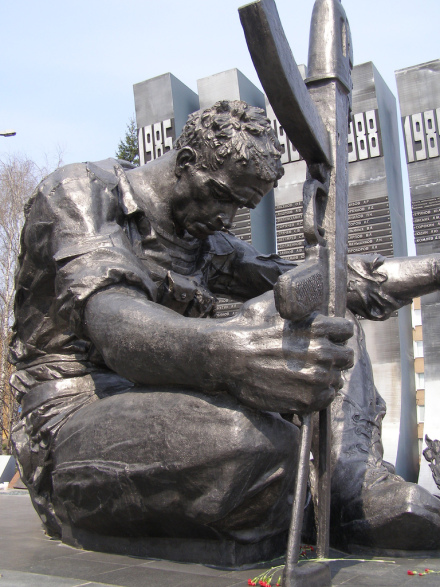
A memorial in Ekaterinburg, Russia, to the Soviet dead in the Afghan war. Image courtesy of beatdrifter (Andy Holmes).

On this day..