U.S. hangmen clocked overtime on this date in 1915. The Washington D.C. Herald of August 8 covered the bloodbath thus:
Robert Watkins and John Salter were executed for the murder of Mrs. Mary Lassiter at Evergreen. A militia guard prevented a mob from burning the negroes. The other two executions in Alabama [Millard Carpenter and George James -ed.] were for the murder of white men.
At Fresno, Miss., Peter Bolen and Jim Seales, who killed another negro, were executed while 5,000 persons sang “There Is a Land of Pure Delight.” Bunyan Waters was executed at Fayetteville, Miss.
Nor were legal executions the end of it.
A dispatch from Shawnee, Okla., relating the story of the lynching of Ed Berry, stated that the affair was “one of the most orderly lynchings in the State.” Berry was hanged from a railroad bridge, and his body was riddled with bullets, after which the mob dispersed “in an orderly manner.”
In Trilby, Fla., a crowd of citizens lynched Will Leach, accused of attacking a 13-year-old girl.
Early today a report from Liberty stated that a lynching was almost certain if a mob caught a negro laborer who attacked a farmer’s wife near there.
While this piece focuses on the U.S. South, there was also a hanging on August 6, 1915, in Connecticut. Just minutes after midnight, with the words “Good-bye, Father, good-bye,” followed by a firm “not guilty!” from under the hood, Bernard Montvid died for murdering a Catholic priest named Joseph Zebris, along with Zebris’s housekeeper Eva Gilmanaitis in a home invasion/robbery that earned less than $5. Worse yet, Montvid had to split this paltry blood money with his partner, Peter Krakas — who had already been separately hanged by the time Montvid paid his own penalty.
The Espy file of U.S. executions, a wonderful resource but liable to errors, attributes an August 6, 1915 hanging to the state of Georgia. I’ve trawled several newspaper databases without substantiating this supposed execution of Henry Floyd.
(Thanks to Richard Clark of Capital Punishment U.K. for the guest post, a reprint of an article originally published on that site with some explanatory links added by Executed Today, and footnotes which are also my own commentary. CapitalPunishmentUK.org features a trove of research and feature articles on the death penalty in England and elsewhere. -ed.)
Sarah was born in 1819 as Sarah Reynolds in the village of Potton in Bedfordshire, the daughter of the village barber, Phillip Reynolds. Phillip died when Sarah was seven years old and her mother then embarked on a series of relationships with other men. Hardly an ideal childhood.
Sarah grew up to be a tall, attractive girl with long auburn hair and large brown eyes. However she too was promiscuous and by the age of nineteen had met and married a local man called Simeon Mead. They lived in Potton for two years before moving to the village of Tadlow just over the county border in Cambridgeshire in 1840. It is thought that the move was made to end one of Sarah’s dalliances. Here she gave birth to a son in February 1840, who was christened Jonah. The little boy was the apple of his father’s eye, but died at the age of seven months, completely devastating Simeon. In October Simeon too died suddenly, to the shock of the local community. Sarah did the grieving mother and widow bit for a few weeks, before replacing Simeon with another man, twenty-three-year-old William Dazley. This caused a lot of negative gossip and considerable suspicion in the village. In February 1841, Sarah and William married and moved to the village of Wrestlingworth three miles away and six miles north east of Biggleswade in Bedfordshire. Sarah invited Ann Mead, Simeon’s teenage daughter, to live with them. It seems that all was not well in the marriage from early on and William took to drinking heavily in the village pub. This inevitably led to friction with Sarah which boiled over into a major row culminating in William hitting her. Sarah always had other men in her life through both her marriages and confided to one of her male friends, William Waldock, about the incident, telling him she would kill any man who hit her. Sarah also told neighbours a heavily embroidered tale of William’s drinking and violence towards her.
William became ill with vomiting and stomach pains a few days later and was attended by the local doctor, Dr. Sandell, who prescribed pills which initially seemed to work, with William being looked after by Ann Mead and showing signs of a steady recovery. Whilst William was still bedridden, Ann — not entirely realising what she was seeing at the time — observed Sarah making up pills in the kitchen.
Sarah told a friend of hers in the village, Mrs. Carver, that she was concerned about William’s health and that she was going to get a further prescription from Dr. Sandell. Mrs. Carver was surprised to see Sarah throw out some pills from the pillbox and replace them with others. When she remarked on it, Sarah told her that she wasn’t satisfied with the medication that Dr. Sandell had provided and instead was using a remedy from the village healer. In fact the replacement pills were those that Sarah had made herself. She gave these to William who immediately noticed that they were different and refused to take them. Ann who had been nursing him and had still not made any connection with the pills she had seen Sarah making, persuaded William to swallow a pill by taking one too. Inevitably they both quickly became ill with the familiar symptoms of vomiting and stomach pains. William vomited in the yard and one of the family pigs later lapped up the mess and died in the night. Apparently Sarah was able to persuade William to continue taking the pills, assuring him that they were what the doctor had prescribed. He began to decline rapidly and died on the 30th of October, his death being certified as natural by the doctor. He was buried in Wrestlingworth churchyard. Post mortems were not normal at this time, even when a previously healthy young man died quite suddenly.
As usual Sarah did not grieve for long before taking up a new relationship. She soon started seeing William Waldock openly and they became engaged at her insistence in February 1843. William was talked out of marriage by his friends who pointed to Sarah’s promiscuous behaviour and the mysterious deaths of her previous two husbands and her son. William wisely broke off the engagement and decided not to continue to see Sarah.
Suspicion and gossip was now running high in the village and it was decided to inform the Bedfordshire coroner, Mr. Eagles, of the deaths. He ordered the exhumation of William’s body and an inquest was held on Monday the 20th of March 1843 at the Chequers Inn in Wrestlingworth High Street. It was found that William’s viscera contained traces of arsenic and an arrest warrant was issued against Sarah. Sarah it seems had anticipated this result and had left the village and gone to London. She had taken a room in Upper Wharf Street where she was discovered by Superintendent Blunden of Biggleswade police. Sarah told Blunden that she was completely innocent and that she neither knew anything about poisons nor had she ever obtained any. Blunden arrested her and decided to take her back to Bedford. What would be a short journey now required an overnight stop in those days and they stayed in the Swan Inn, Biggleswade. Sarah was made to sleep in a room with three female members of the staff. She did not sleep well and asked the women about capital trials and execution by hanging. This was later reported to Blunden and struck him as odd.*
The bodies of Simeon Mead and Jonah had also now been exhumed and Jonah’s was found to contain arsenic, although Simeon’s was too decomposed to yield positive results.
On the 24th of March 1843, Sarah was committed to Bedford Gaol to await her trial and used her time to concoct defences to the charges. She decided to accuse William Dazley of poisoning Simeon and Jonah on the grounds that he wanted them out of her life so he could have her to himself. When she realised what he had done she decided to take revenge by poisoning William. Unsurprisingly these inventions were not believed and were rather ridiculous when it was William’s murder she was to be tried for. In another version William had poisoned himself by accident.
She came to trial at the Bedfordshire Summer Assizes on Saturday the 22nd of July before Baron Alderson, charged with William’s murder, as this was the stronger of the two cases against her. The charge of murdering Jonah was not proceeded with but held in reserve should the first case fail.
Evidence was given against her by two local chemists who identified her as having purchased arsenic from them shortly before William’s death. Mrs. Carver and Ann Mead told the court about the incidents with the pills that they had witnessed.
William Waldock testified that Sarah had said she would kill any man that ever hit her after the violent row that she and William had. Forensic evidence was presented to show that William had indeed died from arsenic poisoning, it being noted that his internal organs were well preserved. The Marsh test, a definitive test for arsenic trioxide, had been only available for a few years at the time of Sarah’s trial. Arsenic trioxide is a white odourless powder that can easily pass undetected by the victim when mixed into food and drink.
Since 1836 all defendants had been legally entitled to counsel and Sarah’s defence was put forward by a Mr. O’Malley, based upon Sarah’s inventions. He claimed that Sarah had poisoned William by accident. Against all the other evidence this looked decidedly weak and contradicted the stories Sarah had told the police. It took the jury just thirty minutes to convict her. Before passing sentence Baron Alderson commented that it was bad enough to kill her husband but it showed total heartlessness to kill her infant child as well. He recommended her to ask for the mercy of her Redeemer. He then donned the black cap and sentenced her to hang. It is interesting to note that Baron Alderson had, at least in his own mind, found her guilty of the murder of Jonah, even though she had not been tried for it.
During her time in prison, Sarah learnt to read and write and began reading the Bible. She avoided contact with other prisoners whilst on remand, preferring her own company and accepting the ministrations of the chaplain. In the condemned cell she continued to maintain her innocence and as far as one can tell never made a confession to either the matrons looking after her or to the chaplain.
There was no recommendation to mercy and the Home Secretary, Sir James Graham, saw no reason to offer a reprieve. The provision of the Murder Act of 1752, requiring execution to take place within two working days, had been abolished in 1836 and a period of not less than fourteen days substituted. Sarah’s execution was therefore set for Saturday the 5th of August 1843. A crowd variously estimated at 7,000 – 12,000 assembled in St. Loyes Street outside Bedford Gaol to watch the hanging. It was reported that among this throng was William Waldock.
The New Drop gallows was erected on the flat roof over the main gate of the prison in the early hours of the Saturday morning and the area around the gatehouse was protected by a troop of javelin men. William Calcraft had arrived from London the previous day to perform the execution.
Sarah was taken from the condemned cell to the prison chapel at around ten o’clock for the sacrament. The under sheriff of the county demanded her body from the governor and she was taken to the press room for her arms to be pinioned. She was now led up to the gatehouse roof and mounted the gallows platform, accompanied by the prison governor and the chaplain. She was asked if she wished to make any last statement which she declined, merely asking that Calcraft be quick in his work and repeating “Lord have mercy on my soul”. He pinioned her legs, before drawing down the white hood over her head and adjusting the simple halter style noose around her neck. He then descended the scaffold and withdrew the bolt supporting the trap doors. Sarah dropped some eighteen inches and her body became still after writhing for just a few seconds, as the rope applied pressure to the arteries and veins of her neck, causing a carotid reflex. Sarah was left on the rope for the customary hour before being taken down and the body taken back into the prison for burial in an unmarked grave, as was now required by law.
It was reported by the local newspapers that the crowd had behaved well and remained silent until Sarah was actually hanged. Once she was suspended they carried on eating, drinking, smoking, laughing and making ribald and lewd remarks. Copies of broadsides claiming to contain Sarah’s confession and her last dying speech were being sold among the crowd, which amazingly people bought even though she had made neither. You can see a broadside about her hanging below. Note the stylised woodcut picture that was modified to show a man or a woman as appropriate.
The 1840s were a time of great hardship nationally and yet Sarah, whilst hardly wealthy, did not seem to suffer from this and it was never alleged that she was unable to feed her child or that she was destitute. Extreme poverty in rural areas did appear to be the motive in some murders at this time, especially of infants. Sarah’s motive seems to be a much more evil one, the elimination of anyone who got in the way of her next relationship.
Sarah’s was the first execution at Bedford since 1833 and she was the only woman to be publicly hanged there. In fact Bedfordshire executions were rare events and there were to be only two more in public, Joseph Castle on the 31st of March 1860 for the murder of his wife and William Worsley on the 31st of March 1868 for the murder of William Bradbury.
Notes on the period.
Queen Victoria ascended to the throne in 1837, at the age of eighteen and her reign saw a great deal of change in the penal system. For the first thirty one years of it executions were a very public event enjoyed by the masses. People would come from far and wide to witness the spectacle, in some cases special trains were even laid on! Broadsides were sold at many executions giving the purported confessions of the prisoner and there was considerable press interest, particularly where the criminal was female.
Thirty women and two teenage girls were to be executed in England and Scotland in the thirty one year period from May 1838 to the abolition of public hanging in May 1868. Of these twenty-one had been convicted of poisoning (two thirds of the total). Sarah Chesham was actually executed for the attempted murder of her husband but was thought to be guilty of several fatal poisonings as well. Attempted murder ceased to be a capital crime in 1861 under the provisions of the Criminal Law Consolidation Act of that year. Mary Ann Milner would have made the total thirty three had she not hanged herself in Lincoln Castle the day before her scheduled execution on the 30th of July 1847. There were no female executions in Wales during this time but a further ten women were hanged in Ireland during the period, all for murder.
Sarah Chesham‘s case prompted a House of Commons committee to be set up to investigate poisoning. This found that between 1840 and 1850, ninety seven women and eighty two men had been tried for it. A total of twenty-two women were hanged in the decade 1843-1852 of whom seventeen had been convicted of murder by poisoning, representing 77% of the total. There were no female executions in the years 1840-1842 in England. This rash of poisonings led to a Bill being introduced whereby only adult males could purchase arsenic. Poisoning was considered a particularly evil crime as it is totally premeditated and thus it was extremely rare for a poisoner to be reprieved whereas it was not unusual for females to be reprieved for other types of murder, such as infanticide. One of the few poisoners to be reprieved was Charlotte Harris in 1849 who had murdered her husband but who was pregnant at the time of her trial.
* I’m baffled as to why anyone would find it odd — much less incriminating — for a person freshly in custody on a potential capital charge to lose sleep fretting about the horrors of execution. -ed.
** Alderson took part in his share of capital trials, as did any judge of consequence in his day, but was notable as a jurist on the more progressive and less bloody-minded end of the spectrum. An oft-quoted comment of his cautioning against stretching facts to fit your theory would have prevented many a wrongful punishment imposed by tunnel-visioned investigators: “The mind is apt to take pleasure in adapting circumstances to one another, and even in straining them a little if need be, to force them to form parts of one consecutive whole … and in considering such matters to overreach and mislead itself, to suppose some little link that is wanting, to take for granted some fact consistent with previous theories, and necessary to render them complete.”
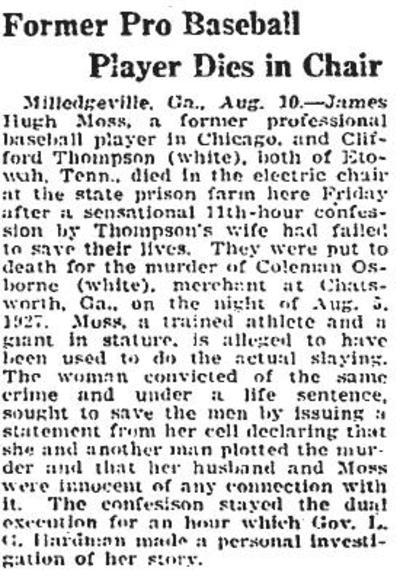
Former Negro Leagues baseball player James Hugh Moss was electrocuted in Georgia on this date in 1928, along with a white man named Clifford Thompson.
The threesome of Moss, Thompson, and Thompson’s wife Eula, were Prohibition bootleggers from Etowah, in eastern Tennessee. A year before almost to the day (August 5, 1927), they had rolled up with a car full of moonshine whiskey to a general store in Chatsworth, Georgia, 45 miles away. Although it was after hours they were able to rouse the shopkeep Coleman Osborne. Some kind of argument ensued, and Osborne was shot dead.
All three of the smugglers were capitally convicted.
Eula Thompson’s electrocution was postponed and as we shall see, never ultimately conducted — but on the eve of the men’s death, she attempted to save them with a sketchy confession to an affair with a local farmer that necessitated Osborne’s murder when the latter found out about it. This sent Georgia Gov. Lamartine Griffin Hardman on an 11th-hour investigation into the exculpatory claim but as a physician he knew just what to do and according to a news report, “Governor Hardman announced recently that the phrenology of Clifford Thompson, the woman’s husband, and Jim Hugh Moss, Negro electrocuted for the murder of Osborne, played a part in his decision not to interfere in their cases.”
That gem comes from a writeup of the case at Baseball Prospectus, which notes that after Eula Thompson’s gambit to exonerate the boys failed, she resorted to a gambit to exonerate herself by blaming the whole thing on (the by then already-executed) Jim Moss. This got her a reprieve while Governor Hardman put his skull forceps to work and eventually the Peach State decided not to run any volts at all through the charming young lady. She married an admirer from the public, got paroled in the 1930s, and ended up back in prison for murdering her brother.
As to Moss’s former athletic feats, the thing that draws our attention in the first place, they’re only glancingly alluded to by the period’s press report. He would have played in the complex of black professional leagues during the period that Major League Baseball enforced a whites-only color line.
A Negro Leagues blog made a go at tracking him down and found that a guy named “Moss” (no first name given) made a single documented appearance in 1918 for the Chicago American Giants. The name subsequently appears on a lower-tier barnstorming team, the Havana Stars. (Chicago-based, despite what the name would suggest.)
This 2004 episode from Manx Radio gives us the story of John Kewish, hanged on this date in 1872 for killing his father with a pitchfork. Kewish is the last person ever executed on the Isle of Man — indeed even at his own time such a punishment was so passe that the local gallows-makers were vexed by the contract.
Interestingly, because this Irish Sea island is a crown dependency rather than a part of the United Kingdom proper, capital punishment did not end on the Isle of Man when Westminster abolished in the 1960s. Death sentences continued to be handed down there until 1992, and thus it is that a Manx judge holds the distinction of being the last person in the British Isles to pronounce a death sentence from the bench, and a Manx criminal that of being the last to hear it. (Such latter-day sentences were always commuted by Queen Elizabeth II’s royal prerogative.)
Covenanter David Hackston was drawn and quartered at the Tolbooth on this date in 1680, for participating in the assassination of the hated (by Covenanters) Episcopalian Archbishop James Sharp a year before.
This primate of a landowning family of centuries vintage was a Cameronian — that is, a follower of Richard Cameron. Cameronians were the most prominent radical faction of Covenanters — Scottish Presbyterians who insisted upon the terms of the Covenant made by Presbyterians to support the restoration of the Stuart monarchy after the beheading of King Charles I.
At the time of that covenant, 1650, the executed king’s son Charles II was badly in need of allies, and in no small danger of fading into irrelevance in continental exile.
If one can test the character of a man by how he treats those who cannot help him, Charles fils failed the exam: as soon as he was restored to the throne in 1660, he renounced the deal and put the screws to religious dissidents, especially the sizable contingent of Scottish Presbyterians, Calvinists who chafed under top-down control of the (to their eyes) Catholic-esque Anglican hierarchy. Religious dissidence and political dissidence were heads of the same coin as Covenanters bid defiance to increasingly stringent measures meant to suppress their field preachers and the unauthorized religious gatherings they led.
The culmination of this hostility was the Killing Time, that period of the 1680s when Episcopalian forces were explicitly licensed to conduct summary executions of apparent Covenanters.
And that turn to the bloodiest phase of the struggle had a great deal to do with the Cameronians.
The aforementioned 1679 assassination of Archbishop Sharp was one such outrage. Our man David Hackston, a prominent dissident, was involved in the plot but stood by during the assassination, allegedly because a pending lawsuit between he and Sharp might have thrown an undue personal taint on a political murder. In images of the event, look for Hackston depicted on the fringes.
Hackson holds his horses while his buddies do for Sharp. (cc) image by Kim Traynor of a memorial to Sharp, at St Andrews.
A year later, Hackston was part of the entourage of Richard Cameron himself when the latter marched into the village of Sanquhar and issued what’s known as the Sanquhar Declaration — an embrace of open rebellion, a gauntlet thrown at the feet of the House of Stuart.
[W]e, for ourselves, and all that will adhere to us as the representative of the true Presbyterian Kirk and covenanted nation of Scotland, considering the great hazard of lying under such a sin any longer, do by these presents, disown Charles Stuart, that has been reigning, or rather tyrannising, as we may say, on the throne of Britain these years bygone, as having any right, title to, or interest in, the said Crown of Scotland for government, as forfeited, several years since, by his perjury and breach of covenant both to God and His Kirk, and usurpation of His Crown and royal prerogatives therein, and many other breaches in matters ecclesiastic, and by tyranny and breach of the very leges regnandi in matters civil. For which reason we declare, that several years since he should have been denuded of being king, ruler, or magistrate, or of having any power to act or to be obeyed as such. As also we, being under the standard of our Lord Jesus Christ, Captain of Salvation, do declare a war with such a tyrant and usurper, and all the men of his practices, as enemies to our Lord Jesus Christ, and His cause and covenants; and against all such as have strengthened him, sided with, or anywise acknowledged him in his tyranny, civil or ecclesiastic; yea, against all such as shall strengthen, side with, or anywise acknowledge any other in like usurpation and tyranny — far more against such as would betray or deliver up our free reformed mother Kirk unto the bondage of Antichrist the Pope of Rome …
also we disown and by this resent the reception of the Duke of York [the heir presumptive, and the future King James II -ed.], that professed Papist, as repugnant to our principles and vows to the Most High God, and as that which is the great, though not alone, just reproach of our Kirk and nation. We also, by this, protest against his succeeding to the Crown, and whatever has been done, or any are essaying to do in this land, given to the Lord, in prejudice to our work of reformation. And to conclude, we hope, after this, none will blame us for, or offend at, our rewarding those that are against us as they have done to us, as the Lord gives opportunity.
It’s stuff like this that helped to catalyze the killing time — but also the destabilized legitimacy of a reigning house that would be seen off before the decade was out.
David Hackston was not around to witness that glorious legacy because he was captured shortly after the Sanquhar Declaration, at the same battle where Richard Cameron was killed. The Scottish Privy Council ordained him a gruesome fate.
That his body be drawn backward on a hurdle to the Mercat Cross; that there be a high scaffold erected a little above the Cross, where, in the first place, his right hand is to be struck off and, after some time, his left hand; then he is to be hanged up, and cut down alive, his bowels to be taken out, and his heart shown to the people by the hangman; then his heart and his bowels to be burned in a fire prepared for that purpose on the scaffold; that, afterwards, his head be cut off, and his body divided into four quarters; his head to be fixed on the Netherbow; one of his quarters with both his hands to be affixed at St. Andrews, another quarter at Glasgow, a third at Leith, a fourth at Burntisland; that none presume to be in mourning for him, or any coffin brought; that no person be suffered to be on the scaffold with him, save the two bailies, the executioner and his servants; that he be allowed to pray to God Almighty, but not to speak to the people; that Hackston’s and Cameron’s heads be fixed on higher poles than the rest.
Those piked heads also rose higher than their persecutors, however. An infantry regiment raised to support the new Protestant rulers William and Mary in 1689 was nicknamed “Cameronians” in tribute to this once-proscribed movement — and had the honor of “rewarding those that are against us as they have done to us” by playing a pivotal role in suppressing the forces still loyal to the deposed King James.
On this date in 1869, two men of the aboriginal Hesquiat nation of Vancouver Island off British Columbia’s Pacific coast were hanged outside their village by the white colonial authorities, on the charge of gratuitously murdering the (again, white) survivors of a shipwreck.
The English-built barque John Bright foundered in a gale just offshore from the location of the eventual gallows in February of that same year, with all aboard lost — including apparently the wife of the captain, their children, and the pretty young English nursemaid who looked after them.* Although within sight of a Hesquiat village also called Hesquiat, the violent surf put the vessel beyond aid.
The tale of a ship lost to the sea soon became in the eyes of Vancouver Island’s European capital city, Victoria, a very different tale of villainous “West Coast savages.” An unprincipled trader named James Christenson was the first to report the shipwreck in Victoria and put about his suspicions that at least some of the John Bright‘s denizens had reached shore alive. His evidence for this claim was seeing several headless bodies. A more generous interlocutor might proceed from this observation to indict the implacable violence of the rough open-ocean surf that would have carried the drowned to shore, crashing through the John Bright‘s timbers and tossing boulders hither and yon.
Instead the most diabolical inferences were immediately bandied as fact, with the city’s preeminent journalist D.W. Higgins categorically broadcasting that the ship’s personnel “were without doubt murdered by the Indians” and whipping political pressure that forced the colonial government into action. The HMS Sparrowhawk was dispatched to investigate with its conclusions so firmly determined that the refusal of the ship’s doctor to endorse a finding of homicide relative to the bodies he examined did not save native canoes from a cannonade meant to force the village to surrender some suspects. In the end the gunboat returned to Victoria with seven new passengers, two of whom wound up on the gallows: a man named John Anayitzaschist, whom some witnesses accused in contradictory accounts of shooting survivors on the beach, and a wretch named Katkeena (or Kahtkayna) who wasn’t even present in Hesquiat Village at the time of the shipwreck. The former man was a factional rival of the Hesquiat chief. The latter “was a simpleton of inferior rank and considered so worthless that not one woman of his tribe would take him as a husband,” according to the Catholic missionary Augustin Brabant, who lived for many years afterward among the Hesquiat people. He seems to have been given over to the executioner because he was disposable.
The case has receive a bit of renewed scrutiny in the 21st century: the British Columbia government issued a statement of regret in 2012, and an empathetic musician composed a string quartet (“Cradle Song for the Useless Man”) in honor of the forlorn Katkeena.
Executed Today comes by the affair via a wonderful 1997 book, Glyphs and Gallows: The Art of Clo-oose and the Wreck of John Bright. Author Peter Johnson weaves the wreck of the John Bright and the legal shambles that ensued with his exploration of native art — including the titular petroglyphs etched into coastal stone by native artists where still they sit to this day.
Drawn to the story by (accurate) reports of glyphs depicting European ships, Johnson hiked to the petroglyph site at Clo-oose where he sketched and photographed these amazing productions. The glyphs tantalize with the never-consummated possibility that they might directly allude to the John Bright affair, but more than this: in Johnson’s telling, they’re a priceless point of contact offered us by the hand of the artist to a cosmology in the moment before it is irrevocably lost to the tectonic action of European settlement.
Soon after the John Bright affair, things changed on the coast. The Colony of British Columbia joined Confederation, and the Royal Navy no longer sent its gunboats to intimidate worrisome Aboriginals. Settlement occurred, law and order prevailed, the potlatch and the totem poles were taken away. Disease forced a good many Natives to sanitoria, and Native children were sent to the residential schools run by Roman Catholic and Anglican missionaries. Families were disconsolate. The soul of a race was broken, and the moss-wet forest slowly reclaimed the longhouses and the welcome figures of a once proud people. A whole culture was literally on the brink of being wiped out completely. And then, from the very edge of oblivion, the elders began to retell their stories. It was these bits of remembered tales, called up from a desperate soul’s interior like images forced onto stone, that would enable everything to begin again.
The motive for metaphor is the motive to create a story: it is the artistic drive. The impulse to use symbols is connected to our desire to create something to which we can become emotionally attached. Symbols, like relationships, involve us with deeply human attributes. Raven and Bear can speak to us directly. I can smile at the glyph of a seal, with its curious smiling head poking just above the water, and I am filled with wonder at the image of a bird carrying a small child or a bodiless head. A symbols is at once concrete, palpable, and sensual — like a rose. At the same time, it reaches beyond itself to convey an idea of beauty, of fragility, and of transience. The great thing about art is that it continually forces us to see new sets of resemblances. Those long-gone artists who created the petroglyphs at Clo-oose used two sets of symbols — their own and those of nineteenth-century Western Europeans — in order to depict a vignette that was firmly grounded in their point of view. Like the carvers of the Rosetta Stone, they wisely used sets of metaphors and imaginative icons against materialist images of nineteenth-century commercial technology. Unlike the Rosetta Stone, however, the petroglyphs of Clo-oose do not use one set of images to explicate the other; the petroglyphs of Clo-oose are stunning because they incorporate one set of images into the other. Like a series of lap dissolves in modern film, we are drawn to ponder one story while at the same time being faced with the jarring reality of another … They are rich metaphors of the interior world of Native spirituality and history, and they have been juxtaposed with metaphors of European conquest. As such, they are eloquent indeed.
It is impossible to completely crack the codes of the sailing-ship glyphs of Clo-oose because the meaning of the Native spiritual images cast upon the rocks on that lonely shore has died with those to whom it was relevant. Our interpretations are approximations born of respect for the images themselves and of a renewed feeling for the time. We are left to ponder one significant story born of cultural collision. The petroglyphs of Clo-oose have served us well. They have, like any great code, prompted us to express, and urged us to remember, what might otherwise have been ignored. They have brought some light to an obscure world.
“Petroglyphs, monuments, art, music, dance, poetry, etc. are at the core of any culture,” Peter Johnson told us in an interview. “Where a mix of cultures occurs, then look to its art as a means of understanding the complex motives of such clashes.”
Executed Today: It’s the “Gallows” that draws our site‘s eye but can you introduce the native-carved petroglyphs of Clo-oose, including glyphs of 19th century ships akin to the ones involved in your narrative? Twenty-plus years after your book, have these treasures become any better appreciated as art and cultural heritage, or any better preserved and curated at their site?
Peter Johnson: An excerpt of the Clo-oose affair from D. W. Higgins’s The Passing of a Race (Toronto: William Briggs Publisher, 1905) is included in the back of Glyphs and Gallows. Being directly facing the Pacific, the Clo-oose site is one of many that Higgins suggests captures Native / Indigenous interactions in the 19th century. The four ships at the Clo-oose Site, Higgins suggests, are: the Sparrowhawk (long thin one that the Royal Navy used as a gunship to apprehend the so-called guilty tribesmen who “murdered the crew of the John Bright as it foundered just offshore”); the John Bright (the other long one, a barkentine freighting lumber from the coast to Valpariso, Chile); and, the smaller two ships may have been ships that sailed to the site and “discovered” the bodies. The official name of the site (anthropologically speaking) is DdSf 1 or commonly called Blowhole Site, because of a spout of water that comes shooting out of a cleft in the rocky shore at high tide. Other sites nearby are Hill Site, nearby on a sandstone ledge showing a huge beaked bird, and a copulating couple. Southeast of Clo-oose about 6 miles away, is Carmanah Lighthouse; there is a site there that contains several petroglyphs of human figures (one seemingly impregnated with a child) and other sites nearby show huge, fat, birds, and various fishes. These don’t say anything we can understand about first contact with “whites” and are likely religious figures which had a role in Native cosmology or family organization.
Peter Johnson’s sketch of the Blowhole Site, circa mid-1990s: there’s no way to conclusively identify any of the ship images with any one specific vessel, but if we are to suppose that association then in Johnson’s estimation the ship at the top would be the Sparrowhawk and the one at just left of center at the bottom the John Bright. The image is (c) Peter Johnson and used with permission.
The maps, mention and location of the sites are no longer found in recent books about the West Coast Trail, and the sites themselves have been left to erode away along the shore. Since Glyphs and Gallows, there has been no attempt, that I am aware of, to cover, reveal or understand more of their cultural and artistic messages. It’s as if the Natives don’t wish any further trace of information to be transmitted to other cultures and perhaps, they don’t know any more about the sites than we do. For example, totem poles of other indigenous peoples are left, as part of their meaning, to rot in the bush. We have a different predilection, and that is to save objects from the past. Which is more important? Who knows? Perhaps, the one that serves the intent of the original artist is most important?
As sandstone erodes fairly quickly, these important cultural sites will be gone in 100 years. I personally believe they are very important artistically and historically. Were they found in Britain, like the monoliths on the Orkneys, (at Scara Brae) or Stonehenge and other henges, they would be covered and revered. Here, the new Natives at Clo-oose don’t seem to know much more detail about such petroglyphs at Clo-oose, or do not wish to preserve them as culturally important artifacts. Perhaps, too, they are too difficult to decipher, much like Champolion’s translation of Egyptian hieroglyphics, that previously to him took many hundreds of years. Native myths do not seem to be currently studied as much as they are simply appreciated … appreciation is good, but it’s only a start of understanding. Digging for meaning, beyond a purely aesthetic appreciation, is equally, if not more important.
One of the questions you set out to explore was whether these glyphs directly depict the events around the John Bright wreck and the subsequent hangings. Your answer is indeterminate on that … but how should we understand what they say more generally about the cultural upheavals concerning contact with Europeans, and about the civilization that preceded that contact?
The context of what happened during the first 50 years of European contact with West Coast natives, needs to be read about and understood by more “Whites” and Natives alike. D. W. Higgins believes whiskey traders destroyed many Native lives through the products they brought. (I don’t entirely believe this.) Higgins suggests in July 1858, the Native population in Victoria was 8,500, and goes on to say that at least 100,00 Natives perished from booze-related afflictions. I believe smallpox wiped out great numbers as Natives were moved away from Victoria up-country and spread the disease (like Covid), as they met other indigenous groups. Many were vaccinated, but Gov. Douglas at the time (1862), needed to save some vaccine for his own Europeans who settled in Victoria. They did not cruelly withhold the vaccine from the Natives, several European governors helped them as much as possible … that so-called dismissal today is a more popular misreading of the history of the time which serves a current, darker political purpose.
Once the idea that the John Bright survivors had reached shore only to be murdered by the Hesquiat got around, it’s comprehensible how a racist “tunnel vision” fit all facts into this understanding. However, I struggled with why this idea was initially formulated at all — it’s not the null hypothesis when a ship founders in a gale and nobody survives. Was it the shock value of “headless bodies” even though the Europeans on Vancouver Island should have been familiar with the devastating force of the surf? Was it a wholly cynical formulation by James Christenson to, as you put it, “elicit regular naval protection from Natives that he and other unscrupulous traders had cheated”?
Yes, it was a cynical formulation by Christenson and others to elicit naval protection from bald-faced raiding of their Native resources (lumber, fish, etc.). Shock value of the headless bodies certainly inculcated White racist reaction against Native action.
Victoria’s precarity at this moment, as a city that aspired to political leadership but was still a muddy frontier settlement, riven by class conflict, so bereft of women that they arranged bride ships — another of your books — and with a politically uncertain future between England, Canada, and the U.S. … felt eerily resonant with our treacherous current historical moment. Can we interpret the rush to judgment and the hangings here as to some extent expressions of a civic psychological insecurity? If so, did anyone involved in the prosecution later express any misgivings about it as Victoria grew and Canadian confederation became settled?
Yes I think so, not so much insecurity as fear. Myths had been perpetrated about Native violence (Natives attacked and killed white settlers on Lummi Island and in Cowichan Bay about this same time). So certainly, the Indigenous peoples gained much “bad press” about their time. That probably led to the gunboat frontier mentality of the time and the not-so-much later movement to remove the diminishing numbers of children in Native settlements to the White residential schools. This movement is usually interpreted as Native genocide on the part of ingigenous peoples and many Europeans themselves believe this. A few felt it was the only way to save what they believed was a dying culture by giving them proficiency in English so they could survive and integrate among a juggernaut of white settlers that became Canada. I guess the anxiety here is about the meaning on the word “integration.’
The debate over that issue remains. Too bad the petroglyphs are ignored today, they (and pictographs, etc.) could shed more light on the complex cosmology of the region’s Native cultures. Protest, and not an understanding of the historical context, seems to get more coverage. Real knowledge, not bitterness on both sides, is the answer. Proper historical co-operation would help immensely here.
One of the threads in your narrative is teasing out this undercurrent of skepticism about the verdict that stretches back to the European coroner who would not support a finding of homicide and includes the missionary priest Augustin Brabant, who extensively rebutted the D.W. Higgins narrative of native guilt … but only in private. Do we have any direct native sources from the time, or any later traditions, that tell us how the John Bright affair has been remembered in that community? And why did Brabant never publish his extensive personal knowledge from decades of living with the Hesquiat?
Father Brabant had a Catholic ulterior motive. His answer was to turn the Natives away from their own cosmology to a belief in Catholicism. That kind of religious zeal and “cultural blindness” led to the divisions we are trying to solve today. I bet very few remember the John Bright Affair or even care to, as an example and a means to dismiss and/or destroy early Native humanity. It took him years to write about his own view, likely because the Catholic Church would have condemned or excommunicated him.
[Brabant told Higgins in private correspondence that Christenson was at Hesquiat Village when the John Bright wrecked, but fled without attempting to render aid for fear that he would “expose myself to be killed by the Indians.” (That’s Brabant quoting Christenson at third hand.) Brabant thought Christenson only returned, weeks later, to cover up his own cowardice by bearing “to town a tale of cruelty, and barbarism, of which there is not a particle of truth.” Since Higgins extensively published the tale of cruelty and barbarism, it’s no surprise that he didn’t buy what Brabant was selling. Brabant also witnessed another shipwreck in 1882 — he wasn’t there for the John Bright itself — and described victims washing up on the beach in pieces, arms and legs horrifically torn from their torsos by the incredible force of the surf. -ed.]
* We lack a precise complement of the ship and especially of the women-and-children contingent, who were renumbered and rearranged by conflicting reports. Rumors that one or more of the children lived on as wards of this or that tribe circulated for years afterwars.
The most recent execution in Trinidad and Tobago occurred on this date in 1999.
A month after the much higher-profile hangings of crime boss Dole Chadee and eight of his associates, the far more mundane criminal Anthony Briggs was executed for murdering a taxi driver.
We’d hesitate to call this the last execution in Trinidad and Tobago. That Caribbean country has continued handing down death sentences and resuming executions has intermittently been a hot-button political issue; it’s perhaps largely because its prisoners submit appeals to the Judiciary Committee of the Privy Council in Westminster that executions never actually go forward. Should the dam ever break, however, Trinidad and Tobago boasts the second-largest death row in the Americas, after the United States.
Contract killer Allen Wayne Janecka was executed in Texas on this date in 2003.
This bearer of the classic middle name was the instrument and the last casualty of a Houston insurance agent’s campaign for blood money. Markham Duff-Smith, the insurance agent in question — a man whose lifestyle rather outstripped his premiums — had hired Janecka way back in 1975 to murder his, Duff-Smith’s, adoptive mother so that he could take early collection on some inheritance.
Janecka did that, and everyone got away with the crime, Gertrude Duff-Smith Zabolio being taken for a suicide. But of course Duff-Smith’s issue was voracity and by 1979 he’d burned through the windfall … and he ran the same play a second time, retaining Janecka to murder his adoptive sister Diana Wanstrath, her husband, John; and their 14-month-old son, Kevin. When this trio was found shot to death, the coroner initially ruled it a murder-suicide.
A Javert-like detective who was convinced of foul play cussedly kept the investigation going, even publicly airing his dissent from the official finding which caused Duff-Smith to contemplate whacking him. When the only tool you have is a hit man, every problem looks like a hit.
(Janecka in this instance was the voice of reason, refusing the contract on the obviously correct grounds that such an act would bring way too much heat. You can read all about dogged investigator Johnny Bonds in The Cop Who Wouldn’t Quit.)
Not until late 1980 did the needed break emerge, in the form of some incriminating letters between Duff-Smith’s go-between and Janecka. The latter’s unveiling in the suspect brother’s orbit soon exposed the murder scheme, including the 1975 hit.
Duff-Smith was executed in 1993 for instigating the whole catastrophe.
He has gone to his death through an oversight on my part. It was a foolish thing for me to have drawn the revolver, but I was in liquor or I would have never done it. I could not control the event. I went there purely on a matter of business and my business was very simple and very plain. The result was as it was. I am prepared to die.
By far the more consequential figure in the transaction was the victim. One of the Fathers of Confederation, the visionary Scottish emigre bequeathed to the country he helped to shape such institutions as the Liberal Party and the Toronto Globe (now the Globe and Mail, after a 20th century merger with a rival newspaper). His personal and political rivalry with Conservative lion John A. Macdonald, and the “Great Coalition” formed by these two to steer a faltering polity deadlocked by the mutual vetoes Anglophones and Francophones towards the Canadian Confederation, is the subject of a fine 2011 CBC film, John A.: Birth of a Country.
Brown’s killer, and our date’s principal, was Brown’s employee for five-ish years, as an engineer in the boiler room. He had a dissolute, chaotic life, marked by frequent domestic disturbances and heavy drinking. It was his propensity for turning up to work drunk that set in motion the tragedy, for his mishandling of the boiler one night early in 1880 led to his dismissal by the foreman.
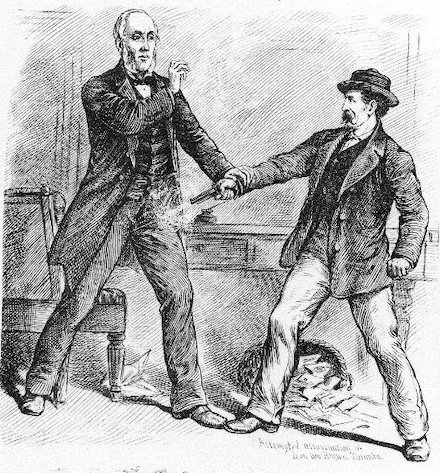
A great scribbler of words, Bennett in this time produced copy by turns vengeful and despairing, and of course he kept hitting the bottle. On March 25, he turned up at his former workplace where he rantingly accosted several former coworkers. By late afternoon he’d found his way to George Brown’s office, and inviting himself in he proceeded to importune the publisher with his disordered grievances. At last he pressed Brown to sign a paper affirming his length of employment. Brown had little idea who this impertinent drunk was, and still less that the impertinent drunk was armed; the boss’s attempts to redirect Bennett to his supervisor or the business administrators to address his paperwork request enraged his ex-employee, who suddenly produced a pistol and through a scuffle put a ball into George Brown.
One wouldn’t think the injury pictured above would be fatal; indeed, the next day’s Globeexulted that “Yesterday afternoon one of the most seditious and dastardly attempts at murder ever made in this city took place in the private office of the Hon. George Brown in the Globe Building. Fortunately, owning mainly to Mr. Brown’s presence of mind and superior physical strength, the attempt was unsuccessful, the only results being a severe flesh wound to the thigh and the nervous prostration which is the inevitable result of such an encounter. Had the miscreant who made the murderous assault been a little more prompt in taking his aim, or had the pistol been of a different construction, the attempt could hardly have resulted so favourably, for he persisted in his efforts to effect his bloody purpose until he was overpowered and the weapon was wrenched from his grasp.” But the relief proved premature when the leg wound torn by Bennett’s bullet turned gangrenous and eventually — seven weeks later — killed Brown.
Monuments to the murdered statesman abound in Canada, including the Second Empire home he built and died in, preserved as the historic George Brown House, and George Brown College. His whiskered statue strides on Parliament Hill.
Brown’s widow returned to Scotland with her children, and the Canadian hero’s son George Mackenzie Brown followed his father’s career in both printing and politicking: per Wikipedia, “As a publisher, he produced Arthur Conan Doyle’s books; as a politician, he beat him to win election to the House of Commons.”
Dr. Perry H. Talbott was among the most prominent citizens of Nodaway County, Missouri. In addition to being a skilled physician, Talbott was state legislator, a writer and a newspaper editor. He was a civic minded citizen with strong beliefs, highly admired by friends and neighbors. But towards his family, Dr. Talbott was cold and distant. Miserly and neglectful, he had little interaction with his children beyond the occasional scolding. When Dr. Talbott was shot by an unknown assassin on September 18, 1880, in his dying breath he blamed his political enemies. The Nodaway county authorities, however, believed the killer was someone closer to home.




 This bearer of