1945: Josefa Llanes Escoda

On this day in 1945, Filipina suffragist Josefa Llanes Escoda was last seen before her presumed execution by the Japanese occupying troops holding her at Manila’s Far Eastern University.

Escoda came of age with her native archipelago under American colonization. An energetic and brilliant woman, Escoda lectured in sociology at the University of the Philippines, held several civil service posts, founded the Girl Scouts of the Philippines and helped win female suffrage.

During the Japanese occupation, her efforts to aid POWs — including those on the Bataan Death March — made her the “Florence Nightingale of the Philippines”.

But she declined to do so in the capacity of Japanese collaborator and she and her husband Antonio were arrested in 1944 and executed in the weeks following MacArthur’s return and push towards Manila.

Escoda is pictured on the Philippines’ current 1000-peso bill.


Escoda is in the center of the three figures on this banknote. Jose Abad Santos, also executed by the Japanese, is in the top left.

On this day..

1948: Amir Sjarifuddin

On this date in 1948, leftist former Indonesian Prime Minister Amir Sjarifuddin was summarily executed by forces of the infant Indonesian Republic for his participation in an attempted coup d’etat three months before.

A Dutch-educated Communist politician who had adhered to an anti-fascist “common front” position, Sjarifuddin was a vigorous activist against the Japanese occupation during World War II — and lucky to avoid execution for it.

Indonesia’s declaration of independence following the war sparked the National Revolution, during which Sjarifuddin emerged a leading player of the left as rival factions maneuvered against each other within Indonesia under pressure from the Dutch colonial power looking to reassemble its old dominions.

Sjarifuddin briefly served as the fledgling state’s second prime minister, but resigned in January 1948 after an unpopular diplomatic foray to calm tensions with the Dutch. His support for a botched and premature revolt by Communist officers in September sealed his end as a political factor and eviscerated left influence in the revolution, confining the latter’s character to an essentially nationalist one.

The rising’s suggestion of internal division may also have encouraged the Dutch incursion into Java on this date. There was a touch of poetic justice if that was the case: Republican troops, melting away from superior firepower for an insurgency campaign, opted to execute Sjarifuddin and about 50 other captured leftists before retreating rather than free them.

According to George Kahin, Sjarifuddin rendered with his death one last service to his nationalist — if not his Communist — ambitions:

[O]nce the [Indonesian] government … had put down the [September] rebellion and shot its leaders, it was no longer possible for the Dutch to make American officials and the US Congress believe — as previously many of them had — that most leaders of the Republic were under strong Communist influence and that their government was providing a bridge to an ultimately Communist Indonesia.

Its Marshall Plan aid threatened, the Netherlands recognized Indonesian independence in 1949.

On this day..

401 B.C.E.: Clearchus of Sparta

Around this time in the late autumn or early winter some weeks following the Battle of Cunaxa, the general of a Greek mercenary army — along with most of its other commanders — was treacherously seized by a Persian satrap and summarily beheaded.

In the train of the Peloponnesian War‘s devastation, sturdy Greek hoplites with bills to pay found a lucrative gig backing a Persian prince‘s bid to seize the throne.

The prince marched the Hellenes deep into Persia before falling in battle at Cunaxa in Mesopotamia, a discomfiting scenario alike for the stranded but still-potent invading army and the somewhat outclassed Persians.

The seizure around this day of the veteran soldier and former tyrant of Byzantium Clearchus — lured under color of friendship — aimed to crush the Greeks’ morale, but instead feathered the laurels of “the Ten Thousand”. This “marching Republic” hastily self-organized and proceeded upon an astonishing escape, intrepidly fighting its way north over the ensuing year to the Black Sea, and thence to hearth and home.

The Greeks’ perseverance offers one of classical antiquity’s stock testimonies to the resilient polis — and at this stage, practically the last breath of that dying spirit. More to the immediate point, it illustrated strikingly the Persian army’s vulnerability to the phalanx, exploited to decisive effect in the century to come by Alexander the Great.

One of the replacement generals, Xenophon, immortalized the Greeks’ march in the Anabasis.

After the generals had been seized, and the captains and soldiers who formed their escort had been killed, the Hellenes lay in deep perplexity — a prey to painful reflections. Here were they at the king’s gates, and on every side environing them were many hostile cities and tribes of men. Who was there now to furnish them with a market? Separated from Hellas by more than a thousand miles, they had not even a guide to point the way. Impassable rivers lay athwart their homeward route, and hemmed them in. Betrayed even by the Asiatics, at whose side they had marched with Cyrus to the attack, they were left in isolation. Without a single mounted trooper to aid them in pursuit: was it not perfectly plain that if they won a battle, their enemies would escape to a man, but if they were beaten themselves, not one soul of them would survive?

Haunted by such thoughts, and with hearts full of despair, but few of them tasted food that evening; but few of them kindled even a fire, and many never came into camp at all that night, but took their rest where each chanced to be. They could not close their eyes for very pain and yearning after their fatherlands or their parents, the wife or child whom they never expected to look upon again. Such was the plight in which each and all tried to seek repose.

The tale’s motif was borrowed for a 1965 novel of a New York gang struck leaderless making its way out of hostile territory, later adapted for a cult 1970’s film:

On this day..

1974: Charles Dean and Neal Sharman

On or about this date in 1974, a young American traveler — or perhaps intelligence agent — named Charles Dean and his Australian friend Neal Sharman are believed to have been executed in Laos by the Pathet Lao guerrillas.

The 23-year-old Dean was in the midst of a protracted post-university globetrotting when he was apprehended with his friend traveling down the Mekong River in the war-torn country. They were held in captivity for three months — long enough for the family to learn they were detained, and Dean’s father to fly to Laos to negotiate in vain for his release.

Charles Dean’s older brother Howard, perhaps the most prominent death penalty survivor in the United States, subsequently became governor of Vermont and is now chairman of the Democratic Party’s chief national organ.

Coincidentally, it was also at about this point of the 2003-04 presidential election cycle that Howard Dean, then the frontrunner for his party’s presidential nomination, learned through DNA analysis that remains recovered in Laos were indeed those of his brother. Twenty-nine years after his execution, Charles Dean was repatriated and buried with military honors.

Dean had remembered the loss in his campaign autobiography:

[Charlie] wrote me a letter about what it was like to sit outside his bungalow [in Laos] at night, listening to the thump of distant artillery and the muffled explosions as the shells hit the ground. I almost wrote him back, saying, “What are you thinking? Get out of there — it’s not safe.” Then I reminded myself that he was a twenty-three-year-old who was capable of making these judgments himself. I’ve often wished I had written that letter, although I don’t think he would have changed his mind had he read it.

There was speculation that Charlie was in Laos because he was working for the CIA and I think my parents believed that to be the case. Personally, I don’t think he was employed by the U.S. government in any capacity, but we’ll probably never know the answer to that question.

Charlie’s capture and death were the most traumatic events of my life. They have eaten at me ever since. You never get over something like this; all you can do is live with it. It was awful for my two other brothers and me, and it was far worse for our mother and father. It was so painful for my father that he rarely spoke of it afterward.

One of the feelings that accompanies survivor’s guilt is anger at the person who was killed. You are angry because your loved one left you with this terrible loss. I had never understood why Charlie had gone to Laos and stayed there so long.

I often think about the courses our lives might have taken had Charlie been around. One thing is certain: I’m sure that, had he lived, he’d be the one running for president and not me.

Update: Gov. Dean’s December 2012 tweets on his family’s loss:

@executedtoday It was Dec 14. Charlie was my younger brother. He would have turned 63 on April 5, 2013. view original

@executedtodayHe was likely killed by North Vietnamese operating inside Laos. I have been to the site of his execution thanks to JTFA view original

Australian Neil Sharman was captured with him in September, 1973 and also died with him 38 years ago today view original

On this day..

41 B.C.E.: Arsinoe IV, Cleopatra’s sister

On an unknown date late in 41 B.C.E., Cleopatra’s younger sister and rival Arsinoe was put to death in Asia Minor as the famous queen cemented her fatal alliance with Mark Antony.

Like Cleopatra herself, Arsinoe lived her short life in the internecine maelstrom of Ptolemaic politics under the sway of a Roman Empire itself immersed in civil strife. Violent death was something of an occupational hazard.

Nevertheless, had some flash of prescient irony visited her when Antony’s legionaries unsheathed their blades, she might well have wondered at the small happenstances of fate that left her a nigh-forgotten footnote in her sister’s story, rather than the other way around.

Three siblings had grasped at the Egyptian throne during the Alexandrian War, and whether it was charm or cold calculation won Caesar’s backing for Cleopatra, Arsinoe and her brother Ptolemy XIII still pressed the Roman garrison of Alexandria with a vastly superior force in a battle that was said to have set the Library of Alexandria aflame.

Timely Roman reinforcements decided the matter, and Arsinoe was marched in chains at Caesar’s sumptuous quadruple Triumph of 46 B.C.E. — though she was spared the execution that typically concluded such an ignominy and instead packed off to a temple on the coast of modern-day Turkey.*

In Margaret George’s historical novel The Memoirs of Cleopatra, the danger of maintaining an enemy who has styled herself Queen is neatly summarized in a conversation between Caesar and Cleopatra set after the Triumph:

“I have spared Arsinoe.” [said Caesar]

My [Cleopatra’s] first feeling was a rush of relief. My second was worry. Arsinoe the proud would not retire quietly.

“Where is she to go?”

“She has requested sanctuary at the great Temple of Diana in Ephesus,” he said. “And I will grant it, if you agree.”

Ephesus! Too close to Egypt! Better send her to Britain! Yet … I would gamble, and be merciful. Perhaps I was not enough of a Ptolemy after all. Arsinoe would not have granted it.

“Yes, I will allow it.”

That very perception of her potential danger hung over Arsinoe like the sword of Damocles.

The sword fell — figuratively and literally — five years later after Cleopatra seduced Mark Antony at Tarsus in the autumn of 41. Her terms for Egypt’s alliance supposedly included elimination of this lingering rival — though if Arsinoe had made common cause with Caesar’s Republican assassins, Antony may well have had his own reasons to dispatch the young woman.

Arsinoe’s death helped seal a pact that was itself destined for a bloody end. Distracted by his foreign paramour, Antony steadily lost political ground to his adversary Octavian. In another decade’s time, open war broke out again.

The Egyptian fleet would gather at Ephesus, not far from Arsinoe’s final resting place, bound for the catastrophic Battle of Actium whose outcome added Cleopatra’s and Antony’s blood to the soil from which sprung the long reign of Octavian — soon to be styled Augustus Caesar, the first emperor of Rome.

* A Temple of Artemis — either in Miletus (as Appian has it), or the wonder of the world in Ephesus (as Josephus has it). She met her death at the temple — whichever it was — dragged to its steps and put to the sword. Ephesus seems to be the more generally accepted locale, and an octagonal tomb there has been speculatively identified as Arsinoe’s.

Part of the Themed Set: The Fall of the Roman Republic.

On this day..

1941: Zoya Kosmodemyanskaya

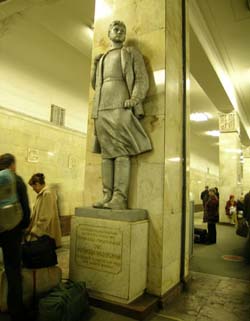
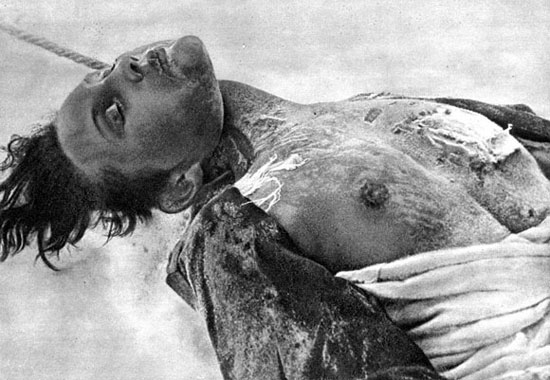
On this date in 1941, Soviet partisan Zoya Kosmodemyanskaya was hanged by the Wehrmacht for sabotaging buildings behind German lines near Moscow.

A statue of Zoya Kosmodemyanskaya stands vigil over Moscow’s World War II-era Partizanskaya metro station. Image used with permission.

One of the most famous Soviet war heroines and the first woman decorated as Hero of the Soviet Union during World War II, the 18-year-old had quit school to volunteer for a partisan unit only a few weeks before her hanging as Russia mobilized against Hitler’s race towards Moscow.

Known simply as “Tanya”, the nom de guerre which was the only information she volunteered during two days of torture, the power of the press offered her apotheosis into a propaganda coup for the Kremlin, and a symbol of courage that would long outlive Stalin. Before the public execution, the Nazis paused to photograph the scene; Kosmodemyanskaya availed the lull to harangue the Germans — “you can’t hang all 190 million of us!” — and call on the Russian villagers present to resist occupation.

Her bayoneted, mutilated body hung on the gibbet until the Red Army recaptured the village; witnesses related the tale of her dying heroism to a newsman.

It was only after the story of “Tanya” hit the press in January 1942 that her identity was established … and then promulgated widely. Anonymous and obscure in death, Zoya Kosmodemyanskaya would inspire millions and become the heroic emblem of other women partisans.


Soviet propaganda poster unabashedly modeled on the already-iconic image of Zoya Kosmodemyanskaya’s abused corpse.

Zoya, a 1944 Soviet film, was scored by Dmitri Shostakovich.

Part of the Themed Set: Women Against Fascism.

On this day..

1944: An unknown Allied airman

On this date in 1944, in the midst of a worldwide conflagration that would claim 70 million lives, one unknown crew member of an Allied bomber was shot by Nazi SS/SD troops in the woods around Enschede, Netherlands.

From late 1942, the Allies’ massive industrial capacity had sapped the vaunted Luftwaffe, bleeding down the German air force in desperate airborne combat in the Mediterranean and the Eastern front. Crippling losses in July and August 1943 lay Germany’s industrial heart open to devastating bombing and would within a year spell the end of the Luftwaffe as an effective fighting force.

The contest’s stakes were high. This hour-long compilation of contemporaneous U.S. propaganda footage celebrates the decisive effect of air supremacy in western Europe:

With hostile planes darkening Europe’s skies, the Germans called upon ruthlessness to stand in for materiel. Nazi SS chief Heinrich Himmler issued, according to Robin O’Neil, an August 1943 order to show no quarter to captured enemy pilots.

The young man shot this day suffered its effects:

The airman (estimated age 26 years), who was apparently unhurt, was taken by the SS to the cellar of the villa [serving as SS headquarters], where he was kept under guard while arrangements were made for his disposal. These arrangements consisted of the removal of his flying kit, and the substitution of a civilian light-coloured shirt, a pair of dark trousers, and a pair of socks.

In this dress he was put into a security vehicle, his hands handcuffed behind his back, and taken some distance in the grounds of the SS HQ to a spot within the compound where a grave had already been prepared. The airman was marched from the car by an escort of two SS men, one of whom dropped back and shot the airman in the back of the neck. He was buried and the grave was carefully camouflaged.

To this day, the airman’s identity has not been established. It was assumed that he was British or American, most probably American, as the trousers he was wearing were of a dark shade of khaki, and the fact that when he was informed in the car, in English, that he was to be executed, he made an indistinct reply in which the word “America” was uttered.

Countless such executions undoubtedly took place and were lost, forgotten or concealed in the charnel house of war. Thanks to the witness of Dutch prisoners who survived the war, this single act of routine brutality endured not only historically but juridically: little more than a year later, its author, Dr. Karl Eberhard Schongarth — an SS officer who participated in the Wannsee Conference and slaughtered thousands in occupied Poland and Holland — faced a war crimes prosecution for the execution of the anonymous airman.

His actions this date may have been small by the gauge of a bloodthirsty career, but since pre-war treaties explicitly regulated treatment of war prisoners, they also constituted a conveniently plain transgression of the far-from-bright line demarcating “war crimes.” For this one killing, Schongarth was himself hanged as a war criminal in Hamelin, Germany on May 16, 1946.

On this day..

1695: Zumbi dos Palmares

On this date in 1695, Zumbi dos Palmares, the last leader of Brazil’s most famous free colony of fugitive slaves, was captured by the Portuguese and summarily beheaded.

From the very beginning of European settlement in the New Wold, Maroon communities of escaped slaves, free-born blacks, Indians, poor whites, and mixed-race outcasts formed at the fringes of slave states.

Colonial power did not welcome their presence.

Consequently, the community of Palmares faced repeated harassment from the Portuguese and the Dutch West Indies Company from the time of its establishment around 1600 — even as it burgeoned into a kingdom of over 30,000 inhabitants.

Zumbi, a black free-born in Palmares, was kidnapped by such a sortie and raised with a missionary priest who taught him Portuguese and Latin. At 15, he escaped and returned to Palmares, quickly rising to prominence and in 1678 overthrowing his adoptive uncle King Ganga Zumba when the latter attempted to accept peace under Portuguese rule.

Zumbi’s skepticism was vindicated when the followers of Zumba who had defected to Portugal were re-enslaved, but free Palmares soon faced intensified Portuguese pressure. In 1694, artillery finally battered its largest settlement into submission — forcing its ruler into the bush, where he long eluded capture.

In Zumbi’s honor, November 20 is a Brazilian celebration of national pride and especially pride for those of African descent … while the king who would not be a slave has lent his name, somewhat paradoxically, to an international airport.

On this day..

1002: St. Brice’s Day Massacre

On this date over a millennium past, according to the chronicle of John of Wallingford, King Ethelred the Unready of England conducted a massacre of Danes living in the realm.

The character of this sanguinary event — named after a fourth-century French bishop whose feast day Nov. 13 happens to be — lies half-buried in history’s shifting sands. Surely the slaughter of every Dane in a Britain then very much in the Scandinavian orbit would have been not only morally reprehensible but logistically unimaginable.

The accepted, albeit sketchy, story has it that to consolidate his own authority — or to check an actual or suspected plot against him — Ethelred ordered the surprise apprehension and summary execution of some sizable number of Danish lords and mercenaries. British historian Thomas Hodgkin characterizes it as a sort of coup d’etat.

On this date, it was the Danes who were unready for Ethelred.

But whatever its true extent or immediate object, it occurred within the context of intensifying conflict between the English crown and Scandinavian aspirants. Ethelred was to spend the better part of his life struggling — both militarily and through the ruinous tribute of Danegeld — to hold back the incursions of the Viking king Sweyn I.

The St. Brice’s Day Massacre exacerbated those tensions. Sweyn’s sister was apparently among those massacred, and — whether driven by vengeance or simply availing a pretext — Sweyn resumed harrying the English kingdom in the following years.

By 1013, Sweyn had driven Ethelred to Normandy and ruled all of England, welding together a Norse empire fringing the whole north of Europe.

But the empire — and England’s place in it — proved an historical cul-de-sac. Authority in England would be contested for another half-century, gradually sapping the crown’s strength until the Norman Conquest in 1066 swept aside Viking power and set England on a course that would redefine its history.

Update: The story of Ethelred, Normandy, and the Vikings told in Episode 3 of Lars Brownworth’s Norman Centuries podcast:

[audio:http://c4.libsyn.com/editions/58550/17915/03-richard-the-good.mp3]

The British History Podcast covers the St. Brice’s Day Massacre in episode 328.

On this day..

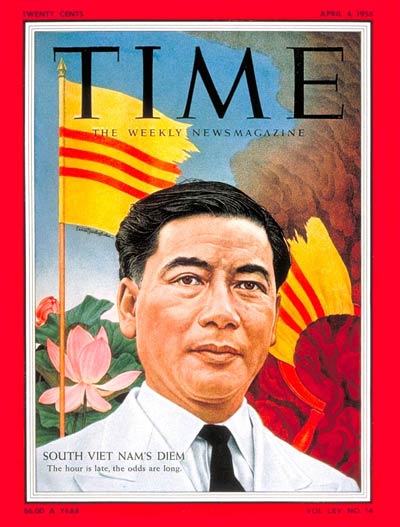
1963: Ngo Dinh Diem

On this date in 1963, Ngo Dinh Diem, the first president of South Vietnam, was executed in the back of an armored personnel carrier along with his younger brother and secret police chief, Ngo Dinh Nhu, the day after their government had been overthrown in a military coup.

Born into the Buddhist country’s Catholic elite, Diem was brought up as a French colonial administrator but fled Vietnam in 1950 under a death sentence from Ho Chi Minh’s nascent Vietminh. Over several years living and lecturing in the United States, he established his anti-communist bona fides with influential conservatives and was returned to his native country as Prime Minister when the U.S. inherited the foundering French war against nationalist guerrillas.

Fearing communist victory at the polls, Diem blocked scheduled 1956 elections to unify North and South Vietnam, making an interim division permanent. But Diem made an inconsistent American client, often spurning Washington’s advice and alienating the Buddhist majority with heavy-handed authoritarianism that eventually prompted Buddhist monks to begin public self-immolation as a form of protest.

The government responded by arresting monks.

By now more a liability than an asset, Diem was ousted with the blessing of a fellow Catholic head of state, John F. Kennedy.

This first successful coup — Diem had already quashed attempted putsches in 1960 and 1962 — began a cycle of internecine revolts in which weak South Vietnamese governments were toppled in rapid succession … leaving Saigon ever more visibly the puppet of Washington, and dragging the United States ever more deeply into the Vietnam War.

On this day..