1515: Gio Batta, on the Capitoline Hill

You’ll not find the single execution (and its accounting of fees) that forms the very slim hook for this post until the very end of an extensively bloody tour of Renaissance and Early Modern Rome’s execution topography. This unauthorized appendix to your Rome tourism guide comprises excerpts of the public domain volume The Roman Capitol in Ancient and Modern Times, by Emmanuel Rodocanachi.


THE TARPEIAN MOUNT OR MOUNT CAPRINO.

In the Middle Ages nothing survived of what had constituted the splendour of the Tarpeian Mount of antiquity. Here and there only were a few scattered shafts of columns lying, a few sides of walls that had fallen, a few vestiges of foundations, while the other end of the Capitoline Mount was becoming the centre of municipal life, and a church, that of S. Maria Aracoeli, adorned it. Furthermore, this portion of the hill was soon chosen as the public execution place. In a chronicle of the thirteenth century, relating the legend of Pope Filigato (996 [sic]), we read: “… idcirco usque adhuc nullus papa venire vult in montem tarpeium ad arcen Urbis Romae scilicet in Capitolium ubi iste Johannes tormenta sustinuit. Ibi itaque semper ferebantur sententiae mortis contra sceleratos et contra adversarios Romanorum.”

To this spot the name platea of spianata was given, in translation of the word area, area capitolina (as opposed to arx), which had formerly designated it. This explains why the place of execution was often so called. Fra Montreale, who was condemned to death by Rienzo, was led “a lo piano” to be executed there. His head was cut off near the ruins of a tower.

The spot appointed for executions is fixed with accuracy by a curious document. In 1385, Giordanello degli Ilperini or Alberini, a nobleman of the Monti quarter, was cast into the prisons of the Capitol. Fearing the rage of the lords bannerets, furor presentium dominorum banderentium,” and not wishing to die without a will, he drew one up, forthwith, in the great hall where the assemblies of the people were held. Among other dispositions, he required his heirs to spend two florins in having a figure painted “ad imaginem gloriosissime virginis Marie,” in front of the gibbet and place of execution, “ante furcas et locum iustitie.” And, in fact, the figure was painted beneath the portico of a granary belonging to the Maffei family, in a spot indicated by Infessura thus: “in una costa di muro appresso santa Maria delle grazie di sotto a Campidoglio a piedi lo monte.” Thenceforward, criminals had a sight that consoled them in their last moments.

The custom of hanging people in this place was continued in the fifteenth century. In the Diario di Antonio Petri (1407) is the expression: “In loco iustitiae, videlicet in plano Capitolii.” The gallows is clearly visible in the Sienna plan. Somewhat later, documentary allusions become more frequent. An Act dated in 1457 bears on it: “in loco qui dicitur Monte Arpetio (Tarpeio) sive lo piano inter hos fines … ab alio via per quam itur ad furcas.” In another document, dated in 1473, and referring to the settling of a boundary, the following passage occurs: “ab alio tenet locus iustitiae qui dicitur lo piano.” This same document informs us that, behind the palace of the Conservators, lay a garden belonging to them, part of which exists to-day, while the other has been taken into the Caffarelli palace, which, at present, is the German embassy.

Executions were witnessed by the Senator. It was a duty incumbent on his office. He took up his position at the window in the palace situated in the southern tower. This window, as previously said, was ornamented in 1413 by the Senator Nicola of Diano.

Among the celebrated executions which took place on the gibbet of Mount Caprino was that of the accomplices of the Chevalier Stefano Porcari, who himself was hanged from the battlements of St. Angel’s castle in 1453. His accomplices were nine in number; and eight of them were hanged together. In 1490, a man accused of trying to poison Pope Innocent VIII, at the instigation of the Sultan of Constantinople, was beaten to the ground, on the ordinary execution place, by blows on his head with a club; then he was struck on the chest and stomach with an iron-covered fist, after which he was drawn and quartered. Hangings were numerous; in 1507, there were seven. The gibbet continued to be used in this spot until 1550, when the improvements that were undertaken in the surroundings brought about its suppression. Thenceforward, criminals were hanged on the Giudea square, at the entrance to the Ghetto.


A high gallows towers over Rome’s Piazza Giudia in this 1752 engraving by Giuseppi Vasi.

On occasion, use was made, as a prison, of the ruins standing on this potion of the hill, perhaps of some pits that will be spoken of further. Under the pontificate of Innocent III, the Romans confined their prisoners of war there.

The neighbouring quarters, suffering from the presence of the gibbet, remained deserted and neglected. Goats browsed in them, which soon caused the hill to receive the name of Mount Caprino, a name that it retained for a long time. The locality was almost a jungle. Gregory XIII, having remade, in 1582, the road that led to it, was justified in having inscribed on a stone that still exists in the Via di Monte Tarpeio these words: “Hinc ad tarpejam sedem et capitolia ducit. Pervia nunc olim silvestribus horrida dumis …”


The Piazza del Campidoglio atop Capitoline Hill, where beheadings took place. This is a view of its condition prior to Michelangelo’s 16th century makeover of the place, which changed it into this …

EXECUTIONS IN THE CAPITOLINE PALACE.

Whilst hangings took place on the gibbet of Mount Caprino, the beheadings were carried out on the Square of the Capitol [Piazza del Campidoglio -ed.], and even inside the palace. If Fra Montreale was beheaded at the foot of the Mount Caprino tower, it was by way of compromise, since he was considered as much a malefactor an an “enemy of the people” as a prisoner of war. Usually, executions in the Capitol took place on the great staircase, near the lion. It was there that, on the 3rd of March, 1398, the conspirators were beheaded who had attempted to re-establish the power of the bannerets, destroyed by Pope Boniface IX.

In the fifteenth century, executions were frequent. In 1405, Paolo Maracini, Giovanni Gnafri, and Motta were beheaded in the Capitol. In 1406, Antonio Carola was beheaded there also, as well as Giovanni Colonna, Jacovo de Nepi, “miles libertatis,” Ricardo Sanguineis, rebels against Pope Gregory XII. In 1497, Galleotto de Normanis was “decollatus, de mane, hora consueta, in loco institiae Capitolii, tanquam proditor Urbis.” Sometimes the execution was carried out in the evening: “De sero, hora completorii, fuit capta uxor Cole Cancellarii de Reg. Columne ac etiam Paulus de Cancellariis … omnes tanquam proditores Urbis et ducti per mercatum ad Capitolium et martirazti.” Before each execution, the condemned person had his sentence read to him, in the great hall of the Capitol. The bell rang thrice, and, at the third peal, he was put to death. In certain cases, the bell was not run; but this, as previously said, was when the execution was considered to be a murder. Occasionally the execution was inside the palace. We read that Lello Capocci was decapitated “Intus in palatio Capitolii ad pedem secunde columne ubi tenetur ratio.” The Square of the Capitol was also used as a place to expose criminals. Cardinal Vitelleschi shut up in three wooden cages, which were set there for the people to mock at, a triplet of thieves who had stolen the precious stones adorning the reliquary wherein were kept, at the church of St. John Lateran, the heads of St. Peter and St. Paul. The thieves were subsequently executed on the Square of the Lateran.

Now and again, hangings took place from the windows or arcades of the Capitoline loggia. On the 19th of December, 1458, Bernardo della Rosa was hanged from the window of the great staircase. At that time, however, hangings were not frequent. Infessura complains of it: “In Capitolio nulla vel saltem rara executio corporalis fit, nisi quod per curiam domini vicecamerarii aliqui nocte suspenduntur et mane suspensi reperiuntur apud turrim Nonae sine nomine et sine causa: et hoc ordine vivitur hodie in Urbe sedente Innocentio octavo” (1489).

EXECUTIONS IN THE SIXTEENTH CENTURY.

The hangings that Infessura, in his time, regretted were so few, as was seen in the previous chapter, were not long before they began again; and numerous ones took place on the Capitol during the sixteenth century, and in the few yers prior to it.

In the single year of 1497 were hanged from the windows of the Capitol: Matteo di Andrea, Francesco di Giacomo, Pietro Santi, Giordano della Scarpa. At the same time, hangings were also carried out on the gibbet of Mount Caprino.*

The expenses of executions were generally paid by the Governor, who deducted the necessary sums from the money furnished by fines, taxae maleficiorum. Under the date of the 13th of July, 1515, the executioner received three julii (about a hundred sols) for cutting off the head of a male servant, Gio. Batta; he received, besides, a salary of three gold ducats a month. The price paid for hangings was the same as for decapitations, three julii. It cost no more to have the criminal burned, after he had been hanged. However, it would seem that compensation was made for the wood, the chains, and the scaffold, when the criminal had been burned alive. Eighteen carlins were paid for the execution of a forger; and, for floggings, the executioner charged six carlins.

* A footnote here in the original helpfully explains that the executions referenced in this section come from “Archiv di Stato, Archivio di s. Giovanni Decollato, Busta XXIV. vol. 2″: “This brotherhood’s mission was to assist criminals; a regular register was kept of the executions at which the brethren of the order had been present.”

On this day..

1758: Not Florence Hensey, Seven Years’ War spy

The French spy Florence Hensey was due to die at Tyburn on this date in 1758. As it happened, the only violence done there was to the spectators.

A well-traveled Irish Catholic, Hensey had a prosperous London medical practice when he made an offer to a former colleague in France to share intelligence on war preparations at the outset of the England-vs.-France Seven Years’ War (1756-1763).
Upon being accepted into the ranks of salaried moles, Hensey set his industry to forming acquaintances at establishments where parliamentarians and their clerks met and gossiped, transmitting the resulting nuggets to France by way of Germany in lemon juice ink concealed within letters bearing nothing but everyday pleasantries. Eventually clerks suspicious at the volume of such superficially trivial exchanges being imposed upon the international post got nosy and found out the real story.

Hensey’s treachery was obvious, ongoing, and in the midst of wartime. He should have died for it, but on that very morning he was spared that miserable fate. The Newgate calendar professes “much surprise at the extension of royal mercy” considering numerous other precedents to the contrary.

De la Motte, the particulars of whose case we shall hereafter give, was “hanged, drawn, and quartered,” for the same kind of offence which Hensey committed; and in still more recent times, numbers have suffered death for similar treason; and yet we have to observe, without finding any especial reason for it, that Doctor Hensey was pardoned. If granted from political motives, it must have been in fear of Spain; an unworthy impulse of the ministers of a far greater and more powerful nation.

Indeed, the Spanish connection appears to be the best explanation for Hensey’s unexpected reprieve: he had a brother in the retinue of a Spanish ambassador who was able to exercise his empire’s diplomatic channels in the doctor’s service. (Spain was on the sidelines at this moment, and Britain keen to keep her there; the Spanish finally joined the war on France’s side very late in the game, in 1762.)

This gambit, however, came as quite a nasty surprise to the ample and bloodthirsty crowd that had turned up at Tyburn.

The awful procession to Tyburn, intended to impress the multitude with sentiments of reverence for the laws of their country, produced a very contrary effect; and the eager and detestable curiosity of the populace, to witness executions, became a source of considerable emolument to certain miscreants, who were in the habit of erecting scaffolds for spectators; many of these scaffolds were substantial wooden buildings, and erected at every point from whence a glimpse of the execution could be obtained; the prices for seats varied according to the turpitude or quality of the criminal: — Dr. Hensey was to have been executed for High Treason in 1758, the prices of seats for that exhibition amounted to 2s. and 2s. 6d.; but, in the midst of general expectation, the Doctor was most provokingly reprieved.

As the mob descended from their stations with unwilling steps, it occurred to them, that, as they had been deprived of the intended entertainment, the proprietors of the seats ought to return the admission-money; which they demanded in terms vociferous, and with blows offensive, and in short, exercised their happy talent for rioting with unbounded success. On this occasion a vast number of these erections were destroyed.

Hensey spent a couple more years in Newgate, then was released into obscurity; presumably he left the realm to his brother’s custody.

On this day..

1864: The Andersonville Raiders

It’s not hard to understand why the Andersonville Raiders turned criminal. But on this day in 1864, the group was decapitated when six of its leaders were hanged in a quasi-legal action at the most inhospitable prisoner of war camp in the Confederacy.*

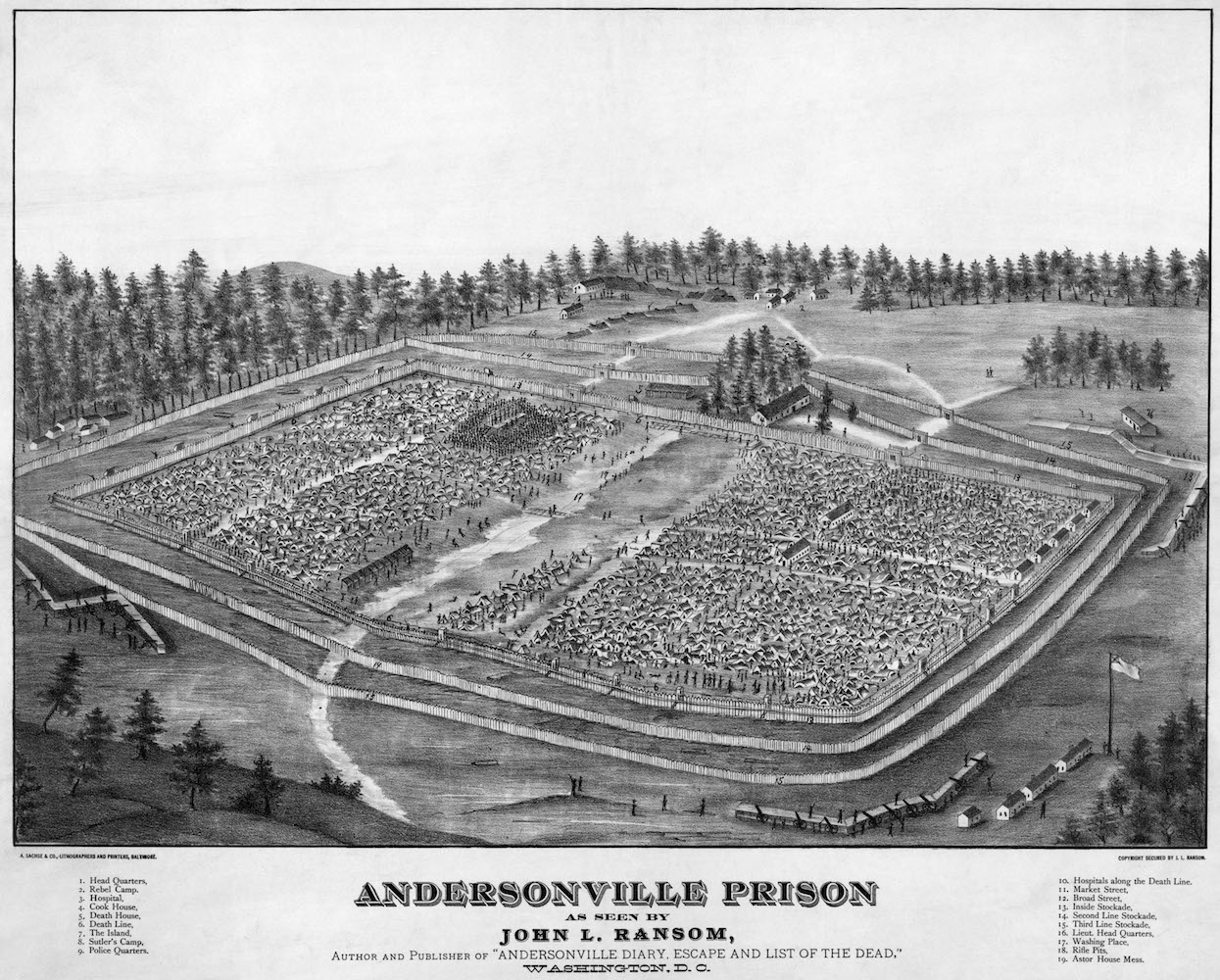
Andersonville Prison was opened in February 1864, 26.5 Georgian acres (about 0.1 square kilometers, or about the size of a square 4 city blocks on a side) of tightly-packed tents with a ditch of water flowing through its center. Its design population was 10-15,000 prisoners; its true population at one point was almost 30,000.** Some 45,000 Union soldiers went in, passing first the outer stockade, then the so-called “dead line” that demarcated the line outside of which they could be shot summarily, and finally into a mass of malnourished, often sickly humanity. Of these, 13,000 never emerged.

The Confederacy, you may recall, was not the war’s winner. As an aspiring nation, the CSA borrowed heavily to fund its arms, then found itself strapped for basic supplies as the war dragged on. By 1863 the nation was already economically depressed, and when a CSA-USA prisoner exchange agreement broke down, the Confederacy found itself with a lot of Union soldiers to house and nowhere to put them. Enter Andersonville: far enough from the North to be “safe”, easily defensible, and in the heart of slave labor to build it. All the Confederacy needed to build some basic housing was wood, which should be … oh wait … war update!…the Union controlled lumber supplies. Guess there won’t be housing.

Prisoners instead got lumped in with their brigade, and (at least initially) basic materials to make some sort of shelter.† New arrivals often showed up without being thoroughly checked over, so they might come in with food and supplies that weren’t already available to other internees.‡ Very quickly, the grounds were littered with Union POWs from around the country, people with vastly different backgrounds and goods. As the camp’s population breached 10,000 and then 20,000,§ there were, of course, inmates with designs on better living.

It’s not hard to see where this is going.

Sometime around May 1864, dozens of them assembled into a loose affiliation. The Raiders were headed by about a half dozen men: Charles Curtis, Patrick Delaney, John Sarsfield, William Collins (“Moseby”), a guy known only as “A. Munn”, and W.R. Rickson (or possibly Terry Sullivan; there’s an unusual disparity in diary accounts on the person’s name, but first-hand diary entries from the moment prefer Rickson) were considered the principal offenders. Each headed a small band of thieves who would trick new entrants, burgle tents, or use violence or threats of violence to amass “wealth” and keep themselves well-fed, well-clothed, and, most importantly to them in this hostile place, alive.

The Raiders had some huge advantages when they committed these crimes. Thanks to their amalgamated resources, they had good odds of being better armed and more fit than their victims — unless those victims were green, in which case they just knew the place better. The thieves started out as midnight raiders who turned tail at the first sign of genuine resistance unless they thought they could readily overpower the victim. By mid-June they were brazen, according to John Ransom: “Raiders … do as they please, kill, plunder and steal in broad day light, with no one to molest them.”

The victims were soldiers who, even if they weren’t killed, were left without resources in a deadly environment. Even the robberies and beatings were, in many cases, a prolonged form of murder, and Union inmates knew it. Indeed, Collins was thought by most to have never directly assaulted anyone, but he was known to steal blankets from the ill.

It’s unclear what the full Raider population was (estimates range from 100 to 500, but most people settle on the 100-200 range). What we can say definitively is that it was large enough to be a problem. Late in June of that year, a group called “the regulators” began taking police-like action against the perpetrators. Inmates brought their complaints to the group, which sought out and punished — usually through head shaving or other non-destructive means — those they found responsible.

On June 29, that problem started getting a real solution when the Raiders assaulted and robbed a prisoner now known only as Dowd. Dowd complained to the guards, and Andersonville’s overseer, Captain Henry Wirz, officially endorsed the Regulators as a police force/tribunal to maintain order. But first he announced an end to inmate rations until the Raiders were given up. (What a guy!)

The Regulators, headed by a man called “Lumber” (or maybe “Limber”) Jim, quickly had 80-100 inmates to deal with. Jury trials were implemented in the spirit of (but without most of the protections of) common law, and most punishments ranged from setting in the stocks to running the gauntlet.


Detail of a panorama sketch of Andersonville (click to see it) makes space for a certain well-attended sextuple hanging.

The ringleaders were also among this bunch. They were assembled on July 11 and executed at a hastily-erected gallows on the north end of camp. As far as the POWs were concerned, the ultimate crime of the Raiders was a violation of the soldier code of death before dishonor. Their bodies were buried separately from other inmates, and the US makes a point of placing no memorial flags at their graves.

To be clear, the Andersonville Raiders were, for most inmates, not the primary problem but an obviously controllable one. Remember that 30% of the interned died, and for the most part those deaths were borne of bad sanitation, hunger, and disease. The removal of the Raiders was a morale boost at best, as Andersonville was still a pee-pee soaked heckhole in which another 10,000 soldiers would die before liberation in May 1865, most of them before the summer’s end.

* It was also known as Camp Sumter, named after the county it resided in.

** The population density at peak was 330,000 people per square kilometer. For comparison, the world’s densest city is Manila, at about 71,000 people per square kilometer.

† It turns out the term “shebang” wasn’t widely-used camp lingo. Drawings and photos of the camp illustrate the variety of dwellings: open sleeping, simple V-tents, structured tents, lean-tos, huts, and shacks were all scattered about the grounds.

‡ They also came with new diseases.

§ The original camp was actually only 16.5 acres, and the population ballooned to 20,000 in early June and 33,000 in August of that year. Ransom notes that the stockade was “enlarged” on July 6. Fall transfers dropped the number to 1,500 and it bumped back up to 5,000 until war’s end. Sanitation issues persisted throughout.

On this day..

1941: George Johnson Armstrong, under the Treachery Act

Marine engineer George Johnson Armstrong on this date in 1941 was hanged at Wandsworth Prison … attaining an unenviable distinction as the first of five Britons executed under the Treachery Act of 1940.

One of the very first laws enacted by the incoming wartime government of Winston Churchill as the Wehrmacht overran France, the Treachery Act anticipated two potential difficulties in punishing various forms of aid that folk might thereafter attempt to extend to the Third Reich.

We’ll let all about those difficulties:

if we rely upon the Treason Act — the main Act, as I have said, is an Act of great antiquity — and other Acts which establish special procedure and special formalities, we shall have a much more complicated and cumbrous procedure than may, in existing circumstances, be justified.

There is also this further point. The law of treason in this country applies, of course, to every British subject wherever that British subject is living, because every British subject owes allegiance to the King. The law of treason also applies to aliens in so far as they owe to the King local allegiance — that is to say, as long as they are resident in this country and enjoying the protection of its laws. It is a very doubtful question indeed whether under the existing law of treason you could proceed against an alien who has come here suddenly, surreptitiously by air or otherwise, for the purposes of wreaking clandestine destruction or doing other acts against the safety of the real. In as much as treason is a crime committed by someone who owes allegiance, it might be well argued that such a person does not owe allegiance to the British Crown.

This act was handy indeed against enemy spies like Josef Jakobs, but it was also employed against five British citizens during and immediately following the war. (We’ve previously met a couple of them in these very pages: Theodore Schurch and Duncan Scott-Ford.) Johnson’s particular offense was to communicate an offer to a German consulate in the United States to help keep the then-still-neutral U.S. out of the war.

A full list of those executed for wartime treachery can be found at CapitalPunishmehtUK.org.

On this day..

1880: A day in the death penalty around the U.S.

A half-dozen murderers hanged in five different U.S. states on this date in 1880.


Cincinnati Commercial Tribune, July 10, 1880. We make the count six, not four.

George Allen Price (Pennsylvania)


Harrisburg (Penn.) Patriot, July 10, 1880.

George Sanford and Richard McKee (Arkansas)


Columbus (Ga.) Daily Enquirer, July 13, 1880.

Alexander Howard (North Carolina), Daniel Washington (South Carolina), and Henry Ryan (Georgia)

(Note: Henry Ryan’s execution is missing from the Espy File of U.S. executions.)

On this day..

1825: Tahvo Putkonen, Finland’s last peacetime execution

Finland’s last peacetime execution occurred on this date in 1825: the instrument was an axe.

Farmhand Tahvo Putkonen, deep in a blue gap celebrating both Christmas and his December 26 name day in 1822, went off his rocker at the party he was hosting because of a guest’s actual or imagined transgression against good manners.

The drunken Putkonen suddenly attacked that guest, farmer Lasse Hirvonen, until this ill-tempered host got kicked out of his own house by the rest of the celebrants. Once he’d convinced everyone that he’d calmed down, he got back in the house and mortally bashed Hirvonen over the head with a firewood log.

Putkonen spent a long-for-the-time 2.5 years appealing against the legal proceedings before they finally struck off his head. So pedants take note: although he has the distinction of being the last peacetime execution, his was not the last peacetime crime that led to execution: one Abraham Kaipainen managed to commit murder (July 31, 1823) and reach the headsman’s block (October 30, 1824) all while Tahvo Putkonen was still fighting his sentence.

The very last executions in Finnish history took place in 1944, during the Continuation War — Finland’s local installment of World War II, fought against the Soviet Union.

Capital punishment is today formally abolished in Finland.

On this day..

1907: Xu Xulin, anti-Manchu assassin

Chinese revolutionary Xu Xulin was executed on this date in 1907.

As a civil servant in Anhui Province, this militant (English Wikipedia entry | German | the far more detailed Chinese) had just one day before assassinated the provincial governor, En-ming, during the ceremonial graduation of a police academy. Xu himself was the academy’s superintendent.

He’d been hoping to touch off a revolution and his hopes, though not ill-founded, were disappointed in this moment. He was beheaded hours later and his heart carved out as an offering to his victim. Xu’s cousin, the feminist Qiu Jin, was executed the following week for the same disturbance.

Surprisingly, Xu’s murder of a Manchu official — the Mongolian peoples who ruled China’s domestic Han majority under the Qing dynasty — directly spurred a national response to his frankly stated ethnic grievances, as the Qing maneuvered (too late, as it would transpire) to implement reforms that could sustain their state through a revolutionary era.

Xu Xilin, during his interrogation, readily confessed that he had killed Enming simply because he was a Manchu … Xu Xilin professed no grudge against Enming personally, nor did he claim that the governor had been particularly hostile toward Han. Rather, Xu’s enmity was directed toward the Manchus in general:

The Manchus have enslaved us Han for nearly three hundred years. On the surface they seem to be implementing constitutionalism, but that’s only to ensnare people’s minds. In reality they are upholding the centralization of authority so as to enhance their own power. The Manchus’ presumption is that once there is constitutionalism, then revolution will be impossible … If constitutionalism means centralization, then the more constitutionalism there is, the faster we Han people will die … I have harbored anti-Manchu feelings for more than ten years. Only today have I achieved my goal. My intention was to murder Enming, then to kill Duanfang, Tieliang, and Liangbi, so as to avenge the Han people … You say that the governor was a good official, that he treated me very well. Granted. But since my aim is to oppose the Manchus, I cannot be concerned with whether a particular Manchu was a good or bad official. As for his treating me well, that was the private kindness of an individual person. My killing of the governor, on the other hand, expresses the universal principal of anti-Manchuism.

The murder of Enming caused tremendous unease among Manchu officials … Because it coincided with a series of revolutionary uprisings in Guangdong that Sun Yat-sen had launched in early May, the assassination was especially upsetting. According to British diplomats, “Everywhere throughout the country the Manchu officials are living closely guarded in their Yamens.” …

[The Empress] Cixi was particularly anxious about Xu Xilin’s anti-Manchuism. At an audience a month later with her foreign minister, Lu Haihuan (1840-1927), the empress dowager was reportedly still wrestling with Xu’s ghost. She insisted to Lu, “The bandit Xu Xilin claimed that there is prejudice between Manchus and Han, but really when we select provincial officials there is no prejudice whatsoever.” More to the point, she issued within five weeks of each other two edicts that were clearly prompted by Enming’s murder. The first, promulgated on 8 July, two days after the assassination, called once more upon her subjects to present proposals for reform, but this time her appeal went beyond the elite of top officials who were authorized to memorialize the throne to the much broader group of junior officials and scholar commoners, who were now permitted to have their ideas forwarded to her by either the Censorate or the provincial officials.

[The second edict, of 10 August] focused specifically on Manchu-Han relations. Cixi maintained, yet one more time, that the Qing dynasty throughout its long history had always treated Manchus and Han impartially, both as officials and as subjects. Nor had it, in recent appointments to the banner system [hereditary provincial military and administrative posts that were overwhelmingly Manchu], distinguished between Manchus and Han … she then called on all officials to offer suggestions on “how to totally eradicate the boundaries between Manchus and Han.”

-Edward J. M. Rhoads, Manchus and Han: Ethnic Relations and Political Power in Late Qing and Early Republican China, 1861-1928

Proposals from various officials ran the gamut, — encouraging intermarriage, abolishing legal privileges still enjoyed by Manchus, suppressing the Manchu language, and moving Manchu cultural practices towards the Han in everything from naming conventions to forms of address. Even Cixi’s Grand Council was shaken up to establish parity between Manchus and Han.

The chilling words of the dead assassin still echoing, the government moved on these proposals with surprising urgency. By the autumn,

the court issued two edicts, ten days apart, that resolved to drastically change, though not abolish, the Eight Banner system. The first edict, handed down on 27 September, ordered … that the provincial garrisons be disbanded over a ten-year period and their inhabitants be prepared to make their own living … The second edict, issued on 9 October, dealt with the customary and legal differences between Manchus and Han, such as the length of the mourning period and the commutation of punishments. It called on the Ministry of Rites together with the Commissioners for Revising and Codifying the Laws to draw up a set of ceremonies and penal codes that would apply uniformly to Manchus and Han, excepting only the imperial lineage.

These two edicts thus accepted many of the proposals advanced by the memorialists after Enming’s assassination …

Meanwhile, in response to the growing demands of the constitutionalist reformers … Cixi, in her own name, issued two other edicts that clarified the vague promise that she had made a year earlier to institute a constitutional regime. On 20 September 1907 she declared that her ultimate intention was to establish “a bicameral deliberative body.” As a preparatory step, she ordered the immediate creation of a Consultative Assembly, appointed the fourth-rank prince Pulun (1874-1926) and the elderly grand secretary Jia’nai as its co-presidents, and charged them, together with the Grand Council, to draw up a detailed plan for this new national assembly. A month later, on 19 October, she authorized the formation of provincial deliberative assemblies as well. Afterward, she sent Pulun to Japan to learn more about constitutional government at first hand.

Cixi died the following year. The Xinhai Revolution ended the Qing dynasty in 1911.

On this day..

2018: Shoko Asahara and six Aum Shinrikyo followers, for the Tokyo sarin attack

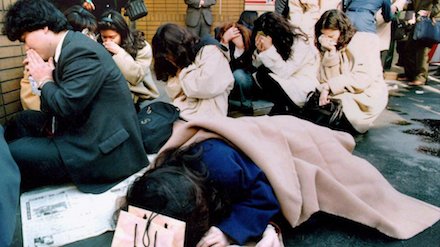
Shoko Asahara and six of his followers in the Aum Shinrikyo cult were hanged today in Japan as authors of one of the most infamous terrorist attacks in recent history: the sarin attack on the Tokyo subway of 1995.

Thirteen people died and several thousand more were injured when members of this millenial sect deposited punctured bags of homemade liquid sarin on multiple rail lines of Tokyo’s subway during Monday rush hour.

It was only one of several gas attacks perpetrated by Aum Shinrikyo during the 1990s; just nine months previous, they had killed nine people in a sarin attack in Matsumoto. But it is by far the most notorious. Images of stricken commuters, blinded and suffocating under the nerve agent’s influence, sprawled on the transit platforms or outside them shocked orderly Japan in 1995, especially so since it came fast on the heels of the devastating January 1995 Kobe earthquake.

These comprised “two of the gravest tragedies in Japan’s postwar history,” according to Haruki Murakami’s Underground: The Tokyo Gas Attack and the Japanese Psyche. “It is no exaggeration to say that there was a marked change in the Japanese consciousness ‘before’ and ‘after’ these events.” Japanese Justice Minister Yoko Kamikawa struck a similar chord in announcing the hangings today: “These crimes … plunged people not only in Japan but in other countries as well into deadly fear and shook society to its core.”

Its mastermind Shoko Asahara, the first man executed this morning, emerged soon thereafter into public view a bedraggled and half-blind fanatic, almost the picture of an agent of chaos. Shockingly, his cult had been able to thrive in the early 1990s thanks in part to murdering an attorney who was investigating Aum Shinrikyo back in 1989.

Beyond the seven hanged on July 6, 2018, six additional members of the cult still remain under sentence of death in Japan for the Tokyo subway atrocity.

On this day..

1530: Johnnie Armstrong, border reiver

Scottish “border reiver” John Armstrong of Gilnockie was hanged on this date in 1530 with his followers at Caerlanrig, without benefit of trial.

The job description of the border reiver was to, well, reave the border. These mounted raiders exploited the wide gaps in sovereignty that opened along the ill-controlled England-Scotland border throughout the 16th century (their heyday) and indeed for centuries prior. They plundered vulnerable* farmers both north and south of the notional line. Sometimes the prize was livestock; other times, the “black rent” due your basic protection racket would suffice.

Their presence left an indelible imprint on the Anglo-Scottish marches, from the farmhouse fortresses called bastle houses to provisions in the “March Law” governing the manner of permissible counter-raiding.

Nettlesome as they were, they also stood useful mercenaries hired out for a number of the era’s battles; notably, English-hired reivers held off a much larger Scottish incursion in 1542. Only with the union of the crowns under James VI of Scotland/James I of England were the reivers finally suppressed.**

Johnny/Johnnie Armstrong, the younger brother of Thomas, Laird of Mangerton, is perhaps the most lasting legend among them — thanks to the signal boost he would later receive from Sir Walter Scott. Chief of a reiver band 160 strong, Armstrong made himself enough of a headache for English-Scottish diplomacy that the Scots king James V resorted to treachery to eliminate him. Having dialed up the frontier “prince” for a meeting, James simply had the sharp-dressed marauder arrested and summarily hanged when the reiver came to call. Thirty-six of his fellow reivers died with him.

Johnny Armstrong is the subject and the title of a notable child ballad (no. 169) whose lyrics can be perused in their entirety here; several renditions of its climactic third chapter can be found in the usual places.

John murdred was at Carlinrigg,
And all his galant companie;
But Scotlands heart was never sae wae,
To see sae mony brave men die.

Because they savd their country deir
Frae Englishmen; nane were sae bauld,
Whyle Johnie livd on the border-syde,
Nane of them durst cum neir his hald.

* “Vulnerable” mostly meant, neither in the ambit of a powerful protector, nor of the reiver’s own clan.

** A subsequent echo of the border reivers — in the same vein and the same region, but clearly distinct from them — emerged later in the 17th century in the form of the moss troopers.

On this day..

1828: William Rice but not John Montgomery, who cheated the hangman with prussic acid

(Thanks to Meaghan Good of the Charley Project for the guest post. -ed.)

Just before 6:00 a.m. on July 4, 1828, prison officers arrived at the cell of disgraced ensign John Burgh Montgomery in Newgate Prison‘s condemned hold.

They were there to escort Montgomery to his hanging. The 33­-year-­old would have been one of the last in England executed for for the crime of uttering forged notes — except that his wardens instead found him lying stone dead. With the aid of prussic acid, the counterfeiter had cheated the hangman of half his day’s prey, leaving his prospective gallows partner, thief William Rice, to face the hemp alone.

Although his guards had confiscated his razor and penknife as a routine precaution against suicide, no one had expected Montgomery to take his own life. He had pleaded guilty before the court and seemed resigned to his fate. In custody he was a model prisoner, spent his last days writing to his loved ones, and “addressed himself with great anxiety to his religious offices.”

Nobody was able to figure out how the condemned man came by enough poison to kill thirty people and how he kept it hidden, given that he and his cell were regularly searched.

The Irish-­born Montgomery, Nicola Sly records in her book Goodbye, Cruel World… A Compendium of Suicide,

was said to be a very respectable, well­-educated man, who had once held a commission in the Army. However, after inheriting a considerable fortune, he frittered it away and resorted to passing phony banknotes to support his rather dissipated lifestyle. Given his pleasing looks, gentlemanly appearance and good manners, he was very successful, since nobody thought him capable of any wrongdoing. However, he was caught after becoming careless and making the mistake of committing frequent repeated offense in a small geographical area of London.

Montgomery left behind several letters, marked by expansive tragic romanticism but no hint of suicidal intent. One letter was for the prison surgeon, asking that his body be used for dissection. He said that by this he wanted to provide some positive contribution to the public to make up for his crimes. He asked that his heart be preserved in spirits and given to his girlfriend.

To the girlfriend he wrote,

My dear idolized L.,

One more last farewell, one more last adieu to a being so much attached to the unhappy Montgomery. Oh, my dearest girl. If it had been in the power of anyone to avert my dreadful doom, your kind exertions would have been attended with such success. Oh, God, so poor Montgomery is to die on the scaffold. Oh, how dreadful have been my hours of reflection, whilst in this dreary cell.

Oh, how tottering were all my hopes; the bitterness of my reflection is bitter in the extreme. This will be forwarded to you by my kind friend Mrs. D. I should wish you to possess my writing portmanteau. Oh, I wished to have disappointed the horrid multitude who will be assembled to witness my ignominious exit. Farewell forever,

P.S. Here I kiss fervently.

The jury on the inquest into Montgomery’s death recorded a verdict of felo de se, meaning that Montgomery had willfully and knowingly taken his own life whilst of sound mind. As such, his body was buried in the graveyard of St. Sepulchre­-without-Newgate at night, and without any memorial service.

On this day..