1865: William Grant, evidently a ringleader, a persuader, and adviser

The account below of a forgotten saddler hastily attainted a participant “in the background” in the Morant Bay rebellion comes from Illustrations of Martial Law in Jamaica: Compiled from the Report of the Royal Commissioners, and Other Blue Books Laid Before Parliament.


Another victim was William Grant, saddler, of Morant Bay. The following record of the proceedings in his case is probably unique in the history of judicial or quasi-judicial investigations :—

October 20th, 1865.
Drum-head Court Martial.

President:—Lieut. H. Brand, E.N.
Members:—Lieut. Errington, K.N., Ensign Kelly, 4th W.I.R.

William Grant, charged with being one of the ringleaders and originators of this rebellion.

The Provost sworn states :—

About four or five days ago I was informed that this man was the originator and founder of the party who raised the rebellion, that he was not likely to be seen himself, but makes the others. He keeps a saddler’s shop, where the secret meetings took place. On the road from St. Thomas-in-the-East to the Guinness (Ginnep) tree, where placards had been posted, calling secret meetings, I searched the house of Chisholm, also a confederate, and in the presence of Mr. Jones, E.A., I took a blue card, as an admission ticket to a Society of Friends, printed William Grant, Founder. That card I sent to the Governor.

The prisoner Duncan Stuart, in his defence, when called upon by Captain Astwood, voluntarily made this statement. He had previously made it in the presence of Mr. Miller, J.P., whose signatures I here produce. “Grant called Bogle at Dr Alveranga’s, and said, ‘Don’t pull this down, wait a little, don’t join with the Volunteers, when you see what they do, run in.’ Grant said, ‘Now is the time to vindicate.’ ”

Mr. Miller, Justice of Peace, for St. Thomas-in-the-East, sworn:—

That statement was voluntarily given and sworn to before me.

Geo. F. Judah, Sergeant-Major of Volunteers:—

I gave the prisoner my rifle to repair on the morning of the riot, and he has kept it, and I have never seen it since.

The prisoner in his defence merely states that he never knew anything about the riot before it actually broke out. He has acknowledged to having corresponded with Mr. Gordon, but that, he states, was quite private, about some land.

This man was evidently a ringleader, a persuader, and adviser, and did his utmost to keep in the background and push the ignorant on to rebel.

Found Guilty, October 20th, 1865. Sentence, Death.

H. Brand, President,
Lieutenant E.N.
Approved and confirmed,

A. A. Nelson,
Brig. Genl. Commanding Field Force.

[The proceedings of the Courts-martial were retained by the Commissioners, and they refused to exhibit them to the Counsel for the parties complaining of the measures of suppression. General Nelson and others were therefore not cross-examined in reference to these trials.]

The first witness, Ramsay, the Provost-Marshal, told the Court only of what he had been informed — the great crime of the prisoner apparently being that he was the founder of a Society of Friends, and had actually a blue card of membership in his house.

The witness, Duncan Stewart, was not called. He had already been tried and was under sentence of death, and was duly hanged the same evening along with Grant. (See List). A so-called statement of this man was produced in writing. It will be noticed he spoke only of “Grant” having used certain words. Three Grants were hung at Morant Bay, and a William Grant was convicted by a Special Commission at Kingston, while the Royal Commissioners were sitting, and sentenced to penal servitude for life. It is clear from the evidence then given that the William Grant alluded to by Duncan Stewart was the one who was then sentenced. John Dickenson, on being examined by the living William Grant at that trial said:— “There was a William Grant, a saddler, who is hung. You are left. You are the man.” (No. 355 of Papers laid before the Royal Commissioners by Mr. Eyre).

Ramsay had evidently a strong interest in the conviction of this prisoner. He sent the following letter to Captain Luke, on 16th October, 1865:— “I also personally apprehended William Grant, the founder of the Society of Friends. I hope I may not be thought seeking for pecuniary benefit alone in claiming the rewards for information against G. W. Gordon at large, seizure of Chisholm, Grant, and Miles.”

Brand, the President of the Court-Martial, seems to have felt the evidence was weak, and he supplemented it by the following statement of his own. “This man was evidently a ringleader, a persuader, and adviser, and did his utmost to keep in the back ground and push the ignorant on to rebel.” The Judge having thus convinced himself, by his own conclusive testimony, adds “Found guilty. Sentence, death,” and, as a matter of course, the experienced officer of Her Majesty’s Service, who was the revising officer, adds:—”Approved and confirmed. A. A. Nelson, Brig.-Genl., Commanding Field Force, Morant Bay, 20th October, 1865.”

It is unnecessary to add that in the list of the executed is to be found the name “William Grant, under date of the 20th October. Charge, ringleader of rebellion!”

On this day..

1749: Bosavern Penlez, whorehouse expropriator

To the memory of the unfortunate
BOSAVERN PEN LEZ
Who finished a Life, generall well reported of,
By a violent and ignominious Death.
He was the Son of a Clergyman,
To whom he was indebted for an Education, which he so wisely improv’d
As to merit the Love and Esteem of all that knew him.
But actuated by Principles, in themselves truly laudable
(When rightly directed, and properly restrain’d)
He was hurried by a Zeal for his countrymen,
And an honest Detestation of Public Stews
(The most certain Bane of Youth, and the Disgrace of Government)
To engage in an Undertaking, which the most Partial cannot defend,
And yet the least Candid must excuse.
For thus indeliberately mixing with Rioters, whom he accidentally met with,
He was condemn’d to die:
And of 400 Persons concerned in the same Attempt, he only suffer’d,
Tho’ neither Principal, nor Contriver.

How well he deserved Life, appears
From his generous Contempt of it, in forbidding a Rescue of himself;
And what Returns he would have made to Royal Clemency,
Had it been extended to him, may fairly be presumed
From his noble Endeavours to prevent the least Affront to that Power,
Which, tho greatly importun’d, refused to save him.

What was denied to his Person, was paid to his Ashes,
By the Inhabitants of St. Clement Danes,
Who order’d him to be interr’d among their Brethren,
Defray’d the Charges of his Funeral,
And thought no Mark of Pity or Respect too much
For this Unhappy Youth,
Whose Death was occasioned by no other Fault
But a too warm Indignation for their Sufferings.

By his sad Example, Reader be admonish’d
Of the many ill Consequences that attend an intemperate Zeal.
Learn hence to respect the Laws — even the most oppressive;
And think thyself happy under that Government
‘That doth truly and indifferently administer Justice,
‘To the Punishment of Wickedness and Vice,
‘And to the Maintenance of God’s True Religion and Virtue.’

On this date in 1749, Bosavern Penlez — surely one of the all-time great names to hang on a gibbet — was put to death to the sorrow of all of England. You know how they say that horse thieves are not hanged for stealing horses, but that horses might not be stolen? Bosavern Penlez was hanged that whorehouses might not be torn down by mobs of angry sailors.

(Fourteen other less remarkable folk were hanged for less remarkable crimes at the same time. Just another mass execution day at Tyburn.)

A petition of over 300 St. Clement Danes residents for sparing the two men condemned in the riots. (From the General Advertiser, Oct. 11, 1749.) John Wilson received the solicited pardon; Bosavern Penlez did not.

On the first three days of July in 1749, the Strand in London saw a running series of riots after a mob of angry sailors descended on a whorehouse where some of their brethren had been robbed and abused. Those sailors pulled down that bordello and then moved on to the nearby bawdy-houses, eventually also ransacking the Star Tavern owned by a character named Peter Wood.

Gendarmes had to be called out to control the situation (and this done without proper legal authorization), but somehow not the mob’s ringleaders nor its inciters nor its most enthusiastic wreckers wound up in legal jeopardy.

Only two faced death: John Wilson, a journeyman shoemaker. And Bosavern Penlez, a young wig-maker who’d been out drinking in the neighborhood. And both of these seemed to have just been caught up accidentally or opportunistically in events.

They were comprehensively damned by the testimony of Peter Wood, the aggrieved procurer of Star Tavern, and his wife — disreputable people of whom a neighbor remarked, “I would not hang a dog or a cat upon their evidence.” But then, besides the eyewitness testimony, Bosavern Penlez was also apprehended with a bundle of linens he had evidently liberated from the Wood’s devastated cathouse, linens whose source he unconvincingly claimed not to remember. So the picture one has is that Wilson was perhaps little more than a passerby … but Penlez was a distinct, if minor, participant who could more or less be shown to have got himself tanked and treated the mayhem like it was a gift certificate to Bed, Bath & Beyond.

Not exactly saintly but also not a cardinal sin. Public sentiment for these fellows’ clemency was intense, starting right with the jury that convicted them but also recommended mercy.

Only Wilson was spared, however.

According to the Newgate Calendar, George II was mightily disposed to pardon both, but justice John Willes, who heard the case personally, vigorously opposed the royal mercy for “no regard would be paid to the laws except one of them was made an example of.”

Penlez, in the end, was the one made example of.

His hanging this date in 1749 would bleed into an election held later that same autumn, almost dealing a serious setback to the sitting Pelham government. Those events are detailed in Malvin Zirker’s introduction to this out-of-print volume.

And the resultant fusillade of pamphlets and public protests asserting a maximalist take on Penlez’s purity induced novelist Henry Fielding to enter the fray with a manifesto of his own strongly supporting the young man’s execution.

Readers of Fielding’s fiction might start at the rigidity of his editorial line.

Penlez’s defenders couldn’t really argue that he was completely innocent. Still, they contested the justice of the death penalty for such a character whose involvement in the whole thing was so tertiary and happenstance, not to mention influenced by drink. Doubly so that it was attested by the word of such a villain as Peter Wood. In the words of one pro-Penlez polemic, Wood would “run at every one, like a mad Dog, … indifferent who it was he hang’d by his Oath.”

Fanny Hill author John Cleland entered the fray on the side of the accused; his The Case of the Unfortunate Bosavern Penlez is aghast at “shedding the Blood of this young Man for the Example-sake … such a Severity being too much for the Nature of the Guilt actually chargeable on him, [and] will serve rather to confound and destroy all Ideas of Right and Wrong.”

Penlez was convicted not as a thief — which charge would have given the jury leave to find that the value of his linens amounted to less than the threshold necessary to hang him — but under the Riot Act which directly mandated death for “unlawfully, riotously, and tumultuously assembled together, to the disturbance of the publick peace.” Wood’s eyewitness testimony to the effect that Penlez (and Wilson, too) smashed up windows and furniture in his house and threatened him was essential to establishing a part in the tumultuous assembly.*

As this level of guilt was popularly doubted, our friend Henry Fielding — himself the very magistrate** who had engineered the suppression of the disturbance, having returned on the third day of it from a weekend away from London — took up his pen post-hanging to support the government’s handling of Penlez from arrest all the way to the scaffold. His A True State of the Case of Bosavern Penlez produces the witness accounts sworn before him as magistrate during the riots themselves, and reproves those Penlez supporters whose anger at his execution made the “malefactor” into “an object of sedition, when he is transformed into a hero, and the most merciful prince who ever sat on any throne is arraigned of blameable severity, if not of downright cruelty, for suffering justice to take place.”

If, after perusing the evidence which I have here produced, there should remain any private compassion in the breast of the reader, far be it from me to endeavour to remove it. I hope I have said enough to prove that this was such a riot as called for some example, and that the man [Penlez] who was made that example deserved his fate. Which, if he did, I think it will follow, that more hath been said and done in his favour than ought to have been; and that the clamour of severity against the government hath been in the highest degree unjustifiable.

* The Ordinary of Newgate reported that Penlez, who long remained cagey on the point, admitted in the end entering the bawdy-house during the riot, but disavowed any attack upon its owner. Wilson, for what it’s worth, always denied having entered the house and insisted Wood had misidentified him.

** Henry Fielding was the half-brother of magistrate and policing pioneer John Fielding. The Fieldings’ mutual roles in the creation of London’s first professional investigators to supplant the problematic “thief-taking” system of private, rewards-driven prosecution, is the subject of The First English Detectives: The Bow Street Runners and the Policing of London, 1750-1840.

On this day..

1768: Seven coal-heavers to crush the London port strike

On this date in 1768, a year of tremendous labor agitation in London, seven coal-heavers were hanged near the Shadwell dock.

With food prices surging,* the city’s hard-pressed urban proletariat was at peak militancy — which also lent violent energy the cause of hunted radical politician John Wilkes, who had returned from exile this year to stand for Parliament. Two principal loci of labor insurgency in 1768 were the Spitalfields weavers, whose struggle we have already observed, and the “coal heavers” — the men who did the grueling labor of offloading coal from Thames barges.

Coal-heaving was ill-paid and dangerous, and it was notoriously sensitive to fraud: workers (largely Irish: they’d been imported to hold down wages) being paid by the “sack” or the “vat” fought supervisors at riverside over just how fully loaded with coal such a sack or vat should be. Workers had their own recourse to “indirect Practises,” pilfering a few coals on the side to supplement pay up to within hailing distance of subsistence. The boss would call “theft” this grey-area practice harkening to labor traditions ancient and still-current. The rope would help him define it so.

Peter Linebaugh’s magisterial social history The London Hanged dramatically treats the fraught and violent months of the spring of 1768, when Irish workingmen were “bringing river traffic to a stand-still … [and] stopped the imperialist artery.”

Dockside taverns doubled as fraternal entities and regiments in the unfolding dock war. One John Green, keeper of a pub on New-Gravel Lane (not as scenic as the nearby Cutthroat Lane)

organized scab labour from [his] Roundabout Tavern. It was attacked in April with gunfire. A shoemaker bled to death on the pavement, a coal-heaver took a bullet in the head, ‘dropped down backwards, and never stirred’. The taverns were besieged, their furnishings destroyed. Gunfire was frequent. Green was acquitted of murder. Those testifying for him were mobbed and one witness had her jaw broken. The coal-heavers were as violent in word as in deed. ‘They would have Green’s Heart and Liver and Do for him’; ‘they would have him joint from joint’; ‘they would have his heart and liver, and cut him in pieces and hang him on his sign’; ‘they would hang him over his sign Post & cut him into Beef Stakes’.

Our seven — by name John Grainger, Daniel Clark, Richard Cornwall, Patrick Lynch, Thomas Murray, Peter Flaharty, and Nicholas McCabe — were indicted on grounds that they “with force and arms, with certain guns loaded with gunpowder and leaden bullets, feloniously, wilfully, and maliciously did shoot off at John Green.” Not quite cut into Beef Stakes, but it’ll get the job done.

Though the trials of Green, and then of Green’s assailants, were weeks apart, they concerned the very same disturbance on the night of April 20-21, when Green’s residence had been besieged by angry coal-heavers and Green with others had shot out the windows and killed at least two … but managed to hold his foes at bay during what must have been a harrowing night. Green wasn’t hurt, and gave evidence at the “shooting off” trial.

The London Irish had by 1768 an unparalleled knowledge of arms and armed struggle. They contributed to an insurrectionary impulse within the London working class. At the same time, as a consequence, the Irish had close knowledge of violent death. The intimacy of that knowledge was expressed in vivid euphemisms designed to reduce the terror of hanging. Seven coal-heavers received the ‘cramp jaw’ at the Old Bailey only after a new interpretation was placed upon the Waltham Black Act. The seven danced ‘a new jig without music’ on 26 July 1768. This particular ‘crack neck assembly’ was located in Sun Tavern fields, Shadwell … The move from Tyburn was designed to terrify the poor and working people of the river parishes. The ‘breath stopper’ was witnessed by 50,000 spectators, perhaps the largest crowd at such a scene since the hanging of the Earl of Ferrers eight years earlier. The Government anticipated disorders, if not rescue attempts, when these seven were to dance ‘tuxt de ert and de skies’. From 6 a.m. more than 600 soldiers patrolled the streets of Wapping and Shadwell. The Sheriff ordered all the constables of the Tower and Holborn divisions to assemble at the hanging site and to come armed with their staves. Thomas Turlis, the hangman, had stolen coal from a neighbour’s cellar five years earlier. But, that his work might not be interrupted, the Sheriff quickly obtained a pardon for him. He did his duty upon the coal-heavers, sent ‘a-spinning like a whirligig’. Once they had ‘peacably’ exited the world, many of the spectators may have gone for a drink as was customary:

Wid a facer we coddled our blood
For de wind id blows cold from de gibbett.

… The hanging at Sun Tavern Fields … taught a hard lesson about collective bargaining: attempts to counteract the rise in the price of provisions by improving wage rates would not be allowed. … the insurrectionary vanguard of the river proletariat was broken.

Or, as a more sanguine observer put it, after the hangings “the tumults immediately ceased, and peace and industry was happily restored.” And they all lived happily ever after.

* Bread prices doubled in 1768, leading to work stoppages, hoarding, and food riots throughout the city. Representative slogan shouted by desperate rioters: “We might as well be hanged as starve.” (George Rude, “The London ‘Mob’ of the Eighteenth Century,” The Historical Journal, Vol. II, no. 1 (1959))

On this day..

1989: A day in the death penalty around post-Tiananmen China


Yue Minjun, who still lives in China, says Tiananmen was “the catalyst for conceiving” of his Execution but that it is most certainly not about the famous protest and ensuing crackdown.

Although 1989 protests toppled dictatorships in Eastern Europe, this pregnant year’s great rally in China brought a bloody (pdf) crackdown.

The student-led Tiananmen Square protests packed hundreds of thousands into that Beijing plaza — with sympathy protests in other major cities — demanding liberalization.

For seven weeks, they seemed on the brink of making another world.

Then on June 4th came the crackdown.

The masters of China must have been holding their breath that day: would the soldiers follow their orders? Would the rebellion shrink away, or metastasize? You really never know.

By night, the masters of China could exhale.

Judicial reprisals were mere days in commencing … and June 21 appears to mark the first known executions* resulting from that tragic movement. And while most “perpetrators” didn’t die for the affair, it seems from the distance of a generation as if their cause did.

There was likewise, it was noticed in the American press, no comment on this date’s signal executions from the United States president. Washington and Beijing, these regimes west and east, alike weathering the end of the Cold War — they had a future in common.

Despite the harsh crackdown on protest, Chinese leaders and mass media have been almost desperately urging foreign businesses to maintain their ties with the country.

The New China News Agency carried a whole series of reports aimed at promoting international economic ties. These included:

— A report that foreign businesses will in the future be permitted to set up officially recognized chambers of commerce in China.

— An announcement that 10 large international industrial exhibitions will be held this year in Shanghai.

— A report that a Japanese businessman said investors from his country have confidence in China’s economy. “Some businessmen from the United States and the European Community have expressed their desire to continue to invest in China,” the report added.

— A statement by Ma Shizhong, vice governor of Shandong province, stressing that his part of China has “a favorable environment for import of foreign capital and introduction of up-to-date overseas technology.”


Only eleven days after the June 4th massacre that cleared Beijing’s Tiananmen Square, the first trial of pro-democracy protesters saw three workers condemned to death in Shanghai.

According to this pdf on the aftermath of Tiananmen, Xu Guoming, a brewery worker, Bian Hanwu, unemployed, and Yan Xuerong, a factory worker, were all convicted of “setting fire to a train and indiscriminate destruction of transport and transport equipment in a serious riot at the Guangxin Road Rail Crossing of Huning Railroad on June 6.”

According to Nick Kristof, that “riot” had been a sit-in on a rail line to protest the June 4 military incursion — until a train actually rammed the demonstrators, who retaliated by torching the machine. Some firefighters were beaten in the disturbance, but nobody was killed.

For their part in this — whatever part that was — Xu, Bian and Yan were deprived of their political rights, and expeditiously shot on June 21. Eight other people got prison sentences shortly thereafter for the same “riot”, having pleaded guilty (all but one of them) to “smashing railway cars, setting fire to nine railway cars and six public security motorcycles, turning over police boxes, beating up firemen to impede them from putting the fire out and fabricating rumors to mislead the people.”


Lin Zhaorong, Zhang Wenkui, Chen Jian, Zu Jianjun, Wang Hanwu, Luo Hongjun, and Ban Huijie, meanwhile, were sentenced for “vandalism and arson in a counter-revolutionary riot” on June 17, 1989, by the Beijing Intermediate People’s Court — stuff like burning a military vehicle, looting supplies from it, and beating up (although again, not killing) a soldier.

(This pdf gives the execution date as June 22; most other sources list June 21.)

An eighth member of their same party, Wang Lianxi, received a suspended death sentence instead. She was spared.


“An undetermined number of anti-government demonstrators,” according to a UPI report, were among 17 prisoners publicly convicted and immediately shot in Jinan on a generic charge of endangering public order on June 21. (UPI is explicit as to the date, but some reports say June 20.)

State radio reported that 10,000 people attended the trial, which meted out 45 sentences in all on a variety of charges and is said to have mixed political prisoners with common criminals.


We note in passing a gentleman who has never qualified for an entry in this blog, and we hope never will.

The identity and fate of the figure at the center of those protests’ most indelible images, the so-called “Tank Man”, remain an enduring mystery.

There exist widespread rumors and ill-substantiated press reports of his execution. But who Tank Man was and what really became of him remains utterly unknown.

* Amnesty International’s appeal for the three workers — and this is the Spanish version; if the English is available, I have not found it — very plausibly alleges that secret, summary executions were already underway before this date’s grim milestone.

On this day..

1769: Two weavers, for the Spitalfield riots

On this date in 1769, two weavers hanged in East London in a bitter fight over wages and labor power.

Spitalfields, the East London district also known as the stomping-ground of legendary jailbreaker Jack Sheppard, was the capital of a thriving English silk-weaving industry. It had attained 18th century prosperity thanks in large measure to the decision of William and Mary to invite Lyons Huguenots being hard-pressed by the French crown to relocate their talents across the channel. This now-domestic industry* quickly began supplanting formerly dominant French imports.

In 1713 it was stated that silks, gold and silver stuffs and ribbon made here were as good as those from France, and that £300,000 worth of black silk for hoods and scarves was made annually. In 1721 the value of the silk manufactured in England amounted to £700,000 more than in 1688, when wrought silks were imported from France to the annual value of half a million sterling. (Source)

In this roaring and prestigious business, William Hogarth situated his 1747 Industry & Idleness plates: both the Industrious Prentice (eventually destined to become Lord Mayor of London) and the Idle Prentice (eventually executed at Tyburn) start off shoulder to shoulder at the Spitalfields looms.

But as the 18th century unfolded, even the most industrious Spitalfield weavers came under increasing competitive pressure especially from Chinese and Indian imports.

Although Parliament attempted to ban textile imports to preserve the domestic industries, Spitalfield workers were known to enforce their prerogatives directly by attacking people in the street thought to be wearing foreign prints. This simmering tension came to a rapid boil after settlement of the Seven Years’ War enabled England and France to resume trading — and a glut of French textiles to undermine weavers’ price controls.

Conflicts were no less fierce within the weavers’ community, between masters and laborers. Workers combined to maintain wages by attacking those thought to be undercutting prices.

In September 1769, one such action punished a wealthy anti-“combination” (for “combination”, read “labor union”) manufacturer named Lewis Chauvet, and cut the silk handkerchiefs right out of his looms.


From Season 3, Episode 2 of the BBC drama Garrow’s Law, which is directly based on this case. As of this writing, the entire episode can be found on YouTube.

Cutting silk from the loom was a rough method of enforcement by the labor combination. It had also been made a capital crime a few years before. And it turned out that Chauvet was ready to make his the test case.

Richly paying off a couple of independent artisan weavers for their questionable testimony, he secured the conviction of John Valloine or Valline (other alternate spellings are possible; the name clearly denotes the district’s Huguenot heritage) and John Doyle, two weavers allegedly part of the loom-smashing action. The accused denied it, Doyle reported to have fulminated at the gallows, “I am as innocent of the fact I am now to die for as the child unborn. Let my blood lie to that wicked man who has purchased it with gold, and them notorious wretches who swore it falsely away.”**

Manufacturers’ purposes were served just as well whether innocent or guilty. The point was labor discipline, not a few lost hankies.

Accordingly fixing “to strike Terror into the Rioters”, the crown ordered the execution to occur not at the Tyburn gallows, but right in the weavers’ backyard, adjacent Spitalfields at Bethnal Green.

This order actually delayed the sentence for the judiciary’s consideration of the minor point of whether this was allowed at all — since the actual boilerplate sentence read from the bench had specified “the usual place.” The wisest magistrates of the land considered the matter and in time agreed that “the time and place of execution was no part of the sentence” and therefore subject to His Majesty’s discretion. Bethnal Green it was.

They were therefore this morning taken in a cart from Newgate through the City to Whitechapel, and thence up the road to Bethnal Green, attended by the Sheriffs &c, with the gallows, made for the purpose, in another cart; it was fixed in the cross road, near the Salmon and Ball.


The Salmon and Ball pub, where the execution happened, today. (cc) image by Ewan Munro.

There was an inconceivable number of people assembled, and many bricks, tiles, stones &c thrown while the gallows was fixing, and a great apprehension of a general tumult, notwithstanding the persuasion and endeavours of several gentlemen to appease the same. The unhappy sufferers were therefore obliged to be turned off before the usual time allowed on such occasions, which was about 11 o’clock; when, after hanging about fifty minutes they were cut down and delivered to their friends. (cited here)

Vengeful weavers having their noses rubbed in their comrades’ executions smashed up Chauvet’s house in the riots on this date, and the powers that be decided that one hanging-day at Bethnal Green was plenty. A few other rioters convicted as confederates of Doyle and Valline were put to death at Tybun later in December 1769.

Years of violent labor conflict were finally quelled with the 1773 Spitalfield Weavers Act, a political compromise which protected the domestic industry from foreign competition and enabled magistrates to set wages.

Though this act stabilized a tense domestic situation, its effect over several decades was seriously problematic: a protected monopoly with wage-controlled workers maintained an increasingly obsolete system of labor-intensive manufacture that fell behind power looms coming online elsewhere.

As late as 1851 — mechanization wouldn’t fully take over until Britain’s trade liberalization of the 1860s — Charles Dickens visited Spitalfields, and saw a weaver

doing now, exactly what his grandfather did. Nothing would induce him to use a simple improvement (the ‘fly shuttle’) to prevent the contraction of the chest of which he complains. Nothing would turn him aside from his old ways. It is the old custom to work at home, in a crowded room, instead of in a factory.

Disallowed from taking lower wages even in bad times (or when cheaper cotton started displacing silk), many weavers sat completely unemployed instead — gradually sinking into a proletarianization they had fought to avoid. Spitalfield weavers eventually became one of the classic case studies in the laissez faire economics canon.

* Just to be clear, Huguenots weren’t the first silk weavers in Spitalfields; it’s just that their arrival let the industry take off.

** The hanged man’s comrades made good his gallows menace. Peter Linebaugh, whose The London Hanged is an outstanding resource on the economic pressures that brought these weavers and many others to the gallows, relates:

At noon upon a cold and snowy day, 16 April 1771, [Chauvet’s paid witness against the weavers] Daniel Clarke … went walking in Spitalfields. It had been sixteen months since the hangings of the cutters whom Clarke had sworn against, and he must have thought the people cowed or forgetful. He was recognized. ‘There goes Clarke, that blood-selling rascal,’ was the shout, and instantly a small crowd gathered to badger and pester him. He took to his heels and found temporary refuge in the house of Mary Snee. The currents of popular memory run deep; now they flooded to the surface. A hundred people beset the house hurling maledictions. ‘They would hang him, or burn him, or stone him,’ said Mary Snee. He was cornered, stripped and dragged by his feet into the street, where he was led by the neck on a parade of humiliation. The crowds grew. Widow Horsford [wife of one of the weavers hanged later in December 1769 at Tyburn] was seen to ‘jump out of the loom’ at the news Clarke was cursed and dragged to the brick-fields. Children pelted him with dirt. Bespattered with muck, he was thrown into a pond where he was ducked within a breath of drowning. He was removed to a sandheap, buried, dug up and returned to the freezing water. It was estimated that the crowd numbered 3,000. While he could speak, he taunted his tormentors, saying ‘he would take twenty of them’. Widow Horsford said, ‘Clarke, Clarke, I am left a widow, my children is fatherless on account of you.’ Clarke answered, ‘Chauvet is worse than me,’ and then he expired. A grim ending that would be remembered for generations.

On this day..

1780: Five for the Gordon Riots

This date in 1780 saw three men and two women hanged at various spots around London for the previous month’s Gordon Riots. They were the first five souls among 19 who would suffer the last extremity of the law for that disturbance.

The eponymous Protestant Lord George Gordon, had inflamed a mob against the 1778 Papists Act, which disencumbered British Catholics of some of their legal disabilities. (In part to pad out the redcoat ranks as the army found itself stretched thin by the American Revolution.)

The Gordon Riots started from Lord Gordon’s march on Parliament to serve it an anti-Catholic petition, and turned into five days of anti-Catholic mayhem before the troops were finally called out to quell it. (The want of a standing professional police force was among the deficiencies London encountered.)


This did not help Britain’s diplomatic overtures towards Habsburg Austria.

But the matter metastasized well beyond a merely sectarian event: a mass rally originating in the working-class Moorfields took an unmistakable class dynamic — assailing Newgate Prison and The Clink, liberating convicts in the process. The latter dungeon would never resume operations. “Crimping houses” for impressed sailors and “sponging houses” imprisoning debtors were also liberated.

Alongside white sailors and day laborers, London’s emerging black population would feature prominently in this affair. A “copper coloured person,” a former slave named John Glover, was observed at the front rank of those torching Newgate. Peter Linebaugh attributes to Glover the incendiary (and, as it turned out, credible) threat, “Damn you, Open the Gate or we will Burn you down and have Everybody out.” (Glover was condemned to death, but reprieved for likely-fatal servitude on the African coast.)

Three of the five executed in London on this date were hanged at Tower Hill, including both women, Mary Roberts and Charlotte Gardiner. Gardiner, like Glover, was an African; she and Roberts had helped sack the house of an Italian Catholic innkeeper.

Although nineteen folks put to death within a month and a half hardly constitutes giving the rioters a pass, it’s somewhat striking in view of the unabashedly anti-authority conflagration in hemp-happy 18th-century England that the death toll wasn’t greater. And it could have been: in a treatment in the December 1997 History Today, Marika Sherwood reports that fully 326 people were tried for some role in the Gordon Riots. But elites’ sense of the situation may well be captured by Edmund Burke’s remark,

If I understand the temper of the publick at this moment a very great part of the lower, and some of the middling people of this city, are in a very critical disposition, and such as ought to be managed with firmness and delicacy.

Less than two score were actually condemned to death for all this mess, and barely half of them were actually executed.


The 19th century writer Charles Dickens set his very first historical novel,* Barnaby Rudge, during the riots, and has his fictitious lead characters among the crops doomed to the scaffold.

(As we have seen several times, Dickens abhorred public executions, a circumstance also apparent in this passage.)

Barnaby would have mounted the steps at the same time — indeed he would have gone before them, but in both attempts he was restrained, as he was to undergo the sentence elsewhere. In a few minutes the sheriffs reappeared, the same procession was again formed, and they passed through various rooms and passages to another door — that at which the cart was waiting. He held down his head to avoid seeing what he knew his eyes must otherwise encounter, and took his seat sorrowfully, — and yet with something of a childish pride and pleasure, — in the vehicle. The officers fell into their places at the sides, in front and in the rear; the sheriffs’ carriages rolled on; a guard of soldiers surrounded the whole; and they moved slowly forward through the throng and pressure toward Lord Mansfield‘s** ruined house.

It was a sad sight — all the show, and strength, and glitter, assembled round one helpless creature — and sadder yet to note, as he rode along, how his wandering thoughts found strange encouragement in the crowded windows and the concourse in the streets; and how, even then, he felt the influence of the bright sky, and looked up, smiling, into its deep unfathomable blue. But there had been many such sights since the riots were over — some so moving in their nature, and so repulsive too, that they were far more calculated to awaken pity for the sufferers, than respect for that law whose strong arm seemed in more than one case to be as wantonly stretched forth now that all was safe, as it had been basely paralysed in time of danger.

Two cripples — both mere boys — one with a leg of wood, one who dragged his twisted limbs along by the help of a crutch, were hanged in this same Bloomsbury Square. As the cart was about to glide from under them, it was observed that they stood with their faces from, not to, the house they had assisted to despoil; and their misery was protracted that this omission might be remedied. Another boy was hanged in Bow Street; other young lads in various quarters of the town. Four wretched women,† too, were put to death. In a word, those who suffered as rioters were, for the most part, the weakest, meanest, and most miserable among them. It was a most exquisite satire upon the false religious cry which had led to so much misery, that some of these people owned themselves to be Catholics, and begged to be attended by their own priests.

One young man was hanged in Bishopsgate Street, whose aged grey-headed father waited for him at the gallows, kissed him at its foot when he arrived, and sat there, on the ground, till they took him down. They would have given him the body of his child; but he had no hearse, no coffin, nothing to remove it in, being too poor — and walked meekly away beside the cart that took it back to prison, trying, as he went, to touch its lifeless hand.


Gordon himself, an odd duck, had better resources than these poor saps, and repelled a treason prosecution.

However, fate still ordained him a death in Newgate Prison — by illness many years later, after being convicted of defaming Marie Antoinette. By that time, the former Anglican rabble-rouser had converted to Orthodox Judaism, circumcision and all.

* The first of just two historical novels for Dickens; the second, of course, was A Tale of Two Cities.

** We’ve met Lord Mansfield before, articulating the jurisprudence of a slave society. His home was also targeted by Moorsfield rioters.

† Dickens is wrong about “four wretched women” being hanged: Gardiner and Roberts, our day’s pair, were the only two. Evidently, though, these two were arresting enough in the public conscience to forge “memories” of entire cartloads of ladies gone to Tyburn. (n.b.: none of the Gordon Rioters were hanged at Tyburn, either.)

On this day..

1648: The leaders of the Salt Riot

On this date in 1648, the ringleaders of a short-lived rebellion over salt taxes were executed in Moscow.

Salt saker image (cc) Greg Bishop

The Salt Riot is exactly what you’d think from its name, right down to being over in a matter of weeks.

Common folk irked at a new salt tax* that made the commodity dramatically more expensive besieged tsar Alexei I at the beginning of June, soon joined by opportunistic Streltsy who hadn’t been paid in a while.

The specific target of their rage was the boyar Boris Morozov, the elder brother-in-law of the teenage monarch, and the true power behind the throne. He accordingly played the traditional role of bad cop to the tsar’s presumptive good cop.

Of course, both guys were really on the same team.

A few days of mayhem, a few boyars’ heads on pikes later, the Streltsy had been bought off and the rioters divided and quashed. Alexei avoided handing over Morozov to the vengeance of the mob, and “exiled” him to a monastery. He would return from “exile” in a few months, once everyone had chilled out and the rising could be taken with a grain of salt.


Salt Riot in Kolomenskoe, by Nikolay Nekrasov.

This passing spasm in the Russian polity left a long-lived and troublesome legacy: one of the demands of the rioters was the convocation of the Zemsky Sobor to hammer out a new legal code.

This happened to be a need for the Russian state anyway, since its rulers were governing by the haphazard issuance of countless ukases nobody could keep straight. So, 1649 saw the promulgation of the Sobornoye Ulozheniye, helpfully rationalizing the lawmaking process.

Win, and win! Except that this legislative milestone also codified serfdom in its most heavy-handed form, formally binding most Russian peasants to their estate without freedom of movement, and making this unhappy condition hereditary. The legal code, and the institution of serfdom subsisted until the 19th century.

* According to The Cambridge History of Russia, the salt tax itself had actually been abolished at the end of 1647, but “other direct taxes were tripled to compensate for the loss of revenue.”

On this day..

1846: William Westwood, aka Jackey Jackey

On this date in 1846, the Australian outlaw William Westwood — better known as Jackey Jackey — was hanged with 11 others for a prison riot/escape attempt that claimed several guards’ lives.

“To the old hands,” relates George Boxall in this volume of bushranger folklore, “he was always the gentleman bushranger.”

More legends have collected round the name of Jackey Jackey than round that of any other of the bushrangers, and many of them are obviously variants of the stories told of the historical highwaymen of England. For instance, Jackey Jackey is said to have bailed up the carriage of the Commissary. When he discovered that the Commissary’s wife was inside he dismounted, opened the door and, sweeping the ground with his cabbage tree hat, as he bowed low before her, he invited her to favour him with a step on the green.* He rode incredible distances in incredibly short periods of time** … [and] never did anything mean or brutal or unworthy of a gentleman bushranger, until he was almost goaded to madness by the cruel discipline of Norfolk Island.

Transported to Australia at the age of 16, Jackey Jackey made that reputation with only a scant few months in the bush. The Victorian era was already underway in our young outlaw’s mother country; the day of the highwayman had long since given way to the day of romanticizing the highwayman.

Only on the empire’s distant fringes could the profession persist; there, men like our day’s principal self-consciously took their chivalrous forebears as their templates: Jackey Jackey thrashed a confederate who did violence to a woman, and threatened to murder the man if they should meet again.

Jackey Jackey had only a few months out in the bush in 1840-41 to trace the outlines of the gentleman bandit figure he aspired to. Caught in an inn in 1841, he spent the next several years exercising that other great craft of the folklore criminal: escape.

A cycle of jailbreaks, fleeting moments of liberty, recaptures, higher-security lockups, and increasingly desperate jailbreaks eventually landed at Norfolk Island, where “the treatment of the prisoners in the island was rigorous in the extreme, and may aptly be described as savage.” (Boxall, again)

Just a few years before Jackey Jackey’s death, they had been savage enough to provoke inmates desperate for the release of death to draw lots between the privileges of being murdered by a fellow-prisoner and hanging as that murderer.

Norfolk experimented with liberalizing its regimen in the early 1840s, but it was in rollback mode when our bushranger landed there. The steady removal of the minute privileges that make incarceration bearable — the right to grow a few potatoes; access to one’s own cooking tin and utensils — eventually triggered a similar suicidal mental break … but this time, on a riot scale.

Jackey Jackey made the following speech: “Now, men, I’ve made up my mind to bear this oppression no longer ; but, remember, I’m going to the gallows. If any man funks let him stand out. Those who wish to follow me, come on.”

A policeman named Morris was standing in the archway or entrance to the yard, Jackey Jackey rushed forward, struck him a fearful blow with an enormous bludgeon, and knocked him down. A large mob of the prisoners snatched up such weapons as came to their hands and followed him.

there were about eighteen hundred prisoners on the island, and of these, sixteen hundred were among the rioters. The soldiers numbered only about three hundred, but their discipline enabled them to overawe the vastly superior force, numerically, opposed to them. Perhaps the habits of obedience and submission, so long enforced on the prisoners, may have had some influence. Perhaps, even among this herd of desperate and reckless men, the sight of the soldiers standing firmly with their guns presented ready to fire may have instilled some fear. However this may have been, there was no fight. The rebels retired slowly and unwillingly to the Lumber Yard, where they permitted the soldiers to arrest them one after the other without making any show of defence until one thousand one hundred and ten of them were placed “on the chain.” Perhaps Jackey Jackey and the more violent of his followers may have thought that they had done sufficient to ensure them that death on the gallows which was the avowed object of their rising, while the majority had been so demoralised by official brutality as to be utterly indifferent as to what might become of them.

Twelve suffered death on the Norfolk Island gallows this date for the murder of the guard, with headline-grabber Jackey Jackey exonerating four of his fellow-sufferers in his dying statement.


The remains of the gallows area at the Norfolk Island gaol, gorgeously captured by Canberra photographer Allyeska. (Image used with permission.)

The bitter letter our despairing bushranger wrote to a gaol chaplain, meanwhile, could have been posted from many a modern penitentiary.

I was, like many others, driven to despair by the oppressive and tyrannical conduct of whose whose duty it was to prevent us from being treated in this way. Yet these men are courted by society; and the British Government, deceived by the interested representations of these men, ontinues to carry on a system that has and still continues to ruin the prospects of the souls and bodies of thousands of British subjects … instead of reforming the wretched man, under the present system, led by example on the one hand, and driven by despair and tyranny on the other, goes on from bad to worse, till at length he is ruined body and soul. Experience, dear bought experience, has taught me this. In all my career, I never was cruel I always felt keenly for the miseries of my fellow-creatures, and was ever ready to do all in my power to assist them to the utmost, yet my name will be handed down to posterity branded with the most opprobrious epithet that man can bestow. … this place is now worse than I can describe. Every species of petty tyranny … is put in force by the authorities. The men are half-starved, hard worked, and cruelly flogged. … Sir, out of the bitter cup of misery I have drunk from my sixteenth year ten long years and the sweetest draught is that which takes away the misery of living death; it is the friend that deceives no man; all will then be quiet no tyrant will there disturb my repose, I hope, William Westwood.†

(Boxall’s History of the Australian Bushrangers is available from archive.org here.)

* This legend is lifted wholesale from the c.v. of English highwayman Claude Duval.

** Warp-speed horsemanship features in many English outlaw legends, including those of Dick Turpin and the lesser-known John Nevison.

† Death as an escape from injustice and misery: another timeless theme.

On this day..

1644: Looters in conquered Beijing

The Shun Dynasty only lasted two months in China, but it still managed to find its way to these pages by deposing the ruling Ming Dynasty and setting the scene for the Q’ing Dynasty.

In the early 1500s, the Ming Dynasty significantly increased contact with Europe, and it immediately saw the value in exploited mineral wealth from the West. At the time, the government was having difficulty maintaining a currency with perceived value: paper money was a massive flop and standard copper coins could not be trusted. Something new was needed, and European silver was a quick and easy answer.

But the decision to move to silver coins backfired a century later, when a variety of converging factors cut the silver supply to China and caused a spike in the price of the metal. As a result, the economy sagged. In the mid-1640s, a drought also gripped the country, and the Ming government was in the unenviable position of watching over a collapsing nation. It didn’t help that the government was highly centralized, with almost all activity occurring in Beijing; a working regional governing mechanism may have allowed it to dig out of the hole, but with the rise of an elite class — and prospective officials seeking every opportunity to serve as close to the power center as possible — there was no hope of a savior once the emperor’s power waned.

Enter the Manchu.

(This is long.)

Originating in Northeast China and Southeast Siberia,* the Manchu occupied their own territory under a local khan. The Manchu army was building strength at the same time that the economic woes under Ming rule increased. While the Manchu originally considered themselves distinct from and superior to the Han Chinese, they made several legal concessions to match the social mores of those they ruled over which enhanced their credibility.

With the Ming Dynasty weakening, the Manchu saw their opportunity to move south.

But even as the Ming fought to repel those Manchu invaders, an internal insurrection was brewing under a man named Li Zu’cheng, an apprentice ironworker from Yan’an. The Chuang Wang (“Roaming King”, Li’s regnal name) was considered a savior of the common folk, even earning a widespread local song looking forward to the day he would arrive:

You’ll feed your mates,
You’ll dress your mates,
You’ll open wide your city gates.
When Prince Chuang arrives, there’ll be no more rates.

(Source)

Li had a strong foothold in the heart of the country, and he was persistent. More importantly, the Ming government was hemorrhaging cash to its frontiers. Eventually, the money began to dry up, and even the ministers within the Chongzhen Emperor’s circle saw the writing on the wall. By mid-March, the Manchus were known to be marching through nearly undefended lines; by mid-April, the treasury stopped paying its military entirely.

On April 24, with Li Zu’cheng at the city gates, Emperor Ch’ung Chen tried in vain to escape his own compound. In his wake, he left the corpse of the empress (suicide), the corpse of his daughter (killed by the drunken emperor in a rage), and a seriously injured crown princess (maimed by the drunken emperor). Having mowed through his family, the emperor joined his chief eunuch Wang Cheng’en, climbed atop a local hill, and, shortly after midnight on April 25, hanged himself.

Li Zu’cheng entered the city unopposed, the gates (as the ditty had promised) flung open for his invading army.

Government officials hid in an attempt to escape retribution, but Li’s forces were reportedly quite orderly and did not seek revenge. Instead, they marched slowly through the city, where many of the locals marked themselves as Shun-min, or subjects of Li’s Shun dynasty.

Looters and bandits, however, were not tolerated, and the well-disciplined force dispatched them quickly and without trial. Their bodies were put on display by nailing them to local streetposts, and by noon, the city was calm.

The Roaming King only managed to hold power for a few weeks before his army was swept away by the Manchus. Li Zu’cheng lived almost two more years on the run, still claiming his title of Emperor of Shaanxi as he fled the newly installed government. It would be several more years before the Manchu would retake Southern China,** but the Q’ing Dynasty would dominate China until the Xinhai Revolution in 1912.

* The Manchurians were technically Tungusic, a significant Chinese minority both then and now. The Manchu largely resisted integration into Han society until the latter half of the 19th century.

** Southern China remained, technically, a distinct entity called the Southern Ming Dynasty, south of the Huai River, until 1662.

On this day..

1924: Ali Reshti and Sayyid Husain, to placate America

On this date in 1924, diplomatic maneuvering, oil patch politics, and a dead American consul put two Iranian teenagers in front of a firing squad.

Largely forgotten today, the affair which prompted their execution helped Cossack commander Reza Khan‘s ongoing consolidation of power, culminating in another year’s time with his conquest of the Persian throne itself.

By the summer of 1924, he was by title Prime Minister and his domestic opponents could read the writing on the wall: he had made a premature bid for formal executive authority in 1923 only to be rebuffed.* At the same time, he was engaged in the perilous oil game with an attempt to use American companies to break a British oil monopoly.

On July 18, 1924, American Vice Consul Maj. Robert Imbrie and his civilian countryman Melvin Seymour were attacked by a Tehran mob while photographing a well which had become a Moslem devotional site for purported miraculous healings. Imbrie was beaten to death; Seymour was lucky to survive … and it soon emerged that soldiers from the nearby barracks had not only failed to protect the Americans but actually taken part in the assault.

Iran’s emerging strongman lost no time in making the most of it.

The event gave [Reza Khan] … the excuse for declaring martial law and a censorship of the Press … Numerous arrests have been made, chiefly of political opponents of the Prime Minister. (British military attache Col. W.A.K. Fraser)

It’s like Lenin said, you look for the person who will benefit and, uh, you know, uh, you know, you’ll, uh, you know what I’m trying to say …

Assuming one discerns some measure of design in the Imbrie murder, and the convenient outburst of anti-Baha’i paranoia that sparked the fatal incident, one can go a couple of different directions at this point.

  1. That the Prime Minister’s foes, allied with British oil interests (the British angle was so widely believed in Iran at the time that press censorship forbade the incendiary charge), were firing up the rowdies in an attempt to shake his power. This 1924 American cable makes that case:

    “It had the earmarks from the beginning of an artificially inspired movement, of which the organized powers of evil were quick to take advantage in order to create disorder for the Government … Reza Khan found himself faced with a situation before which he was powerless. The fanaticism of the crowd was so incited by the continuous preaching of the Mullahs that any act on his part would have been interpreted as treason to Islam and prima facie evidence that he was a Bahai; hence his unfortunate orders to the military and the police not to intervene under any circumstances in religious demonstrations and under no circumstances to fire.”

  2. That Pahlavi’s own agents fomented the disorder. According to Michael Zirinsky‘s review of the case, another American official speculated that Reza Khan himself hoped a foreigner would die “so that he could declare martial law and check the power of the Mullahs.”

Which, in the event, is exactly what happened.

The U.S. made a great show of demanding exemplary justice, and it had the leverage to do so: Iran (how times change!) wanted American support and American oil exploitation.

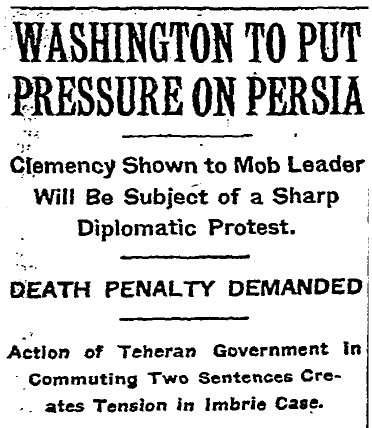
Three were condemned to death for their parts in the riot, and after the first, a young soldier named Morteza said to have incited the mob, was shot on Oct. 2, the government announced leniency for the other two.

Not good enough.


“When you are dealing with a government like Persia … if you ask them to execute a Moslem for the death of a Christian … if they do it, you accomplish more for the prestige of your country than if they paid a million.” -a young Allen Dulles, in 1926 testimony to the U.S. House of Representatives.

At American insistence, those other two were recalled to death after all: 17-year-old mullah Sayyid Husain (various alternate transliterations – e.g., Seyid Hussein), who was supposed to have raised the riot-triggering “Baha’i well-poisoner” accusation in the first place, and 14-year-old camel driver Ali Reshti.

Zirinsky once again:

With the ending of the Iran-U.S. dispute by the execution of Ali and Husain on November 2, 1924, Reza was free to leave the capital city. He had support from the foreign legations, he had secured financing for the army, he had reestablished discipline in the Cossack Brigade, and by executing Sayyid Husain — a mullah — he had demonstrated his domination over the clergy … in the course of the next months’ campaign, he completed the unification of Iran and ensured that his government would get all the [Anglo-Persian Oil Company] royalties…

While the Imbrie affair was not the only critical event of Reza’s seizure of total power in Iran, it came at a critical moment in his rise … he used the murder to his best advantage.

And they all lived happily ever after.

* The future Shah’s future rival Mohammed Mossadegh was among the Iranian Majlis members who blocked Reza Khan’s attempt to rule Iran as a republic in 1923.

** “Blood, Power, and Hypocrisy: The Murder of Robert Imbrie and American Relations with Pahlavi Iran, 1924,” International Journal of Middle East Studies, vol. 18, no. 3 (Aug. 1986). Zirinsky quotes an American diplomat who believed Reza Khan was actually intentionally trying to create a situation where a foreigner would be killed, to give him a pretext for bringing his nation to heel with foreign support.

On this day..