The Roman Emperor Tiberius expired at Misenum on this date in 37 A.D.
The Death of Tiberius, by Jean-Paul Laurens. Tacitus records that the aged princeps was thought to have expired, to the great relief of all, when word came that he was reviving. “[Praetorian prefect] Macro, nothing daunted, ordered the old emperor to be smothered under a huge heap of clothes.”
As Tiberius had been spending his last years terrifyingly purging Rome of alleged “traitors,” his death was met with some considerable relief. Great news: charismatic young prince Caligula is in charge now!
Anyway, despite the old man’s unpopularity and the manifest injustice of his treason trials, Tiberius’s death did not quite halt momentum of political butchery. Ever thus with bureaucracies.
The people were so glad of his death, that at the first news of it some ran about shouting, “Tiberius to the Tiber,” while others prayed to Mother Earth and the Manes to allow the dead man no abode except among the damned. Still others threatened his body with the hook and the Stairs of Mourning, especially embittered by a recent outrage, added to the memory of his former cruelty. It had been provided by decree of the senate that the execution of the condemned should in all cases be put off for ten days, and it chanced that the punishment of some fell due on the day when the news came about Tiberius. The poor wretches begged the public for protection; but since in the continued absence of Gaius [Caligula] there was no one who could be approached and appealed to, the jailers, fearing to act contrary to the law, strangled them and cast out their bodies on the Stairs of Mourning. Therefore hatred of the tyrant waxed greater, since his cruelty endured even after his death.
But Tiberius’s cruelty didn’t endure too long after his death. Pretty soon, Caligula’s cruelty would have the stage all to itself and Tiberius survivors would be yearning for the good old days.
The History of Rome podcast covers Tiberius’s crazy years and the transition to Caligula here.
* It’s not completely explicit that it was on this same March 16 that news of the emperor’s death hit Rome; therefore, it’s conceivable that the drama described here played out on a subsequent date.
On this date in 1939, Azerbaijani poet Mikayil Mushfig was shot during Stalin’s purges.
The 30-year-old former schoolteacher was a socialist enthusiast as a youth in the 1920s; his work celebrated officially sanctioned subjects like virtuous peasants and workers, and modernization of the alphabet.
How far to go to put aside the backward old ways? Poets debated in verse whether the traditional instrument tar ought to be banned.
[O]ne poet, Suleyman Rustam, wrote, “Stop tar, stop tar, You’re not loved by proletar!” Another poet, Mikayil Mushfig, countered, “Sing tar, sing tar! Who can forget you!”
The tar wasn’t banned, but Mushfig’s enthusiasm for the Soviet project was deemed (however genuine) insufficient, “petit-bourgeois”.
The nightingale is sorrowing near the rose,
Though autumn comes-it lingers to depart,
Life, life! This cry of longing ever grows:
With love, with burning passion how to part?
With feelings new, you string your singing lute
My youthful pen, now just about to start!
O friends, give answer to my pain acute:
With this great seething fire flame, how to part?
Here‘s a pdf of some Mushfig poetry in Azerbaijani.
On this date in 1961, American William Morgan — once an anti-Batista rebel — was shot in Havana’s La Cabana fortress for counter-revolutionary activity against the Castro government.
He’d had an unsettled life, this Morgan. He’d been a convict, a circus sideshow, a wanderer. But he was about to make his name.
This strange gringo soon to be nicknamed “El Americano” walked into the Escambray Mountains and joined a group of anti-Batista rebels that was unaffiliated with Castro’s 26th of July Movement. Morgan won the respect of Cubans for his courage and his evidently un-mercenary commitment to the cause.
Fatally for him, that cause was a constitutional-democracy take on opposing the Batista dictatorship.
Those two men’s columns nearly exchanged shots when Guevara was dispatched by Castro to reach an understanding with Morgan. Morgan and Guevara came to terms that day — there was a revolution to be won, after all — but animosity would remain between these two impassioned freedom-fighters whose visions of freedom could never be reconciled.
They personify the competing choices before post-Batista Cuba, in those first years when Cuba kept to a tenuous hold on non-alignment.
Morgan supported that revolution; he even made the headlines for dramatically foiling a Dominican-backed plot to topple Castro in 1959.
But it was Guevara who was the future. More radical July 26th members won senior spots in the new administration, while outsiders like Morgan got assignments like frog-farming. Geopolitical events saw Cuba sliding into the Soviet camp.
He was caught in late 1960, held incommunicado for a period, then tried, convicted and condemned two days before his execution (along with fellow-traveler and -plotter Jesus Carreras Zayas (Spanish link)) after nightfall March 11, 1961.
Morgan’s execution was carried out by a fellow Yanqui, Herman Marks — himself destined to run afoul of the Castro regime down the road. (Marks fled back to the U.S.) The sympathetic account of el Americano‘s death is quite the flowery affair, with the Cubans kneecapping Morgan when he defiantly refuses to kneel.
Castro himself is sometimes said to be present, the shadowy observer issuing the fatal commands to which Morgan will not bow, like the insouciant silhouette of Stalin behind a screen at trials where his former henchmen were purged.
A poetic touch, though one would think a head of state might have more pressing business than personally orchestrating executions: and indeed, it seems that Fidel actually spent that evening at a diplomatic reception with Soviet and Chinese ambassadors. Two months later, Castro officially declared Cuba a socialist state.
And as with Morgan, so with many of his brethren-in-arms from the Escambray Mountains. It took Havana the better part of the 1960s to suppress anti-communist “bandits” in Morgan’s old stomping-grounds — Cuba’s (successful) War Against the Bandits.
* There’s more skullduggery in Morgan’s shadowy life than this post has space for, but theories exist that the Dominican plot he “foiled” was actually one he had been an earnest participant in before it was sniffed out by Cuban security, with the war hero Morgan forced to betray it.
On this date in 1986,* Nigerian Major-General Mamman Jiya Vatsa was shot (along with nine others) by command of his childhood friend — the dictator Ibrahim Babangida, whom Vatsa was allegedly plotting to overthrow.
A gifted writer since youth, Vatsa was just a nameless twenty-something junior officer in the early 1970s when he emerged onto the national literary scene.
In the 15 years before his death, Vatsa churned out 20-plus volumes, mostly poetry. He had a special inclination for writing for children.
Simultaneously, his star ascended in his professional sphere.
Testimony against them — much of it of the speculative or torture-induced variety — described a ring of officers piqued at the Babangida coup (Vatsa was out of the country when it occurred) and keen to undo it. The scheme would have been only one of many such hatched or imagined in an unstable political situation that surely made the new big man nervous.
In the end, “only” ten (the nine others are named here) were stood up against the wall for the alleged plot. Many others, however, were imprisoned or purged, a lasting injury to the Nigerian brass that particularly crippled its air force.
Babangida, of course, rejected clemency appeals from the Vatsa family he knew well. He has since justified his harshness by arguing that Vatsa would have continued plotting against him in prison or in forced retirement. “Rawlings did it in Ghana,” Babangida said. “And you know Vatsa was very stubborn.”
I don’t know, nobody ever asked.
That was how some heroes died.
They died.
-Vatsa, “They Died” (Voices from the Trench)
* Some sources give March 6 as the execution date, but contemporaneous western press reports (admittedly an impeachable source) prefer the 5th. For instance, the March 6 Chicago Tribune says the executions occurred on “Wednesday” (the 5th).
** Ironically, Vatsa himself had once sat on a tribunal for another group of failed putschists, the 1976 Dimka coup.
On an uncertain date in March 1289, fallen nobleman Ugolino della Gherardesca was immured in a Pisan tower with two sons and two grandsons — all doomed to starve to death and land in the Inferno.
Hungry? Ugolino with his starving whelps, as chiseled by Jean-Baptiste Carpeaux. (Ugolino was around 70 at his death, so his sons and grandsons were actually quite a bit older than these tots.) Auguste Rodin also sculpted Ugolino, more literally following Dante’s narrative.
In the dangerous Guelph vs. Ghibelline political landscape, Gherardesca had a knack for switching sides.
Originally a Ghibelline, he was banished once for plotting but returned with the support of Guelphs, and was made podesta to negotiate with Pisa’s Guelph enemies, Florence and Lucca.
Having made the unpopular but perhaps politically necessary decision to buy peace with Florence at the expense of territory and castles, Ugolino schemed to extend his own authority in Pisa, only to find himself hoisted on his own petard when onetime plotting-partner Archbishop Ruggieri Ubaldini had Ugolino and descendants seized for (wait for it) … treachery.
Months later, Archbishop Ruggieri ordered the keys to their dungeon thrown into the Arno and left them to starve to death.
Ugolino’s fate is mostly remembered by way of Dante, who places both Ugolino and Ruggieri deep in hell — where the treacherous noble has at least the satisfaction of gnawing vengefully on the treacherous cleric, but detaches his maw long enough to deliver himself the poem’s longest speech by any of the damned.
I beheld two spirits by the ice
Pent in one hollow, that the head of one
Was cowl unto the other; and as bread
Is raven’d up through hunger, th’ uppermost
Did so apply his fangs to th’ other’s brain,
Where the spine joins it. Not more furiously
On Menalippus’ temples Tydeus gnaw’d,
Than on that skull and on its garbage he.
“O thou who show’st so beastly sign of hate
‘Gainst him thou prey’st on, let me hear,” said I
“The cause, on such condition, that if right
Warrant thy grievance, knowing who ye are,
And what the colour of his sinning was,
I may repay thee in the world above,
If that, wherewith I speak be moist so long.”
HIS jaws uplifting from their fell repast,
That sinner wip’d them on the hairs o’ th’ head,
Which he behind had mangled, then began:
“Thy will obeying, I call up afresh
Sorrow past cure, which but to think of wrings
My heart, or ere I tell on’t. But if words,
That I may utter, shall prove seed to bear
Fruit of eternal infamy to him,
The traitor whom I gnaw at, thou at once
Shalt see me speak and weep. Who thou mayst be
I know not, nor how here below art come:
But Florentine thou seemest of a truth,
When I do hear thee. Know I was on earth
Count Ugolino, and th’ Archbishop he
Ruggieri. Why I neighbour him so close,
Now list. That through effect of his ill thoughts
In him my trust reposing, I was ta’en
And after murder’d, need is not I tell.
What therefore thou canst not have heard, that is,
How cruel was the murder, shalt thou hear,
And know if he have wrong’d me. A small grate
Within that mew, which for my sake the name
Of famine bears, where others yet must pine,
Already through its opening sev’ral moons
Had shown me, when I slept the evil sleep,
That from the future tore the curtain off.
This one, methought, as master of the sport,
Rode forth to chase the gaunt wolf and his whelps
Unto the mountain, which forbids the sight
Of Lucca to the Pisan. With lean brachs
Inquisitive and keen, before him rang’d
Lanfranchi with Sismondi and Gualandi.
After short course the father and the sons
Seem’d tir’d and lagging, and methought I saw
The sharp tusks gore their sides. When I awoke
Before the dawn, amid their sleep I heard
My sons (for they were with me) weep and ask
For bread. Right cruel art thou, if no pang
Thou feel at thinking what my heart foretold;
And if not now, why use thy tears to flow?
Now had they waken’d; and the hour drew near
When they were wont to bring us food; the mind
Of each misgave him through his dream, and I
Heard, at its outlet underneath lock’d up
The’ horrible tower: whence uttering not a word
I look’d upon the visage of my sons.
I wept not: so all stone I felt within.
They wept: and one, my little Anslem, cried:
“Thou lookest so! Father what ails thee?” Yet
I shed no tear, nor answer’d all that day
Nor the next night, until another sun
Came out upon the world. When a faint beam
Had to our doleful prison made its way,
And in four countenances I descry’d
The image of my own, on either hand
Through agony I bit, and they who thought
I did it through desire of feeding, rose
O’ th’ sudden, and cried, ‘Father, we should grieve
Far less, if thou wouldst eat of us: thou gav’st
These weeds of miserable flesh we wear,
‘And do thou strip them off from us again.’
Then, not to make them sadder, I kept down
My spirit in stillness. That day and the next
We all were silent. Ah, obdurate earth!
Why open’dst not upon us? When we came
To the fourth day, then Geddo at my feet
Outstretch’d did fling him, crying, ‘Hast no help
For me, my father!’ There he died, and e’en
Plainly as thou seest me, saw I the three
Fall one by one ‘twixt the fifth day and sixth:
“Whence I betook me now grown blind to grope
Over them all, and for three days aloud
Call’d on them who were dead. Then fasting got
The mastery of grief.” Thus having spoke,
Once more upon the wretched skull his teeth
He fasten’d, like a mastiff’s ‘gainst the bone
Firm and unyielding. Oh thou Pisa! shame
Of all the people, who their dwelling make
In that fair region, where th’ Italian voice
Is heard, since that thy neighbours are so slack
To punish, from their deep foundations rise
Capraia and Gorgona, and dam up
The mouth of Arno, that each soul in thee
May perish in the waters! What if fame
Reported that thy castles were betray’d
By Ugolino, yet no right hadst thou
To stretch his children on the rack. For them,
Brigata, Ugaccione, and the pair
Of gentle ones, of whom my song hath told,
Their tender years, thou modern Thebes! did make
Uncapable of guilt.
(According to Dante, the Wayfarer, Ugolino’s daughter married Guido Novello, and the couple actually hosted Dante at one point in his long exile.)
Dante’s quite understandable speculation that Ugolino might have been driven to cannibalize children has been recently disputed by scientists examining the apparent remains of this unfortunate bunch. But it hardly matters now … and Dante was sure right about the cannibalism scene’s dramatic potential.
On this date in 1939, a couple of “New Bolsheviks” recently flying high after helping purge the Old Bolsheviks had their own reversals of fate culminate with a bullet to the head.
Stanislav Kosior* (or Kossior), a Pole who ran the Ukrainian Communist Party for much of the 1930’s, and Vlas Chubar, a Ukrainian politburo member who had once served as Prime Minister, were shot this day along with Pavel Postyshev,** once Stalin’s personal representative to the Ukraine.
Left to right: Kosior, Chubar, and Postyshev — the first and last on post-rehabilitation Soviet stamps.
Though these obviously died because of parochial party politics under the terrifying reign of Stalin — and all were accordingly rehabilitated after Stalin’s death — posterity has another bone to pick with them: the Ukrainian famine known as the Holodomor.
Their portfolios included carrying out the forced collectivization to which the famine is generally attributed. Participation was strongly encouraged.
It was a grim time: starving peasnts dared not touch collectivized foodstuffs slated for use elsewhere on pain of execution themselves.† (Kosior won the Order of Lenin for his achievements in agriculture.) These Soviet VIPs themselves faced very similar pressure to implement Moscow policy and party line with exactitude … and very similar consequences for any perceived failure. (Kosior, too steely to succumb to torture, finally broke when his captors raped his teenage daughter in front of him.)
State organs adapted to the fall of these powerful men with Orwellian aplomb. “Radio Kosior” was renamed “Radio Kiev” overnight with its namesake’s arrest. Secret police chief Lavrenty Beria personally expropriated Chubar’s dacha. And
there is an account of a case in the Ukraine in which fifty students were charged with forming an organization to assassinate Kossior, who had been named as one of the senior intended victims in the great Moscow Trials. A year’s work on this case, which was a structure of great intricacy, had been performed by the interrogators. In 1938, however, it became known that Kossior himself had been arrested as a Trotskyite. Everyone thought that the students would be released. But a new interrogation immediately started, and they were beaten up for having lied to the NKVD. After a few days, the stool pigeons in the cells let them know what they were supposed to confess this time. It was to change their deposition, putting the name of Kaganovich for that of Kossior. The NKVD could not face the trouble of constructing a completely new fabrication. Finally everything was in order, and the students were sent off to labor camps.
* When Kosior was assigned to Moscow in 1938, he was replaced in the Ukraine by a good friend: future Soviet Premier Nikita Khrushchev. (According to Nikita’s son.) To judge by the ferocity and extent of the purges Khrushchev oversaw, he took to heart the lesson from his predecessors’ fall.
** But on the plus side, Russians’ and eastern Slavs’ (continuing) tradition of putting up New Year’s trees in at least partly attributable (Russian link) to a Postyshev epistle to Pravda in 1935 calling for same. (The New Year’s yolka was a religious/tsarist tradition that had been discontinued after the Russian Revolution, but like many such cultural artifacts proved amenable — with Postyshev’s nudging — to secular/Communist reappropriation.)
† The nature of the Holodomor is the subject of furious present-day wrangling: can the mass starvation accurately be classed as a “genocide”? Especially given that such a finding could expose Russia and/or Russians to legal liability, there’s something of a difference of opinion on the matter between Kiev and Moscow.
On this date in 1942, Estonian linguist and ethnographer Boris Vilde was shot with his French Resistance circle at Fort Mont-Valerien.
St. Petersburg-born, Estonian-raised, the young scientist came to Paris at age 25 (French link) with his life in a backpack.
In the eight short years remaining to him before he gave his life for his adopted land’s anti-Nazi resistance, Vilde cofounded the Paris Musee de l’Homme. (When visiting, be sure to look for the skull of Suleiman al-Halabi, a Syrian executed for assassinating one of Napoleon’s Egyptian officers in 1800.)
It says here that Vilde even imported the French word “resistance” into Estonian.
Boris knew whereof he spoke.
His Musee de l’Homme group recruited scientists and intellectuals and published anti-fascist propaganda.
When the Vichy government infiltrated it and had its principals condemned, one of Vilde’s compatriots is said to have bellowed at the firing squad at the last moment,
One day after Nicholas Brembre’s treason trial was interrupted for the sudden capture and summary execution of his political ally Robert Tresilian, the former Mayor of London was back in the dock of the Merciless Parliament this day to receive (and immediately suffer) the Lords’ judgment that he be hanged.
Like Robert Tresilian, Brembre had backed the young Richard II’s bid to throw off the influence of a circle of advisors during the dangerous 1380s.
Brembre spent the early part of the decade bursting his ample coffers with a plum customs-collection gig (in which capacity he employed Geoffrey Chaucer), with a couple of stints as London mayor mixed in.
He earned a reputation for corruption and election-rigging (“on the day of the election … Sir Nicholas and others of his faction ordered to the Guildhall of London certain persons, ‘foreigns’ and others in great numbers, who were armed, to make the election”).
A wiser fellow than myself once said, sometimes you eat the bear and sometimes the bear, well, he eats you.
A rough customer to the last, Brembre tried (pdf) to mount a defense by right of single combat. It was not taken up.
He was drawn from the Tower through the city on a hurdle to Tyburn, resting at furlong intervals he gave great penance, beseeching mercy from God and men against whom he had sinned in past times, and many commiserating prayed for him. And when the noose was put on him so that he might be hanged, the son of Northampton* asked him whether the aforesaid things done elsewhere to his father by Brembre were legally done. For Northampton was formerly a mayor of the city of London, a richer and more powerful citizen among all those who were in the city, and through certain ones, associates who were death-bearing plagues, namely Brembre, Tresilian and others, was enormously vexed by certain nefarious conspiracies and confederacies then condemned to death, and with all his goods stripped hardly escaped alive. And concerning those things Brembre confessed that neither piously nor justly but with a violent heart for the sake of destroying Northampton he had infelicitously committed those things. And seeking forgiveness, hanging by the rope, he died when his throat was cut. Behold how good and pleasant it is to be raised up to honors! It seems to me better to carry out business at home among paupers than be thus lordly among kings, and at the end climb the ladder among thieves; since it is more a matter of onerousness than honor to assume the name of honor. You who are reading, look down to regard him, and you might be able to consider by their ends how their works receive results. For in every work be mindful of the end. (Source)
Richard II subsequently outmaneuvered the foes whose ascendance in 1388 forced Brembre’s execution; in 1399, the attainder was posthumously reversed … just before his royal patron Richard II was overthrown by Henry IV.
* “Northampton” here refers to former London Mayor John of Northampton, not to be confused with the ennobled Earl of Northampton — which latter title was actually held at this time by Henry Bolingbroke, the future King Henry IV and a member of the anti-Ricardian Lords Appellant party that engineered Brembre’s downfall. (Got all that?)
On this date in 1388, England’s former Chief Justice was executed for his executive-friendly jurisprudence.
For some reason, this illustration of Tresilian’s execution from Froissart‘s chronicles shows him receiving a dignified beheading, rather than a nude hanging.
The ambitious Robert Tresilian (or Tresillian) had shimmied his way up the 14th century legal ranks for his dutiful service to the monarch, including presiding over a “bloody assize” after Wat Tyler’s revolt.
Despite stringing up 500 rebels, Tresilian couldn’t have been too upset about the disturbance: it also killed off the sitting Chief Justice and opened the seat for a man of Tresilian’s talents and loyalty.
A few years later, Richard would require of this position a legal opinion vindicating his personal authority as against the council his rivals had foisted upon him. Tresilian duly produced a writ affirming the unitary executive authority.
The upshot of this opinion was to put that council at risk of life and limb. It turned out to be more dangerous to its author.
The lords thereupon announced that in matters of such high concern the rules of civil law oculd not be observed; the parliament was itself the supreme judge; it was not to be bound by the forms which guided inferior courts, that were merely the executors of the ancient laws and customs of the realm, and of the ordinances and establishments of parliament.
In a characteristically judge-like juxtaposition of wit, naivete and arrogance, Tresilian was somehow smart enough to go into hiding but dumb enough to hide by disguising himself and hanging around the parliament where his associate, London Mayor Nicholas Brembre, was putting on a theatrically futile defense. Since Tresilian had absconded, he was already judged guilty in absentia and liable to suffer execution immediately upon capture.
This date in 1388, that’s exactly what happened: capture, and summary hanging.
Before they had argued to the finish the end of the trial against Nicholas Brembre, the hapless Tresilian occupied their attention. He had been located above the gutter of a certain house annexed to the wall of the palace, hiding among the roofs the sake of watching the lords coming and going from parliament. However, when resolute soldiers had entered that house and looking around found no one, a certain knight with intent expression strode to the father of the house and pulled his head up by the hair, drawing his dagger, saying, “Show us where Tresilian is or your days are numbered.” Immediately, the terrified father of the household said, “Behold the place where that man is positioned at this moment,” and under a certain round table which was covered for deception with a tablecloth, the unfortunate Tresilian, disguised as usual, was miraculously discovered. His tunic was made out of old russet, extending down to mid-shin, as if he were an old man, and he had a wiry and thick beard, and wore red boots with the soles of Joseph, looking more like a pilgrim or beggar than a king’s justice. This event was immediately made clear to the lords’ ears, and when, quicker than a word, the aforesaid five appellants under a hasty pretext left the parliament without explaining the reason for their departure, all who remain in parliament were stunned, and many others followed them with passionate zeal. And when at the palace gate they had seized Tresilian, leading him toward the parliament, they proclaimed in a universal voice, “We havet hym! We havet hym!” Meanwhile, interrogated in the parliament how he would excuse himself concerning the false treachery of this kind and other things done by him, he remained nonetheless stock-still and mute, his heart hardened even in the face of death, and he would not confess to the things committed. Immediately parliament was broken for the sake of this matter, and on the grounds of dealing with Tresilian they sent away for the day Brembre, who had remained present. And at once Tresilian was led to the Tower of London so that execution of his sentence might be carried out on his person. His wife and daughters, moaning and imploring weepingly, were present at hand there in that place, and with voiceless requests, kissing him first from one side then the other, they forgave him for one or another of the crimes he had committed. But she, overwhelmed with sorrow in her heart, fell to the ground as if dead. At length Tresilian was bound hand and foot to a hurdle, and along with a vast multitude of lords and commoners, horsemen and pedestrians, he was dragged from the back of horses through the city squares, resting at intervals of about the length of a furlong out of considerations of charity, to see if he wanted to repent anything. But alas, he did not publicly confess, and indeed it is not known what he would say to his friar confessor, nor has it been ours to discover: the friars well treated Tresilian, preserving him from his transgression. And when he had come to the place of Calvary that he might be made defunct, he did not want to climb the stairs but goaded by sticks and whips that he might ascend, he said, “While I carry a certain something around me, I am not able to die.” Immediately they stripped him and found particular instructions with particular signs depicted in them, in the manner of astronomical characters; and one depicted a demon’s head, many others were inscribed with demons’ names. With these taken away, he was hanged nude, and for greater certainty of his death his throat was cut.
“His fate,” wrote Baron John Campbell, “seems to have excited little compassion, for he had shown himself ready to mete out like injustice to others, and he had extra-judicially pronounced opinions which, if acted upon, would have been for ever fatal to public liberty.”
On this date in 1960, Romanian anti-communist Oliviu Beldeanu was executed at Jilava prison for a headline-grabbing protest he’d orchestrated in Switzerland five years before.
Beldeanu (here‘s his Romanian Wikipedia page) was the ringleader of a group of Romanian exiles who’d commandeered the Romanian embassy in Bern(e) in February 1955.
The aptly-named Berne Incident was meant to be a symbolic protest — Communist symbols smashed, damaging secret correspondence released, that sort of thing — but it did also result in an embassy driver being shot to death.
These “legionary fascist groups”* and “traitors abroad,” (pdf) (in the official lexicology of Bucharest) were handled fairly gently by Switzerland, predictably keen to stay clear of diplomatic incidents.
And that would have been the end of it … but a Communist cloak-and-dagger operation after the ex-cons were freed lured Beldeanu to Berlin. He was kidnapped by the East German Stasi and flown to Romania, there to be subject to a perfunctory trial and speedy execution.
* “Legionary fascist” denunciations — associating the Switzerland activists with Romania’s notorious Iron Guard — cited by Paul Nistor, “The five who scared … America, too. The immediate effects of the attempt in Bern (1955) over the Romanian diplomacy”, Valahian Journal of Historical Studies, Dec. 2009.


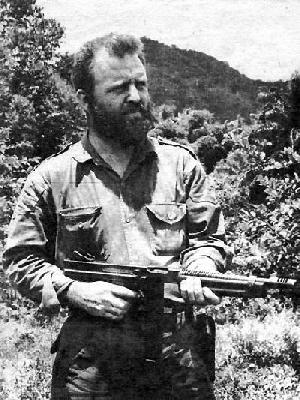
 A gifted writer since youth, Vatsa was just a nameless twenty-something junior officer in the early 1970s when he emerged onto the national literary scene.


 St. Petersburg-born, Estonian-raised, the young scientist came to Paris

 Beldeanu (