1889: “Cattle Kate” Ella Watson lynched

On this date in 1889, Ella Watson, a homesteader with a small ranch, was demonstratively lynched by vigilantes of Wyoming’s powerful cattlemen.


“Cattle Kate”

In the Western frontier amidst the rapine of the Gilded Age, ranching oligopolists had Wyoming by the throat.

Ellen Watson was a late-30’s escapee of an abusive marriage in Kansas who had homesteaded her own land and set up shop as an independent proprietor.

This put her in a class of people soon to be pitted in a resource war against the big ranchers — the Johnson County War, to erupt in 1892.

Watson was a casualty of the increasingly violent run-up to open “war”, a period when the catchall “cattle rustling” charge did the dirty work of licensing arrests and property seizures (and worse) deemed convenient for Big Cattle. When the latter decided that Watson’s stock was stolen, they seized her and partner James Averell and strung them up.

Hanging from the limb of a stunted pine growing on the summit of a cliff fronting the Sweetwater River, were the bodies of James Averell and Ella Watson. Side by side they swing, their arms touching each other, their tongues protruding and their faces swollen and discolored almost beyond recognition. Common cowboy lariats had been used, and both had died by strangulation, neither fallen over two feet. Judging from signs too plain to be mistaken a desperate struggle had taken place on the cliff, and both man and woman had fought for their lives until the last.

The subsequent trial of the paramilitaries ended in acquittal when potential witnesses were bought off or intimidated into silence, leaving “Cattle Kate” a legendary figure most defined by cattlemen-controlled Cheyenne newspapers. These made her out to be not only a thief but a (literal) whore, an image sharply contested by George Hufsmith’s The Wyoming Lynching of Cattle Kate.

Michael Cimino’s legendary cinematic Hindenburg Heaven’s Gate is about the Johnson County War, and features Isabelle Huppert as Watson, opposite Kris Kristofferson as Jim Averell. The film treats her sympathetically … but she’s also a madam who accepts payment for her cathouse’s services in the form of rustled cattle.

On this day..

1793: Charlotte Corday, Marat’s murderess

On this date in 1793, Charlotte Corday lightly dropped her head beneath the guillotine for the murder of Jean-Paul Marat.


The Death of Marat, by David.

She is of stately Norman figure; in her twenty-fifth year; of beautiful still countenance: her name is Charlotte Corday, heretofore styled d’Armans, while Nobility still was … A completeness, a decision is in this fair female Figure: ‘by energy she means the spirit that will prompt one to sacrifice himself for his country.’ What if she, this fair young Charlotte, had emerged from her secluded stillness, suddenly like a Star; cruel-lovely, with half-angelic, half-demonic splendour; to gleam for a moment, and in a moment be extinguished: to be held in memory, so bright complete was she, through long centuries!–Quitting Cimmerian Coalitions without, and the dim-simmering Twenty-five millions within, History will look fixedly at this one fair Apparition of a Charlotte Corday; will note whither Charlotte moves, how the little Life burns forth so radiant, then vanishes swallowed of the Night.

Carlyle’s voluptuous prose is well-suited to our heroine (for so she has officially seemed, since fall of Robespierre, or from the very first): in the mere hours from striking dead the ferocious Jacobin Jean-Paul Marat on July 13 to her beheading this day, she captivated the country and immortalized her name.

Hapless beautiful Charlotte; hapless squalid Marat! From Caen in the utmost West, from Neuchatel in the utmost East, they two are drawing nigh each other; they two have, very strangely, business together.

Or was it strange at all?

Implacable in her purpose, utopian in her design, unafraid to plant a butcher’s knife into the chest of an enemy of France, Corday has a little something in common with her mortal foe.


Charlotte Corday, by Paul-Jacques-Aime Baudry.

These make casting too easy: Marat, bad because he was ugly and ugly because he was bad; Charlotte, therefore, just the reverse. (She was also a virgin; they made sure to check at the autopsy.) Our Norman assassin’s looks have inordinately exercised her interlocutors from the moment of her arrest; her prosecutors, too, understood them as essential.

“Not at all pretty,” a contemporaneous government article (cited in Crisis in Representation) put about. “She was a virago, brawny rather than fresh, without grace, untidy as are almost all female philosophers and eggheads … an old maid … with a masculinized bearing … [who] had thrown herself absolutely outside of her sex.”

And there it is. Charlotte Corday’s power to excite both rapture and repulsion is plainly rooted in the unexpected contradiction between her sex and her crime. If she is a resolute political assassin, surely she is not feminine … or is it the other way around?

Take Andre Chenier‘s engorged ode: “Fair, young, resplendent, led to the executioners, you seemed to be riding in your bridal car … You alone were a man and vindicated the human race. And we, vile eunuchs, a cowardly and soulless herd, we know how to repeat some womanly whimper, but the steel would weigh heavy in our feeble hands. … One scoundrel less crawls in this slime. Virtue applauds you. Hear the majestic sound of its virile praise, heroic maid.” This is “throwing herself outside of her sex” in the affirmative sense of uplifting herself beyond mere womanhood, a girl so heroic she might almost qualify as a dude.

Place it at the historical pivot into a modernity unready to reckon with the place of the woman, and confusion reigns.

“The spectacle of such wickedness, beauty, and talent united in the same person,” a newspaper recorded, “the contrast between the magnitude of her crime and the weakness of her sex, her appearance of actual gaiety, and her smile before the judges, who could not fail to condemn her, all combined to create an impression on the spectators that is difficult to portray.”*

Still, this judgment offers more insight than some latterly “tributes,” like this Anglo magazine piece 30 years later: “an ornament and an honour to the sex of woman … Woman is the child of feeling. From this source spring up all her good and bad qualities. It is seldom ambition or policy which leads her on to any enterprise: it is the passions. … it was under the influence of such feelings that Charlotte Corday performed that act, which virtuous and generous minds, so far from considering a crime, will look upon as one of the most heroic deeds of recorded history.”

Which is a fascinating form of sexism, since it was precisely Corday’s unearthly calm — masculine virtue! — that awed the Revolutionary Tribunal. But everything about Charlotte Corday is up for interpretive grabs; Nina Rattner Gelbart even argues, in “The Blonding of Charlotte Corday” (Eighteenth-Century Studies 38.1 (2004)) that though a real-life brunette, her depictions trend increasingly flaxen-haired.**

As for Charlotte Corday her work is accomplished; the recompense of it is near and sure. The chere amie, and neighbours of the house, flying at her, she ‘overturns some movables,’ entrenches herself till the gendarmes arrive; then quietly surrenders; goes quietly to the Abbaye Prison: she alone quiet, all Paris sounding in wonder, in rage or admiration, round her. …

On Wednesday morning, the thronged Palais de Justice and Revolutionary Tribunal can see her face; beautiful and calm: she dates it ‘fourth day of the Preparation of Peace.’ A strange murmur ran through the Hall, at sight of her; you could not say of what character. Tinville has his indictments and tape-papers the cutler of the Palais Royal will testify that he sold her the sheath-knife; “all these details are needless,” interrupted Charlotte; “it is I that killed Marat.” By whose instigation? — “By no one’s.” What tempted you, then? His crimes. “I killed one man,” added she, raising her voice extremely (extremement), as they went on with their questions, “I killed one man to save a hundred thousand; a villain to save innocents; a savage wild-beast to give repose to my country. I was a Republican before the Revolution; I never wanted energy.” There is therefore nothing to be said. The public gazes astonished: the hasty limners sketch her features, Charlotte not disapproving; the men of law proceed with their formalities. The doom is Death as a murderess. To her Advocate she gives thanks; in gentle phrase, in high-flown classical spirit. To the Priest they send her she gives thanks; but needs not any shriving, or ghostly or other aid from him.

On this same evening, therefore, about half-past seven o’clock, from the gate of the Conciergerie, to a City all on tiptoe, the fatal Cart issues: seated on it a fair young creature, sheeted in red smock of Murderess; so beautiful, serene, so full of life; journeying towards death,–alone amid the world. Many take off their hats, saluting reverently; for what heart but must be touched? Others growl and howl. Adam Lux, of Mentz, declares that she is greater than Brutus; that it were beautiful to die with her: the head of this young man seems turned. At the Place de la Revolution, the countenance of Charlotte wears the same still smile. The executioners proceed to bind her feet; she resists, thinking it meant as an insult; on a word of explanation, she submits with cheerful apology. As the last act, all being now ready, they take the neckerchief from her neck: a blush of maidenly shame overspreads that fair face and neck; the cheeks were still tinged with it, when the executioner lifted the severed head, to shew it to the people. ‘It is most true,’ says Foster, ‘that he struck the cheek insultingly; for I saw it with my eyes: the Police imprisoned him for it.’†

In this manner have the Beautifullest and the Squalidest come in collision, and extinguished one another. Jean-Paul Marat and Marie-Anne Charlotte Corday both, suddenly, are no more. ‘Day of the Preparation of Peace?’ Alas, how were peace possible or preparable, while, for example, the hearts of lovely Maidens, in their convent-stillness, are dreaming not of Love- paradises, and the light of Life; but of Codrus’-sacrifices, and death well earned? That Twenty-five million hearts have got to such temper, this is the Anarchy; the soul of it lies in this: whereof not peace can be the embodyment! The death of Marat, whetting old animosities tenfold, will be worse than any life. O ye hapless Two, mutually extinctive, the Beautiful and the Squalid, sleep ye well,–in the Mother’s bosom that bore you both!

In Carlyle’s third volume on the French Revolution, “Charlotte Corday” is the first chapter in Book IV: The Terror.

While the assassin went contentedly to her death, and left smitten admirers in her passing, more realistic politicians saw that all her magnificent stoicism, all her self-sacrifice, had doomed the liberals who were her political fellow-travelers and opened the door to the very Terror she meant to avert. (And also that the gesture might have been better directed elsewhere, since Marat was already dying.)

“She has killed us,” prophesied Girondin deputy Pierre Vergniaud. “But she has taught us how to die.”

What meaning this leaves one with — any at all? — is the subject of the Peter Weiss play-within-a-play Marat/Sade, which sets a cast of lunatics in the Napoleonic era under the direction of the Marquis de Sade to portraying Marat’s rendezvous with Charlotte Corday.

* Cited by Elizabeth R. Kindleberger in “Charlotte Corday in Text and Image: A Case Study in the French Revolution and Women’s History,” French Historical Studies, Vol. 18, No. 4 (Autumn, 1994).

** Also of interest from Gelbart is the Vichy government’s affinity for our murderess: “Antisemitism made of Marat a Jew and a vile creature, dark, dirty, satanic, a bloodthirsty monster. In contrast, Corday was pure, saintly, beautiful, virginal, and of course fair.”

† The slap given Charlotte Corday’s severed head is historically attested by the French press (which was aghast); the famous story about it of a much more fantastic quality is that the severed head blushed — and, in the phrasing of Englishwoman Helen Maria Williams, “exhibited this last impression of offended modesty.” The legend of Charlotte’s crimsoned cheeks always comes up in the backstory of the guillotine’s experiments to determine if a head retained consciousness; Charlotte’s blush may in fact be credited as one of the reasons these experiments actually came to pass.

Part of the Themed Set: The Feminine Mystique.

On this day..

1546: Anne Askew, the only woman tortured in the Tower

On this date in 1546, Protestant martyr Anne Askew was martyred for her Protestantism.

One of the more intriguing religious martyrs of Tudor England, Askew was a gentlewoman forced to take her older sister’s place in an arranged betrothal when said sister (as was the style in the 16th century) dropped dead young.

Askew’s adherence to Protestantism put her at loggerheads with her Catholic husband, a domestic prefiguring of the factional political dispute that would see her to a Smithfield stake: the Reformation that rent England was itself contested within, with more aggressively reformist Protestant types resisted by the more conservative Catholic-without-Rome faction. Taking the wrong line at the wrong time was taking your life in your hands, and in the treacherous Tudor court, religion became the stalking-horse of deadly politics.

A like conflict played out in townships and households throughout the realm.

Askew and her husband separated (but were not granted divorce) over her conversion to Protestantism; she moved to London and started preaching doctrines anathema to the doctrinaire. As a noblewoman herself, she was absorbed into social circles reaching Henry VIII’s last wife, Katherine Parr.

Askew’s outspoken heterodoxy soon brought her into conflict with anti-Protestants, and when the “send her back to hubbie” strategy didn’t take, they had her clapped in the Tower.

Here she evidently became a pawn in courtly politics; with the obese and aging king liable to drop dead any moment, religious and political authority during the succession was at stake.

Askew was therefore racked in the Tower in an effort to extract evidence against powerful women of known Protestant inclinations, possibly up to and including the queen herself.

Then came Rich and one of the council, charging me upon my obedience, to show unto them, if I knew any man or woman of my sect. My answer was, that I knew none. Then they asked me of my Lady of Suffolk, my Lady of Sussex, my Lady of Hertford, my Lady Denny, and my Lady Fitzwilliam. To whom I answered, if I should pronounce any thing against them, that I were not able to prove it. Then said they unto me, that the king was informed that I could name, if I would, a great number of my sect. I answered, that the king was as well deceived in that behalf, as dissembled with in other matters.

Then they did put me on the rack, because I confessed no ladies or gentlewomen to be of my opinion, and thereon they kept me a long time; and because I lay still, and did not cry, my lord chancellor and Master Rich took pains to rack me with their own hands, till I was nigh dead.

Then the lieutenant caused me to be loosed from the rack. Incontinently I swooned, and then they recovered me again. After that I sat two long hours reasoning with my lord chancellor upon the bare floor; where he, with many flattering words, persuaded me to leave my opinion.

Askew didn’t talk, and the act of torturing a woman shocked contemporaries so much that it has never been officially repeated. She was burned to death with three fellow-heretics in Smithfield, so crippled by torture that she had to be carried in a chair to the pyre.


Anne Askew’s executed, together with John Lascelles, John Adams and Nicholas Belenian. Preaching in the pulpit is Nicholas Shaxton, who avoided the fagots with a timely recantation.

Askew survives to us as a particularly consequential Protestant martyr not only for her what-might-have-been proximity to a court plot that might have altered the course of English history, but because she left her own testimony to the ordeal.

Her Examinations — firsthand accounts of her interrogations — were reportedly smuggled out of England where they were published by John Bale. Still, we come by Anne’s own voice in the mediated form of other (male) publishers with their own agendas.

One reading of Bale’s editions that has now become conventional envisions Askew’s narrative as an embattled text: an authentic narrative, the autobiography of a learned and valiant woman, onto which Bale has imposed an insensitive, misogynistic misreading.

Specifically, Bale has been dinged for shoehorning source material that reveals a contentious and tough-minded critic into the vanilla pattern of the meek woman suffering for the faith — a cardboard cutout martyr shorn of less consumer-friendly unfeminine behavior.

While both Bale and Protestant martyrologist John Foxe, who also published versions of the Examinations, stand in that sense between us and the “real” Anne Askew, their polemical needs are precisely the reason we are able to descry the woman standing behind the martyr-archetype.

while her body was consumed by the flames, her identity remains at least partially preserved. The Henrician Anglo-Catholics made Askew famous through the process of her trial and public execution. The Protestant reformers rhetorically retrieved Askew’s broken, tortured, criminalized body from the stake and restyled it as a saint and symbol of their cause. Her identity thus paradoxically emerges in a variety of ways from the tensions … that we find in all the scraps of surviving archival material relating to her. (Theresa D. Kemp, “Translating (Anne) Askew: The Textual Remains of a Sixteenth-Century Heretic and Saint,” Renaissance Quarterly, Vol. 52, No. 4 (Winter, 1999))

Part of the Themed Set: The Feminine Mystique.

On this day..

1977: Princess Misha’al bint Fahd al Saud and her lover

On this date in 1977, a 19-year-old royal adulteress and her paramour were executed in a Jeddah parking lot by the order of the girl’s powerful grandfather.

Princess Misha’al‘s fate has been obscured by secrecy and the Rashomon-like interpretations imposed upon it by observers.

In its outline (and the first stock interpretation we’re imposing) it’s that timeless human tragedy, the love story, in which headstrong royal daughter and suffocating traditional family square off over the seditious power of the feminine libido.

The princess, in a youthful arranged marriage by most accounts, took up with a Saudi boy while both were studying abroad in cosmopolitan Beirut, and dangerously attempted to maintain the affair back in the royal kingdom to the point of a quixotic (and obviously foiled) escape attempt. Whether under color of a judicial proceeding — the story says Misha’al refused to walk away by simply renouncing her lover and defiantly brought down the death sentence by confessing adultery — or simply on his own authority, the girl’s staunchly conservative* grandfather exercised his right as tribal patriarch to inflict an honor killing for the disgrace they had brought on the family.

The execution in Jeddah — she by gunshot,** he by a very clumsy beheading — that is supposed to have occurred on this date was public, but quiet; news of it got abroad only slowly and incompletely. Small wonder that, once it did, the blended motifs of Romeo and Juliet, harem titillation and oil politics made dynamite material for high-, middle- or lowbrow exploitation.

In 1980, the affair became the subject of one of the most notorious television programs ever aired, the docudrama Death of a Princess. This film’s airing in Britain in 1980 led Riyadh to expel the British ambassador, and cost £200 million of lost revenue for the UK from canceled orders and product boycotts by the Saudis.†

It was aired on in the United States on PBS in 1980 to similar controversy, as oil companies rushed to distance themselves from it.

Rebroadcast in 2005, Death of a Princess is available online for your judgment (as is this partial script): is this a muckraking expose of a shameful crime? orientalist heavy petting? “a sensitive and thoughtful exploration of the Arab dilemma,” as per its own advance publicity? and what did the official apologies (and in only a few countries, censorship) say about the political weight of the petroleum industry?

These, meanwhile, are the western reactions, already removed from events by a further layer of mediation, a forest of axes seeking grinding. If the writer who composed this piece is to be believed, the executed girl has posthumously achieved a sort of universal symbolic gravity in the Arab world, standing for the plight of any hopeless cause of justice dashed against authoritarian power.

* For the House of Saud, it must be recalled, the personal was political in the problematic confrontation between tradition and modernity athwart the desert kingdom’s sea of oil.

** “Princess Misha’al” was executed fully veiled, which permits the rumor that the slain woman was actually a surrogate and the onetime royal favorite lives on incognito somewhere.

† According to the July 4, 1980 London Times.

Part of the Themed Set: The Feminine Mystique.

Editor’s note: References to “Princess Misha” corrected; thanks to hannah for the clarification.

On this day..

1600: Jean Livingston, Lady Waristoun

At 4 o’clock in the morning this day — as a favor to her powerful father to limit the public spectacle — Jean Livingston lost her head for arranging the murder of her husband just three days before.

Provoked by one beating too many, Lady Waristoun (or Lady Warriston) got a servant to murder him in his bed on the night of July 1.

Robert Weir blew town — he wouldn’t be apprehended until 1604, whereupon he suffered one of the very few instances of execution on the breaking-wheel to occur in the British Isles — but the Lady and her nurse Janet Murdo were “caught red-handed”, an actual juridical concept in Scottish law which means what it says on the tin.

They were condemned to death by burning, which dad’s pull was able to mitigate for his daughter (but not the nurse), so

scho wes tare to the Girth Crosse upon the 5 day of Julii, and her heid struk fra her bodie at the Cannagait fit; quha diet verie patiently. Her nurische wes brunt at the same tyme, at 4 houres in the morneing, the 5 of Julii.

In the exceedingly brief time — about a day and a half — between sentence and execution, Lady Waristoun was reported to have undergone a wonderous transformation. The not-uninterested report* of her confessor offers these mournful final words, a stark contrast to her defiant state just after condemnation.

The occasion of my coming here is to show that I am, and have been, a great sinner, and hath offended the Lord’s Majesty; especially, of the cruel murdering of mine own husband, which, albeit I did not with mine own hands, for I never laid mine hands upon him all the time that he was murdering, yet I was the deviser of it, and so the committer. But my God hath been always merciful to me, and hath given me repentance for my sins; and I hope for mercy and grace at his Majesty’s hands, for his dear son Jesus Christ’s sake. And the Lord hath brought me hither to be an example to you, that you may not fall into the like sin as I have done. And I pray God, for his mercy, to keep all his faithful people from falling into the like inconvenient as I have done! And therefore I desire you all to pray to God for me, that he would be merciful to me!

Then, she had her head lopped off by the maiden while at the same hour Janet Murdo, much less wept for, was burnt alive at Castlehill.

This sudden and sensational fall of an elite, and allegedly beautiful, woman obviously made quite a splash, with printed accounts feeding almost inevitably into the Scots ballad tradition.

My mother was an ill woman,
In fifteen years she married me ;
I hadna wit to guide a man,
Alas! ill counsel guided me.

O Warriston, O Warriston,
I wish that ye may sink for sin;
I was but bare fifteen years auld,
When first I enter’d your yates within.

I hadna been a month married,
Till my gude Lord went to the sea;
I bare a bairn ere he came hame,
And set it on the nourice knee.

But it fell ance upon a day,
That my gude lord return’d from sea;
Then I did dress in the best array,
As blythe as ony bird on tree.

I took my young son in my arms,
Likewise my nourice me forebye;
And I went down to yon shore side,
My gude lord’s vessel I might spy.

My lord he stood upon the deck,
I wyte he hail’d me courteouslie;
“Ye are thrice welcome, my lady gay,
Wha’se aught that bairn on your knee?”

She turn’d her right and round about,
Says, “Why take ye sic dreads o’ me?
Alas! I was too young married,
To love another man but thee.”

“Now hold your tongue, my lady gay,
Nae mair falsehoods ye’ll tell to me;
This bonny bairn is not mine,
You’ve loved another while I was on sea.”

In discontent then hame she went,
And aye the tear did blin’ her e’e;
Says, “Of this wretch I’ll be revenged,
For these harsh words he’s said to me.”

She’s counsell’d wi’ her father’s steward,
What way she cou’d revenged be;
Bad was the counsel then he gave, —
It was to gar her gude lord dee.

The nourice took the deed in hand,
I wat she was well paid her fee;
She kiest the knot, and the loop she ran,
Which soon did gar this young lord dee.

His brother lay in a room hard by,
Alas! that night he slept too soun’;
But then he waken’d wi’ a cry,
I fear my brother’s putten down.

O get me coal and candle-light,
And get me some gude companie;
But before the light was brought,
Warriston he was gart dee.

They’ve ta’en the lady and fause nouriee,
In prison strang they hae them boun’;
The nouriee she was hard o’ heart,
But the bonny lady fell in swoon.

In it came her brother dear,
And aye a sorry man was he;
“I wou’d gie a’ the lands I heir,
O bonny Jean, .to borrow thee.”

“O borrow me, brother, borrow me–
O borrow’d shall I never be;
For I gart kill my ain gude lord,
And life is nae pleasure to me.”

In it came her mother dear,
I wyte a sorry woman was she;
“I wou’d gie my white monie and gowd,
O bonny Jean, to borrow thee.”

“Borrow me, mother, borrow me,–
O borrow’d shall I never be;
For I gart kill my ain gude lord,
And life’s now nae pleasure to me.”

Then in it came her father dear,
I wyte a sorry man was he;
Says, “Ohon! alas! my bonny Jean,
If I had you at hame wi’ me.

“Seven daughters I ha’e left at hame,
As fair women as fair can be;
But I would gie them ane by ane,
O bonny Jean, to borrow thee.”

“O borrow me, father, borrow me,–
O borrow’d shall I never be;
I that is worthy o’ the death,
It is but right that I shou’d dee.”

Than out it speaks the king himsell,
And aye as he steps in the fleer,
Says, “I grant you your life, lady,
Because you are of tender year.”

“A boon, a boon, my liege the king,
The boon I ask, ye’ll grant to me.”
“Ask on, ask on, my bonny Jean,
Whate’er ye ask, it’s granted be.”

Cause take me out at night, at night,
Lat not the sun upon me shine;
And take me to yon heading hill,
Strike aff this dowie head o’ mine.

Ye’ll take me out at night, at night,
When there are nane to gaze and see;
And ha’e me to yon heading hill,
And ye’ll gar head me speedilie.

They’ve ta’en her out at nine at night,
Loot not the sun upon her shine;
And had her to yon heading hill,
And headed her baith neat and fine.

Then out it speaks the king himsell,
I wyte a sorry man was he;
“I’ve travell’d east, I’ve travell’d west,
And sailed far beyond the sea,
But I never saw a woman’s face
I was sae sorry to see dee.

“But Warriston was sair to blame,
For slighting o’ his lady so;
He had the wyte o’ his ain death,
And his bonny lady’s overthrow.”

* Snappily titled, “A Worthy and Notable Memorial of the Great Work of Mercy which God wrought in the Conversion of Jean Livingstone Lady Warristoun, who was apprehended for the Vile and Horrible Murder of her own Husband, John Kincaid, committed on Tuesday, July 1, 1600, for which she was execute on Saturday following; Containing an Account of her Obstinacy, Earnest Repentance, and her Turning to God; of the Odd Speeches she used during her Imprisonment; of her Great and Marvellous Constancy; and of her Behaviour and Manner of Death: Observed by One who was both a Seer and Hearer of what was spoken.”

Part of the Themed Set: The Ballad.

On this day..

1706: Dona Beatriz Kimpa Vita, the Kongolese Saint Anthony

On July 2, 1706, Kimpa Vita, a Congolese noblewoman also known by her baptismal name Dona Beatriz, was burned as a witch in Evululu.

This remarkable woman claimed to be a medium for the spirit of Saint Anthony of Padua, a popular saint in the Catholicized Kingdom of Kongo, and attracted a mass movement in the midst of civil war and social breakdown in the proud Kongo state.

Executed Today is pleased to mark this occasion with an interview with Boston University Prof. John K. Thornton, author of The Kongolese Saint Anthony: Dona Beatriz Kimpa Vita and the Antonian Movement, 1684-1706.


This is a very unfamiliar story to most, as you point out in The Kongolese Saint Anthony. So let’s begin with some orientation — the Kingdom of Kongo is in the midst of a ruinous civil war. Why?

The civil war in Kongo was basically a dynastic affair, that is, a battle between branches of the royal family for control over the throne. Kongo had a very highly centralized political structure, the king and his council had a lot of power not only over who held high office, but also who got what income, because a lot of income derived from holding office. So controlling the kingship and its related patronage was very important.

This story is very complicated, I try to lay it out as simply as possible in Chapter II of my book. To make matters short, by D Beatiz’ day it had two branches duking it out — the Kimpanzu and the Kinlaza, with Pedro IV, conveniently descended from both these families, as a sort of conciliatory figure.

And it’s a highly Catholic country. How did that come to be?

Pretty remarkable story.

Actually I think it’s the only real missionary victory that the Catholic church had in the early modern period. By that I mean that they spread the faith to a completely independent country and not just by conquest.

Officially, it was a series of miracles that both Catholic priests and Kongo elites witnessed in 1491 that led Nzinga a Nkuwu, the king of Kongo to become a Christian and be baptized on May 3, 1491 (my birthday is May 3, 1949 which I have taken to be a sort of sign that I should be studying Kongo).

However, it was Nzinga a Nkuwu’s son Afonso (ruled 1509-1542) that really established the church. Afonso provided for the funding of the church, created schools for teaching literacy and Christian religion for the nobility, had children educated in Portugal and returned to the country, and working with his own educated people and Portuguese priests also figured out how to blend the two traditions into a religion that was acceptable in the country. It’s no wonder the Church called him the “Apostle of Congo”.

The kings who followed elaborated and extended what Afonso started, especially by creating a network of schools all over the country. By and large Rome and Portugal collaborated and blessed the project, so the Pope allowed Afonso’s son Henrique to be the first Sub-Saharan African bishop in 1518, and assigned him to extend the church in Kongo (Henrique died in 1531). In 1596 the Pope made Kongo’s capital city the seat of the Bishop of Congo and Angola.

The Church grew again in the late sixteenth century when a series of kings named Alvaro (I and II, father and son, in particular) went a lot farther than Afonso had in Europeanizing Kongo. They gave the nobles titles of nobility in European fashion (Counts, Dukes and Marquis), the brought in relics from Europe (bones of martyrs, for example), established an embassy in Rome, renamed the capital city as Sao Salvador, and so on. The Kongolese ambassador to Rome, Antonio Manuel, who died in 1608 and is honored in a wing in the church of Santa Maria Maggiore in Rome, left personal papers when he died now found in the Vatican archives. They show the sort of culture a person educated entirely in Kongo could show, in addition to a fascinating array of Kongolese administrative documents — the only ones we have. He also studied Carmelite mysticism, and had correspondence from many different people all over Europe. He was clearly at home among elite Europeans and was regarded by those who met him as a cultured individual in a period when extra-Europeans were not always seen that way.

The Jesuits established a college in Kongo in 1624 and it provided advanced education along European lines until it was close just about the time that Beatriz was active. Kongo had a library, in fact, though no trace of it exists any more, found on the second floor of the Jesuit college.

So in short, the answer is that the political elite of the country decided in the sixteenth century to make their country a Catholic one, and they took vigorous steps to make it happen.

They put teachers out all through the country, visiting priests from Europe constantly met these teachers in the rural areas, they were usually literate and possessed a good deal of knowledge of European culture, some had even lived in Europe. These schoolmasters were the soul of the church; they instructed the people (using a catechism in their own language after 1624), prepared them for the sacraments and led weekly prayers at places of worship, usually large wooden crosses erected at key points all around the country.

So there’s a religious penetration that on the face of it might seem to be a religion of colonization, of foreign domination. But that’s clearly not the way most Kongolese thought about it.

It was never a religion of conquest, and for that reason, the Kongos managed to make it their own without feeling they were abandoning or being forced to give up something. In the sixteenth and seventeenth centuries foreign visitors often commented on how proud the Kongos were, of their country, their language, their food and the like, thinking that they were the best people in the world. “Congo arrogance” was a common epithet that the Portuguese who built the colony of Angola on Kongo’s southern border used to describe them.

And it’s still very true today. I go to Angola quite a bit and have been to Mbanza Kongo twice. You can feel and hear that pride even now. During the colonial period (roughly 1885 to 1975 in that area) the Portuguese tried very hard to replace indigenous languages with Portuguese and to erase African culture in a systematic way, especially after 1926. But the Kongos simply refused to be erased: they continued their language secretly, kept their special foods and taught their children that they were still the best. It worked.

Today in Angola, you see in so many places that Portuguese is the language of daily life — even street kids shout at each other in Portuguese in Luanda and the land east all the way to Malange. But in Mbanza Kongo and elsewhere in the north, the language of daily life is Kikongo, the ancient language of the country. Their pride has been a problem for Kongo, too. In 1992 a lot of them were massacred in Luanda, partially for political reasons that are very complicated, but also I think because other Angolans resent this pride. But enough on that.

Anyway, the Kongolese were proud to be not just Christians but Catholics. The Portuguese tried to invade Kongo from Angola several times, first in 1622, then again in 1657, and finally in 1670. Each time they were decisively defeated. On the other hand, the Kongos were also unable to invade Angola, as they were repelled there also, first in 1580 and again in 1665 (when the famous Battle of Mbwila was fought on the border between the two domains of Angola and Kongo).

This led to great hostility between Kongo and Portugal and especially its governors of Angola. Portuguese were massacred in the wake of the 1622 invasion and after the Battle of Mbwila in 1665, and by the 1670s they had been effectively forced to leave the country, trading their only with Africa servants called pombeiros who represented their interests. (Priests were an exception).

Yet this history didn’t impact on the way Kongos saw themselves as Catholics. King Garcia II (1641-1661) famously wrote a letter in which he proudly stated that they obeyed the Pope, vicar of Christ on earth, even though the Portuguese, whom they hated, had introduced them to the religion. Indeed, the only thing that we see in the correspondence of Kongolese kings that they do say good about Portugal was that it introduced them to the religion.

The idea of a Catholic Kongo was reinforced when Kongo made an alliance with the Dutch. This took place in 1622 in the aftermath of the failed Portuguese invasion. Pedro II, the king, sent a letter to the Dutch States General proposing an alliance in which the Dutch would send a fleet to attack Angola by sea, and Kongo would send an army by land. The first attempt to do this in 1624 failed, in part because the Portuguese went out of their way to conciliate Kongo, but the second attempt, in 1641, succeeded and for a time the Kongo-Dutch alliance (joined by the formidable Queen Njinga of Ndongo-Matamba who was also at war with Portugal) nearly drove the Portuguese out of Angola.

The Dutch hoped to use this opportunity to also convert Kongo to the Calvinism of the Dutch Reformed Church and they even had special literature designed to convert Catholics who spoke Portuguese to Calvinism. But Garcia II would have none of it, and had the books burned (it was the seventeenth century after all), and forced the ministers to leave. He wrote a letter to the Dutch Estates General protesting the attempt and in it he made the statement I summarized in the paragraph above.

Kongo tried to make contact with Dutch speaking Catholic countries in the aftermath of the third failed Portuguese invasion in 1670. It seemed like a good compromise though the Dutch never did come back to Angola to fight, and the Catholic parts weren’t part of the Dutch program.

So, that’s background — now, who is Dona Beatriz Kimpa Vita?

She was the daughter of a noble Kongo family from the region right around Kibangu, a flat-topped mountain that lays some distance east of the capital of Mbanza Kongo (on a clear day you can see that mountain from Mbanza Kongo).

She seems to have had spiritual gifts even as a youth, and had dreams of playing with angels and visions and the like. Not surprisingly, she turned to religious pursuits, becoming a nganga Marinda, a spiritual person whose role the Catholic missionaries did not like, but was widely accepted in the Kongo as legitimate. She was probably too spiritual and independent to be married, since she had two failed marriages by the time she began her prophecy.

Her movement combines both a religious renewal and a national restoration. Should one think of her as a religious person whose cause happened to have political implications, or someone who’s very intentionally trying to alter the balance of power? Is it even right to separate the secular and the religious dimensions?

I think Beatriz was trying to end war as much as anything else. This was at the height of the slave trade: thousands of people were being exported annually to Brazil, to the Spanish Indies, to Suriname, and some even to South Carolina.

The slave trade was one of the byproducts of war (along with death and destruction), and because slavery was lucrative, it helped to continue the wars in a vicious cycle. As Beatriz understood it, the solution was to end the civil war and restore the kingdom. None of the pretenders to the throne seemed able to do that.

She thought that he had sent Saint Anthony do to that, and he had come to earth and chose to be incarnate in her. It harmonized with Kongos’ belief that they were God’s chosen people (he had created Kongo himself, sending his angels to create the rest of the world), and he would intervene to set things right.

And who exactly are her followers?

Beatriz had followers from all ranks and walks of life. Pedro IV had her burned, but his own wife Hipolyta became a devotee. Pedro was intrigued by her message himself. A number of the top contenders also were either tempted or became her followers. The most notable of her followers was Pedro Constantinho da Silva, one of Pedro’s generals who saw allying with her as a chance to become king. Along with the political guys was a great mass of peasants, who really hoped for a better time and thought that Beatriz’ movement could restore the kingdom.

It was the politics of her movement that got her in trouble. Once Beatriz threw herself in with Pedro Constantinho she was doomed because the other contenders became her enemies. It was Pedro IV who managed to capture her, and he had her burned as a heretic and witch. Before she went over to Pedro Constantinho, Pedro IV had been very interested in her mission and protected her.

Dona Beatriz? Kimpa Vita?
What’s In A Name?

Kongos in those days usually had at least two names.

The first one was a zina dia santu (Saint’s name), given as a Portuguese name though often pronounced as in Kikongo and always incorporating “Dom” or “Dona” as part of the name. So someone named Joao would be called Ndozau, and someone named Miguel would be Ndomigel.

Their second name was a Kikongo name, like Mpanzu, Nkuwu, Vita, Nzinga and so on. As far as I can tell people got both names from their parents when they were born, and they probably started using the zina dia santu even before baptism. If people had two Kikongo second names, the second one was the father’s first name, sort of like the Scandanavian system where a Johan’s child is named Johansson.

Beatiz’ second names mean “scheme” or “plan” (Kimpa), and “war” (Vita). It might be because she was born in a war and this was added, or it might just be her father’s first Kikongo name. King Antonio I had Vita as an element in his name; some people use this as evidence she was descended from this king who was killed in the Battle of Mbwila in 1665. I think such a fact would have been noted at the time and I doubt it.

Nowadays, people in Angola and DRC tend to look down on the zina dia santu, which they view (wrongly, I believe) as a remnant of the colonial past. Many Angolans believe that somehow the Portuguese organized all that Christian stuff in Kongo and the local people resisted or rejected it.

I think the reason for this is twofold: first, because that’s what the Portuguese claimed during the colonial period, that they really more or less created the Kingdom of Kongo, which is totally untrue. A second reason is because most Angolans with any nationalist feeling don’t like to be identified with Portugal and so look to a non-Portuguese past. Hence, D Beatriz is rather militantly known as “Kimpa Vita” in Angola and one does not often hear her Christian name, though of course people know it.

-J.K.T.

Dona Beatriz rejects or alters a number of religious practices we might think of as essentially Catholic, like the iconography of the cross, but she’s not doing it in the name of rejecting Catholicism — she’s doing it in the name of Saint Anthony of Padua. Was there simply a pent-up need for renegotiating the way the faith worked for Kongolese? If so, did it happen in some other way after she was executed?

I think she was concerned that Christianity was too European, and one of the things she chided the missionaries about was that they did not represent any black saints.

She had direct revelation from God on her side, she died every Friday and spent each weekend in Heaven conferring with the Heavenly Father about the affairs of Kongo and so what she got there was pretty much undeniable. From these sessions in Heaven she learned the stories about Jesus being born in Nsundi, baptized in Sao Salvador and Mary being a slave of a Kongo marquis. There was probably a lot more richness to these stories that our accounts tell us.

Kongos were pretty sure, I think, that God was an African and their pride also gradually placed stories in Africa, so in this way Beatriz was confirming what people believed or wanted to believe. After her death, we find a lot of art objects, particularly crucifixes, in which Jesus is shown as an African (his features are African) and is wearing a cloth with a specifically Kongo design. Cecile Froment has recently competed a wonderful Ph.D. thesis at Harvard on this art which I think will really demonstrate how much the Church in Kongo incorporated Kongo concepts. I don’t know if Beatriz’ movement inspired this art directly, but her movement and the art together represent what many people were thinking.

An aside here. From Afonso’s time onward, there was a desire to make an independent Kongo church under its own bishop and with its own clergy. They had the educational resources to support this, so they felt they should. Alvaro II entertained ideas that he could control such a church, that the king was “vicar of his kingdom” and could appoint clergy at will. This wasn’t canonical and the church didn’t support it, even going to far as to try some of those who advised him on this through the Inquisition. But even when Kongo got its own bishop in 1596, the kings of Portugal managed to get control of appointment and put Portuguese in there.

This was the cause of endless conflicts between the kings and the bishops, particularly because of the hostility between Portugal and Kongo over Angola. Finally, a compromise was worked out. While the bishop ended up residing in Angola, and he refused to ordain many Kongolese, the priestly needs of Kongo were to be met by missionaries, who weren’t really there to spread the faith (it had already spread) but to perform the sacraments that an ordained priest could. Because Portugal didn’t want Kongolese clergy, and Kongo didn’t want Portuguese clergy, the compromise was to chose Italian clergy who were from neutral states (mostly Florence, but others as well). These priests came from the Capuchin order, a strongly Counter-Reformationist order that wanted to purge Kongo’s Catholicism of its local elements in the name of purifying the faith. That didn’t go so well, and the struggle over just how Kongo the church could be was waged along these lines.

Beatriz came into this struggle on the Kongo side. While not denying the Capuchins their place as priests, she contended with them over the theological questions. She lost this round, mostly for political reasons and not theological ones. Maybe the African Jesus of Froment’s thesis was the theological victory of Beatriz or at least her followers.

She occupies the ruined former capital. What’s the significance here? Had she remained unmolested, what trajectory might her movement have been on?

I think that messianic religious leaders like her in a politically charged environment don’t have much chance unless they are very astute or their supporters are strong. Of course occupying the capital was vital. It had been abandoned in 1678 and was in ruins, yet it was the very symbol of Kongo. The kings were all buried there, the cathedral was there. Holding the city was in effect restoring the kingdom and presumably ending the civil war.

She could only have remained in power if she had stayed with Pedro Constantinho and if his forces had been enough to protect her and to fend off the inevitable attacks that the other two primary contenders, Joao II of Bula and Pedro IV of Kibangu, would mount. Pedro ended up beating both of these two, first Pedro Constantinho in 1709 and then Joao. So with Pedro Constantinho as patron she could not have survived.

She also made the political mistake, which we can only put down to overconfidence or naivete, of going back home to her parents who lived in Pedro IV’s domain to have her baby. Having the baby also upset her, and made her feel guilty since as a saint she should not have done this.

But let’s be a bit speculative and say that Pedro IV didn’t capture her, or he decided to follow her and put distance between himself and the Catholic clergy who were obviously opposed to her. What might have happened? Perhaps he would have re-founded the church in Kongo with a new relationship to Rome, and decided to have Kimpa Vita and some sort of apostolic succession from her ordain priests and bishops. These would clearly have been drawn from the schoolmasters who ran the church in Kongo anyway. A good number of them did become Antonioans and they would have created a new church. It would have had some of its own new traditions, like the stories that Beatriz told about Jesus’ birth in Nsundi and baptism in Mbanza Kongo, or the descent of kings and the like. These might have been written since the chruch was literate and perhaps formed a new scripture. And perhaps they might have found, in time a way to reconcile this with Rome, but maybe not. It would have been an independent church as we see all over Africa now.

What exactly leads to her execution? Cui bono?

Her execution was done following her capture as described above. She was tried in a civil not an ecclesiastic court under Kongo and not church law. Kongo law prescribed punishment for witchcraft and heresy and those were the charges against her.

We don’t know what happened in her trial since the record has not survived (my dream is to find it, since there probably was one once, and who knows, it might have been sent to the Inquisition in Portugal or Angola). But all we know is what the Italian priests, Bernardo da Gallo and Lorenzo da Lucca told us, and they were not invited to the trial (fine by them; they didn’t want to be too closely associated with the results). They questioned her about her beliefs, and da Gallo’s account of that inquiry is our basis for knowing what she believed. But they could do no more on that end than hear the result. They were happy for it since that’s what they wanted too.

Her movement isn’t destroyed by her execution. What happens over the next 2 1/2 years before the Battle of Sao Salvador? And what happens after that battle: What was Dona Beatriz’ immediate legacy? Was she remembered, was her name invoked? What became of her followers?

We know the movement remained very strong in Mbanza Kongo after her death, and that Antonian prayers were shouted out by the defenders of the city in 1709. But there is not documentary mention of them further after that. But don’t read too much into this, since the documentary record becomes very, very quiet after 1710 or so — we just don’t have any details about it from any source. In fact, until I discovered a kinglist written in 1758 (I think by a Kongo) we weren’t sure how long the reigns of the kings were for the next fifty years or even what order they ruled in. It is possible that the movement survived even there.

We also know that the movement had very strong bases in the southwest part of Kongo, in lands belonging the the Kimpanzu faction that had been headed by Suzanna de Nobrega. This faction was not involved in the war in 1709 and thus would not have suffered the inevitable persecution that took place in Mbanza Kongo.

But Manuel II, the king who followed Pedro IV after his death in 1718, came from that faction and region. He had abandoned the Antonians to join Pedro, and perhaps he also suppressed the movement back home. We have a couple of letter from him, written early in his reign and dealing with ecclesiastical matters, but the question of Antonians doesn’t come up in them.

After my book was published, Simon Bockie, a librarian at Berkeley and an excellent ethnographer of Kongo (he’s a Kongo himself) wrote a critical review. He claimed that I had not made use of abundant oral traditions that he had heard in his youth about Kimpa Vita in writing my book and thus I had written an account based on only the testimony of her enemies.*

I had searched published sources in French, Portuguese and Kikongo for traditions that I could relate to Beatriz when I did my research, and I did make as much use of these as I could when I wrote. But at the time I had not been able to do research in Mbanza Kongo and so had to let that aspect go. When my wife, Linda Heywood and I went to Mbanza Kongo in 2002, we specifically asked about traditions concerning Kimpa Vita (as she is usually called today) and were taken to a man who claimed to be the local expert on her. He asked us if we wanted to hear the tradition in French, Portuguese or Kikongo (Mbanza Kongo is very near the border of the Democratic Republic of the Congo and probably half the population is trilingual). We said Kikongo, which he proclaimed to be the right answer. He then went into a half-hour or maybe forty-five-minute discourse on the question. He had some interesting things to say. First, I noticed that he gave dates in his account, but he stated them in French. Likewise, he mentioned the names of the missionaries and the Christian names of Kongo kings in French also. I thought this was strange and concluded that he had received a “fed back” tradition, meaning that he had combined what he might have known from oral sources, such as his parents or elders, with written sources that drew on the movement which was described in French at least as early as 1953.

I might have easily concluded that both his traditions and those Bockie heard as a youth were simply feed back stories made to surround an event known only from modern historical reconstruction. You can hear such a tradition and have no idea that it is of modern creation, since you might not know its sources and even the one telling you might have heard rather than read it. Personal elaboration around a few set facts is a common point of oral tradition, and thus explaining things one receives from tradition or even from books can be expanded this way.

But having said that I was very intrigued by other elements in the story which were purely Kikongo. The most important was the very significant role played in the story I heard in Mbanza Kongo by Beatriz’s mother (ngudi andi Kimpa Vita), to the point where much of the inspiration of the movement was in fact from the mother, and moreoever, the mother continued the movement after her daugher’s death.

The traditionalist went on to link modern religious movements through the descent of this mother. Was it possible that the movement did live on? I can’t say. I do know that several independent churches claim Kimpa Vita as their founder, or claim to be heirs to her message, most notably some branches of the Kimbanguist church (founded in the 1920s by a prophet named Simon Kibangu) and the Bundu dia Kongo, a rapidly growing church founded by Mwanda Nsemi in the 1960s. It could be true, or it could be simply propaganda of these movements, also fed back into tradition.

Was it unusual that this movement was led/instigated by a woman? Or would that not have been consequential to her followers and opponents?

The movement was led by Saint Anthony; D Beatriz was only his earthly form. Why he chose a woman is harder to say.

Did it make a difference that he did? Probably. Beatriz realized that the woman/man thing was a problem. When Pedro’s soldiers arrested her they challenged her, asking how Saint Anthony, who was a man, could have a baby. Her only answer was that she didn’t know, only that it had come from Heaven. She certainly was attentive to women; for example, she could make the barren bear children, and women were among her close followers.

I don’t think, though, that we should read too much into the sex issue. There were also a number of very powerful women in Kongo at her time: Queen Ana Afonso de Leao all but ruled the southeast, and Queen Suzanna de Nobrega ruled the southwest. Although Joao II ruled Lemba, everyone knew that his sister, Elena was the real ruler of that territory. There were provisions in Kongo law allowing women who reached a certain political level to have male concubines and treat them more or less as men treated female concubines.

Finally I confess that I didn’t do as much as I wanted to or could about the question of women and females in Kongo life when I wrote the book, and sacrificed some analytical asides in the interests of narrative. I tried to remedy this ever so slightly in an dense and technical article I published in the Journal of African History, called “Elite women in the Kingdom of Kongo”, not for the faint-hearted, that addressed the question of female power. I had also addressed female power in the life of Queen Njinga, who ruled in the Kimbundu speaking area south of Kongo, in another article some twenty years ago, and I hope to write more about women in the future.

Has there been a reclamation or rediscovery of her in the postcolonial period? How does Dona Beatriz/Kimpa Vita read in Angola now?

As long ago as 1996 there was an official decision to erect a statue to her somewhere in the country. There is an image of her, drawn by Bernardo da Gallo from life, on the cover of my book, so it wouldn’t be hard to do. This would be the “book” D Beatriz Kimpa Vita, with the full apparatus of scholarship, as opposed to the “tradition” Kimpa Vita, supported by the oral traditions and independent churches. It will be interesting to see how these two versions, my book, and Kongo pride run into each other.

* Canadian Journal of African Studies, Vol. 32, No. 3 (1998), pp. 645-647, in which Bockie writes,

As a child growing up in the Lower Congo listening to tales from our oral history, I heard many times about the exploits of Kimpa Vita, who was still remembered after 250 years as a major cultural heroine … It was something of a shock to find that Thornton has chosen to present his account almost exclusively through the eyes of her enemies and killers … there remains no convincing Kongo voice or presence in this book.

On this day..

1749: Maria Renata Singer, theological football

On this date in 1749, an aged subprioress of the Unterzell nunnery was beheaded and burnt in Wurzburg for witchcraft … and for the principle of witchcraft.

Maria Renata Singer (or Singerin — here’s her German Wikipedia page) had been a reclusive denizen of the convent for half a century.

A dying nun accused her of working black magic, and everything snowballed in the usual way: other nuns got into the act, often in the throes of exorcism. Confinement and interrogation (torture is not recorded) eventually induced her to confess to having been a witch for more than 60 years. (Details of the unfolding procedure here, in German.)

On this morning 260 years ago, her sentence — moderated from burning alive — was carried out: Singer’s head was struck off and mounted on a pole, and her body burned to ashes.


Witnesses reported seeing a vulture appear when the body was burned.

Nothing so remarkable, really, in the annals of witchcraft. Nothing except the date. Witch-burnings in 1749! Voltaire was in his fifties. Thomas Jefferson was alive. Wurzburg itself hadn’t seen witchcraft executions since the madness of the Thirty Years’ War.

But even in the Age of Enlightenment, the benighted world got its licks in. And in this instance, the case of the witch-nun of Bavaria was bulletin-board material in an unfolding public debate over witchcraft.

Scholars and theologians were burdening the mid-18th century printing presses with treatises on the legitimacy of witchcraft persecutions. Singer herself, when first confronted with the accusation, had not simply denied it: she had denied there was any such thing as a witch.

That same year of 1749, Girolamo Tartarotti‘s influential Congresso notturno delle lammie skewered witchcraft jurisprudence.

Tartarotti’s work fit into a growing critique naturally animated by the rationalist spirit of the times.

Partly through Singer’s execution, the witchsniffers’ intellectual defenders mounted their last defense.

Jesuit Georg Gaar, who had been Singer’s confessor before death, preached a sermon at her cremation “praising the wise severity of laws against these crimes, and speculating that this might be God’s warning against the men of our time who do not believe in witches, or magic, or the devil, or God. Father Gaar plainly thought himself, and told the people, that they only needed to read the evidence from Unterzell to be persuaded of the justice of the sentence and the truth about witchcraft.”

Tartarotti reprinted this sermon with a critical commentary. But some theologians (and not only Bavarians*) were ready to go to bat for the traditional superstitions.**

According to Brian Copenhaver, writing in the Journal of the History of Philosophy (January, 1979):

The rigorist Dominican Daniele Concina [Italian link -ed] argued that God permits witchcraft “for the greater confirmation of faith,” and he disposed of the skeptical sections of the Canon episcopi as a forger’s work. In a variation on Pangloss’s reasoning about noses and spectacles, Benedetto Bonelli deduced the reality of witchcraft from the existence of laws against witches.

As another critic of Tartarotti fretted, “Does not the denial of the existence of demons open the way and lead directly to the denial of the existence of God?”

Interestingly, Tartarotti accepted the reality of “magic” while denying the existence of witches, ascribing the latter’s survival as folklore to incomplete Christianization. While (see Copenhaver once again) this tack could be read as a tactical choice of moderation on Tartarotti’s part to achieve the pragmatic end of eliminating witchcraft trials, it put him in the crossfire between more rigorously rationalist intellectuals and the likes of Georg Gaar.

This angle of Tartarotti’s, especially given his simultaneous interest in the occult, has led to his work’s subsequent adoption as an antecedent to the still-popular if academically disreputable theory that underground sects of pagan practitioners really did persist in Europe, and were the true targets of witch-hunts like the one that killed Maria Renata Singer.

A lengthy 19th-century treatment of the case is available in German in a public domain Google books entry here.

* 18th century English theologian John Wesley, feeling himself pinned by the Old Testament verses about not-suffering-a-witch-to-live and all that, insisted that “giving up witchcraft is, in effect, giving up the Bible” and “the credit of all history, sacred and profane.”

** Conversely, a German scholar sneered at the backward prejudices of “the common rabble, especially in our beloved Bavaria.”

On this day..

1989: Sandra Smith and Yassiem Harris

(Thanks to Richard Clark of Capital Punishment U.K. for the guest post, a reprint of an article originally published on that site. The images accompanying this post are also provided by Mr. Clark. -ed.)

Sandra Smith was the last woman to be hanged in South Africa (with her boyfriend Yassiem Harris).

Background.

Sandra Smith was a 22-year-old coloured woman (official South African designation during the apartheid era) who was married to a trawlerman called Philip and had two small children. Philip spent long periods at sea and sent money back for Sandra and the children. She began having an affair with Yassiem Harris, who was 3 years her junior, in the autumn of 1983 and soon they were deeply in love. Harris had been involved in crime since the age of 13 and had convictions for theft and fraud and was also a drug user. Philip found out about the affair from his neighbours and in March of 1986, he finally threw Sandra out. She and Harris now began living together in a rented apartment but soon the money that Philip used to give her ran out and their finances became tight.

The crime.

To make ends meet, they tried renting video recorders from shops and then selling them but this didn’t net them any real money. Harris, who was unemployed, also spent time hanging about outside a girl’s school and got to know some of the girls, including Jermaine Abrahams. He soon found out where she lived and from his conversations with Jermaine, he concluded that her family were quite wealthy.

They hatched a plan to break into the Abrahams’ family home and steal her mother’s jewelry and anything else of value. Harris had also found out that her parents left for work at 7.00 a.m. in the morning and she left for school about 7.40 a.m.

The victim, Jermaine Abrahams.

Smith and Harris arrived at the house about 7.30 a.m. on September the 1st, 1986, and Harris was let in by Jermaine on the pretext of him wanting to use the telephone. They tied Jermaine up but were disturbed by someone knocking at the door. She started to shout for help and struggle so they then tried to strangle her with a dish cloth. Harris now fetched a knife from the kitchen and repeatedly stabbed Jermaine in the neck. Amazingly, she didn’t die from her injuries and managed to get to her feet and stagger a few paces before collapsing. Harris carried Jermaine to her parents bedroom and made her show him where the jewelry and valuables were kept. He wrapped the poor girl in a duvet and then cut her throat, leaving her to bleed to death. He and Smith collected up what they wanted and then left the house.

Two weeks later, while Smith was being questioned by the police regarding the video scam, she surprised the interviewing officer by confessing to the killing of Jermaine. “I wouldn’t have been able to live with it,” she said. In her statement she told the police, “He pulled the scarf tight across her mouth and then cut her throat.”

On the 15th of September 1986, Sandra Smith was formally charged with the murder and 5 days later Harris was arrested and also charged with it.

Trial.

At their committal hearing at the Mitchell’s Plain Magistrates’ Court on the 23rd of September, they pleaded guilty to murder, alternatively to culpable homicide, and to stealing R2,000 worth of jewelry.

They were tried together at the Cape Town Supreme Court on December the 1st, 1986, before Mr. Justice Munnik, the Judge-President of the Cape Court, and two assessors. South Africa did not use the jury system, although its court proceedings were based upon British law, but instead a system of a judge and assessors. Both were represented by counsel and both attempted to shift the blame on to the other. Smith maintained that Harris had done the actual killing and Harris claimed to have been dominated by Smith, although they both admitted being present during the murder.

Sandra Smith was embarrassed by the revelations of her sex life with Harris in court and seemed at times more concerned with these than the fact that she was on trial for her life.

Having heard all the evidence, Mr. Justice Munnik gave a full reasoned judgement in which he described Harris as “an appalling witness.” He said it was clear that it was Harris who had stabbed the girl and slit her throat to prevent her identifying them. He also rejected Harris’ defence claim that he been dominated by Smith which had been refuted by the psychiatrist giving evidence for the prosecution. He accepted that Smith was demanding but not dominant, and there was no evidence to indicate that she forced Harris to kill Jermaine, nor that she had done anything to prevent the murder. He thus concluded that they were both equally responsible for the crime under the doctrine of “common purpose.” Thus on the 11th of December 1986, they were both formally convicted of the murder of Jermaine Abrahams and with robbery with aggravating circumstances and remanded for sentence.

Eleven days later they were brought back to the court and received the mandatory sentence for murder — that they be hanged by the neck until they were dead. Additionally, Harris received a 10-year prison sentence for robbery and Smith was given seven years for it. Sandra Smith became hysterical when she was sentenced to death and had to be taken struggling and screaming to the cells.

They were transferred to the country’s only death row, at Pretoria Central Prison, a modern facility on the outskirts of the capital where all South African executions were carried out. Their appeals were turned down and the review of the trial transcripts to determine whether to recommend that the state president grant clemency carried out by the Ministry of Justice failed to find any mitigating circumstances. As clemency was not forthcoming, their execution date was set for the 2nd of June 1989. Apparently, only around one in 50 people convicted of homicide were actually hanged at this time, the majority serving a prison sentence.

Execution.

At 6.50 a.m. on that morning, Smith was taken to meet Harris for the first time in over two and a half years. Together with two other men who had been convicted of murder, they were led the 52 steps to the pre-execution room next to the gallows. The death warrants were read to them and they were given the opportunity to say their last words. Their hands were handcuffed behind them and white hoods placed over their heads, these having a flap at the front which was left up until the last moment.

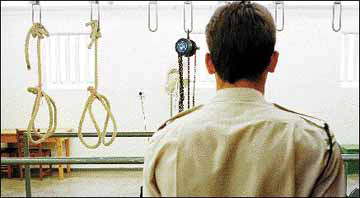
They were now led forward by warders into the large and brightly lit execution room. It was some 40 feet long with white painted walls. They would have seen the gallows beam running the length of the room and the 7 large metal eyes from which the four nooses dangled. (Seven prisoners could and often were hanged at once on this gallows.) The picture shows very much what Smith and Harris would have seen as they were led to the gallows. The chain hoist on the middle metal eye is used for raising the trapdoors after an execution.

They were positioned side by side, on painted footprints over the divide of the trap and held by warders while the hangman placed the nooses around their necks. He then turned down the hood flaps and when all was ready, pulled the lever plummeting them through the huge trapdoors.

They were left to hang for 15 minutes before being stripped and examined by a doctor in the room below. Once death had been certified, the bodies were washed off with a hose and the water allowed to drain into a large gully in the floor. A warder put a rope around each of their bodies and with a pulley lifted them to allow the rope to be taken off. They were then lowered onto a stretcher and placed directly into their coffins before taken to a public cemetery for burial.

Although executions in South Africa were held in private, the procedure was described in detail by the then hangman, Chris Barnard, in an interview before he died. He officiated at over 1,500 hangings there.

South Africa hanged 1,123 people at Pretoria Central prison between 1980 and 1989, Solomon Ngobeni being the last on November 14th, 1989. Surprisingly perhaps, almost all of these were for “ordinary” murders rather than politically motivated crimes and most attracted very little publicity.

According to the South African Department of Correctional Services, two other coloured women were hanged for murder in the years 1969 to 1989, Gertie Fourie, on the 20th of May 1969 and Roos de Vos, on the 12th of December 1986. A total of 14 women were executed between 1959 & 1989, out of a total of 2,949 hangings.

President De Klerk ordered a moratorium on executions in 1990 and capital punishment was abolished altogether by the incoming black government of Nelson Mandela on the 7th of June 1995.

Comment.

We cannot know why Smith and Harris went to the Abrahams’ home while they knew Jermaine would still be there or whether they had actually formed any intention to kill her. Neither of them had any record of violence prior to the murder. My guess is that they panicked when she started to call for help from the person who knocked on the door and they tried to silence her. However, it seems hard to believe that Harris really thought she wouldn’t identify him to the police as soon as they had left and he may well have decided to kill her for this reason. It is claimed that Smith wanted Jermaine dead as she was jealous of her having some sort of relationship with Harris. In any event, Jermaine suffered a horrible and agonising death at their hands.

We cannot know, either, which one of them did the actual killing or whether they both took equal part in it. But there was clear “common purpose” established under law, and there were no obvious mitigating circumstances to allow the state to reduce the sentence on either of them. South Africa had the highest rate of judicial execution in the world during the 80’s so they would surely have known the penalty for murder but like so many people, gave no thought to it until it was too late.

Sadly, it is so typical of the kind of brutal and senseless murder that happens all too frequently and one that led to cruel deaths for three young people.

On this day..

1871: The Paris Commune falls

On this date in 1871, the last barricade of the Paris Commune fell to the onslaught of the army — and a legion of Parisians fell to the army’s firing squads.

On the evening of that bright Sunday when the insurrection finally collapsed, a Sunday when the streets of central Paris were crowded with returning bourgeois, all expressing their satisfaction that the struggle was at last over, the city’s walls were placarded with a proclamation emanating from MacMahon. “Inhabitants of Paris,” said he, “the Army of France has come to save you. Paris is delivered. At four o’clock our soldiers carried the last position occupied by the insurgents. Today the struggle is over, order, work and security will now revive.

I read that announcement in the Rue de Rivoli, not far from the Hotel-de-Ville. A moment later, however, I heard a discharge of musketry … Several insurgents who had been taken fighting were being shot. (My Adventures in the Commune, Paris, 1871, an anti-Commune source)

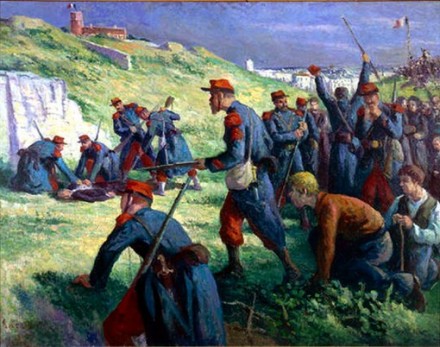
The day was climax and curtains for the first working-class seizure of power in industrial Europe, but in truth indiscriminate reprisal executions had been underway since troops of the conservative Versailles government first breached rebellious Paris on May 21.

What followed was semaine sanglante, the “bloody week” — each barricade’s surviving defenders executed summarily, and anyone in the city liable to a similar fate if the nearest French officer disliked the cut of his or her jib. Rumors swept the city that women of the Commune were torching buildings, for instance, and suddenly any woman in the street could be killed as an arsonist; some firefighters were shot as saboteurs when the “water” they threw on such flames failed to speedily quench them,* and was consequently adjudged to be kerosone.

And heaven help he who should chance to resemble one of the wanted Communard leaders!

Any passer-by calling a man by a revolutionary name caused him to be shot by soldiers eager to get the premium … Members and functionaries of the Commune were thus shot, and often several times over, in the persons of individuals who resembled them more or less.


Un rue de Paris en 1871, by Maximilien Luce.

The total body counts are guesswork: the killing ran far ahead of the record-keeping. Twenty thousand, or thirty, or more are thought to perished by summary execution. Even the press of the bourgeoisie, whose sword arm the Versailles men comprised, was aghast. London’s Times filled its broadsheets with calumnies upon the Commune, but noted on May 29:

“The Revolution is crushed;” but at what a cost, and amid what horrors! … the Communists seem not very much worse than their antagonists. It sounds like trifling for M. Thiers to be denouncing the Insurgents for having shot a captive officer “without respect for the laws of war.” The laws of war! They are mild and Christian compared with the inhuman laws of revenge under which the Versailles troops have been shooting, bayoneting, ripping up prisoners, women and children, during the last six days.

Whatever the true death toll, it massively surpassed that of the much more eagerly commemorated Revolutionary Terror.

Not for Executed Today to number what the butchers themselves could not. In a city turned charnel house in the midst of a Week of Blood, a few scenes of mortality from the day the Commune fell. (Heavily sourced to the very pro-Commune — hence potentially sensational — History of the Commune of 1871)

This people, heroes in the face of the foreigner, must therefore by called assassins, criminals, wretches, because they died for the Universal Republic, because in defense of their beliefs, their conscience, their idea, they preferred, in their fierce enthusiasm, to bury themselves in the ruins of Paris rather than abandon it to the coalition of despots a thousand times more cruel and more lasting than any foreigner.

-Lissagaray

The 147 Fédérés at Communards’ Wall

At a wall still consecrated to leftists in the Pere Lachaise cemetery of Belleville, 147 were summarily shot.

The 147 are acclaimed as the last defenders of the Commune.

the Commune is in its death throes. Like the dragon of fairy lore, it dies, vomiting flames … What must these men feel who are killing and being killed in the cemetery! To die among the dead seems horrible. But they never give it a thought; the bloody thirst for destruction which possesses them allows them only to think of one thing, of killing! Some of them are gay, they are brave, these men. That makes it only the more dreadful; these wretches are heroic! Behind the barricades there have been instances of the most splendid valour. A man at the Porte Saint-Martin, holding a red flag in his hand, was standing, heedless of danger, on a pile of stones. The balls showered around him, while he leant carelessly against an empty barrel which stood behind. — “Lazy fellow,” cried a comrade. ‘”No,” said he, “I am only leaning that I may not fall when I die.”

Paris Under the Commune, an anti-Commune source

Communard Eugene Varlin

Varlin, alas! was not to escape. On Sunday the 28th May he was recognized in the Rue Lafayette, and led, or rather dragged, to the foot of the Buttes Montmartre before the commanding general. The Versaillese sent him to be shot in the Rue des Rosiers. For an hour, a mortal hour, Varlin was dragged through the streets of Montmartre, his hands tied behind his back, under a shower of blows and insults. His young, thoughtful head, that had never harboured other thoughts than of fraternity, slashed open by the sabres, was soon but one mass of blood, of mangled flesh, the eye protruding from the orbit. On reaching the Rue des Rosiers, he no longer walked; he was carried. They set him down to shoot him. The wretches dismembered his corpse with blows of the butt-ends of their muskets.

Varlin was shot along with a nameless batch of others to whom the March 18 execution of Generals Lecomte and Thomas had been hastily imputed (they were held at the generals’ execution site, to contemplate their sin). A pro-government paper allowed that Varlin “died game.”


L’execution de Varlin, another Maximilien Luce scene.

Many at the stock exchange

According to the Paris Francais as quoted by this Marxist review of the events

It is at the Bourse that there was to-day the largest number of executions. The doomed men who attempted to resist were bound to the iron railing.

The stock exchange is “a fit place, to be sure, for this sort of business,” observes our interlocutor.

Eighty-plus defenders of Belleville, at the Arc de Triomphe

The London Times editorialized on May 31 upon this incident when the Marquis de Gallifet plucked from the mass of Belleville’s May 28 captives “eighty prisoners, principally soldiers of every arm, linesmen, artillerymen, and Zouaves, [who] were set apart and afterwards led to the right of the rampart to be shot.”

The French are filling up the darkest page in the book of their own or the world’s history. The charge of ruthless cruelty is no longer limited to one party or to one class of persons. The Versailles troops seem inclined to outdo the Communists in their lavishness of human blood. The Marquis de Gallifet is escorting a column of prisoners to Versailles or Satory. He “picks out eighty-two of them, and shoots them at the Arc de Triomphe.” Next came a lot of 20 firemen, then a dozen women, one aged 70. On another spot our Correspondent came upon “80 corpses, piled upon each other, a mass of arms and legs and distorted faces, while the roads and gutter literally flowed with blood.” About 1,000 are said to have thus suffered. By this wholesale and summary execution of prisoners in batches of 50 and 100, not only must the innocent perish with the guilty, but many must bear the penalty of imaginary guilt.

An utterly disconnected Englishman, according to the paper’s correspondent, was accidentally among the four score at the Arc, and only saved by the fortuitous intervention of a Belgian attache.

an English officer somehow got mixed up in the procession, and was forced to keep in it by the escort, who, out of 5,000 prisoners, could not, of course, be expected to recognize one innocent man … it so happened that some of the prisoners tried to escape, and to make an example the leader of the cavalry escort, the Marquis de Gallifet, a man who is not prone to err on the side of mercy, had then and there 81 shot, and the English officer was all but one of them, his explanations being at first refused the slightest attention. Human life has, in fact, become so cheap that a man is shot more readily than a dog.

Socialist physician Tony Moilin

One single fact was Tony Moilin reproached with: that of having on the 18th March taken possession of the mairie of his arrondissement, and having thus had a share in giving the signal for the insurrection …

The court-martial condescended to tell him that the fact of the mairie, the only one he could be reproached with, had in itself not much importance, and did not merit death, but that he was one of the chiefs of the Socialist party, dangerous through his talents, his character, and his influence over the masses; one of those men, in short, of whom a prudent and wise Government must rid itself when it finds a legitimate occasion to do so

[A] respite of twelve hours was granted him in order that he might make his testament, write a few words of farewell to his father, and finally [marry his pregnant lover] … on the 28th May, in the morning, Tony Moilin was led into the garden a few steps from the palace and shot. His body, which his widow claimed, the surrender of which had been at first promised, was refused her. (History of the Commune of 1871)

The unnumbered dead of Lobau Barracks

Since morning a strong cordon is being formed round the theatre (Châtelet); where a court-martial is permanently established. From time to time one sees a band of fifteen to twenty individuals coming out, composed of National Guards, civilians, women and children fifteen to sixteen years old.

These individuals are condemned to death. They march two by two, escorted by a platoon of chasseurs, who lead and bring up the rear. This cortege goes up the Quai de Gevres and enters the Republican Barracks in the Place Lobau. A minute after one hears from within the fire of platoons and successive musketry discharges; it is the sentence of the court-martial which has just been executed.

The detachment of chasseurs returns to the Chatelet to fetch other prisoners. The crowd seems deeply impressed on hearing the noise of the shootings.

This is another publication’s story cited in the History of the Commune of 1871, which itself also details the court-martial procedures of this drumhead tribunal:

Thousands of prisoners who were led there were first of all penned in upon the stage and in the auditorium, under the guns of the soldiers placed in the boxes; then, little by little, like sheep driven to the door of the slaughter-house, from wing to wing they were pushed to the saloon, where, round a large table, officers of the army and the honest National Guard were seated, their sabres between their legs, cigars in their mouths. The examination lasted a quarter of a minute. ‘Did you take arms? Did you serve the Commune? Show your hands.’ If the resolute attitude of a prisoner betrayed a combatant, if his face was unpleasant, without asking for his name, his profession, without entering any note upon any register, he was classed. ‘You?’ was said to the next one, and so on to the end of the file, without excepting the women, children, and old men. When by a caprice a prisoner was spared, he was said to be ordinary, and reserved for Versailles. No one was liberated.

The classed ones were at once delivered to the executioners, who led them into the nearest garden or court. From the Châtelet, for instance, they were taken to the Lebau Barracks. There the doors were no sooner closed than the gendarmes fired, without even grouping their victims before a platoon. Some, only wounded, ran along by the walls, the gendarmes chasing and shooting at them till they fell dead. … There were so many victims, that the soldiers, tired out, were obliged to rest their guns actually against the sufferers. The wall of the terrace was covered with brains; the executioners waded through pools of blood.


Summary executions — death squads — continued for days or weeks afterwards in Paris; martial law throttled left organizing in the city; and those “fortunate” enough to have been captured alive were processed in a steady stream of judicial executions over the months yet to come.

The Commune, a palpably subversive example even in the present day, was destroyed in every way possible for the Versailles government. But its example could hardly be forgotten.

Marx would write The Civil War in France of the only proletarian revolution he would actually witness in his lifetime.

The next generation’s subversives also took inspiration from the Parisian example … and lessons from its mistakes. Lenin — a fond student of the Commune, who was eventually buried wrapped in a Communard banner — said that

two mistakes destroyed the fruits of the splendid victory. The proletariat stopped half-way: instead of setting about “expropriating the expropriators”, it allowed itself to be led astray by dreams of establishing a higher justice in the country united by a common national task; such institutions as the banks, for example, were not taken over … The second mistake was excessive magnanimity on the part of the proletariat: instead of destroying its enemies it sought to exert moral influence on them; it underestimated the significance of direct military operations in civil war, and instead of launching a resolute offensive against Versailles that would have crowned its victory in Paris, it tarried and gave the Versailles government time to gather the dark forces and prepare for the blood-soaked week of May.

“The lesson learnt by the proletariat will not be forgotten,” Lenin vowed, and his own revolution gained a vital object lesson in the Bloody Week of Paris, and an anthem besides: Communard Eugene Pottier, fleeing the Versailles army’s slaughter, wrote the verses that have been sung ever since by millions dreaming of a better world — the Internationale.

* Water can accelerate a fire, under the right circumstances.

On this day..

1831: Mariana de Pineda Muñoz, Spanish liberal

On this date in 1831, Mariana Pineda died for her flag.

The problem, in the eyes of feckless royal troglodyte Ferdinand VII, was that Pineda’s flag stood for “Equality, Freedom and Law.”

The widowed 27-year-old (English Wikipedia page | the much more detailed Spanish) had become a devotee of the liberal Zeitgeist that contended in post-Napoleonic Europe with absolutism.

Spain had had the briefest of flings with liberal government in 1812, only to have Ferdinand reverse Spain from one of the most progressive governments in Europe to one of its most backward. The man even reintroduced the Spanish Inquisition.

By the 1830’s, tensions between constitutional liberals and unreconstructed royalists had Spain on the point of civil war, which would in fact erupt upon Ferdinand’s death two years hence.

Mariana Pineda swam with liberal circles, even helping a death-sentenced cousin escape prison. In 1831, the authorities found a flag in her home embroidered with the “Equality, Freedom and Law” slogan.

Pineda refused to name accomplices, and Ferdinand threw the book at her. Pineda remained adamant.

Before suffering public garrotting in her native Granada (while the offending flag was burnt before her), Pineda declared,

“The memory of my ordeal will do more for our cause than all the flags in the world.”

Her prediction wasn’t so far off.

Pineda’s posthumous repute as heroine has migrated from the particular cause of her day to the general pantheon of Spain. These days, a Granada public holiday (festivities held in the square named in Pineda’s honor) commemorates her sacrifice. Her name is also a byword for the struggle of women to win full political participation (there’s a Centro Europeo de Las Mujeres “Mariana de Pineda”). And martyred playwright Federico García Lorca turned her story into a theatrical classic — his first successful play.

On this day..