Fully engaged with the liberal intellectual currents of the Enlightenment, de Gouges spent the 1770’s and 1780’s in Parisian salon circles cranking out plays (over 40) and petitions, pamphlets and manifestos on animal welfare, poverty, the treatment of orphans, and ending slavery.
The latter issue, and not women’s rights, was the cause her contemporaries would have most associated with her.
But the natural-born gadfly didn’t pick her battles with injustice, and the Terror was a bad period to be indiscriminate. Like some of her Girondist associates, she risked the Paris mob’s wrath by openly opposing Louis XVI‘s execution — right in character, Olympe was down on the whole idea of the death penalty — and she carried principle into foolhardiness by printing broadsides savaging Robespierre.
There can be no mistaking the perfidious intentions of this criminal woman, and her hidden motives … calumniating and spewing out bile in large doses against the warmest friends of the people, their most intrepid defender.
Olympe de Gouges, born with an exalted imagination, mistook her delirium for an inspiration of nature. She wanted to be a man of state. She took up the projects of the perfidious people who want to divide France. It seems the law has punished this conspirator for having forgotten the virtues that belong to her sex.
And strange to say, that condescension outlived Robespierre by centuries.
Only recently, as mainstream thought has (sort of) caught up with de Gouges, has the scope of her work (French link) attracted renewed appreciation, and Olympe been acknowledged an Olympian herself.
* Article 10: “Woman has the right to mount the scaffold; she must equally have the right to mount the rostrum.” The work was dedicated to Marie Antoinette.
On this date in 2001, former pop singer and shaman Mona Fandey was hanged with two accomplices at Kajang Prison outside Kuala Lumpur, closing the noose on one of the world’s weirdest and most sensational recent crimes.
Aging B-list pop crooner Maznah Ismail — “Mona Fandey” was her stage name — had transitioned to a gig as a high-rent spiritualist and healer, known locally as a bomoh.
In that capacity, she and hubby Mohd Affandi Abdul Rahman landed a politician with more money than sense. After collecting a bunch of cash from him, they got him to lie down with his eyes closed as part of a ritual that was supposed to make money fall from the skies. Instead, the couple’s assistant Juraimi Hussin chopped off his head, and Mona went on a shopping spree.
The effect of the grisly celebrity murder was heightened by Mona’s cheery demeanor throughout the trial and thereafter, as if a murderess’ notoriety was the pinnacle she never achieved as an entertainer.
She and her husband maintained an unsettling placidity about their demise to the very end. Some sources say she uttered the mysterious remark, “I will never die” just before her hanging. (Others have everyone silent.)
The end of the three killers was hardly the end of such a headline-grabbing case in the public memory. Her cell is becoming a protected “heritage site”, and her story has been treated on screens both small and silver.
(It’s Samhain — the ancient, pagan wellspring of Halloween. Thanks to Royelen for this timely remembrance of a completely undated witch-burning from Scottish folklore.)
A gurgling fountain at the property border announces a gentle place. The fountain has a small pond filled with friendly goldfish which swim your way. They are hoping for morsel of food but it feels like an appropriate welcome to a local herb shop.
The mission is to find a remedy for leg pain. For a few moments the pain can wait while the lemon thyme gets rubbed by fingers gathering up the smell for a delightful inhalation. And then there is the basil, the chocolate mint, the rosemary — and so it goes with rows and rows of little pots of tiny green plants, each fragrant in a unique way. Each creating its own sensation.
When sated with nasal stimulation, it’s time to enter the house. It causes no surprise when cheery sounding chimes ring as the door opens. Inside the walls are lined with shelves. Each shelf is filled with glass jars. Each jar has a different dried leaf. There are many jars. An herb shop employee is happy to help.
“Pain, long-standing muscle pain? In your leg. Uh-huh. It’s possibly a nutritional deficiency, you want to take calcium, two pills twice-a-day. You’ll know in two weeks if this is the cause.”
This knowledge, long forgotten and now denied by Western medicine, may have been the kind of knowledge that got Kate McNiven killed.
Scottish lore has it that Kate McNiven’s community of Monzie in Scotland first sought her out for her wisdom, maybe for her herb cures and curse-ending charms. Then, in the era of witch burnings, her community pulled her from her service and burned her to death. After killing her, Kate McNiven’s community made her a local legend.
Today we might assess Kate McNiven as a real witch based on the power of the curse she left behind — a curse which the generations passed down and which now comes to us across the Internet; a curse which leaves us the tale of a talisman known as the Inchbrakie Moonstone.
Though there are no official records, the curse is said to begin in 1615* when Kate was accused of witchcraft. Having been found guilty, word spread of her immediate execution by fire. A landowner of a nearby estate, having come upon the fire preparations, asked the gathered crowd to stop their execution plan. While he had no success, he did win favor from the named witch.
As the fires around her grew, Kate McNiven began her curse. The landowner of execution site was cursed, then the area known as Monzie was cursed, and finally she honored the unsuccessful estate owner who attempted to stop her execution. She threw from the fires a charm — a blue stone that had been around her neck — and told him that if he kept it close, he would always be blessed with sons and they would always be blessed with lands.
The legend goes that the cursing was successful. The landlord on whose land she died was not able to pass the property on. Monzie withered.
Of course, the land owner who pleaded her case kept the stone near as directed. As the legend goes it always was put on the fingers of the daughter-in-laws and heirs were always produced. Centuries of fecundity were enjoyed until one descendant made the mistake of allowing the stone to be moved outside of the estate. That was the end of the good run and proof of Kate’s powers as a witch.
Is the legend of the Witch of Monzie a romantic retelling of a woman’s death or is it a community reassuring itself that the executed woman was guilty of her crimes? Maybe both. Maybe more.
Swiss psychotherapy pioneer Carl Jung’s theory of the shadow tells us that Kate McNiven’s peers attributed to her what they could not accept in themselves. They found her untrustworthy and capable of doing strange things. For some reason, she of all people was chosen as the one to be the scapegoat. It may have been for no other reason than she didn’t point the finger at someone else. The people of Monzie did not fight for her release, and they likely felt relieved that the pressure was off of them. Their untrustworthiness and strange behaviors were not under scrutiny. For the moment, they were safe.
It’s easy to imagine Kate McNiven as Tessie in Shirley Jackson’s short story, “The Lottery”:,
The children had stones already. And someone gave little Davy Hutchinson a few pebbles.
Tessie Hutchinson was in the center of a cleared space by now, and she held her hands out desperately as the villagers moved in on her. “It isn’t fair,” she said. A stone hit her on the side of the head. Old Man Warner was saying, “Come on, come on, everyone.” Steve Adams was in the front of the crowd of villagers, with Mrs. Graves beside him.
“It isn’t fair, it isn’t right,” Mrs. Hutchinson screamed, and then they were upon her.
* Not only the year but the century of Kate McNiven’s — or M’Niven, McNieven or Nicniven — execution is disputed. Sources report both 1615 (in the midst of King James’ witch-sniffing reign), and 1715 (which would make her one of the last witchcraft executions in Scotland).
On this date in 1622, Anne de Chantraine was burned at the stake for witchcraft in Waret-la-Chaussee, Belgium.
Our day’s heroine answers most prominently to fictional modern interpretations — about which more in a moment — but Anne de Chantraine was a flesh-and-blood person, at least for 17 years.*
In outline form, Anne is said to have faced the usual litany of sorcerous allegations and the usual ordeals to demonstrate guilt, with the usual result: confession, execution. Here in the opening years of the Thirty Years’ War coeval with the the conflicts of the Protestant Reformation, one cannot but suspect the fearful hand of endangered authority in witch-hunts. Historian Hugh Trevor-Roper argued that
this recrudescence of the witch-craze in the 1560s was directly connected with the return of religious war … It can be shown from geography: every major outbreak is in the frontier-area where religious strife is not intellectual, a dissent of opinion, but social, the dissidence of a society. … Thereafter, almost every local outbreak can be related to the aggression of one religion upon the other.
Anne de Chantraine’s environs fit the theorem.
The Walloon region of Liege at this point was governed by a Catholic Prince-Bishop of Habsburg stock, just as the Holy Roman Empire was putting down the Protestant stirrings in Bohemia that would initiate Europe’s epochal war and send armies to and fro through the Low Countries. Said Prince-Bishop, name of Ferdinand of Bavaria, would win renown as a zealous persecutor of the diabolical in his realms.
Alas for Anne.
She’s a bit better documented among Francophones (see this biography in French, for instance, full of sensual details like the gorgeous red hair, a spurned lover accusing her, and the rough play of medieval torture; there’s also a brief roundup in German here), but worldwide, she’s a literary character of some consequence — most notably, perhaps, through the work of Belgian author Francoise Mallet-Joris: her 1968 Trois âges de la nuit (translated to English as simply The Witches) presents Anne de Chantraine as the focal point of one of three vignettes reimagining real historical “witches” as persons struggling for spiritual growth.
Anne, in this version, does participate in (staged, not-really-supernatural) witches’ sabbaths, plus a lesbian affair with a fellow participant. Her seekings both godly and infernal (paralleled by lifestyles both monastic and hedonistic) fall short of satisfactory; in the end, exercising magic unto her own death is a form of self-actualization among fellow people who, unable to recognize her humanity, brutalize or ignore her.
Players of the long-running video board game Atmosfear (or Nightmare) will also recognize Anne de Chantraine as a recurring witch character. The series uses recordings (VCR tapes originally; DVDs now) played during gameplay; “the witch” is featured as the central character in Atmosfear III/Nightmare III:
(In the comment thread for this video on YouTube, the French actress Frederique Fouche drops in to confirm her part as the witch. According to this French interview, the role caused her to become an emigre in Australia.)
* Some reports say she was burned at age 17, others that she was arrested at 17, which would have made her 18 or 19 at her death.
This afternoon in Paris, 1793, the French Revolution devoured the Queen.
Thirteen-year-old Madame Antoine — a year before marriage, and rebranding as Marie Antoinette. A vast gallery of her portraiture awaits here.
Among the most emblematic death penalty victims in history, Marie Antoinette — the “widow Capet,” as she was styled in egalite, after the guillotine shortened her husband — had the bad luck to personify the decadence of the ancien regime under the hegemony of the sans-culotte.
(And, of course, the good luck to be born heir to all the perks of absolutism she enjoyed for the first thirty-plus years of life. So, you know: a mixed bag.)
Those infamous excesses — and her infamous alleged bon mot, “let them eat cake” — are said to have been greatly exaggerated, nothing that everyone wasn’t doing, nothing that wasn’t understandable under the circumstances.
She had a gift, it seems, for accumulating to her personal reputation the outrage incurred by every gross and petty indulgence of the old order. And she had a popular press, the libelles, ready to embroider them salaciously.
Jacques-Louis David sketched this portrait of a haggard Marie Antoinette en route to the guillotine.
Cruel, wanton, senseless … her death was all of these, but then many others in the Terror suffered the same, as many others had under the Bourbons.
As royal dynastic pairings go, she’d been dealt a bad hand.
Her mere presence in France was fruit of the controversial policy of alliance with the Austrian Habsburgs from the Seven Years’ War, and she was trundled off with her dowry and her teenage wiles to the foreign snakepit of Versailles just as the minister advancing that policy fell. Distrusted by the French as an Austrian catspaw, castigated by her family for her inadequacies thereto, socially expected to display conspicuous regal largesse during a budget crisis not of her making, and unable for the longest time to get a successful coition from her indifferent and/or impotent husband, it must have seemed to her some days like every play was a losing one.
She struggled to gain traction at court. But she would lose much more than influence.
I was a queen, and you took away my crown; a wife, and you killed my husband; a mother, and you deprived me of my children. My blood alone remains: take it, but do not make me suffer long. (WikiQuote)
Her bearing she kept forever: in a kangaroo court with a foreordained outcome where her imperious dignity still managed to turn aside an accusation of sexual abuse her son had been cajoled into supplying; on the scaffold, when she did not neglect courtesy to the executioner whose foot she trod:
“Monsieur, je vous demande pardon. Je ne l’ai pas fait exprès.”
For much more queenliness, Marie-Antoinette.org delivers what the url promises, in quantity. If this figure or this period appeals, be sure to browse its forums.
Naturally, the doomed queen has had plenty of attention from printed word as well:
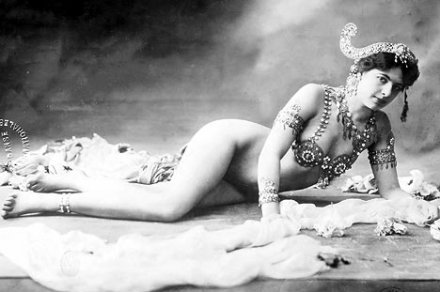
At 5 a.m. this date in 1917, Margaretha Geertruida Zelle — better known as Mata Hari — was awoken at Saint-Lazare Prison to news that it was her last day on earth.
She died in a muddy drill field outside Paris, facing a firing squad as she had lived: self-possessed, mysterious, her eyes (she refused a blindfold) open.
For the oldest profession, it may be there is nothing truly original, nothing new under the sun. But Mata Hari — thanks in no small part to her genuinely fatale end — redefined it for the dawning age of mass visual media and tapped the power of sexual allure for a commercial century.
She was already pushing 30 when she got into the exotic dance game, with a failed May-December marriage behind her from what a wag might call her first sexual bargain, to get out from under the thumb of her family and see the world. In Paris in the belle epoque, there were assuredly dancers younger, prettier. Margaretha, who here debuted the show name by which history would know here, surpassed them with showmanship.
She exploited her exotic olive-toned looks — there were rumors of Javanese or Jewish blood even in her childhood — and claimed to be an Indian princess; her talent for repackaging oriental exoticism with just the right amount of otherness combined with her willingness to push boundaries of eroticism made her an instant sensation. Naturally gregarious and unprudish, she segued into the courtesan biz on the side with dashing officers and wealthy industrialists.
Not bad for a thirty-something mother of two.
She comes at the start of our own era: sensual postcards and posed photos of Mata Hari were at once her pitch and her product; celluloid was just coming online, and 14 years after her death, she’d be portrayed by silver screen femme fatale Greta Garbo:
That’s her with the last object of her affections, a Russian aviator young enough to be her son, and a reminder that the birth of Greta Garbo’s era was also the death of Mata Hari’s own.
She was aging, for one thing. For another, of course, war shattered Europe. Famous, decadent, polyglot … those things that had been her passport suddenly became her liabilities. Globetrotting travel? Payoffs from a multinational cast of officers for her companionship?
There’s no take here on whether she was really, as convicted, a German spy of any variety at all — she seems to have been approached, to have tried her hand clumsily or to have been set up by either French or German intelligence, or simply to have behaved indiscreetly. Once she was caught up against events, her maneating reputation did her no favors.
Spying, she was terrible at. Commanding men’s attention? As a British correspondent reported, Margaretha Zelle owned her role to the very last.
The first intimation she received that her plea had been denied was when she was led at daybreak from her cell in the Saint-Lazare prison to a waiting automobile and then rushed to the barracks where the firing squad awaited her.
Never once had the iron will of the beautiful woman failed her. Father Arbaux, accompanied by two sisters of charity, Captain Bouchardon, and Maitre Clunet, her lawyer, entered her cell, where she was still sleeping – a calm, untroubled sleep, it was remarked by the turnkeys and trusties.
The sisters gently shook her. She arose and was told that her hour had come.
‘May I write two letters?’ was all she asked.
Consent was given immediately by Captain Bouchardon, and pen, ink, paper, and envelopes were given to her.
She seated herself at the edge of the bed and wrote the letters with feverish haste. She handed them over to the custody of her lawyer.
Then she drew on her stockings, black, silken, filmy things, grotesque in the circumstances. She placed her high-heeled slippers on her feet and tied the silken ribbons over her insteps.
She arose and took the long black velvet cloak, edged around the bottom with fur and with a huge square fur collar hanging down the back, from a hook over the head of her bed. She placed this cloak over the heavy silk kimono which she had been wearing over her nightdress.
Her wealth of black hair was still coiled about her head in braids. She put on a large, flapping black felt hat with a black silk ribbon and bow. Slowly and indifferently, it seemed, she pulled on a pair of black kid gloves. Then she said calmly:
‘I am ready.’
The party slowly filed out of her cell to the waiting automobile.
The car sped through the heart of the sleeping city. It was scarcely half-past five in the morning and the sun was not yet fully up.
Clear across Paris the car whirled to the Caserne de Vincennes, the barracks of the old fort which the Germans stormed in 1870.
The troops were already drawn up for the execution. The twelve Zouaves, forming the firing squad, stood in line, their rifles at ease. A subofficer stood behind them, sword drawn.
The automobile stopped, and the party descended, Mata Hari last. The party walked straight to the spot, where a little hummock of earth reared itself seven or eight feet high and afforded a background for such bullets as might miss the human target.
As Father Arbaux spoke with the condemned woman, a French officer approached, carrying a white cloth.
‘The blindfold,’ he whispered to the nuns who stood there and handed it to them.
‘Must I wear that?’ asked Mata Hari, turning to her lawyer, as her eyes glimpsed the blindfold.
Maitre Clunet turned interrogatively to the French officer.
‘If Madame prefers not, it makes no difference,’ replied the officer, hurriedly turning away. .
Mata Hari was not bound and she was not blindfolded. She stood gazing steadfastly at her executioners, when the priest, the nuns, and her lawyer stepped away from her.*
The officer in command of the firing squad, who had been watching his men like a hawk that none might examine his rifle and try to find out whether he was destined to fire the blank cartridge which was in the breech of one rifle, seemed relieved that the business would soon be over.
A sharp, crackling command and the file of twelve men assumed rigid positions at attention. Another command, and their rifles were at their shoulders; each man gazed down his barrel at the breast of the women which was the target.
She did not move a muscle.
The underofficer in charge had moved to a position where from the corners of their eyes they could see him. His sword was extended in the air.
It dropped. The sun – by this time up – flashed on the burnished blade as it described an arc in falling. Simultaneously the sound of the volley rang out. Flame and a tiny puff of greyish smoke issued from the muzzle of each rifle. Automatically the men dropped their arms.
At the report Mata Hari fell. She did not die as actors and moving picture stars would have us believe that people die when they are shot. She did not throw up her hands nor did she plunge straight forward or straight back.
Instead she seemed to collapse. Slowly, inertly, she settled to her knees, her head up always, and without the slightest change of expression on her face. For the fraction of a second it seemed she tottered there, on her knees, gazing directly at those who had taken her life. Then she fell backward, bending at the waist, with her legs doubled up beneath her. She lay prone, motionless, with her face turned towards the sky.
A non-commissioned officer, who accompanied a lieutenant, drew his revolver from the big, black holster strapped about his waist. Bending over, he placed the muzzle of the revolver almost – but not quite – against the left temple of the spy. He pulled the trigger, and the bullet tore into the brain of the woman.
Mata Hari was surely dead.
* Inevitably, a story got around that she’d opened her funereal coat to the firing squad, revealing no clothing beneath it.
Early this morning in 1915, the German military occupying Belgium shot aid worker Edith Cavell at Brussels for aiding the British war effort.
The matronly nurse had been condemned only the day before by a German military court for helping Allied soldiers escape from behind German lines — charges Cavell readily admitted. The British chaplain who attended her the night before her death reported her saying (not actually her last words, but recalled as her parting sentiment, as it were):
But this I would say, standing as I do in view of God and eternity, I realize that patriotism is not enough. I must have no hatred or bitterness toward any one.
So naturally, she immediately became the Entente’s bloody banner of the barbarous Hun, helping dramatically ramp up recruitment for the other team’s set of moral cretins.
The thing is, the Germans actually had a point. Cavell ran a nursing school in Brussels, and courageously stuck around when the Germans smashed through Belgium as World War I opened. She’s sometimes remembered as getting in hot water for treating the wounded regardless of nationality, but she did a lot more than that: she got involved with an underground railroad funneling Allied soldiers back to enemy countries.
It was one of those impossible trials of conscience that wartime brings: Cavell, whose hospital was subsumed by the Red Cross during the war, should technically have remained neutral; her actions did bring material aid to Germany’s foes.
However, Belgian, French and English troops caught behind lines by the Germans’ lightning advance were in danger themselves of summary execution, as were civilians who harbored them. Neutrally treating them and handing them over as POWs might have been tantamount to killing many of them, especially in the first few months of the war. Though Edith Cavell said that “I am happy to die for my country,” her actions look more humanitarian than nationalistic — the best choice to be made when no good ones are available. Patriotism of a higher order, if you like.
Probably Cavell’s was a case tailor-made for executive clemency, but Germany was keen to send one of those proverbial messages: civilians in occupied countries had best stay out of the war. Despite the frantic lobbying of England’s ambassadors (and, ominously for Germany, those of the United States), the sentence was carried out on both Cavell and a fellow-traveler in her network, Belgian Philippe Baucq.
Clumsy propagandists, the Kaiser’s boys badly misjudged the message so sent.
In the face of intense international outcry, Germany soon found itself defending its actions (.pdf), and then commuting the sentences (.pdf again) of Cavell’s other collaborators.
None of this abated Cavell’s stupendous propaganda value to Germany’s enemies. And — holy wow, the graying 49-year-old gets made over into quite the heartbreaker in most of these.
The nurse’s repute — and she was said to have struck a Joan of Arc-like chord in those parts — caused a renaissance for the name “Edith” among French and Belgian newborns, most notably singer Edith Piaf (born in December 1915). While Cavell’s sacrifice did nothing to stem her name’s declining Anglo (or at least American) popularity, there is a Mount Edith Cavell named for her in Canada, and a plethora of monuments and public spaces dedicated to her throughout the Allied powers’ lands. (Here are just a handful.) And she still packs enough symbolic punch for the current British Prime Minister Gordon Brown to deploy her in the propagandist’s subtler modern arts.
There’s plenty more about her online, but world headquarters (with information about the Cavell Festival) is edithcavell.org.uk. There’s also a stupendous collection of text and images (several already used in this post) at the sometimes slow-loading but endlessly fascinating site The Great War in a Different Light.
On October 4, 1621, the Duke of Württemberg declared Katharina Kepler free of a witchcraft charge for which she had barely avoided execution … with the help of her son, the astronomer Johannes Kepler.
The famous scientist was very well along his career, and his mother (German Wikipedia link) a too-old-for-this-crap 69, when authorities in her native town of Leonberg initiated proceedings in 1615.
It says here she was an eccentric, cantankerous old dame, just the sort liable to face a gossip campaign that would promote her into partnership with the Evil One. She was only one of a number of people targeted in the town’s witch-spasm, noticeably occurring as the Catholic-Protestant conflict was stoking that crucible of modernity, the Thirty Years’ War — a fine time and place for infernal superstition.
Several of the suspected were put to death.*
Kepler, whose heterodoxy and heliocentrism made him a touchy figure in a fraught time for scientists, might have done her no favors with his trippy Dream, whose overt musings on “daemons” and the like might have drawn suspicion onto the family. Johannes made six years of atonement struggling — ultimately successfully — to keep his mother alive and untortured.
The judicial college at the University of Tübingen — Kepler had matriculated there as a younger man — opened the door to Katharina’s release by declaring the evidence insufficient either way, and issuing a split-the-baby conviction directing that she be shown but not subjected to the instruments of torture.
On September 28, 1620, the Feast of St. Wenceslas, the executioner showed Katharina Kepler the instruments of torture, the pricking needles, the rack, the branding irons. Her son Johannes Kepler was nearby, fuming, praying for it to be over. He was forty-nine and, with Galileo Galilei, one of the greatest astronomers of the age — the emperor’s mathematician, the genius who had calculated the true orbits of the planets and revealed the laws of optics to the world. Dukes listened to him. Barons asked his advice. And yet when the town gossips of Leonberg set their will against him, determined to take the life of his mother on trumped-up charges of witchcraft, he could not stop them.
…
There were tidal forces at work in this little town. The events around the duchy of Württemberg would gather into themselves all the violent changes of the day, for by their conviction of Katharina, the consistory (the duke’s council), the magistrates, and the Lutheran church authorities had bundled together their fear of Copernicus and their anger against Johannes, a man they had already convicted of heresy. The Reformation, like an earthquake, had cracked Western Christianity, stable since the fifth century, into Catholics and Protestants, and the Protestants into Lutherans, Zwinglians, Calvinists, Anglicans, and Anabaptists, with the many camps drifting apart like tectonic plates. Even the heavens had begun changing, and Kepler had been a part of that change. … Fear ruled Europe — fear of difference, fear of change.
And there, in one corner of Swabia in southern Germany, the mother of a famous man, a mathematician and scientist, a respected, pious Lutheran, nearly paid with her life.
…
Early that morning, she was led to the torturer by Aulber, the bailiff of Güglingen, who was accompanied by a scribe for recording her confession, and three court representatives. The torturer, with the bailiff standing to one side, then shouted at her for a long time, commanding her to repent and tell the truth and threatening her if she didn’t. He showed her each instrument and described in detail all that it would do to her body — the prickers, the long needles for picking at the flesh; the hot irons for branding; the pincers for pulling and tearing at the body; the rack; the garrote; and the gallows for hanging, drawing, and quartering. He adjured her to repent, to confess her crimes, so that even if she would not survive in this world, she could at least go to God with a clear conscience.
Stubborn Katharina was having none of it.
Do with me what you want. Even if you were to pull one vein after another out of my body, I would have nothing to admit. (Source)
Having survived the “torture,” she was in the clear; at her son’s relentless insistence, the Duke ordered her released six days later.
* This German timeline of Leonberg says the witchsmeller got nine out of 10 targets. Other versions have slightly different head counts for the persecution; at any rate, Katharina wasn’t alone.
On the morning this day in 1599, the Cenci family — mother Lucrezia, son Giacomo, and immortal tragic heartthrob Beatrice — were put to death at Sant’Angelo Bridge for murdering the clan’s tyrannous father.
Francesco Cenci, the victim, was more accustomed to making victims of his own: detested around the Eternal City, he indulged his violent temper and fleshy lusts with the impunity of a wealthy cardinal’s son. By all accounts, he enjoyed pushing around his family, too.
This much is stipulated. What lies beyond is legend.
But the legend is why we’re dallying with Beatrice today, so we might as well begin there: in fear that her father would rape her, it goes, Beatrice tried to turn to the authorities, who let mean old dad walk on account of his connections. Desperate to protect herself from incest, Beatrice and family arrange to batter his gulliver and toss him over a balcony to make it look like suicide.
So the family was hauled in and tortured, and eventually Lucrezia and Beatrice (both beheaded) and Giacomo (quartered after suffering the mazzolatura of an incapacitating hammer blow to the head followed by gory lethal knifework by the executioner) all paid the price while the youngest child watched, spared death but condemned to life in the galleys.
(The papacy gobbled up the patricides’ estate, which puts a fine point on the ironically-named Pope Clement VIII‘s law-and-order stance on the appeal for mercy, and his subsequent edicts to quash public comment on the affair.)
Then Beatrice’s body — the part below the neck — contrived to disrobe when fumbled by the brethren taking it away for burial.
You’ve got to admit it’s pretty romantic. Some versions even hold that the responsible executioners died violently themselves within a month, or that a ghostly Beatrice returns to the scene of her demise on this anniversary.
And not a word of Italian fluency will be necessary to catch the gist of this excerpt from this 1969 Lucio Fulci film:
While the case was a true sensation Rome at the turn of the 17th century, the legend as we know it was heavily constructed in the 19th century … and specifically Percy Bysshe Shelley, who heard the story in Italy* where it had persevered as local folklore. A girl who killed her despot-father, executed by the despotic agents of the Divine Father? You don’t get into the canon without knowing what to do with that kind of material.
And he had this charming painting of her to boot:
Shelley amped up the menaced-virginal-purity theme, made the bloodshed a lot more demure, and turned it into a long poem, “The Cenci” (available on Google Books, and on Bartleby.com) which in Melville’s description proceeds from putting its protagonist between the “two most horrible crimes possible to civilized humanity — incest and parricide.”
This doesn’t all actually turn out to be well supported: at a minimum, Shelley inflated an incest allegation of doubtful lineage into accomplished fact. Beatrice’s camp did not raise this claim until just before her execution, when it needed a high card for clemency. The loutish victim eventually got his own biographer, who strongly disputed the incest charges. (Francesco also sports his own Italian Wikipedia page.)
Remarkable how the tradition in its modern incarnation proceeds root and branch from Shelley’s apprehension of a single painting, and how his reading stamped itself upon the canvas for later observers — like Hawthorne, writing in his journal:
It is the very saddest picture that ever was painted, or conceived; there is an unfathomable depth and sorrow in the eyes; the sense of it comes to you by a sort of intuition. … It is the most profoundly wrought picture in the world; no artist did it, or could do it again. Guido may have held the brush, but he painted better than he knew. I wish, however, it were possible for some spectator, of deep sensibility, to see the picture without knowing anything of the subject or history; for no doubt we bring all our knowledge of the Cenci tragedy to the interpretation of the picture.
He wrote better than he knew: the painting is no longer attributed to Guido Reni, and it’s doubtful whether it’s a portrait of Beatrice at all. One wonders if it would retain its place in Hawthorne’s estimation as a local washer-woman modeling for an allegory.
Allegedly on this date in 1724, a young woman was hanged at Edinburgh’s Grassmarket for concealing her pregnancy.
Any number of details in this horrible/wonderful story are shaky, including the date: some sources make it 1728, a few say 1723, and only a handful attest a specific calendar date. Nobody seems to doubt the tale in the main, however — and it’s certainly excellent enough lore to deserve even a heavily asterisked entry.
Deserted by her husband, young Maggie Dickson took lodgings at an inn in exchange for work, and became pregnant by either the innkeeper or his son. (Again — details in the various sources available read like a game of telephone.) Since single* pregnant working-class women had about as many employment options as birth control options, Maggie kept quiet about her condition in the interest of keeping her job.
And since male parliamentarians figured their job was to keep young lasses of loose character and modest means on the straight and narrow by criminalizing their options, Maggie’s sleight-of-womb put her in violation of a law against concealing a pregnancy. (The same situation was playing out elsewhere in the British sphere at this time.)
When the resulting infant turned up dead, the trail led straight to Dickson … but the concealment of the pregnancy and birth were capital crimes on their own, making it immaterial whether it had been a miscarried pregnancy, an act of infanticide, or simply one of the many early 18th century babies to die in the cradle. The law was an indiscriminate instrument to prevent women terminating their pregnancies.
Nothing noteworthy about the hanging itself is recorded; it seems to have been one of the routine public stranglings of the age, and even the scuffle over the body between family and medical students hunting dissection-ready cadavers was a normal occurrence.
The family won. And en route to Musselburgh for burial, Maggie started banging on the inside of the coffin, and was forthwith revived. Officials decided the sentence of hanging had already been carried out … and her awestruck neighbors suddenly started seeing Maggie sympathetically
And they all lived happily ever after. This day’s principal, at any rate, gained a foothold in adequate prosperity, bore more children, and answered to the nickname “Half-Hangit Maggie Dickson” all the many more years of her life.
The story passed into legend; the dates, as we’ve alluded, fuzzed. One entrepreneurial English broadside publisher of the 19th century even transported the affair to February 1, 1813 — four years after a Concealment of Pregnancy Act reduced the penalty for Maggie Dickson’s “crime” to penal servitude. And near the site of the not-quite-Passion, should you call sometime in Edinburgh, you can raise Half-Hangit Maggie a pint at Maggie Dickson’s Pub.
I’le crye as fu’ o’ tears an egg,
‘Death, I’ve ae favour for to begg,
That ye wad only ge a flegg,
And spare my life,
As I did to ill hanged Megg,
That graceless wife

 Most recognizable today for her Declaration of the Rights of Woman and the Citizen* — a proto-feminist call for equality of the sexes issued in response to the day’s revolutionary but guy-centric Declaration of the Rights of Man and of the Citizen — de Gouges was much more than a one-issue woman.
 Aging B-list pop crooner Maznah Ismail —



 The
The