1848: Camila O’Gorman and Father Ladislao Gutierrez, for traditional family values

On this date in 1848, a pregnant 20-year-old socialite and her forbidden lover were shot at the order of an Argentine dictator.

Virtually a lens for the contradictory currents of gender, class and power in her time, Camila O’Gorman was the daughter of an elite family of (as her name suggests) Irish extraction, and a bosom friend of the daughter of her future executioner, dictator Juan Manuel de Rosas.

She fell into a torrid affair with Gutierrez, the family priest, and in 1847 eloped with him, a grand gesture of romanticism that brought a government warrant for their capture to “satisfy religion and the law and to prevent further cases of immorality and disorder.”

A scandal, as one might suppose — there was much chatter over who seduced whom, and whether it was a kidnapping — but a manhunt (and womanhunt)? Rosas appears psychotically enraged by two young people crazy in love, and still more so for summarily decreeing their death when he had them in his clutches. Another priest, it turned out, handed them over — more in sadness than in anger, in the manner of such folk, but understanding deep down that the arbitrary law is the law and immorality and disorder don’t go about preventing themselves.

O’Gorman was the first woman executed in independent Argentina, and she was eight months pregnant: the better to “satisfy religion” (though not the law, which forbade the execution of a pregnant woman), O’Gorman’s unborn child was baptized … by making her mother drink holy water.

The lovers were then shot together at the town of General San Martín, then known as Santos Lugares de Rosas.

The pregnant O’Gorman, borne to her firing squad. The image comes from this Argentinian page (in Spanish) about the heroine.

According to this effusively pro-elopers essay,

Camila and Uladislao’s brave sense of freedom upset the structured norms of a society used to obeying through fear. Their only way of facing the tyrannical power was escaping from a society which would never understand. They did not give up on their love to please the Restorer [Rosas], as was expected in those days. They never showed signs of repentment, [sic] on the contrary their peaceful minds reflected their clean consciences.

And among the many questions this tragic true story might raise, there’s one that particularly appals [sic] us: why did Rosas shoot Camila knowing the law stated a pregnant woman could not be murdered? Was that baby guilty of his parents’ “crime”?

He evidently was, since by being born he would symbolise the testimony not only of the criminal act, but also the evidence of “disobedience” of a moral code imposed by a fearful dictator.

Such Shakespearean drama ripped from recent history has not failed to inspire literary treatment — such as Enrique Molina’s Una Sombra Donde Suena Camila O’Gorman, (“A Shadow Where Camila O’Gorman Dreams”) and this 19th century Spanish text.

On the screen, O’Gorman and Gutierrez’s doomed love was the topic of one of the first Argentine feature films (a century-old silent film now thought lost), and an Academy Award-nominated 1984 film with plenty of talking:

On this day..

1978: Antonina Makarova, Nazi executioner

On this date in 1978, a young Soviet girl’s desperate collaboration with the Wehrmacht caught up with a 55-year-old mother.

A village girl and the first in her family to go to school, young Antonina Parfenova was dubbed “Makarova” (after her father, Makar) by a teacher when the girl forgot or was too shy to say her surname. This childhood switcheroo would follow her into adulthood and ultimately buy her half a lifetime and a family to mourn her.

At 19, she had moved to Moscow when the German onslaught against the Soviet Union erupted, and like many young people in similar straits, she volunteered to help fight the Nazis. But as the front swept past her, she found herself in enemy territory, and was nabbed by the SS and persuaded to become the Germans’ executioner of Russians at Lokot, a village near the Ukrainian and Belarussian borders for which a short-lived Nazi-controlled “republic” was named.

A 2005 Pravda article (with a somewhat prurient concern over the young woman’s sexual incontinence) delves into her activities:

Usually Antonina Makarova was ordered to execute a group of 27 people, the number of partisans which a local prison could house. Death sentences were carried out on the edge of a pit half a kilometer from the prison. She never knew people whom she executed and they had no notion who the executioner was either. Antonina executed the first group of partisans being absolutely drunk and the girl could hardly realize what she was doing. She often kept clothes of those whom she killed if the things were good; she carefully washed them and heaped them in her room.

In the evenings after work Antonina loved to dress up and enjoy her time dancing with German officers together with other girls who came there as prostitutes. Antonina boasted she used to live in Moscow that is why other girls kept aloof from her.

At dawn, Antonina often came to the prison and peered into the faces of people whom she was to execute in the morning. The woman just did her job when executing people and believed that the war would write her crimes off.*

“Antonina Makarova” was implicated in some 1,500 executions, and formally charged in around 200 cases with identifiable victims. The KGB turned up scores of women of the right age with the right name, but none of them fit the bill: the real Makarova’s passport said “Parfenova.”

Not until 1976 did the case break, when a relative applying for a travel visa named her in a routine list of relatives. Now named Antonina Ginsburg — she had married a veteran and taken his name — she was living quietly in Belarus, but hardly in hiding: the pair attended parades and town functions in the honor accorded World War II survivors.

Viktor Ginsburg would be in for a bit of a shock.

Even 35 years after her spell with the Germans ended, the wounds of the Great Patriotic War were raw enough to spell her death in very quick order in Briansk, the capital of Lokot’s district. She was the last World War II traitor of any note executed in the Soviet Union, and according to this page, the only Soviet woman ever judicially executed by shooting. (I’d take that claim cautiously without more corroboration.)

The Pravda article cited above is about the only original English source readily available online; Russian speakers (or people prepared to grapple with an online translator’s inelegance) can read much more at her Russian Wikipedia page as well as here, here and here.

Update: Courtesy of Executed Today’s own Sonechka, a translation from this Russian story of Makarova’s daughter’s heartbreaking remembrance of a woman she only knew as a mother:

Pain, pain, pain … She spoiled the life of four generations … You would like to know whether I would take her back if she returned? I would. She is my mother after all… I really don’t know how to remember her — as if she’s alive or dead. According to the tacit law, women were not shot. Maybe she’s alive somewhere? And if not, tell me — I’ll finally light a candle for her soul.

(Candles in Orthodox churches are lit for “zdravie” — literally “good health, well being” — or “upokoi” — “peace of a soul.” The former is intended for living beings, the latter for dead ones.)

* This, at least, is what she told her interrogators.

On this day..

1676: Malin Matsdotter and Anna Simonsdotter, ending a witch hunt

On this date in 1676, two starkly contrasting women were executed for sorcery in Stockholm.

Anna Simonsdotter Hack — also known as “Tysk-Annika” — is the forgotten one of the pair, who played the expected role of a condemned witch and meekly gave herself over to the judgment. There were rewards for good behavior: Tysk-Annika had her head cleanly lopped off.

Malin Matsdotter, however, did not plan any reciprocal back-scratching with the men who came to kill her.

Accused by her own daughters of carrying their children — Malin’s grandchildren — to Satanic masses, “Rumpare-Malin” obstinately refused to cop to the charge. (Naturally, not confessing was a further indicator to the court that Satan was fortifying her defiance.) Without a confession, the authorities couldn’t assuage themselves by giving her the easy-ish death of decapitation; the law required burning at the stake.* A sack of gunpowder around the neck to speed things up was the best they could offer her.

Matsdotter maintained her innocence to the stake, frustrating the confessors, and when one of her daughters called on her to admit the crime, “she gave her daughter into the hands of the devil and cursed her for eternity.”

And maybe it worked. Judges may well have been wearying of the eight-year-old witch craze, but Matsdotter’s discomfiting end was the turning point; the cases dried up, existing sentences were overturned, and the clergy was summoned to draw a line under the proceedings by announcing from the pulpits that witches had been driven out of Sweden for good. Only one more witchcraft execution ever took place in Sweden — and that in 1704.

By the end of 1676, several of the most notorious accusers in the witch trials were being hunted for perjury by those very same courtrooms. Reportedly, Matsdotter’s daughter was herself executed for her fatal accusation.

* Previously, the law had not allowed a witchcraft execution without a confession, and in a notable case a few years before Matsdotter’s burning, two other women had escaped death by refusing to confess. Evidently, they closed that loophole.

On this day..

1794: The last cart of the Terror, not including the Marquis de Sade

July 27th, 1794 — the 9th of Thermidor, year II — is inscribed in history as the day Robespierre fell, when a parliamentary coup d’etat between the right and the remnants of the parties he had destroyed shouted him down as he readied the National Convention for his next purge.

This scene from the multinational bicentennial epic La Revolution Francaise conflates the events of 8 Thermidor — when Robespierre delivered a menacing two-hour address but provoked outcries by failing to name the deputies he implicated in “conspiracy” — and 9 Thermidor, when Robespierre’s lieutenant Saint-Just was shouted down from the podium and Robespierre ended up staggering through the benches appealing against the imprecations of his colleagues as his arrest is decreed.

Even as the month of Thermidor’s eponymous epochal event was unfolding, the daily gears of Revolutionary justice were turning: the usual haul of unfortunates condemned, including seven women from the previous day’s batch of Saint Lazare prison conspirators who had pled their bellies to buy a day.

That day was one day too little.

Stanley Loomis is overtly hostile to the Revolution, but his middlebrow sensibilities are well-tuned for the pathos of the scene:

Indifferent to the storms that were raging in the Convention, the Revolutionary Tribunal continued to go about its implacable business with cold efficiency. The arrest of its President [the Robespierrist Rene-Francois Dumas (the link is French), who was taken in the courtroom] startled no one. Since its inception that court had been witness to too many dramas to be astonished any further. Dumas quietly departed; the trials continued. Forty-two prisoners were sentenced to death. By four o’clock their hair had been cut and they were ready to be sent on their way. But Samson, aware of disturbances in the St. Antoine quarter of the city, suggested to [prosecutor] Fouquier[-Tinville] that the executions be deferred until the morrow.*

“Justice must take its course,” snapped the Public Prosecutor. “Do your work.”

And so the last “batch” lumbered off in the direction of the Faubourg St. Antoine and the Place de la Nation. With the exception of the Princesse de Monaco, they were nearly all obscure and humble members of the petite bourgeoisie. Hanriot, waving his sabre, conducted the procession to the place of execution. By seven o’clock that evening, as the minutes of the military escort poignantly show, the unfortunate victims, who had been so close to deliverance, had all been executed.

Henriot proceeded directly from his escort service to the Convention to liberate Robespierre for the night’s brief pitched battle against the Convention, and here we take our leave of them, for now. We shall meet both of them on the scaffold tomorrow.

Not on the wagon** with the Princess of Monaco was a man whom Loomis would have pitied rather less.

The bloated, penniless 54-year-old fruit of an ancient noble house, Donatien Alphonse François de Sade, Marquis de Sade had, in the most recent chapter of his astounding career, navigated the Revolution in the improbable guise of a proletarian section head and revolutionary tribunal judge, until his own arrest late the previous year.

This day, de Sade’s name was on a list of prisoners to be seized from Madelonnettes Prison — “Sade, former count, captain of Capet’s guards in 1792, has corresponded with enemies of the republic,” it said — which he had occupied until a recent transfer to Picpus, a monastery converted into a prison adjacent to the guillotine’s place at the Place de la Nation. Whether the result of another of the many bureaucratic snafus we’ve witnessed this week or a well-placed bribe from his friend and/or mistress Marie-Constance Quesnet, the guards were in the wrong place, didn’t find him, and didn’t care to dig any further.

Three months later, he was — for the last time in his life — a free man.

One could hardly say that the Revolution made the author of Justine the man he so (in)famously was — but having lived within sight of the blade that might any day be called upon to chop off his own head, and the entire tableau of the years preceding, left their impression. Hundreds of bodies from the Terror were stuffed in the unpropitious clay of the makeshift jail’s yards under de Sade’s cell. “Those few months in the shadow of the guillotine did me more harm than all the years of my incarceration under the King,” he wrote a friend.

According to Writing the Orgy: Power and Parody in Sade, Revolutionary France would inexorably influence his subsequent work,

strangely mixing real memories with very Sadean embellishments … Plots, betrayals, denunciations, beheadings: these fictional motifs and Sadean phantasies are linked with the reality and the imaginary of the Revolution.

Good for what ails you.

* Sanson’s diaries — a memoir of the family business constructed by the famous executioner’s grandson — leave off before the events of Thermidor and suggest that the hecatombs of the Terror were taking their toll on the aging headsman. Other accounts of this day have the tumbrils stopped in the streets by clemency-inclined onlookers, only to be forcibly extricated by Henriot.

** Also not (really) on the cart: the fictional occultist Zanoni, who is beheaded in this batch in the novel of the same title by legendary awful writer Edward George “it was a dark and stormy night” Bulwer-Lytton.

Part of the Themed Set: Thermidor.

On this day..

1794: Loizerolles and others for the Conspiracy of the Prisons

On this date in 1794, the Jacobin government struck what would prove to be its last blow against the “Conspiracy of the Prisons.”

The “conspiracy” was really a cover story for Robespierre‘s boys to wield their purifying torch against prisons and (of course) tighten the grip of authority by wild reference to treasonable plots abroad.

Supposedly, the prisons had birthed a scheme to effect a mass escape further to some sort of counterrevolutionary insurrection, or assassination of Robespierre. Marvelously, these conspiracies simultaneously spanned most all of Paris’ prisons, and their “authors” formed a dominant demographic among the Terror’s last tumbrils as the authorities purged each prison in turn.

While we have tarried to profile select victims individually this week, we have in fact repeatedly met so-called prison conspirators.

Luxembourg Prison — whose warders had concocted the earlier “conspiracy” involving Camille Desmoulins’ wife — had been purged repeatedly earlier in the month; its last spasm swept up the Noailles women.

An efficient detour to the Carmelite Monastery converted by revolutionary Paris into another gaol netted Alexandre de Beauharnais.

And the first batch of St. Lazare Prison felled Andre Chenier, where, as elsewhere, dozens were punished for some impressively villainous designs.

Being convicted of having declared themselves the enemies of the republic, by keeping up communications with the enemies of the state; by furnishing them with assistance; by participating in the plots, conspiracies, and assassinations of the tyrant and his wife, against the people; by conspiring in the maison d’arret (lock-up house), called Lazare, to escape, and to dissolve, by the assassination and murder of the representatives of the people, and more especially of the members of the committees of public safety and general security, the republican government, and to re-establish royality; — in fine, by wishing to destroy the unity and indivisibility of the republic.

(The march of the penal inquisitors through the plots is covered in a French Wikipedia page.)

Charles-Louis Muller’s 19th century painting of the Saint Lazare Prison “conspirators” being summoned to their doom. Seated in the center is Andre Chenier.

Each of these famous figures is a noticeable face among dozens of hapless wretches, largely drawn from the Third Estate and often laughably implausible escape artists and assassins — such as, among this day’s victims, an 80-year-old priest. The most poignant fate among the many forgotten threads threads of life clipped short is undoubtedly one Jean Simon Loizerolles, who was imprisoned with his son.

On the 7th Thermidor, about four o’clock, p.m., the bailiff of the tribunal presented himself at the prison with the mortuary list, or, in other words, the death-warrant.

Loizerolles was called for: it was Loizerolles, junior, whom death surrounded. Loizerolles, the father, did not hesitate to present himself; and, comparing his sixty-one years to the twenty-two years of his son, he determined to give him life a second time: the father went down, and was conducted to the Conciergerie.

He there received the bill of accusation, drawn up by order of the Committee of Public Safety, and headed Prison Conspiracy.

This bill bore the name of Loizerolles, junior.

The next day the father appeared for examination, with his twenty-five companions of misfortune.

The bill of accusation, which was joined to the depositions, stated that it was Francois Simon Loizerolles, junior, aged twenty-two.

The declaration of the sentence, prepared in anticipation upon the bill, bore the same designations. The recorder contented himself with effacing the name of Francois, and putting above it Jean.

Finally, the questions submitted, for the sake of form, to the jury, and drawn up in anticipation upon the same bill of accusation, contained the names and the designation mentioned in the accusation. But, at the time of the trial, when the charge was made to the jury, Coffinhal took care to efface the name of Francois, to substitute that of Jean, and to erase te word son, which was replaced by the word father. He rudely altered the two figures from twenty-two to sixty-one, and added the former profession of the father, which the accusation did not state.

And Jean Simon Loizerolles, against whom there was no accusation, was put to death on the 8th Thermidor.

Loizerolles is renowned for nothing in life save the touching valor of his death, but his name was a watchword for paternal devotion in France in the 19th century; Jadin wrote a short opera to his honor, and Victor Hugo references Loizerolles (bizarrely side by side with Robespierre’s younger brother) in Les Miserables as the sort of paragon of loyalty disdained by a gauche skeptic. But the gambit worked: Loizerolles junior survived the last days of the Terror, and was later pensioned by Charles X.

For every triumph, there were countless tragedies. The prisoners had wind of the enterprise to decimate their number days before; an anonymous account printed here (also the source of the Loizerolles story) describes a ramping-up of abuses great and petty in an effort to provoke a rising that would license a bloodbath, and the fear and desperation of the prisoners as death circled them.

Our melancholy and dejected hearts prepared themselves for death. The prison appeared surrounded by a funeral veil, and the death-like silence which pervaded it produced a dreadful feeling of misery in its inmates. Games and amusements were banished from the grounds, and our cadaverous countenances afforded an index of our afflicted souls; the refectory, which was wont to inspire a sentiment of cheerfulness, became a meeting of moving spectres, who quitted each other without exchanging a word.

The prisoners at St. Lazare could no longer indulge in illusions on the fate that awaited them … old age and infancy had ceased to be respected; all were alike condemned as guilty of the project of escape; and the man who was the most harmless and the most devoted to his country was no longer exempt from accusation.

But there was a small favor: a third repetition of the scene was postponed two days, which turned out to be all the difference between life and death.

[T]he Robespierrists, delighted in perpetuating our terrors, announced that the tragic scene would be renewed on the 10th.

The two days which we passed in anticipation of our destiny were two days of unmitigated agony: a general mourning reigned through our asylum; our eyes, in fancy, beheld on all sides the palpitating and struggling bodies of the victims of Robespierre, and of the villainy of his agents; tranquility quite abandoned us; death was hovering over our heads; and the prison appeared, to our diseased fancies, like a sea of blood, on which we had suffered shipwreck …

In this deplorable situation we saw no end to our sorrows but in death; and, however terrifying the grim visitant may naturally be, yet we deemed his arrival too long delayed, and invoked his coming, while we regretted that we had not been of the number of the first victims. When, about ten o’clock, p.m., of the 9th Thermidor, it was reported in the prison, that Robespierre was formally accused, the news, which had been brought by three new prisoners from without, inspired distrust, and savoured too much of the miraculous to be easily believed.

The following morning … the information was confirmed … in such a positive and circumstantial manner that we could no longer entertain a doubt of its truth.

It may easily be conceived how sudden was the change which was effected in the prison of St. Lazare: the prisoners began, for the irst time, since the 5th, to breathe more freely; their hearts, which had been so long cast down, received a fresh inspiration; their countenances cleared up; the full use of their suspended faculties was restored; and the images of death, which had affrighted them, were dissipated; and if they could have forgotten the assassination of their companions, they might have entirely lost the recollection of their misfortunes.

The death of Robespierre, and the close of his dark crimes, were the subject of an epigram, which an individual wrote upon the wall; it describes the monster too accurately, not to find a place here:

Il s’abreuva du sang d’un million de victimes, —
Il parla de vertus, et commit tous les crimes.

A thousand victims slaked his thirst for blood,–
He spoke of virtues while he swam in crimes.

Part of the Themed Set: Thermidor.

On this day..

1794: Three generations of Noailles women, but not the Marquise de Lafayette

On this date in 1794, three women of the Noailles family were guillotined in Paris.

The grandmother, mother and sister of Adrienne Noailles all shed their blue blood on the scaffold (grandpa, with impeccable timing, had died of natural causes the previous summer) for their aristocratic stock — the eldest had been Marie Antoinette‘s etiquette tutor.

They are noteworthy of themselves because their courageous Catholic confessor, one Abbe Carrichon, made good a promise to accompany them to the very shadow of the blade to give them absolution and left to us in a description of these pious ladies’ nerve-wracking journey on the tumbrils one of the surprisingly few first-hand narrative descriptions of the Terror’s guillotine at work. We’ll come to it momentarily.

But they are noteworthy, too, for the fourth kinswoman who stood in the same mortal peril but did not join them. Adrienne was the wife of the the Marquis de Lafayette.

Adrienne and Lafayette had hitched wagons in their teens — an arranged match, but one that evidently blossomed into real love between like-minded partners — before the Marquis ran off to become that famous imported general and patron of the American Revolution.

Such liberal credentials made him an early star in the French Revolution, but by the time of the Terror the reformist gentleman rated a hidebound right-winger on the political spectrum and in short order a refugee in Prussia and Austria; neither his name nor (obviously) his title would have availed him safety had he had the misfortune to be captured in France.

A (possible) portrait of the Marquise de Lafayette, c. 1790. (More.)

But American regard for the name remained high — and at a time when virtually the whole world set its hand against France. Future U.S. president James Monroe arrived in Paris as ambassador just after the Terror, when his predecessor Gouverneur Morris had delicately impressed upon the Committee of Public Safety the damage Adrienne’s beheading would do to one of France’s few remaining friendly foreign relations. Together with his wife Elizabeth, who visited the still-imprisoned Adrienne in an intentionally theatrical gesture, Monroe was able to procure her eventual her release.

(Adrienne decamped to Austria where her husband was considered not a dangerous reactionary but a dangerous radical, and had been imprisoned on that ground. She voluntarily shared his dungeon until Napoleon forced their release. There’s a short account of her life from the New York Times here (pdf))

If Adrienne’s married name was insufficient to purchase the lives of her own family, the latter have acquired a measure of remembrance in their death in one of the Revolution’s most human and emotional scenes, and not least because one is conscious in the account that the priest who gives them comfort and absolution and whose narrative remains for us was himself running a mortal risk at every step (he confesses in the narrative to his nerve having failed him in such a mission on a previous occasion, as it nearly fails him this time).

Here — because it is of such deep interest not only to the theme not only of this week, but of this blog altogether — is the Abbe Carrichon’s account excerpted at length, as drawn from Madame de Lafayette and Her Family, a biography in the public domain and available free at Google Books. (There is another free biography whose focus is the Marquis Lafayette that also treats this episode here.)

One day, as the ladies were exhorting each other to prepare for death, I said to them, as by foresight: ‘If you go the scaffold and if God gives me strength to do so, I shall accompany you.’

They took me at my word and eagerly exclaimed: ‘Will you promise to do so?’ For a moment I hesitated.

‘Yes,’ I replied, ‘and so that you may recognize me, I shall wear a dark blue coat and a red waistcoat.’ … On the 22nd of July on a Tuesday morning, as I was just going out, I heard a knock. I opened the door and saw the Noailles children with their tutor. The children were cheerful … the tutor looked sad, careworn, pale, haggard. ‘Let us go to your study,’ said he, ‘and leave the children in this room.’ We did so. He threw himself on a chair.

‘All is over, my friend,’ he said. ‘The ladies are before the Revolutionary Tribunal. I summon you to keep your word. I shall take the boys to Vincennes to see [their sister]. While in the woods I shall prepare those unfortunate children for their terrible loss.’

Although I had been prepared for this news, I was greatly shocked … I soon recovered myself, and after a few questions and answers full of mournful details, I said to M. Grellet:

‘You must go now, and I must change my dress. What a task I have before me! Pray that God may give me strength to accomplish it.’

Thoughtful and irresolute, I slowly retraced my steps to the ‘Palais de Justice,’ dreading to get there and hoping not to find those for whom I was seeking. I arrived before five o’clock. There were no signs of departure. Sick at heart, I ascended the steps of the Saint-Chapelle, then I walked slowly unto the Grande salle, and walked about. I sat down, I rose again, but spoke to no one. From time to time I cast a melancholy glance towards the courtyard, to see if there were any signs of departure. My constant thought was that in two hours, perhaps one, they would be no more. I cannot say how overwhelmed I was by that idea, which has affected me all through life on such occasions, and they have been only too frequent. While a prey to these mournful feelings, never did an hour appear to me so long or so short as the one which elapsed between five and six o’clock on that day. Conflicting thoughts were constantly crossing my mind, which made me suddenly pass from the illusions of vain hopes to fears, alas! too well founded. At last I saw from a movement in the crowd, that the prison door was on the point of being opened. I went down and placed myself near the outer gate … The first cart was filled with prisoners and came toward me. It was occupied by eight ladies whose demeanor was most edifying. Of these seven were unknown to me. The last, who was very near me, was the Marechale de Noailles. A transient ray of hope crossed my heart when I saw that her daughter and grand-daughter were not with her, but alas! they were in the second cart.

I heard one near me say: ‘Look at the young one; how anxious she seems. See how she is speaking to the other one.’ For my part, I felt as if I had heard all they were saying. ‘Mama, he is not there.’ ‘Look again.’ ‘Nothing escapes me — I assure you he is not there!’ The first cart stopped before me during at least a quarter of an hour. It moved on, the second followed. I approached the ladies, they did not see me. … I followed the cart over the bridge, and thus kept near the ladies, though separated from them by the crowd. Mme. de Noailles still looking for me, did not perceive me. … I felt tempted to turn back. Have I not done all that I could, I inwardly exclaimed? Everywhere the crowd will be greater; it is useless to go any further. I was on the point of giving up the attempt. Suddenly the sky became overclouded, thunder was heard in the distance. I made a fresh effort. A short distance brought me before the carts to the Rue Saint-Antoine, nearly opposite the too famous La Force [prison]. At that moment the storm broke forth, the wind blew violently; flashes of lightning and claps of thunder followed in rapid succession; the rain poured down in torrents. I took shelter at a shop door. In one moment the street was cleared; the crowd had taken refuge in the shops and gateways. … By a precipitate and involuntary movement I quitted the shop door and rushed towards the second cart and found myself close to the ladies. Mme. de Noailles perceived me, and, smiling, seemed to say:

‘There you are at last! How happy we are to see you! How we have looked for you! Mama, there he is!’

… all the irresolution vanished from my mind. By the grace of God, I felt possessed of extraordinary courage. Soaked with rain and perspiration I continued to walk by them …

We were close to the carrefour preceding the Faubourg Saint-Antoine. I went forward, examined the spot, and said to myself, ‘This is the place for granting them what they so much long for.’

The cart was going slower. I turned towards the ladies and made a sign which Mme. de Noailles understood perfectly.

‘Mama, M. Carrichon is going to give us absolution,’ she evidently whispered. They piously bowed their heads with a look of repentance, contrition and hope. Then I lifted my hand, and, without uncovering my head, pronounced the form of absolution and the words which follow it distinctly and with supernatural attention. Never shall I forget the expression on their faces. From that moment the storm abated, the rain diminished, and seemed only to have fallen for the furtherance of our wishes. I offered up my thanks to God, and so did, I am sure, those pious women. Their exterior appearance spoke contentment, security and joy. …

At last we reached the fatal spot. I cannot describe what I felt. What a moment! What a separation! What an affliction for the children, husbands, sisters, relations, and friends who are to survive those beloved ones in this valley of tears! There they are before me full of health, and in one moment I shall see them no more. What anguish! Yet not without deep consolation at beholding them so resigned. … A ring of numerous spectators soon formed, most of whom were laughing and amusing themselves at the horrible sight. It was dreadful to be amongst them.

While the executioner and his two assistants were helping the prisoners out of the first cart, Mme. de Noailles’s eyes sought for me in the crowd. She caught sight of me. What a wonderful expression there was in those looks! Sometimes raised towards heaven, sometimes lowered towards earth, her eyes so animated, so gentle, so expressive, so heavenly, were often fixed on me in a manner which would have attracted notice if those around me had had time for observation. I pulled my hat over my eyes without taking them off her. I felt as if I could hear her say: ‘Our sacrifice is accomplished; we have the firm and comforting hope that a merciful God is calling us to him. How many dear to us we leave behind! but we shall forget no one. Farewell to them, and thanks to you. Jesus Christ who died for us is our strength. May we die in Him. Farewell. May we all meet in heaven!’

It is impossible to give an idea of the animation and fervour of those signs, the eloquence of which was so touching that a bystander exclaimed: ‘Oh, that young woman, how happy she seems, how she looks up to heaven, how she is praying! But what is the use of it all?’ and then, on second thoughts, ‘Oh, the rascals, the bigots!’

The mother and daughter took a last farewell of each other and descended from the cart. As for me, the outer world disappeared for a moment. At once broken-hearted and comforted, I could only return thanks to God for not having waited for this moment to give them absolution, or, what would have been still worse, delayed it until they had ascended the scaffold. We could not have joined in prayer while I gave and they received this great blessing as we had been enabled to do in the most favourable circumstances possible at such a time. I left the spot where I was standing and went over to the other side, while the victims were getting out. I found myself opposite to the wooden steps which led to the scaffold. An old man, tall and straight, with white hair and a good-natured countenance, was leaning against it. I was told he was a fermier general. Near him stood a very edifying lady whom I did not know. Then came the Marechale de Noailles [the grandmother] exactly opposite me, dressed in black taffetas, for she was still in mourning for her husband. She was sitting on a block of wood or stone which happened to be there, her large eyes fixed with a vacant look. … All the others were drawn up in two lines looking towards the Faubourg Saint-Antoine. From where I stood I could only see Mme. d’Ayen [the mother], whose attitude and countenance expressed the most sublime, unaffected, and devout resignation. She seemed only occupied with the sacrifice she was about to make to God, through the merits of the Saviour, his divine son. She looked as she was wont to do when she had the happiness of approaching the altar for holy communion. I shall never forget the impression she made on me at that moment. It is often in my thoughts. God grant that I may profit by it!

The Marechale de Noailles was the third person who ascended the scaffold. The upper part of her dress had to be cut away in order to uncover her throat. I was impatient to leave the place, yet I wished to drink the cup of bitterness to the dregs and to keep my promise, as God was giving me strength to do so, even in the midst of all my shuddering horror. Six ladies followed; Mme. d’Ayen was the tenth. How happy she seemed to die before her daughter! The executioner tore off her cap, as it was fastened by a pin which he had forgotten to remove; he pulled her hair violently, and the pain he caused was visible on her countenance.

The mother disappeared; the daughter took her place. What a sight to behold that young creature, all in white, looking still younger than she really was, like a gentle lamb going to the slaughter! I fancied I was witnessing the martyrdom of one of the young virgins or holy women whom we read of in the history of the church. What had happened to the mother also happened to her; the same pin in the removal of her cap, then the same composure, the same death. Oh! the abundant crimson stream that gushed from her head and neck; how happy she is now, I thought, as her body was thrown into that frightful coffin!

May Almighty God in his mercy bestow on the members of that family all the blessings which I ask and entreat them to ask for mine! May we all be saved with those who have gone before us to that happy dwelling where revolutions are unknown, to that abode which, according to the words of Saint Augustine, has truth for its King, Charity for its law, and will endure for eternity!

(Also in this batch: Gen. Louis-Charles de Flers, who was recalled on trumped-up charges of treason by Revolutionary commissars after he lost a battle against the Spanish in the War of the Pyrenees.)

Part of the Themed Set: Thermidor.

On this day..

1918: Tsar Nicholas II and his family

In the small hours after midnight on the night of July 16-17 90 years ago, the former Tsar Nicholas II, his wife, children, and four family retainers, were shot in a Yekaterinburg basement by their Bolshevik jailers.

Doting family man, vacillating dictator, as weak and rich as Croesus … the doomed Emperor and Autocrat of All the Russias was a man small of stature. His reign emerged under a bad star when 1,300 Muscovites were trampled to death in the crush for his coronation largesse; 18 years later, Nicholas‘s support for Serbia against Austria-Hungary was instrumental in pitching Europe into World War I, a blunder for which he reaped a whirlwind long in the making.

When an anti-Bolshevik force approached Yekaterinburg (or Ekaterinburg), where the deposed royals had been stashed in a commandeered private residence,* Yakov Sverdlov (for whom the city was subsequently renamed) ordered the prisoners shot — not only the tsar, but his beloved wife, their hemophiliac heir, and those four daughters who had to be bayoneted because the state jewels secreted in their corsets shielded them from the gunfire.

The executioners (here’s the account of their leader; here’s another guard’s version) did their best to destroy and conceal the remains, helping fuel subsequent rumors that one of the children had survived and escaped.

Those rumors are only now, with post-Soviet investigation and DNA forensics, being debunked, and not yet to the satisfaction of all comers. This very week, Moscow affirmed (though the Orthodox church has not accepted) that the last of Nicholas’s family had been accounted for:

Modern nostalgia for this unimpressive sovereign is making a minor comeback, with Nicholas absurdly contending in a current poll for the title of “greatest Russian” … supported not only by the miseries of the state that succeeded his, but by the family’s decent and accessible private life.

Even a monarchist — especially a monarchist! — shouldn’t reason that the greatest monarch is the one who drove the bus over the cliff. But much is forgiven a martyr. Indeed, like Charles I of England, the last Romanov monarch has been posthumously saddled with divine sanction; he and all the family are certified “passion bearers”. (Update: And possible future relics!)

A handful of the many books about the Romanovs and their fall

* The Ipatiev House where the tsar was held (and shot) no longer stands. On its spot is a church consecrated five years ago yesterday to the Romanov canonization.

Update: The Romanovs were officially rehabilitated by the Russian Supreme Court on October 1, 2008.

On this day..

1865: Four for Abraham Lincoln’s assassination

On a sweltering July 7, 1865, a mere 12 weeks after Abraham Lincoln was shot at Ford’s Theater, four of his assassin’s accomplices were hanged in the courtyard of the District of Columbia’s Washington Arsenal — present-day Fort McNair, and specifically its tennis courts.

Booth, on the far left, playing Marc Antony in Julius Caesar opposite his brothers. He had Brutus’ example in mind, as he wrote in his diary while on the run: “with every man’s hand against me, I am here in despair. And why? For doing what Brutus was honored for.”

The exact nature of the conspiracy against the man who had seen the North to victory in the Civil War has been debated ever since actor John Wilkes Booth lodged a ball from his one-shot Derringer behind Honest Abe’s ear. But it was a conspiracy — an astoundingly bold one.

Simultaneous with Booth’s successful attack upon Lincoln, there was an unsuccessful attempt to kill Secretary of State William Seward; it would emerge in the investigation that another man had been detailed to murder Vice President Andrew Johnson, but got drunk and chickened out. The apparent upshot: with the President and Vice President dead, new national elections would be required to replace the Senator who would become acting president — and with the Secretary of State dead too, there’d be nobody to implement them. Booth was trying to paralyze the North with its own constitutional machinery in some desperate hope of reviving the defeated South.

Ten Against D.C.

Hundreds were detained in the stunning assassination’s immediate aftermath, but ten would ultimately be the federals’ targets. A massive manhunt pursued Booth through southern Maryland and into Virginia, where he was killed in a shootout. John Surratt, who had conspired with Booth in an earlier plot to kidnap the president — that failed plot had been reconfigured into the assassination — escaped from the country.

The other eight were rounded up and stashed at the Arsenal to face a military tribunal. It was a highly controversial arrangement: the war had entered a gray area — Robert E. Lee’s surrender just days before the murder had effectively ended the war, but when the trial opened in May Confederate President Jefferson Davis was still at large, and the last Southern general wouldn’t lay down his arms until late June. The District of Columbia was still technically under martial law … so would it do to use a military court?

Military Tribunal

So the government asked itself: government, would you rather have looser evidentiary rules and a lower bar of conviction than you would have in civil court? The government duly produced for the government an opinion that the military characteristic of the assassination — that is, to help whatever southern war effort still obtained — licensed the government to use the military courts.

That didn’t sit well with everyone. One former Attorney General griped:

If the offenders are done to death by that tribunal, however truly guilty, they will pass for martyrs with half the world.

Indeed, a year later, the Supreme Court’s landmark ex parte Milligan ruling would forbid the use of military courts where civilian courts are open — which they were in Washington, D.C.

That, of course, was too late to help Booth’s comrades. It would be a military trial, with a majority vote needed for conviction and no right of appeal but to the president for the most infamous crime of the Republic. Everyone had a pretty good idea what the results would be.

A cartoon depicting the defendants as Gallow's (sic) Birds.

Rogues’ Gallery

Two of the four today were doomed from the outset under any juridical arrangement imaginable: Lewis Powell (also known as Lewis Paine or Lewis Payne) had made the attempt on Secretary of State Seward; David Herold had guided him there with the getaway horse, and later escaped along with Booth. They were in way past their eyeballs. George Atzerodt, the schmo who couldn’t rise to the occasion of popping Andrew Johnson, looks a bit more peripheral from the distance of a century and a half, but in the weeks following the assassination he was much too close to the action to have any hope. All received death sentences.

Two others — Michael O’Laughlen and Samuel Arnold — had been involved in Booth’s earlier scheme to kidnap the president, but didn’t seem to have much to do with the murder. Still another two — Ned Spangler and Dr. Samuel Mudd* — were lesser participants. They all received long prison sentences for their pains, and the three of them still surviving were pardoned by Andrew Johnson as he left the presidency in 1869.

That left Mary Surratt, mother of the fugitive John and the only woman in the dock, the focus of attention and controversy. The 42-year-old widow owned a downtown boardinghouse, plus a tavern of sufficient importance at a Prince George’s County, Maryland, crossroads, that its community was called Surrattsville.**

The conspirators met frequently in her lodgings; Surratt maintained her innocence beyond that, but evidence and witness testimony began to pile up heavily against her … especially when Seward assailant Lewis Powell wandered into her place looking for refuge right while the police were questioning her. Booth and Herold turned out to have made a pit stop at her Surrattsville tavern to pick up a package of guns that Mary had prepared for them.

Though Surratt’s avowal of ignorance was not widely believed, a gesture of presidential mercy was anticipated — many thought (and think) she went on trial as a virtual hostage for her absconded son, who declined to take the bait. Strangely, five members of the nine-judge panel who condemned Mary Surratt turned around and asked President Johnson for clemency. Johnson claimed never to have seen the memo, but his mind seemed pretty made up — when Surratt won a habeas corpus stay on the morning of her scheduled hanging, he promptly “specially-suspended” the writ specifically to hang her:

I, Andrew Johnson, President of the United States do hereby declare that the writ of habeas corpus had been heretofore suspended in such cases as this; and I do hereby specially-suspend this writ, and direct that you proceed to execute the order heretofore given upon the judgment of the Military Commission.

Harsh treatment, and possibly well-deserved, for the first woman executed by the U.S. government. Even so, it does seem a curious thing when all is said and done that the mother of “the nest that hatched the egg” was worth a special suspension of the Great Writ, and even the stagehand who just held Booth’s horse for him caught six years, but old Jeff Davis — who apart from having figureheaded a treasonous four-year insurrection was implicated for giving Booth’s kidnapping plot official Confederate sanction — got to retire to write his memoirs.

Fine pages on the Lincoln assassination are here, here and here. There are also contemporary newspaper accounts posted online as filed for The Boston Post and The New York Herald.

The Surratt houses, by the way, are still standing. The Maryland tavern is kept as the Surratt House Museum by the Surratt Society. The downtown boarding house is a Chinese restaurant … marked with a plaque remembering more momentous doings than bubble tea.

The Chinatown restaurant where Mary Surratt had her boarding house ...

... as marked by plaque ...

... and how it looked back then.

* The panel voted 5-4 to hang Mudd, a Maryland doctor who not only set the leg Booth broke when he leaped onto the stage after shooting Lincoln, but then misdirected Booth’s pursuers. However, the rules for the trial said a two-thirds majority was required for execution.

** They changed the name after the unpleasantness. Today, it’s Clinton, Maryland.

On this day..

1946: Eleven from the Stutthof concentration camp

On this date in 1946, officials of Soviet-occupied Poland publicly hanged eleven convicted war criminals of the Stutthof concentration camp.

Set up immediately upon Germany’s September 1, 1939 invasion of Poland and not liberated until after official German capitulation in 1945, Stutthoff handled over 100,000 prisoners during its long service.

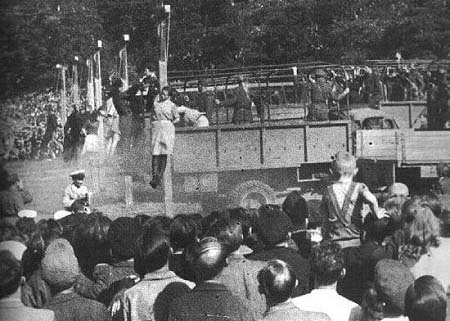
This day’s condemned — camp commandant Johann Pauls, five male kapos, and five female guards — were the product of the first of four Stutthof trials held in 1946-1947. At a hill in Gdansk known as Biskupia Gorka (Bishop Hill), upon a specially-erected row of four T-shaped double gallows centered around a pi-shaped triple gallows, and before a crowd of thousands, the doomed eleven were noosed on the back of military trucks which then drove away to leave them strangling to death with a “short drop” hanging.

The following gut-twisting images are among a number to be found here.

Above: on one end of the gallows row, the truck has just pulled away from Jenny Wanda Barkmann — a modish Hamburg lass in her mid-20’s known to Stutthof prisoners as “the Beautiful Specter” for her cruelty. Down the row, one can see that some of the prisoners are already swinging, while others have not yet been dropped.

Upon hearing her sentence, Jenny Barkmann retorted, “Life is indeed a pleasure, and pleasures are usually short.” (More about Barkmann, including trial photos, here.) In this closer view of her, just as in the first photo, she is still alive and struggling. Next to her, Ewa Paradies, another guard, is prepared for the same fate.

The central triple gallows. Commandant Johann Pauls hangs in the middle with Gerda Steinhoff — one of the senior female guards — in the foreground. The line of five male kapos recedes behind them into the enormous crowd of onlookers.

There’s more about Stutthof’s history at the Holocaust Research Project, and at the current memorial facility’s home page.

On this day..

1950: Milada Horáková, democrat and feminist

On this date in 1950, Milada Horakova was hanged with three others in Prague’s Pankrac Prison as a spy and traitor to the Communist Czechoslovakian government.

Not (yet) as internationally recognizable as Rudolf Slansky,* the Communist General Secretary in Horakova’s time who would run afoul of Stalin and die on the same gallows two years later, Horakova (English Wikipedia page | Czech | the detailed French) is a potent symbol domestically of her country’s Cold War nightmare.

Lawyer, social democrat, and a prominent feminist in the interwar and postwar periods — her life’s work, rather overshadowed by an end that was memorable for different reasons — Horakova survived Nazi imprisonment and was a member of parliament when the Communists seized power in 1948.

She spurned counsel to flee the country, and found herself the headline attraction at a show trial for a supposed plot to overthrow the government. In a hopeless scenario, she distinguished herself with off-script defiance despite having broken under torture and signed a confession; Albert Einstein, Winston Churchill and Eleanor Roosevelt all pleaded in vain for clemency.

Photo of Milada Horakova defending herself at trial.

Horakova left the world clear in her purpose. In a letter to her teenage daughter awaiting execution, she justified her own dangerous choices:

The reason was not that I loved you little; I love you just as purely and fervently as other mothers love their children. But I understood that my task here in the world was to do you good … by seeing to it that life becomes better, and that all children can live well. … Don’t be frightened and sad because I am not coming back any more. Learn, my child, to look at life early as a serious matter. Life is hard, it does not pamper anybody, and for every time it strokes you it gives you ten blows. Become accustomed to that soon, but don’t let it defeat you. Decide to fight.

Hours before her hanging, she wrote a few last words for her loved ones:

I go with my head held high. One also has to know how to lose. That is no disgrace. An enemy also does not lose honor if he is truthful and honorable. One falls in battle; what is life other than struggle? (Both excerpts cited here)

The only woman among Czechoslovakia’s postwar political executions was abortively rehabilitated during the 1968 Prague Spring. Since the fall of the Iron Curtain, her resistance to both Naziism and Communism — worthy of an opera (topical interview) and a forthcoming film — have elevated her into her country’s official pantheon.

As a result, this date is “Commemoration day for the victims of the Communist regime” in the Czech Republic.

Meanwhile, Horakova’s now-octogenerian prosecutor Ludmila Brozova-Polednova, whose repulsive legal barbs at trial (“Don’t break her neck on the noose. Suffocate the bitch — and the others too.”) were probably the consequence of the foregone conclusion more than the cause, was convicted late last year for her role in the trial. That verdict has kept in the news these past several months — most recently, the Czech Supreme Court returned it for retrial after an appeals court overturned the sentence — a tangible symbol of the challenges inherent to confronting the past. (Brozova-Polednova, for her part, is unapologetic.)

* One of the goons who tortured confessions out of the conspirators in Horakova’s “terrorist center,” Karel Svab, was among those later hanged with Slansky.

On this day..