On this date in 1999, Yemen executed (in its own inimitable style) terrorist Zein al-Abidine al-Mihdar, for orchestrating a kidnapping of western tourists.
A Xerox executive among the party of kidnapped tourists relates her post-captivity search to understand her ordeal.
The very next day, a massive Yemeni army raid busted up the kidnappers and freed the hostages — all, except for the four who were killed in the affray.
Tried for the kidnapping (a capital crime itself) and those resulting deaths — although some victims slated the army and its aggressive response for those lost souls — three men were condemned death.
“The only dialogue,” al-Mihdar told his judges, “should be with bullets.” And so for him, a bullet had the last word. (The other two condemned men drew commutations.)
On this date in 1975, five Australia-based journalists were slain in East Timor: executed (ahem, “allegedly”) by Indonesian security forces preparing to invade the former Portuguese colony.
The Balibo Five — Australians Greg Shackleton and Tony Stewart; Britons Brian Peters and Malcolm Rennie; and New Zealander Gary Cunningham — worked for two different Australian networks, but were together filing reports from the village of Balibo during the tense run-up to the December 1975 Indonesian invasion.
Just weeks before this date, the more Indonesian-friendly faction in the newly-independent statelet had been routed into Indonesian West Timor by the revolutionary Fretilin. Indonesian security forces were “covertly” probing into East Timor; to those on the ground, it was obvious that an attack was imminent.
Just three days after Greg Shackleton filed that broadcast, he was dead, along with all those colleagues who had been so moved by their Timorese hosts.
The Anglo journos had counted on their passports to protect them, and prominently advertised their Australian affiliations, believing that Indonesia’s western-backed dictatorship would not risk alienating its Cold War allies. By the official story — it’s still Indonesia’s official story — the Balibo Five nevertheless managed to all find their way into the crossfire when Indonesian troops overran Balibo on October 16.
But western sponsorship of this impending incursion went much deeper than the reporters imagined.
Much to the dismay of the men’s families, Canberra proved quite amenable to burying the matter rather than create a diplomatic incident. It even took a pass on the subsequent execution of another Australian who came to Timor Leste to investigate what happened to the Balibo Five — and was himself killed during Indonesia’s full-scale invasion.
Nevertheless, a considerable body of evidence has accumulated to the effect that the journalists’ death was the cold-blooded elimination of eyewitnesses who “could have testified that there was indeed an invasion by Indonesian troops.”
Australian filmmaker Robert Connolly last year fired new interest in the case by releasing Balibo, a dramatic feature film (shot on location in Balibo with Timorese extras) based on Jill Jolliffe’s book about the journalists.
Balibo is endorsed by East Timor’s president, and banned in Indonesia.
Later in the war, American advances in the Pacific would enable the Yankee to do this regularly. In 1942, it was all but a suicide mission.
The plan involved launching 16 B-25s from an aircraft carrier — an unprecedented feat in itself — to fly light with arms and heavy with fuel to just make it 400 miles to Honshu, and with any luck on to China before the tanks ran dry.
Considering that the bombers had to launch in a panic when the carrier group was spotted a couple hundred miles too early, the raid’s success was downright miraculous: all 16 bombers made it on to (or near enough) the mainland without being shot down, where the crews bailed out and, for the most part, escaped to allied forces. Jimmy Doolittle would title his autobiography I Could Never Be So Lucky Again.
But not all were quite as lucky as Lt. Col. (later, General) Doolittle.
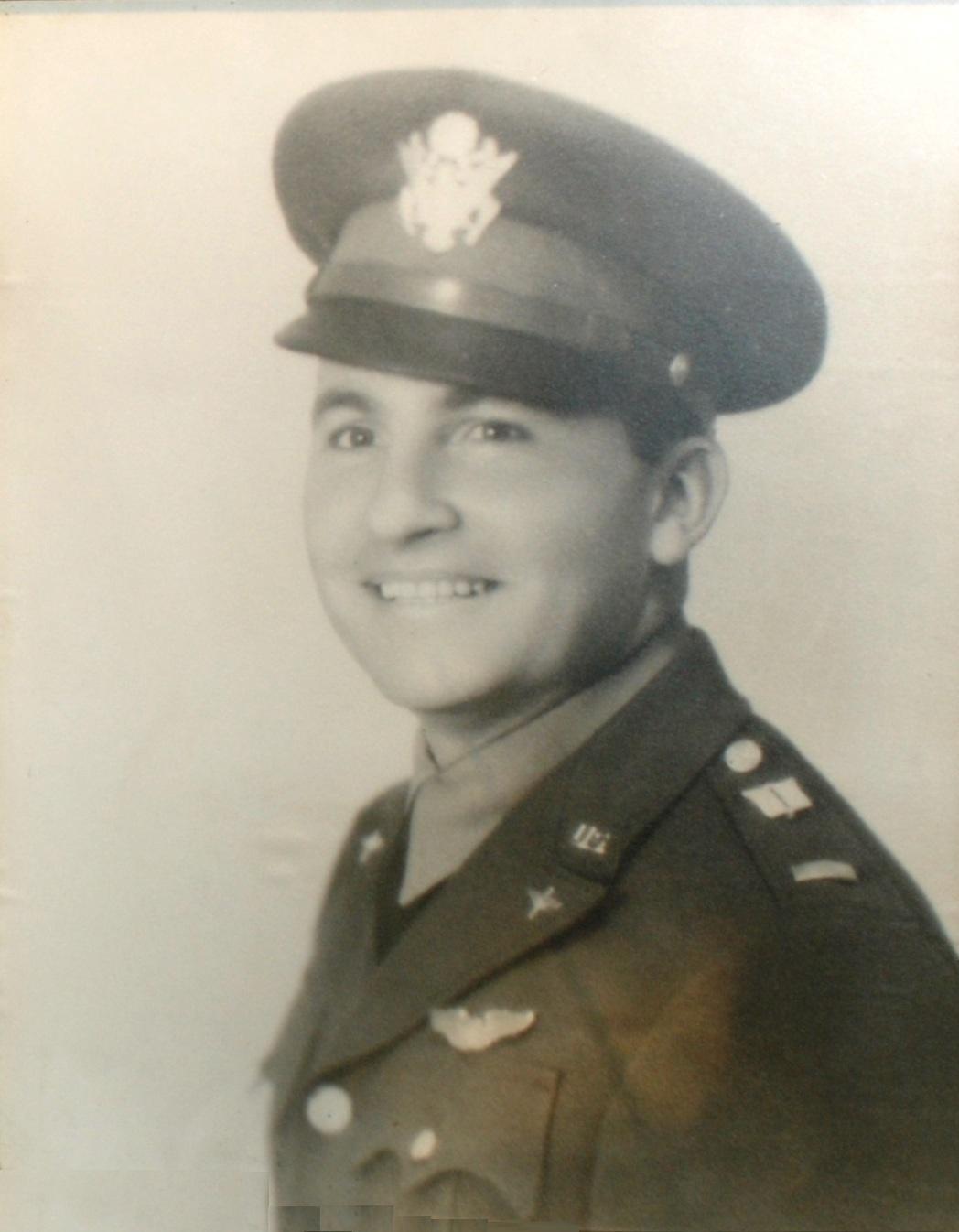
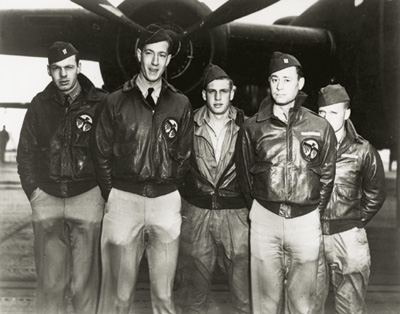
Farrow (left) and Hallmark. Spatz was a member of Farrow’s crew, and is pictured center in that plane’s crew shot here.
Two (out of eighty) drowned when their ride was ditched in the drink. Eight others were captured by the Japanese.
Four of those eight captives would survive the war to tell the tale. A fifth died in captivity. And the other three — pilots William Farrow and Dean Edward Hallmark, and (for somewhat unclear reasons) gunner Harold Spatz — were shot this day in a Shanghai cemetery following a sketchy military trial which condemned them for hitting civilian targets.
Designed largely for its psychological effect, the morale-boosting Doolittle raid has attracted interest from countless other sources who treat it in greater depth. DoolittleRaid.com and DoolittleRaider.com both provide detailed online information about the raid.
For more traditional media, one could do worse than bomber pilot Ted Lawson’s book, and its subsequent propaganda film adaptation, Thirty Seconds Over Tokyo.
(Thanks to Robert Elder of Last Words of the Executed — the blog, and the book — for the guest post. This post originally appeared on the Last Words blog here. Fans of this here site are highly likely to enjoy following Elder’s own pithy, almanac-style collection of last words on the scaffold. -ed.)
“Are—they—really—going—to—hang—me? Don’t— let—them. Save me. Jesus—Mary—Joseph. My little baby! My wife! . . . I’m—going—my—rest. Take— care—me. Where are you, Mr. Meisterheim [his jailer]? Talk to me.”
Meisterheim: “Be brave, Frank. It’ll be over in a minute.”
“Shake hands once more then. Are they—really going—to hang me?”
— Frank Campione, convicted of robbery and murder, hanging, Illinois.
Executed October 14, 1920
Part of the Cardinella Gang, Campione and company were responsible for more than four murders and 250 holdups and burglaries, according to authorities. The gang killed Albert Kubalanzo for $6.30.
During the months he was in jail and on trial, Campione sang lullabies to his pillow night and day. Even when admitting that he had been feigning madness, Campione held the pillow. “I’ll die happy if you let me keep this pillow with me,” he said. “It reminds me of my baby son.”
On this date in 1846, the Australian outlaw William Westwood — better known as Jackey Jackey — was hanged with 11 others for a prison riot/escape attempt that claimed several guards’ lives.
“To the old hands,” relates George Boxall in this volume of bushranger folklore, “he was always the gentleman bushranger.”
More legends have collected round the name of Jackey Jackey than round that of any other of the bushrangers, and many of them are obviously variants of the stories told of the historical highwaymen of England. For instance, Jackey Jackey is said to have bailed up the carriage of the Commissary. When he discovered that the Commissary’s wife was inside he dismounted, opened the door and, sweeping the ground with his cabbage tree hat, as he bowed low before her, he invited her to favour him with a step on the green.* He rode incredible distances in incredibly short periods of time** … [and] never did anything mean or brutal or unworthy of a gentleman bushranger, until he was almost goaded to madness by the cruel discipline of Norfolk Island.
Transported to Australia at the age of 16, Jackey Jackey made that reputation with only a scant few months in the bush. The Victorian era was already underway in our young outlaw’s mother country; the day of the highwayman had long since given way to the day of romanticizing the highwayman.
Only on the empire’s distant fringes could the profession persist; there, men like our day’s principal self-consciously took their chivalrous forebears as their templates: Jackey Jackey thrashed a confederate who did violence to a woman, and threatened to murder the man if they should meet again.
Jackey Jackey had only a few months out in the bush in 1840-41 to trace the outlines of the gentleman bandit figure he aspired to. Caught in an inn in 1841, he spent the next several years exercising that other great craft of the folklore criminal: escape.
A cycle of jailbreaks, fleeting moments of liberty, recaptures, higher-security lockups, and increasingly desperate jailbreaks eventually landed at Norfolk Island, where “the treatment of the prisoners in the island was rigorous in the extreme, and may aptly be described as savage.” (Boxall, again)
Just a few years before Jackey Jackey’s death, they had been savage enough to provoke inmates desperate for the release of death to draw lots between the privileges of being murdered by a fellow-prisoner and hanging as that murderer.
Norfolk experimented with liberalizing its regimen in the early 1840s, but it was in rollback mode when our bushranger landed there. The steady removal of the minute privileges that make incarceration bearable — the right to grow a few potatoes; access to one’s own cooking tin and utensils — eventually triggered a similar suicidal mental break … but this time, on a riot scale.
Jackey Jackey made the following speech: “Now, men, I’ve made up my mind to bear this oppression no longer ; but, remember, I’m going to the gallows. If any man funks let him stand out. Those who wish to follow me, come on.”
A policeman named Morris was standing in the archway or entrance to the yard, Jackey Jackey rushed forward, struck him a fearful blow with an enormous bludgeon, and knocked him down. A large mob of the prisoners snatched up such weapons as came to their hands and followed him.
…
there were about eighteen hundred prisoners on the island, and of these, sixteen hundred were among the rioters. The soldiers numbered only about three hundred, but their discipline enabled them to overawe the vastly superior force, numerically, opposed to them. Perhaps the habits of obedience and submission, so long enforced on the prisoners, may have had some influence. Perhaps, even among this herd of desperate and reckless men, the sight of the soldiers standing firmly with their guns presented ready to fire may have instilled some fear. However this may have been, there was no fight. The rebels retired slowly and unwillingly to the Lumber Yard, where they permitted the soldiers to arrest them one after the other without making any show of defence until one thousand one hundred and ten of them were placed “on the chain.” Perhaps Jackey Jackey and the more violent of his followers may have thought that they had done sufficient to ensure them that death on the gallows which was the avowed object of their rising, while the majority had been so demoralised by official brutality as to be utterly indifferent as to what might become of them.
Twelve suffered death on the Norfolk Island gallows this date for the murder of the guard, with headline-grabber Jackey Jackey exonerating four of his fellow-sufferers in his dying statement.
The remains of the gallows area at the Norfolk Island gaol, gorgeously captured by Canberra photographer Allyeska. (Image used with permission.)
The bitter letter our despairing bushranger wrote to a gaol chaplain, meanwhile, could have been posted from many a modern penitentiary.
I was, like many others, driven to despair by the oppressive and tyrannical conduct of whose whose duty it was to prevent us from being treated in this way. Yet these men are courted by society; and the British Government, deceived by the interested representations of these men, ontinues to carry on a system that has and still continues to ruin the prospects of the souls and bodies of thousands of British subjects … instead of reforming the wretched man, under the present system, led by example on the one hand, and driven by despair and tyranny on the other, goes on from bad to worse, till at length he is ruined body and soul. Experience, dear bought experience, has taught me this. In all my career, I never was cruel I always felt keenly for the miseries of my fellow-creatures, and was ever ready to do all in my power to assist them to the utmost, yet my name will be handed down to posterity branded with the most opprobrious epithet that man can bestow. … this place is now worse than I can describe. Every species of petty tyranny … is put in force by the authorities. The men are half-starved, hard worked, and cruelly flogged. … Sir, out of the bitter cup of misery I have drunk from my sixteenth year ten long years and the sweetest draught is that which takes away the misery of living death; it is the friend that deceives no man; all will then be quiet no tyrant will there disturb my repose, I hope, William Westwood.†
(Boxall’s History of the Australian Bushrangers is available from archive.org here.)
* This legend is lifted wholesale from the c.v. of English highwayman Claude Duval.
** Warp-speed horsemanship features in many English outlaw legends, including those of Dick Turpin and the lesser-known John Nevison.
† Death as an escape from injustice and misery: another timeless theme.
On this date in 1565, the French Huguenot New World settlement plan was nipped in the bud when Spaniards executed en masse the inhabitants of Fort Caroline in present-day Jacksonville, Fla.
Jean Ribault.
During the late 16th century’s fractiousFrench Wars of Religion, far-sighted Protestant admiral Gaspard de Coligny sponsored this like-minded colony in Florida — a sort of side bet on a satellite Protestant presence overseas, while the party in the mother country fought for its life.*
Jean Ribault (or Ribaut) was the loyal naval aide chosen to lead this colony. After an abortive attempt to plant a settlement in Charlestown, S.C., Ribault set up Fort Caroline and claimed greater Jacksonville for France.
Historical marker of Jean Ribaut/Ribault’s landing place, in Jacksonville, Fla. (cc) image from POsrUs.
French colonial projects further north enjoyed better success.
Down in Florida, both geopolitical and religious rivalry set Fort Caroline up for trouble. Ponce de Leon, questing for the Fountain of Youth, had planted the Spanish flag in Florida half a century before, and that country was none too pleased to find its continental rival jumping its claim. That it was Calvinist Frenchmen doing the usurping would prove downright intolerable to more-Catholic-than-the-Pope Spanish ruler Philip II.
The Spaniards attacked [Fort Caroline], hanged the colonists, and fastened above the heads of the corpses a placard on which was written, “Not because they were Frenchmen, but because they were heretics.” A French Catholic, de Gourgues, moved with righteous indignation, fitted out a ship and avenged this act by hanging their murderers, over whose bodies he put a similar placard, bearing the inscription, “Not because they were Spaniards, but because they were assassins.” But Coligny’s efforts failed, and he had to leave to the English race the realization of his dream of a great American Protestant state. (Source)
* It’s another country, another creed, and another century, but it reminds of the traffic between English New World settlements and England proper during the English Revolution.
On an unspecified date around this time in the late 1820s, the narrator of Victor Hugo’s Last Day of a Condemned Man leaves off his diary — bound for the guillotine.
An illustration from The Last Day of a Condemned Man.
The young Hugo‘s first major work of fiction, this 1829 story dramatizes the torment of an unnamed man doomed for an unstated crime. By abstracting its central character, Hugo generalizes its unabashed anti-death penalty message … but one of the few morsels of specificity places the man’s conviction on “a beautiful morning at the close of August,” with the action unfolding over the ensuing six weeks until his date with the guillotine.
They say that it is nothing,–that one does not suffer; that it is an easy death. Ah! then, what do they call this agony of six weeks,–this summing-up in one day? What, then, is the anguish of this irreparable day, which is passing so slowly and yet so fast? What is this ladder of tortures which terminates in the scaffold? Are they not the same convulsions whether life is taken away drop by drop, or intellect extinguished thought by thought?
…
Now I must fortify myself, and think firmly of the Executioner, the cart, the gendarmes, the crowd in the street and the windows.
I have still an hour to familiarize myself with these ideas. All the people will laugh and clap their hands, and applaud; yet among those men, now free, unknown to jailors, and who run with joy to an execution,–in that throng there is more than one man destined to follow me sooner or later, on the scaffold.
More than one who is here to-day on my account, will come hereafter on his own.
Hungarian painter Mihaly Munkacsy‘s The Last Day of a Condemned Man has no relationship to Hugo’s book, but deals in a similar mood. It won an award from the Paris salon in 1870.
* The prisoner finds in his cell the names of then-notable criminals who previously occupied it — a concession to period specificity. The last of these names is Castaing, meaning our man’s story takes place after that poisoner’s 1823 beheading. A subsequent reference to Louis-Auguste Papavoine, executed in 1825, would push the execution to the even narrower window of October 1825, 1826, 1827, or 1828.
On this date* in 1800,** the Virginia slave Gabriel — sometimes remembered as Gabriel Prosser after his owner’s surname, although that wasn’t what his contemporaries called him — was hanged in Richmond, along with a number of his confederates in a planned slave rising.
Decades before Virginia’s more famed Nat Turner rebellion, Gabriel was plenty frightening for the growing little burg of Richmond in 1800. (The incident would result in a clampdown on education and mobility for slave and free blacks alike.)
Gabriel and company conceived a daring revolution to seize the city of Richmond, take hostage Governor (and future U.S. President) James Monroe, and rearrange the state’s power structure.
This scheme, in which the rebels actually stay in Virginia, depended on an optimistic assessment for the prospects of a multiracial alliance — with Richmond’s own poor whites, and also, according to testimony given by conspirators, with Indians and with the French in opposition to a pro-British American policy tilt.
But if ever the time might have been right for such a plot, it was in 1800. A bitter presidential contest adjudicating the Republic’s most fundamental issues was unfolding; there were rumors that the governing Federalists would not voluntarily relinquish power, and the matter might fall to civil war between by the factions.
Gabriel unabashedly attempted to leverage this division between whites; working as he and many other urban blacks did side-by-side with white Republican laborers — whose own interests vis-a-vis Federalist merchants were being so bitterly contested — he must have had a good vibe about the situation on the ground to gamble his life on it. Though the hope was that the white working class would join the revolt after it broke out, there were at least a few whites already initiated into the conspiracy beforehand.
Alas, what broke out was not rebellion but a storm: a downpour that rained out the first planned rising, washing out bridges and roads that the conspirators were counting on to assemble. Before the makeup date could be scheduled, some slaves taking a care for their own necks had betrayed it.
The public mind has been much involved in dangerous apprehensions, concerning an insurrection of the negroes in several of the adjacent counties. Such a thing has been in agitation among the blacks, principally instigated by an ambitious and insidious fellow, a slave, by the name of GABRIEL, the property of Mr. Thomas Prosser, of the county of Henrico. This villain, assuming to himself the appellation of General, through his artfulness, has caused some disturbance, having induced many poor, ignorant, and unfortunate creatures to share in his nefarious and horrid design.
The plot has been entirely exploded, which was shallow; and had the attempt even been made to carry it into execution, but little resistance would have been required, to render their scheme entirely abortive. Thirty or forty of the party have been arrested and confined in jail for trial. Yesterday a called court was held for that purpose, at the court house in this city when six of them were convicted and condemned to suffer death this day at 12 o’clock. It is said that the evidence which has been procured, will go to prove nearly this whole of them guilty. To-day the court will proceed to go thro’ with the rest of the trials.
[The Governor has issued his Proclamation, offering a reward of THREE HUNDRED DOLLARS† for the apprehension of the above “GENERAL,” who has thought proper to take himself off. Exclusive of this sum, he likewise promises “to any number not exceeding five of the said accomplices, who shall apprehend the said GABRIEL, and deliver him up so that he be brought to justice, a FULL PARDON for their offences.” ]
It would be interesting counterfactual history to know the world in which the insurrection was actually launched — whether “but little resistance” would have sufficed to put it down. Gabriel might have reckoned naively on the prospective balance of forces,‡ but his read of the fractious alliance against him was spot-on. Maybe with a modern communications infrastructure, the affair could have become a full-blown October Surprise.
The Jeffersonian party, desperate not to give its plantation supporters cause to rethink its partisan alignment, took pains to downplay what was really quite a bold conspiracy. Not for the last time, wealthy merchants (here backing the Federalists) sought their own advantage pressing the racial wedge issue — for the slaves’ prospective lower-class white allies were also part of Jefferson’s coalition.
“If any thing will correct & bring to repentance old hardened sinners in Jacobinism, it must be an insurrection of their slaves,” editorialized the Boston Gazette — ex cathedra, as it were, from 18th century America’s very temple of Mammon. (The quote comes from this tome.)
One thing all right-thinking whites could agree on was a heaping serving of scorn for “General” Gabriel.
Columbian Mirror, Saturday, October 4, 1800.
But then, that personal interview with Monroe also gives a lie to Gabriel’s insignificance. (Gabriel told Monroe nothing of any use to the latter; Monroe sent him away with orders to keep him nearly incommunicado from the sort of working stiffs who would figure to be his jailers.)
A few years later, an English visitor captured at second hand this indefatigable portrait of the doomed slave in his masters’ courts.
I passed by a field in which several poor slaves had lately been executed, on the charge of having an intention to rise against their masters. A lawyer who was present at their trials at Richmond, informed me that on one of them being asked, what he had to say to the court in his defence, he replied, in a manly tone of voice: “I have nothing more to offer than what General Washington would have had to offer, had he been taken by the British and put to trial by them. I have adventured my life in endeavouring to obtain the liberty of my countrymen, and am a willing sacrifice to their cause: and I beg, as a favour, that I may be immediately led to execution. I know that you have pre-determined to shed my blood, why then all this mockery of a trial?”
In 2007, James Monroe’s (distant) successor as governor of the Old Dominion (informally) posthumously pardoned Prosser’s Gabriel. Gov. Tim Kaine’s statement on the occasion validated Gabriel’s own defense of himself.
“Gabriel and his colleagues were freedom fighters and deserve their rightful place in history as women and men of integrity who fought for freedom.”
* Some sources give Oct. 7 as the date of execution; this apparently was the initial sentence of the court but delayed a few days to hang the ringleader along with others in a variety of spots around town.
† It was a slave who eventually turned in Prosser’s Gabriel … but Virginia stiffed him on the reward, handing over only $50 instead of the promised $300.
‡ Or maybe that’s just hindsight talking. In 1800, the Haitian Revolution was underway — so who could blame slaves for thinking big?
(Thanks to Jonathan Shipley of A Writer’s Desk for the guest post. -ed.)
It was on this day that a Welsh squire, Llywelyn ap Gruffydd Fychan, was gruesomely executed for thwarting the efforts of King Henry IV’s forces to squelch Welsh resistance to English rule.
First, the man’s stomach was cut out and cooked in front of him. Then, he was hanged, drawn and quartered.
The torturous execution took several hours before he succumbed to death. Then, a grisly postscript: his salted remains were sent to other Welsh towns to deter Welshmen from opposing the king.
Rewind to October, 1399.
Henry IV has been crowned King of England after overcoming the unpopularRichard II. Henry had his predecessor imprisoned and killed, then displayed at St. Paul’s Cathedral to prove to his supporters that he was gone.
Little surprise much of Henry’s reign was spent defending himself against plots, rebellions and assassination attempts. One rebellion? That of Owain Glydwr, who declared himself Prince of Wales in 1400.
This didn’t sit well with the new king. Armed men were sent out to find this treasonous Welshman. Found them they did, though perhaps they wished they hadn’t. In the summer of 1401, on the slopes of Pumlumon, Owain Glydwr crushed Henry’s army. This, too, did not sit well with the king.
Give me leave
To tell you once again that at my birth
The front of heaven was full of fiery shapes,
The goats ran from the mountains, and the herds
Were strangely clamorous to the frighted fields.
These signs have mark’d me extraordinary;
And all the courses of my life do show
I am not in the roll of common men.
Where is he living, clipp’d in with the sea
That chides the banks of England, Scotland, Wales,
Which calls me pupil, or hath read to me?
Henry then led a huge army, arriving in Llandovery, to capture this meddling countryman prince.
It was here that the English military met a 60-year-old man. A land owner from Caeo, his name was Llywelyn ap Gruffydd Fychan and the English army strongly suggested he assist them in helping locate Owain Glydwr. Llywelyn agreed.
Little did the English know, as they chased Glyndwr, that Llywelyn was taking them in the wrong direction.
He had two sons, did this Llywelyn, in Owain’s army. Though he knew he’d undoubtedly pay the ultimate sacrifice, he would not betray the Welsh people and his own family but leading the English king to the insurrectionists.
And so he led the English army on a wild goose chase.
For weeks Llywelyn lead the king and his forces through the uplands of Deheubarth. All the while Owain and his men made their escape the opposite direction to consolidate, grow, and fortify.
The king’s patience became taxed. He began to see that Llywelyn was not taking them to their man.
Angrily, the king drug Llywelyn to the town of Llandovery. In front of the castle gates, there in the town square, he was disemboweled and dismembered. Though Glyndwr’s war of liberation fizzled out, Owain was never captured nor betrayed.
Fast forward to the year 2001.
600 years after Llywelyn’s execution, a sculpture is erected. Standing 16 feet tall, erected by the castle he died in front of, is a statue of a cloaked figure, spear and shield in hand, atop a stone base inscribed with Welsh verse.
It is he, Llywelyn, commemorating his ultimate sacrifice.
Llywelyn’s striking steel statue stands watch over Llandovery. Images (c) Canis Major and stused with permission.
Execution of Cristeros by federal soldiers on the outskirts of San Gabriel, Jalisco, October 8, 1927. On the same site, the soldiers were ambushed, suffering the same fate.