1962: Arthur Lucas and Ronald Turpin

Forty-five years ago today, two men linked by nothing but fate stood back to back on the gallows of Toronto’s Don Jail and became the last hanged in Canada.

Book CoverToday, Executed Today interviews author Robert Hoshowsky, whose new book The Last to Die explores how this day’s events came to pass.

The doomed men were far from Canada’s greatest criminals. The 29-year-old Turpin was a small-time thief who shot a policeman while fleeing a restaurant robbery; the 54-year-old Lucas was convicted of killing an FBI informant despite lingering questions over his guilt and his mental impairment. Both were petty criminals with little previous violence to their history, seemingly almost too small for the historical role that even on the night of their hanging they seemed probable to play.

The Last to Die is the first book about Canada’s last execution, and has been met with general acclaim. CourtTV Canada recently profiled the story:

Executed Today: Why you, why now, why this book? What brought you to it?

Robert Horshowsky: I’ve worked as a freelance writer for almost 20 years now, and in that time, some stories were assigned to me, while others were the product of my own imagination. This book, like many before it, got its start as an article.

In 2001, I was in the library at Maclean’s magazine, where I worked as a Researcher-Reporter. They have a large section on Canadian history, and I saw a book by John Robert Colombo, who is very well known for his works on history and trivia. I believe the book was 1001 Questions About Canada. Picking up Colombo’s paperback, the first page I turned to asked, “When was the last execution in Canada?” The brief paragraph mentioned Ronald Turpin, a Canadian criminal, and Arthur Lucas, a Black man from Detroit. Both men were hanged on Dec. 11, 1962. Since it was a book of trivia, there wasn’t much more information than that, which got me thinking, “I wonder if I can pitch a story on the 40th anniversary for the December 2002 issue of Maclean’s?” Although it is a weekly news magazine, Maclean’s often ran articles on subjects of historic note, and the story I submitted on Turpin and Lucas was very well-received by the editors.

The one thing I have been accused of my entire working life is over-researching a subject, and the piece entitled “The Last Night of the Condemned” was no exception. My editor at the time said, “You’re not writing a book” in regard to the amount of research I had conducted, and I took this, perhaps subconsciously, as a challenge.

I was hooked by the stories of Turpin and Lucas for a number of reasons. There had never been a book about them, a fact that still boggles my mind. The end of the death penalty in different countries is a subject that is widely covered. The last two men to hang in England, for example, were Peter Anthony Allen and Gwynne Owen Evans. They were executed in 1964, and a book was published about them a year later. Turpin and Lucas were hanged in 1962, and my book was published in 2007, 45 years after the fact. Of course, there were newspaper and articles about them, a chapter here and there, or a mention in a law textbook, but not much else, certainly not a book. Through my research I soon discovered that others had attempted plays and documentaries about the two, with little success. This made me wonder if the subject was cursed, which is certainly how I felt sometimes.

ET: What effect did writing the book have on you?

The book took a toll on me physically and mentally. Research at times was slow and painful, and obtaining documents – especially from the Canadian government – was a tedious and frustrating process. In Canada, we have something called the Freedom of Information and Access to Privacy Act, which I used over and over again to obtain jail records, court documents and the like on Turpin and Lucas. In the United States, I used the Freedom of Information Law to access documents on Arthur Lucas; since he was an American from Detroit, I figured there would be rap sheets and the like on him, which there were. All these documents were very useful, but getting hold of them was a real challenge, since you have to prove the person you’re inquiring about is dead, that no other persons will be incriminated or named in the documents, etc.

The hardest thing for me to deal with was the cancer that took my mother’s life in March of this year. Her last wish was that I finish this book, and I struggled against two deadlines: the publisher’s, and my mother’s. As soon as I finished a chapter, I gave it to mom to read, followed by the next. Completing the book was a bittersweet experience: although she read the entire thing, mom didn’t live long enough to see it published, passing away six weeks before it was printed. In hindsight, I’m shocked I didn’t fall to pieces. The most difficult section for me to write was the funeral of Frederick Nash, the policeman shot to death by Turpin. I wrote this after interviewing his widow, and three of his four daughters – the eldest was 11, and one of them, Karen, was only two months old when he died. That was tough, the mental image of these little kids holding flowers outside the church, not quite realizing that their father was never coming home again. That was one of the reasons I wanted to write an entire chapter about those people left behind, like officer Nash’s children, the Salvation Army chaplain who was with Turpin and Lucas when they died, and many others involved in the cases. Far too often, true crime books focus almost entirely on the killers, and not enough on the families of the victims.

ET: Canada was trending towards abolition, and Lucas and Turpin knew themselves that they might be the last ones hanged. Was it just happenstance, or was there some intentionality in pushing these cases in particular? What was the fallout in Canada?

RH: In the early 1960s, there was a push in many countries to eliminate capital punishment, and Canada was no exception. As early as 1914, a Canadian Member of Parliament named Robert Bickerdike introduced a private members’ bill for the abolition of the death penalty. Although it was defeated, there were other members’ bills over the years. In 1935, a woman named Thomasina Sarao was unintentionally decapitated during her hanging in Montreal, which led to more and more executions in Canada taking place behind closed doors. Sarao’s beheading didn’t directly lead to the end of capital punishment, but the idea of a woman dying in such a gruesome fashion certainly didn’t help the pro-death penalty camp!

Ronald Turpin

By the 1950s, more changes were made to Canada’s Criminal Code, limiting the reasons a person could be executed. By 1961, changes were made which divided murder into a capital and a non-capital crime. One of the reasons you would die was for the murder of a police officer, a crime committed by Roland Turpin when he shot Fred Nash in February of 1962. There was always the possibility that even though you were found guilty of murder, the jury could recommend mercy, sparing your life. This didn’t happen in either Turpin or Lucas’s case.

Prior to the executions of Turpin and Lucas, there were a number of appeals for both men. The Salvation Army chaplain who was spiritual advisor to both men, Cyril Everitt, even appealed to the Prime Minister at the Time, John Diefenbaker. Law professors tried to fight the hangings, with no effect.

There was no doubt Ronald Turpin killed the police officer. I believe he suffered from some sort of mania or persecution complex. This certainly wouldn’t absolve him of shooting and killing a cop, but there is no doubt – to me at least – that Turpin was mentally unstable.

Arthur Lucas

As for Arthur Lucas, there was a lot of evidence against him, and all of it was circumstantial. Chaplain Everitt wasn’t to save both men body and soul, and he believed with all his heart that Arthur Lucas was innocent.

There wasn’t so much fallout after the hangings as there was serious doubt. Doubt about the guilt of either man, especially Lucas, who was convicted entirely on circumstantial evidence. Doubt about the competency of their legal representation, which was conducted by a brilliant but alcoholic lawyer named Ross MacKay, who acted for both Turpin and Lucas. Imagine it: MacKay was just 29 years old and inexperienced. Turpin and Lucas were his first and last capital cases, and he had no budget, compared to the estimated $40,000 spent by the government to prosecute Lucas alone. On top of that, Mackay had less than three weeks between the trial of Arthur Lucas, and the trial of Ronald Turpin. There is evidence that MacKay showed up to court hung over on some days. And the majority of the newspapers were against Turpin – who had a lengthy criminal record for break-ins and the like – and Lucas, who was slow (his IQ was just 63, borderline retarded), and happened to look like a killer. Read More

On this day..

1937: Teido Kunizaki

On this date in 1937, Japanese intellectual Teido Kunizaki was shot as a “spy of the Japanese army” in Moscow.

The reader is not deceived to infer from the date and place the dread hand of Stalin’s NKVD at the height of the Soviet purges. The fate of the Soviet Union’s tiny community of Japanese emigres, one of the hidden chambers in a house of horrors, only became fully understood after the Soviet Union collapsed.

The leader of the Japanese section of the German Communist Party in Weimar Germany, Kunizaki’s opposition to Japanese intervention in China and involvement in a publication as subversively titled as Revolutionary Asians had made him unwelcome in Germany shortly before Hitler took power.

But arriving in Russia in September 1932 with his German wife, he stepped into a struggle for power within the Japanese Communist Party’s Russian organs.

According to Tetsuro Kato, the professorial Kunizaki was among those denounced by another seminal Japanese communist, Kenzo Yamamoto — a working-class activist who distrusted intellectuals.

Kunizaki’s execution this day was only one of many wrought on the Japanese party by the Soviet secret police in the dangerous exchange of accusations and denunciations. On this date, Yamamoto himself was already in prison; early in 1939, he would swallow the same draught as Kunizaki — denounced, as it emerged after the Cold War, by yet another of Japan’s revered old Marxists.

In the 1920s and 1930s, there were about 100 Japanese who dreamed of living in “the paradise of the working class” and went to the USSR. These people were mainly communists, who were oppressed by the imperial police in Japan. There were also ordinary workers, intellectuals and artists who were not communist … Almost all Japanese living in the USSR [in the 1930’s] faced the same destiny. The exact number of victims is not yet known, but I now estimate there to have been about 80 Japanese [shot by the NKVD].

On this day..

1793: Sydney Carton posing as Charles Darnay

On an unspecified date in December 1793 is set one of literature’s immortal execution scenes, when ne’er-do-well Sydney Carton heroically goes to the guillotine in the place of his aristocratic doppleganger Charles Darnay at the climax of A Tale of Two Cities.

In Charles Dickens‘ classic 1859 novel of the French Revolution, Darnay, the good-hearted scion of the cruel Evremonde line, falls prey to the Revolutionary Terror.

The dissolute, tormented Carton is the respectable Darnay’s literary dark twin, whose appearance he also happens to strikingly resemble. Driven by an unrequited love for Darnay’s wife, who stands in danger not only of losing her husband but of following him to the scaffold, Carton contrives to switch places with the doomed noble.

While those saved by his sacrifice flee for England, Carton goes to the guillotine in a batch of 52 condemned prisoners,* one of them a sweet and frightened girl he comforts tenderly.

His prophetic thoughts as he awaits the blade form the conclusion of the novel, and the last sentence ranks among literature’s most recognizable lines.

“I see that I hold a sanctuary in their hearts, and in the hearts of their descendants, generations hence. I see her, an old woman, weeping for me on the anniversary of this day. I see her and her husband, their course done, lying side by side in their last earthly bed, and I know that each was not more honoured and held sacred in the other’s soul, than I was in the souls of both.

“I see that child who lay upon her bosom and who bore my name, a man winning his way up in that path of life which once was mine. I see him winning it so well, that my name is made illustrious there by the light of his. I see the blots I threw upon it, faded away. I see him, fore-most of just judges and honoured men, bringing a boy of my name, with a forehead that I know and golden hair, to this place — then fair to look upon, with not a trace of this day’s disfigurement — and I hear him tell the child my story, with a tender and a faltering voice.

“It is a far, far better thing that I do, than I have ever done; it is a far, far better rest that I go to than I have ever known.”

A Tale of Two Cities is one of thousands of public-domain books available for free at Project Gutenberg. Stanford’s “Discovering Dickens” community reading project guide annotates the novel here.

* Never one for understatement, Dickens crowds his mass execution tableau with far too many extras. “The Terror” is usually dated from September 1793 through July 1794, but only during its bloodiest last two months would so many as 52 have been guillotined together; at the time of Carton’s execution, half as many would have constituted a large group.

On this day..

1596: Francisca Nunez de Carvajal, her children, and four other crypto-Jews of her family

On this date in 1596, the Inquisition sent nine Jewish converts to Christianity to the stake in Mexico City for Judaizing — a cruel fate offering a window into a secret history of New World settlement.

When Spain expelled its Jews (and subsequently its Muslims), those who did not flee had to convert. Conversions at swordpoint being of suspect sincerity, the Inquisition spent much of the following centuries hunting Conversos — so-called “New Christians” — who secretly preserved their outlawed faiths.

For some crypto-Jews, the New World held an appeal akin to that which would draw later generations of northern Europe’s religious minorities.

Latin America in particular attracted considerable numbers of New Christians. The advantage of these territories was that they offered the New Christians a familiar culture and the possiblity of direct — even if infrequent — contact with the mother countries … These factors also helped permit [crypto-Jews] to practice Judaism.

The Carvajals (or Carabajals) were just such a family, settling in Monterrey under the aegis of their kinsman, Spanish governor Luis de Carvajal y Cueva.

But in 1590, the governor’s sister Francisa was tortured by the Inquisition into implicating her entire family in Judaism.

They got off with a humiliating public recantation, but evidence of a relapse a few years later resulted in Francisca being burned at the stake at an auto de fe — along with her children Isabel, Catalina, Leonor and Luis, and four of their in-laws. The 30-year-old Luis left a testimonial to his faith and his tortures.

A headstone in New Mexico, USA, suggests crypto-Jewish descent. Image used with permission.

Despite the grisly doings of this day, however, the Inquisition never could extirpate Jews from its American territory.

These hidden communities filtered into Mexico and north to the present-day United States, keeping adapted versions of Jewish traditions secretly alive.

Still, crypto-Jews produced scant potentially self-incriminating documentary evidence. Although DNA testing has latterly entered the scene, the true extent and nature of these populations has been the subject of lively scholarly controversy.

But the Carvajals and others like them, seemingly lost to the Inquisition’s depredations, are coming alive again. This day’s executions are the subject of a modern opera and a spring 2008 Texas A&M symposium.

And the wider community of crypto-Jews have their own umbrella organization and a burgeoning body of historical literature.

Books about crypto-Jews

On this day..

41 B.C.E.: Arsinoe IV, Cleopatra’s sister

On an unknown date late in 41 B.C.E., Cleopatra’s younger sister and rival Arsinoe was put to death in Asia Minor as the famous queen cemented her fatal alliance with Mark Antony.

Like Cleopatra herself, Arsinoe lived her short life in the internecine maelstrom of Ptolemaic politics under the sway of a Roman Empire itself immersed in civil strife. Violent death was something of an occupational hazard.

Nevertheless, had some flash of prescient irony visited her when Antony’s legionaries unsheathed their blades, she might well have wondered at the small happenstances of fate that left her a nigh-forgotten footnote in her sister’s story, rather than the other way around.

Three siblings had grasped at the Egyptian throne during the Alexandrian War, and whether it was charm or cold calculation won Caesar’s backing for Cleopatra, Arsinoe and her brother Ptolemy XIII still pressed the Roman garrison of Alexandria with a vastly superior force in a battle that was said to have set the Library of Alexandria aflame.

Timely Roman reinforcements decided the matter, and Arsinoe was marched in chains at Caesar’s sumptuous quadruple Triumph of 46 B.C.E. — though she was spared the execution that typically concluded such an ignominy and instead packed off to a temple on the coast of modern-day Turkey.*

In Margaret George’s historical novel The Memoirs of Cleopatra, the danger of maintaining an enemy who has styled herself Queen is neatly summarized in a conversation between Caesar and Cleopatra set after the Triumph:

“I have spared Arsinoe.” [said Caesar]

My [Cleopatra’s] first feeling was a rush of relief. My second was worry. Arsinoe the proud would not retire quietly.

“Where is she to go?”

“She has requested sanctuary at the great Temple of Diana in Ephesus,” he said. “And I will grant it, if you agree.”

Ephesus! Too close to Egypt! Better send her to Britain! Yet … I would gamble, and be merciful. Perhaps I was not enough of a Ptolemy after all. Arsinoe would not have granted it.

“Yes, I will allow it.”

That very perception of her potential danger hung over Arsinoe like the sword of Damocles.

The sword fell — figuratively and literally — five years later after Cleopatra seduced Mark Antony at Tarsus in the autumn of 41. Her terms for Egypt’s alliance supposedly included elimination of this lingering rival — though if Arsinoe had made common cause with Caesar’s Republican assassins, Antony may well have had his own reasons to dispatch the young woman.

Arsinoe’s death helped seal a pact that was itself destined for a bloody end. Distracted by his foreign paramour, Antony steadily lost political ground to his adversary Octavian. In another decade’s time, open war broke out again.

The Egyptian fleet would gather at Ephesus, not far from Arsinoe’s final resting place, bound for the catastrophic Battle of Actium whose outcome added Cleopatra’s and Antony’s blood to the soil from which sprung the long reign of Octavian — soon to be styled Augustus Caesar, the first emperor of Rome.

* A Temple of Artemis — either in Miletus (as Appian has it), or the wonder of the world in Ephesus (as Josephus has it). She met her death at the temple — whichever it was — dragged to its steps and put to the sword. Ephesus seems to be the more generally accepted locale, and an octagonal tomb there has been speculatively identified as Arsinoe’s.

Part of the Themed Set: The Fall of the Roman Republic.

On this day..

63 B.C.E.: Publius Cornelius Lentulus

On this date in 63 B.C.E., Publius Cornelius Lentulus was executed by strangulation in Rome’s Tullianum for conspiring to overthrow the Roman Republic.

He was one of the key figures in the Catiline conspiracy, a political intrigue set against a ruinous social crisis that pushed the country to the precipice of civil war.

Roman had fought Roman intermittently over much of the preceding 70 years in episodes underpinned by a class conflict pitting wealthy landowners (politically represented by the Senate) against the growing populations of plantation slaves who tilled their fields and urban plebeians displaced from independent farming on the other. Debt was choking the Roman economy.

Catiline, an ambitious politician from a fading patrician family, had sought the consulship on a populist platform of debt forgiveness; failing to win the office through legal channels, he maneuvered to take it by force. The affair is known mostly through the testimony of its enemies, so it is difficult to gauge the true mixture of opportunism and conviction that informed the conspirators.

A cliffhanger sequence of moves and countermoves against the consul Cicero ensued, highlighted most spectacularly by one of Cicero’s famous orations driving every Senator to seat himself away from Catiline — who nevertheless rose passionately in his own defense.

Catiline left Rome to raise an army in the countryside, leaving Lentulus (himself a former consul) to manage the intrigue within Rome.

Lentulus made the least of the moment, dilating when he could have acted and exposing the plot by dint of a ham-handed attempt to involve visiting Gauls with grievances of their own.

The arrested conspirators’ fate was debated in the Senate this very morning. The young Gaius Julius Caesar, then conducting an affair with Cicero’s Cato’s [correction] sister, stood against (illegal) summary execution, but the victories he would enjoy over Cicero yet lay some years into the future; fearing an attempted rescue, the Senate’s grim sentence was carried out immediately. Cicero personally escorted Lentulus to his death.

Lentulus’ failure likewise doomed Catiline, whose army shrunk from desertions before its commander hurled it into martyrdom with a stirring speech that recalled in passing “how severe a penalty the inactivity and cowardice of Lentulus has brought upon himself and us.”

Part of the Themed Set: The Fall of the Roman Republic.

On this day..

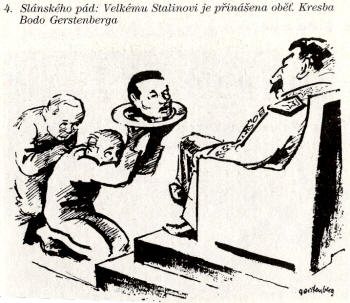
1952: Rudolf Slansky and 10 “conspirators”

On this date in 1952, eleven high-ranking Czechoslovakian politicians were hanged at Prague’s Pankrac Prison two weeks after a show trial purging unreliable elements from the Communist party.

One of the most infamous show trials in Czechoslovakia saw 14 high-ranking Communists — eleven of them Jews — railroaded for a “Trotskyite-Titoist-Zionist activities in the service of American imperialism”. Three received life sentences. The other eleven went to the gallows.

While the roots of the persecution, especially the undertones of anti-Semitism, sink into the id of the Stalinist Eastern bloc, the most evident proximate cause was the USSR’s assertion of control over its satellite states at a time when Josip Tito was successfully charting a course of independent communism. Purges in Poland, Bulgaria and Hungary had taken place in the years before.

The Soviet agents rounding up suspects for Stalin did not trifle with small game. Rudolf Slansky was General Secretary of the Communist Party and therefore the second-most powerful man in the country; by the time he was tried, after a year in prison under torture, he was publicly denouncing himself.

Otto Sling, whose name became synonymous with forbidden heterodoxy, did likewise — “I was a treacherous enemy within the Communist Party … I am justly an object of contempt and deserve the maximum and the hardest punishment.”

And Vladimir Clementis, the Slovak Minister of Foreign Affairs, was erased from a photo taken with the Czechoslovakian President, a circumstance Milan Kundera reflected upon in The Book of Laughter and Forgetting:

In February 1948, the Communist leader Klement Gottwald stepped out on the balcony of a Baroque palace to harangue hundreds of thousands of citizens massed in Old Town Square … Gottwald was flanked by his comrades, with Clementis standing close to him.

…

The propaganda section made hundreds of thousands of copies of the photograph taken on the balcony where Gottwald, in a fur hat and surrounded by his comrades, spoke to the people. On that balcony the history of Communist Bohemia began. Every child knew that photograph, from seeing it on posters and in schoolbooks and museums.

Four years later, Clementis was charged with treason and hanged. The propaganda section immediately made him vanish from history and, of course, from all photographs. Ever since, Gottwald has been alone on the balcony. Where Clementis stood, there is only the bare palace wall.

The hanged were rehabilitated in 1963.

Artur London, who received a life sentence and was released after rehabilitation, wrote about his experiences in The Confession, subsequently a 1970 Costa-Gavras film. The wife and son of Deputy Minister of Foreign Trade (and Auschwitz survivor) Rudolf Margolius have also both written memoirs covering the trial.

The younger Margolius in particular, who has staunchly defended his father as an essentially apolitical man and not a Communist apparatchik, has been in the thick of present-day disputes in Czechoslovakia’s successor states over whom is due sympathy and recognition for bygone political crimes.

On this day..

2005: Van Tuong Nguyen

On this date in 2005, Australian national Van Tuong Nguyen was hanged* in Singapore’s Changi Prison for smuggling heroin.

Three years before, in dire financial straits, Nguyen had agreed to act as a drug courier and been caught attempting to carry 396.2 grams — less than a pound — of heroin through the airport of the notoriously execution-happy city-state. He had no criminal history and cooperated with the authorities, but the quantity of contraband on his person incurred an automatic death sentence.

Nguyen became an international cause celebre and the Australian government appealed for clemency — though some detected tepid public notice for the young man of Vietnamese extraction in comparison with white Australians in similar situations.

His family’s two-year campaign mobilizing worldwide pressure to save him was the profile of a 2006 documentary that laid bare the continuing grief left to Nguyen’s family and friends … and their continuing work against the death penalty in his remembrance. This personal tribute of unidentified provenance captures both:

* By Darshan Singh, whose identity as Singapore’s hangman was exposed on the occasion.

On this day..

1581: Edmund Campion, Ralph Sherwin and Alexander Briant

On this date in 1581, three English Catholic martyrs were hanged, drawn and quartered at Tyburn, casualties of the bloody confrontation between religious and secular power of the English Reformation.

Edmund Campion — later sainted — was the towering figure among them and the great attraction for those that thronged the Tyburn scaffold on a rain-drenched Friday.

A brilliant Oxford scholar once tipped as a possible future Archibishop of Canterbury, Campion abjured his Anglican holy orders in favor of Rome — a mortal peril in Elizabethan England.

He slipped away to Ireland, then to the continent and safety. But at age 40, after nearly a decade abroad, the missionary zeal of the converted called him back to Albion as part of a secret Jesuit mission. Hunted from the day he set foot back in Britain, he survived a year on the run, an underground minister to an illicit faith.

Though priestly investiture alone technically made him capitally liable, a government with millions of Catholic citizens grappled for some firmer ground upon which to condemn the renowned intellectual. Since Campion succumbed neither to torture nor to blandishments, nor to the surreal interludes when he was hauled out of his dungeon and made to debate with the Crown’s theologians, he was finally convicted on the strength of made-to-order witness testimony to the effect that his mission had some vague upshot of undermining Queen Elizabeth’s hold on her subjects.

In effect, it was very much like convicting him for his faith: the Anglican-Catholic conflict had crystallized, and dozens of priests would follow the route of Campion in the years to come. Between a mutually implacable state and church, either flesh or soul must burn.

Not a few of those who trod the martyr’s path would take inspiration from the beatific Jesuit — as young Henry Walpole, whose own route to Calvary is said to have begun when he was spattered by Campion’s blood this day and come full circle to his own execution 15 years later. Walpole’s embrace of martyrdom fairly glows from his proscribed tribute to Campion:

Hys fare was hard, yet mylde & sweete his cheere,
his pryson close, yet free & loose his mynde,
his torture great, yet small or none his feare,
his offers lardge, yet nothing coulde him blynde.
O constant man, oh mynde, oh vyrtue straunge,
whome want, nor woe, nor feare, nor hope coulde chaunge.

…

Yee thought perhapps, when learned Campion dyes,
his pen must cease, his sugred townge be still.
But yow forget how lowd his deathe yt cryes,
how farre beyond the sownd of tounge or quill.
yow did not know how rare and great a good
yt was to write those precious guiftes in bloode.

That famous eloquence was Campion’s legacy, so overwhelmingly so that he presents in the lineup of men who might have written Shakespeare.

His best-know work was “Campion’s Brag”, the scornful nickname his foes gave to an apologia he produced while underground in England … and to whose steady words Edmund Campion proved true this day:

[B]e it known to you that we have made a league — all the Jesuits in the world, whose succession and multitude must overreach all the practices of England — cheerfully to carry the cross you shall lay upon us, and never to despair your recovery [to Catholicism], while we have a man left to enjoy your Tyburn, or to be racked with your torments, or consumed with your prisons. The expense is reckoned, the enterprise is begun; it is of God, it cannot be withstood. So the Faith was planted: so it must be restored.

But Protestant England did withstand the enterprise. The generation to come saw Catholic ideas and writing put to withering siege, Campion’s not least among them. For all the tribute of history to the man of Christlike fortitude, it is by no means apparent that the enjoyments of Tyburn and the kindred “practices of England” did not, after all, lay a cross heavier than English Catholics could bear.

On this day..

1944: Lilo Gloeden, Erich Gloeden and Elisabeth Kuznitzky

On this date in 1944, Berlin housewife Elisabeth “Lilo” Gloeden was beheaded with an axe in Plotzensee Prison, along with her husband and mother.

They had been sentenced — and intentionally made an example of — just three days before for hiding a fugitive from the July 20 Plot to assassinate Hitler.

As Martin Gilbert observes in The Second World War: A Complete History, the fury of Hitler’s domestic crackdown came in inverse proportion to Germany’s fortunes in war.

[The family’s] fate was then publicized, as a warning to anyone else who might try to shelter the enemies of the Third Reich.

The fate of that Reich could not, however, be seriously in doubt. On the day of Lilo Gloeden’s execution, American troops drove the Germans from Mackwiller, in the Saar, inside Germany’s pre-war frontier. In Hungary, the Red Army entered Eger, less than twenty-five miles from the central Slovak frontier.

Part of the Themed Set: Women Against Fascism.

On this day..