1839: Amos Perley and Joshua Doane, for the Upper Canada Rebellion

On this date in 1839, Amos Perley and Joshua Doan(e) were hanged in London, Ontario for a feeble armed invasion from Detroit.

The Battle of Windsor was pretty much the last gasp of Canada’s Rebellions of 1837 — touching Lower Canada (Quebec) as well as Upper (Ontario).

The effort saw stateside refugees of the Upper Canada Rebellion, also known as the Patriot War, organize an attempt to overthrow British-Canadian authority between Windsor and Niagara. But a brief incursion (a few houses were captured) failed to trigger a general response in a populace that was all risings’ed out, while United States authorities stayed well clear of these troublemakers. Officials had little difficulty mopping them up.

Six different people (named here) were executed at intervals in London, Ontario, beginning on January 7, 1839 — and ending with the two this date.

Amos Perley was a New Brunswick native who had been an American resident (citizenship status is unclear) for some time, but fell in with the Patriots.

Joshua Doane was a Quaker — a sect ordinarily leery of armed conflict and liable to be considered disloyal as a result — who abandoned the whole pacifism thing in favor of the Patriot cause. He’d had to beat it over the border when the last round of Upper Canada disturbances had been put down the previous winter: he wouldn’t get another chance after the 1838 invasion fizzled.

Doane’s touching last letter to his soon-to-be-widow survives.

London, January 27th, 1839

Dear Wife,

I am at this moment confined in the cell from which I am to go to the scaffold. I received my sentence today, and am to be executed on February 6th. I am permitted to see you tomorrow, any time after 10 o’clock in the morning, as may suit you best. I wish you to think of such questions as you wish to ask me, as I do not know how long you will be permitted to stay. Think as little of my unhappy fate as you can; as from the love you bear me, I know too well how it must affect you. I wish you to inform my father and brother of my sentence as soon as possible. I must say good-bye for the night, and may God protect you and my dear child, and give you fortitude to meet that coming event with the Christian grace and fortitude which is the gift of Him, our Lord, who created us. That this may be the case, is the prayer of your affectionate husband,

JOSHUA G. DOANE.

At this point, “people [in London] were so fed up” with the intermittent public hangings they’d been subjected to that the remaining condemned had their sentences commuted instead to penal transportation, and got shipped to Australia instead.

The disruptions did, however, help to contribute to the 1840 political unification of Upper and Lower Canada.

On this day..

1838: The first hangings of the Lower Canada Rebellion

On this date in 1838, Joseph-Narcisse Cardinal and Joseph Duquet were hanged for a rebellion.

As the names suggest, these weren’t rosbifs themselves: they were French, born under crown jurisdiction by grace of their forbears’ thrashing at British hands in the Seven Years’ War.

In 1837, French Lower Canada rose in rebellion — la Guerre des patriotes, to the Quebecois. The British dispatched it.

Cardinal and Duquet were young notaries of radical sympathies who organized a sort of aftershock insurrection (French link) in 1838 at their native Chateauguay. It was instantly suppressed, its authors court-martialed for treason.

Those patriotes spared the pains of the gallows were condemned instead to a different kind of suffering — exile. The folk song “Un Canadien Errant” (“The Wandering Canadian”) eulogizes the land lost to these unfortunates.

“If you see my country,
my unhappy country,
Go, say to my friends
That I remember them.”

A monument pays tribute to all those executed or exiled for the rebellion.

On this day..

1831: John Bishop and Thomas Head, the London Burkers

On this date in 1831, two of the “London Burkers” hanged for murdering a child to sell his body to anatomy schools for dissection.

It was one of the city’s most infamous crimes, touching explosive resentments among Londoners for the vampiric trade in human cadavers ultimately demanded by medical students. Thirty thousand packed the streets around Newgate Prison to send this date’s hated offenders on to the hereafter.

As the gang’s nickname indicates, it closely followed the similar affair of Burke and Hare in Edinburgh. (“Burking” had immediately come to mean “killing someone for their marketable cadaver”, a shadowy underworld phenomenon that was in need of a catchy name.) But although William Burke made the OED, it was the London Burkers who most directly triggered the legislation to reform the anatomy business.

Historian Sarah Wise wrote the acclaimed book about this case, The Italian Boy. Executed Today is thrilled to interview her on this 180th anniversary of the London Burkers’ deaths.

The Italian Boy purchase links for Anglophones

Book CoverET: Let’s begin with the title of your book, The Italian Boy — an allusion to the victim in the case. Who was this youth, how did he come to be in London, and what did the city look like to a penniless foreign child in 1830?

SW: Well the book is less a ‘whodunnit’ and more of a ‘who-was-it-done-to’. The identity of that particular victim was never fully established. But, as still happens today in murder cases, some types of victim seem to have more appeal than others, and rumour that a little Italian beggar boy was missing from his usual pitches snowballed into a situation where even the courts, police and newspapers were accepting it as fact that it was his body that had been delivered to an anatomist. The final chapter of my book goes into why this might not have been so.

The ‘Italian Boy trade’ was a racket, whereby traffickers paid poor peasant parents, worried about what future they could offer their children, and took charge of the child, walked them north to the wealthy cities of northern Europe, and got them exhibiting small animals or plaster images around the streets, in the hope of being thrown a penny or two. Huge sums could be obtained in this way, but needless to say, the children themselves saw little of this. [There’s an 1872 New York Times article describing the trade into North America here. -ed]

I was fascinated by the warmth shown to these kids in what was otherwise a pretty mean city. This really is the London of Oliver Twist — dark, filthy, with all sorts of Fagin types (and much worse) around. Child vagrancy (as with adult vagrancy) was all too common and yet there were practically no public or civic bodies to offer any help; the idea of hordes of kids sleeping rough is just extraordinary, but that’s how London was right up until the end of the 19th-century.

But Londoners loved these attractive, exotic-looking little Italian waifs, and would also defend other types of beggars if anyone appeared to be hassling them. Ordinary city-dwellers seemed to me, in reading the primary source material, to be a lot less withdrawn and in their own little world than we city-dwellers are today, and seemed to show more class, or social, solidarity.

And how about the killers? What’s their own background, and how do they get into the business of killing people to sell the bodies?

One of the killers, John Bishop, came from a good, solid, small-business background, having been bequeathed a successful carting company. He drank away the family firm, and then turned to the related trade of bodysnatching — there was often a close connection between those involved in city transport and those who needed to move their very questionable goods around surreptitiously. Both trades had the pubs in the street called Old Bailey as their headquarters.

The other killer, Thomas Head, aka Williams, was younger and harder to find out about. He was said to have come from a very poor but honest home, and his parents were devastated when he began to go off the rails in his adolescence, firstly petty-thieving, and then moving on to the less petty-thieving of grave robbery.

I’ve touched a bit elsewhere on the site on the underlying dynamic at work: more demand for medical cadavers than was being met by the gallows. Do we have a sense at this time, after the Burke execution, what proportion of those extra cadavers were being provided by resurrectionists? And how many might have been provided by outright homicide?

Numerical estimates vary hugely for every aspect of this subject. In terms of the sheer volume of bodies medical students were getting through, the 1828 Select Committee on Anatomy canvassed many opinions, and came up with the hugely divergent total of between 500 and 1,000 in a year — the ideal being three bodies per student, with each student completing a 16-month surgical and dissection training. The Select Committee suggested that on average, the Resurrection Men were supplying around 500 to 550 corpses a year — by one means or another. But all these stats should be used with caution.

As for grave robbery: it was all highly surreptitious, as you would expect — there is no great documentary source to turn to, and so we have only scraps of rumour and hearsay. John Bishop, one of the Italian Boy murderers, is said to have ‘lifted’ between 500 and 1,000 corpses in his career, which lasted from 1818 to 1831. That is a huge differential and there is no way of checking whether the lower or higher number is the more likely. Someone shouted at Bishop, in the Old Bailey cells, ‘You’re a bloody murdering bastard, and you should have been topped [hanged] years ago!’, which suggests that the Italian Boy killing was not his first.


Image of a burking, from a broadside on the London Burkers among a book full of street literature here.

As we know, only around twelve people a year were executed for murder in England in these years — people executed for other crimes were not sent to the anatomists. My guess is that many folks who died in public hospitals or workhouses were anatomised, but that this was a highly secret matter and went on illegally. The other main sources of corpses, to make up the shortfall, will have been corrupt undertakers, church sextons and gravediggers. I suspect many coffins in London graveyards were filled with nothing more than brick or earth. As the 1820s wore on, actual exhumations are likely to have declined in favour of more simple ‘sneak-thieving’, with insiders giving the tip-off about where a recently deceased body was likely to be found.

One more ‘statistic’ for you: in a plea bargain attempt during the Italian Boy case, the police placed in front of one prolific bodysnatcher a list of all the resurrection men they had ever known or come across and asked the witness if he would mark with a cross any of the 50 whom he thought capable of murder for dissection. When he handed it back, he had marked six names.

Huge irony: when anatomised, John Bishop was found to be one of the very best specimens the Royal College of Surgeons had ever dissected — great, strong muscles, extremely fit and hearty, from his horrible career in body-handling.

How overtly implicated were aspiring or actual doctors with this sort of thing (even “mere” resurrection as against murder) as a “necessary” part of their education that they chose to turn a blind eye towards? And was there any engagement with the problem as an ethical question?

The public cared hugely about the ethics; the legislature very little. That’s why Dr. Knox, in the Burke and Hare case, was so unusual — no one protected him when the case came to trial, and he was vilified and more or less chased out of Edinburgh. But in the Italian Boy murders, no doctor got anywhere near the witness box. Society and the legislature really rallied around them, to make sure the public did not take their feelings out on them.

But popular resentment that the doctors might have encouraged, or turned a blind eye to, grave-robbery (not murder) remained very common.

By around 1800, doctors and students had wholly outsourced exhumations for dissection material — gangs of specialised labouring men did it for them, and part of the deal was that (in return for a good wage) the bodysnatchers themselves, if caught, would keep silent, do their stretch in gaol, and they and their families would be looked after financially by the surgeons who commissioned them.

One surgeon, Joshua Brookes, fell foul of the bodysnatchers (refusing to put up their wages) and in revenge, they placed half-dissected corpses close to his Soho premises. These were tripped over in the dark by pedestrians, which caused a huge rumpus and the police had to come to protect Brookes from the mobs who wanted to stone his house. Such events were the exception, rather than the rule.

There’s something just sublimely Swiftian about a disposable person being literally, bodily consumed by the city and its professional class. Was it surprising that a doctor would bust these men when they came to sell the body, and/or that it would trigger an aggressive police response? Had they probably pulled this trick with a wink and a nod many times before?

The Italian Boy case was highly unusual in that it was a surgeon, Richard Partridge, who blew the whistle — not only on the killers but essentially on the whole trade. He was the anatomy teacher at the brand-new King’s College, which was very religious-based, though funnily enough, I don’t think Partridge himself was devout. In getting the men arrested, he really blew wide open this secretive, terrifying world of the trafficking of (poor people’s) corpses.

It is the Italian Boy case — not Burke and Hare — which brought about swift legal change, which ensured the demise of surreptitious grave-robbery for anatomical teaching.

Other than hanging the perps, what was the fallout from this case at the level of policy or social evolution? Was there conflict between the privileged and the poor over how to understand this sort of crime and how to go about addressing it?

The ‘resolution’, the ‘evolution’, was the 1832 Anatomy Act, which essentially legalised what had been going on all along. It permitted anatomists to claim as legitimate teaching material the corpse of anyone who died in a workhouse or public hospital whose body went unclaimed by friends or family for private burial. In practice, it seems that even when apparently friendless beggars died, and associates did come forward, the doctors had already earmarked the body for their own purposes.

This type of thing caused decades and decades of bitter class resentment in this country, and fear of doctors and hospitals was even discernible in my late parents’ generation. These worries still occasionally resurrect themselves. The UK’s Human Tissue Act of 2004 was passed following disclosure of the mass storage of children’s organs, without any permission or consent having been sought from the parents. I think consent remains a huge issue in medical matters, in most cultures, and those who are deemed powerless in some way — by class, race, caste, gender and so on — are by far the more likely to have their bodies commandeered in the name of science.

Sarah Wise has been a Londoner since the age of 14. She has a BA in English Literature and a Masters degree in Victorian Studies, from Birkbeck College, University of London. The Italian Boy: Murder and Grave Robbery in 1830s London won the Crime Writers’ Association Gold Dagger for Non-Fiction in 2005 and was shortlisted for the 2005 Samuel Johnson Prize for Non-Fiction.

Sarah was a major contributor to Iain Sinclair’s compendium London, City of Disappearances, published by Hamish Hamilton in 2006.

Her forthcoming book, Inconvenient People, investigates the phenomenon of sane people being put into lunatic asylums in Victorian England, and will be published in the summer of 2012.

On this day..

1834: The bushrangers John Jenkins and Thomas Tattersdale

Cried Peter, where’s your certificate
Or if you have not one to show
Pray who in Heaven do you know?

Well I know Brave Donohue
Young Troy and Jenkins too
And many others whom floggers mangled
And lastly were by Jack Ketch strangled.

“A Convict’s Tour to Hell” by Australian prisoner Frank McNamara (1839)

On this date in 1834 was strangled the aforementioned Jenkins — John, to his friends — alongside accomplice Thomas Tattersdale for one of 19th century Australia’s headline-grabbing crimes.*

Along with a third man who would turn state’s evidence to save his own neck, these convicts busted out of jail.

On the run in the bush, these fugitives came across the massive estate of Dr. Robert Wardell, a prominent public figure in early Australia. When this newspaper publisher, barrister, and land magnate personally bumped into the trio, he naturally urged the prisoners to give themselves up. Instead, John Jenkins shot Wardell dead.

These outlaws were definitely not of the gentleman variety.

Tattersdale, a non-triggerman who had actually tried to talk Jenkins out of killing Wardell in the first place, sported a suitably Dostoyevskyan appreciation of his own guilt, and basically just asked the court for a few days to prepare his soul. Jenkins made the trial a three-ring circus with his profane attacks on the court, and his bodily attack on his fellow-defendant when he learned that Tattersdale had offered to testify for the crown. (Tattersdale weepily made up with an irritated Jenkins at the time of their hanging, which was only three days after they were condemned.)

Tattersdale’s lamblike submission just got him written out of the ballads; even the newsmen covering the hanging itself “did not much regard” him.

Jenkins, by contrast, stole the show “with that vulgar attempt at bravado courage which distinguishes men of his class.” He’d been joking about his hanging since the trial, and he played cocksure right up to the time they dropped the trap on him — including a distinctly unauthorized last comment on his life and crime.

Well, good bye my lads, I have not time to say much to you. I acknowledge I shot the Doctor, but it was not for gain, it was for the sake of my fellow prisoners because he was a tyrant and I have one thing to recommend you as a friend, if any of you take the bush, about every bloody tyrant you come across, and there are several now in the yard who ought to be served so.

* An unrelated criminal named McCormick died with them, for murdering his wife.

On this day..

1832: Lucy (Wells), jealous slave

This date in 1832 was the Republic’s only execution of a female in Tyler County, West Virginia (then part of Virginia): a slave named Lucy who murdered the daughter of a neighboring family.

Detail on this case comes salvaged from the now-defunct (we think) death penalty history site Before the Needles:

Just across Middle Island from the Wells home lived a family which had a daughter named Mary Ann Fletcher.

Communication between the two homes was by canoe or johnboat and quite frequently Lucy was sent to the creek bank to set Miss Fletcher across the stream for a visit to the Wells home when they heard a halloo from the opposite shore. For some reason Lucy became intensely jealous of the attention which her master’s family lavished on the young Fletcher girl and determined to slay her.

One day after visiting the Wells home Lucy was sent with Miss Fletcher to set her across the creek and after a little longer delay than usual Lucy returned to “Stonehurst” her usual calm self, but later in the evening Mr. Fletcher came to the creek bank and hallooed across to “Stonehurst” and asked if they would send Mary Ann home immediately, as it was growing late.

Squire Wells and his family wondered what had happened, but did not think of anything wrong untill Mr. Fletcher called to them a second time. Lights were secured by both families who went to the crossing and in a short time the body of Mary Ann, drowned, was discovered.

An examination of the body disclosed the she had evidently died from foul play, because the fingers of both hands had been badly crushed and she also had bruises on her head and face. Lucy was immediately suspected and shortly confessed that she had pushed Miss Fletcher out of the boat, and when she did not readily drown, and had caught the sides of the canoe with her hands, she (Lucy) had pounded Miss Fletchers hands with the paddle, struck her over the head several times and pushed her under the surface of the stream.

On this day..

1838: Tsali, Cherokee

The decade following establishment of the “permanent Indian frontier” was a bad time for the eastern tribes. The great Cherokee nation had survived more than a hundred years of the white man’s wars, diseases, and whiskey, but now it was to be blotted out. Because the Cherokees numbered several thousands, their removal to the West was planned to be in gradual stages, but discovery of Appalachian gold within their territory brought on a clamor for their immediate wholesale exodus. During the autumn of 1838, General Winfield Scott‘s soldiers rounded them up and concentrated them into camps. (A few hundred escaped to the Smoky Mountains and many years later were given a small reservation in North Carolina.) From the prison camps they were started westward to Indian Territory. On the long winter trek, one of every four Cherokees died from cold, hunger, or disease. They called the march their “trail of tears.”

-Dee Brown, Bury My Heart at Wounded Knee

This date in 2010 happens to be Thanksgiving in the United States.

Dating to the Civil War in its modern incarnation, its ancestral event is the “first thanksgiving” wherein European colonists* chowed down with the Wampanoags who had saved them from starvation in New England.

This moment of apparent amity obviously also presages the near-annihilation of native peoples by those European colonists over the succeeding centuries; even in 1621, the seeds of future conflict were at hand. By the very next year, Wampanoag chief Massasoit would demand the execution of legendary Pilgrim-befriender Tisquantum (Squanto).

So it’s also fitting to remember that this day in 1838** was the execution of Tsali, the hero of those escaped North Carolina Cherokee whom Brown mentions — a man tied to a tree and shot this date by the U.S. Army for resisting “Indian removal”.

While assimilated Cherokees like Chief John Ross were themselves right in the thick of the debate about deportation, Tsali was a traditionalist farmer in North Carolina who had little contact with such sketchy political machinations.

When Washington’s ethnic cleansing policy shed its diplomatic cover for naked force, Tsali and his family killed some of the soldiers sent to capture them for removal.** General Scott was not amused.

The individuals guilty of this unprovoked outrage must be shot down; & there is another object demanding equal & immediate attention, viz: –the protection of the white families, residing in that region, who are, doubtless, much alarmed (& may be in great danger) at the most unexpected spirit of hostility evinced by the fugitive Indians about them by the murders in question.†

And, of course, they were. Tsali is said to die in that fearlessness of the noble savage, a fitting aspect for any martyr at the last.

I have a little boy…If he is not dead, tell him the last words of his father were that he must never go beyond the Father of Waters, but die in the land of his birth. It is sweet to die in one’s native land and be buried by the margins of one’s native stream.

-Tsali’s recorded last words

It’s one of those ironies of empire (not unlike Thanksgiving Day itself) that Tsali’s dying wish was made possible by the very fact that other Cherokees collaborated in his death. Or at least, that’s how Tsali came to be remembered.

Other Cherokee with farms outside the boundaries of the formal Cherokee nation were then maneuvering to avoid the effects of the removal treaty — which by its own letter ought not apply to other Cherokee. William Holland Thomas, the remarkable Caucasian-born orphan adopted by the chief of these Cherokee, Dancing Bear, cut a deal with General Scott:

if [Dancing Bear’s Cherokee] would seize Charley [Tsali] and the others who had been concerned in the attack upon the soldiers and surrender them for punishment, the pursuit [for other Cherokee in the Great Smokies] would be called off and the fugitives allowed to stay unmolested … he could secure respite for his sorely pressed followers, with the ultimate hope that they might be allowed to remain in their own country …

It was known that Charley and his party were in hiding in a cave of the Great Smokies, at the head of Deep creek, but it was not thought likely that he could be taken without bloodshed and a further delay which might prejudice the whole undertaking. Thomas determined to go to him and try to persuade him to come in and surrender. Declining Scott’s offer of an escort, he went alone to the cave, and, getting between the Indians and their guns as they were sitting around the fire near the entrance, he walked up to Charley and announced his message. The old man listened in silence and then said simply, “I will come in. I don’t want to be hunted down by my own people.” They came in voluntarily and were shot … one only, a mere boy, being spared on account of his youth.†

Scott honored the deal, goes the story, and those un-removed Cherokee indeed persisted in North Carolina. Whether due to Tsali’s sacrifice or not, they remain there to this day: the Eastern Band of Cherokee Indians, headquartered in Cherokee, N.C.

On November 25, 1838, Tsali was executed … They were ordered to kill him so they could stay in North Carolina. Tsali was killed. We are still here. Tsali is a Cherokee hero.

-Resolution of the Cherokee Tribal Council (Source)


Bilingual English/Cherokee street sign in Cherokee, N.C. (cc) image from Chuck “Caveman” Coker.

Nearby, you can hike, bike, or ride horses in the Tsali recreation area.

* Including the first man hanged at Plymouth Colony.

** Or at least, the most widely reported date. The sourcing is slightly inconsistent and ambiguous as to whether all the family turned itself in and was shot together, or whether Tsali’s three kinsmen were executed on a previous date with Tsali shot on this date.

† As cited by Paul Kutsche, “The Tsali Legend: Culture Heroes and Historiography,” Ethnohistory, Vol. 10, No. 4 (Autumn, 1963)

‡ These Cherokee would form a legion in the Confederate army which actually had the distinction — under then-Colonel William Thomas — of firing the last shots in the Civil War east of the Mississippi.

§ John Finger’s sacred cow-slaying take on the evolution of the Tsali legend in The Eastern Band of Cherokees: 1819-1900 is that only the family turned in voluntarily, but the army left Tsali alone once the younger men were killed, and the old man was mopped up (involuntarily) by the Cherokee themselves: “there was no noble sacrifice … [and] the capture and execution of Tsali little affected the right of the Qualla Cherokees to remain in North Carolina.”

That version would also resolve the apparent discrepancy in the date and number executed, with Tsali captured on the 24th and shot on the 25th.

On this day..

1834: Fusilamientos de Heredia

On this date in 1834, one day after overrunning the Alava village of Gamarra, Carlist General Tomás de Zumalacárregui had 118 of its defenders shot.

Zumalacárregui was the outstanding Carlist (read: conservative, absolute-monarchist) officer of the day. (Here‘s a public-domain memoir of his campaigns.)

We meet him on the march in 1834, adroitly reversing the grim royalist position in the First Carlist War — a liberal-vs.-conservative civil war that also mapped onto ethnicity, geography, and royal succession.

On this occasion, he overwhelmed a contingent of liberals and Basques fighting for the child-queen Isabella II. The survivors were taken prisoner and (despite objections from some of Zumalacárregui’s underlings) given a fusillade the next day in the neighboring town of Heredia.

This pithy diary entry from a Carlist officer comes from the incident’s Spanish Wikipedia page:

Día 17. Permanecimos en Heredia donde se fusilaron 118 peseteros. (“Day 17: We remained in Heredia, where we shot 118 Chapelgorris.”)

The Fusilamientos de Heredia — still notorious to this day — were distinguished by their number, but they were hardly unique. Both sides in the civil war unapologetically carried out summary executions of prisoners they had no resources to detain and did not care to turn loose. (And in the more everyday interests of sowing terror, or avenging the last time the other guys sowed terror.)

An English peer eventually brokered the Lord Eliot Convention, an arrangement by which both Carlists and Cristinos agreed to stop slaughtering prisoners and exchange them so that they could properly slaughter one another on the battlefield instead.

On this day..

1831: Gen. Jose Maria Torrijos y Uriarte and his liberal followers

On this date in 1831, one of the great Spanish liberal officers was shot along with dozens of comrades attempting to spark a revolution.

It was a dark time for Spanish liberals under the autocratic rule of Ferdinand VII.

Jose Maria Torrijos y Uriarte (Spanish Wikipedia page) was one of the heroes of that downtrodden cause from way back, a noble-born officer who had been made a captain at the precocious age of 13 and been around for all of Spanish liberalism’s greatest early 19th century tragedies.

He was in Madrid for the ill-fated uprising against its French occupiers in 1808, and was captured en route to aid Pedro Velarde‘s last stand.

Lucky for Torrijos, and luckier still: as a prisoner, he might have been in line for the ensuing mass execution, but an aide-de-camp of General Murat let him go in gratitude for chivalrously preserving a French officer from the Spanish mob.

A few years after the Peninsular War, with independent Spain yoked to a reactionary Bourbon-backed monarchy, Torrijos’ dangerous opinions made him a prisoner once more.

This time, he was liberated by the brief ascendancy of fellow-traveler Rafael del Riego. This effusion, too, was destined for grief upon the scaffold; once more, Torrijos escaped, this time to exile.


The execution of Rafael del Riego

Pushing forty and a bit emptyhanded for all his strivings, Torrijos’ restless soul was not satisfied knocking about the shores of England. He soon assembled a company of like-minded folk (such as Robert Boyd) to make another bid at liberating Iberia. But he was induced to put ashore under the misapprehension of support, and promptly rounded up.

The Malaga governor’s message to Madrid requesting instruction returned the simple order: shoot them all.* (Spanish link)


El fusilamiento de Torrijos y sus compañeros en la playa de Málaga, by Antonio Gisbert

“A la muerte de Torrijos y sus compañeros”
by José de Espronceda (from here (pdf))

Helos allí: junto a la mar bravía
cadáveres están ¡ay! los que fueron
honra del libre, y con su muerte dieron
almas al cielo, a España nombradía.

Ansia de patria y libertad henchía
sus nobles pechos que jamás temieron,
y las costas de Málaga los vieron
cual sol de gloria en desdichado día.

Españoles, llorad; mas vuestro llanto
lágrimas de dolor y sangre sean,
sangre que ahogue a siervos y opresores,

y los viles tiranos con espanto
siempre delante amenazando vean
alzarse sus espectros vengadores.


Monument to Torrijos at Malaga’s Plaza de la Merced.

* Around 50 or so were shot. The exact figure is differently accounted by various sources; I have been unable to determine if any among them are authoritative.

On this day..

1836: Louis Alibaud, failed regicide

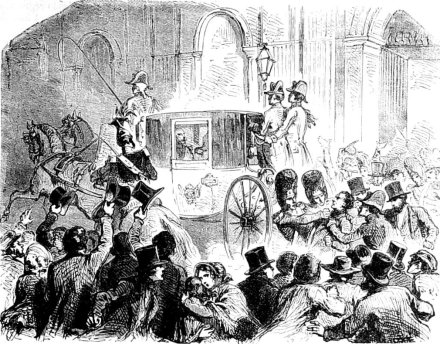
Early this Monday morning in 1836, Louis Alibaud — having been condemned to death by the Chamber of Peers at trial the preceding Friday and Saturday — lost his head for taking a shot at oftshotat French King Louis-Philippe.

As related by the London Times (July 6, 1836),

at half-past 6 in the afternoon of the 25th of June, 1836; the windows of the carriage were lowered, and it was passing through the gate [of the Tuileries palace] leading to the Pont Royale, when a man, who had been standing by a post in the court, raise [sic] a cane gun and discharged it against the King. By a miraculous chance the King was lowering his head to salute the National Guard under arms, and the ball passed just four lines above his head, and entered one of the angles of the carriage, settling about an inch deep in an oak beam.

The assassin was immediately arrested; he was a young man, of about 25 years of age, dressed in a dark coat, cloth pantaloons, and black hat, and wearing under his chin a thick brown beard.

The disabled former infantryman, “inspired by political fanaticism and a morbid satiety of life,” mounted no defense of himself save for a defense of tyrannicide — “I had the same right to his life that Brutus had to the life of Julius Caesar!” (Source)

Naturally, this line had neither the intent nor the effect of securing clemency, and he was repeatedly cautioned by the court against pursuing it; all concerned knew precisely where matters were headed, of course, and the state had no interest in providing a public forum for sedition.

On this day..

1839: William John Marchant

On this date in 1839, a spooked 18-year-old servant was hanged at Newgate Prison for murdering fellow-servant Elizabeth Paynton.

A good Chelsea lad with no rap sheet, Marchant slashed Paynton’s throat with a razor when they were left alone, fled, but was so pursued by guilt that he gave himself up and pleaded guilty. Awaiting death, he lamely told his distraught parents

the upper house-maid and the cook went out, leaving [Marchant] with the deceased in the house by themselves. The cook, as she was leaving the house, dared him to get possession of a riband or pair of garters which the deceased had displayed before the servants in the kitchen in jest, and threatened to inflict some ludicrous punishment upon him if he did not … [Marchant] improperly endeavoured to obtain possession of the garters, but she resisted him, and at length slapped his face, called him some ill names, and said she would get him out of his situation for his rudeness. He then ran to fetch a razor to cut the garters and get them into his own possession, and he then had not the least intention of killing her or perpetrating any other offense … but when he did return with the razor in his hand he was seized, as he says, with a sudden and unaccountable impulse, which he could not define, and in a paroxysm of insanity in a moment, and without premeditation, he cut her throat.

(In a later telling, he dropped the garter cover story and copped to a more distinctly identifiable attempted rape, with the murder precipitated by its object’s threat to have him sacked.)

As the London Times remarked on the hanging,

It is difficult, perhaps, to hold him out as an example to other erring youth; for, as he neither appears to have been a drunkard, nor given up to licentious courses, his crime is of so extraordinary a character, that it is hardly possible any other, by following the same course, should terminate his career by the same shameful death … there [may] be no occasion to read a lesson to those who in ordinary cases might be seduced to commit a similar offence.

The dearth of instructional opportunity (and the fact that “the crowd was not great”) did not obstruct London’s enterprising gallows-foot entrepreneurs from cranking out multiple broadsides,* complete with cookie-cutter didactic poem. This sort of thing was standard fare for the day’s forgettable petty villains, not merely its crimes of the decade.

All ye who pity my sad fate,
With sorrow most sincere,
Unto the truth which I will state,
I pray you lend an ear.
Condemned in scorn and shame to die
My doom is most severe,
‘Tis but a few short days since I
Just reached my eighteenth year.

My face is all beset with woe,
My cheeks are worn with care,
My eyes are parch’d and sunk with Grief,
That once so sparkling were.
Strange horrors chill my every vein,
A voice most wild and true,
Whispers to this distracted brain,
Thy hand Elizabeth slew.

At this my very heart doth bleed
With grief, remorse, and guilt
To think upopn the ruthless deed,
The blood which I have spilt;
For never since that hour have I
One moment’s comfort knew,
And poor Elizabeth’s murdered corpse
Is ever to my view.

Behold my days are like a flower,
That blooms at break of day,
Cut down and withered in an hour,
And vanished away.
Lament, lament, to see me die
All ye who do me view,
A poor, heartbroken, wretched lad,
Must bid this world adieu.

Vain, are my lamentations, vain
These unavailing sighs,
Girm [sic] death is hastening apace,
I must prepare to die.
Heaven grant none may hereafter be
Like luckless me undone,
But always strive with humble mind,
The tempters snare to shun.

* From Harvard University’s collection.

Update: The Times Archive Blog flags another interesting bit of this story: the newspaper’s hectoring the doomed footman’s chaplain for excessive “enthusiasm.”

Part of the Themed Set: The Ballad.

On this day..