1936: Grigory Zinoviev and Lev Kamenev, Old Bolsheviks

During the purges of the 1930s, Josef Stalin showed a particular relish for eliminating the Old Bolsheviks whose red credentials predated the revolution. (And potentially, outshone his own.)

Zinoviev

On this date in 1936, one of the oldest of them, Grigory Zinoviev, was shot with his longtime ally Lev Kamenev.

These guys had been major movers and shakers among the early Bolsheviki, adherents of Lenin during the first decade of the century when the aspiration for a Communist Russia seemed hopelessly far-fetched. Zinoviev rode with Lenin from Switzerland to Petrograd in the famous sealed train after the February Revolution toppled the tsar. (Not so Kamenev: he was serving time in Siberia, but was freed by the revolution.)

In the years that followed, both played leading roles in the Soviet government despite their impolitic opposition to the Bolshevik coup in October.

Kamenev was briefly head of state in 1917, and he married Leon Trotsky’s sister. Zinoviev was the longtime head of the Communist International, in which capacity he showed Moscow’s public face for communist movements in other countries. Bela Kun was another ally of Zinoviev’s.)

In this capacity, he’s known in British history for the “Zinoviev letter”, a purported summons to Anglo agitation that was actually a dirty trick dropped before an election to help the Tories sweep to power.*

Those were the good old days — when Lenin was fading away and Zinoviev, Kamenev, and Stalin were the “troika” running things. They should have checked with the Romans how triumvirates work out.

Because of their alliance, Zinoviev and Kamenev provided the decisive support that enabled Stalin to remain General Secretary of the party after the public airing of Lenin’s Testament warning against him. Without Zinoviev and Kamenev at this crucial moment, Stalin probably could not have survived politically; the name Koba might have gone into history books as little more than a terror to the paperwork of some forgotten bureau. (And the pre-revolutionary Caucasus!)

Talk about hoisted by your own petard.

Having been helpfully maintained in his position against Lenin’s dying wish, Stalin soon marginalized these formerly useful creatures. Their last decade was doomed to a spiral of failing power struggles, sinking rank, furtive dissension, and craven submission to party discipline.

Stalin at length destroyed them at the first great Moscow show trial, the Trial of the Sixteen — which hyped a “Trotskyite-Zinovievite” plot in a nicely Orwellian twist. (Despite Kamenev’s marital connection, Trotsky was actually a political rival.) The charge sheet must have reminded the defendants on every one of their dwindling days of the alliance with Trotsky they could have made back when they mattered.

The Trial of the 16 defendants would help to write the script for succeeding acts of this awful theater: after fighting the allegations, Zinoviev and Kamenev agreed to plead guilty on private assurances that their lives would be spared.

But once he had their “admissions” on the record, Stalin altered the deal.

Not only Zinoviev and Kamenev, but all 16 from the trial of the 16 were shot shortly after midnight this date.

From exile, their “conspirator” Trotsky called it the “end of an epoch”.

His obituary for Zinoviev and Kamenev minces no words about the men’s personal shortcomings (“they lacked sufficient character”), but still achieves a certain elegaic sympathy for these former fellow-travelers and their shared movement, now swallowed by Stalinism.

I have had the occasion to hear tranquil petty bourgeois tell me in the days between the beginnings of the trial and my internment: “It’s impossible to understand Zinoviev … He is so lacking in character!” And I would reply: “Have you yourselves experienced the full weight of the pressure to which he has been subjected for a number of years?” Unintelligent in the extreme are the comparisons, so widespread in intellectual circles, of the conduct in court of Danton, Robespierre and others. These were the instances of revolutionary tribunes who found the knife of justice suspended over them, directly in the midst of the arena of struggle; at a time when they were in the full flower of their strength, with their nervous system almost untouched and, at the same time, when they despaired of all hope of salvation.

[By contrast] For ten years they [Zinoviev and Kamenev] had been enveloped by clouds of slander paid for in heavy gold. For ten years they had swayed between life and death, first in a political sense, then in a moral sense, and lastly in a physical sense. Can one find in all past history examples of such systematic, refined and fiendish destruction of spines, nerves and all the fibers of the soul? Zinoviev or Kamenev would have had more than ample character for a tranquil period. But the epoch of grandiose social and political convulsions demanded an extraordinary firmness of these men, whose abilities secured them a leading place in the revolution. The disproportion between their abilities and their wills led to tragic results.

* There are numerous theories of the Zinoviev Letter’s origin; one has it that spy Sidney Reilly had a hand in it.

On this day..

1936: Aberra Kassa and Asfawossen Kassa, Ethiopian royalty

On this date in 1936, Italian forces consolidating control of occupied Ethiopia mopped up a couple of royal relatives who had resisted a bit too long.

Brothers Aberra Kassa and Asfawossen Kassa had briefly become, with the flight to exile of their ally Haile Selassie, symbolic leaders of Ethiopia’s domestic resistance to Mussolini’s imperialism.

Along with another brother, these sons of Ras Kassa mounted an abortive July 1936 attack on Addis Ababa, precipitating a furious Italian response.

The rebels were hunted to their retreat: the other brother was caught in a cave and summarily executed, which must have been at the back of Aberra and Asfawossen’s mind when they surrendered under a pledge of safe conduct.

‘Now I tell you to surrender’, wrote Graziani, ‘and I assure you nothing will happen to you. Why do you want to die uselessly?’

Only his cousins had remained with Dejaz Aberra: Mesfin Sileshi and the two younger men, Lij Merid Mangasha and Lij Abiye Abebe. They suspected Italian treachery. ‘If you want to be killed’, said Mesfin, ‘shall I kill you?’ …

The exact sequence of the events that followed is difficult to disentangle … Aberra and Asfawossen finally decided to submit. Aberra however sent his wife and baby son away with Mesfin and the two cousins, a last-minute concession to their pleas and threats.

A letter was sent up to General [Ruggero] Tracchia who had now occupied Fikke:

“To General Tracchia

“As you have assured me in your letter ot me that our lives will be spared, we shall assemble our armies and receive you by peaceful parade in a place called Bidigon.

“Aberra Kassa”

Ras Hailu in person led Aberra and Asfawossen to General Tracchia’s camp. While they were in the tent drinking coffee with the General, the men of their escort were disarmed, apparently without difficulty, and taken away (they were released the next morning). A group or carabinieri entered the tent and arrested the two brothers. It was 21 December, three days after Ras Imru had surrendered. At 7 p.m. the men in the escort heard a volley of shots in the centre of the town.

Tracchia sent a laconic cable to Graziani: ‘Dejaz Aberra and brother shot dusk in piazza of Fikke’. Graziani sent a cable to Lessona (Italian link) repeating Tracchia’s message and adding ‘Situation Salale liquidated’.

This reference to the Salale or Selale branch of the Ethiopian royal family was not entirely correct, however.

Not liquidated was the youngest brother, Asrate Kassa, who had escaped to exile and would return with Haile Selassie’s post-Mussolini government. Asrate ultimately qualified for these dolorous pages himself, however, as one of the victims of the 1974 Derg purge.

Of more immediate concern for Graziani and his ilk: Abera Kassa’s widow Kebedech Seyoum (French link) legendarily rose from childbirth after learning of her husband’s execution to become one of the Ethiopian resistance’s greatest military leaders. She’s a national hero in Ethiopia … and there’s also a Laboratorio Femminista Kebedech Seyoum in Rome, dedicated to the study of ant-fascist women.

On this day..

1936: The Sacred Heart, by Spanish leftists

On this date in 1936, anticlerical leftists in the Spanish Civil War allegedly subjected a monumental statue of Christ to a ritual “execution”.


“This picture, taken by a Paramount News-reel representative and received by air from Madrid yesterday, illustrates an outrage which has no parallel in the photographs published by “The Daily Mail” of the Spanish Reds’ war on religion. It shows a Communist firing squad aiming at the colossal Monument of the Sacred Heart on the Cerro de los Angeles, a hill a few miles south of Madrid which is regarded as the exact centre of Spain.” (Source)

This outstandingly incendiary image made for great recruiting for the Francoist enemies of the “firing squad” and gave credence to a “crusade” lexicology that insured the devout would break overwhelmingly against the Republic. (Nearly 7,000 men and women in religious orders whose deaths during the war are charged to the Republican account also helped.)

Maybe that was inevitable, anyway.

George Orwell, the English leftist who volunteered for the Spanish Republicans, noted in his Homage to Catalonia that

the people in this part of Spain must be genuinely without religious feeling — religious feeling, I mean, in the orthodox sense. It is curious that all the time I was in Spain I never once saw a person cross himself; yet you would think such a movement would become instinctive, revolution or no revolution. Obviously the Spanish Church will come back (as the saying goes, night and the Jesuits always return), but there is no doubt that at the outbreak of the revolution it collapsed and was smashed up to an extent that would be unthinkable even for the moribund C. of E. in like circumstances. To the Spanish people, at any rate in Catalonia and Aragon, the Church was a racket pure and simple. And possibly Christian belief was replaced to some extent by Anarchism, whose influence is widely spread and which undoubtedly has a religious tinge.

Be that as it may, Republican types suspected photographic fakery.

Just like its inspiration is reported to have done, this statue survived its “execution” in fine shapewas resurrected by public subscription, and can still be seen at Cerro de los Angeles outside Madrid.


The “executed” statue today. (cc) image from bigchus.

On this day..

1936: Aboune Petros, Ethiopian bishop

On this date in 1936, the Italian forces occupying Ethiopia executed anti-occupation cleric Aboune Petros.

War on Ethiopia had been Benito Mussolini‘s monument to muscular Italian nationalism.

By May of 1936, it had forced Haile Selassie into exile and established control of the country. Mission accomplished!

At last Italy has her empire.

-Mussolini

As is often the case, the war of conquest instead transmogrified into a war against continuing resistance to foreign military occupation, and the colony of Italian East Africa was a short-lived and bloody affair.

The Duce will have Ethiopia, with or without the Ethiopians.

-Italian Gen. Rodolfo Graziani

(Though the progressive counterpart to Italy’s iron-fisted approach to troublemakers was monumental construction, and 1930s-era fascist architecture is still to be seen in Addis Ababa today.)

Ethiopian Orthodox patriarch Aboune — it’s a title that can also be rendered Abuna or Abune — Petros cut a public profile a little too sympathetic to the native subversives. When the Italians demanded that he tone it down, he replied (according to a hagiography that appears several places online),

The cry of my countrymen who died due to your nerve-gas and terror machinery will never allow my conscious to accept your ultimatum. How can I see my God if I give a blind eye to such a crime?

On July 28, Italians repelled a large* Abyssinian insurgent attack by the sons of Ras Kassa between Addis Ababa and Petros’s stomping-grounds of Dessie; the next day, Petros was escorted to an abrupt martyrdom to the mirroring causes of national self-determination and anti-insurgency realpolitik.

His sacrifice is commemorated in statuary as well as a couple of notable theatrical pieces, Yedam Dems (The Voice of Blood) by Makonnen Endalkachew** and Petros Yachin Saat (Petros At That Hour) by Tsegaye Gebre-Medhin.

* On the scale of thousands. It “showed a certain tenacity,” according to the London Times‘ droll Rome correspondent in a July 30 story.

** Not the same guy as the post-colonial Prime Minister who was executed in a 1974 purge.

On this day..

1936: Antonio José, forgotten composer

On this date in 1936, the Spanish composer Antonio José was shot by Falangists during the Spanish Civil War.

The 33-year-old Burgos native (English Wikipedia page | the more detailed Spanish) was a rising young star, a writer, teacher and “folklorist” who had only that April earned plaudits for a paper on popular songs at an international musicology conference.

That July, the Spanish Civil War erupted … and the fascists clapped him in irons and shot him in the marshes near Estepar, Spain. I have not been able to find any clear documentation as to specifically how he earned the death sentence — which is not to say that the Spanish Falange deserves the benefit of the doubt for the regularity of its judicial procedures.

Despite Maurice Ravel’s (pre-Civil War) opinion that Jose would become “the Spanish composer of our century,” Jose’s work vanished into obscurity after his untimely death. Pieces like this Sonata Para Guitarra have only recently been widely rediscovered.

On this day..

1936: Rainey Bethea, America’s last public hanging

On this date in 1936, thousands thronged Owensboro, Kentucky, for a glimpse of what would prove to be the last public hanging in the United States.

The U.S. followed the trend of its onetime mother country, England, in moving the formerly iconic public hanging increasingly behind closed doors, but its federalist structure made that change uneven. In Kentucky itself at this time, the law displayed sedimentary layers of death penalty history.

Caught up for killing a 70-year-old woman — done in the midst of a drunken burglary, he had left a telltale ring at the scene; fingerprint analysis also helped establish his guilt — Rainey Bethea was on the hook for murder, robbery and rape. The former two indictments would have subjected him to (private) electrocution at the state penitentiary. The latter charge still carried the punishment of public hanging in the local county seat.

Bethea was charged only with rape.

While the explicit sentencing disparity between the crimes bears the clear marks of racism and patriarchy that made purported black-on-white sexual crimes such live fodder for lynch law, and the four-and-a-half-minute jury deliberation doesn’t have the look of solemnity, Bethea’s actual guilt seems fairly well-established.

But the case attracted a nationwide media swarm not for any exceptional quality of the crime or the anachronistic nature of the punishment, but for the involvement of a female sheriff. The “matronly” (virtually all descriptions of her gravitate to this adjective) Florence Thompson had inherited the top law enforcement post upon the death of her husband … and that meant she had inherited the responsibility of hanging Rainey Bethea, which would make her the first American woman to supervise an execution.

Would she or wouldn’t she? The press descended on Owensboro to cover the edifying spectacle of a plump mother stringing up a rapist, or else maneuvering her way out of the job. Thompson played cagey until the very last moment, when the ringers she had secretly hired appeared on the scaffold while she watched from a nearby vehicle.

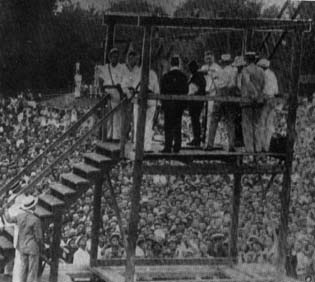
In this photo, Bethea — almost totally obscured between his escorts — has just begun ascending the gallows.

The man who threw the trap showed up drunk and performed appallingly, but press reports subsequently focused on the beastly behavior of the “jeering” crowd rushing the gallows to tear souvenirs from the corpse. (For instance, Time and the New York Times.)

But according to Perry T. Ryan’s 1992 review of the case — including interviews with surviving witnesses — little to nothing of the kind occurred. Ryan claims Bethea faced about the most dignified hanging mob imaginable.

Maybe hyped-up atrocities in the hinterlands were part of what distant editors demanded after H.L. Mencken at the Scopes trial. Certainly, the local Messenger-Inquirer painted a sharply different picture from more prominent outlets in this August 16 editorial (titled “Panderers Galore”) whose themes could have stepped fresh from a modern cable TV gabfest:

Ambitious and irresponsible reporters and photographers who swarmed into Owensboro for the Bethea hanging dipped their ready hands into the cloaca of evil designs and plastered over the name of this fair city the dirty results of their pandering.

Those who saw the dawn kindling in the east and ushering in the last sunrise of the despicable creature about to die, did not expect all of the watchers to be in reverent mood, but a calm, quiet demeanor characterized their behavior, as a group, throughout their long wait, surprisingly moderate for an occasion on which the law was exacting the supreme penalty.

Considering the size of the throng that witnessed the hanging Friday morning and that it was composed largely of people, who journeyed to Owensboro from distant places, the wonder is that there was no demonstration, no emotional outburst. There was not the semblance of ‘mob impulse’ or ‘eagerness for the kill.’ For the sensation seeking star scribes of quacks of American journalism, it was entirely too tame an affair. This is the reason that some of them reported it as they wanted it to be — not as it was.

They heard a very few people on the outskirts of the crowd call out at different times: ‘Hurry up,’ ‘Get it over’ or ‘hang him.’ To give screaming bulletins to the yellow press and to ruthless radio commentators, they magnified and colored it into a scene of ‘great disorder’ though there was never a general outcry of any kind.

When a priest held up his hand from the scaffold for silence, as Bethea was about to go to his death, there was no ‘blood thirst’ mob ‘shouting and yelling.’ Present were several thousand, who came from near and far to see a man legally hanged for the most heinous crime ever committed in Daviess county, and several thousand more, who turned out to see how the rest would act. When that hand went up in a gesture for silence, the buzz of the multitude’s conversations died down till the fall of the proverbial pin could have been heard.

The smart scribes and sob sisters looked on. All they saw was a black man standing on a scaffold with a rope around his neck and a mass of people peering up at him. That was too tame, they would call it a ‘jeering’ throng. All they heard was the click of the trap door. That would not do. There would have to be ‘cheering.’ So they said there was. Then they heard cameramen from cities where nothing is cared about the horrible crime Bethea committed. They were bawling at officials to ‘move out of the way,’ to ‘give us a break.’ They had to have their souvenirs to show the half civilized readers of their yellow sheets. The boys and girls who had to tell the story needed more color to regale them with atrocious accounts of how the people behaved. They found a few individuals who had gone in the bizarre which inspired thundering headlines about ‘gayety’ and ‘carnival’ spirit.

In administering the last sacrament, the Rev. H. J. Lammers, of Louisville, made an opening in the hood. When the doctors pronounced Bethea dead, one of the attendants at the scaffold took a tag off the hood. Another then took a fragment and others, who were at arms length from the dead man, followed suit. The blunder of tearing off that tag gave the high powered thrill-writers their big opening. They pictured the crowd as tearing Bethea’s clothes from his body. The crowd was never in disorder and Bethea’s clothes were never torn.

The ‘souvenir hunting mob’ did not even pick up the sox [sic] and shoes the doomed man left at the foot of the gallows. It did not so much as touch the basket in which Agnew and Wheatley, colored undertakers, placed the body, clothes and all, or molest it or them in the slightest as they bore it away.

The scavenger writers who came to depict a ‘jolly holiday’ and ‘gala occasion’ had both, but they never saw a more orderly throng at a baseball game.

The public hanging of Bethea was not a disgrace to Kentucky. But, a disgrace to Illinois, Missouri, Tennessee, and some other states, was the spectacle made of it in their scandal monger press. Owensboro should not be surprised at the scurrilous attack upon it by lurid writers and glib tongued talkers in northern and eastern states for they delight to distort any news from Kentucky into weird barbaric tales. We have learned how best to protect our women from rapists-murderers, white or colored. The only way, it seems, that we will ever be able to protect them from the cruelties of a sordid section of the press, will be by softening the state’s anti-rape law, which makes public hanging mandatory. So many as favor that will please tell the legislature.

Vendors of news occupy an important place in the nation, and their purpose should always be to maintain unquestioned exactness of facts. Where the subject matter is susceptible to coloring there should be no sacrifice of truth. To pervert the high honor of the profession for the paltry reward of more readers is a dangerous venture and one that should be curbed.

Owensboro’s citizenry, than which no finer representatives of high-bred Americans can be found anywhere, regrets that it was necessary to invoke the Mosaic law, but a sobered regret and a more solemn memory is that the hanging was eagerly seized upon and transformed into a picturization of the exhibition of low passions loosed.

We are proud of our city, and justly so, for no people are of finer fiber. The putrid pens of those who wore the garb of the news profession painted in lurid colors purported happenings, and it is sad but true that such distorted reports are accepted while the plain statement of facts is discarded as an attempted apology.

Thousands of those who witnessed the Bethea hanging came from outside the county. They belonged to good families in their communities, temporarily bereft of their better judgment and bent on viewing a scene which ordinarily would be extremely repugnant to them. And the out-of-town reporters found in the visitors elements to embody in their sordid stories.

A thoughtless word here and there, expressed without cognizance of its probability of misuse, and the staid citizen away from home becomes to the wild-eyed correspondent a Kentuckian gunning for human game. There should be available means of calling to account the writer who for a few filthy shekels diverts his sense of justice into the recording of things that never were.

As the editorial intimates, regardless of what actually happened in Owensboro, the circus atmosphere quickly brought the matter of public hangings into question. In 1938, the Kentucky legislature moved all executions behind prison walls … and Bethea secured an indefinite claim to the status of last person publicly executed in the United States.

Part of the Themed Set: At the End of the Rope.

On this day..

1936: Edgar André

On this date in 1936, communist politician Edgar Andre was beheaded in Fuhlsbüttel Prison for treasonous complicity in the Reichstag Fire.

This 1936 German pamphlet denouncing Andre’s execution concludes: “Edgar André lives. In his spirit, we march: Despite all.”

A politician raised in Belgium, Andre had bolted the Socialist Party of Germany for the Communist Party in the early 1920’s, becoming a major labor leader in Hamburg. Andre was arrested within days of the 1933 Reichstag Fire as Adolf Hitler crushed official leftist opposition.

But Andre was not brought to trial for over three years — by which time torture had crippled and deafened him, and the political climate made the doubtful nature of the evidence against him scant protection in the courts. His conviction and sentence were a foregone conclusion.

The Spanish Civil War, which erupted over the summer of 1936 between Andre’s trial and execution, saw the service of a battalion in the International Brigades named for Edgar Andre.

Just days after Andre was beheaded, that battalion entered its first action — with German volunteers helping stave off fascist capture of Madrid. The unit’s hymn commemorated their namesake:

[audio:Das_Batallion_Edgar_Andre.mp3]

On this day..