1685: James Scott, Duke of Monmouth

On this date in 1685, the haughty Duke of Monmouth mounted the scaffold at London’s Tower Hill to suffer beheading for treason, and tipped the headsman with the words, “Here are six guineas for you and do not hack me as you did my Lord Russell. I have heard you struck him four or five times; If you strike me twice, I cannot promise you not to stir.”*

Upon this tart public reminder of his recent and infamous failure of craft, the eponymous executioner Jack Ketch quite came apart.

Monmouth, certainly, would have appreciated the advance that would bring the guillotine. Beheading by a free-swinging axe was a ghoulishly inexact procedure: bad aim, insufficient force, an untimely flinch, or the tough neck muscles of a grizzled campaigner regularly complicated the process, often to the fury of spectators. Jack Ketch is sometimes reported a sadist, and sometimes a professional hangman so rarely summoned to give a nobleman the chop that he simply lacked proficiency. Either way, he’d been on the job for a generation by this time: his reputation for infelicity with the blade preceded him.

Historical fiction from the perspective of the Duke of Monmouth.

Monmouth, an illegitimate son of King Charles II, had cause to dread Ketch’s offices for the rebellious culmination of a long power struggle with his uncle, the future King James II.

The personal contest between these men for the throne of England was the echo of the decades-old struggles straining the English polity — the Reformation and the reach of royal authority.

As it became known that the king’s brother James had gone from Catholic sympathizer to Catholic convert, Protestants began maneuvering to keep him from inheriting the crown. For three years, Parliament pushed the Exclusion Bill, which would have excluded James from succession.**

Favor among the bill’s supporters settled on the Protestant playboy Monmouth — politically convenient rumors that he was actually a legitimate child began circulating. “Weak, bad, and beautiful,” this unfriendly-to-Monmouth free book has him; whatever he was, his allies in the House of Commons were handily outmaneuvered. The Exclusion measures failed, and in 1685, James II began his reign as England’s last Roman Catholic monarch.

Monmouth’s hopes had been raised, however, and he proceeded to invade England at Dorset with a somewhat ragtag army that was routed by the Protestant royal troops who remained loyal to James at the Battle of Sedgemoor — not quite the last battle fought on English soil, but the last consequential one (the last fought with pitchforks makes a livelier distinction). Monmouth was caught trying to get away in a shepherd’s disguise. Other fugitives of his cause were hunted mercilessly.

The defeated duke was reputedly not above begging the sovereign for his life; obviously, that didn’t work out. But his cause was a popular one, nearing reverence among some commoners. Jack Ketch may have had a case of the butterflies even before the duke undressed him … and as it turns out, Ketch almost left the scaffold worse than his victim.

Here is the scene in Macaulay’s words:

The hangman addressed himself to his office. But he had been disconcerted by what the Duke had said. The first blow inflicted only a slight wound. The Duke struggled, rose from the block, and looked reproachfully at the executioner. The head sank down once more. The stroke was repeated again and again; but still the neck was not severed, and the body continued to move. Yells of rage and horror rose from the crowd. Ketch flung down the axe with a curse. ‘I cannot do it,’ he said; ‘my heart fails me.’ ‘Take up the axe, man,’ cried the sheriff. ‘Fling him over the rails,’ roared the mob. At length the axe was taken up. Two more blows extinguished the last remains of life; but a knife was used to separate the head from the shoulders. The crowd was wrought up to such an ecstasy of rage that the executioner was in danger of being torn in pieces, and was conveyed away under a strong guard.

In the meantime many handkerchiefs were dipped in the Duke’s blood; for, by a large part of the multitude he was regarded as a martyr who had died for the Protestant religion.

Just the sort of soil for posthumous tall tales — that his execution was bogus and he was in hiding to return again, or had been packed off to France to become the Man in the Iron Mask. One possibly better-founded legend is that his head was set back upon its stump to sit him for what must have been a pungent portrait.

Protestant opponents of James were much thicker on the ground than the Duke’s own person, of course. They soon succeeded where Monmouth had failed.

* Slightly different versions of this address from the Duke to the executioner are recorded. Macaulay omits the “if you strike me twice” clause but adds “My servant will give you some more gold if you do the work well”; a more polite (barely) construction suggests “Do not serve me as you did my Lord Russell.”

** The factions in this dispute — the “Petitioners” (supporting the bill) and the “Abhorrers” (supporting the king) — evolved into the Whig and Tory political parties.

Part of the Themed Set: Embarrassed Executioners.

On this day..

1535: Thomas More, the king’s good servant but God’s first

On this date in 1535, Sir — later Saint — Thomas More kept his conscience at the expense of his head on Tower Hill.

For all More‘s greatness — as intellectual, polemicist, lawyer, statesman, father — none of his many gifts at the end could avail him beside his commitment to Catholicism at the dawn of the English Reformation.

Yet it is for those gifts that he cut such a commanding presence in his times, for those very reasons that his sovereign hounded his first citizen to assent to the divorce and remarriage he was fixed upon.

A devotee and friend of Erasmus from years before, More was in Henry’s more orthodox youth the king’s very scourge of Protestantism. His scatological invective against Martin Luther in Responsio ad Lutherum — much in the impolite tenor of Catholic-Protestant rhetoric continent-wide, it should be noted — is of the sort to crimson the cheeks of the milquetoast modern:

Since he has written that he already has a prior right to bespatter and besmirch the royal crown with shit, will we not have the posterior right to proclaim the beshitted tongue of this practitioner of posterioristics most fit to lick with his anterior the very posterior of a pissing she-mule until he shall have learned more correctly to infer posterior conclusions from prior premises?

Over that hairshirt, he wore the robes of state. But his engagement with the world had a selective bent that must have exasperated his colleague and predecessor as Lord Chancellor, Cardinal Wolsey. Orson Welles and Paul Scofield spar here in the definitive More hagiography A Man for All Seasons over the intellectual’s delicate refusal to dirty his gloves with the great matter of state before them — the annulment the king demanded of his marriage to the Queen (and More’s friend) Catherine of Aragon:

Peas in a pod, these two: Wolsey, the cleric grounded in realpolitik; More, the barrister who trusts to God. (More considered holy orders as a young man.)

Our man’s reputation for honesty in a den of hypocrites has certainly outrun Wolsey’s. Still, all More’s disdain for the deal-making that invests the sovereign majesty and all his foreboding for the relationship he had with his dangerous king were not quite enough to stop him accepting the Chancellorship and the opportunity to stamp out Lutheranism … knowing perfectly well the simultaneous thrust of Henry’s boudoir policy.

It all cuts quite a contrast to More’s (barely) pre-Reformation text, Utopia (available free from Project Gutenberg), which named a literary genre and described an imagined society of tolerant primitive communism that surely would have blanched at its inventor’s coming role in the state’s machinations:

I can have no other notion of all the other governments that I see or know, than that they are a conspiracy of the rich, who, on pretence of managing the public, only pursue their private ends, and devise all the ways and arts they can find out; first, that they may, without danger, preserve all that they have so ill-acquired, and then, that they may engage the poor to toil and labour for them at as low rates as possible, and oppress them as much as they please

[E]very man might be of what religion he pleased, and might endeavour to draw others to it by the force of argument and by amicable and modest ways, but without bitterness against those of other opinions; but that he ought to use no other force but that of persuasion, and was neither to mix with it reproaches nor violence* …

It’s not a given that More himself agrees with every (or even any) sentiment expressed in Utopia, but his most famous work’s criticism of the death penalty too liberally applied makes interesting reading.

[E]xtreme justice is an extreme injury: for we ought not to approve of those terrible laws that make the smallest offences capital … God has commanded us not to kill, and shall we kill so easily for a little money [i.e., execute petty thieves]? But if one shall say, that by that law we are only forbid to kill any except when the laws of the land allow of it, upon the same grounds, laws may be made, in some cases, to allow of adultery and perjury: for God having taken from us the right of disposing either of our own or of other people’s lives, if it is pretended that the mutual consent of men in making laws can authorise man-slaughter in cases in which God has given us no example, that it frees people from the obligation of the divine law, and so makes murder a lawful action, what is this, but to give a preference to human laws before the divine? and, if this is once admitted, by the same rule men may, in all other things, put what restrictions they please upon the laws of God.

This insistence on the supremacy of divine law over human institutions forms the basis of his objection to parliament’s overthrowing the papacy — which he expressed openly only after he was convicted by obviously perjured “jailhouse snitch” testimony

[Y]ou have no authority, without the common consent of all Christians, to make a law or Act of Parliament or Council against the union of Christendom.

Paul Scofield bears enjoying in the role in A Man for All Seasons:

More is sometimes suspected of desiring martyrdom since he marched so unerringly into it, but he also made every attempt to survive Henry’s demand the he affirm the royal remarriage and the king’s ecclesiastical supremacy by withdrawing silently from the public sphere rather than openly opposing it. More had by every account an enviable, downright happy life at his own hearth, and a tender and intellectual relationship with his favorite daughter Meg. (Meg corresponded with her father in prison, collected his works, and retrieved his head from London Bridge.)

But by his way of thinking — Meg tried to talk him out of it — he couldn’t swear to the Act of Succession acknowledging the king’s right to divorce Queen Catherine and disinherit her daughter Mary if Henry decided to force the choice. And in the king’s eyes, there was no middle ground for someone of the ex-Chancellor’s stature.

Henry could see to it, though, to cut his old friend a break and commute the sentence from drawing and quartering to “mere” beheading, here depicted in the past season of the Showtime series The Tudors.

More’s last moments as rendered here — the ironic remark at the foot of the scaffold, “See me safe up: for my coming down, I can shift for myself”;** his generous answer to the headsman’s plea for forgiveness — are well-documented. Undoubtedly, his sturdy martyr’s bearing, the extension of a life of joyful piety, helped cement for posterity the fame he held in life.

And that dying address — “I die the King’s good servant, but God’s first” — gathers in one sentiment free of bombast or self-pity the irreconcilable demands of conscience that would lead many thousands besides More to Henry VIII’s scaffolds, and rings equally true to less lethal challenges to the conscience in every land and time since.

Anne Boleyn, who caused More’s fate, shared it less than a year afterwards.

Thomas More was canonized by the Catholic Church in 1935 — the patron saint of politicians. Rather bizarrely, July 6 is also his feast day on the Anglican calendar, a tribute to the nearly universal regard his memory enjoys.

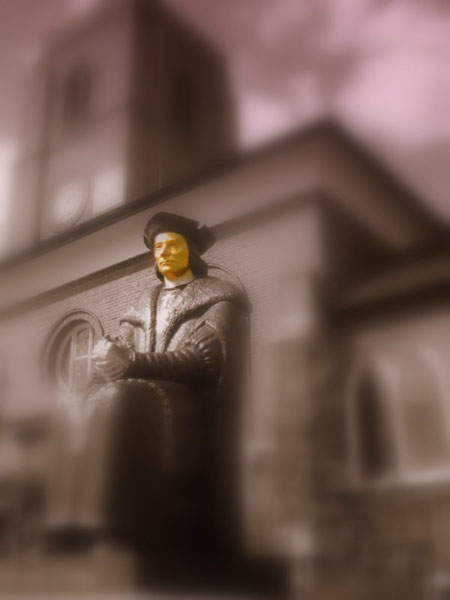
Thomas More's statue at the Chelsea Old Church

Chelsea resident Thomas More’s statue at the (Anglican) Chelsea Old Church.

* Despite its religious tolerance, More’s Utopia — anticipating Dostoyevsky — maintains:

a solemn and severe law against such as should so far degenerate from the dignity of human nature, as to think that our souls died with our bodies, or that the world was governed by chance, without a wise overruling Providence … since a man of such principles must needs, as oft as he dares do it, despise all their laws and customs: for there is no doubt to be made, that a man who is afraid of nothing but the law, and apprehends nothing after death, will not scruple to break through all the laws of his country, either by fraud or force, when by this means he may satisfy his appetites.

** According to the biography published by More’s son-in-law — who married More’s favorite, Margaret — the jest was occasioned by the rickety look of the scaffold. The Mirrour of Vertue in Worldly Greatness; Or, The Life of Sir Thomas More is available free on Google Books.

On this day..

1747: Mary Allen and Henry Simms, Gallows Lovers

(Thanks to Laura James of CLEWS, one of the best crime blogs going, for this guest post — published first at True Crime Magazine; some links have been updated.)

Gallows Love

When Oscar Wilde allegedly gestured at the garish wallpaper in his cheap Parisian hotel room and announced with his dying breath, “Either it goes or I go,” he was exhibiting something beyond an irrepressibly brilliant wit. Freud, you see, wasn’t whistling “Edelweiss” when he wrote that gallows humor is indicative of “a greatness of soul.” The quips of the condemned prisoner or dying patient tower dramatically above, say, sallies on TV sitcoms by reason of their gloriously inappropriate refusal, even at life’s most acute moment, to surrender to despair.

–Tom Robbins, “In Defiance of Gravity”

The Ordinary’s Accounts are some of the earliest true crime stories written in English. Their popularity came at the same time the masses learned to read, and some think there was a cause-and-effect relationship there — Englishmen learned their letters when there were some bloody good murder stories that made the exercise worthwhile.

The Accounts were, in essence, press releases issued by the Newgate prison in London after each execution to give lessons to posterity and to stimulate respect for the criminal laws. Those from the 1740s-1750s are online here.

The authors of these accounts were required to speak to the condemned every day for the weeks between the conviction and execution. They chronicled the confessions and behavior of men and women doomed to die, focusing largely on the personal history of each criminal, their crimes, and questions of faith.

In 1747, an Ordinary recorded the extraordinary story of a shoplifter named Mary Allen and a highwayman named Henry Simms, whose love was born in gaol and lasted to the gallows.

Mary Allen was 26 years old and through shoplifting had “gathered together a large Quantity of Goods of various Kinds, very near sufficient to have furnished a Shop, which it seems was her Intent; which Goods were found in a Room in Park-street.”

The Ordinary did not like Mary. She didn’t want to talk to him because she would have no speeches made about her when she was dead. He thought she was surly, obstinate. She also said it was grief enough to her parents that she was being executed, and she didn’t want to add to their afflictions with her dying quotes. The Ordinary thought it a pity she didn’t think of her parents before she embarked on her criminal career.

Since she wouldn’t speak to him, the Ordinary was forced to record his observations of her. He noted that she was of

[A] turbulent Spirit, and frequently quarrelled with her Fellow-Prisoners, and being the weaker Vessel, frequently came off damaged. When she was tried she had two black Eyes, which she got in a Quarrel; and when she went to the Place of Execution, she had a black Eye, received but a few Days before in another Skirmish. During her Confinement she contracted a great Fondness for Gentleman Harry.

Henry “Gentleman Harry” Simms, aged 30, was an orphan turned highwayman and pimp, known for his large Cutlass and his dandy clothes, and in the Ordinary’s words he was

[As] famous a Thief as ever yet adorn’d the Gallows. The Money he gain’d by Robbing he generally spent among the Whores about Covent-Garden, and as he generally wear very genteely dress’d, they gave him the Title of Gentleman Harry.

While under Sentence of Death, his fertile Brain was continually contriving Schemes in hopes to save his Life. He wrote several Letters to the Secretaries of State, and even to his Majesty himself.

While under Sentence he … still seemed found of the gay Part of Life, having a Number of Ladies coming frequently to see him, and did not appear so much concerned as one in his Circumstances should be.

What occupied Gentleman Harry in his last days was his fellow sufferer Mary Allen. They fell in love and spent their last days in intimacy (though the Ordinary also noted that “they sometimes fell out, when Simms generally beat her.”)

And on the final day, Mary Allen and Gentleman Harry indulged in hugs and kisses and hand-holding until their last moments on earth and met death with a defiant embrace.

THE ORDINARY of NEWGATE’S ACCOUNT of the Behaviour, Confession, & Dying Words of […] MALEFACTORS Who were executed at TYBURN On Wednesday the 17th of JUNE, 1747.

At the PLACE of EXECUTION.

THE Morning of their Execution, after going up to Chappel, where they all behaved very devoutly, they were brought down into the Press-Yard, had their Fetters knock’d off, and was then convey’d to Tyburn … Simms was cleanly dress’d in a White Fustian Frock, White Stockings, and White Drawers; and just as he got into the Cart at Newgate, threw off his Shoes. Being arrived at the Place of Execution, some Time was spent in Devotion, in which they all most heartily joined.

SIMMS … owned the Robbery of Mr. Smith in the Borough.

ALLEN Wept a good deal, and own’d the Robbery for which she died.

And they all went off the Stage calling to the Lord to have Mercy on their Souls.

Just before they were turn’d off, Simms and Allen saluted each other; and then joyning Hands, went off, taking hold of each other.

This is all the Account given by me, JOHN TAYLOR , Ordinary of Newgate.

On this day..

1718: John “Jack Ketch” Price, former hangman

On this date in 1718, the former common hangman got a taste of his own medicine.

As the 18th and especially 19th centuries unfolded and executions became more private, orderly and “humane,” the executioner’s office became more subtle and bourgeois. In the early 1700’s, however, it was commonly filled by a character who might just as easily have been on the other end of the rope. And once in a while … they were.

One disreputable character who performed the office for twenty years and more following the Stuart Restoration, Jack Ketch, lent his very name to the position (and its accoutrement — e.g., “Jack Ketch’s knot,” the hangman’s noose).

Our day’s victim, by the Christian name of John Price, was “Jack Ketch” in 1714-1715 until his debts caught up with him, and if the Newgate chronicle be believed wasn’t half-bad at the gig. Alas that he lost the position: his life in every other respect is reported by our sanctimonious interlocutors as one of drunken savagery.*

In such a state a couple of years later, he beat a woman to death during an attempted (or actual) rape at Bunhill Fields, at which location the law compelled him, in the parlance of the times, to “dance with Jack Ketch.” The prospect of hanging concentrated old Ketch’s mind wonderfully on the task of not missing one precious moment that might be spent drinking.

[H]e was no sooner confined in the condemned hold, than laying aside all thoughts of preparing himself for his latter end, he appeared quite void of all grace; and instead of repenting for his manifold sins and transgressions, he would daily go up to chapel intoxicated with cursed Geneva [i.e., gin] … As he was riding in the cart he several times pulled a bottle of Geneva out of his pocket to drink before he came to the place of execution

One would imagine that the dreadful scenes of calamity to which this man had been witness, if they had not taught him humanity, would at least have given him wisdom enough not to have perpetrated a crime that must necessarily bring him to a similarly fatal end to what he had so often seen of others: but perhaps his profession tended rather to harden his mind than otherwise.

Price/Ketch was not the only public executioner to find himself on the receiving end of his former trade, but he does seem to have the distinction of being the only one who was also gibbeted — his carcass hung up in an iron cage in the London district of Holloway.

Update: John Price’s career narrated by Lucy Inglis of Georgian London in a podcast interview with Early American Crime.

On this day..

1649: Charles I

On this date in 1649, the struggle between parliament and crown cost the Stuart monarch Charles I his head.

Charles‘ political clumsiness and unreconstructed authoritarianism had seen the realm whose unitary sovereignty he insisted upon blunder from disaster to disaster: into bankruptcy, military defeat, religious conflict and the English Civil War.

The assignation of cause and consequence in that war’s genesis has much exercised historians.

What is beyond dispute is that the confrontation between monarch and subject, pitting against each other political and economic epochs, theories of state and power, rates as one of history’s most captivating courtroom dramas.

Charles refused to answer the court’s charge of treason, occasioned most particularly by the king’s fomenting the Second Civil War while already a defeated prisoner of parliament following the first Civil War. He rested firmly on royal prerogatives against what some interlocutors take to be an almost desperate plea by his judges for some hint of acknowledgment that could open the door to compromise:

[A] King cannot be tried by any superior jurisdiction on earth. But it is not my case alone — it is the freedom and the liberty of the people of England. And do you pretend what you will, I stand more for their liberties — for if the power without law may make laws, may alter the fundamental laws of the kingdom, I do not know what subject he is in England that can be sure of his life or anything that he calls his own. Therefore, when that I came here I did expect particular reasons to know by what law, what authority, you did proceed against me here.

It must be borne in mind that the trial of a king was a completely unprecedented event. Charles might be forgiven his attitude, even if it smacked of the impolitic high-handedness that had forced this deadly test of powers.

Parliament’s position — here in the words of its President — is distinctly in the stream of political discourse (if not always actual practice) ascendant in the West to this day.

Sir, as the law is your superior, so truly, sir, there is something that is superior to the law and that is indeed the parent or author of the law — and that is the people of England.

And therefore, sir, for this breach of trust when you are called to account, you are called to account by your superiors — “when a king is summoned to judgment by the people, the lesser is summoned by the greater.”

The modern and the medieval, facing each other at the bar.


A fragment from a World War II bomb-damaged and only-recently-rediscovered Hippolyte Delaroche painting situating Charles in the Christlike pose of enduring the mockery of his captors.

Charles played his lordly disdain to the end, refusing to admit parliament’s jurisdiction by making any sort of plea.

The line between heroic defiance and pig-headed obstinacy being very much in the eye of the beholder, the confrontation is typically played straight-up for its arresting clash of principles — as in the 1970 biopic Cromwell, with Alec Guinness as the monarch:Probably more troubling for the parliamentary party than the regicide taboo was consideration that the execution would transfer royalist loyalties from a man safely imprisoned to an heir beyond their power, who could be expected to (as in fact he did) resume the civil war.

Competing philosophies expounded for the competing interests; the dispute involved the era’s intellectual titans, in conflict over the most fundamental concepts of the state. Thomas Hobbes wrote his magnum opus The Leviathan as a royalist exile in Paris, and its abhorrence for rebellion and divided sovereignty unmistakably reflects the English Civil War experience. John Milton earned his bread as a republican polemicist; his poetic celebration of Satan’s failed rebellion in Paradise Lost, written after the Stuart restoration, can be read as a political critique.

Separated at the block? Charles I and Hobbes’ Leviathan

It’s conventionally thought that the beheading was conducted by a radical minority, though that supposition is debatable, colored as it is by the ultimate restoration of the crown. But although England would have a king again, the weight of political authority would steadily, permanently, gravitate towards parliament, organ of the merchant classes who would steer England henceforward.

Did it have the right? Two implacable powers each claimed an indivisible object; “between equal rights, force decides.” So on this cold winter’s afternoon — Charles wore thick undergarments, so he would not shiver with the appearance of fright — the deposed king was marched to a scaffold erected at Whitehall. He gave a short final address, with the famous words for his principle of martyrdom — “a sovereign and a subject are clean different things” — then laid his head on a low block, where a masked executioner (never definitively identified) cleanly chopped it off.

After the monarchy’s restoration, Charles was canonized as a saint by the Church of England: he’s still the last person so venerated, an odd salute to a mortal career of unalloyed arrogance and incompetence. Observance of the cult was toned down in the 19th century, although a Society of King Charles the Martyr dedicated to its preservation still exists; monarchists of a more secular inclination also continue to mark his martyrdom on this anniversary.

Less reverent by far was Monty Python’s homage:

“The most interesting thing about King Charles the First is that he was five foot six inches tall at the start of his reign, but only four foot eight inches tall at the end of it.”

Part of the Themed Set: The English Reformation.

On this day..

1740: Not William Duell

On this date in 1740, five criminals were hanged at Tyburn.

Sixteen-year-old William Duell was among them. He was hanged — but he did not die. As recounted in The Newgate Calendar:

WILLIAM DUELL was convicted of occasioning the death of Sarah Griffin, at Acton, by robbing and ill-treating her. Having suffered, 24th of November, 1740, at Tyburn, with Thomas Clock, William Meers, Margery Stanton and Eleanor Munoman (who had been convicted of several burglaries and felonies), his body was brought to Surgeons’ Hall to be anatomised; but after it was stripped and laid on the board, and one of the servants was washing it, in order to be cut, he perceived life in him, and found his breath to come quicker and quicker, on which a surgeon took some ounces of blood from him; in two hours he was able to sit up in his chair, and in the evening was again committed to Newgate, and his sentence, which might be again inflicted, was changed to transportation.

Failed hangings were not unheard-of at this time … and if transportation was no mean sentence, the young criminal must have reflected that matters certainly could have gone much worse for him.

On this day..

1914: Carl Hans Lody

On this date in 1914, German spy Carl Hans Lody was put to death in the Tower of London during the opening months of World War I.

Lody‘s was the first execution in the Tower since its heyday as the chopping-block of disfavored nobility had passed in the mid-18th century. Times had changed by the era of trench warfare: Lody was not beheaded, but shot inside a wooden shed erected for the purpose in the Tower yard. Ten more German spies, who seem to have had a harder go of infiltrating Britain than their English counterparts had in Germany, would suffer the same fate by war’s end.

A Berlin-born naval officer, Lody had no experience spying but was tapped for the job because he had traveled abroad and spoke English well enough to pass for an American tourist. He was dead scarcely three months after he entered the Isles, though his work may have helped a U-boat sink a British warship.

According to A.W. Brian Simpson in Domestic and International Trials 1700-2000, the case was a legal landmark as the first espionage trial in England held partly in camera — outside the public view. The outcome, however, was a foregone conclusion, and Lody himself didn’t bother to contest his guilt — seemingly fixated on going to his grave with nothing short of the utmost in romantic gentlemanly decorum.

Part of the Themed Set: Spies.

On this day..