1942: Duncan Scott-Ford, because loose lips sink ships

On this date in 1942, British merchant sailor Duncan Scott-Ford was hanged at London’s Wandsworth Prison for giving German agents sensitive information about ship movements.

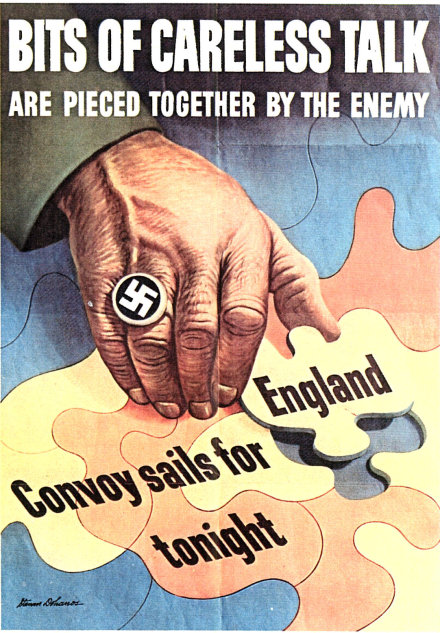
This, of course, was just the sort of thing everyone was trying to discourage.

… and a version to keep young soldiers on the pull Mata Hari-conscious:

For a case that so handily underscored the posters, the Scott-Ford affair made great copy … but not until a day after the hanging itself. Having kept everything secret, the papers were finally allowed on Nov. 4 to announce

that a British subject was executed for treachery at Wandsworth Prison yesterday morning.

Scott-Ford was paid 1,800 escudos by the enemy. This sum, which in English currency is equivalent only to about £18, was all that Scott-Ford in fact received from the enemy, though promises were held out to him which lured him deeper and deeper into the blackmailing clutches of the enemy. Thus when Scott-Ford returned on his second visit to Lisbon with the information which he had collected the Germans, instead of honouring their promises, threatened that they would expose him to the British authorities unless he continued to perform further services, to collect more valuable information and to undergo greater risks in their interest.

Some of the information which Scott-Ford gave to the enemy related to his own ship, and thus imperilled the lives of his own shipmates.

The moral to be drawn from this case is that British and allied seamen when visiting neutral ports should be constantly on their guard against strangers who may frequently approach them for apparently innocent purposes. Such strangers are apt to be enemy agents … (London Times, Nov. 4, 1942)

Shhhhh!

On this day..

1941: Masha Bruskina, Kiril Trus, and Volodia Shcherbatsevich, partisans

On this date in 1941, the German occupiers of Minsk conducted an infamous public hanging of partisans — perhaps the first such salutary public execution of resistance members of the war.

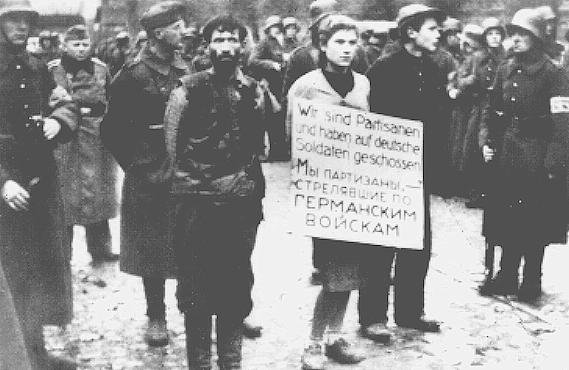
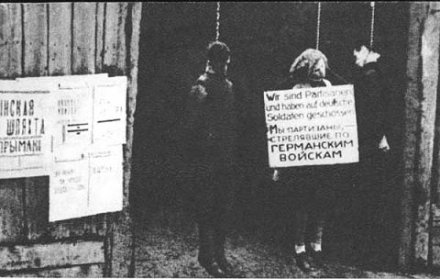
Jewish* 17-year-old Maria (Masha) Bruskina was the central figure of the grim tableau, and wore the placard announcing “We are partisans and have shot at German soldiers.” Evidently, she also attracted the most attention** from the onlookers to whom the scene was addressed.

Before noon, I saw the armed German and Lithuanian soldiers appear on the street. From over the bridge they escorted three people with their arms tied behind their backs. In the middle there was a girl with a sign-board on her chest. They were led up to the yeast factory gate. I noticed how calmly these people walked. The girl did not look around … The first one led to the gallows was the girl.

She was hanged with bewhiskered World War I vet Kiril Trus and the 16-year-old Volodia Shcherbatsevich. The men were members of a partisan cell organizing anti-fascist resistance; Masha Bruskina was a nurse who had been caught aiding the partisans by providing civilian clothes and papers for wounded Red Army soldiers under her care to smuggle them back to the resistance.

The scene of their deaths was captured in a series of powerful photographs taken by one of the Lithuanian Wehrmacht collaborators.

(More images here and here.)

* Phototextualities: Intersections of Photography and Narrative claims that Bruskina lightened her hair and changed her name to prevent her Jewishness affecting her resistance work; even though she was a Minsk native, her initial identification didn’t happen until 1968. The men who suffered with her were named almost immediately after the war.

** Despite the eye-catching place of the girl, she was officially unidentified for decades even after the name Masha Bruskina surfaced. In “A Historical Injustice: The Case of Masha Bruskina,” (Holocaust Genocide Studies 1997, 11:3) Nechama Tec and Daniel Weiss argued that Soviet authorities, and later Belarusian ones, found her Jewishness problematic and resisted identifying her because of it — while an ethnically Russian female partisan like Zoya Kosmodemyanskaya could be more conveniently accepted as a heroine. Maybe, but bureaucratic inertia and simple precedence (since Zoya Kosmodemyanskaya was known immediately while Masha Bruskina was not) are also plausible contributing factors.

A plaque unveiled at the Minsk yeast factory in 2009 finally called her Maria Bruskina.

On this day..

1946: The Nuremberg Trial War Criminals

Victor’s justice was never better served than this date in 1946, when the brass of Third Reich hung for crimes against humanity during the late World War II.

[audio:http://www.stelzriede.com/ms/mus/nuremexe.mp3]

(From this page of original period audio files.)

The landmark legal proceeding* is covered well enough in many other sources for this humble venue to break new ground.

Apart from trailblazing international law, the trial was notable for the gut-punching film of German atrocities; this relatively novel piece of evidence is available for perusal thanks to the magic of the Internet. Caution: Strong stuff. An hour’s worth of Nazi atrocities.The climactic hangings in the predawn hours this day in Nuremberg were conducted by an American hangman who used the American standard drop rather than the British table calibrated for efficacious neck-snapping. As a result, at least some hangings were botched strangulation jobs, a circumstance which has occasionally attracted charges of intentional barbarism.

Media eyewitness Kingsbury Smith’s taut report of the night’s executions (well worth the full read) described just such an ugly end for propagandist Julius Streicher.

At that instant the trap opened with a loud bang. He went down kicking. When the rope snapped taut with the body swinging wildly, groans could be heard from within the concealed interior of the scaffold. Finally, the hangman, who had descended from the gallows platform, lifted the black canvas curtain and went inside. Something happened that put a stop to the groans and brought the rope to a standstill. After it was over I was not in the mood to ask what he did, but I assume that he grabbed the swinging body of and pulled down on it. We were all of the opinion that Streicher had strangled.

There were in all 12 condemned to death at Nuremberg; all hanged this day except Martin Bormann (condemned in absentia; it was only years later that his death during the Nazi regime’s 1945 Gotterdammerung was established) and Hermann Goering (who cheated the executioner with a cyanide capsule two hours before hanging). The ten to die this day were:

* Its resultant Nuremberg Principles comprise a lofty articulation of principles whose actual application, as Noam Chomsky has observed, would have meant that “every post-war American president would have been hanged.”

On this day..

1949: Yoshio Kodaira, soldier turned serial killer

Sixty years ago today, Yoshio Kodaira counted himself “fortunate to be able to die on such a calm and peaceful day.”

For the year after Japan’s wartime surrender to the World War II Allied powers (beginning slightly before that surrender), former Imperial Navy soldier Yoshio Kodaira terrorized Tochigi and Tokyo with a rape-murder binge believed to have claimed ten victims.

Even our monsters — especially our monsters — are creatures of their own milieu.

For Kodaira, that was the Japanese occupation of China, where he slew an unknown number of Chinese soldiers and civilians in his official capacity under the banner of the rising sun … followed by the “anarchy of the postwar years.”

(In between the two, he served a jail term in the 1930’s for killing his father-in-law in a berserk rage when his wife left him.)

Expat author David Peace novelized the 1945-46 Kodaira crime spree in Tokyo: Year Zero, musing (in the voice of the killer),

You know, none of it makes much sense to me … they give us a big medal over there for all the things we did, but then we come back here and all we get is a long rope.

(Here’s an interview with the author.)

On this day..

1941: Olga Kameneva, Christian Rakovsky, Maria Spiridonova and many others by the NKVD

On this date in 1941, as Nazi armies surged into the USSR, the Soviet NKVD summarily executed a reported 157 prisoners held in the soon-to-be-Nazi-occupied city of Oryol (Orel).


Kameneva (top), Rakovsky (middle) and Spiridonova.

Most prominent among them were:

  • Olga Kameneva, a pol in the 1920’s, she was the sister of recently-murdered Communist heretic/Stalin gadfly Leon Trotsky, and she was the widow of executed Old Bolshevik Lev Kamenev.
  • Christian Rakovsky, internationalist Bulgarian revolutionary turned Soviet diplomat. Rakovsky, Dmitry Pletnyov and Sergei Bessonov had been the only three to avoid execution at the Trial of the 21, one of Stalin’s red-letter purges. But all three were shot together this day.
  • Prominent Left SR Maria Spiridonova, a revolutionary who had taken four decades of beatings from tsarist and Bolshevik alike, and who Emma Goldman saluted as “one of the most sincere, well-poised, and convincing” opponents of the Soviet regime.

Many other political transgressors less memorable than these went along with them, leftover targets of opportunity from a generation’s internecine purges and counterpurges.

Why bother to spend the resources evacuating an enemy of the people? By this time, Operation Barbarossa was nearly three months old, and mass prisoner executions ahead of the advancing Germans were a practiced art. One difference this day: this hecatomb was not in the western Soviet Republics, but in Russia proper.

In the autumn of 1941, the Left SRs Spiridonov, Izmailovich, and Mayorov, the Maximalist Nestroyev, and the SR Timofeyev were among the 157 prisoners shot in the Medvedevsky woods. (A Century of Violence in Soviet Russia

As many of them might have been denounced as “fascist” in their time for not hewing the correct revolutionary line, one doubts they would have enjoyed any more comfortable treatment at the hands of the Wehrmacht, which overran Oryol on Oct. 3.

On this day..

1942: Bishop Gorazd of Prague

On this date in 1942, the Orthodox Bishop Gorazd — Matej Pavlík is what his parents named him — was shot in Prague along with priests of Sts. Cyril and Methodius Cathedral for sheltering the Czechoslovakian resistance fighters who had lately assassinated Nazi Reichsprotektor Reinhard Heydrich.

After icing Heydrich, the assassins had taken shelter in the Cathedral basement … only to be betrayed by a onetime compatriot.

The Nazis besieged the church — fiercely, but hopelessly defended.

With the Germans already visiting unspeakable collective punishment for the murder, the act of sheltering the assassins had trouble written all over it.

The Serbian-consecrated first bishop of the Czech Orthodox Church, Gorazd sought to limit the potential scope of reprisals by writing the German authorities, directly claiming responsibility — even though, in fact, he hadn’t found out who his sanctuary was concealing until several days after they had already been installed by sympathetic priests.

He enjoyed the characteristic hospitality of the Gestapo, and was shot at Kobylisy along with priests Vaclav Cikl and Jan Sonnevend; theologian Vladimir Petrek followed them the next day.


From left to right (not counting the guards, of course): Jan Sonnevend, Vaclav Cikl, Vladimir Petrek, and the bearded Bishop Gorazd, at their public show trial September 3. From the Czech Ministry of Defense’s slick and well-illustrated publication (pdf) on Operation Anthropoid.

The Czech Orthodox Church was suppressed while the Germans held Czechoslovakia. Bishop Gorazd is recognized in the Orthodox martyrology on August 22nd (the date of his death per the Julian calendar).

On this day..

1946: Grigory Semenov, anti-Bolshevik

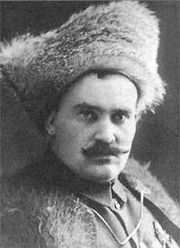
At 11 p.m. this date in 1946, White general turned Japanese collaborator Grigory Semenov (or Semyonov) was hanged for a generation’s worth of anti-Soviet depredations in the Far East.

The tsarist officer Semenov joined the Russian Civil War as a notoriously vicious White commander with the grandiosely retro title of Ataman of the Baikal Cossacks.

According to G. Patrick March, Semenov’s “penchant for killing, torturing, and looting” extended to executing a captured socialist by tossing the man into his locomotive’s fuel chamber.

Although also a rival in the suicidally fractious White political jostle, Semenov was the designated successor of Aleksandr Kolchak when the latter was shot in 1920, but by that time there wasn’t much left to succeed.

Knocking around the interwar era in gloryless exile, Semenov was an easy recruit for the Japanese war machine, which was in the market by the late 1930’s for locals with command experience and a grudge against Moscow and put him on retainer in Manchuria. Like the Soviet-Japanese front in general after Khalkin Gol, nothing much came of that enterprise; the Ataman’s last great hurrah was but a footnote for Japan, and his death would be a footnote in the annals of postwar victors’ justice.

Having picked a loser two wars in a row, Semenov was captured during the short-lived Soviet invasion of Manchuria at the tail end of the war and packed off for the inevitable. Five co-defendants, including Semenov’s son Mikhail, suffered death as well — although they were simply shot, while Semenov was ignominiously hanged. (According to White Terror: Cossack Warlords of the Trans-Siberian, the hanging was either botched or engineered to be an ugly strangulation job.)

On this day..

1944: Bronislav Kaminski, Waffen SS collaborator

On this date in 1944, the Gestapo eliminated more-trouble-than-he-was-worth Russian SS man Bronislav Kaminski.

The St. Petersburg-born Kaminski was Soviet by citizenship, but not Russian by nationality. Half-German and half-Polish, he’d done time twice for his questionable loyalties during the paranoid 1920’s and 30’s.

Turns out the commissars were on to something … or maybe, to paraphrase the old saying, that a Nazi is a Communist who’s been to the gulag.

Either way, when the front swept past Belarus where Kaminski was serving his post-release internal exile, the engineer jumped on an opportunity to join a classmate with the Russian National Liberation Army (RONA, or ROA). Kaminski soon rose to command the anti-partisan “army,” and earned an Iron Cross and the rank of Major General when it was incorporated into the Waffen-SS.

Unfortunately for Kaminski — and more so for anyone who happened to be in his unit’s vicinity — the 29th Waffen Grenadier Division was much better at roughing up partisans and their presumed civilian sympathizers than conducting disciplined military operations.

Little more than a roving band of armed thugs,* it was completely ineffective in the Siege of Warsaw earlier in August 1944, spending its time raping and looting instead.

That, evidently, was enough for Himmler, who had Kaminski eliminated** in punishment for his own looting (the booty was supposed to belong to the Reich), and the alleged rape-murder of German women along with all the expendables in Warsaw.

The exact trigger for this execution (for the juridical machinery always veils acts of discretion and intentionality; certainly, this is evident in a state like Nazi Germany) has never been completely clear; it may have been that between Kaminski and turncoat Red Army general Andrei Vlasov, the shrinking Reich had room enough for only one Russian commander.

Devil knows what he was commanding, anyway.

When, post-Kaminski, Vlasov assigned the remains of the RONA to Ukrainian collaborator Sergei Bunyachenko, the latter fumed, “So that’s what you’re giving me, bandits, robbers and thieves! You’ll let me have what you can no longer use!” … and soon bailed on his “patrons” by switching sides in the war yet again.

* It had some operations with the notorious Dirlewanger Battallion.

** The official announcement was that Kaminski had been killed in a partisan ambush; crazy conspiracy theorists refused to buy it.

On this day..

1944: Ernst Thälmann, German Communist

On this date in 1944, German Communist Ernst Thälmann was shot at the Buchenwald concentration camp.

A true proletarian turned proletarian leader (and reliable adherent to Moscow’s line), Thalmann stood for election to the German presidency no the Communist Party ticket against Hindenburg and Hitler in 1932 (he’d also run in 1925).

Hitler wasn’t a very good winner.*

The Gestapo nabbed Thalmann in its sweep for leftists following the Reichstag Fire. Eleven years he waited in prison — being tortured, naturally — for his turn on the stage of a show trial. Or any trial at all.

It never took place.

Instead, the Weimar Communist leader languished in detention as the horror of Naziism swallowed Germany, with nothing to give the anti-fascist cause but his name — here adopted by a Spanish Civil War battalion.

We have such cinematic treatment of the man because after the war, the legitimately proletarian, demonstrably antifascist, ideologically unsullied, and conveniently dead Thalmann made ideal material for the Communist East German state’s national pantheon.

The myth employed all of the media available to a modern industrialized state. In addition to the scholarship produced by professional historians, popular works with a similar agenda also appeared. Irma, the slain party leader’s daughter, wrote a biography of her father intended for children. Max Zimmering wrote one of several children’s novels about Thalmann, and East German poets lionized the martyred communist leader. … Thalmann memorials were built, and membership in the SED’s youth organization, the Free German Youth (FDJ), began with the Thalmann Pioneers. Finally, Thalmann’s life was the topic of several films and television movies, the most important being the two features, Ernst Thalmann – Sohn seiner Klasse (Ernst Thalmann – Son of His Class, 1954) and Ernst Thalmann – Fuhrer seiner Klasse (Ernst Thalmann – Leader of His Class, 1955).

And something else, too: a barely-there Caribbean island ceremonially gifted to East Germany by Cuba in 1972. Is it the last outpost of the German Democratic Republic?

* Yes, this is glib; Hindenburg, not Hitler, won the 1932 election. However, the Nazis’ plurality victory in that year’s Reichstag election also gave Hitler the juice to demand the Chancellorship and set himself up to wield total power in Germany. Whatever the ballot boxes on any particular day had to say, Hitler obviously won the early 1930’s.

On this day..

1943: Blessed Franz Jagerstatter, conscientious objector

On this date in 1943, an Austrian farmer was beheaded in Berlin’s Plotzensee Prison for refusing to fight for the Third Reich.

Franz Jägerstätter, who lost his own father in World War I, was anschlussed right into the Third Reich when Germany absorbed Austria in 1938.

In Solitary Witness is the aptly-titled biography of the man; though his fatal refusal of mandatory military service (and his critique of Nazi Germany) sprang from his deep-rooted Catholicism, it was far from the norm for his German-Catholic neighbors.

“We must go courageously on the way of suffering,” he wrote, “whether we begin sooner or later.” Somewhat oddly neglected as a martyr figure in the immediate postwar period, Jagerstatter was recently beatified by Pope Benedict XVI — a German himself, of course, who did not refuse his tiny measure of youthful service to the Wehrmacht in those years, and who assuredly grasps the untapped public relations potential of this compelling figure.


An icon of Franz Jagerstatter, and a naked Nazi imp.

Jagerstatter’s widow is still alive; she and her children movingly keep Franz’s memory to this day — and his example continues to inspire Catholics who go the way of suffering today against war and injustice.

On this day..