On this date in 1941, Nazi Berlin disposed of its railway killer.
Roger Moorhouse, author of a forthcoming book about Ogorzow, tells the story of this unjustly neglected homicidal maniac on his blog, and in a BBC History Magazine interview:
Paul Ogorzow (German link) plied his trade in a city blacked-out against British bombing, but he provides an illuminating glimpse at criminal investigation.
While Ogorzow benefited from Berlin’s preternatural darkness, he didn’t go greatly out of his way to cover his tracks otherwise. At least four of his eight murders were within a mile of his house; one woman who survived his attack reported the assailant was wearing German Railways kit.
The police, prone then as now to (sometimes hastily) settle on a theory and seek evidence to confirm it, remained blind to the seemingly obvious possibility that a railway worker was the culprit … even if he also happened to be a Nazi party member in good standing.
The official fixation on Untermenschen may not be surprising given the ideological climate, but Germany had had its share of noteworthy murderers in the interwar years who were neither Jews nor foreign laborers nor British agents — the suspect profiles favored by German investigators while Ogorzow continued his killing spree.
With the slightest measure of care, the S-Bahn Murderer might have plied his hobby unmolested until the wartime manpower shortages started making him look like an attractive bit of cannon-fodder for the eastern front. Alas for him, his voracious appetite for murder — eight victims with similar m.o. in just a few months — eventually made him so obvious that even the police could no longer overlook him.
Although the government kept the crime and its unedifying investigation fairly quiet, it was known. There was even a 1944 true crime potboiler by Wilhelm Ihde (pseudonymously writing as “Axel Alt”), Der Tod fuhr im Zug (Death Rode the Train). According to Todd Herzog,
Alt’s novel is representative of the dominant tendency of the period to celebrate the work of the criminal police while avoiding any portrayal of the totalitarian apparatus that surrounded criminal politics in the Third Reich.
Little surprise there.
Alt’s novel ultimately aligns itself with [Fritz] Lang’s film [M] in showing the methodical work of professional detectives to be ineffective in capturing the modern killer and explicitly calling for … recruitment of the public to aid the police in fighting crime.
On this date* in 1826, five leaders of the Decembrist revolt were hanged at St. Petersburg’s Peter and Paul fortress for their abortive eponymous uprising eight months before.
In Russia’s complex interaction with the West — its ideas, its political institutions, its ways of life — these were the westernizers, who saw constitutionalism as the way of the future.
Upon the mysteriously sudden death of Tsar Alexander I, an irregular succession to the second-oldest surviving brother, Nicholas I, gave our day’s doomed and gallant youth cause to occupy St. Petersburg’s Senatskaya Square to uphold the rights of the first brother — and more to the point, to uphold the constitution to the extent of constraining the monarchy.
Decembrists at Senate Square, as depicted by Karl Kolman.
Uh … Now What?
This badly organized affair failed in its aim to attract the mass of soldiery and, constitutionalists as its organizers were, did not even aim at mobilizing the general populace.
After the initial heady rush of marching into the square in the name of liberty, the Decembrists were left in a standoff against a much larger force of loyalists. When the latter started shooting, that was that.
“Mere” hanging was deemed sufficient for the purpose. That would be about the maximum embrace of liberalism by the Russian autocracy, whose lesson from the uprising was to crack down against any hint of forward-thinking politics — ultimately an unsuccessfulstrategy for the Romanov dynasty.
St. Petersburg’s Senate Square — renamed Decembrist Square by the Soviet government — where the action happened. The iconic equestrian statue of Peter the Great, commissioned by Catherine the Great and unveiled in 1782, witnessed it all; the statue acquired its enduring moniker, “The Bronze Horseman”, from a poem of the same title penned in 1833 by Alexander Pushkin, a friend of several Decembrists.
One of the greatest works of Russian literature, Pushkin’s “Bronze Horseman” weaves an ambiguous Decembrist-tinged critique of cruel imperial power and overreach into a complex narrative of St. Petersburg whose upshot is still up for lively literary debate. “The Bronze Horseman’s crag rose up before the poet on an empty square,” wrote one historian, “washed with the blood of those who rebelled on December 14, 1825”
Appalling there
He sat, begirt with mist and air.
What thoughts engrave His brow! what hidden
Power and authority He claims!
What fire in yonder charger flames!
Proud charger, whither art thou ridden,
Where leapest thou? and where, on whom,
Wilt plant thy hoof?
“They don’t even know how to hang you …”
When the hangings were carried out, Kakhovsky, Muravyov-Apostol and Ryleyev all had their ropes break; while some in the crowd anticipated the old prerogative of mercy for any prisoner who survives an execution, they just got re-hung instead. “Unhappy country,” quipped Ryleyev as the fresh nooses were fixed up, “where they don’t even know how to hang you.”**
Other Decembrists not condemned to the unreliable craftmanship of the Russian gallows were shipped to Siberia, where they invigorated the cultural life of the Lake Baikal city of Irkutsk — many of them famously followed by their “Decembrists’ wives,” an iconic type that continues to denote heroically sacrificial loyalty since the women had to renounce their own right to return to European Russia.
These, at least, had a place to call their own, however distant. But the class of Russian elites to which they belonged would be thrust into a trackless wilderness by their failure (in the Decembrist rising and otherwise) to carve out some distinct place for themselves. Russia’s long reckoning with modernity still had many years to run.
A worn postcard of a 19th century Russian painting depicting (perhaps) a political prisoner in the Peter and Paul Fortress.
A poet himself and a romantic to the point of fanaticism, Ryleyev wrote odes extolling executed national heroes like Artemy Volynsky and Severyn Nalyvaiko, seemingly alluding (as in this excerpt from the latter work) to his anticipation of joining them.
I know full well the dire fate
Which must upon the patriot wait
Who first dare rise against the foe
And at the tyrant aim the blow.
This is my destined fate
On this date in 1942, anarchist, trade unionist and anti-fascist Joan Peiro was shot with six others at Paterna, Spain.
Joan (or Juan) Peiro (English Wikipedia page | Spanish) was a Barcelona glassworker of anarcho-syndicalist politics.
As Secretary General of the Confederacion National del Trabajo (CNT) and editor of the anarchist rag Solidaridad Obrera, Peiro mixed it up in the rough-and-tumble interwar political scene, eventually becoming Minister of Industry for Republican Spain — an untoward position to more orthodox anarchists.
When the Spanish Republic lost the Civil War, Peiro fled to France, where he was nabbed and extradited.
The nationalist general Emilio Mola had said before the war’s conclusion,
Whoever is, openly or secretly, a supporter of the Popular Front, must be shot … we must sow terror … eliminating without scruple or hesitation those who do not think as we do. (Source)
In practice, reprisals weren’t that vicious (maybe because Mola himself had died in a plane crash and wasn’t managing them) — but the leadership and intelligentsia who could rally an anti-Franco political bloc were purged ruthlessly.
The imprisoned Peiro was offered — repeatedly — a sellout package to oversee Franco’s house unions, and he repeatedly refused.
He earned martyrdom for his troubles, and after Franco’s death re-entered the public sphere as the sort of bloke to name streets after. (As an anti-Stalinist, Peiro had had all the right enemies.)
Placa Joan Peiro, a major square in Barcelona.
The Spanish judiciary, however, has thus far declined (Spanish link) to overturn his sentence.
A final example of the S-21 archives discovered by the Documentation Center is more mundane, yet poignant and telling. This particular document is of a type we refer to as an “execution log,” a daily record of executions at a given security center, in this case, at Tuol Sleng itself. Dated July 23, 1977, it is signed You Huy (a chief of guards) and authorized by Hor, the deputy director of S-21. The typewritten form lists biographical details on eighteen prisoners executed that day and, almost as an afterthought, in Huy’s handwriting a note at the bottom adds, “Also killed 160 children today for a total of 178 enemies killed.” This chilling glimpse into the Khmer Rouge internal security services is but a tiny example of the tens of thousands of documents discovered by the Documentation Center of Cambodia.
Huy survived his stint as a guard at the notorious Tuol Sleng prison, which was no mean feat: guards were routinely arrested and executed themselves. (Of course, prisoners had it worse.)
All prisoners were blindfolded so they did not know where they were taken and their hands were tied up to prevent them from contesting us …
They were asked to sit on the edge of the pits and they were struck with stick on their necks …
Their throats were slashed before we removed their handcuffs and clothes, and they were thrown into the pits.
Him Huy has argued that guards like him “were victims too”. At least some victims and outside observers view him as a man more important to the killing process than Huy makes himself out to be.
Both accounts, though, could be true simultaneously: everyone in Cambodia was in danger of being purged, and guards at Tuol Sleng could find themselves inmates for the slightest derelictions of duty or enthusiasm. From April 17, 1975, Cambodia fell into madness.
Today the French town of Beziers remembers the 800th anniversary of the first sack and massacre of the Albigensian Crusade.
Rome was alarmed by the advent in southern France of a mass religious movement, Catharism, with such scandalous doctrines as spirit-body dualism and not giving tons of money to Rome.
Naturally, God said to cut them to pieces.
Beziers was the first town invested by the invading crusader army, left to its fate as the Cathars mustered in Carcassone. Interestingly, this particular city did not so much present that familiar spectacle of Christians killing Christians who thought differently — unless the thought in question was about handing over their neighbors to a throng of land-grabbing nobles.
Part of the Catholic faith did itself honor this day: those Biterrois who refused to abandon to the glories of martyrdom the Cathars in their midst, who are thought to have numbered merely a few hundred. So when the walls fell, it was mostly orthodox Catholics killing orthodox Catholics.
Well, what’s a crusading army with other cities to sack supposed to do?
When they discovered, from the admissions of some of them, that there were Catholics mingled with the heretics they said to the abbot “Sir, what shall we do, for we cannot distinguish between the faithful and the heretics.” The abbot, like the others, was afraid that many, in fear of death, would pretend to be Catholics, and after their departure, would return to their heresy, and is said to have replied “Kill them all for the Lord knoweth them that are His” (2 Tim. ii. 19) and so countless number in that town were slain.
And they killed everyone who fled into the church; no cross or altar or crucifix could save them. And these raving beggarly lads, they killed the clergy too, and the women and children. I doubt if one person came out alive … such a slaughter has not been known or consented to, I think, since the time of the Saracens. (William of Tudela, cited in Cathar Castles)
Ten to twenty thousand are thought to have been slain this day — in what proportions Catholic and heretic, only God can say.
At 4 a.m. this date in Dhaka Central Prison, Lt. Col. Abu Taher was hanged for treason.
A series of coups in the mirrored-sunglasses era of military governance shook the young state of Bangladesh:
The autocratic Sheikh Mujibur Rahman was toppled by a revolt of junior officers on August 15, 1975;
Senior brass in turn felled the ruling junta on November 3, 1975, jailing powerful officer Ziaur Rahman;
A quick counter-coup of junior officers — also remembered as the “sepoy mutiny”* — mounted by leftist war hero Abu Taher on November 7 put Ziaur Rahman’s hand back on the helm of state.
Abu Taher, a retired officer and a hero of the 1971 Bangladesh Liberation War that had detached the former East Pakistan from Islamabad, had visions of social revolution. But three coups in as many months is the sort of thing to rattle the new big man, and Zia consolidated his own power by eliminating threats to both left and right political flanks.
A mere 17 days after doing that National Revolution and Solidarity thing, the guy with the mass movement (pdf) of armed men was arrested for treason. He faced a military tribunal the following year.
On this date in 1889, Ella Watson, a homesteader with a small ranch, was demonstratively lynched by vigilantes of Wyoming’s powerful cattlemen.
“Cattle Kate”
In the Western frontier amidst the rapine of the Gilded Age, ranching oligopolists had Wyoming by the throat.
Ellen Watson was a late-30’s escapee of an abusive marriage in Kansas who had homesteaded her own land and set up shop as an independent proprietor.
This put her in a class of people soon to be pitted in a resource war against the big ranchers — the Johnson County War, to erupt in 1892.
Watson was a casualty of the increasingly violent run-up to open “war”, a period when the catchall “cattle rustling” charge did the dirty work of licensing arrests and property seizures (and worse) deemed convenient for Big Cattle. When the latter decided that Watson’s stock was stolen, they seized her and partner James Averell and strung them up.
Hanging from the limb of a stunted pine growing on the summit of a cliff fronting the Sweetwater River, were the bodies of James Averell and Ella Watson. Side by side they swing, their arms touching each other, their tongues protruding and their faces swollen and discolored almost beyond recognition. Common cowboy lariats had been used, and both had died by strangulation, neither fallen over two feet. Judging from signs too plain to be mistaken a desperate struggle had taken place on the cliff, and both man and woman had fought for their lives until the last.
The subsequent trial of the paramilitaries ended in acquittal when potential witnesses were bought off or intimidated into silence, leaving “Cattle Kate” a legendary figure most defined by cattlemen-controlled Cheyenne newspapers. These made her out to be not only a thief but a (literal) whore, an image sharply contested by George Hufsmith’s The Wyoming Lynching of Cattle Kate.
Michael Cimino’s legendary cinematic Hindenburg Heaven’s Gate is about the Johnson County War, and features Isabelle Huppert as Watson, opposite Kris Kristofferson as Jim Averell. The film treats her sympathetically … but she’s also a madam who accepts payment for her cathouse’s services in the form of rustled cattle.
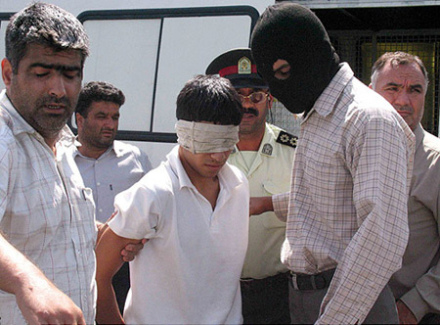
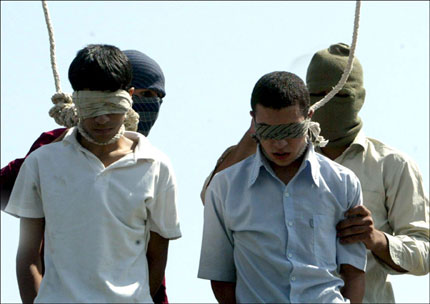
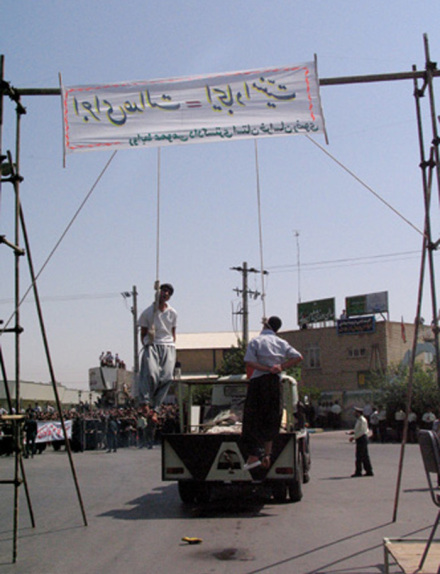
On this date in 2005, two teenagers were hanged in Mashhad, Iran.
Affecting photos of these two youths, their faces etched in fright and grief, their 16- and 18-year-old bodies pitifully boyish next to their executioners, became an immediate worldwide sensation.
These shocking images were quickly followed by a storm of controversy. The crime for which Asgari and Marhoni swung was the rape of a 13-year-old while both the offenders were themselves minors; gay organizations and human rights groups subsequently became mired in contentious dispute over whether (as a factual, legal, or tactical matter) they could be said to have succumbed to a “lethal reign of terror targeting Iranian gays”. For instance, was the conviction reliable, or a pretext? Would these boys actually have self-identified as “gay”?
To that were added charges and countercharges among western campaigners of racism, imperial lickspittle-ism, objective-pro-Islamic-fascism, and the like. Like, awfully convenient that Iran’s longtime dim view of homosexuality has everyone exercised at just the moment bombing Tehran was being openly mooted.
But whatever the text: those pictures. Still, those pictures.
It is certain that both Mahmoud Asgari and Ayaz Marhoni were juvenile offenders, whose execution is anathema almost everywhere in the world but Iran — just one of that country’s unique characteristics.
“The Indian Ahan,” read the dispatch in the British Columbian this date in 1865, “will have expiated his crime upon the gallows ere these lines meet the public eye. The execution will take place in the rear of the jail early this morning.”
Ahan and another Tsilhqot’in (or Chilcotin) were of the party of Klatsassin, whom we have already met in these pages. Months after the Chilcotin War‘s mass execution, the luckless pair were arrested trying to pay what would have been a routine-for-them bit of blood money.
Both were condemned; Lutas received clemency, and his freedom. (“I eagerly availed myself of some favorable circumstances in the case of Sutas and sent him back pardoned to his tribe. A sufficient number of Indians has now perished on the scaffold to atone for the atrocities committed last year.”)
Ahan’s execution in New Westminster, now part of the Vancouver, B.C. metropolis, isn’t dead, though — and isn’t even past.
Over the course of the past year, a public school project in the city that had been built over an old pauper’s grave that might have become the hanged man’s resting place was gravely (ahem) complicated by the continuing Tsilhqot’in search for Ahan’s remains. While Ahan’s own situation remains unresolved, the suit on his behalf eerily outlined the macabre past lurking everywhere beneath our workaday feet.
She is of stately Norman figure; in her twenty-fifth year; of beautiful still countenance: her name is Charlotte Corday, heretofore styled d’Armans, while Nobility still was … A completeness, a decision is in this fair female Figure: ‘by energy she means the spirit that will prompt one to sacrifice himself for his country.’ What if she, this fair young Charlotte, had emerged from her secluded stillness, suddenly like a Star; cruel-lovely, with half-angelic, half-demonic splendour; to gleam for a moment, and in a moment be extinguished: to be held in memory, so bright complete was she, through long centuries!–Quitting Cimmerian Coalitions without, and the dim-simmering Twenty-five millions within, History will look fixedly at this one fair Apparition of a Charlotte Corday; will note whither Charlotte moves, how the little Life burns forth so radiant, then vanishes swallowed of the Night.
Hapless beautiful Charlotte; hapless squalid Marat! From Caen in the utmost West, from Neuchatel in the utmost East, they two are drawing nigh each other; they two have, very strangely, business together.
Or was it strange at all?
Implacable in her purpose, utopian in her design, unafraid to plant a butcher’s knife into the chest of an enemy of France, Corday has a little something in common with her mortal foe.
These make casting too easy: Marat, bad because he was ugly and ugly because he was bad; Charlotte, therefore, just the reverse. (She was also a virgin; they made sure to check at the autopsy.) Our Norman assassin’s looks have inordinately exercised her interlocutors from the moment of her arrest; her prosecutors, too, understood them as essential.
“Not at all pretty,” a contemporaneous government article (cited in Crisis in Representation) put about. “She was a virago, brawny rather than fresh, without grace, untidy as are almost all female philosophers and eggheads … an old maid … with a masculinized bearing … [who] had thrown herself absolutely outside of her sex.”
And there it is. Charlotte Corday’s power to excite both rapture and repulsion is plainly rooted in the unexpected contradiction between her sex and her crime. If she is a resolute political assassin, surely she is not feminine … or is it the other way around?
Take Andre Chenier‘s engorged ode: “Fair, young, resplendent, led to the executioners, you seemed to be riding in your bridal car … You alone were a man and vindicated the human race. And we, vile eunuchs, a cowardly and soulless herd, we know how to repeat some womanly whimper, but the steel would weigh heavy in our feeble hands. … One scoundrel less crawls in this slime. Virtue applauds you. Hear the majestic sound of its virile praise, heroic maid.” This is “throwing herself outside of her sex” in the affirmative sense of uplifting herself beyond mere womanhood, a girl so heroic she might almost qualify as a dude.
Place it at the historical pivot into a modernity unready to reckon with the place of the woman, and confusion reigns.
“The spectacle of such wickedness, beauty, and talent united in the same person,” a newspaper recorded, “the contrast between the magnitude of her crime and the weakness of her sex, her appearance of actual gaiety, and her smile before the judges, who could not fail to condemn her, all combined to create an impression on the spectators that is difficult to portray.”*
Still, this judgment offers more insight than some latterly “tributes,” like this Anglo magazine piece 30 years later: “an ornament and an honour to the sex of woman … Woman is the child of feeling. From this source spring up all her good and bad qualities. It is seldom ambition or policy which leads her on to any enterprise: it is the passions. … it was under the influence of such feelings that Charlotte Corday performed that act, which virtuous and generous minds, so far from considering a crime, will look upon as one of the most heroic deeds of recorded history.”
Which is a fascinating form of sexism, since it was precisely Corday’s unearthly calm — masculine virtue! — that awed the Revolutionary Tribunal. But everything about Charlotte Corday is up for interpretive grabs; Nina Rattner Gelbart even argues, in “The Blonding of Charlotte Corday” (Eighteenth-Century Studies 38.1 (2004)) that though a real-life brunette, her depictions trend increasingly flaxen-haired.**
As for Charlotte Corday her work is accomplished; the recompense of it is near and sure. The chere amie, and neighbours of the house, flying at her, she ‘overturns some movables,’ entrenches herself till the gendarmes arrive; then quietly surrenders; goes quietly to the Abbaye Prison: she alone quiet, all Paris sounding in wonder, in rage or admiration, round her. …
On Wednesday morning, the thronged Palais de Justice and Revolutionary Tribunal can see her face; beautiful and calm: she dates it ‘fourth day of the Preparation of Peace.’ A strange murmur ran through the Hall, at sight of her; you could not say of what character. Tinville has his indictments and tape-papers the cutler of the Palais Royal will testify that he sold her the sheath-knife; “all these details are needless,” interrupted Charlotte; “it is I that killed Marat.” By whose instigation? — “By no one’s.” What tempted you, then? His crimes. “I killed one man,” added she, raising her voice extremely (extremement), as they went on with their questions, “I killed one man to save a hundred thousand; a villain to save innocents; a savage wild-beast to give repose to my country. I was a Republican before the Revolution; I never wanted energy.” There is therefore nothing to be said. The public gazes astonished: the hasty limners sketch her features, Charlotte not disapproving; the men of law proceed with their formalities. The doom is Death as a murderess. To her Advocate she gives thanks; in gentle phrase, in high-flown classical spirit. To the Priest they send her she gives thanks; but needs not any shriving, or ghostly or other aid from him.
On this same evening, therefore, about half-past seven o’clock, from the gate of the Conciergerie, to a City all on tiptoe, the fatal Cart issues: seated on it a fair young creature, sheeted in red smock of Murderess; so beautiful, serene, so full of life; journeying towards death,–alone amid the world. Many take off their hats, saluting reverently; for what heart but must be touched? Others growl and howl. Adam Lux, of Mentz, declares that she is greater than Brutus; that it were beautiful to die with her: the head of this young man seems turned. At the Place de la Revolution, the countenance of Charlotte wears the same still smile. The executioners proceed to bind her feet; she resists, thinking it meant as an insult; on a word of explanation, she submits with cheerful apology. As the last act, all being now ready, they take the neckerchief from her neck: a blush of maidenly shame overspreads that fair face and neck; the cheeks were still tinged with it, when the executioner lifted the severed head, to shew it to the people. ‘It is most true,’ says Foster, ‘that he struck the cheek insultingly; for I saw it with my eyes: the Police imprisoned him for it.’†
In this manner have the Beautifullest and the Squalidest come in collision, and extinguished one another. Jean-Paul Marat and Marie-Anne Charlotte Corday both, suddenly, are no more. ‘Day of the Preparation of Peace?’ Alas, how were peace possible or preparable, while, for example, the hearts of lovely Maidens, in their convent-stillness, are dreaming not of Love- paradises, and the light of Life; but of Codrus’-sacrifices, and death well earned? That Twenty-five million hearts have got to such temper, this is the Anarchy; the soul of it lies in this: whereof not peace can be the embodyment! The death of Marat, whetting old animosities tenfold, will be worse than any life. O ye hapless Two, mutually extinctive, the Beautiful and the Squalid, sleep ye well,–in the Mother’s bosom that bore you both!
While the assassin went contentedly to her death, and left smitten admirers in her passing, more realistic politicians saw that all her magnificent stoicism, all her self-sacrifice, had doomed the liberals who were her political fellow-travelers and opened the door to the very Terror she meant to avert. (And also that the gesture might have been better directed elsewhere, since Marat was already dying.)
What meaning this leaves one with — any at all? — is the subject of the Peter Weiss play-within-a-play Marat/Sade, which sets a cast of lunatics in the Napoleonic era under the direction of the Marquisde Sade to portraying Marat’s rendezvous with Charlotte Corday.
* Cited by Elizabeth R. Kindleberger in “Charlotte Corday in Text and Image: A Case Study in the French Revolution and Women’s History,” French Historical Studies, Vol. 18, No. 4 (Autumn, 1994).
** Also of interest from Gelbart is the Vichy government’s affinity for our murderess: “Antisemitism made of Marat a Jew and a vile creature, dark, dirty, satanic, a bloodthirsty monster. In contrast, Corday was pure, saintly, beautiful, virginal, and of course fair.”
† The slap given Charlotte Corday’s severed head is historically attested by the French press (which was aghast); the famous story about it of a much more fantastic quality is that the severed head blushed — and, in the phrasing of Englishwoman Helen Maria Williams, “exhibited this last impression of offended modesty.” The legend of Charlotte’s crimsoned cheeks always comes up in the backstory of the guillotine’s experiments to determine if a head retained consciousness; Charlotte’s blush may in fact be credited as one of the reasons these experiments actually came to pass.

 Paul Ogorzow (German link) plied his trade in a city blacked-out against British bombing, but he provides an illuminating glimpse at criminal investigation.


 Joan (or Juan) Peiro (



 A series of coups in the mirrored-sunglasses era of military governance shook the young state of Bangladesh: