1546: Anne Askew, the only woman tortured in the Tower

On this date in 1546, Protestant martyr Anne Askew was martyred for her Protestantism.

One of the more intriguing religious martyrs of Tudor England, Askew was a gentlewoman forced to take her older sister’s place in an arranged betrothal when said sister (as was the style in the 16th century) dropped dead young.

Askew’s adherence to Protestantism put her at loggerheads with her Catholic husband, a domestic prefiguring of the factional political dispute that would see her to a Smithfield stake: the Reformation that rent England was itself contested within, with more aggressively reformist Protestant types resisted by the more conservative Catholic-without-Rome faction. Taking the wrong line at the wrong time was taking your life in your hands, and in the treacherous Tudor court, religion became the stalking-horse of deadly politics.

A like conflict played out in townships and households throughout the realm.

Askew and her husband separated (but were not granted divorce) over her conversion to Protestantism; she moved to London and started preaching doctrines anathema to the doctrinaire. As a noblewoman herself, she was absorbed into social circles reaching Henry VIII’s last wife, Katherine Parr.

Askew’s outspoken heterodoxy soon brought her into conflict with anti-Protestants, and when the “send her back to hubbie” strategy didn’t take, they had her clapped in the Tower.

Here she evidently became a pawn in courtly politics; with the obese and aging king liable to drop dead any moment, religious and political authority during the succession was at stake.

Askew was therefore racked in the Tower in an effort to extract evidence against powerful women of known Protestant inclinations, possibly up to and including the queen herself.

Then came Rich and one of the council, charging me upon my obedience, to show unto them, if I knew any man or woman of my sect. My answer was, that I knew none. Then they asked me of my Lady of Suffolk, my Lady of Sussex, my Lady of Hertford, my Lady Denny, and my Lady Fitzwilliam. To whom I answered, if I should pronounce any thing against them, that I were not able to prove it. Then said they unto me, that the king was informed that I could name, if I would, a great number of my sect. I answered, that the king was as well deceived in that behalf, as dissembled with in other matters.

…

Then they did put me on the rack, because I confessed no ladies or gentlewomen to be of my opinion, and thereon they kept me a long time; and because I lay still, and did not cry, my lord chancellor and Master Rich took pains to rack me with their own hands, till I was nigh dead.

Then the lieutenant caused me to be loosed from the rack. Incontinently I swooned, and then they recovered me again. After that I sat two long hours reasoning with my lord chancellor upon the bare floor; where he, with many flattering words, persuaded me to leave my opinion.

Askew didn’t talk, and the act of torturing a woman shocked contemporaries so much that it has never been officially repeated. She was burned to death with three fellow-heretics in Smithfield, so crippled by torture that she had to be carried in a chair to the pyre.


Anne Askew’s executed, together with John Lascelles, John Adams and Nicholas Belenian. Preaching in the pulpit is Nicholas Shaxton, who avoided the fagots with a timely recantation.

Askew survives to us as a particularly consequential Protestant martyr not only for her what-might-have-been proximity to a court plot that might have altered the course of English history, but because she left her own testimony to the ordeal.

Her Examinations — firsthand accounts of her interrogations — were reportedly smuggled out of England where they were published by John Bale. Still, we come by Anne’s own voice in the mediated form of other (male) publishers with their own agendas.

One reading of Bale’s editions that has now become conventional envisions Askew’s narrative as an embattled text: an authentic narrative, the autobiography of a learned and valiant woman, onto which Bale has imposed an insensitive, misogynistic misreading.

Specifically, Bale has been dinged for shoehorning source material that reveals a contentious and tough-minded critic into the vanilla pattern of the meek woman suffering for the faith — a cardboard cutout martyr shorn of less consumer-friendly unfeminine behavior.

While both Bale and Protestant martyrologist John Foxe, who also published versions of the Examinations, stand in that sense between us and the “real” Anne Askew, their polemical needs are precisely the reason we are able to descry the woman standing behind the martyr-archetype.

while her body was consumed by the flames, her identity remains at least partially preserved. The Henrician Anglo-Catholics made Askew famous through the process of her trial and public execution. The Protestant reformers rhetorically retrieved Askew’s broken, tortured, criminalized body from the stake and restyled it as a saint and symbol of their cause. Her identity thus paradoxically emerges in a variety of ways from the tensions … that we find in all the scraps of surviving archival material relating to her. (Theresa D. Kemp, “Translating (Anne) Askew: The Textual Remains of a Sixteenth-Century Heretic and Saint,” Renaissance Quarterly, Vol. 52, No. 4 (Winter, 1999))

Part of the Themed Set: The Feminine Mystique.

On this day..

1977: Princess Misha’al bint Fahd al Saud and her lover

On this date in 1977, a 19-year-old royal adulteress and her paramour were executed in a Jeddah parking lot by the order of the girl’s powerful grandfather.

Princess Misha’al‘s fate has been obscured by secrecy and the Rashomon-like interpretations imposed upon it by observers.

In its outline (and the first stock interpretation we’re imposing) it’s that timeless human tragedy, the love story, in which headstrong royal daughter and suffocating traditional family square off over the seditious power of the feminine libido.

The princess, in a youthful arranged marriage by most accounts, took up with a Saudi boy while both were studying abroad in cosmopolitan Beirut, and dangerously attempted to maintain the affair back in the royal kingdom to the point of a quixotic (and obviously foiled) escape attempt. Whether under color of a judicial proceeding — the story says Misha’al refused to walk away by simply renouncing her lover and defiantly brought down the death sentence by confessing adultery — or simply on his own authority, the girl’s staunchly conservative* grandfather exercised his right as tribal patriarch to inflict an honor killing for the disgrace they had brought on the family.

The execution in Jeddah — she by gunshot,** he by a very clumsy beheading — that is supposed to have occurred on this date was public, but quiet; news of it got abroad only slowly and incompletely. Small wonder that, once it did, the blended motifs of Romeo and Juliet, harem titillation and oil politics made dynamite material for high-, middle- or lowbrow exploitation.

In 1980, the affair became the subject of one of the most notorious television programs ever aired, the docudrama Death of a Princess. This film’s airing in Britain in 1980 led Riyadh to expel the British ambassador, and cost £200 million of lost revenue for the UK from canceled orders and product boycotts by the Saudis.†

It was aired on in the United States on PBS in 1980 to similar controversy, as oil companies rushed to distance themselves from it.

Rebroadcast in 2005, Death of a Princess is available online for your judgment (as is this partial script): is this a muckraking expose of a shameful crime? orientalist heavy petting? “a sensitive and thoughtful exploration of the Arab dilemma,” as per its own advance publicity? and what did the official apologies (and in only a few countries, censorship) say about the political weight of the petroleum industry?

These, meanwhile, are the western reactions, already removed from events by a further layer of mediation, a forest of axes seeking grinding. If the writer who composed this piece is to be believed, the executed girl has posthumously achieved a sort of universal symbolic gravity in the Arab world, standing for the plight of any hopeless cause of justice dashed against authoritarian power.

* For the House of Saud, it must be recalled, the personal was political in the problematic confrontation between tradition and modernity athwart the desert kingdom’s sea of oil.

** “Princess Misha’al” was executed fully veiled, which permits the rumor that the slain woman was actually a surrogate and the onetime royal favorite lives on incognito somewhere.

† According to the July 4, 1980 London Times.

Part of the Themed Set: The Feminine Mystique.

Editor’s note: References to “Princess Misha” corrected; thanks to hannah for the clarification.

On this day..

Themed Set: The Feminine Mystique

Our tour through the world’s condemned has made the company of many a woman, but our hobby is a noticeably gendered one: whether as common criminals, fallen royals, political prisoners, war criminals, or any other subset of the execution-prone, women who face the headsmen map differently in the public conscience than men.

If the distinctions are none other than those that structure every social transactions, the dramatic tableau of the scaffold raises the stakes, sharpens the gendering, be she whore or madonna, black widow or holy maid.

Often, condemned women excite more sympathy, even romantic longing; occasionally, a crime’s inversion of femininity redoubles their opprobrium. A few criminal categories — abortion, witchcraft — are, for lack of a better term, female-gendered by default.

Though this series hardly marks the last women for these pages, three very notable cases in very different situations offer a vantage point not only on female and male through history, but on one’s own response to the spectacle of the executed woman.

On this day..

1939: Howard Long, New Hampshire’s most recent hanging

As of today, it’s been 70 years since the U.S. state of New Hampshire carried out an execution, despite maintaining a death penalty statute almost continuously since.

“Craving for boys,” Long was condemned for molesting and beating to death a 10-year-old in 1937, evidently his second molestation/murder: in the first, he reportedly drove around for 10 hours with his prisoner before plucking up the heart to do the thing, the sort of mental picture to cast a child murder victim of a wannabe-serial killer in the unexpected aspect of boredom.

Long’s execution in the bicentennial of New Hampshire’s first legal hangings was itself the first in 21 years in the Granite State. Although a handful of cases since have potentially fit the steadily narrowing set of death penalty circumstances, none has actually come so far as the gallows (or, today, theoretically, lethal injection) before taking one of the many possible exits — plea bargain, sentence reduction, premature death — from the capital punishment system.

New Hampshire’s present-day death row consists of only one person, and earlier this year its legislature actually voted to abolish the death penalty, a measure spearheaded by State Rep. Renny Cushing, who is the son of a murder victim.* The measure was vetoed by Gov. John Lynch.

* Full disclosure: also a personal friend. Cushing founded Murder Victims Families for Human Rights (MVFHR).

On this day..

1971: Ten failed putschists in Morocco

On this date in 1971, four generals, five colonels and a major who had attempted a coup d’etat in Morocco less than three days before were shot without trial at the military barracks in Rabat.

The senior officers* had taken military cadets and stormed the palace where birthday celebrations for King Hassan II were taking place. They captured the monarch himself before the cadets themselves wavered, and loyal troops successfully counterattacked. Ninety-two people, including the Belgian ambassador, were killed in the affair; the king was at their state funeral on this date at the time the putschists were being shot.

This selection of the coup’s leadership gunned down this day in Rabat did not make an end to the reverberations; other trials followed later in the year, and some others who were implicated were simply “disappeared”.

Although we lack the testimony of any of the coup leaders themselves for their motivations, it occurred in the context of political and social upheaval in post-colonial Morocco. Frank H. Braun (“Morocco: Anatomy of a Palace Revolution That Failed”, International Journal of Middle East Studies, Vol. 9, No. 1 (Jan., 1978)) argues that it was rooted in an eclipse of the traditional prerogatives of the military — and especially of the Berber nobility, who can be said to be the authors of the attempt.

So too can its failure be ascribed to the scant support this parochial and backward-looking cause commanded; non-Berber officers didn’t join the plot. Even so, with one of his government’s traditional pillars of support so heavily compromised (and decimated by this day’s executions and other reprisals), the coup led Hassan II to somewhat liberalize Morocco’s constitution the following year.

Which did not exactly still the tumultuous power politics scene in Rabat.

Mohamed Oufkir, the general who had coolly suppressed the 1971 coup** to become the preeminent military officer in the country, mounted his own bid for power in 1972 and suffered the same fate as this date’s doomed rebels.

* Notably, Mohamed Medbouh (French link), “one of my closest collaborators” in the estimation of the king himself (but also of “the mentality of a jackal”). His surname actually meant “cutthroat,” and was earned by his father’s literally having his throat cut — and surviving — in the 1920’s.

** A Berber himself, Oufkir may have been aware of the earlier coup — and cunning enough not to commit himself until he saw which way the wind was blowing.

On this day..

1537: Robert Aske, for the Pilgrimage of Grace

On this date in 1537, Robert Aske was hanged for leading the Pilgrimage of Grace.

The year preceding had been among the most wrenching in British history, and when Henry VIII began shuttering Catholic monasteries, many an egg that would comprise the English Reformation‘s omelette would be shattered.

In the conservative and Catholic-leaning north, Thomas Cromwell‘s reforms (combined with various political and economic grievances) triggered an uprising that soon controlled York.

This fraught situation ended much easier for the English crown than it might have, with a royal negotiating strategy of nominally accepting the Pilgrimage’s terms inducing the massive rebel force to disband, allowing its leaders to be seized thereafter on the first pretext of renewed trouble.

[flv:https://www.executedtoday.com/video/Pilgrimage_of_Grace.flv 440 330]

Robert Aske, the barrister who had come to the fore of the Pilgrimage movement and had personally negotiated terms with Henry, was among about 200 to suffer death for their part in the affair. In Aske’s case, it was against the will of Jane Seymour, Henry’s demure third queen and also a Catholic-inclined traditionalist; she made an uncharacteristic foray into state policy by ask(e)ing for Aske’s life, summarily vetoed by the king’s reminding her the fate of her politically-minded predecessor.*

Here’s Aske hanged at York Castle in The Tudors:

And here’s an inscription on a Yorkshire church reminding one of Aske’s surviving brothers of the events of those pivotal months.

* In other wives-of-the-king developments, Henry’s future (sixth, and final) wife Katherine Parr was taken a hostage by the rebels during the Pilgrimage.

On this day..

1836: Louis Alibaud, failed regicide

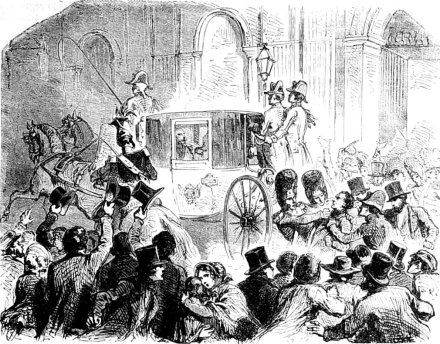
Early this Monday morning in 1836, Louis Alibaud — having been condemned to death by the Chamber of Peers at trial the preceding Friday and Saturday — lost his head for taking a shot at oft–shot–at French King Louis-Philippe.

As related by the London Times (July 6, 1836),

at half-past 6 in the afternoon of the 25th of June, 1836; the windows of the carriage were lowered, and it was passing through the gate [of the Tuileries palace] leading to the Pont Royale, when a man, who had been standing by a post in the court, raise [sic] a cane gun and discharged it against the King. By a miraculous chance the King was lowering his head to salute the National Guard under arms, and the ball passed just four lines above his head, and entered one of the angles of the carriage, settling about an inch deep in an oak beam.

The assassin was immediately arrested; he was a young man, of about 25 years of age, dressed in a dark coat, cloth pantaloons, and black hat, and wearing under his chin a thick brown beard.

The disabled former infantryman, “inspired by political fanaticism and a morbid satiety of life,” mounted no defense of himself save for a defense of tyrannicide — “I had the same right to his life that Brutus had to the life of Julius Caesar!” (Source)

Naturally, this line had neither the intent nor the effect of securing clemency, and he was repeatedly cautioned by the court against pursuing it; all concerned knew precisely where matters were headed, of course, and the state had no interest in providing a public forum for sedition.

On this day..

2000: Dmitry Chikunov, secretly

On this day in 2000, Russian national Dmitry (or Dmitri) Chikunov was secretly put to death* in Tashkent, Uzbekistan for the murder of two men.

A symbolic grave for Dmitry Chikunov; his actual resting place is unknown.

His mother, who had been shooed away from the prison on a previous visit with a demand that she come back later, only learned of the execution when she attempted to visit him two days later.** She has never learned where he was buried.

However, Tamara Chikunova turned out to be the type to turn grief into action.

She became a prominent human rights and anti-death penalty activist in Uzbekistan (and globally); her Mothers Against the Death Penalty and Torture organization was troublesome enough that the government blocked one of its conferences in 2003.

Well, Gandhi said it — “First they ignore you, then they laugh at you, then they fight you, then you win.” On January 1, 2008, Uzbekistan abolished the death penalty.

Tamara Chikunova discusses the rampant official corruption and malfeasance endemic in Uzbekistan’s (former) death penalty, and the issues still ahead for her organization, in this interview.

* Dmitry Chikunov’s execution by gunshot took place only nine months after trial; it’s hardly a surprise that Dmitry claimed to have been tortured into confession.

** In this French article, Chikunova says her son was actually shot while she herself was in the prison attempting to visit him.

On this day..

1294: Rane Jonsen, Marsk Stig conspirator

On an unknown date in 1294, the former page of the late Danish King Eric V was put to death for regicide outside Roskilde.

Rane Jonsen or Jonsson (here’s his short Danish Wikipedia page) had been present at the hunt during which the former monarch, more popularly known as “Erik Glipping”, was murdered by unknown assailants in 1286.

The convention — and the official verdict of state — have it that Jonsen contrived to admit marsk Stig Andersen Hvide and fellow conspirators to the vulnerable king’s presence for the purpose of murdering him, possibly revenging the king’s rape of Andersen’s wife. “Marsk Stig” and Rane both fled, and were condemned along with seven other men by the Danish Assembly in the spring of 1287.

Although there is little remaining primary documentation, it does seem that the guilt of these people was decided above all by political expedience. It was Stig Anderson’s opponents who got control of the government (and the regency of 12-year-old Erik Menved), conveniently declaring the guilty parties to be their own rivals, who had formerly been close to Erik Glipping.*

Our page, himself a noble, got the short end of the stick in all this; he energetically denied the story that he had stood aside to permit the murder of his liege, claiming that he fought back albeit unarmed and outnumbered.

But as an emblem of the perfidy of the king’s inner circle, you couldn’t do much better than Rane theatrically planting his sword into a table and standing aside to signify the king’s vulnerability. You can just picture that story being retold with a meaningful ahem to the boy-king Eric VI.

In fact, it was retold: wrongful conviction or no, this episode (in its official version, with Rane and Stig as evildoers) was the basis for a number of entries in the rich Danish ballad genre.

Though popularly cited as medieval ballads, disputed dating places different verses anywhere from Rane Jonsen’s own time to three centuries later.** In any era, they offer some lovely exemplars of the art.

This book reproduces several; topical for this entry is an imagining of the fugitive regicide’s plight, both sad (for his hopelessness) and menacing (for his violent seizure of a bride) — disconcertingly delivered in a repetitious lullaby singsong.

Ranild bade saddle his charger gray,
‘Twas told me oft before,
“I’ll be the Algrave’s guest today,
“Tho’ friends I have no more.”

Ranild rode up to his castle gate
‘Twas told him oft before
Where ermine-clad the Algrave sate,
Tho’ friends he had no more.

“Hail noble Algrave, here I come,
‘Twas told thee oft before
“To fetch my trothplight Kirstin home,
“Tho’ friends I have no more.”

Then up and spake her mother dear,
“‘Twas told thee oft before,
“For thee is bride no longer here,
“For friends thou hast no more.”

“I’ll either with the maid return,
“‘Twas told you oft before
“Or else your house and chattels burn,
“Tho’ friends I have no more.”

“Nay set not thou the house on flame,
“‘Twas told thee oft before,
“E’en take the bride thou ‘rt come to claim,
“Tho’ friends thou hast no more.”

In mantle wrapt the gentle maid,
‘Twas told her oft before,
On Ranild’s good gray horse was laid,
Tho’ friends he had no more.

No other bridal bed had they,
‘Twas told her oft before,
Than bush, and field, and new made hay,
For friends he had no more.

“The wood has ears, the mead can see,
“‘Twas told thee oft before,
“A wretched outlaw’d pair are we,
“For friends I have no more.”

“And had you not King Erick slain,
“‘Twas told you oft before,
“We still might in the land remain,
“But friends we have no more.”

“Stay, Kirstin, stay, such words forbear,
“‘Twas told thee oft before,
“Where strangers are, take greater care,
“For friends we have no ore.”

With that he slapp’d her cheek so red,
“‘Twas told thee oft before,
“It was not I, smote Erick dead,
“Tho’ friends I have no more.”

From the same source, our day’s principal meets his end:

Report is rife in all the land
Ranild at last is caught;
He surely had never gone from Hielm,
His doom had he bethought;
A death of torture he must die,
As he has long been taught.

Ranild he stepp’d within the door,
‘Good evening’ bade the king,
And all the guard of gentlemen,
Who round him stood in ring;
“Christ! may no son of loyal Dane
“Such trouble on him bring!

“But, O King Erick, noble liege,
“Remember you no more;
“The best was I of all the swains
“Your father’s livery wore;
“And you through wood and flowery mead
“In arms so often bore?”

“Full well I know thou servedst here
“For clothes and food and pay;
“And, like a vile and treacherous knave,
“My father didst betray;
“For which the stake thy carcase bears,
“If I but reign a day.”

“My hands and feet hack from my limbs,
“Tear from my head these eyes;
“With racking tortures martyr me,
“The worst you can devise;
“So much the wrong I’ve done your house
“For vengeance on me cries.”

“Thine eyes put out, that will we not,
“Nor lop thy hands or feet;
“But with a traitor’s hardest death
“The worst of traitors treat;
“And on our father’s murderer take
“Such vengeance as is meet.”

As forth from Roskilde he was led,
He wrung his hands anew,
And tears to see him go to die
Wept ladies not a few;
He turn’d him round, and bade them all
A thousand times Adieu.

They led him forth to where the rack
Stood ghastly on the plain;
“O Christ, from such a martyring death
“Protect each honest Dane!
“Had I but stay’d at Hielm this year,
“And there in safety lain!

“Now were there here one faithful friend,
“Who home for me would go,
“And would my sorrowing wife Christine,
“Her path of duty show!
“O Christ, look on my children dear!
“O comfort thou their woe!

“And you, I pray, good Christian folk,
“Who here are standing round,
“A pater noster read for me,
“That grace for me be found;
“And that this night I reach the land,
“Where heavenly joys abound.”

Marsk Stig, however, is the primary focus of these dramas; he raided shipping from his island base on Hielm (Hjelm), dying of natural causes in 1293. Some additional translated ballads about this character are available here.

But since this is poetry, take a moment to dig the original Danish,† which should be at least partially comprehensible to any English- or German-speaker.

Marsti ind aff dorren tren
med suerd i hoyre hend:
kongen sidder hannem op igien,
saa giorlig han hannem kende

…

>>Hor du, Ranil Ienssen!
oc vilt du verie mit liff:
jeg giffuer dig min soster
oc halff min rige in min tid.<< Det vor Ranil Iensson, han hug i borde oc balck; det vil ieg for sanden sige: hand veriet sin herre som en skalck De stack ham ind at skulder-bende, oc det stod ud aff halss; det vil ieg for sandingen sige: det vaar alt giort med falsk. De stack hannem ind at skulder oc ud aff venster side: >>Nu haffuer wi giort den gierning i dag,
all Danmarck baer for stor quide<<.

Stig burst through the door,
his sword in his right hand;
the king sat upright
and recognized him.

…

“Hear me, Rane Jonson!
If you defend my life
I will give you my sister
and half of my kingdom.”

Rane Jonson swung his sword
and stuck it in the table and in the wall;
in truth,
he betrayed his lord shamefully.

They stabbed him in the shoulderbone
and out through the neck;
in truth,
they did it all deceitfully.

They stabbed him in the shoulder
and out through the left side.
“Now we have done the deed today,
all Denmark bears too heavy a load”

* Discussed at length in “Killing Erik Glipping. On the Early Days of a Danish Historical Ballad” by William Layher in Song and Popular Culture, 45, 2000. Layher reports that the Norwegian government (which received the fugitives) and the Danish were still trading nastygrams over the propriety of the convictions in the early 1300s. On the instigation of the Archbishop of Lund, who supported the exiles, the Church interdicted sacraments to Denmark for several years around the turn of the century.

** See Layher again. At least one contemporaneous bard, minnesinger Meister Rumelant, is known to have composed on the famous murder.

† Extract and translation from Layher, once again.

Part of the Themed Set: The Ballad.

On this day..

1839: William John Marchant

On this date in 1839, a spooked 18-year-old servant was hanged at Newgate Prison for murdering fellow-servant Elizabeth Paynton.

A good Chelsea lad with no rap sheet, Marchant slashed Paynton’s throat with a razor when they were left alone, fled, but was so pursued by guilt that he gave himself up and pleaded guilty. Awaiting death, he lamely told his distraught parents

the upper house-maid and the cook went out, leaving [Marchant] with the deceased in the house by themselves. The cook, as she was leaving the house, dared him to get possession of a riband or pair of garters which the deceased had displayed before the servants in the kitchen in jest, and threatened to inflict some ludicrous punishment upon him if he did not … [Marchant] improperly endeavoured to obtain possession of the garters, but she resisted him, and at length slapped his face, called him some ill names, and said she would get him out of his situation for his rudeness. He then ran to fetch a razor to cut the garters and get them into his own possession, and he then had not the least intention of killing her or perpetrating any other offense … but when he did return with the razor in his hand he was seized, as he says, with a sudden and unaccountable impulse, which he could not define, and in a paroxysm of insanity in a moment, and without premeditation, he cut her throat.

(In a later telling, he dropped the garter cover story and copped to a more distinctly identifiable attempted rape, with the murder precipitated by its object’s threat to have him sacked.)

As the London Times remarked on the hanging,

It is difficult, perhaps, to hold him out as an example to other erring youth; for, as he neither appears to have been a drunkard, nor given up to licentious courses, his crime is of so extraordinary a character, that it is hardly possible any other, by following the same course, should terminate his career by the same shameful death … there [may] be no occasion to read a lesson to those who in ordinary cases might be seduced to commit a similar offence.

The dearth of instructional opportunity (and the fact that “the crowd was not great”) did not obstruct London’s enterprising gallows-foot entrepreneurs from cranking out multiple broadsides,* complete with cookie-cutter didactic poem. This sort of thing was standard fare for the day’s forgettable petty villains, not merely its crimes of the decade.

All ye who pity my sad fate,
With sorrow most sincere,
Unto the truth which I will state,
I pray you lend an ear.
Condemned in scorn and shame to die
My doom is most severe,
‘Tis but a few short days since I
Just reached my eighteenth year.

My face is all beset with woe,
My cheeks are worn with care,
My eyes are parch’d and sunk with Grief,
That once so sparkling were.
Strange horrors chill my every vein,
A voice most wild and true,
Whispers to this distracted brain,
Thy hand Elizabeth slew.

At this my very heart doth bleed
With grief, remorse, and guilt
To think upopn the ruthless deed,
The blood which I have spilt;
For never since that hour have I
One moment’s comfort knew,
And poor Elizabeth’s murdered corpse
Is ever to my view.

Behold my days are like a flower,
That blooms at break of day,
Cut down and withered in an hour,
And vanished away.
Lament, lament, to see me die
All ye who do me view,
A poor, heartbroken, wretched lad,
Must bid this world adieu.

Vain, are my lamentations, vain
These unavailing sighs,
Girm [sic] death is hastening apace,
I must prepare to die.
Heaven grant none may hereafter be
Like luckless me undone,
But always strive with humble mind,
The tempters snare to shun.

* From Harvard University’s collection.

Update: The Times Archive Blog flags another interesting bit of this story: the newspaper’s hectoring the doomed footman’s chaplain for excessive “enthusiasm.”

Part of the Themed Set: The Ballad.

On this day..